Sanjha Morcha

Assam Rifles jawan killed in Manipur blast

Assam Rifles jawan killed in Manipur blast

Imphal, June 30

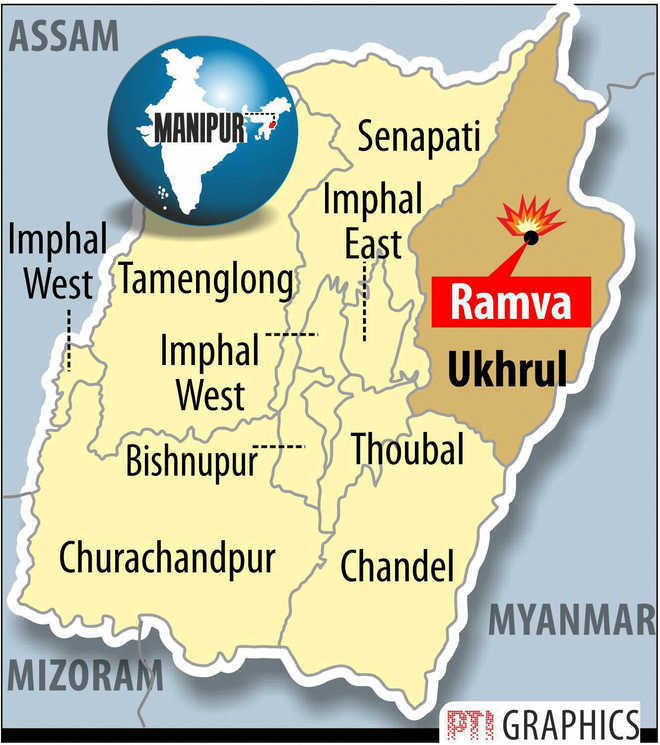
Militants triggered an IED blast at an Assam Rifles check-post in Manipur today, killing an Assam Rifles jawan and injuring two paramilitary men.The IED, planted at 27 Assam Rifles check-post at Ramva in Ukhrul district, exploded at 7.20 am.(Follow The Tribune on Facebook; and Twitter @thetribunechd)The slain jawan was identified as Rifleman Biju Sorupuwar from Lakhimpur district in Assam. Rifleman Yashpal and Havildar Nihar Ranjan Das were airlifted to Leimakhong Army Hospital.On June 15, an Assam Rifles jawan was killed in a blast in the same district. — PTI 


Doklam Standoff: The Real Reasons And How Far Can It Be Taken by Lt Gen Syed Ata Hasnain

Doklam Standoff: The Real Reasons And How Far Can It Be Taken

SNAPSHOT

There is no alternative for India but to do more than lip service to its dire need for better infrastructure and military capability for a two-front conflict.

Doklam will not be the last time it will face intimidation.

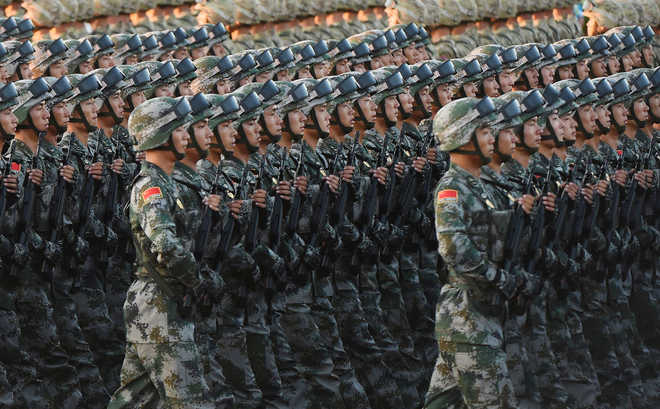
The standoff in the general area tri-junction and specifically the Doklam Plateau on the China-Bhutan border has now been on for over six weeks without a bullet being fired. There is rhetoric on both sides but many times more by the Chinese public relations and propaganda machinery to send home the most intimidating messages seen in a long time. The status is stuck on national egos with both sides under public pressure. In such standoffs, situations can go out of hand with the faintest of wrong gestures, words or even perceptions. The Nathula incident of 1967 comes immediately to mind where large-scale casualties were reported by both sides once the standoff developed into a conflagration.

A few facts will set the tone for this analysis. The Chumbi Valley is a narrow wedge of territory between Bhutan and the Indian state of Sikkim. The boundaries of China, India and Bhutan meet at the disputed tri-junction near the southern end of the valley. Doklam is an 89 square kilometre plateau on the eastern side of Chumbi. The Chinese claim it as theirs and so does Bhutan.

The issue in contention is that the Chinese commenced constructing a road on the disputed plateau to bring an artery to the southern end of the Chumbi Valley. The road, if completed, will alter the operational picture quite drastically as the Chinese can more effectively develop operations southwards, although they would be reasonably unsure of success with their base wedged between two potential adversaries. India’s objection is from two angles. First is that the road construction alters the strategic and operational scenario. Second that it transgresses disputed territory of a country with whom it has a mutual assistance treaty.

So if the Chinese are really professional why have they chosen to address this border issue where they are at operational disadvantage? There can be much conjecture on that, commencing from the question whether this entire standoff is an accidental one, which the Chinese did not think through sufficiently, to whether it is a deliberate selection of a point of dispute where the complexities are large; the Chicken’s Neck and the involvement of Bhutan making it a little more out of the ordinary than Depsang Plateau or Chumar in Ladakh, where the standoffs took place in 2013 and 2014.

The answer lies in a couple of factors, which have not emerged in recent analyses. It’s a question of forcing India to remain fixated on the continental dimension of its security. To do that, it is important for China to draw India into these standoffs to keep the threat of the People’s Liberation Army (PLA) alive and making it two front by also playing the Pakistan card. This is the domain, where India is all alone as land boundary disputes do not draw as much international attention as maritime disputes or even just the entire gamut of the maritime domain. The latter draws far greater attention with sea lanes, continental shelves and exclusive economic zones.

China’s strength lies in the continental dimension; that is the matter of detail that chairman Deng Xiao Ping, the father of modern China, possibly misread and did not direct as part of his four modernisations. Although the military domain was the last in priority, within that domain the PLA Navy received even lower priority. That was surprising because China’s actual security priority lies in the maritime zone. Its economy is dependent on energy transported by sea. Its disputes in South East and East Asia are both in the oceans.

The Indian Ocean in its huge expanse is vulnerability for China, because located at the crown is India, which with a strong navy can remain a threat in being against China’s sea lanes of communication (SLsOC). These SLsOC carry almost 80 per cent of the energy needs especially to the well-developed eastern seaboard. That is the reason for China focusing on its string of pearls strategy, which off late has received a bit of a fillip. None other than Raja Menon, the doyen of India’s maritime experts, has argued for long along the above lines. In fact, China’s New Maritime Silk Route is partially based upon the need for strengthening its outreach to overcome the weaknesses of its stretched SLsOC.

Thus China must keep India pegged to the continental security domain to prevent it from concentrating on and developing its maritime security capability. The increasing cooperation of the Indian Navy with other naval forces, primarily the US, Japan and Australia, is not in China’s interest and this phenomenon keeps it worried. The politico-diplomatic reasons for China resorting to intimidation along with the above rationale can only be traced to three issues.

First is the moral victory, which India appeared to have scored over the Dalai Lama visit to Arunachal Pradesh earlier in 2017. Second is most likely the refusal of India (and Bhutan) to join in even the basic sensitisation discussions on the Belt and Road Initiative (BRI) conducted by China in May 2017; China’s self-perceived magnum opus. Third, perhaps are the increasing indicators of a stronger and more strategically emerging relationship between the US, India and Japan. The plain deduction in the Chinese strategic mind would be the necessity to intimidate India and show it its place in the international strategic scenario at a time when the world order seems more confused than ever before.

The choice could have been anywhere along the disputed areas; Doklam made response and subsequent handling by India more complex. Little did China realise that the complexity will also become a millstone around its neck after India refused to be intimidated and came to Bhutan’s assistance. So where does it go from here? The viral propaganda in the official Chinese media, quite uncharacteristically impolite by any international standards of behaviour, is also a crude attempt at intimidation with the hope that it will force India into submission. The reverse has happened.

However, it is not something for India to be happy about because it does not seek conflict anywhere along its borders and is committed to its economic growth and betterment of lives of its people. China too has to realise that in its relationships it cannot expect nations to acquiesce to its strategic desire at the cost of their self-respect.

Such politico-military-strategic situations cannot simply be glossed over without at least a brief commentary on the military aspects. The most noticeable thing this time is China’s attempt to employ hybrid aspects with psychological warfare at the core. Its aim is to create fear in the minds of the Indian leadership and paint a scenario of India’s helplessness in comparison to China’s economic and military strength. There hasn’t been any subtlety about it reflecting crass attitude in the hope that India will back off.

It is a misnomer for China to think that it can walk all over India’s armed forces. What it is achieving in the bargain is the buying of new generation enmity, which will last into the future. While it may not be correct to assume that we have the fullest support of the international community yet China-Pakistan collusion to target India is not going to be viewed very positively either.

A long standoff stretching into winter, which analysts are speculating about, is not in anyone’s interest as a single spark can anytime put a full border on fire. Bhutan, which has unfortunately been caught between the interests of its giant neighbours, could actually hold the key to a potential dilution of tension. Considering that mutual withdrawal is being considered as a potential Indian success, Bhutan’s request to India to withdraw its troops alongside stoppage of all construction activity by the PLA with a follow up of a resumption in China-Bhutan talks could be a face saver for all. Bhutan could insist on subsequent PLA vacation of Doklam and return to status quo ante for the talks to resume.

The important thing is that with this incident the next may not be too far away. There is no alternative for India but to do more than lip service to its dire need for better infrastructure and military capability for a two-front conflict. Doklam will not be the last time it will face intimidation.



Indo-Thai joint military exercise concludes

Indo-Thai joint military exercise concludes
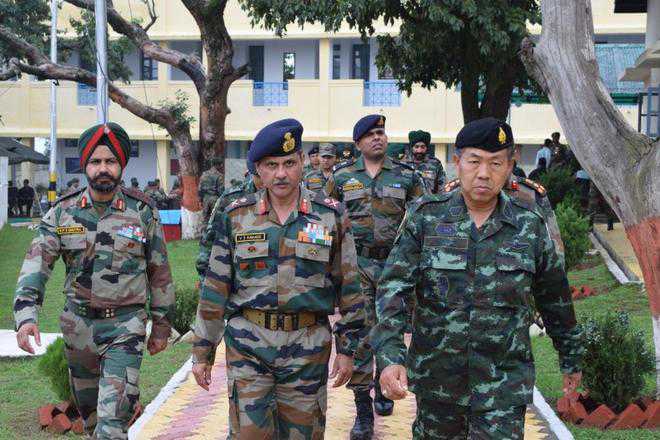
The GOC, Dah Division, at the Bakloh Cantt on Sunday. Photo: Ravinder Sood

Our Correspondent

Palampur, July 16

A fortnight Indo-Thailand joint training exercise “Matree” concluded at the Bakloh Cantt, 90 km from here, this morning.The major thrust of the joint training was to understand the operational methodology, interoperability and conduct tactical operations by joint command post. The exercise finally concluded based on counter-terrorism setting.The General Officer Commanding, Dah Division, while presiding over the event appreciated both the armies. He said the professionability, conduct and confidence of both units had resulted in successful completion of the exercise.The GOC said the military exercise would strengthen friendly relations between India and Thailand and build up the understanding between rank and files of both armies. This exercise had benefited both the armies. In future such training would continue to strengthen the relations of both the countries.


Two militants killed as Army foils infiltration bid in Kashmir’s Naugam

Two militants killed as Army foils infiltration bid in Kashmir's Naugam
The operation is under way. PTI file

Tribune News Service

Srinagar, July 10

The Army on Monday foiled an infiltration bid along the Line of Control (LoC) in Naugam sector of north Kashmir, killing three militants.

(Follow The Tribune on Facebook; and Twitter @thetribunechd)

“Suspicious movement was noticed along the LoC in Naugam sector last night and the terrorists were tracked till dawn, when they were challenged by troops,” an Army official said.

He said in the ensuing gunfight, three militants have been killed so far as the operation was in progress. With PTI


Mission Israel: India’s new strategy evolvingby Lt Gen Syed Ata Hasnain

8

The optics from the scenes at the Ben Gurion airport, bear hugs, gestures and words all displayed the final arrival of a strategic partnership in the making for last many years. Prime Minister Benjamin Netanyahu stated that Israel had been waiting for this moment, of a visit by an Indian Prime Minister to Israel, for the last seventy years; it finally happened and that too symbolically on the anniversary of Israel’s famous intervention operations at Entebbe in 1976 in which Netanyahu lost his elder brother. The visit needs to be viewed beyond the expressed emotions for its true worth in an increasingly dangerous world in which India and Israel find themselves with many common threats.

Driving into Israel from Jordan over the famous King Hussain Bridge some years ago what struck me were the vast plantations in the Jordan Valley, all brought to life through drip irrigation, the agro technology which Israel mastered and which enabled water deficient countries to make use of their arid lands. I start with this observation because mention Israel and every one jumps to only issues related to military technology. The latter will find much reference in this piece but it’s the ability to innovate for survival in diverse fields and take those innovations well beyond which has been the major strength of the Israeli state from which India needs to learn.

While understanding that this is one of Prime Minister Modi’s most important foreign visits it is also relevant to understand what prevented the development of the relationship to this level in the last 25 years after establishment of diplomatic relations. The beginning was shackled by the legacy of Cold War ideas and relationships although the desire for closer defense, economic and people to people ties existed for almost seventy years. What held India back even after 1992 were the compulsions of the management of our ties with the Arab world and in turn with the Islamic world. As a nation with a large Islamic population, the handling of ties with the Islamic world was important. India was extremely concerned because of its ongoing spat with Pakistan who would have exploited any relationship perceived inimical to interests of the large comity of Arab nations and turned them against India. In addition India with its huge dependence on the Arab world for its energy needs could have ill afforded not maintaining strong political ties with them.

Prime Minister Modi’s foreign policy involved almost three years of managing, cultivating and strategizing for this big event; it could not have been possible without that. Sensitive to the presence of an eight million Indian diaspora in the Gulf region and considering all the angles of the implications on India’s energy security and trade relations he first tied up the ends, visited important Islamic nations such as Saudi Arabia, UAE, Qatar and Iran and received delegations from them. He thus ensured that a substantive move towards Israel would not come in the way of relationships in a fast changing strategic environment of the Middle East. The relationship with Israel could not be taken to the next level with the shadow of the Arab world looming in the background and any mention of Israel could not be simply hyphenated with the long standing problems of Palestine. Nations ultimately seek their interests independent of their concern for other nations although this need not substantially change the way they do business with those nations. By not visiting Ramallah on the West Bank Mr Modi is not necessarily shunning a relationship with Palestine but rather giving it a status separated from Israel. In many ways, that should work positively for the Palestinian Authority too.

While there are many issues on the agenda of the visit the dominant part of the relationship remains the security domain. There will be talks on agriculture, water and disaster management, startups, university adoption, student exchange programs and technical education but there is no denying that the domain which drives Israel’s virtual existence is security. Netanyahu’s call for taking ‘Make in India’ to ‘Make with India’ is a relevant one as no other technically advanced nation will share technology with India the way Israel does. Fully aware of the limitations of its own markets Israel would definitely be seeking to enhance its share of 7.9 percent of the Indian arms and equipment market to something much higher. With India it gets to partner a nation both with a security environment with almost similar threats and one which is hungry for technology.

Leading the pack in military equipment is the recent agreement for the Indian purchase of ten Heron advanced armed drones at a cost of almost 450 million USD. Capable of substantially changing the offensive capability across the LoC in a No War No Peace environment the drones can undertake surgical strikes much deeper in adversary territory than can be executed by foot borne Special Forces. The other equipment keenly awaited is the Barak 8 surface to air missile system to boost Indian air defence systems which have been largely deficient in capability. In the field of cyber security, intelligence acquisition and intervention in counter terror operations there can be a no match to the Israeli expertise. The Spike anti-tank guided missile launchers and missiles for Indian infantry units will be a boon in view of the repeated failure in the development of the Nag anti-tank missile. My last important take away from this domain is the creation of an electronic wall for border management. With India’s intent of upgrading border management substantially the Israeli deployment and response system along the Lebanese border is one of the best models to look at.

There will be many nations watching with keen interest the emergence of India’s de-hyphenated foreign policy in the making and it is good that display of complete strategic independence is going to be a part of Indian policy for the future.  Two more days of high profile events beamed live from Israel and discussed threadbare by Indian TV channels are  surely not going to go waste.


Captain among 3 injured in militant ambush in Kashmir’s Bandipora

Captain among 3 injured in militant ambush in Kashmir's Bandipora
Photo for representational purpose only.

Majid Jahangir

Tribune News Service

Srinagar, July 8

At least three Army men were injured in the wee hours of Saturday in a militant ambush in north Kashmir’s Bandipora district.The ambush took place at a time when the entire Kashmir was on a high alert on the death anniversary of militant commander Burhan Wani.The ambush was carried out at Hajin, some 32 km from Srinagar, around 3 am when the Army jawans were going for patrolling in the area.Three Army men, including a Captain-rank officer got injured in the ambush. All of them are stable.Sources said that the militants took advantage of the darkness and congested the locality and fled from the spot.Soon after the shooting, the area was cordoned and searches were being carried to trace the militants involved in the attack.


What does the US’ sale of drones to India symbolise?

By offering unmanned patrol aircraft, Washington has recognised New Delhi as a maritime partner

Prime Minister Narendra Modi’s visit to Washington last week was an effort by both Modi and United States President Donald Trump to demonstrate that India-US ties remain strong and continue to deepen. The repeated embraces — three by most counts — serve as a visual reminder the continued closeness between the two countries. The joint statement presents a range of issues where India and the United States will work closely. One item was particularly important: The US “offered for India’s consideration the sale of Sea Guardian Unmanned Aerial Systems.” This is significant for three reasons.

REUTERSAn MQ­9 Reaper drone aircraft (File photo for representative purposes)

First, if India and the US are able to reach an agreement on a deal for this type of an unmanned aerial system (UAS), it could mark the first transfer by the US of such a system to a non-ally country. The Sea Guardian, a large payload, long-endurance UAS platform, is designed to provide advanced surveillance capability for maritime and littoral missions — an increasingly important mission for India as it seeks to play a larger role in securing lines of communication in the Indian Ocean.

Second, in announcing this offer to India, Trump effectively signalled that the US has staked out a new policy position in India’s favour regarding potential constraints imposed under the Missile Technology Control Regime (MTCR). This voluntary arms control agreement calls for a “strong presumption of denial”, for transfers of large UAS to other member-states. The regime, of which both India and the US are members, was established to limit the proliferation of missile technology (including UAS) that could deliver weapons of mass destruction. The Sea Guardian falls into the most tightly constrained Category I under MTCR.

Third, in offering India Sea Guardians, the US recognises that India is a maritime partner and the interests of both nations are aligning. Should India choose the Sea Guardian for its maritime surveillance missions, it would enable even greater cooperation.

As India and the US work to deepen bilateral ties, a necessary condition will be aligned interests. Over the past two Indian administrations, and the third consecutive US presidential administration, we are seeing that.

Equally important, however, will be continuing to find concrete areas of cooperation where rhetorical ambitions are translated into tangible progress and both countries working more closely together on mutually beneficial efforts. In offering a large unmanned maritime patrol aircraft, the two leaders have achieved just that.


No compromise on Doklam, says China Puts ball in India’s court to resolve standoff

No compromise on Doklam, says China
Photo for representational purpose only. AFP file photo

New Delhi, July 4

China today ruled out a compromise in the military standoff with India in the Sikkim section, and put the onus on New Delhi to resolve the “grave” situation.In unusually blunt remarks, China’s Ambassador to India Luo Zhaohui said “the ball is in India’s court” and it was for the Indian government to decide what options could be on the table to resolve the standoff.Follow The Tribune on Facebook; and Twitter @thetribunechdOn remarks by the official Chinese media and think-tanks that the conflict can lead to a “war” if not handled properly, he said: “There has been talk about this option, that option. It is up to your government policy (whether to exercise military option). The Chinese government is very clear that it wants peaceful resolution at the current state of the situation for which withdrawal of Indian troops is a pre-condition.”China and India have been engaged in a standoff in Doklam near the Bhutan tri-junction for 19 days after a Chinese army’s construction party came to build a road. — PTI

Beijing lists priorities

  • Indian troops should unconditionally pull back
  • India cannot encroach upon territory of other countrieson the ground of its“security concerns”
  • India has no right to interfere with the China-Bhutan boundary talks, nor is itentitled to make territorial claims on behalf of Bhutan

China builds new military facilities on Spratly islands

WASHINGTON: China has built new military facilities on islands in the South China Sea, a US think tank reported on Thursday, a move that could raise tensions with Washington, which has accused Beijing of militarising the vital waterway.

CSIS/AMTI/DIGITAL GLOBEConstruction is shown on Mischief Reef in this June 19, 2017 satellite image released on Friday.

The Asia Maritime Transparency Initiative (AMTI), part of Washington’s Center for Strategic and International Studies, said new satellite images show missile shelters and radar and communications facilities being built on the Fiery Cross, Mischief and Subi Reefs.

The US has criticized China’s build-up of military facilities on the artificial islands and is concerned they could be used to restrict free movement through the South China Sea, an important trade route.

Last month, a US Navy warship sailed within 12 nautical miles of Mischief Reef in a so-called freedom of navigation operation, the first such challenge to Beijing’s claim to most of the waterway since US President Donald Trump took office.

China has denied US charges that it is militarising the sea, which also is claimed by Brunei, Malaysia, the Philippines, Taiwan and Vietnam.

Trump has sought China’s help in reining in North Korea’s nuclear and missile programs, and tension between Washington and Beijing over military installations in the sea could complicate those efforts.

China has built four new missile shelters on Fiery Cross Reef to go with the eight already on the artificial island, AMTI said. Mischief and Subi each have eight shelters, the think tank said in a previous report.

In February, Reuters reported that China had nearly finished building structures to house long-range surface-to-air missiles on the three islands.

On Mischief Reef, an antennae array is being installed that presumably boosts Beijing’s ability to monitor the surroundings, the think tank said, adding the installation should be of concern to the Philippines due to its proximity to an area claimed by Manila.

“Beijing can now deploy military assets, including combat aircraft and mobile missile launchers, to the Spratly Islands at any time,” it said.