Sanjha Morcha

When Romans met the Sikhs

“Pakistan can never defeat India”, the Italian remarked.
That morning in May 1999, on an official trip to Italy, as I had switched on the BBC World News, I had heard the announcement that Indian Air Force had started an offensive on the Kargil peaks and there were fears of a full-fledged war with Pakistan. What had till now been known as a minor incursion by infiltrators was now threatening to engulf the two nations into a suicidal war. My friend and I had begun our usual tour of the fair; visiting booths of major companies.
I vividly remember that stall, and the company owner sitting stylishly having a chat with his clients. These Italians sure are one stylish lot. Brown shoes and a red golf cap. I still have’nt got over my bias for brown shoes acquired during those trips to Italy.
As we got on with our promotional lecture the conversation veered off to the Kargil news.
“Pakistan can never defeat India”, he suddenly remarked.
“Oh yes”, we said, “Of Course, we have a bigger army”, we said proudly.
Oh No!, you got it wrong”, said the Italian
“Is that so? How?”
“You know about Sikhs?”, he asked.
“Of course”, I said, “I am a Sikh”
“Oh, are you?”, he remarked with a surprise, as he suddenly got up from his seat, took off his red cap, “Salute’”, he said in his strong Italian accent; even as he asked me as to why I was not wearing the Sikh turban. I grinned sheepishly in response.
“Hats off, my Sikh friend; you don’t know why Pakistan can never defeat India? It cannot defeat India as long as the Sikhs fight for India.”
We were surprised by his reaction. And we asked him as to how he knew about Sikhs and tried to find out the story behind his view.
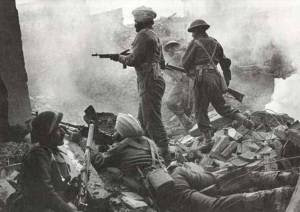
Sikh soldiers in East Africa during World War IISikh soldiers in East Africa during World War II

And then he started speaking animatedly.“My Grandpapa was in Mussolini’s army in World War-II. And he used to tell me a story. He told me that they were winning the war as they moved into Eastern Africa. They won many battles against the British. And then the British brought a regiment of fierce looking warriors. Men that looked like ferocious animals when in battle, the Sikhs. Their war-cry was so frightening that the Italian army used to shiver when it sounded. They attacked with their artillery; when they finished their artillery fire they attacked with their guns; when they finished their bullets they fought with bayonets; and when their bayonets were snatched they fought with knives; and then even as they were bleeding they fought with bare hands.”
I could see the Italian getting more and more excited as he recited the story. He was moving his hands around in the air and acting the part. “My Grandpa used to say that it was the Sikhs that turned the war around. They routed their enemy wherever they went.
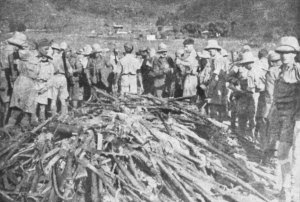
Italian POWs in East Africa during World War-IIItalian POWs in East Africa during World War-II

“Finally, my Grandpa was captured by the Sikh regiment”, he said. “He was a Prisoner of War, with limited canteen. Even water was scarce. The Sikhs, the ferocious Sikhs that behaved like hungry lions on the field were like benevolent guardians in the camps. They slept hungry themselves but gave their food to the prisoners. They gave them so much respect and love that my Grandpapa used to say that he had never seen men like the Sikhs. So gallant in war and so gracious in victory.”
“As I grew up, my grandpapa inspired me with stories of Sikhs and asked me to meet some Sikhs if I wanted to be a man. So I went to meet Sikhs in India. I roamed in the Punjab, went to the temples and met many.”
“But, I wanted to see the Sikh Army in Action. So I went to your parade, that big parade in New Delhi, where all regiments of the Indian army march in glory. The parade was magnificient, the Indian army marching proudly, regiment after regiment.” he remarked as he took a book in his hand and moved it smoothly across the table in one straight line he said “this is how smoothly each regiment moved, like one unit”Sikh regiment contingent at Republic Day parade
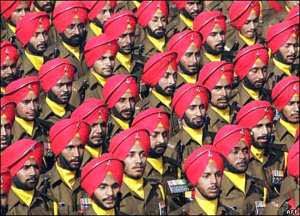
“And then in the distance, I saw the Sikhs”, he said, as he started moving the book across the table. “Boom” he shouted as I saw the book go up an inch, “Boom”, as it went down, even as it moved across in one straight line and he did the entire stretch of the table. “This is how the Sikhs marched, boom, boom, moving like a storm across the road, so disciplined moving like one unit, yet looking so gallant and brave. I have seen the Germans marching, I have seen the march-past of the Russians, but I have never seen an army marching the way the Sikhs do.” He continued for a few more minutes with anecdotes of his grandpa’s and his interaction with Sikhs, as he hammered in the fact that Sikhs were the best fighting force in the world.
“So, my friend, you see. Pakistan can never defeat India, as long as the Sikhs fight for India.”
Postscript:
This incident has stayed with me for over fifteen years now, and I recount it today not in bravado as a fellow Sikh, but as something that needed to be told as an indicator of the impact Sikhs have on people, both in their bravery and in their graciousness; and as a reminder to us Indians.
Sikhs make up 10% of all ranks in the Indian Army, though Sikhs form only 2% of the Indian population.
After 1984, there was an experiment by Gen Vaidya to do away exclusivity, with a company each of Dogras, Garhwalis and South Indians in the Sikh Regiment. The exclusivity was however later restored.
I read an article today from the ‘Telegraph’ of UK that the Britishers were planning to create a ‘Sikh Regiment’ in the British Army.
Perhaps the Britishers know something we Indians seem to be forgetting.

‘Shaheed Smarak’ for 1965, 1971 war heroes inaugurated

‘Shaheed Smarak’ for 1965, 1971 war heroes inaugurated
Lieutenant General KJ Singh, General Officer Commanding-in-Chief, Western Command, inaugurates a ‘Shaheed Smarak’ at Abdul Hamid Samadhi Complex on Thursday. A Tribune photograph

Tribune News Service

Khemkaran, July 21

In order to ensure regular maintenance of Army memorials and pay befitting homage to the great martyrs of 1965 and 1971 Indo-Pak wars, the Army authorities have decided to relocate the memorials to Abdul Hamid Samadhi complex at Cheema village here.Lt General KJ Singh, General Officer Commanding-in-Chief, Western Command, said eight new memorials had been constructed in the ‘shaheed smarak’ to commemorate the sacrifices of these bravehearts. He was here to inaugurate the newly-constructed ‘shaheed smarak’. Speaking on the occasion, he said the Khemkaran sector had witnessed innumerable stories of bravery and courage during the1965 and 1971 Indo-Pak wars. A number of war memorials had been constructed by various units in the memory of respective martyrs, but due to remote location, it had become difficult to maintain them at a regular basis.This memorial has been conceptualised by Golden Arrow Division and the work for the same was executed under the guidance and supervision of the Gurki Brigade, he said. Consequent to inauguration, a Guard of Honour with full military honours was given to all the martyrs. The Army commander laid wreath at the shaheed smarak and paid rich tributes to all who sacrificed their life to uphold the dignity, honour and pride of the nation.Lieutenant General JS Cheema, General Officer Commanding, Vajra Corps, Major General Vijay Pingale, General Officer Commanding Golden Arrow Division and various other senior military and civil dignitaries and war veterans were also present on the occasion.

clip


2,000 CRPF men sent, Army camp targeted Kashmir to remain under curfew, strike call extended

2,000 CRPF men sent, Army camp targeted
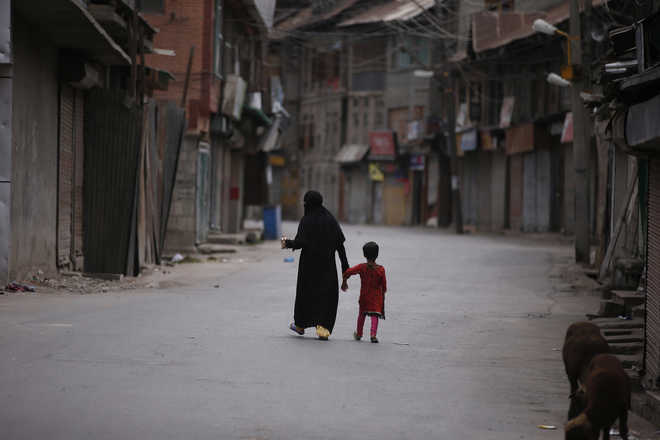
A kashmiri woman holds her daughter’s hand to cross a curfew-bound area in Srinagar on Sunday. Tribune photo: Amin War

Srinagar, July 17

A mob tried to storm an Army camp in Bandipora district, shattering the day-long peace in curfew-bound Kashmir, even as the Centre rushed about 2,000 additional CRPF personnel to shore up security in the Valley, rocked by violence since July 9.Protesters attacked the Army camp at Ajas, forcing the security personnel to open fire. Three persons were injured, the police said. Curfew remained in force for the third consecutive day while life remained paralysed in the wake of the deadly clashes that followed the killing of Hizbul commander Burhan Wani on July 8, leaving 39 dead and over 3,160 injured.Two persons were injured when a mob pelted stones in Eidgah area of Srinagar. After restricting mobile telephone services, the authorities have now snapped landline connections to curb the protests. “All 10 districts in the Kashmir valley continue to remain under curfew,” a police official said.Twenty more companies (100 personnel in each) have been rushed to the Valley, which will be in addition to the 2,800 CRPF personnel sent to assist the state police last week. “Some of the fresh units will exclusively render the task of opening roads to ensure the movement of convoys,” a senior official said. About 60 battalions are already stationed in the state. 

Local newspapers, meanwhile, failed to hit the stands for the second day today after the authorities raided printing presses on Friday night. The government has extended the summer vacations in schools and colleges in the Valley by another week. Both factions of the Hurriyat Conference and the JKLF have extended their strike call till Monday evening. — PTI 


Geared for governance? Cabinet changes driven not by performance alone

The biggest surprise in Tuesday’s reshuffle of portfolios was the shifting of Smriti Irani from the HRD Ministry. The RSS agenda of saffronising education and Prime Minister Modi’s goal of commercialising it required an unquestioning, non-resistant minister and Smriti Irani was eminently qualified for the job. But her penchant for media attention and controversies, including the latest on being called “dear”, came in the way.

Her school dropout status caused little problem. Prakash Javadekar is a smooth talker, avoids needless spats and can justify anything, no matter how damaging. He has ably achieved Modi’s goal of granting quick clearances to industry and built a reputation for efficiency by not letting environmental concerns come in the way of “vikas”. Textiles has a huge potential for creating jobs and capturing markets vacated by China but the harm Smriti can do to this sector is currently underestimated.
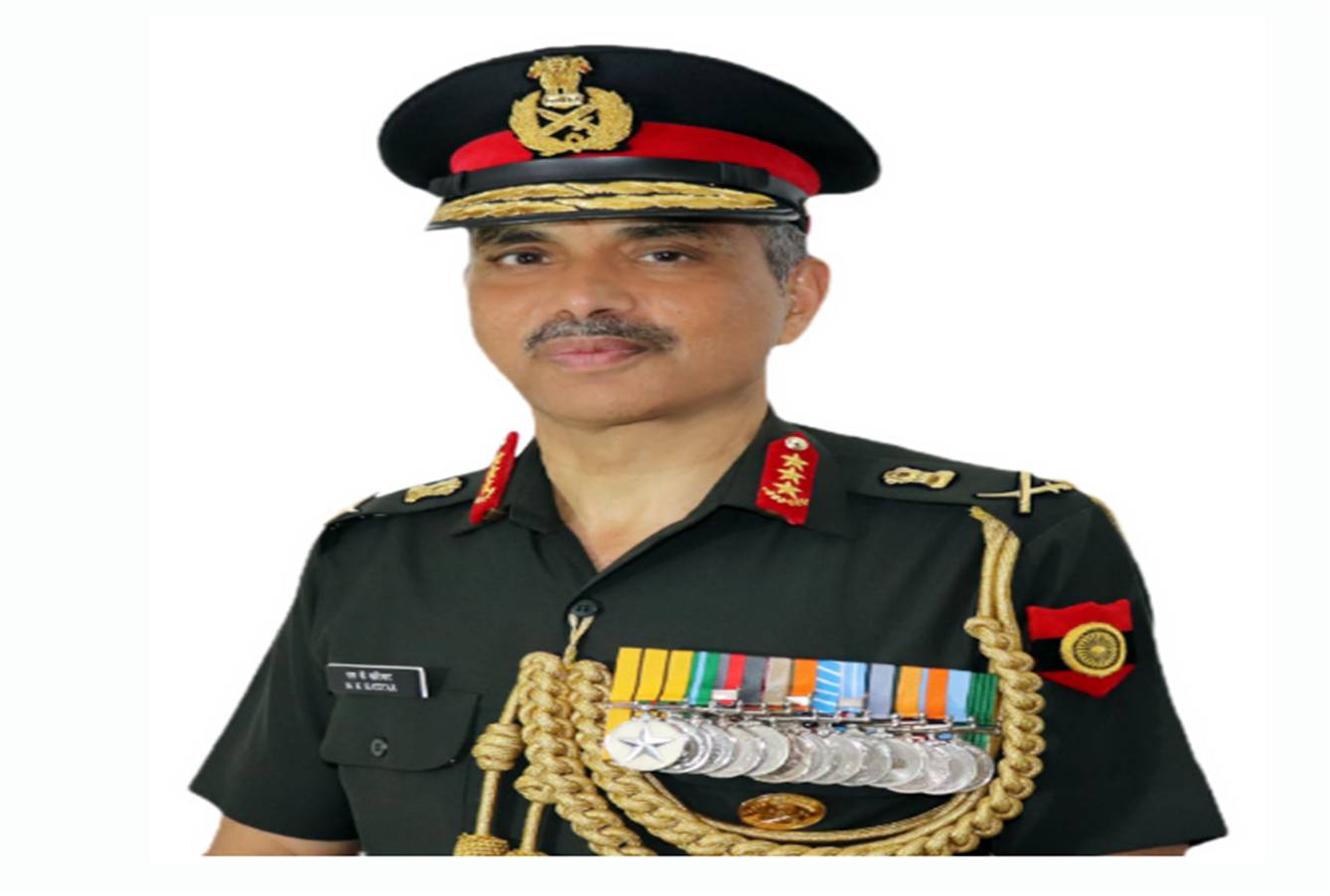
In Jayant Sinha, Finance Minister Jaitley had a good number two. His being grounded in civil aviation appears to be due to the uncontrolled anti-Modi fulminations of his father. Had performance alone guided the Cabinet and portfolio choices, Mahesh Sharma, Niranjan Jyoti, Sanjeev Baliyan and Giriraj Singh would not have survived the scrutiny. By leaving them untouched, Modi has sent a message that making crass, communal talk does not earn anyone poor marks in the performance appraisal. The only saving grace is that a minister from Rajasthan facing rape and murder charges has been dropped. Doomed are the ministries handed over to the electorally useful MPs whose only claim to fame is that they were born in a particular caste. Also, by retaining ministers above 75 and having a jumbo-size ministry, Modi has violated his own rules. Gen VK Singh will have to share Foreign Ministry space with MJ Akbar, even though their senior minister herself is terribly short of work since it is Modi who decides foreign policy. This government is essentially run by the PMO through a select group of trusted officials, drawn mostly from Gujarat. Such a large ministerial army also belies Modi’s assertion of “minimum government, maximum governance”. That too has turned out to be yet another jumla.


Army withdraws from affected villages

Our Correspondent

Pithoragarh, July 6

Army personnel involved in rescue and relief operations in three disaster-affected villages of Bastari, Udma and Pattarkot in Pithoragarh district have been withdrawn today as the NDRF, SDRF and ITBP teams continue their search operation to trace bodies of seven missing persons in the area.The Army contingent from the 8 Assam regiment was the first to reach Bastari village on July 1 this year. “We have been deputed for 72 hours to rescue the injured but we worked for over 92 hours and rescued five persons from debris, besides some animals. We have also coordinated with the local administration and other rescue agencies such as the NDRF and the SDRF, besides the local police in the search operation for bodies,” said Col J Chaudhari, Commander of the Army rescue contingent.Chief Minister Harish Rawat, who visited the disaster-affected villages, also ordered to form a coordination committee to give suggestions on the mode of rehabilitation of the affected villagers. The committee, chaired by the Pithoragarh District Magistrate, comprises Gram pradhans from all disaster-affected villages, block pramukh of Kanalichina block and will submit its report to the government in 10 days.According to the Pithoragarh district administration, after the Chief Minister’s instruction, some more JCB machines have been put to work on the spot to search for seven missing villagers of Bastari, which will continue for two days.“The process of declaring the missing as dead will start, if the bodies will not be found in two days,” said district administration sources.


Welcome Tejas The indigenous aircraft still has a long way to go

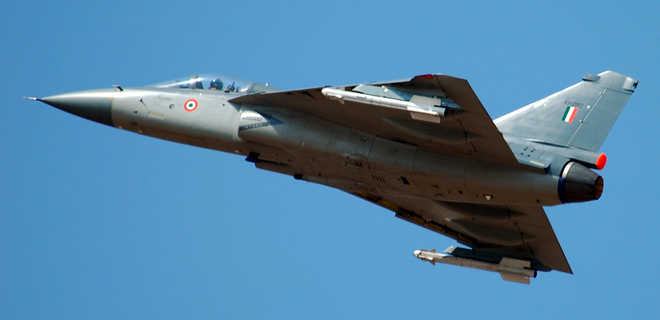
LAST week the IAF formally inducted the indigenously developed Tejas light combat aircraft (LCA). This ‘event’ was hailed by many as a major milestone and technological leap in India’s military aviation history. So far only two of these aircraft have been inducted into the IAF’s first Tejas squadron which will be stationed in Bengaluru for at least two years under the ‘care’ of Hindustan Aeronautics Limited before it is relocated to an operational air base. The squadron is expected to achieve its full complement of 16 fighter versions and two to four more trainer versions of these aircraft during this two-year period.Is there much to celebrate? Fighter aircraft are highly complex and manoeuvrable extreme machines which operate in a high stress aviation environment that comprises sharp turns, high acceleration and the danger of gravity-induced loss of consciousness for pilots who are required to operate sophisticated on board avionics and weapon systems. On the face of it, India has joined a select group of countries that make fighter aircraft, yet that it is still early days for the Tejas which is not yet a ‘finished’ fighter. The much delayed LCA, conceived 33 years ago, was meant to replace the antiquated Soviet-origin MiG-21s which the IAF continues to operate because of inordinate delays and slippages in the development of the Tejas. Unfortunately, the Tejas Mk-I is a heavily compromised aircraft with significant shortfalls in operational performance and capability due to over 50 concessions and waivers. The present Mk-I version is yet to receive its final operational clearance and continues to be import-dependent for 65 per cent of its components ranging from radars and armaments to its engine.The Tejas thus still has a long way to go provided there are no further delays in the development of the  subsequent two versions — Mk-IA and Mk-II — in which the shortcomings are expected to be addressed. The next challenge will be to develop Tejas into a fully mature and dependable fighter. The IAF’s fighter strength is fast depleting, and this is all the more reason that we move beyond symbolism.

Tejas joins IAF today

Tejas joins IAF today

The Air Force will raise the first squadron — Flying Daggers 45 — of home-grown Light Combat Aircraft Tejas  in Bengaluru on Friday with the induction of two aircraft Squadron will be based in Bengaluru for the first two years before being moved to Sulur in Tamil NaduIAF will induct six craft this financial year and eight in the next; Tejas squadrons will have 20 planes in all 

Surface-to-air missile test-fired successfully

Balasore (Odisha), June 30India today successfully test-fired a surface-to-air missile, developed jointly with Israel, from Chandipur off the Odisha coast.“The test launch of the medium-range missile was carried out at 08.15 hours. It was a grand success and met all targets,” a Defence Research & Development Organisation (DRDO) official said.The missile positioned at the launch pad-3 of the integrated test range swung into action after getting a signal from the radars to intercept a moving aerial target supported by an unmanned air vehicle “Banshee” over the Bay of Bengal, officials said.Apart from the missile, the system includes a multi-functional surveillance and threat alert radar (MF STAR) for detection, tracking and guidance of the missile, they said.“The missile along with MF-STAR will help in neutralising aerial threats,” a DRDO scientist said.The Research Centre Imarat, a laboratory of DRDO based at Hyderabad, has jointly developed the missile in collaboration with Israel Aerospace Industries, he said.A new production facility to deliver 100 missiles a year has been established for such type of long-range and medium-range surface-to-air missiles at Bharat Dynamics Limited, India.The missile, which was initially proposed to be tested yesterday, was deferred in the last moment for today. PTI

US ignoring facts on India’s NSG bid: China

Beijing, June 30

China today accused the US of ignoring facts over India not getting entry into the Nuclear Suppliers Group and claimed that the plenary meeting of the elite grouping in Seoul did not discuss the accession of any specific country.China’s assertion came in response to the remarks by US Under Secretary for Political Affairs Tom Shannon yesterday that India failed to get entry into the NSG due to China-led opposition.Shannon had said one country could break consensus in the 48-nation atomic trading bloc and insisted that such member should be held accountable.“With regard to the US official’s comments on the NSG, we want to point out that this official shows no regard to facts,” Chinese Foreign Ministry official Hong Lei told the media.“In the plenary meeting in Seoul, India’s accession was not on the agenda of the meeting,” Hong said. — PTI

Our future is with India alone: Pak economist

Sarbjit Dhaliwal & Amaninder Pal

Tribune News Service

Chandigarh, June 30

Pakistan’s future lies only with India.This realisation has begun to dawn on the people of Pakistan, especially the trading community, said Prof S Akbar Zaidi, an eminent economist from Pakistan. Notwithstanding the Pathankot and Dinanagar incidents, there had been several positives in India-Pakistan ties, he said.“When I say that Pakistan’s future lies with India, it means politically, culturally, and economically and that also means in terms of trade,” said Prof Zaidi. He was at CRRID today to interact with scholars and retired and serving bureaucrats.“Yes, it is true that India is growing at a rapid pace, perhaps the fastest in the world. And Pakistan’s growth rate is 4.5 per cent. The gap between the two countries is widening. Therefore, it is imperative for Pakistan to think of ways to improve trade ties with India,” he said.Quoting dozens of studies, Prof Zaidi said there was a growing demand in Pakistan’s business community that bilateral trade with India should be improved further. “Even in the run-up to the federal elections, Nawaz Sharif had said during campaigning that he would improve ties with India. This had fetched him votes,” Prof Zaidi claimed.“I have read about 45 studies on India-Pakistan ties. Every survey, every study conducted in Pakistan advocates trade with India. Pakistan’s business community too wants trade with India,” he said, while pointing out that Indian films were doing big business in Pakistan.“Udta Punjab is being shown in all big cities. Most Indian films are released in Pakistan and India simultaneously. Your Bollywood heroes are our heroes. There is so much in common, but when it comes to exporting pens, pencils, potatoes and tomatoes, there is a huge problem,” said Prof Zaidi who has been to world’s top universities to deliver lectures.The executive vice-chairman of CRRID, Rashpal Malhotra, said his organisation was trying to bring India and Pakistan closer. “Earlier, there was talk of Punjab-to-Punjab ties. Now, it is about India-Pakistan ties,” he observed. Prof Ranjit Singh Ghuman, an expert on on India-Pakistan trade relations, said CRRID had done substantial work to promote friendship between the two countries.



Indo-Pak War widow launches army canteen at Sainik Sadan

SERVICES UNDER ONE ROOF Earlier, facility was being run from SAS Nagar Industrial Area; now it is part of other services being provided at centre

Everyone will benefit from the facilities like the ECHS, and defence services welfare and training for the wards of ex-servicemen.

SAS NAGAR: Gurmit Kaur, widow of Lance Havildar Joginder Singh — a Vir Chakra awardee of 1947-48 Indo-Pak War — inaugurated a unit-run canteen (URC) at Sector 64, Sainik Sadan, SAS Nagar, on Thursday. Earlier, it was running on rent from Phase 7, Industrial Area of SAS Nagar.

HT PHOTOGurmit Kaur, widow of Lance Havildar Joginder Singh, a Vir Chakra awardee, inaugurating a unit-run canteen at Sector 64, Sainik Sadan, SAS Nagar, on Thursday.

Havildar Joginder Singh killed 7 Pakistan intruders during patrolling on the Baramulla Srinagar road on November 1, 1947, as part of operations undertaken by the army to repel external aggression in the Srinagar valley.

Lt Gen KJ Singh, Army Commander, Western Command, and Anita Singh, regional president , the Army Wives Welfare Association (AWWA), Maj Gen IS Ghuman, Chief of Staff, Western Command, functionaries of public administration, and Rajya Sainik Board, senior army officers, and veterans were also present.

The facility, which is an addition to all other centres, was a long-pending demand of veterans living in the vicinity.

In future, other services like training for wards in management and information technology, and Ex-servicemen Contributory Health Scheme (ECHS) will also be introduced at the centre.

“The facility is in sync with four corner stone of welfare enunciated by the Army Commander, ‘Sahuliyat, Sambandh, Sehat and Samman’ (facility, relationship, health and respect),” stated the Western Command.


Against ministry orders, AIF paid wrong transport grant to city station, says CAG

The audit only checked selected units. There is a need to review all such cases throughout the IAF to avoid recurrences. COMPTROLLER AND AUDITOR GENERAL

CHANDIGARH: In a report tabled in the Parliament on Tuesday, the Comptroller and Auditor General (CAG) has pointed out that the Air Force paid transport allowance to its officers and airmen even in cases when they were absent from duty for a month, which, it stated, is against the orders of the defence ministry and air headquarters.

At 12 Wing, Chandigarh, alone 532 officers and airmen were paid the wrong transport allowance, stated CAG. The defence ministry issued instructions in February 1998 about the transport (TPT) allowance to service officers and personnel below officer rank, stating the TPT allowance should not be given to those who remain absent for a month due to leave or training or tour.

After 6th Pay Commission was implemented, the ministry revised the TPT allowance rates in December 2008.

From June to November 2015, the irregular payment of the TPT allowance was made in eight test-checked stations, and maximum employees (532) who got the wrong payment between April 2012 and July 2015 were from 12 Wing.

The other erring stations included 4 Base Repair Depot (21 employees), 412 Air Force Station (35), 17 Wing (51), 41 Wing (10), 35 Wing (82), Central Servicing Development Organisation (10) and Air Force Central Accounts Office (249). The CAG also issued a statement to Air Headquarter and Air Force Central Accounts Office (AFCAO) on the issue in November 2015, and suggested review.

The AFCAO in November 2015 stated that the recovery would be made where Personnel Occurrence Report (POR) are raised by units, or details are made available by the audit.

“The AFCAO’s reply is not acceptable. It is a repository of all occurrences related to the IAF personnel, including annual leave and individual running ledger accounts. The AFCAO maintains them, and are subject to audit by the Joint Controller of Defence Accounts, Air Force. Further, the audit only checked selected units. There is a need to review all such cases throughout the IAF to avoid recurrences,” reads the report.