Sanjha Morcha

NSG membership: UK assures PM Modi of ‘firm support’

NSG membership: UK assures PM Modi of ‘firm support’
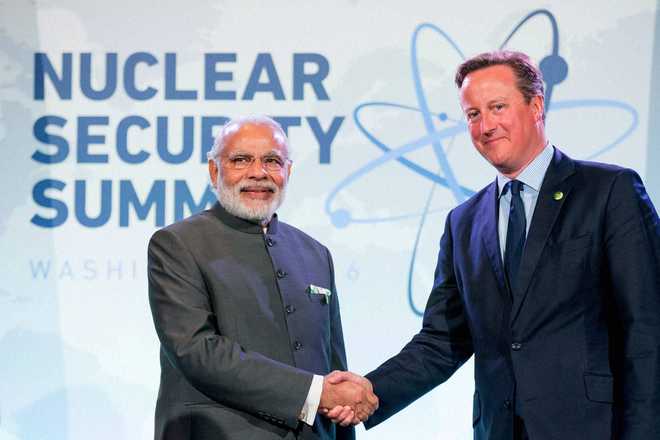
Prime Minister Narendra Modi with British Premier David Cameron. PTI file photo

London, June 17

British Premier David Cameron has assured Prime Minister Narendra Modi of the UK’s “firm support” for India’s NSG membership bid, a boost to the country ahead of the nuclear trading club’s crucial meeting next week.

Cameron confirmed Britain’s backing for India’s membership of the 48-nation Nuclear Suppliers Group (NSG) in a telephone call to Modi yesterday.

A Downing Street spokesperson said, “The Prime Minister spoke to the Indian Prime Minister Narendra Modi about India’s application for membership of the Nuclear Suppliers Group, a group of nuclear supplier countries that works together to prevent nuclear proliferation by controlling the export of materials, equipment and technology that can be used to manufacture nuclear weapons.”

“The Prime Minister confirmed that the UK would firmly support India’s application. They agreed that in order for the bid to be successful it would be important for India to continue to strengthen its non-proliferation credentials, including by reinforcing the separation between civil and military nuclear activity,” the spokesperson said.

The two leaders also took stock of UK-India ties in their telephonic conversation.

“They agreed that the UK-India relationship was going from strength to strength, including through the recent visit of the Duke and Duchess of Cambridge (Prince William and wife Kate),” the spokesperson said.

India’s case for NSG membership is also being strongly pushed by the US, which has written to other members to support India’s bid at the plenary meeting of the group expected to be held in Seoul on June 24.

While majority of the elite group backed India’s membership, China along with New Zealand, Ireland, Turkey, South Africa and Austria were opposed to India’s admission.

China maintains opposition to India’s entry, arguing that it has not signed Nuclear Non-Proliferation Treaty (NPT).

China wants NSG membership for its close ally Pakistan if NSG extends any exemption for India.

India has asserted that being a signatory to the NPT was not essential for joining the NSG as there has been a precedent in this regard, citing the case of France.

The NSG looks after critical issues relating to nuclear sector and its members are allowed to trade in and export nuclear technology. Membership of the grouping will help India significantly expand its atomic energy sector.

India has been reaching out to NSG member countries seeking support for its entry. The NSG works under the principle of consensus and even one country’s vote against India will scuttle its bid. — PTI

US urges NSG members to support India’s membership

US urges NSG members to support India’s membership
US has backed India”s bid for NSG. PTI file

Washington, June 17

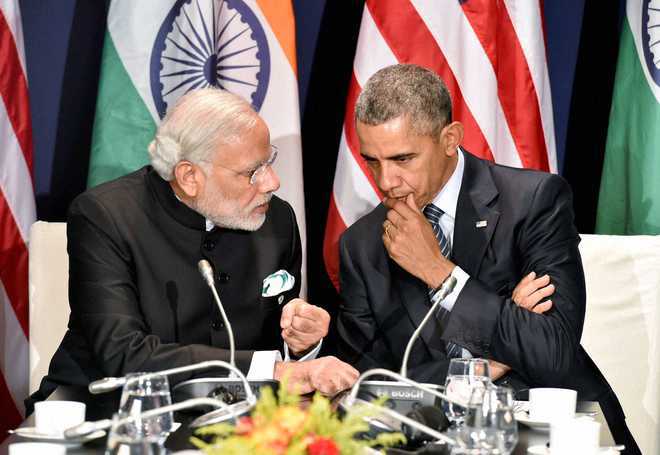
The US has urged members of the Nuclear Suppliers Group (NSG) to support India’s membership into the elite grouping.“The United States calls on NSG participating governments to support India’s application when it comes up at the NSG plenary, which I think is next week,” State Department Spokesman John Kirby told reporters at his daily news conference on Thursday.“I’m not going to get ahead of how that’s going to go or hypothesise and speculate about where it’s going to go, but we’ve made clear that we support the application,” Kirby said in response to a question.(Follow The Tribune on Facebook and Twitter @thetribunechd)During the US visit of Prime Minister Narendra Modi last week, US President Barack Obama welcomed India’s application to the 48-member grouping.The US has been pushing for India’s NSG membership.Earlier, ahead of a meeting here US Secretary of State John Kerry had written a letter to the NSG member countries which are not supportive of India’s bid, saying they should “agree not to block consensus on Indian admission”.A joint statement issued after talks between Modi and Obama said the US called on NSG participating governments to support India’s application when it comes up at the NSG Plenary later this month.India, though not a member, enjoys the benefits of membership under a 2008 exemption to NSG rules for its atomic cooperation deal with the US.The NSG looks after critical issues relating to nuclear sector and its members are allowed to trade in and export nuclear technology. The NSG works under the principle of unanimity and even one country’s vote against India will scuttle its bid.The US support has come a day after China’s official media expressed concern about India’s entry, saying it will “shake” the strategic balance in South Asia and make India a “legitimate” nuclear power. PTI


India, Thailand to firm up maritime security cooperation

Bangkok, June 15

India and Thailand are set to firm up cooperation to combat terrorism, and boost maritime security, defence ties and trade during Thai Prime Minister General Prayuth Chan-ocha’s maiden visit to India, officials said on Wednesday.

The Thai premier will hold talks with Prime Minister Narendra Modi during his three-day visit beginning on Thursday.

The two countries will issue a joint statement later, expressing their expectations to increase maritime security, double trade in five years, push the India-Myanmar-Thai road project, cooperate in civil aviation, fight cybercrime and promote people-to-people cooperation, said Maj-General Werachon Sukondhapatipak, a deputy Thai government spokesman.

Werachon said talks with India would focus on issues such as trade, support for Thai agricultural products and cooperation on education and tourism.

He said Gen Prayuth has said to put all items high on agenda. A high-level delegation will discuss boosting cultural exchanges between the two nations.

India and Thailand will also look for joint projects in solar energy, space applications and space technology sectors.

“Thailand is an extremely important partner and the two sides attach a lot of importance to this visit,” India’s Ambassador to Thailand Bhagwant Bishnoi said.

Bishnoi said that India’s ‘Act East’ and Thailand’s ‘Look West’ policies complemented each other and that India was looking forward to signing several agreements, MoUs on narcotics, cultural exchange with Thailand during the visit.

A Thailand-India Free Trade Agreement will be discussed.

“We are looking forward to a substantial joint statement which would talk of other agreements in the pipeline,” Bishnoi said, and added that Thailand is also keen on India’s ‘Make in India’ programme.

He said India appreciated the fact that Thailand was “very sensitive” to India’s security concerns and ensured that Thai territory was not used by forces inimical to India.

Prayut will be accompanied by Thai foreign minister, Agriculture Minister, Industries minister, IT minister and Deputy Minister of Commerce.

The total trade between the two countries stands at USD 8.5 billion. In 2015, Thai exports to India were USD 5.30 billion while Thai imports from India were USD 2.63 billion.

At least 1.1 million Indian tourists visited Thailand last year. — PTI

Chinese spy ship shadows Malabar naval drill in Pacific

Tokyo, June 15

A Chinese navy spy ship on Wednesday entered Japan’s territorial waters for the first time in over a decade while tailing two Indian naval ships during trilateral Malabar naval exercise attended by the US, India and Japan.

Japanese P-3C patrol aircraft spotted the Dongdiao-class intelligence vessel sailing in territorial waters to the west of Kuchinoerabu Island at around 3.30 am (1830 GMT Tuesday), Deputy Chief Cabinet Secretary Hiroshige Seko told reporters.

The ship travelled on a southeasterly bearing and left Japan’s territorial waters south of the prefecture’s Yakushima Island around 5 am, Kyodo news agency quoted Seko as saying.

It was for the first time that a Chinese spy ship was detected in Japanese water since a submarine was spotted in 2004. The latest intrusion came less than a week after another Chinese naval vessel sailed near islands at the centre of a Tokyo-Beijing sovereignty dispute in the East China Sea.

“The Chinese military vessel moved in after an Indian ship sailed into Japan’s territorial waters as it participated in a Japan-US-India joint exercise,” Defence Minister Gen Nakatani told reporters.

A senior Foreign Ministry official lodged a protest with the Chinese Embassy here over its military activities in view of latest intrusion.

“We are concerned about the Chinese military’s recent activities,” Foreign Minister Fumio Kishida told reporters.

Japanese officials said they are analysing China’s possible motives behind the two actions.

“The government will continue to exert every effort in warning and surveillance activities in the waters and airspace surrounding the country,” Seko said.

As to the spy vessel’s case on Wednesday, the Defense Ministry said it entered the waters while tracking two Indian naval ships that were participating in ongoing Malabar naval drills.

In Beijing, Chinese officials defended the naval vessel’s entry into the waters saying the passage was in line with the principle of freedom of navigation and international rules.

Under international law, ships of all countries, including military ones, are entitled to the right of “innocent passage” through territorial waters as long as it would not undermine others’ security.

“There is no need to provide notification or to get authorisation in advance,” Chinese foreign ministry spokesman Lu Kang said in Beijing.

“So if Japan insists on hyping up this issue in the media, we have to question its motives.” PT


More talks needed to build consensus on India’s entry into NSG: China

More talks needed to build consensus on India’s entry into NSG: China

Beijing, June 12

China said on Sunday that more talks were needed to build a consensus on which countries can join the main group controlling access to sensitive nuclear technology, after a push by the US to include India.

China is seen as leading opposition to the US move to include India in the 48-nation Nuclear Suppliers Group (NSG), but other countries, including New Zealand, Turkey, South Africa and Austria also oppose Indian membership, according to diplomats.

The NSG aims to prevent the proliferation of nuclear weapons by restricting the sale of items that can be used to make those arms.

India already enjoys most of the benefits of membership under a 2008 exemption to NSG rules granted to support its nuclear cooperation deal with Washington, even though India has developed atomic weapons and never signed the nuclear Non-Proliferation Treaty (NPT), the main global arms control pact.

“Large differences” remain over the issue of non-NPT countries joining the NSG, Chinese Foreign Ministry spokesman Hong Lei said in an online statement.

“With regard to what to do on the issue of non-NPT signatories joining (the NSG), China consistently supports having ample discussion on this to seek consensus and agreement and come to a unanimous decision,” Hong said.

“The NPT is the political and legal basis for the entire international non-proliferation system,” Hong said, adding that China would support the group in further talks to come to a consensus at an early date.

Opponents argue that granting India membership would further undermine efforts to prevent proliferation. It would also infuriate India’s rival Pakistan, which responded to India’s membership bid with one of its own and has the backing of its close ally China.

Pakistan joining would be unacceptable to many, given its track record. The scientist that headed its nuclear weapons programme ran an illicit network for years that sold nuclear secrets to countries including North Korea and Iran.

A decision on Indian membership is not expected before an NSG plenary meeting in Seoul on June 20, but diplomats have said Washington has been pressuring hold-outs.

Most of the hold-outs oppose the idea of admitting a non-NPT state such as India and argue that if it is to be admitted, it should be under criteria that apply equally to all states rather than under a “tailor-made” solution for a US ally. — Reuters


A matter of proportions The Indo-US tango is evolving at its own slow pace

Prime Minister Narendra Modi’s latest meeting with US President Barack Obama was no different from their previous six engagements. Both sides have been smitten equally by the desire for a closer strategic embrace but find themselves having to move cautiously because of their existing commitments to other countries and their different belief systems. It was in line with this approach that the US declared India a major defence partner which, on paper, will lead to fewer formalities in transferring closely guarded defence technologies. Both countries also wrapped up a military cooperation agreement, besides making progress in facilitating the setting up of US nuclear plants in India.The two sides also broke fresh ground in bilateral security and defence cooperation by expanding technology cooperation to cover more systems, announcing further steps to deepen collaboration against terrorist threats and deciding to share terrorist screening information. On the global stage, the US expectedly supported India’s membership to the UNSC and other global organisations but in order to keep China in good humour, both sides consciously downplayed future plans for a joint endeavour in the South China Sea. Amidst the emphasis on security issues, the US has inserted itself as an early bird in the India drive to ramp up the share of renewable power in the total energy mix with a slew of agreements.While trade, defence, clean energy and security got their due, India could not wangle more work visas nor could it stop Washington from deducting social security payments from temporary workers. However, high net-worth Indians may not have to face a Shah Rukh Khan moment when they enter the US in the near future after both sides signed an MoU on an expedited traveller initiative. There were two other military agreements on the menu but were not signed because that would spell the end of India’s military trade with Russia. The US also desisted from using strong words against Pakistan, while India walked away with the satisfaction of having named its tormentor in the joint statement. In the end, existing compulsions put the brakes on a convergence that could have been faster.


Dagshai Army school celebrates Founders’ Day

Tribune News Service

Solan, June 2

Army Public School, Dagshai, celebrated its 30th Founders’ Day yesterday. Lt Gen MM Narwane, SM, VSM, GOC, 2 Corps Brig OP Singh, Commandant 14 GTC and chairman of the school, was the chief guest.Gen Narwane complimented the staff and students for the excellent cultural programme and commendable classes X and XII board results. He paid tributes to Lt Major Udai Singh, an old student of the school, who had sacrificed his life while fighting against the militants. The Chief Guest also congratulated Rigzin Dolkar, an old student, who climbed the Mount Everest in May.Students displayed models at an exhibition, which drew appreciation from parents.A classical dance, orchestra, Himachali folk dance, Ladakhi song and koli dance delighted the audience.An English play ‘’The play that goes wrong’’, essentially a murder mystery that turned hilarious when everything went wrong drew much applause from the audience. The delivery of humorous dialogues and befitting expressions of the cast had the audience in peals.A western dance which showed how the brave and gallant soldiers fought fearlessly with their enemies was beautifully depicted in the song. Based on the biography of the greatest Sanskrit poet and dramatist, play Kalidasa was also appreciated by the audience.SK Mishra, principal, APS, read out the school report highlighting the achievements.Hitika Gupta was declared the aII-round best student for 2015-16.Subhash House won the inaugural swachhta trophy whereas Indira House lifted the best kept house trophy. Green House won the Hindi Calligraphy trophy. There was a clean sweep by Red House that won eight trophies, including the coveted cock house trophy.


Pakistan takes a hit G Parthasarathy After the F-16 debacle, the US drone attack has it in a fix

Pakistan takes a hit
Catch-22: Will Pakistan heed US warning, with the Obama Admn on its way out?

THE past fortnight has been traumatic for Pakistan’s ruling elite. They could only look on as American drones crossed the Afghanistan-Pakistan border and eliminated Mullah Akhtar Mohammed Mansour, anointed leader of the Afghan Taliban by the ISI, barely a year earlier, in a public function at Kuchalak on the outskirts Quetta, the capital of Baluchistan. It was  near the site of his appointment that the drones struck and killed Mansour. The drone strike occurred at a virtual stone’s throw away from  the Pakistan army’s Command Staff College, its XII Corps Headquarters, its military recruitment centre and the ISI regional office. The strike signalled that  Taliban leaders based in Quetta for over 15 years under ISI protection could no longer take their safety for granted.To add to their woes, the ISI and Pakistan’s ubiquitous army chief, Gen Raheel Sharif, were made to again look silly. General Sharif personally summoned the American Ambassador to warn the US of dire consequences for its action, described by him and other Pakistani notables, like Interior Minister Chaudhry Nissar, as a “violation of Pakistan’s sovereignty”. To add insult to injury, the Americans responded: “We will carry out strikes to remove terrorists who are actively pursuing, planning and directing attacks against US forces. The strike sends a clear message that those who target Americans and Afghan people are not to be given a safe haven. If you are going to lead attacks against our forces and Afghanistan’s forces, you are going to be targeted and you are not going to have safe havens.” It remains to be seen if the Americans seriously carry out these threats. They will, doubtless, be tested.From Pakistan’s point of view, the past fortnight has been a diplomatic nightmare. Just preceding the drone strike in Baluchistan, the US Congress  made it clear that the new F-16s will not be provided free of cost, as in the past. Moreover, Pakistan had to witness Prime Minister Modi not only being feted and received by Iran’s Supreme Leader Sayyed Ali Hosseini Khamenei, but also a trilateral Iran-Afghanistan-India Summit. Agreement  was reached at the summit to develop the Chabahar Port and an India-Iran-Afghanistan transport corridor, bypassing Pakistan. Moreover, India and Iran agreed to transform their trade relationship into a comprehensive economic partnership and to consult closely in combating threats of terrorism, radicalism, drug trafficking and cyber crime. The past week also saw the anointment of  Mullah Haibatullah Akhunzada as the Taliban’s new leader. He is to be assisted by two deputies — Sirajuddin Haqqani, one of America’s most-wanted terrorists, and Mullah Omar’s son, Mullah Yaqoob. It is now clear that Pakistan would like to see the continuance of a Taliban leadership  drawn from the Kandahar-based Ghilzai Pashtuns, bypassing  the traditional leadership of Durrani Pashtuns, like President Hamid Karzai. Like Mullah Omar and Mullah Mansour, Mullah Akhunzada is a Kandahar-based Ghilzai Pashtun. He is not from the dominant Durrani tribe, from which Afghan rulers, since Ahmed Shah Abdali in the 18th century, have been traditionally drawn.   The  Pakistanis enacted  a stunt to give Mullah Omar’s appointment a veneer of legitimacy and respectability by getting him to appear for the first time in public in 1996, at the main shrine in Kandahar, covered in a cloak, believed to have been worn by the Prophet Muhammad. Ahmed Shah Abdali had brought the cloak to Kandahar from Bukhara. One wonders what stunts the ISI will now resort to in order to similarly give Mullah Akhunzada a veneer of respectability and legitimacy.The entire so-called “peace process” for reconciliation between the Taliban and the Afghan government now lies in a shambles. This  was an initiative doomed to fail, as the Taliban have no belief in democracy and were determined to  use force to acquire power.  The Americans were led up the garden path by both Pakistan and China, to support this process, little realising that while the they wanted a representative government in Kabul, China had an interest in seeing an ISI-sponsored regime in Kabul. Such a regime would do Pakistan’s bidding and  spare China’s Xinjiang Province, where Muslims are persecuted, from terrorist violence. China had, after all, been one of the very few countries that had diplomatic contacts and even economic cooperation with the Taliban regime led by Mullah Omar in the 1990s.These developments have set the stage for more intensive Taliban attacks across Afghanistan in the coming months. The ISI’s favourite Taliban leader, Sirajuddin Haqqani, is  the deputy leader, along with Mullah Yaqoob, son of Mullah Omar. It remains to be seen how the Americans will react to these developments. The State Department has threatened reprisals even on Pakistani soil if attacks in Afghanistan by Taliban  insurgents based there continue. But the Obama Administration is now a ‘lame duck’. General Sharif, meanwhile, appears to be realising that he has perhaps bitten off more than he can chew by committing his soldiers to fight the Tehriq-e-Taliban in the tribal areas bordering Afghanistan. He has obviously learnt no lessons from history.India needs to stay the course in its existing policies on Afghanistan. Its image as a benevolent power will be further enhanced when the Salma Dam built by Indian engineers is commissioned in Afghanistan’s Herat province, bordering Iran, later this year. The presence of the leaders of Iran, Afghanistan and India for inking the agreement making the Chabahar Port a major gateway to Afghanistan and Central Asia has sent a powerful message across the entire region. The reported request of President Ashraf Ghani for more MI-25 attack helicopters needs to be considered after assessing the security situation in Afghanistan. When I last visited Kabul three years ago, I learnt that Pakistani visitors to the Kabul market often declared they were Indians to avoid public wrath against Pakistanis, which runs deep across Afghanistan. One hopes good sense will prevail and Pakistan will learn to behave with greater circumspection and consideration in dealing with its northern neighbour.


No-less-brave ones

No-less-brave ones
President Pranab Mukherjee greets veer naris (war widows) at Rashtrapati Bhavan in New Delhi on Sunday. PTI

The war widows of 8 Jammu and Kashmir Light Infantry (JAK LI) (Siachen), currently on a pilgrimage, called on President Pranab Mukherjee at Rashtrapati Bhavan on Sunday. The infantry unit of the Army has organised the tour for them.“The 8 JAK LI is organising a pilgrimage tour for ‘veer naris’ from Rashtrapati Bhavan to Rishikesh, Haridwar and Badrinath to commemorate the 30th year of the capture of Bana top (on Siachen heights),” a Rashtrapati Bhavan statement said ians


Infiltration In J&K: India’s Battle To Fight And Win Every Day

SNAPSHOT

Lt Gen Syed Ata Hasnain (retd) explains how the Indian Army successfully countered Pakistan-sponsored infiltration in Jammu and Kashmir

 I find that people who meet me socially, often get into discussions on Jammu & Kashmir (J&K). I find most of them have visited the state as tourists and have a considerable interest in the security situation therein. Besides never being able to perceive as to why there is such a large presence of men in uniform all over the Valley, especially in the tourist spots, the airport or even in the boulevard, the other most common question is something which is astounding to me.
It is invariably held that the Indian Army has failed in its job because we do not seem to be able to stop Pakistan-sponsored terrorists from infiltrating into J&K. This is a point which the Army’s PR machinery has never been able to explain with any degree of credibility.

It needs a detailed commentary to allow the right perception to sink in. For that, we need to go back to 1988-89 and progressively see how the J&K theatre’s threats panned out, with focus on the role of infiltration.

The Situation : 1987-89

It is not necessary to describe the triggers which set the Valley aflame. The apparent strategy Pakistan followed was to seize the moment when all parameters of India’s security were almost at rock bottom.

In 1988-89, four of our frontline army formations (about 20,000 men each) were deployed in Sri Lanka. Punjab had an ongoing major internal security problem and Operation Blue Star had made management of the situation even more tentative.

The Bofors case stole attention from what was building up in Kashmir and the political front was in turmoil after Rajiv Gandhi’s exit. All that Pakistan needed was the induction of enough young Kashmiris, trained in guerrilla warfare, led by a few foreign terrorists and SSG men from their own army. The diabolic “Zia Plan”, conceived in 1977, would then be underway.

The Indian Army’s Line of Control (LoC) posture had a “conventional military deployment”, just barely sufficient to ensure the “sanctity” of the LoC. These terms require a brief explanation. The Army’s role and task was to prevent any encroachment on the LoC. It did that then and does that even today, by holding static picquets and posts- the gaps between them are patrolled regularly. This ensures the “sanctity” of the LoC.

Surveillance existed for conventional war, where the adversary could make attempts to infiltrate in large columns to attack from the rear. In conventional operations, the adversary can, at the most, attempt one or two such operations all along the LoC- if it has to be successful at all. Small scale infiltration (strength of six to eight) could hardly be catered for.

The commencement of infiltration

What the Army’s conventional posture on the LoC came up against in 1988-90, and thereafter, was first the infiltration of some Pakistani servicemen in small numbers. They made use of multiple routes, much as they did in Operation Gibraltar in 1965. These formed the core teams for recruitment; who motivated and selected the volunteer youth for jihad and sent them across the LoC by exfiltration, along different routes, into PoK. The ease of infiltration and exfiltration of cadres and recruits was, thus, established.

In fact, these were commonly referred to as “highways”- denoting the relative absence of the Army’s capability to stop this movement. The Pakistani sponsors used the services of guides from the LoC belt who knew the terrain like the back of their hand, having spent all their lives there. They could always outwit our troops, who usually spent two-year tenures in their areas of deployment. The ground knowledge of the troops could never compare with the knowledge of the local guides.

To many, this may sound extremely critical of the Indian Army. It actually isn’t when you realize that an army is not trained, equipped or psychologically conditioned to prevent irregular movement across a linear alignment, on a 24×7 basis. That it has mastered it, since then, is a measure of its extreme flexibility.

Perceptions among our countrymen and, specifically, among the media have been largely based upon visits to the traditional tourist spots and the Valley floor of Kashmir. They have never been enabled a perception of the difficulties of the actual terrain, where the LoC exists.

Most media persons get a faraway glimpse of Uri’s popular Kaman Aman Setu, while driving along the “media route” or the famous Shararat post in Tangdhar, when they are taken on a structured tour by helicopter. None ever visit the famous landmarks along the Northern Gullies or Pir Panjal because they don’t know enough about them. They can go only where the Army wishes to take them.

Getting back to the progressive increase of infiltration and its reduction in subsequent years, it is important to know that, in 1989, a single formation (division) of the Army had the entire responsibility of the LoC in the Valley sector.

There were insufficient troops to increase the density of deployment on the LoC, to cater against small scale infiltration. During 1988-91, the trend of exfiltration of recruits and infiltration of trained cadres, leadership and military wherewithal continued. Switching from “sanctity of LoC” to effective “counter infiltration” was a near impossible military task.

In 1991, it may be recalled by some, how an Indian Army post was attacked by Pakistani regulars in the Keran sector. That commenced a series of such threats, forcing the Army to take measures to strengthen the defensive posture which opened gaps for infiltration, even as it retaliated in kind. After the arrival of the first Rashtriya Rifles (RR) units, there was some semblance of balance starting to return. Redeployment from Ladakh reinforced the LoC to a great strength and the reserve units could then start deployment in the second-tier.

Through the 90s and even afterwards, it is important to remember that the Valley had infiltration from every direction- even over the Pir Panjal. Since the training camps (ultimately, 42 of them) were spread all over PoK, even well south of the Pir Panjal in the Kotli, Nikial and Mangla areas on the PoK side, infiltration took place in the Jammu division too. Here, staging areas and bases were established.

Once inducted there, terrorists could infiltrate further over the Pir Panjal into the Valley. They made use of its high passes, where there was almost no Army or Police deployment. The arrival of the RR units made a major difference as it deployed into South Kashmir and took charge of the Pir Panjal. For many years, the firm base for infiltration into the Valley, employing the Pir Panjal routes, was at Hil Kaka. This was destroyed only in 2002.

Infiltration : The concept adopted by Pakistan

Principally, the concept from the Pakistani side was to employ trained local Kashmiri youth to foist a supposed home-grown militancy. They were first recruited, then exfiltrated, trained and then infiltrated back across the LoC.

This proved counterproductive as the chances of being interdicted, during the two moves over the LoC, started increasing. As the energy levels among local militants started to wane, more foreign terrorists were inducted for fixed tenures with handsome remuneration on return or guaranteed funds to their survivors, if killed.

The idea was that a certain threshold strength of terrorists would be built inside the Valley. They would undertake hit-and-run operations against the Security Forces (SF), keep the flag of resistance flying all over the Valley and intimidate the fence-sitters.

As much as the Army would achieve in terms of operations in the hinterland at the end of each year, the sum total was always against it. That is because even if an average of 1,100-1,200 terrorists were neutralized in a single year, Pakistan could quite successfully induct 1,500 or more through infiltration.

The lofty, jagged peaks rising to 14,000 feet, broken ground and jungle, which abounds the terrain along the LoC, was dominated by the Army night and day. Still, small numbers (six to eight) could slip past silently, even at 10-15 feet distance from ambushes as there was a limited number of night vision devices. The nooks and crannies in this terrain always work for the infiltrator. In the cusp between winter and summer, terrorists undertook the risk of infiltration when snow levels were still high.

Yes, in theory, any infiltration can be stopped a hundred percent but in theory only. That is, by having one Indian Army soldier at every metre along the 750 km LoC- something which can remain only in the figment of one’s imagination.

The task remained split between the protection of posts and picquets, sanctity of the LoC (no encroachments or intrusions) and counter-infiltration. The three-way tasking has always created a dilemma, which was further accentuated by exchanges of artillery fire. Terrorist attrition was reasonably high but for every terrorist killed on or near the LoC, it was estimated that at least three got through.

In spite of the successes that the Army has achieved- the counter-infiltration grid, till as late as 2000-2001 (post Kargil) – could not be optimised. Ambushes were randomly deployed, based on appreciation of ground and previous knowledge but there existed no uniformity of pattern or concept to defeat infiltration.

Infiltration is usually a well-planned process but, often, terrorists continue to repeat the very same routes where their colleagues have died earlier. This is because of their perception to compulsorily reach the “reception area” at the earliest. The “reception area” is a point where a group of terrorists, who are already inside the Valley, move with logistics to receive and guide infiltrators to the nearby villages. Subsequently, they are guided to the safe houses in the urban areas. Routes which involve longer marches are generally avoided and is due to the feasibility of interception, by surveillance of different kinds.

In 2003, under the stewardship of General Nirmal Vij, then Army Chief, the concept of counter infiltration finally changed with a landmark decision based on the experience of almost 15 years. For the first time, a clear-cut mission was given to commanders and troops in the Valley.

“To reduce the strength of terrorists in the Valley and Jammu to sub-1000”; there could not have been a more accurate mission. When such tasks are given, it is usually left to the senior field commanders to evolve the concept of operations- with resources being provided to match the concept as much as is feasible. General Vij, in conjunction with his senior commanders, conceptualised the LoC Fence as the “limit of infiltration”; demanding from field functionaries that it be continuous, overcoming terrain constraints.

The LoC fence did not become a Maginot Line, as many claim it to be. Rather, it is a system of marrying “physical obstacles, electronic surveillance devices, weapons and human resources in varying ratios”. Units and formations took ownership of their segments and focused, counter-infiltration efforts began in July 2004. The one item of equipment, which acted as a force multiplier, was the Hand Held Thermal Imager (HHTI) and its connected surveillance devices (LORROS)- procured on a fast track after Kargil 1999.

Surveillance and Sub-Surveillance Centers were set up to integrate all inputs. Improvisation also became the norm with “Gaddi dogs” (robust Gujjar-owned dogs) becoming the eyes and ears at many posts. Units took the trouble to set up training nodes for these dogs. As the LoC fence matured, the quantum of successful operations increased exponentially.

Some segments became virtually “no-go” areas for infiltration. Terrorists developed technique to defeat the fence but nothing worked. The only lacuna was that the wire obstacle would get compressed by the volumes of soft snow in winter, and the iron pickets would bend; needing high altitude segments to be reconstructed against time in April and May, each year. This took away much time and energy from general preparedness.

What has contributed to reduced infiltration? The effect of the LoC fence, the combination of enhanced and focused, counter-infiltration at the LoC fence, much-improved intelligence by all agencies, better coordination and sharing and, finally, far better dissemination. By 2007, more terrorists were being neutralised at the LoC and the hinterland by the security forces.

In 2008, a bold decision was taken to reinforce counter-infiltration deployment by induction of troops, from the Pir Panjal South to the Valley sector. The effect was enhanced control over infiltration, with some vast contact battles in the Kupwara sector. This had a dampening effect on the situation in the hinterland, which continued to improve. However, indirect effects were street protests and small-scale acts of terror in the hinterland. The focused elimination of terrorist leaders from 2007 onwards further diluted terrorist capability.

The growing success of counter-infiltration, which has reduced the numbers of terrorists from PoK, reaching the urban and semi-urban areas in the Valley, has had the following effects:

-Large-scale terrorist attacks have reduced drastically while resort to gun-snatching has increased.

-IED incidents have reduced and, in fact, have almost entirely vanished.

-New militancy characterised by the presence of local, Kashmiri youth has progressively increased in South Kashmir, with the hold of Pakistani terrorist leaders having been reduced.

-Street protests on slightest pretext are held as a way of keeping alive the issue of separatism.

-New methods of mass mobilisation of street power, to unnerve the SF during encounters, have also found favour.

For the layman, it is important to understand that at no point has infiltration ever been reduced to zero. The Army always maintains that a zero figure is impossible to achieve. I can back that claim completely with my experience of handling counter-infiltration, at various levels, from the lowest to the highest. Is the surge in terrorist activity in recent weeks due to enhanced infiltration? The Army would hotly contest that. Rightly so, because there have been a good number of successful operations in the vicinity of the LoC right through 2015-2016.

The indicators appear to show that infiltration is well under control. However, leakages do continue. North Kashmir, where the presence and hold of foreign (Pakistani) terrorists is higher, is relatively free of terror acts. Sopore, Bandipora, Pattan and Baramulla are unusually quiet. There has been activity around Uri, Tangdhar and Lolab Valley- all nearer to the LoC- indicating successful and some unsuccessful counter- infiltration operations.

If terrorists successfully reach their destinations, there would be a spurt in violence just around early July- when the tourists start returning home, and the Sri Amarnath Yatra gathers more steam. The events in South Kashmir’s Anantnag do not, thus, seem related to any surge in infiltration so far. Yesteryears’ concentration of terrorists at Anantnag would also be from the Jammu division, infiltrating over the Pir Panjal. That may be possible, even currently, while the by-election process is underway until 19 June.

However, the strength in the Jammu division itself is extremely weak and does not support that analogy. The Army has to remain alert at the LoC as there are areas which have not been exploited for some years. The routes over the Shamshabari in Uri sector, Naugam, Tangdhar, Pharkian and Zamindar Gali have been frequented far too often. Usually, the terrorists using these routes end up at the forest tracts- Rafiabad, Rajwar and Hafruda- which are under security forces domination. Gurez and Gulmarg need some additional focus. Helicopter-borne response teams are necessary for these areas, along with UAV surveillance and observation.

The link with the situation of infiltration efforts into Pakistan is indirectly proportional to the internal situation in Pakistan. Now that the internal security environment is under better control and the closing months of General Raheel Sharif’s tenure are underway, perhaps a surge is what the ISI could be planning for. The Lashkar-e-Taiba (LeT) and Jaish-e-Mohammad (JeM) are rabid outfits. In their strategy, major attrition of jihadis is acceptable as long as a few prominent leaders can be inducted along with some logistics, military wherewithal and lower-end cadres. For an attempt by 100 terrorists, they are willing to lose up to 60, if not more.

That means that the Army’s success in neutralising terrorists on the counter-infiltration grid may not necessarily mean reduced strength of terrorists in the hinterland, especially if the “deep state” in Pakistan decides that a surge is what it wants. The only deduction from this is that the counter-infiltration machinery has to be fully geared up and reinforced with intelligence, being generated and disseminated in near real-time. None of that “put up on file” business which some warriors, who are not used to the grid, may want to follow.

The lesson of this essay is that the focus of operations may be on “New Militancy in South Kashmir” and the mobs obstructing operations. That is all fine, operational and tactical. The real and strategic-level decision-making aims at bolstering the counter- infiltration grid so that the progress of the last 13 years will not languish. The Army is up against a reinvigorated ISI, which will look for innovative ways and areas in the attempt to execute its aim of increasing the footprint of the sponsored terrorists in the Valley.

There is no rest for the Army. Its 24×7 posture has to remain activated, everywhere. Mostly so, on the LoC and the reception areas of North Kashmir, Rafiabad, Hafruda, Rajwar, Lolab Valley and Tehgam. All of them are household names in the lexicon of the Army, which must remain free of terrorists. The flanks will also feel the pressure and focus, and attention needs to shift to the old, traditional routes. The Indian Army has to succeed and, given its professionalism, it will succeed.



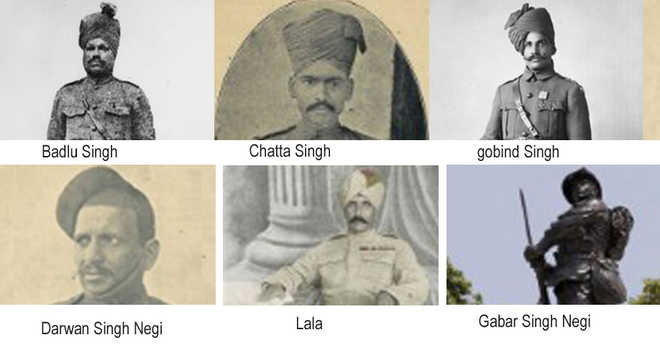
Indian war heroes honoured in UK digital archive

Indian war heroes honoured in UK digital archive
Photo taken from www.gov.uk/government/case-studies. Credits: USI – CAFHR and IWM

London, June 21

Britain has launched a new digital archive telling the inspiring stories of war heroes, including six Indians, as part of the UK government’s centenary celebrations to mark World War I.As many as 175 men from 11 overseas countries were awarded Britain’s highest award for valour, the Victoria Cross (VC), during the war. These included six soldiers from undivided India who fought in the war as part of the British Indian Army and honoured in a commemorative plaque presented to India back in 2014.”Behind every name engraved on the memorial plaques there is a truly remarkable story. It is fitting that we pay tribute to the Victoria Cross recipients from overseas by bringing their stories together in this digital archive,” said Foreign and Commonwealth Office (FCO) minister Hugo Swire.”By doing so we are sending a message that these men, and the important role played by their home countries in the First World War, will never be forgotten by the people of the United Kingdom,” he said.The new Digital Archive was launched by FCO yesterday to chronicle individual biographies of Risaldar Badlu Singh from Punjab, Sepoy Chatta Singh from UP, Naik Darwan Singh Negi and Rifleman Gabar Sing Negi from modern day Uttarakhand, Lance- Daffadar Gobind Singh from Rajasthan, and Lance Naik Lala from Himachal Pradesh.They were all awarded for their “conspicuous bravery” on the battlefield.Besides six VCs from India, the 11 countries covered by the special plaques include Pakistan (3); Nepal (2); Canada (70 VCs); Australia (66); New Zealand (16); South Africa (14); US (5); Denmark (2); Belgium (1) and Ukraine (1).August 2014 had marked 100 years since Britain entered the First World War. Prime Minister David Cameron had launched the ongoing commemoration programme back in October 2012.The new digital archive can be accessed through the UK government’s official gov.uk portal. — PTI


2 militants killed in Sopore encounter

ENCOUNTER COMES A DAY AFTER FOUR MILITANTS AND A SOLDIER WERE KILLED IN TANGDHAR SECTOR

SRINAGAR: Two suspected militants were killed by security forces in an encounter on Friday in Kashmir’s Sopore town, army said.

The gunfight started in the morning between militants and security forces in Sopore town after police received information about the presence of militants, sources said.

Police sources said the identity of the militants killed in the encounter has been ascertained as Altaf Mir of Sopore and Imtiyaz Lone of Bandipora district.

The recent encounter comes a day after four militants and one soldier were killed in another encounter on Thursday after security forces foiled an infiltration attempt in Tangdhar sector near the Line of Control.

Army on Friday paid tributes to soldier Prem Bahadur Resmi Magar who was killed in the Tangdhar encounter.

The 37-year-old soldier was a part of the team that had killed seven militants in the same area in two earlier encounters.

He was a native of Falpa district in Nepal and is survived by his wife and two children. “He was a true embodiment of the Gorkhas’ martial and yet mirthful character,” an army spokesperson said.

A day before that, soldier Ajay Singh Choudhary succumbed to the injuries he suffered in an encounter on Tuesday in Machil sector of Kupwara district.

“Signalman Ajay was part of his unit’s Quick Reaction Team, which was the first to intercept and engage an infiltrating column of terrorists in the highly inhospitable terrain of Machhal area on [June 14],” an army statement said.

getimage (4)


“Displaying exceptional gallantry and selflessness, he had continued to engage the terrorists, killing one despite being grievously wounded himself. He was evacuated from the encounter site but unfortunately succumbed to his injuries later