Sanjha Morcha

Married to the olive green Col HP Singh (retd)

I MARRIED a girl from a civil background who had no clue about matters military. All she knew was that we wore the olive green uniform and defended the country deployed at the ‘border’. Blissfully unaware of the hierarchy of the organisation, it took a while for her to understand the difference between a GOC (General Officer Commanding) and a JCO (Junior Commissioned Officer). The jargon used by my colleagues was Greek to her and she found the use of abbreviations in writing very amusing.Curious like a kitten, she would bombard me with questions: What do we do when there is no war? Why do we have so many types of dresses to wear? Why do soldiers wear a woollen beret even in summer? Why do we drink standing and not sit in parties when all chairs are empty? Why does the Commanding Officer salute me when in uniform? It took some effort to educate her about our customs and traditions.Married to an aviator gave her a sense of pride in her circle of friends and one got a lot of attention and ‘likes’ even when Facebook and Whatsapp were not conceived. It was only after a couple of helicopter crashes and a few deaths in the squadron that reality dawned upon her. The Army was not about picnics and golfing alone, we had serious business to do and the risk to life was higher than any other profession. The agonising separations that followed due to one’s postings to the Siachen Glacier and the Valley introduced her to the concept of God. Her baptism into the Army was complete when the Kargil war broke out and she would feel the pain of every family which received ‘body bags’ from the frozen frontiers.    As I grew in service, she got involved in the welfare of families and children of troops under my command. Dealing with cases of marital discord, counselling children and efforts to improve their quality of life became her priority. My professional commitments did not give me enough time for my own family. Single-handedly, she reared up our children, and before I realised, they grew up into confident youngsters ready to explore their dreams. Wedded for two decades now, her approach to life is regimented. Before any ‘project’ in the house, she holds a family ‘conference’, giving out the ‘aim’. Options are discussed and she decides upon the ‘most preferred option’. She takes into account ‘contingencies’ and keeps ‘reserves’. A ‘recce’ is carried out and she insists on ‘feedback’ after it is accomplished to ensure ‘economy of effort’. Having started the journey as a fiancée of a Captain, she has traversed a long distance and stands tall. As I fade away from the olive greens, all that remains for me is to salute this person who stood by me without demanding any acknowledgement.


Commercial flights from Adampur soon: Parrikar

Deepkamal Kaur

Tribune News Service

Jalandhar, June 14

Union Defence Minister Manohar Parrikar said today that decks had been cleared to open the Adampur air force base for commercial flights as the two requisite NoCs required from the defence authorities had been granted.He said that a meeting would be held next month with the officials of Airport Authority of India and Air India. Parrikar said this during his visit to Hoshiarpur where he opened a war memorial. Alighting at the Adampur air force station, he first paid his respects to the 567 martyrs of the district and laid a wreath at the memorial.He was received by Union Minister and Hoshiarpur MP Vijay Sampla and BJP national vice- president Avinash Rai Khanna. Parrikar held a meeting with the intellectuals on the two years of the Modi government followed by a media interaction.Justifying the shoot-at-sight orders by the Indian Air Force against anyone found scaling the boundary walls of an installation, he said it was a normal practice to issue such orders in high-alert areas. He said an NIAteam was leaving for Pakistan for a probe into the Pathankot attack but the green signal from Pakistan was still awaited.On the crash of MiG 27 and a move to ground the aircraft by 2018, he said air accidents were currently rated as 0.23 per cent for 10,000 flying hours and had reduced considerably. “We will phase them out,” he replied.On the NCC cadets not getting their uniform, he said they would start getting these soon.

clip


OPERATION CACTUS ::: LT GEN VINOD BHATIA, PVSM, AVSM, SM


“India now has the capability of protecting its strategic interests. The massive operation which came as the year was closing, demonstrated that the three services, the Army, the Air Force and the Navy, had acted in perfect coordination. The Maldives Operation has been a show piece in military strategy.” —Janes Magazine, Dec 1988.

In the early hours of 03 November 1988, 55,000 residents of Male (the capital of Maldives) awoke to the reality of an armed coup, hearing gunshots all round for the first time in their lives. Till then, the Maldivian’s had hardly ever witnessed crime leave aside violence. The last murder in this island nation was reported in 1976 and that too of a German murdering his girlfriend and the one before that was way back in 1793. Now, a rich businessman, Abdullah Luthufi, had taken over the island nation, capturing the radio and TV stations and the presidential palace with the help of mercenaries from the People’s Liberation Organisation of Tamil Eelam (PLOTE). The 1500 strong National Security Service (NSS) whose headquarter is located adjacent to the presidential palace was besieged by the mercenaries, who fortunately failed to enter and take over the armoury. Complicity of a few NSS cadres was never ruled out.

Mr Maumoon Abdul Gayoom, the president since 1978, had been returned to power with a 98.5 per cent majority for the third time. He was scheduled to visit India prior to his oath taking ceremony on 11 November. On learning of the coup, the president went into hiding, taking shelter in a safe house in the capital island of Male. From the safe house he requested assistance, first from the U.S. followed by the Soviets and thereafter Pakistan to rescue him. The U.S. base at Diego Garcia was the nearest, located 1,175 kms away, but it was election year with the U.S. Presidential elections scheduled for the 8th of November. Not having received a positive response from the three nations, President Gayoom requested India for assistance. It would be remembered that India was at that time assisting Sri Lanka with the IPKF deployed in the Northern and Eastern parts of Sri Lanka, fighting the LTTE.

3500 kms away from Male, where this violent drama for power of a small though important island nation was unfolding, another seemingly normal day dawned for the paratroopers of 50 (I) Parachute Brigade located at Agra. This was soon to change to an exciting, challenging and historical day. I was then serving as the Brigade Major (BM) of 50 (I) Parachute Brigade and at around 1000h, I received the first indication of an impending operation when I received a call from Brig. V.P. Malik (later General and COAS) the Deputy Director General of Military Operations (DDG MO). Brig. Malik issued crisp instructions and the urgency in the voice conveyed the gravity of an emerging though uncertain situation. I was informed that the Para Brigade was to move to an Island for operations. One company group and one battalion group was to be kept at standby to move at 6 hours notice and at 12 hours notice respectively. The Brigade Commander with one staff officer was required to move to the MO Directorate at Delhi by the evening, but the time was not specified.

At this time, Brig. F.F.C. Bulsara, Commander 50 (I) Parachute Brigade was on a visit to the Army Airborne Training Area at Kheria. He was requested to fall back immediately to the headquarters. Not being privy to any further information, we thought that this was one more of the numerous moves of the Para Brigade’s Reconnaissance and Order group to Sri Lanka for another of those contingency plans for Op Pawan, the codename given to\ operations being conducted by the IPKF.

At about 1040h, I received another call from the Army Headquarters, this time from the VCOAS, Lt Gen. (later COAS) S.F. Rodrigues. As the Commander was moving back from Kheria to the brigade headquarters and was not in communication, the Vice Chief spoke to me and gave the following orders/ instructions:
• Brigade to move to Maldives.
• One Battalion group to emplane by 1230 hours (ie less than 2 hours)
• Brigade less battalion group to move to Maldives on night 03/04 November.
• Prepare for an airborne assault on an island, para drop planned on a beach.
• Enemy is equipped with small arms, rocket launchers, mortars and general purpose machine guns (GPMGs). There is no air defence, though the enemy may possess some surface to air missiles.
• Air effort allotted is three IL-76 and ten AN 32 aircraft.
• First and second line ammunition to be carried.

The brigade was located in Agra, but most troops were committed on training and administrative activities. Of the three battalions of the brigade, 7 Para was out on collective training, 3 Para had two companies deployed at Lucknow and 6 Para had two companies providing security at COD Agra. However, 6 Para and 3 Para were both mobilised and 7 Para was instructed to move back to Agra forthwith. In the meantime, 10 Guards (Mechanised) was also mobilised from Gwalior by MO Directorate to move to Agra and marry up with the Para Brigade at the earliest. Those were not the days of the internet and mobile communications, and we had very little or no information on Maldives. All that we knew was that Male was the capital of the Island nation and the airfield was at Hulhule. It was only after Brig. V.P. Malik landed at Agra at around 1515h, with the Indian High Commissioner to Maldives, Mr Ashok Banerjee, that the clarity and enormity of the task dawned on us. By this time, the Commander had also returned.

Brig. Malik gave out the task and plan as formulated at MO Directorate. The task was categorical “To rescue the President of Maldives and escort him safely to India”. The plan in essence included two airborne assaults – one on a beach at Male and the other in Hulhule airfield. Thereafter, the rest of the combat echelons were to be landed at the Hulhule airfield, once it was secured. However, if the airfield at Hulhule island was under the control of troops loyal to the President, then the two IL-76 aircraft would land troops at Hulhule. However, the airborne assault at Male would still go ahead as there was no wherewithal to move the assault echelons to Male island which was separated by about one kilometre of ocean. If the airfield was in the hands of loyal troops, codeword ‘HADIYA’ was to be sent by radio and the runway lights were to be switched on and off. To facilitate landing, the airfield lights were to be switched on just prior to landing and switched off once the landing was successfully accomplished.

With scant inputs of not only the prevailing situation but also of the topography, the situation remained uncertain and confused. The only maps available were photocopies of tourist sketches of Male and Hulhule islands. But now Brig F.F.C. Bulsara, took charge. A decisive military leader and soldier, he comprehended the seriousness of the situation which was compounded by the prevailing confusion, and issued clear and concise instructions not only to the units of the Para Brigade but also to the Air Force and the Military Operations Directorate. He had trained the brigade very effectively so as to achieve all military tasks,especially airborne tasks under the most challenging of circumstances. After getting as much information as he could from Mr Ashok Banerjee’s detailed knowledge of Male, Brig. Bulsara decided to launch the operation with Col (later Brig.) S.C. Joshi, CO, 6 Para spearheading the operation. Two plans were made for the operation:

Plan ‘A’ was to launch an airborne assault with sixty paratroopers from one IL 76 at Hulhule airfield, to capture and secure the airfield. The remaining paratroopers in that IL-76 aircraft were then to be landed, followed by troops from the follow up IL-76 aircraft. Thereafter, the troops were to move to Male to rescue the President by capturing and commandeering local boats. The limit of sixty paratroopers was dictated by the availability of packed parachutes with the Air Force on that particular day and time. Plan ‘B’ involved a landing at the Hulhule airfield. The decision as to which plan was to be implemented was to be taken by Brig. Bulsara, once the the aircraft were over Hulhule airfield or when nearing Maldives. Flying the two aircraft were Group Captain (later Air Marshal) AK Goel and Group Captain A.G. Bewoor, the Commanding Officer of 44 Squadron.

The assault echelons of 6 Para, 3 Para and 17 Para Field Regiment, along with sappers, signallers and medical detachments, emplaned in the two IL 76 aircraft and took off from Agra at around 1730 hours. I, along with the GSO3, accompanied the Commander in the lead aircraft as part of the tactical headquarter. The four and half hour flying time from Agra to Male was well spent in carrying out detailed briefings of all contingencies, including showing the photograph of the president to all ranks.

On approaching Hulhule one could only see the vast ocean. Group Captain Bewoor then confirmed receipt of codeword ‘HADIYA’ on radio from the ATC. The light signal had also been give. It was decision time now for the Commander.

Was the code given under duress or by deceit? Even during the landing, it was easy for the rebels to simply position a vehicle on the runway, thus jeopardising not only the mission but also the lives of 180 troops on board. The other alternative seemed equally dangerous as Male is about two square kilometres only and the assaulting paratroopers would have mostly landed in the sea, with no chance of survival. The drop zone where the airborne assault was planned was no more than 200 m by 50 m. Weighing up the odds, Brig. Bulsara decided to land. That decision proved vital and was to be discussed in military circles for many years, with many self proclaimed military experts criticising the decision. Given the task and the situation it was a bold and pragmatic decision, the less risky of the two alternatives and with a better probability of success, exemplifying in full measure the motto of the Paratroopers “Who Dares,Wins”.

Fortunately the landing was unopposed and the first IL -76 with 6 Para and the brigade tactical headquarter landed at 2148 hours and secured the airfield in quicktime. The second IL 76 landing after a gap of ten minutes, brought in the company of 3 Para under Maj. (later Lt Gen.) N.K.S Ghei, elements of sappers and medical and the artillery component under Col K.K.K. Singh. Hulhule was totally abandoned, but intermittent firing could be heard at Male. 6 Para with a company under Maj. R.J.S. Dhillon, after commandeering the boats had moved for the main assault to secure a beachhead South West of Male with the 3 Para company heading straight for the Male jetty as a diversionary. Around this time, the troops observed a ship sailing between the two islands. The ATC also gave information that the rebels had taken control of a merchant vessel and were fleeing with hostages including a minister and his wife. The ship was effectively engaged with all available firepower including recoilless guns and machine guns.

In the meantime the Commander got in touch with the President from the ATC. The President informed him that the situation was desperate as he was surrounded from all sides by the rebels and could not hold out any longer. It is to the credit of the Commander’s plan and the flawless execution by the troops that by around 0220 hours, Col SC Joshi and Maj RJS Dhillon secured the President from his safe house. In the meantime troops had lifted the siege on the NSS headquarters, TV and radio stations and the presidential palace and commenced securing and sanitising the areas. President Gayoom, now safe and secure wanted to stay on at Male, whereas the orders were to evacuate him to India. This was also the time that the follow up waves started landing at Hulhule and by early morning more than 1600 troops had built up with all support echelons.

By around 0430 hours the NSS headquarters had been fully secured and the president moved, to enable him to speak on a secure link to the Prime Minister of India. The primary task achieved with surgical precision, the brigade was tasked to now help restore the situation and neutralise all rebels. Early morning the IAF fighter air crafts made a couple of passes over Male reassuring all that normalcy had been restored by the Indian Armed Forces. At 0800 hours an Indian Navy IL 38 reconnaissance aircraft landed at Hulhule and after an update on the ship (MV Progress Light) having escaped with the rebels and hostages on board confirmed that while enroute they had sighted a ship listing portside, South West of Male. The navy thereafter kept a surveillance over MV Progress Light and with INS Godavari and Betwa having moved in on 06 November, rescued the hostages, took the rebels including their leader into custody and destroyed the ship.

The coup leaders and rebels were brought to Male and handed over to the Maldivian authorities. The Indian Army was requested to keep the rebels in their custody till the legal proceedings could be completed, and accordingly they were taken to a prison Island Gamadoo under the escort of Indian troops. 50 (I) Para Brigade less 6 Para with two companies de-inducted by 17 November. Thereafter, the Indian Army, on the request of the Maldivian government took on the task of capacity building and helping NSS reform to meet their future security challenges.

The precision timed “Operation Cactus” in which Indian armed forces acted within hours to thwart a coup attempt to dislodge a lawfully elected government on the Indian Ocean Island of Maldives made military watchers sit up worldwide.

On 03 April 1989, Time magazine ran a cover story “Super Power Rising” stating “India asserts its place on the world stage”, consequent to the Indian Armed Forces unprecedented success in executing an intervention operations albeit at the request of a friendly government. Op Cactus launched to rescue President M.A. Gayoom, demonstrated Indian power and capability to be a ‘net security provider’ in the region. The operations launched from a cold start and executed with surgical precision was successfully accomplished within 16 hours of the first indication of an impending operation, 3000 km from base. The cover story of Timemagazine by Ross H. Munro flags India’s growing military power, quote “At an air force base five miles from the Taj Mahal at Agra, hundreds of India’s finest combat troops (50(1) Parachute Brigade) filed into the cavernous holds of Soviet built IL-76 transporters, whose jet engines were whining impatiently. Soon the transporters were headed into the night, winging southwards across the subcontinent and then out over the Indian Ocean. When they landed four hours later at one of the 1200 coral islands, that make up the republic of Maldives, the paratroopers charged out of the planes, rifles at the ready.”

Operation Maldives launched conjointly by the Army, Navy and the Air Force was successfully accomplished without a single casualty. The operation exemplifies the excellent jointness achieved. The success of this operation at home mostly went unnoticed as did a few important lessons learnt. Had it failed, maybe India too would have created structures and organisations to exploit the full potential of a Special Operations Command to safeguard national interest and assets, much like the United States which established the US Special Operations Command (USSOC) comprising the SOF of the three services and marines, in the aftermath of the failure of Operation EAGLE CLAW to rescue American diplomats held hostage at the US Embassy at Tehran in April 1980.

Operation Cactus is undoubtedly one of the most professionally executed military operation in the world, right on top with the likes of Operation Thunderbolt (Israeli raid on Entebbe), Otto Skorzeny’s rescue of Mussolini, the long range desert patrols of David Sterling (Phantom major) and Op Geronimo, the Abbottabad raid by US seals to neutralise Osama Bin Laden among a few others.

Lt Gen. Vinod Bhatia, PVSM, AVSM, SM was the Brigade Major during the above operation. After superannuating from the Indian Army, he is presently the Director, CENJOWS (Centre for Joint Warfare Studies), an inter-service think tank based in New Delhi. Views expressed are personal.




THE SON OF A COOK IN OFFICERS’ MESS GETS SWORD OF HONOUR

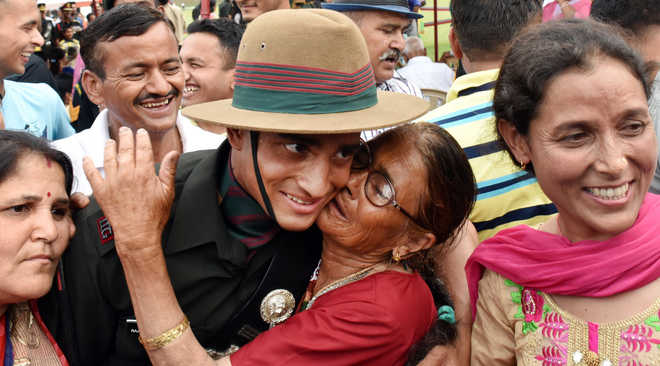
For years, he cooked and served food to the army officers in the officers’ messes, but on Saturday tears of joy flowed from the eyes of G S Bisht when his son Rajendra Singh Bisht, donning olive green of army with epaulets of an officer, saluted him.

The happiness of the family belonging to remote Pachisi Kapaddi village in Almora district doubled when the bright GC was conferred with  the prestigious Sword of Honour for being the best all -round cadet among the GCs of passing out course.

A beaming father of the young officer, who at present serves as a civilian staff in Kumaon Regimental Centre at Ranikhet said that he always dreamt that one day his son would don the uniform of an officer and it was a dream come true for him. The entire family of Bisht was present on the occasion. A proud Nandi Devi, the grandmother of the officer, said that Rajendra would be the first officer in the army from the area they hail.

The elder brother of the officer, Kamal Singh Bisht, a mechanical engineer by profession, was also present on the occasion. He said that Rajendra always excelled in studies.

The recipient of the Sword of Honour has done his schooling from Kendriya Vidhyalayas of Bareilly in UP and Ranikhet in Uttarakhand. The boy showed his calibre when he was selected for Sainik School, Ghorakhal. Incidentally, Rajendra was adjudged  the best cadet during his stint at the National Defence Academy (NDA), Kharakwasla.


Modi the statesman has arrived :::The five-nation visit is an attempt to consolidate partnerships

Modi the statesman has arrived
Hands full: Modi’s foreign policy is on track.

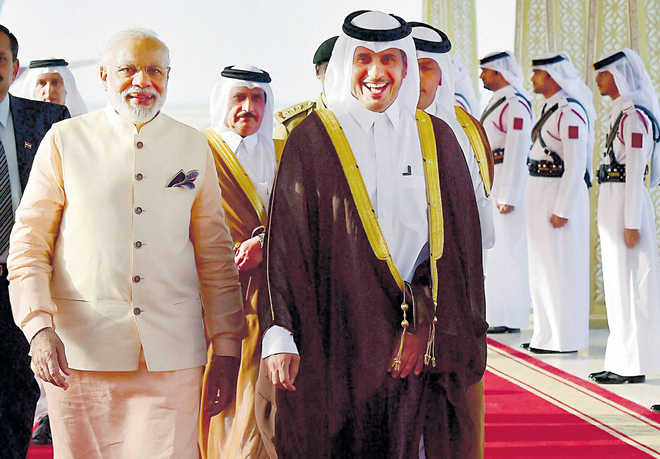
PRIME Minister Narendra Modi is on a five-nation trip, making on June 4 a whistle-stop in Afghanistan — to inaugurate the Salma Dam on the Hariud, which will irrigate 640 villages around Herat, besides generating power — en route to a two-day stopover in Qatar. He then swung through Switzerland on June 6, before arriving in the US for his seventh meeting with President Barack Obama in the PM’s two years in office. The joint statement calls it the “third major bilateral summit” between the two leaders. He would return to India via Mexico, having crunched five countries in a week or less. Gone were the diaspora hooplas or extended detours into the hinterland. Modi, the working statesman,  had arrived.  The underlying themes were those  etched during earlier visits — consolidate past work; explore economic advancement and dovetail it into the PM’s vision, like ‘Make in India’; reposition India in a world witnessing the rise of China, radical Islam and economic slowdown; and seek, as the joint statement’s title spells it, ‘enduring global partners’. There were, however, specific reasons for each stopover or longer engagement on the way to the US, on which the trip was focussed.Afghanistan has been for India,  since Independence, an important counter-balance to Pakistan, and since 1996, when the Taliban captured Kabul, and specifically 1998, when a hijacked Indian plane ended up in Kandahar — a region where Pakistan influence via surrogates had to be curtailed. The Salma Dam was part of India’s strategy, denied by the US a security role since its intervention in 2001, to use development projects to consolidate partnership. The dam construction in the face of Taliban attacks, sponsored mostly by Pakistan or allegedly even Iran (which as a lower riparian beneficiary resents the blockage of water), was the victory of resolve over disruption. The PM’s presence and hyperbolic address went down well in a nation seeking pacification and stability. The visit to Qatar was part of Modi’s  outreach to Gulf nations, balancing between the Sunni and Shia powers, the latter led by Iran. Qatar has been a principal supplier of LNG and LPG to India, despite neighbouring Iran having competing large reserves of gas. Qatar has deep pockets and a small population, though as an adherent to the Wahabbi brand of Islam of Saudi Arabian provenance —  albeit more tolerant — it has boxed above its international weight by two means: the ruling family-owned crusading Al Jazeera news channel; and sponsorship of disparate extreme right-wing affiliates in the post-Arab Spring battles in Libya, Syria, etc. Unmentioned during the PM’s visit was the need to consider a sub-sea natural gas pipeline, aligned from Oman to Gujarat, to carry both Iranian and Qatari gas, as the source is a shared gas field. India has invited Qatar to join the second phase of Indian strategic oil reserve storage. Besides the usual homilies about India’s visionary conceptions about smart, clean and connected cities, the  Qatar Investment Authority was approached to open its purse strings and direct investment in India. The success of this and approaches to other five Gulf Cooperation Council nations depends on the follow-up and creation of an enabling environment for them to look at India as more than a supplier of manpower, a civil aviation junior partner and the exporter of select commodities. The Swiss refuelling halt and meeting with the Swiss President was focussed on obtaining support for India’s membership of the NSG, which, with Mexico, are the few remaining nations with reservations; and to seek better cooperation in investigating black money transfers. On the first there was success; on the second there was dissimulation and promise of an early agreement on an automatic exchange of information. Switzerland, some years ago, had already agreed to cooperate if India could establish criminality of account holders. The problem is that India is often on a fishing expedition based on sketchy evidence. The US was the prime reason for the visit. With time running out for the Obama presidency and with over 50 sub-groups devoted to examining different aspects of the bilateral engagement, there was a dire need to consolidate, give a top-down push and recommit to a strategic vision adumbrated in the declarations during Obama’s India visit in  2015. Foreign Secretary S Jaishankar called it sketching the road map for the vision statements of the past. President Obama pushed legacy issues like climate change, fearing that a Trump victory could unravel the Paris Accord, which the US wants made operational before December. India, in turn, has sought financial and technical commitments to move to cleaner non-fossil fuel energy before it ratifies the accord. The additional burden of curtailing hydrofluorocarbons under the amended Montreal Protocol puts India in a further financial and economic conundrum. But it is crucial the two largest polluters — the US (17.89%) and China (20%) — ratify it first. For the Paris Accord’s operationalisation, at least 55 signatory states, out of the 190-odd signing, and whose total emissions exceed 55 per cent of global emissions, must ratify it. The US has a long list of demands concerning trade, intellectual property rights, market and financial reforms, which perhaps the Obama administration realises it no longer has time to pursue. Two issues, however, needed addressing. One was to bring the civil nuclear cooperation — the US having done the heavy lifting to get India the waiver from the NSG — back on track. A significant announcement was, after steady effort to address the issue of suppliers’ liability, that contracts relating to six AP 1000 reactors of Westinghouse would be finalised within a year. The related issue of Indian membership of the NSG was flagged. The US will push China, but ultimately, China would want to extract some promise of a similar deal later for Pakistan. India, too, will have to bilaterally soften China, which would not want to be isolated or push India more stoutly into US arms. The second issue was defence cooperation, including co-production, transfer of technology and inter-operability of forces and logistics. “Strategic independence” has been a cornerstone of Indian foreign policy since Independence. Post-Cold War, India has been evolving towards selective partnerships. The finalisation of the Logistics Exchange Memorandum of Agreement and Modi laying a wreath at the tomb of the Unknown Soldier were signals that India was moving towards a new kind of big power engagement. The raison d’etre has been the rise of China, its unabashed transfer of weapons of mass destruction technology and delivery systems to Pakistan and mutating radical Islamist groups which have degraded the Indian and South Asian security environment. The Modi visit has taken the next logical step in that direction. Ironically, while the joint statement talks of “shared values of freedom, democracy, universal human rights, tolerance and pluralism”, a caucus of the US Congress examines India’s poor record on this count. Highlighting the same paradox has been the fracas over the ham-handed censoring of Udta Punjab, depicting the nexus between politics and drugs. The media attention that the director got, distracting from Modi visit’s coverage, demonstrates that Modi the politician and Modi the statesman cannot function in silos. Hopefully, he would have deduced during his tete-a-tete with his “friend” Obama that what endangers democracies the most are not external threats, but the Trumps within. The writer is a former Secretary, Ministry of External Affairs


India gets Swiss backing on NSG entry, PM heads to US

India gets Swiss backing on NSG entry, PM heads to US

India gets Swiss backing on NSG entry, PM heads to US
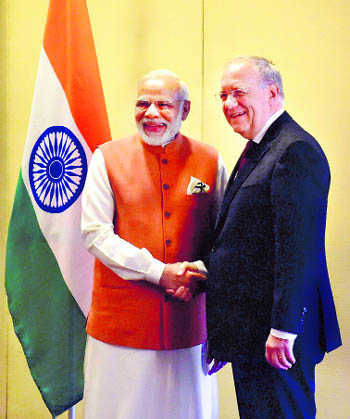
PM Narendra Modi shakes hands with Switzerland President Johann Schneider-Ammann in Geneva on Monday. PTI
Simran Sodhi
Tribune News Service
New Delhi, June 6
Prime Minister Narendra Modi today secured the support of Switzerland for India’s entry into the elite 48-member Nuclear Suppliers Group (NSG).
For India, this is a significant diplomatic achievement as it is working hard to get into the elite grouping. India formally applied for NSG membership on May 12 and later this month, when the plenary meeting of the NSG takes place in Seoul, India’s membership candidature is likely to be discussed.
After securing Switzerland’s support, Modi will now seek the support of the US and Mexico, which he will visit over the course of the next few days. The membership works by consensus and China has already made noises that India, a non-signatory to the Non Proliferation Treaty (NPT), cannot be admitted into the NSG.
In another sign that things with the US may also not be that smooth, The New York Times in an editorial on Sunday made a case that India does not merit membership into the NSG.
In Geneva today, Swiss President Johan Schneider-Ammann said: “We have promised India support in its efforts to become a member of the NSG.” He made the statement after holding talks with Modi.
In his statement to the media, Modi thanked “the President for Switzerland’s understanding and support for India’s membership of the Nuclear Suppliers Group”. Besides securing Swiss support for India’s candidature, the other big issue that was discussed between the two leaders was that of black money.
The PM also reached out to the business community in Switzerland and invited them to invest in India.
Later in the day, Modi left for Washington DC. The US tour will be watched most closely, with the PM scheduled to address a joint session of the US Congress on June 8.
Modi is also expected to ask US President Barack Obama for his country’s support for India’s entry into the NSG.

Better cooperation on black money

  • Switzerland has assured India of stepping up cooperation in unearthing black money stashed by Indians in its banks
  • PM Narendra Modi raised the issue of black money and tax evasion by Indians with Swiss President Johann Schneider-Amman
  • Switzerland will send a state secretary for international financial matters to India on June 14 to explore enhancing cooperation on the issue

Martyr’s wife plans to join the Army

Martyr’s wife plans to join the Army
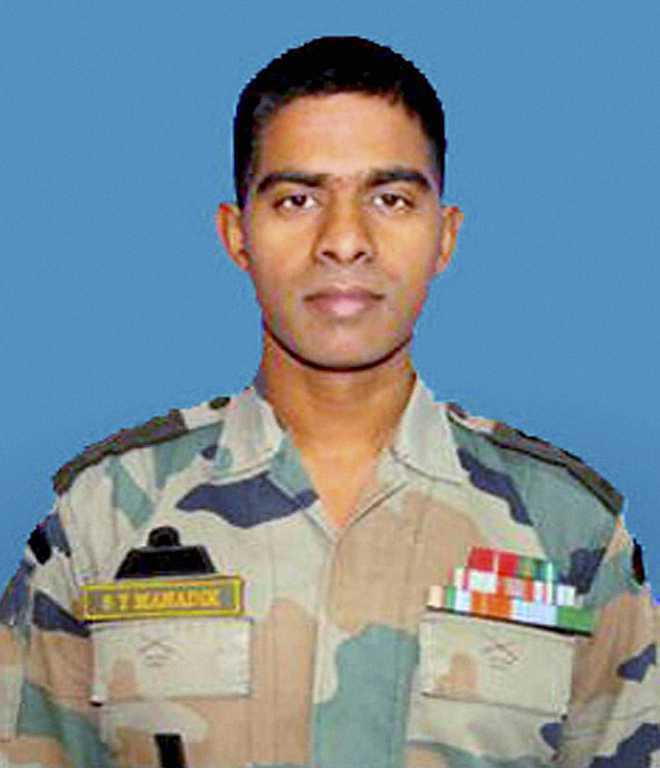
File photo of Colonel Santosh Mahadik who attained martyrdom while leading his troops in an encounter with a group of three terrorists in Kupwara district of Jammu and Kashmir. PTI

New Delhi, June 7

Swati Mahadik, wife of Army commando Col Santosh Mahadik, who was killed during an anti-militancy operation in Jammu and Kashmir, is all set to follow her husband’s footsteps into the Army.Col Mahadik and his men were ambushed on November 17 last year when they were combing forests near the LoC for infiltrating militants. Mahadik was awarded Shaurya Chakra posthumously on the Republic Day.Swati (32), a mother of two appeared for the Services Selection Board (SSB).She had decided to appear for the SSB interview following relaxation of age given to her by the government.“The final list should be out soon. Only then can we know the status of her application. If she clears, Swati Mahadik has to go to Officers Training Academy (OTA) in Chennai where women officers are trained.“It is after her training that she will be posted as per her request and requirement,” said a senior official.— PTI


J&K will never be as unsafe as Pakistan: CM

J&K will never be as unsafe as Pakistan: CM
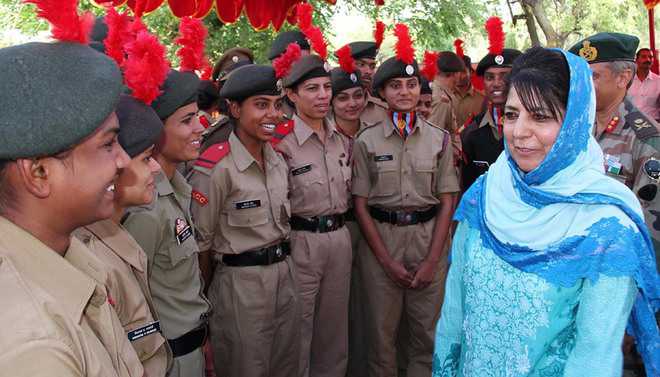
Chief Minister Mehbooba Mufti interacts with NCC cadets in Srinagar. A Tribune photo

Tribune News Service

Srinagar June 5

Chief Minister Mehbooba Mufti has said people of Jammu and Kashmir would never allow themselves to get entrapped in the ominous situation of death and destruction perpetuated in most Muslim countries, including Pakistan and Afghanistan.“We have to ponder over the gory saga of death and destruction being perpetuated in most Muslim countries around the world, including the neighbouring Afghanistan and Pakistan where even schools and hospitals are not spared by the perpetrators of violence,” Mehbooba said while addressing the participants of the Special National Integration Camp-2016 organised by the NCC at the Jammu and Kashmir Light Infantry Regimental Centre here last evening.Mehbooba said J&K had distinct religious and cultural ethos and the emancipated people of the state would never allow themselves to get entrapped in such an ominous situation. “And I am sure our well-informed and bright youth will lead us out of this gloomy scenario of death and destruction,” she said.Urging youth to become a part of the “movement for peace and change”, the CM said the young generation should become a potent voice to denounce violence which has only brought miseries. “Violence has no religion and it just consumes everybody. I urge J&K’s youth to come forward and help us in making peace a reality in the state and ending the miseries of the people.”Mehbooba said the main source of J&K’s confidence was its human resource. “It is heartening to note that even after going through the most difficult times, our young boys and girls are doing us proud in whatever field they choose,” she said.The Chief Minister said the youth remain both delicate and strategic assets. “Delicate because they are prone and susceptible to all sorts of influences, both good and bad. Strategic assets because they constitute our future, and equally they are also very influential and energetic,” she said.Around 400 NCC cadets and staff representing all states and union territories of the country are participating in the Special National Integration camp.The Chief Minister, on her arrival at the camp was received by Maj Gen SS Jakhar, Additional Director General, NCC.


Two cops killed by suspected militants in Anantnag

SRINAGAR: Striking for the second time in less than 24 hours in south Kashmir, militants on Saturday killed two police personnel in poll-bound Anantnag from where CM Mehbooba Mufti is contesting.

WASEEM ANDRABI/HTJ&K chief minister Mehbooba Mufti lays a wreath on the coffins of three BSF personnel, who were killed in an attack by militants on Friday, on the outskirts of Srinagar on Saturday.In a targeted action against security personnel, suspected militants opened fire at a police party at the main bus stand in Anantnag at 11.20am, injuring assistant sub-inspector Bashir Ahmad and constable Reyaz Ahmad. Both succumbed to their injuries.

“Two policemen were killed when militants opened fire on them at around 11.20 in the morning,” a police officer at the Anantnag police control room informed HT, adding that it was not a police patrol party but they were duty.

The attack comes less than 24 hours after militants of banned Hizbul Mujahideen ambushed a BSF convoy in neighbouring Goriwan area at Bijbehara, killing three of its personnel.

Saturday’s attack in Anantnag is seen as an attempt by militants to scare the voters as Mehbooba is seeking her election to the state assembly from here. The seat, where elections are now scheduled to be held on June 22, had fallen vacant after the death of former CM Mufti Mohammad Sayeed. Police and CRPF are carrying out searches at various places to nab the culprits.

Opposition National Conference hit out at the PDPBJP government, saying, “Instead of making tall claims of improved ground situation on papers, the state government should do something concrete on ground and ensure safety and security of people.”

Party spokesperson Junaid Mattu said with elections round the corner in the assembly, ongoing tourist season and forthcoming Amarnath Yatra “one expects that security should be at its best. But every now and then, loopholes within the security establishment stand exposed”.

Pak not cooperating in Pathankot airbase attack probe: Rajnath

We allowed the Pakistani probe team to visit the airbase as a gesture of goodwill, but the neighbouring country again betrayed us. RAJNATH SINGH, Unionhome minister

PATHANKOT: Slamming Pakistan for not cooperating in the Pathankot airbase attack probe, home minister Rajnath Singh on Saturday said this showed the neighbouring country was sponsoring terrorism from its land.

Rajnath, who was in the city on Saturday, said: “We allowed the Pakistani probe team to visit the airbase as a gesture of goodwill, but the neighbouring country again betrayed us. Even after five months of the attack, they are not allowing our National Investigation Agency team to visit their country as the agency has ample proof of Pakistan’s hand in the attack,” said the home minister.

Pakistan talks about Kashmir on every international platform, but it is not an issue, it’s PoK which needs to be discussed. “Prime Minister Narendra Modi has been trying to improve relations with neighbouring countries, but we have not received positive response from Pakistan,” he said. “We have heightened vigil along the borders by installing modern equipment and efforts are being made to check infiltration,” the home minister said while replying to a query.

Rajnath said the previous United Progressive Alliance government had broken all records of corruption, but no one could point a figure at the Modi government. “At 7.6%, India is the fastest-growing economy and we even hope to come closer or even surpass the US if this trend continues,” he said.

“We believe in procedural and structural development and our aim is to provide corruption-free and good governance,” he added.

Later, the home minister attended a function of BJP workers which was attended by minister of state for defence Rao Inderjit Singh and party’s national vice-president Satpal Malik.


Pak cheers NIA chief’s remark, India does damage control

Pak cheers NIA chief’s remark, India does damage control

New Delhi, June 3

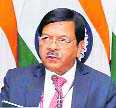
The reported statement of the NIA chief that there is no hand of the Pakistan government or its agencies in helping the JeM carry out the Pathankot attack has triggered sparring between India and Pakistan with New Delhi saying that involvement of its nationals “is an accepted fact”.Even as the NIA backtracked on its chief Sharad Kumar’s statement, Islamabad said his remarks were a “vindication” of its long-standing position in that regard. The row started over a written interview by Kumar to a television channel in which he said, “So far, (there is) no evidence to show that the Pakistan government or any Pakistani government agency was helping Jaish-e-Mohammed (JeM) or Masood Azhar or his aides carry out the Pathankot attack.”Later, the NIA issued a statement saying the observation attributed to the NIA DG is “strongly refuted”. It said his statement had been misquoted. Ministry of External Affairs spokesman Vikas Swarup said, “I understand that the DG NIA has issued a clarification that his words are being misinterpreted. Let me clarify the position. The involvement of Pakistan’s nationals in the Pathankot air base attack is an accepted fact.” He further said “enough information” has also been provided to the Pakistani authorities through two Letters Rogatory to conduct investigation in Pakistan so that “all those associated in Pakistan with planning, support and execution of the attack are brought to justice”.  — Agencies


What Sharad said on Pathankot attackSo far (there is) no evidence to show that the Pakistan government or any Pakistani government agency was helping Jaish-e-Mohammed (JeM) or Masood Azhar or his aides carry out the Pathankot attack. – Sharad Kumar, NIA DG


No clean chit to Pak official machinery: RijijuThere is no question of a clean chit or any clarification in connection with the terror attack on the Pathankot airbase. Investigation is on – Kiren Rijiju, union minister of state for home.


clip