









Sanjha Morcha

610 cadets pass out of IMA GOC-in-C of South Western Command, Lt Gen Sarath Chand, was the Reviewing Officer

Himanshu Kumar Lall

Tribune News Service

Dehradun, June 11

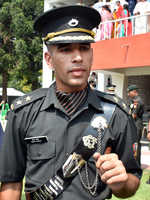
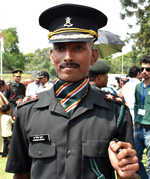
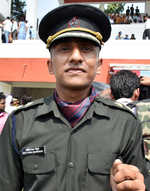
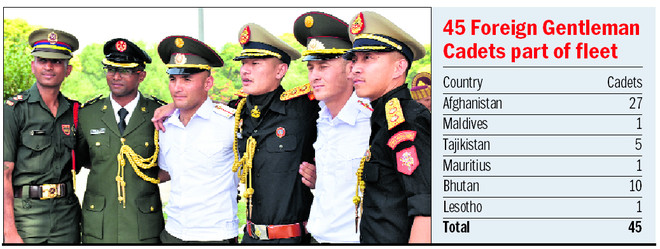
A total of 610 Gentlemen Cadets (GCs) passed out of the Indian Military Academy (IMA) here today. They took part in an impressive passing-out parade held on the drill square in front of the historic Chetwode Hall, marking the end of their training.  Lt-Gen Sarath Chand, General Officer Commanding-In-Chief (GOC-In-C), South Western Command, and Colonel of Garhwal Rifles, and Garhwal Scouts, was the Reviewing Officer of the parade. The fleet of 610 GCs include 425 from 138 Regular Course, including 107 GCs from direct entry, and 140 from 121 Technical Graduate Course, including 24 University Entry Scheme and 45 from six friendly foreign countries.The parade began with company markers marching on the drill square and forming the inspection line. The eight Company Sergeant Major (CSM), who were company markers of their company, formed the line. The physically tough and immaculately dressed GCs in different contingents entered into the drill square on the tunes of the academy song “Bharat Mata Teri Kasam”, “Col Bogey” and “Sare Jahan Se Achcha”. The contingents were led by Parade Commander Academy Cadet Adjutant (ACA) Rajendra Singh Bisht.Lt-Gen Sarath Chand along with IMA Commandant Lt-Gen SK Saini inspected the parade. The most-awaited ceremonial march past began with smartly dressed-up GCs of the passing-out course from different companies of the academy exhibiting their drill skills.In the address to the pass-out course cadets, Lt-Gen Sarath Chand urged them to keep themselves updated about modern warfare as the latest lethal weapons and advance technologies were capable of more casualties. He said the pre-commissioning training would help them to face any adverse situation.“Your juniors will blindly follow you, if as young officers you lead them by setting examples,” he said. It was the need of the hour to remain professionally competent and adept yourself as the situation demands in war or peace time. Lt-Gen Sarath said young officers should work hard to learn new military technologies and strictly take care of men behind weapons. Later, he gave away prizes to GCs who excelled in military training, academics, sports and extra-curricular activities during the pre-commissioning training.ACA Rajendra Singh Bisht won the most coveted “Sword of Honour” for being adjudged the best from the regular course and the bronze medal for standing third in the order of merit. BUO Aman Dhaka wont the gold medal for standing first in the overall order of merit from the regular course while SUO N Dinesh Kumar won the silver medal.Among the technical entries, GC Avijit Hazra Chowdhury won the silver medal for being adjudged second in the order of merit while FGC Choki Dorji from Bhutan bagged the silver medal. The Chief of Army Staff Banner was given to “Imphal” Company for being adjudged the best company among all companies of the academy. Later, emotions ran high among the parents and relatives of the GCs of the passing-out course as they started towards the ‘final step’. Three helicopters showered petals on the GCs as they headed towards Antim Pag (final step), Chetwode Hall. The day ended with the peeping-in and oath-taking ceremony.

Arms, ammunition recovered from militant hideout in Rajouri

Rajouri, June 11

Troops of the 38 Rashtriya Rifles and the Rajouri police this morning busted a militant hideout in Thanamandi tehsil of Rajouri district and recovered a cache of arms and ammunition.Army sources said the operation was launched in collaboration with the personnel of the Special Operations Group of the Rajouri police after specific inputs about the militant hideout in a forest adjoining Phangai village.“The hideout was in a natural cave at Lakrewali Gali near Dera ki Gali, a tourist spot, and was busted this morning after taking every possible security measure,” said a senior Army officer.An Army spokesperson said the recovery included one AK-47 rifle with two magazines and 115 rounds, one Chinese pistol with a magazine, four Chinese grenades and four under-barrel grenade launcher (UBGL) rounds.The grenades and UBGL rounds were destroyed on the spot by the troops while the arms and other ammunition was handed over to the police for further investigation and legal action, he added. — OC


Wreath-laying ceremony at IMA

Wreath-laying ceremony at IMA
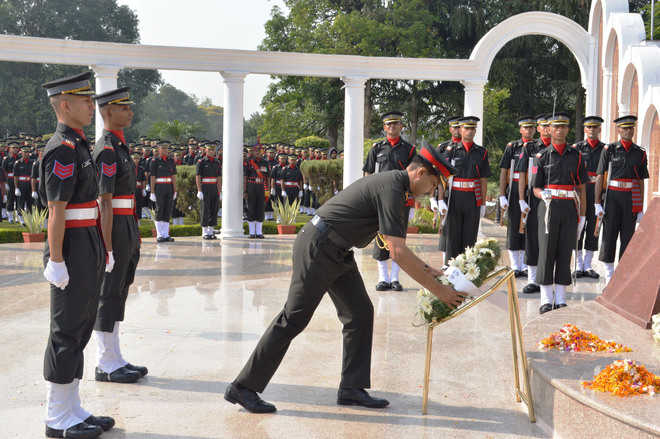
Lt-Gen SK Saini, Commandant, Indian Military Academy, lays a wreath at the war memorial of the academy in Dehradun on Friday. The solemn ceremony is held every term as a precursor to the passing-out parade. Tribune photo


Tribune News Service

Dehradun, June 10

A day before the passing-out parade, a wreath-laying ceremony was held at the War Memorial of the Indian Military Academy (IMA), here today. The solemn ceremony is held every term as a precursor to the passing-out parade.The remembrance ceremony is to pay homage to the brave alumni of the prestigious training academy, who laid down their lives in keeping the highest tradition of sacrifice, upholding the honour of the nation.Lt-Gen SK Saini, Commandant, Indian Military Academy, along with officers and the Academy-under-officer, on behalf of the passing-out course, laid wreaths and offered floral tributes to the gallant martyrs.The sanctum-sanctorum of the War Memorial is a seven-and-a-half-feet bronze statue of a gentleman cadet saluting with a sword. To the rear of the statue are designed arches on which are etched the names of the 832 valiant alumni, who have sacrificed their lives till date.As many as 610 cadets took the resolve to keep the nation’s flag flying high.


Vajra Corps concludes summer drill

JALANDHAR: In an effort to hone its conventional operational preparedness on the western front, Vajra Corps conducted a series of tactical war exercises with troops under annual summer month’s field exercise programme.

HT PHOTOArmy personnel holding a war drill in the western sector.The areas where the regiment conducted drills included Nakodar-Nurmahal and the vicinity of Ludhiana.

The officials said that they also conducted the exercise at Khem Karan, historically known as ‘Patton Graveyard’ and Jalalabad, both in the general area of Ferozepur by ‘Double Victory Brigade’ and ‘Golden Arrow Division.’

Vajra Corps officers informed that the drills were conducted as per the schedule despite the intense heat inside the tank or infantry combat vehicle, and the troops displayed remarkable skills while undertaking works under the training.

Officers further informed that the exercises involving large scale tank, infantry and aviation manoeuvres were supervised by Lt Gen JS Cheema, general officer commanding Vajra Corps.

Meanwhile, the exercise was witnessed on the concluding day by Lt Gen KJ Singh, general officer commanding-in-chief, Western Command.

Speaking on the occasion, the army commander compliment the troops for displaying professionalism and also appreciated the formation for its innovative training methodology in actual terrain and weather condition that has enhance its operational and logistics preparedness for conventional operations, adding to the might of the Western Command


Terror Creeping Back In Anantnag: How Can It Be Countered?:::Syed Ata Hasnain

SNAPSHOT

The security forces of India had cleared Anantnag and its environs off jihadi terrorists a few years ago. However, events of the last few days appear to indicate that grounds for the return of jihadi terror to Anantnag are being prepared. How should India’s security forces fight this threat? Lt Gen Syed Ata Hasnain (retd) weighs in.

While the coalition government of the PDP and BJP is ensuring that political time bombs are handled without unnecessary passion and has generally shown a propensity towards working on issues concerning governance, the separatists way of response is also through spiraling acts of violence in which the Police forces find themselves the latest victims. Two policemen were killed on 4 June in Anantnag and three BSF men at Bijbehara on 3 June, preceded by three policemen in Srinagar in hit and run strikes. That makes a total of nine in three days; if that is not worrisome then nothing else can be.

Two things should worry those handling the overall security of South Kashmir. First, in a fortnight’s time Anantnag assembly constituency goes to the polls to elect Chief Minister Mehbooba Mufti or her opposer. Second, the Amarnath Yatra commences on 2 July 2016 and that is an iconic annual event which has threat perceptions of every kind.

Why is Anantnag so important and what place does it occupy in Kashmir’s security matrix?

Lying just off the National Highway from Jawahar Tunnel to Srinagar, across the Jhelum, this is the second largest town of Kashmir. It is the headquarters of Anantnag district and the veritable core centre of activities in South Kashmir. It sometimes shares ignominy with Kulgam, Shopian and Pulwama which all lie in its vicinity but have their own levels of notoriety. Anantnag’s importance generically stems from the fact it has been the center of intellectual activity, education and tourism. During the commencement of the sponsored proxy war, it was one of the first urban centres which came into the lap of violence. The famous Martand temple is located nearby on the route to Pahalgam which too is one of the major tourist attractions of Kashmir. The mountains in the east are a part of the Kishtwar range and there are famous trekking trails all over. Some of them lead over the Kishtwar to the Warwan Valley, a distant, isolated and very sparsely populated part of Kashmir.

In 1995, the infamous Al Firan group, which kidnapped five tourists and beheaded one of them, had apprehended them from the upper reaches of the Aru Valley and then taken them to Warwan. Within the district also lies the restive Lidder Valley which is like a transit point for terrorists moving into Tral valley of Pulwama district or the southern tracts of Anantnag towards Kokarnag, Daksum and Verinag. The entire Kishtwar belt is thickly forested and offers excellent hideouts for terrorists.

The Amarnath Yatra’s logistics base is Anantnag town although Pahalgam could be considered as Base 2. The Yatra goes on for about six to seven weeks and in that duration there is presence of a larger compliment of security forces (SF). In addition, the bhandaras which feed the massive influx of pilgrims also have their supply chain going back to Anantnag town. All pilgrims adopting the long, 48 km route to the holy cave move through the town which means the traffic to Pahalgam expands exponentially in July-August.

Anantnag and surrounding areas

Two more things need to be known. First, the Army’s 21 Field Ammunition Depot (FAD) is located 18 km to the south-east across the township of Achabal at a place called Khundru. Through the 1999 Kargil operations, the Army’s entire ammunition for Kargil sector moved from Khundru in ammunition convoys. The road ran over 110 Hume pipe crossings, any of which could have been used to emplace Improvised Explosive Devices (IEDs) to blow up an ammunition laden vehicle. It was a herculean effort on the part of the Army’s Rashtriya Rifles HQ 1 Sector RR which patrolled and dominated the area extensively to prevent the terrorists from disrupting the ammunition supplies to Kargil. Second, this is the area where the Lashkar e Toiba (LeT) announced its arrival in South Kashmir with the dastardly killing of 36 Sikhs at Chittisinghpura on 19 Mar 2000. That was then the signature LeT way of announcing its arrival and upstaging other terror groups from the primacy of terror operations.

From a terrain angle Anantnag offers the ideal ground for breeding of terrorists and their sustenance. The town has multiple inlets and exits, is crowded with narrow lanes and there are a number of religious institutions within. Traffic is dense and of different types, which is difficult to check. Policemen on duty will always be vulnerable to hit and run tactics and unlike Srinagar, these need not be motorcycle-borne. In fact, it is easier to exploit the maze of crowded lanes on foot and there is no need to carry AK-47s and be noticeable. Such operations can always be conducted by being armed with pistols.

However, on the National Highway and the road to Pahalgam, operations by terrorists can be of different kinds. Isolated CRPF men on road protection duties are the most vulnerable and the predictable movement of the Army or CAPF convoys makes them ideal targets. For this, terrorists need to be armed with automatic weapons and grenades which are used at random in burst mode for just a minute or so to impose casualties before they escape into buildings or fields behind the immediate built up areas along the highway. This is how it always begins.

What are the counter measures to this which can be effective?

Sustained operations by the SF in the entire spectrum, is the only answer. Number 1 Sector RR which is responsible for most of Anantnag district and the security of the Amarnath Yatra is one of the prize commands for officers of the Indian Army. This Sector (brigade size) has every challenge that the spectrum of counter insurgency and counter terrorist (CI/CT) operations can offer.

Equally, the appointment of SSP Anantnag district is a prize one for the JK Police. The CRPF too has its job cut out for it and has always had some fine professionals leading it. It is appropriate to state that Anantnag was probably the district with almost the highest density of terrorist presence in the heyday of militancy. It also produced the longest lasting terrorist leaders such as Shabir Baduri who was the Hizbul Mujahideen (HM) leader for close to 8-9 years. Through painstaking operations and some great cooperation between the various SF, Anantnag including the Lidder Valley, Bring Valley and Kokarnag were cleaned out and a few years ago hardly any terrorist presence existed.

Some redeployment from the area was effected to cater for areas on the counter infiltration grid. It now appears that terrorist presence has rekindled and the new militancy has taken its grip. There is no shortcut to continued domination by the SF if the area has to be kept safe and no quarter is given to the new outfits. The National Highway, 21 FAD Khundru, the Amarnath Yatra and the Pahalgam tourist spots are assets whose security cannot be diluted. Till the recent past, additional formations of the Army were deployed from outside the Valley to secure the Yatra. It gave a chance to the SF in Anantnag to continue operations for domination of the grid without much redeployment.  The spirit of road protection went to the extent of the entire Headquarters of 1 Sector RR turning out for some time to secure the entry and exit of the Army convoy through the built up area.

Anantnag is too important a town for it to be allowed to fall within the ambit of freedom of movement of terrorists. The current political battle of the polls is the moment that the terror groups are bound to seize to enhance their presence even as the SF focus on security of political meetings and candidates. The SF need to revisit the past to examine how exactly their predecessors ensured the progressive dilution of terrorists from the area. The tendency to avoid increase of Army footprint will prove counter-productive.

Towns such as Anantnag which nestle in the shadow of terrain which is ideal for militancy to fester cannot be tackled from within. It is the outlying areas which need to be dominated night and day if the return of high profile militancy has to be prevented. The events of the last few days appear to indicate that grounds for that very return are being prepared. It calls for the best integration of all SF under the Army’s Victor Force at Avantipur to achieve the task so well performed some years ago.

8


Lt. Gen Syed Ata Hasnain (Retd) is the former Corps Commander of the Srinagar based 15 Corps, and is currently associated with Vivekanand International Foundation and the Delhi Policy Group, two major strategic think tanks of Delhi

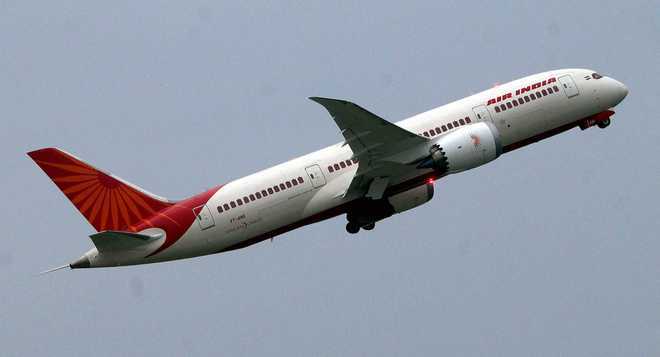
Air India to allow gallantry award recipients free upgrade to business class

Air India to allow gallantry award recipients free upgrade to business class
An Air India aeroplane. PTI file photo

New Delhi, June 3

In a novel gesture to honour armed forces personnel, national carrier Air India will allow recipients of war and peace time gallantry awards to upgrade to the business class if vacant seats are available at the time of boarding.According to Air India, the soldiers who have been bestowed with military honours such as Param Vir Chakra (PVC), Maha Vir Chakra (MVC), Vir Chakra (VC), Ashok Chakra, Kirti Chakra and Shaurya Chakra, will get an upgrade to business class from economy at the time of boarding in case seats are available in the aircraft from this month.”If seats are available, we will upgrade these awardees to business class at the boarding gate,” an Air India official said.The decision to upgrade these recipients of various gallantry awards to a higher class, which is effective from this month, is an initiative of Air India Chairman and Managing Director Ashwani Lohani, he said.The Indian Armed Forces are eligible for various military decorations, which are awarded for extraordinary bravery and courage, as well as distinguished service during times of war and peace.Domestic carriers, including Air India, already provide a 50 per cent discount on basic fare on select classes on their domestic network to active Military personnel of Indian Armed Forces and their family members travelling at their own expense.The upgrade scheme, according to Air India, can be availed on the production of identity cards at the airline’s check-in counters. — PTI

Air India to allow gallantry award recipients free upgrade to business class

Soldiers who have been bestowed with honours such as Param Vir Chakra, Maha Vir Chakra, Ashok Chakra, Shaurya Chakra, and Kirti Chakra, will be eligible for this gesture by Air India.

In a novel gesture to honour armed forces personnel, national carrier Air India will allow recipients of war and peace time gallantry awards to upgrade to the the business class if vacant seats are available at the time of boarding.

According to Air India, the soldiers who have been bestowed with military honours such Param Vir Chakra (PVC), Maha Vir Chakra (MVC), Vir Chakra (VC), Ashok Chakra, Kirti Chakra and Shaurya Chakra, will get an upgrade to business class from economy at the time of boarding in case seats are available in the aircraft from this month.

“If seats are available, we will upgrade these awardees to business class at the boarding gate,” an Air India official said.

The decision to upgrade these recipients of various gallantry awards to a higher class, which is effective from this month, is an initiative of Air India Chairman and Managing Director Ashwani Lohani, he said. The Indian Armed Forces are eligible for various military decorations, which are awarded for extraordinary bravery and courage, as well as distinguished service during times of war and peace.

Domestic carriers including Air India already provides a 50% discount on basic fare on select classes on their domestic network to active Military personnel of Indian Armed Forces and their family members travelling at their own expense.

The upgrade scheme, according to Air India, can be availed on the production of identity cards at the airline’s check-in counters.

COMMENT

There is need to review the order. If its a question of Gallantry awardee only than what about the dependents( especially wife) of martyrs who were bestowed award posthumously. Knowing fully well that the percentage of gallantry awardee are few and not many travel by Air India ,thus seems to be the generosity by air India.
Rather the veterans above 75 and disability soldiers with imputed limbs lost in operation should had been added if recognition for armed forces to be recognized.

It an opportunity,location and act of bravery of sacrifice before self which earn such medals but not every one does not get an opportunity

khera3
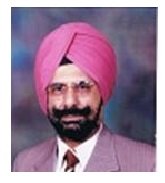
Col Charanjit Singh Khera(Retd)
Gen Secy
Ex-Servicemen Joint Action front
(Sanjha Morcha)


Parrikar off to S’pore, Vietnam

Parrikar off to S’pore, Vietnam
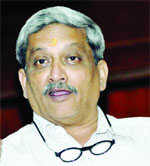
Defence Minister Manohar Parrikar

Ajay Banerjee

Tribune News Service

New Delhi, June 2

Defence Minister Manohar Parrikar headed off to Singapore and Vietnam tonight to pursue two different tracks of the “Act East” policy.In Singapore on June 3 and June 4, Parrikar will attend the Shangri-La Dialogue where, on the sidelines of the summit, he is slated to meet his counterparts from the US, Japan, France, UK, Canada and Switzerland. At the dialogue, Parrikar is expected to address India’s concerns on various issues in Asia.On his second leg of his tour (June 5 and June 6), he will visit Vietnam, a country that has a defence cooperation agreement with India, and is now seeking the BrahMos missile. Parrikar will be accompanied by the DRDO Chief, Secretary (Defence Production), Chief of the Eastern Naval Command, Director General Military Training and Director Generation Operations of the IAF.This will be Parrikar’s second visit to a country that is seeking the Brahmos. On May 22 and May 23, he was in the UAE, which is also keen to have the BrahMos in its arsenal. As of now, there is no hint that New Delhi has agreed to sell the missile to either of the two nations.The missile, a joint venture between Russia and India, can be launched from ship or land. Its supersonic speed and the ability to skim the surface at heights as low as 10 m make it hard for an enemy’s radar to track. It is practically invulnerable to modern anti-missile and air defence systems.Vietnam, along with China, is one of the six countries locked in a bitter dispute over navigation rights through the South China Sea. More than $70 billion worth of Indian trade is routed through these waters. India also has rights to two oil-drilling blocks off the Vietnam coast. India’s relations with Vietnam in the past few years have been keenly watched by China. When Russia sold the Kilo Class submarines to Vietnam, the Indian Navy trained the Vietnamese Navy.India, on its part, is also setting up a satellite tracking and imaging centre in southern Vietnam that will give Hanoi access to pictures from Indian earth observation satellites that cover the region, including China and the South China Sea.On May 23, the US announced an end to its embargo on sales of lethal arms to Vietnam, a historic step that draws a line under the two countries’ old enmity.

To raise India’s concerns at Shangri-La Dialogue

  • In Singapore, Defence Minister Parrikar will attend the Shangri-La Dialogue where heis expected to address India’s concernson various issues in Asia
  • On his second leg of his tour (June 5 and June 6), he will visit Vietnam, a country that has a defence cooperation agreement with India, and is now seeking the BrahMos missile

7वें वेतन आयोग में न्‍यूनतम सैलरी 7 हजार से बढ़ाकर 18 हजार रुपये, एरियर का भुगतान इसी साल : वित्तमंत्री जेटली

7वें वेतन आयोग में न्‍यूनतम सैलरी 7 हजार से बढ़ाकर 18 हजार रुपये, एरियर का भुगतान इसी साल : वित्तमंत्री जेटली

नई दिल्ली: केंद्रीय वित्तमंत्री अरुण जेटली ने सातवां वेतन आयोग की रिपोर्ट लागू करने के कैबिनेट के फैसले के बारे में मीडिया को जानकारी दी। उन्होंने बताया कि इस आयोग की रिपोर्ट को लागू करने से सरकार पर सालाना 1.02 लाख करोड़ रुपये का सालाना भार आएगा।

जेटली की कही बातों का मुख्य अंश –

  • 3 बड़े हाइवे प्रोजेक्‍टस को कैबिनेट की मंजूरी।
  • पंजाब, ओडिशा और महाराष्‍ट्र में हाइवे का प्रस्‍ताव।
  • महिलाओं के लिए रोजगार का अवसर बढ़ाने की कोशिश।
  • महिलाओं को देर तक काम करने की इजाजत का प्रस्‍ताव।
  • 5वां पे कमिशन आया था तो सरकार को उस पर निर्णय लेने के लिए 19 महीने लगे, जबकि 6वें में 36 महीने लगे थे।
  • पे और पेंशन के संबंध में कमिशन की सिफारिशों को सरकार ने स्‍वीकार किया है। 1 जनवरी 2016 से लागू होंगी।
  • 47 लाख सरकारी कर्मचारी और 56 लाख पेंशनर्स पर प्रभाव पड़ेगा।
  • निजी सेक्‍टर से सरकारी सेक्‍टर की सैलरी की तुलना की गई। निजी सेक्‍टर से तुलना के आधार पर सिफारिश की गई।
  • कमेटी की सिफारिशें आने तक मौजूदा भत्‍ते जारी रहेंगे।
  • सातवें वेतन आयोग की सिफारिशों को अधिकतर स्वीकार किया गया है।
  • ग्रुप इंश्‍योरेंस के लिए सैलरी से कटौती की सिफारिश नहीं मानी।
  • इस साल एरियर का 12 हजार करोड़ का अतिरिक्‍त बोझ पड़ेगा।
  • क्लास वन की सैलरी की शुरुआत 56100 रुपये होगी।
  • वेतन आयोग रिपोर्ट में जो भी कमी है उसे एक समिति देखेगी।
  • ग्रैच्युटी को 10 लाख बढ़ाकर 20 लाख किया गया।
  • एक्स ग्रेशिया लंपसम भी 10-20 लाख से बढ़ाकर  25-45 लाख रुपये किया गया।
  • वेतन आयोग द्वारा सुझाए गए भत्तों पर वित्त सचिव अध्ययन करेंगे और फिर इस अंतिम निर्णय होगा।
  • कुछ कर्मचारी संगठनों के विरोध के प्रश्न पर जेटली ने कहा कि विरोध का कोई औचित्य नहीं है।

इससे पहले जेटली ने ट्वीट कर कहा था कि सरकारी कर्मचारियों के वेतन और पेंशनभोगियों के पेंशन में ऐतिहासिक वृद्धि करेगा। प्रधानमंत्री नरेंद्र मोदी की अध्यक्षता में केंद्रीय मंत्रिमंडल ने बुधवार को सातवें वेतन आयोग की सिफारिशों को मंजूरी दे दी।

मंत्रिमंडल की बैठक के बाद जेटली ने एक ट्वीट में कहा, “सातवें केंद्रीय वेतन आयोग द्वारा केंद्र सरकार के अधिकारियों, कर्मचारियों और पेंशनभोगियों को उनके वेतन और भत्तों में ऐतिहासिक वृद्धि पर बधाई।” वेतन आयोग की सिफारिशों को मिली मंजूरी का लाभ केंद्र सरकार के करीब 47 लाख कर्मचारियों और 52 लाख पेंशनभोगियों को मिलेगा। जेटली बुधवार को ही बाद में अन्य विवरणों की और जानकारी देंगे।


7th Pay Commission: Here’s why govt staffers aren’t really celebrating windfall

The Narendra Modi government’s decision to accept the 7th Pay Commission recommendations, promising Rs 1 lakh crore of hikes in salaries, perks and pensions for over 1 crore serving and retired government employees, has been hailed as a big bonanza for the top executives in the government. Besides, this is also a booster dose for the growth-hungry Indian economy that’ll benefit from a consumption boost.

But, no government employee is really celebrating the 7th pay commission hike — neither the top babu nor the class C employee, who is the lowest cadre. Why?

Reasons will vary depending on who you talk to.

If it is a top executive, he will complain about the huge difference in compensation with the private sector. Even after the 7th Pay Commission hike, the highest salary drawn by a government employee, the cabinet secretary, is Rs 2.5 lakh per month.

Representational image. Reuters

If one compares this with that drawn by a chief executive of a medium-sized private sector company with an annual turnover of Rs 1,000-2,000 crore, this figure is a pittance. The private sector counter part will be drawing anywhere between Rs 10 lakh and Rs 25 lakh per month, besides generous provisions for annual bonuses and performance-linked perks.

“This is one reason why there is a drain form the government to private sector that has escalated of late,” observes a senior government official who wished not to be identified. “And many of those who stay back have a feudal-sort of mentality. They make up for their losses for serving the government by way of hefty ‘under table’ payments,” the official said.

The government has announced salary increases in the range of 14. 27 percent to 25.5 percent. The government has put on hold allowance payments. This is against about 40 percent rise in pays implemented by the sixth pay commission in 2008. The 7th pay hike, the employee unions argue, is the lowest in the last 70 years.

Unlike the private sector, where the compensation is revised annually depending on the performance and skills, government employees have to typically wait for a decade for any substantial revision in their wages, if one sets aside the 3 percent routine annual pay increase.

Often, even the well performing bureaucrats feel that there is no value for their work, beyond the element of mental satisfaction, since the reward is same for the performers, laggards, sleepy heads and those who take a detour during their morning walks to office only to punch in their attendance and later return post lunch.

Performance-based pay dumped?

A quick glance at the 7th pay commission recommendations show that the government hasn’t so far accepted the Mathur panel recommendation of performance-based pay or has watered down the key proposal to nothing.

Finance minister Arun Jaitley largely dodged questions on performance pay saying administrative issues will be looked at by a separate committee. This has irked many bureaucrats who were batting against uniform pay for all.

This was suggested by the sixth pay panel too, but remained on paper since there was no methodology to effectively assess performance. Mathur panel, noting that now the systems are in place, had pushed for performance pay and even sought to change the bonus mechanism.

“We are also of the view that there should not be automatic payment of bonus and all existing schemes of payment of bonuses should be linked to productivity,” it said.

Until the time the performance-linked pay scheme is implemented, the existing bonus schemes should be reviewed and linked with increased profitability and productivity under well-defined parameters, the panel had proposed.

This recommendation was critical since if the pay is linked to performance that can change the very ‘sarkari’ nature of the government staff and improve the productivity of the government departments. The Mathur panel also talks about how the civil servants need to be more efficient focusing more on targets and not processes.

Now, in the case of non-executive cadre (the C-class employees, there is no more class-D peons), their salary is now better than their counter-parts in the private sector. Jaitley, during the presser, cited an IIM-Ahmedabad study that said the pay of government employees is now distinctly greater than their private sector counter parts leaving no room for protests.

But, they too are unhappy. Why?

The fundamental reasons can be tracked to the rising aspirations of middle class and a sharp spike in the cost of goods and services over the period, though inflation figures indicate otherwise. When it comes to ambitions, the class difference almost nil. The wish for better education and lifestyle among the lower-income group is as high as the upper class.

“Even a clerk wants to send his son to a top engineering college or even abroad for higher studies. That is one side of the ‘problem’ why the class C staff isn’t satisfied with even a marginal increase in pay. On the other hand, the cost of living and prices of food items have gone up so much since the sixth pay commission that a salary of Rs 20,000 means nothing for him,” said the official who quoted earlier.

That’s a valid argument. The pay package of non-executive staff, which makes up majority of the total government workforce, hasn’t gone up commensurate with the sharp rise in the costs of expenses. This is possibly the reason why they lament despite the pay increase, the official said.

If indeed the government has dumped the proposal to link the pay increase and bonus provisions to performance and targets, that is a big regressive step and mistake by the Modi government. It wouldn’t do any good to improve the efficiency and work culture of the government staff.

As for the Rs 1 lakh crore bonanza, yes it will certainly fuel the consumption growth in the economy. But, don’t get it wrong thinking that the government staff are happy. They are not.http://www.firstpost.com/business/7th-pay-commission-heres-why-govt-staffers-arent-really-celebrating-windfall-2864594.html?utm_source=FP_CAT_LATEST_NEWS


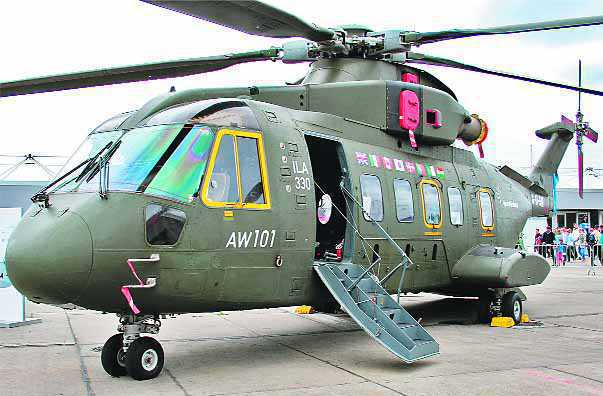
VVIP chopper deal: ED freezes Rs 86-cr shares

VVIP chopper deal: ED freezes Rs 86-cr shares
File photo

New Delhi, June 20

Initiating fresh action in the VVIP chopper deal money laundering case, the ED today conducted searches in Delhi, Mumbai and Hyderabad on at least 10 premises of some “involved” firms and froze shares worth over Rs 86 crore kept by them in foreign shores.Officials said during the searches, conducted under the provisions of the Prevention of Money Laundering Act (PMLA), the agency seized many documents and issued orders to freeze shares of certain firms located in Dubai, Mauritius and Singapore.(Follow The Tribune on Facebook and Twitter @thetribunechd)The agency had recently filed a fresh chargesheet in the case naming British national and alleged middleman Christian Michel James as part of its probe.The ED had registered a PMLA case in this regard in 2014 and named 21 people in its FIR. It had also arrested Delhi-based businessman Gautam Khaitan in the case, who is out on bail now. — PTI