Sanjha Morcha

To maintain parity with India, Pak to buy more fighter jets

Simran Sodhi

Tribune News Service

New Delhi, March 15

Relations between India and Pakistan continue to remain tense with Pakistan now looking to increase its aircraft fleet by trying to purchase more fighter jets from the US, Russia and France.The sale of eight F16 fighter jets to Pakistan by the US is now almost a done deal with the US Senate refusing to block the deal, which is now in its final stages. India made public its discomfort with the US decision but that did not deter the US from going ahead with the deal.Pakistan’s insecurity emanates from a desire to maintain parity with the Indian Air Force, which is planning to replace its existing fleet by 2020. Pakistan is already planning to buy 10 more F16 fighter jets from the US once the sale of the initial eight F16 is completed. The eight F16s that Pakistan is buying from the US include two single-seat F-16Cs and six twin-seat F-16Ds, along with associated equipment. The deal is expected to cost Pakistan $699 million.According to a report on Jane’s Defence Weekly, Pakistan is looking not just to the US but also to France and Russia to buy new fighter jets. The report quotes Pakistani officials as saying that “Pakistan Air Force needed to retire 190 planes by 2020, forcing the country to look for various options”.India has already gone ahead and decided to directly purchase 36 Rafale fighter jets from France. The liability issues and the pricing of the Rafale have time and again delayed the final contract but with India closer to upgrading its fleet, jitters in the Pakistan establishment were expected.

8 US F16s on way

  • The sale of eight F16 fighter jets to Pakistan by the US is now almost a done deal with the US Senate refusing to block the deal, which is now in its final stages
  • The eight F16s include two single-seat F-16Cs and six twin-seat F-16Ds, along with associated equipment
  • The deal is expected to cost Pakistan $699 million
  • 62450

Tejas to fire US, Russian missiles at IAF show

Tejas to fire US, Russian missiles at IAF show
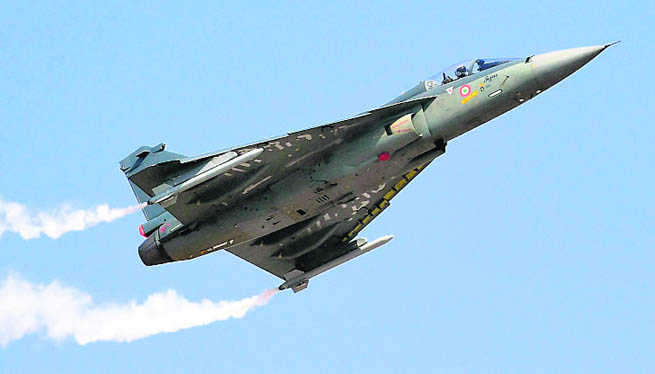
India’s indigenous Light Combat Aircraft, the Tejas

Ajay Banerjee

Tribune News Service

New Delhi, March 10

India’s indigenous Light Combat Aircraft (LCA), the Tejas, will fire US- and Russian-origin missiles at an Indian Air Force show, ‘Iron Fist-2016’, scheduled to be held in Rajasthan on March 18.The jet is on its way to achieve final operational clearance and induction into the Indian Air Force (IAF).The IAF has confirmed that the Tejas jet will be flying at the IAF exercise, ‘Iron Fist-2016’, in Rajasthan on March 18.
The Tejas will fire the beyond visual range (BVR) air-to-air missile, the  R-73 of Russian origin, and the precision laser-guided bomb Griffen missile, produced by US company Raytheon.‘Iron Fist’ is IAF’s largest fire power demonstration event with the network-centric capabilities being used by planes.Air Marshal B.S. Dhanoa, Vice-Chief of the IAF, said on Thursday that the LCA shall do both tasks in a single flight.
The exercise will display the ‘capability to punish’, said the IAF Vice-Chief.The IAF had demonstrated its day-dusk-night operational capabilities during ‘Iron Fist-2013’.Meanwhile,  Hindustan Aeronautics Ltd (HAL), the producer of the plane, has integrated a new quartz radome radar from Cobham, UK. The radar was flight-tested in the last week of February and is expected to increase the radar range to 80 km and beyond.Meanwhile, the Ministry of Defence has decided to locally produce 106 upgraded Light Combat Aircraft Tejas jets to replace the ageing fleet of MiG fighter aircraft of the Indian Air Force. The “Tejas Mark 1-A” will have 43 improvements over the existing Tejas currently being test-flown by the IAF for various parameters and slated for final operation clearance in March.The existing project is running years behind schedule. The Ministry of Defence has set a 2018 deadline for the first aircraft to be ready with a target to complete its production by 2022-2023. The HAL has been asked to produce 16 jets annually and a Rs 1,252-crore modernisation plan has been okayed to ramp up capacities from the present six-seven planes annually. The decision will go a long way in keeping the IAF battle-ready. The upgraded jets will fill the void created by MiG-21s and MiG-27s that will be phased out by 2022.There are 260 Soviet-era single-engine MiG-21 and MiG-27 jets in the IAF fleet. The Air Force needs 400 jets over the next 10 years.


10 terrorists have entered India: Pak Minister

short by Anupama K / 11:23 am on 09 Mar 2016,Wednesday
Pakistan’s Interior Minister Chaudhary Nisar Ali Khan on Wednesday confirmed that 10 terrorists have entered India from Pakistan. This is the first time that a key minister from Pakistan PM Nawaz Sharif’s Cabinet confirmed the same on record. Three days earlier, Pakistan’s National Security Adviser Naseer Khan Janjua reportedly shared the same intelligence report with his Indian counterpart.

Army says ready to help Kashmiri youths in career planning

Charar-e-Shareef: A senior army officer on Wednesday said the force is open to help Kashmiri youths who want to pursue conventional careers in life.

“We are pained when some youth shout slogans and then pick up stones and later some of them also pick up guns. We are pained when 17 or 18-year-old boys are killed in encounters,” General Officer Commanding (GOC) of Srinagar-based Chinar Corps, Lt Gen Satish Dua told reporters in central Kashmir’s Budgam district.

“Army and Rashtriya Rifles (RR) are in the nooks and corners of Kashmir and we have many programmes under which we are ready to help those youth who come to us. Our doors are open for them always,” Lt Gen Satish Dua said.”Army and Rashtriya Rifles (RR) are in the nooks and corners of Kashmir and we have many programmes under which we are ready to help those youth who come to us. Our doors are open for them always,” Dua said.

Citing examples of young achievers from the Valley, he said the youth have a choice to excel in their life or follow those who drive them off the track.

“Three girls from the state went to participate in the Republic Day parade, out of whom one from Anantnag was awarded the second best cadet in the whole country.

“We started ‘Super 30’ programme and a student was selected in IIT with a good rank. There are others as well. Another youth has been selected as a commissioned officer in army and is going for training.

“We want to tell the youth that you have a choice. You will find many who will drive you off the track and it is up to you whether you want to become like those I gave the examples of or not,” Dua said.

Earlier, the GOC had inaugurated a Youth Fare dedicated to the aspirations of today’s youth at the sports ground. The fare was aimed at providing a focused guidance on various career opportunities available for different age groups and qualifications.

TV personalities Jai Bhanshali and Kunwar Amarjeet Singh and Indian Hockey team member Yuvraj Valmiki were also present at the event


PAY REVISION Resurfacing of ‘lost’ order, a ray of hope for ex-Army officer

Tribune News Service

Chandigarh, March 7

After struggling to get benefits of pay revision for the past 36 years, the resurfacing of a “lost” order has given a ray of hope to a 85-year-old former Captain who retired as the Zila Sainik Welfare Officer of Chandigarh in 1988.Capt Dhan Singh Rathore, an emergency commission officer, who fought in the 1965 Indo-Pak War, was released from the Army in 1968 and thereafter appointed as the Zila Sainik Welfare Officer. At the time of his appointment, it was a Class-II post given the population of ex-servicemen in Chandigarh.A fresh census of ex-servicemen consequently revealed higher population and accordingly, the central government issued a letter in 1977, upgrading the appointment to a Class-I post. Captain Rathore was entitled to the difference due to an increase in salary with effect from 1978, which was to be re-fixed in accordance to the pattern followed by Punjab.Captain Rathore said that the then Chief Commissioner of Chandigarh issued orders in 1980, sanctioning revised pay scale for him, but no action was taken by the dealing staff. The revision of pay also means revision of pension.“Ï made numerous rounds of the offices concerned, but nothing moved. I was told that either the orders were not available or have not been received,” he said. “In 1984, the Deputy Commissioner again wrote to the Home Secretary on the matter, but to no avail,” he added.Later, he met with a serious accident, which required hip replacement and was bed-ridden for a long time. After he recovered, his son took him to Canada with him so that he could be taken care of properly. Consequently he could not pursue his case.“I have now again taken up my case and sought details under the Right to information Act. Copies of the relevant orders and letters on pay revision that were earlier said to be missing, were attached to the reply, which now strengthens my case and gives me hope”, Rathore said. “I have now been asked to meet senior UT Administration officers later this month with regard to my claims,” he added.


Two IAF personnel drown in Ravi River level rose after release of water from Chamera dam; 3 others recuperating

Two IAF personnel drown in Ravi
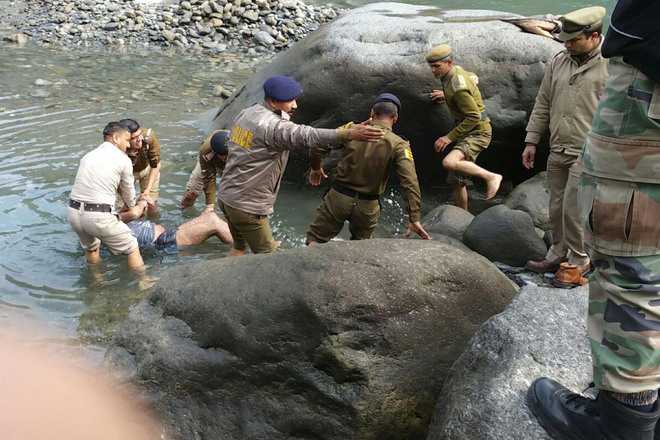
Rescue teams look for the bodies of the IAF personnel in the Ravi near Chamba on Saturday. Photo: Kamaljeet

Lalit Mohan

Tribune News Service

Dharamsala, March 6

Two Indian Air Force (IAF) personnel from the Pathankot airbase drowned while three airmen were hospitalised after the water level in the Ravi river rose near Chamba town on Saturday evening.The sudden rise in the level was caused due to release of water from the Chamera-II dam, sources said.Those who drowned have been identified as Corporal Shakti Singh (30) of Jaipur and Corporal Nitesh Mishra (26) from Meerut in Uttar Pradesh. Airmen Naval Pandey, Naveen Sharma and Gajender Singh are recuperating at the Chamba Civil Hospital.Deputy Commissioner Sudesh Mokhta said, “The five IAF personnel were clicking photos on the river bank near Chamba when the strong currents swept them away. While Nitesh and Shakti drowned, the three others managed to swim to a safer place.”The district authorities were informed about the accident following which search was launched. The bodies of the two airmen were recovered today.The sources said the water level in the river rose when surplus water was discharged from the Chamera-II dam of the National Hydro Power Corporation (NHPC) located upstream. It was being suspected that the airmen did not hear the alert sounded through a siren by the NHPC authorities. Deputy Commissioner Sudesh Mokhta has ordered a magisterial probe into the incident. Additional District Magistrate (ADM) Shubhkaran Singh will head the investigation and will submit the report within 15 days regarding the circumstances that led to the accident. Last year, when students drowned in the Beas river in Mandi, the state government had issued directions regarding the release of water from dams. It had ordered closure of all paths into the riverbeds. However, it seems that the directions were not complied with at Chamba where the personnel had entered the Ravi riverbed for clicking photographs.

Probe ordered

  • The five Indian Air Force personnel were clicking photos on the river bank near Chamba
  • The personnel might have not heard the alert sounded by the NHPC authorities
  • Deputy Commissioner Sudesh Mokhta has ordered a magisterial probe into the incident
  • Two IAF men drown in Ravi near Chamba while clicking photos

  • DHARAMSHALA: Two Indian Air Force (IAF) personnel from the Pathankot airbase were drowned and three airmen were hospitalised after the water level in the Ravi river suddenly rose near Chamba town on Saturday evening.

    HT PHOTOPolice at the spot where the bodies of the two Indian Air Force personnel were recovered near Chamba on Sunday.

    The dead were identified as corporal Shakti Singh, 30, of Jaipur in Rajasthan and corporal Nitesh Mishra, 26 from Meerut in Uttar Pradesh. Airmen Naval Pandey, Naveen Sharma and Gajender Singh were admitted to the Chamba Civil Hospital.

    Deputy commissioner Sudesh Mokhta said, “The five were clicking photos on the river bank near Chamba town when the water level in the Ravi suddenly rose and swept them away. Nitesh and Shakti were drowned, while the three others managed to swim to safety.”

    The district authorities were informed about the accident following which a search was launched.See page 9

    he bodies of the two IAF personnel were recovered on Sunday morning.

    ALERT WENT UNHEARD?

    Sources said that the water level in the river rose when surplus water was discharged from the Chamera-2 dam of the National Hydro Power Corporation (NHPC) located upstream.The sources said that it is suspected that the airmen did not hear the alert sounded through a siren by the NHPC authorities.

    MAGISTERIAL PROBE

    The government has ordered a magisterial probe into the incident. “Additional district magistrate (ADM) Shubhkaran Singh will hold the investigation and submit a report in 15 days,” the deputy commissioner said.

    RIVER TRAGEDIES

    Twenty-four engineering students of a private college from Hyderabad were washed away when they were clicking photos on the bank of the Beas river on June 8, 2014. The water level suddenly rose when the Larji dam authorities released surplus water into the river, causing one of the worst tragedies of its kind in the state.

    In December last year, eight people were swept away in the Chandrabhaga in the tribal Pangi valley of Chamba district when their vehicle veered off the road and fell into the river. The bodies were found after a week-long search.


लागू होने वाली वन रैंक, वन पेंशन का विरोध

रेस्ट हाउस में सोमवार को एक्स सर्विस मेन वेलफेयर कमेटी की ओर से वन रैंक वन पैंशन की मांग को लेकर बैठक का आयोजन किया गया। जिसकी अध्यक्षता करते हुए प्रधान अतर सिंह मुल्तानी ने आज से लागू होने वाली आधी अधूरी वन रैंक वन पेंशन का विरोध किया।
उन्होंने कहा कि लोकसभा और राज्यसभा में जो पेंशन लागू की गई थी उसे पूरी तरह लागू नहीं किया गया। जबकि पूर्व सैनिकों की पूरी मांग को लगातार अनदेखा किया जा रहा है। उन्होंने कहा कि अगर सरकार की ओर से जल्द ही जंतर मंतर पर 260 दिनों से बैठे भूतपूर्व सैनिकों के नुमाइंदों को बुलाकर उनकी मांगों को पूरा नहीं किया गया तो सैनिकों द्वारा कड़ा आंदोलन किया जाएगा। जिसके चलने से प्रधानमंत्री के निवास स्थान पर धरना दिया जाएगा और साथ ही अन्य मंत्रियों के घरों का घेराव किए जाएंगे। इसके जो परिणाम होंगे सरकार खुद ही जिम्मेवार होगी। दूसरी ओर, भूतपूर्व सैनिकों ने मांगो को लेकर किए जा रहे पिछले आंदोलनों पर भी विचार विमर्श किया और साथ ही आगामी आंदोलन को ओर तेज करने को लेकर रूप रेखा तैयार की गई। वहीं बैठक में

सांझा मोर्चा पंजाब के प्रधान बिग्रेडियर मनजीत सिंह व महामंत्री कर्नल सीजेएस खेरा के उपस्थित होने पर सैनिकों द्वारा स्वागत किया गया।
इस मौके पर कर्नल अमर सिंह, ब्रिगेडियर मंजीत सिंह, कैप्टन सी एस बुटर, सीनियर प्रधान जेपी मेहता, सीनियर जनरल सेकेटरी बाबू राम सैनी, जनरल सेकेटरी खुशबीर सिंह दत, कैप्टर गुलजार सिंह, सुबेदार मेजर धर्मपाल, जयवीर, सुलखन सिंह, हवलदार हरदीप सिंह, मामराज, दिलदार सिंह आदि मौजूद रहे।
एंड्रॉएड ऐप पर अमर उजाला पढ़ने के लिए क्लिक करें. अपने फ़ेसबुक पर अमर उजाला की ख़बरें पढ़ना हो तो यहाँ क्लिक करें.

IN DEFENCE-LESS SPEECH, A PALTRY HIKE FO R FO RCES

BUCKING TREND For the first time in recent years, finance minister leaves out defence from speech, hikes outlay by 9.76%

IF TH E H IKE IN TH E DEFENCE OUTLAY IS CALCULATED AG AINS T TH E BUDG ET ES TIMATES OF 2015-16, IT WORKS OUT TO ONLY 1.16%

NEW DELHI: India will spend ` 2.58 lakh crore on defence in 2016-17, a marginal hike of 9.7% over last year’s revised estimates of ` 2.33 lakh crore.

VIPIN KUMAR/H TThe government failed to spend ` 11,595 crore of its capital budget set aside for buying new weapons and systems last year.The military spending does not include defence pensions that would take up the budget to nearly ` 3.41 lakh crore compared to last year’s ` 2.93 lakh crore.

The pension component of the budget is huge at ` 82,332.66 crore, with the outgo towards implementing the one-rank-one-pension (OROP) scheme contributing to the financial burden. The allocation of military modernisation in the budget stands at ` 87,209.63 crore.

If the hike in the defence outlay is calculated against the budget estimates of 201516, it works out to only 1.16%. Finance minister Arun Jaitley made no mention of India’s defence allocation in his Budget speech on Monday.

The defence ministry failed to spend ` 11,595 crore of its capital budget earmarked for buying new weapons and systems last year, besides over

` 6,700 crore of the expenditure budget remained unspent.

The defence budget for 2016-17, excluding pensions, accounts for 1.7% of the country’s gross domestic product.

Experts believe India’ s military spending should be around 3% of the GDP to counter China’s rapidly growing military might, but the figure has been hovering below 2% in recent years.

If the pensions are counted, the allocations account for 2.2% of the GDP.

Experts feel that the funds made available to the armed forces may not be sufficient to power critical modernisation programmes.

India’s military modernisation effort centres around buying new fighter planes, building next-generation submarines, helicopters, missiles and artillery guns.

Strate gic af fairs exper t Brigadier Gurmeet Kanwal ( retd) said, “I don’t think there’s been a hike at all in real terms. The rupee has fallen against the dollar from 62 to 69. Also, inflation in prices of weapon systems can be around 15%.”

This year’s defence spending includes a revenue expenditure of more than ` 1.68 lakh cr ore meeting day-to-day expenses of the armed forces.

India’s defence spending averaged 1.59% of the GDP from 1947 to 1962, the year India fought a war with China. The country sustained a defence spending of 3.1% of the GDP between 1963 and 1988, but it has remained under the 2%-mark for several years now.

The budget also talks of changes in customs and excise duty rates on certain inputs to reduce costs and improve competitiveness of domestic industry and promote the Make in India plan in sectors including defence production, maintenance, repair and overhauling of aircraft and ship repair.


Pathankot attack: JIT given proof of ‘Pak hand’

Pathankot attack: JIT given proof of ‘Pak hand’
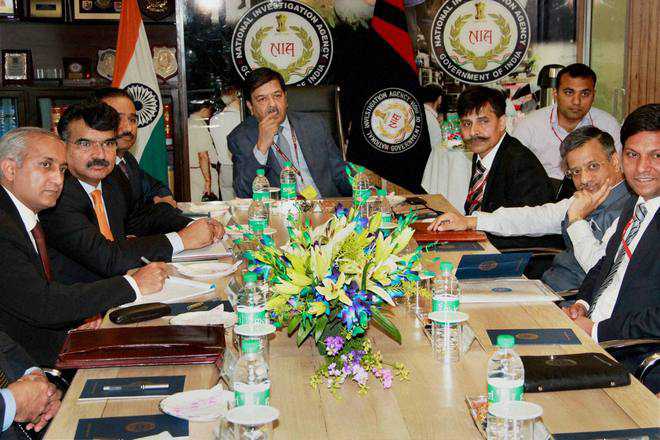
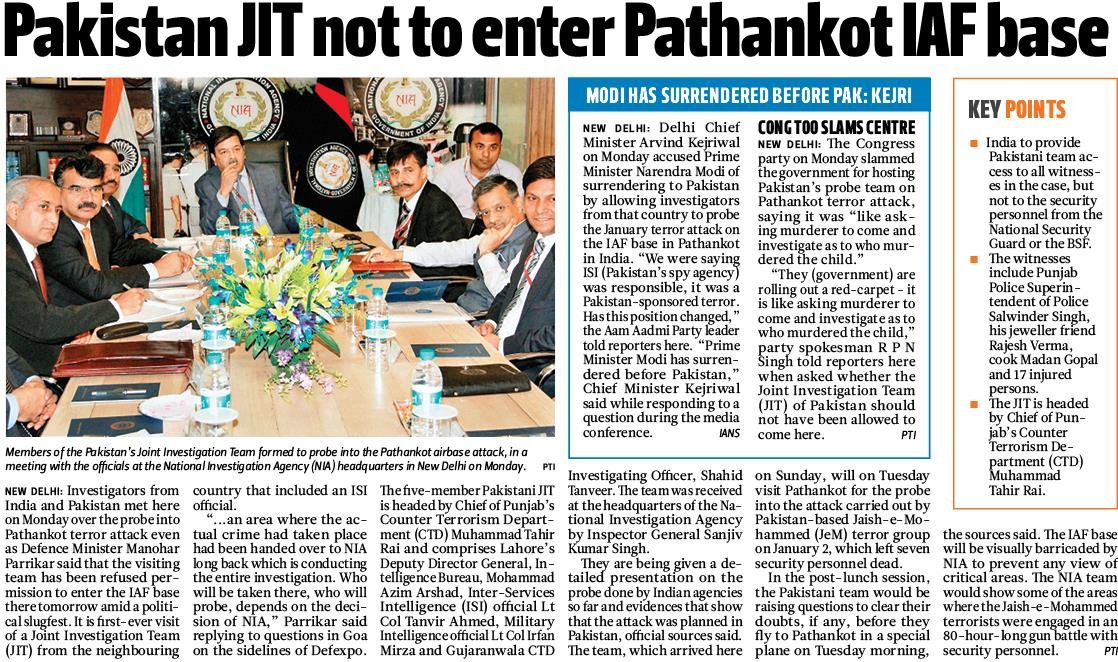
NIA Director-General Sharad Kumar chairs a meeting with Pakistan’s Joint Investigation Team members in New Delhi on Monday. PTI

Shaurya Karanbir Gurung & Mukesh Ranjan

Tribune News Service

New Delhi, March 28

India today shared with Pakistan’s Joint Investigation Team (JIT) the details establishing Pakistan nationals’ role in the Pathankot air base attack as the team met Indian investigators.The JIT members, it is learnt, did not raise objections to the evidences of the involvement of terror group Jaish-e-Mohammed (JeM) and other Pakistan nationals.A day after their arrival, the JIT members reached the National Investigation Agency (NIA) headquarters, where they were briefed about the probe carried out so far.After daylong deliberations with the team, NIA Director-General Sharad Kumar, while talking to The Tribune, said: “We are ready to share all information and evidences available with us as part of our investigation. Our probe is transparent and we have nothing to hide. But we need cooperation and reciprocity from Pakistan in the interest of the investigation to reach a conclusion.”During the interaction, the Indian investigators gave a presentation to the visiting officials on the findings of the investigation so far.India put forth evidences that allegedly linked JeM’s head Maulana Masood Azhar and the leadership to the attack, an NIA source said.“We have evidences and intercepts of the conversations between the slain terrorists and their JeM bosses, including Azhar and his brother Rauf Asgar. We also have a video of Asgar declaring that he sent the terrorists,” said the source.Right before the attack, Azhar was in contact with Asgar, the JeM’s commander, who was further in touch with their key planner and handler Kashif Jaan, explained the source. In most conversations, Kashif was talking to the terrorists from Bahawalpur in Pakistan. “He was dictating to them how the plan had to be executed. The JeM bosses, including Kashif, had escorted the terrorists to the point of infiltration into India,” said the source, adding India had sought voice samples of Azhar, Asgar and Kashif.India also showed to the JIT photographs of the arms and ammunition — carried by the terrorists — allegedly bearing Pakistan marking, said the source. Clothes, medicines, shoes, food packets, thermal wear and even wire cutters were also allegedly brought from Pakistan.One of the terrorists had spoken to his cousin and mother based in Pakistan before the attack, said the source. The NIA showed proof of this conversation to the JIT and demanded the DNA samples of the terrorist’s mother from Pakistan.“We have shown them the evidences (in relation to the JeM and Pakistan’s link to the attack) and the JIT has not raised objections,” said an NIA officer. India had also sent Letter Rogatories (LRs) to Pakistan, seeking evidences in connection with the attack. India also asked the JIT to respond to the LRs, if they wanted to cooperate with the investigation.While the NIA officer denied the Pakistan team making requests regarding the attack’s investigation, sources said the JIT demanded the call data records and the IMEI numbers of the mobile phones, belonging to Punjab Police Superintendent Salwinder Singh, his wife, gunman, the base commander of the Pathankot Air Force Station and others related to the case.Singh with his jeweller friend Rajesh Verma and cook Madan Gopal were allegedly abducted on the night of December 31-January 1 by the terrorists, who had attacked the airbase on January 2. The JIT further demanded the sketch and the CCTV footage of the gun battle, a copy of an alert issued to the airbase, details of security measures taken by the base commander, said the source. It also wanted a report on the alleged border crossing and the BSF deployment along the International Border with Pakistan. The Pakistan team sought access to the Garud commandos, National Security Guards and any witnesses who have seen the terrorists. The team asked the Indian side to give the autopsy report, DNA samples and the details of itemsrecovered from the terrorists. 

No objections raised

  • India shared intercepts of conversations between slain terrorists and their JeM bosses besides photos of arms and ammunition bearing Pak markings, an NIA source said. “We have shown them the evidences and the JIT has not raised objections,” an officer said

Limited air base access

  • Amid attacks by the Opposition over allowing Pak team to probe the attack, Defence Minister Manohar Parrikar said the JIT would be given access to an isolated crime spot and not the entire air base during Tuesday’s visit.faf3d5d6-f620-425c-a2fd-94ec4b6d650d

62526


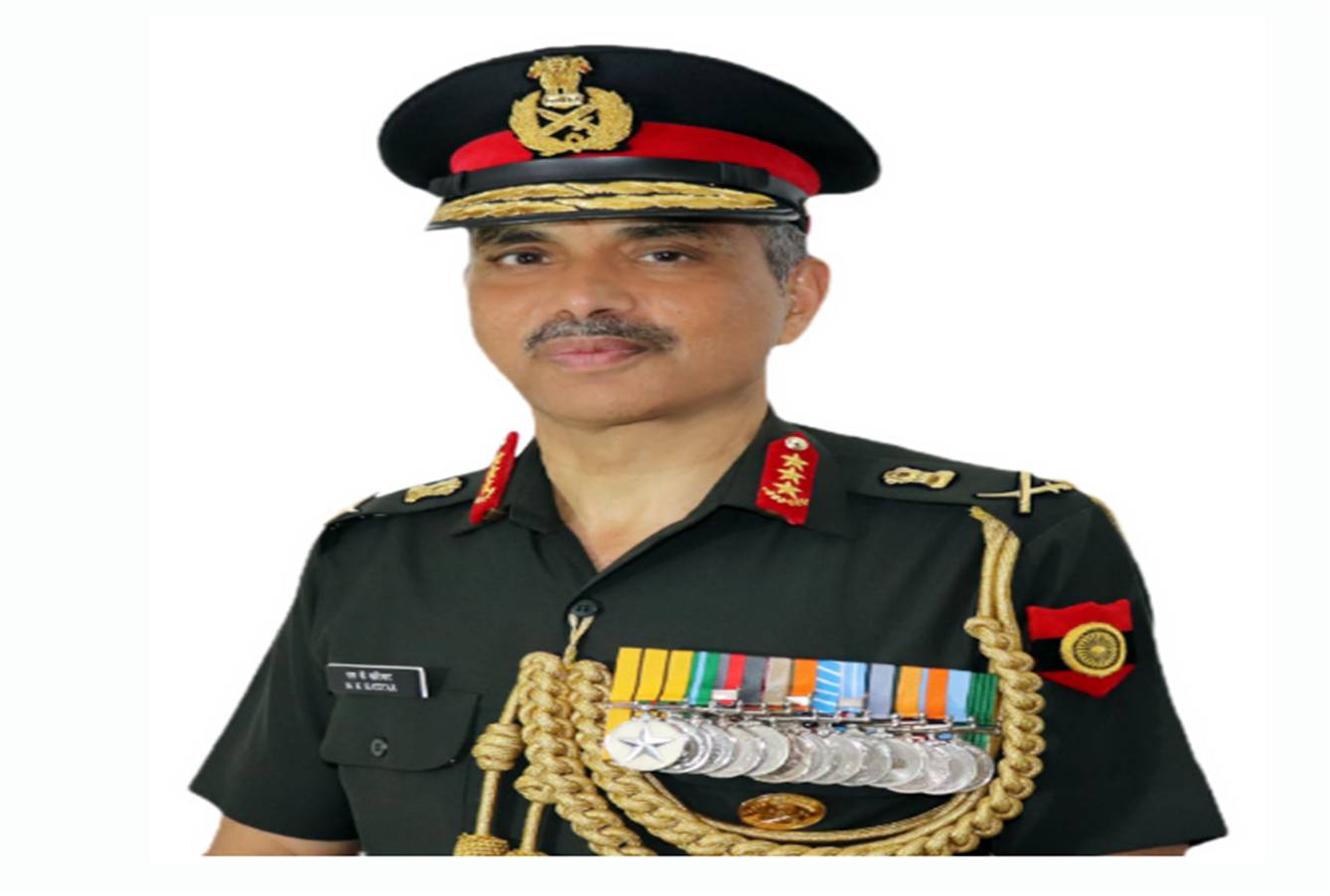
China-Pak economic corridor Gen VP Malik (retd)

China-Pak economic corridor

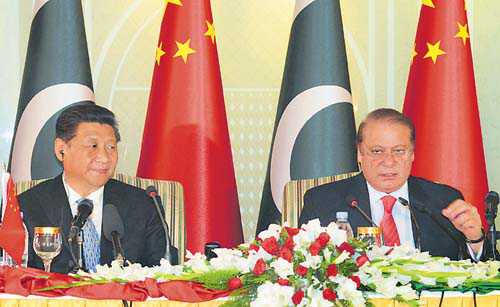
IN the 1950s, China constructed a strategic road connecting Tibet to its Xinjiang province through Aksai Chin area of J&K. The intrusion became one of the triggers for the 1962 India-China war.In 1963,
1malik

China signed a border agreement with Pakistan in which Pakistan unilaterally ceded Shaqsgam valley, another part of J&K (called Gilgit-Baltistan now) to it. Both nations then built the Karakoram highway linking Kashgar in Xinjiang to Abbottabad of Pakistan.In April 2015, China and Pakistan signed accords worth $46 billion to build the China-Pakistan Economic Corridor (CPEC) through Gilgit-Baltistan. This will extend to Gwadar Port in Pakistan and give China access to the Indian Ocean and beyond.When China signed the boundary agreement with Pakistan in 1963, the objective given in its Article 1 was to ‘formally delimit and demarcate the boundary between China’s Xinjiang and the contiguous areas, the defence of which is under the actual control of Pakistan’. Article 6 stated ‘the two parties have agreed that after the settlement of the Kashmir dispute between Pakistan and India, the sovereign authority concerned will re-open negotiations with the Government of the People’s Republic of China on the boundary so as to sign a formal boundary treaty to replace the present agreement. In the event of that sovereign authority being Pakistan, the provision of this agreement and the protocol shall be maintained in the formal treaty.’ (Note the doubt over the status of J&K and China making sure of its national interest in future.)India and China resumed boundary talks in the early 1990s. But China has refused to disclose its perception of the Line of Actual Control which could lead to a boundary settlement.During the Kargil conflict, China preferred to go along with the overwhelming world opinion. It advised Pakistan to withdraw its forces and abide by the LoC. But nearly a decade later, when India refused to cede Tawang in the Special Representatives-level boundary dialogue, China made a perceptible pro-Pakistan shift in its stance on J&K. It started issuing ‘stapled visas’ to Indian citizens of J&K, and refused visa to the GOC-in-C, Northern Command, for military-level exchanges. Around the same time, China increased its civil and military presence in Gilgit-Baltistan, purportedly to improve the infrastructure in this area. Senge H Sering, a scholar from Gilgit-Baltistan, wrote: “China has a huge and long-term presence in Gilgit-Baltistan and is building extensive road, bridge and telecom networks to sustain it. The drivers compelling China to develop Karakoram Corridor are diverse and mainly pertain to its economic, strategic and political ambitions.” According to India’s Ministry of Defence, the length of China-India boundary, measured from the extreme eastern side (India-China-Burma junction) to the extreme north-western end of POK is 4,056 km. This includes 2,175 km in the western sector, 556 km in the central sector, and 1,325 km in the eastern sector. But Chinese officials and the media started mentioning the length of the China-India boundary as nearly 2,000 km. This was first stated by China Daily in its report on the 13th round of boundary talks between China and India. In 2010, People’s Daily wrote that China and India share a nearly 2,000-km border and disputed areas cover about 125,000 sqkm on both sides. After the 14th round of border talks held in Beijing on November 29-30, 2010, the party-controlled Global Times quoted former ambassador to India, Zhou Gang: “The Sino-Indian border stretches for about 2,000 km and the two countries have never officially mapped it out. For a long time, the two sides abided by a traditional customary line based on their respective administrative regions.” Another former ambassador to India, Cheng Ruisheng, said in a TV interview: “China and India share roughly a 2,000 km border which has never been formally delineated.” Chinese officials and media have not only persisted with China-India border being only 2,000 km, but also attempted to correct figures, whenever quoted by Indian officials.It is apparent that China, which had never openly questioned the Indian estimate of the length of common border earlier is now unilaterally seeking to exclude the Chinese-occupied territory in the Ladakh sector of J&K. It is also questioning India’s locus standi to discuss this part of the border due to Pakistan’s claims to this area. This may be an indication that China does not recognise India’s claims of sovereignty over J&K.In the 2015 accord, China and Pakistan have agreed to work on 51 projects comprising network of roads, rails, pipelines and power plants, mostly in the area covered by the CPEC. The money will be lent by Chinese state and its banks to Chinese companies to carry out the work, thereby making it a commercial venture, with direct impact on China’s slackening economy. China also obtained a commitment from Pakistan for the security of the project and the workforce involved. The Pakistan army has raised a special security division for this, with headquarters in Diamer district of Gilgit-Baltistan. To ensure security at the Arabian Sea end, China will sell eight submarines to Pakistan, which would double its fleet.If and when CPEC is completed, it will be a political, economic and strategic game changer in the region. China’s control of Shaqsgam and other valleys of Gilgit-Baltistan will enable this area to be linked with its military and industrial complexes of northwestern Tibet.India claims that China is in occupation of nearly 38,000 sqkm of Indian territory in Ladakh region. Along with 5,500 sqkm of territory ceded by Pakistan, China occupies over 20,000 sqkm of Gilgit-Baltistan covering Shaqsgam, Raskam and Aghil valleys. The China-Pakistan collusion has enhanced strategic importance of Siachen sector whose northern part overlooks Shaqsgam valley.Beijing’s new position underlines its centrality in J&K. While our debate on Kashmir is focussed on Pakistan, China has emerged as a decisive new factor. Just as the Chinese decision to call Arunachal Pradesh ‘South Tibet’ has begun to gain international traction, repeated references to the length of China-India border as 2,000 km will impact the global discourse over J&K. India has to come to terms with the changing geo-politics in its north-western region where its two fronts with Pakistan and China come together. Henry Kissinger in his book On China emphasises the difference between Chinese ‘comprehensive approaches’ to ‘segmented policy making’ by other nations. He states that the Chinese think in civilisational terms. They are willing to strategise in long cycles and create levers of power based on realpolitik rather than morality. The Chinese style of dealing with strategic decisions is “thorough analysis; careful preparation; attention to psychological and political factors; quest for surprise; and rapid conclusion”.  It would be useful to know and learn from Chinese strategic thinking.— The writer is a former Army Chief