

















New Delhi, March 1
Drones, which are being considered a major security risk as they could be used by terror groups for mounting assaults, have been included in the prohibited list and flyers entering India will have to declare them from April 1.The government has decided to revise “Indian Customs Declaration Form” to include drones in the list of prohibited and dutiable goods and made it mandatory for the passengers to declare.Drones are generally imported by government agencies for use by the security personnel in maintaining law and order as well as ensuring vigil along the international borders and line of control with Pakistan, Bangladesh and China. They have also been used for surveillance in Naxal-hit areas.The need for all flyers to fill the customs form upon their arrival has been done away with and those who carry dutiable or prohibited goods alone will have to fill it in, as per the new rules.Foreigners’ duty-free allowance has also been increased to Rs 15,000 from the existing limit of Rs 8,000.The duty-free allowance of cigarettes, cigars and tobacco has been doubled and people will be able to bring in 200 sticks of cigarettes, 50 cigars and 250 gm tobacco.The limit to bring duty-free goods worth Rs 6,000 for passengers of Indian origin and coming from China has also been taken away. However, the free allowance for people coming from Nepal, Bhutan and Myanmar has been increased to Rs 15,000, more than two times of the limit of Rs 6,000 at present. — PTI

Ravinder Saini
Tribune News Service
Jhajjar, March 14
The Army was also misled about the location of the violence-hit Chhawani Colony when the unruly mob was setting the houses on fire and attacking residents with firearms and sharp weapons during the Jat stir on February 21. This made the Army take at least three hours to reach the colony for the protection of the residents.This was stated by Chhawani Colony residents during an interaction with Prakash Singh, former DGP, who was in the colony to inspect the damaged properties. He is probing the role of administrative and police officials in the violence and arson during the stir.“On the fateful day, district administrative and police officials along with Army personnel reached our colony in the afternoon. An Army officer said they had received information about the violence, but were misled about the location of the colony, which led to inordinate delay in arrival,” residents told the DGP.They also demanded that the officials who deliberately misguided the Army and sent them in the wrong direction should be traced. They also sought action against the Jhajjar DC and SP for their failure to protect people and their property.Earlier, Prakash Singh accompanied by Vijay Vardhan Singh, Additional Chief Secretary; KP Singh, DGP (Crime), and Chander Prakash, Rohtak Division Commissioner, inspected the damaged Bank of Patiala, Chhotu Ram Dharamshala and shops near the bus stand here.He interacted with the victims Chhawani Colony and also inspected the spot where two men were murdered by the mob.
Quepem (Goa), March 28
After a delay of over a year, the much-awaited new defence procurement policy was unveiled by the government today with an aim to ensure transparency, fast-track acquisitions and to lend a push to the “Make in India” initiative.The Defence Procurement Procedure (DPP)-2016 announced by Defence Minister Manohar Parrikar, however, did not contain a key chapter on the proposed strategic partnership. Parrikar said it would take another 2-3 months to finalise the model.To be applicable from April, the procurement policy lays the roadmap on how India, the world’s largest arms importer, will acquire defence equipment in future.The announcement was made at the inaugural ceremony of the Defence Expo (Defexpo)-2016 at Quepem town, about 50 km from Panaji. The new DPP has included a new category to acquire weapons—IDDM (indigenously designed, developed and manufactured). The IDDM will be the first preferred category.Parrikar said a review of the new DPP would be undertaken after six months. “I do not say the document is foolproof. Let us take a review after six months. Nothing is perfect, but we are taking it to perfection,” he said.He said the DPP could push the agenda of “Make in India” and country’s target of achieving defence industry network. With the new DPP, it would be ensured that there was greater transparency and faster clearances, he said.The DPP has been loaded online on the Defence Ministry’s website and will be made available in hard copy format after 15 days.Parrikar said certain concerns of foreign companies would be addressed through this policy over 3-4 months. The new policy also allows the Defence Acquisition Council to take a “fast-track” route to acquire weapons, something which was limited to only the armed forces till now.In a bid to cut down on the time taken for acquisition process, it mandates that all AONs (acceptance of necessity) of a particular platform will be valid for only six months as against the 12-month deadline now.Also, no AON will be notified until it is accompanied by a finalised RFP (request for proposal or tender). This means the time taken for an RFP has been cut down drastically.Parrikar said defence export clearances were to be granted online. He said the policy would also include “Start-up India” initiative.Parrikar had earlier said the new blacklisting policy would also be issued separately next month and made it clear that there would be “no relaxation” for those already blacklisted. “Bribe givers” would be punished, he said.However, the existing blacklisted firms would be allowed to appeal before a vigilance committee of the Defence Ministry for delisting under the new policy. — PTI
New Delhi, March 14
A large chunk of the Gilgit-Baltistan area, part of Pakistan-occupied Kashmir (PoK), has been allegedly occupied by neighbouring North-West Frontier Province, triggering protests in the Shia-dominated region, also claimed by India as part of the disputed Jammu and Kashmir state.Large contingents of Pakistan paramilitary troopers have been deployed in the apprehension of trouble brewing in the occupied 25 km border area that connects divided Gilgit-Baltistan with the Khyber Pakthtunkhwa province, says a news report in “Baad-e-Shimaal”, an Urdu daily in PoK.“And the Gilgit-Baltistan government is watching like a mute spectator,” the daily said in its cover of the Monday edition.“The provincial government has deployed Chitral forces in the area after illegally taking over and including the occupied mineral-rich chunk of land in its territory.” A lawmaker, Sarfaraz Shah, has reportedly written a letter in protest against the “territorial aggression” to the government of the frontier province asking it to vacate the land.But the government has denied the allegation and dismissed the lawmaker’s protest, saying it was part of land forms and “deploying paramilitary Chitral forces is our right”, the daily said.The report came after alarm bells rang in the Indian security establishment following Chinese People’s Liberation Army (PLA) troops being spotted at forward posts along the Line of Control (LoC) along PoK where the Chinese government is building a Jhelum-Neelam 970 MW Hydel power project. —IANS
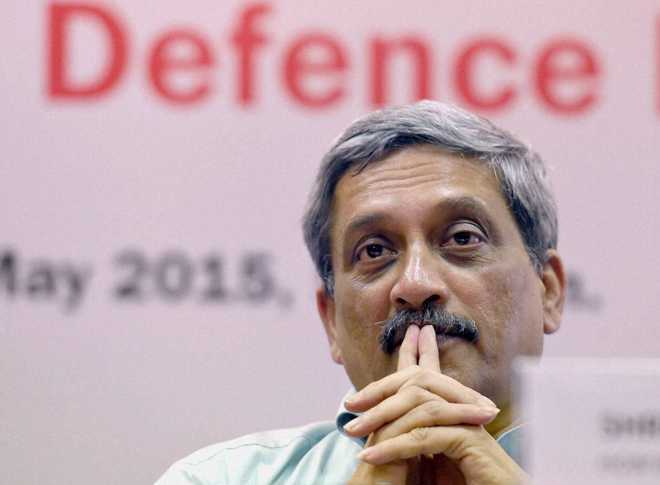
Defence Minister Manohar Parrikar
Roorkee, March 19
The ‘Make in India’ vision is a priority for defence procurement but “operational readiness” is the military’s primary task as “we don’t want people to look at us with big eyes”, Defence Minister Manohar Parrikar has said.
“We need adequate equipment and that cannot change. Make in India is in its place, our military preparedness is paramount,” he said speaking at a panel discussion on Make in India initiative in the defence sector on the opening day of the three-day technical festival – Cognisance 2016 – of IIT Roorkee yesterday.
“I would like to make it clear…Make in India is our priority for defence procurement…but the first priority cannot be forgotten, the primary task of our military, which is operational readiness…in view of our neighbours…so that no one can look at us with big eyes,” he said.
There have been calls for stepping up the country’s defence preparedness after the terror attack on the Pathankot Air base and in Gudsaspur.
Opposition Congress had in Parliament recently criticised the government for its handling of the Pathankot incident in which seven security personnel were killed. — PTI
The Cold War between the US and China on the South China Sea dispute is becoming hot. Last month, it was reported that the US and India have held talks about conducting joint naval patrols that could include the disputed South China Sea. The US and India were quick to dismiss the report.
Even though it seems that the US and India are not ready for joint patrols, the trial balloon is indicative of the evolving Indian position on one of the key disputes in the Asian strategic landscape. A number of factors are forcing India’s hand. The US itself has been forced to adopt a more robust posture in the Indo-Pacific. The dramatic acceleration in American military commitment to the region is a function of the astonishing rise of China, which is becoming a serious regional military power.
Since most of China’s territorial conflicts are spread across the East and South China Seas, naval force projection has gained uncharacteristic momentum for a country that, for most of its history, had a continental mind-set. China’s maritime strategy and its increasing capabilities may overwhelm the smaller powers in the region. Its singular objective is to deny them any operational space in its oceanic sphere of influence. US President Barack Obama’s ‘pivot’ towards Asia represents an attempt to warn China away from using heavy-handed tactics against its neighbours and provide confidence to other Asia-Pacific countries that want to resist pressure from Beijing.
Maritime security cooperation between India and the US has become a strategic necessity. American strategy, according to some in the US, should focus on supporting Indian pre-eminence in the Indian Ocean and closer US-India strategic cooperation.
India has to respond to this burden of growing expectations and it has its own reasons for challenging China. China’s anti-piracy operations in the Gulf of Aden have raised hackles with some in the Indian Navy questioning the need for the People’s Liberation Army Navy’s (PLAN’s) deployment of two frontline warships and a tanker. If, for China, the Indian Ocean is not an Indian lake, New Delhi’s imperative is to contest impressions in Beijing that the waters east of Malacca automatically fall under the latter’s sphere of influence. India’s naval engagement in the East, therefore, is also a reaction to China’s expansion in the Indian Ocean. The turf war between the two navies, as both nations seek greater roles in regional dynamics, is set to grow.
Indian naval officials and maritime strategists seem to favour a ‘naval forward strategy’ that could extend eastward. India’s engagements with Japan, Vietnam and the Philippines have become more serious.
Joint patrols with the US or not, India is conceiving a more ambitious role for itself in East Asia and India-US interests in the region are converging at an unprecedented rate. It is now up to New Delhi and Washington to take full advantage of these developments.
Harsh V Pant is professor of International Relations at King’s College London The views expressed are personal
The situation in Xinjiang is becoming ever more stable. Local authorities have strengthened their ability to prevent and fight terrorist activity. ZHANG CHUNXIAN, chief, Communist Party of China
BEIJING: Religious extremism is on the wane in the remote and often restive region of Xinjiang, a political adviser claimed on Sunday as Chinese leaders continue to say that development is the key to controlling ethnic tension in the province, the country’s largest.
“Religious extremism has weakened remarkably in the Xinjiang Uyghur Autonomous Region(XU AR),” Nurl an Abdumankin, political adviser attending the ongoing session of Chinese People’s Political Consultative Conference (CPPCC) said.
The region over the last few years has seen violence between the Uyghur community and local authorities including the police including large-scale riots. The government tightly controls information coming from the region. Uyghur rights groups say the government’s hardline policies have alienated the community, triggering violence. Many are angry at Beijing’s apparent efforts to stamp-out the unique cultural identities of the Muslim Uyghur community, which has close cultural and language affinity to central Asian states.
Beijing, on the other hand, claims foreign-trained separatists are to blame for the riots and are trying to separate the region from China.
But according to Abdumankin, the situation has changed.
Ethnic unity and religious harmony have been significantly promoted in the region, he said.
He added that the “…central government should further strengthen coordination between Xinjiang and inland provinces in cracking down on extremism and illegal religious activities”.
“The situation in Xinjiang is becoming ever more stable. Local authorities have strengthened their ability to prevent and fight terrorist activity,” said Zhang Chunxian, the Communist Party of China (CPC) chief at the National People’ s Congress’ China’s rubber-stamp Parliament, session.
“However, Zhang warned that Xinjiang still faces a tough task to maintain stability. The local government will maintain pressure on terrorists, the official news agency, Xinhua said in a report.
The government’s efforts has been to show that it is doing all it can to promote development in the region – and that it is bearing fruit.

Early this year, all news outlets in India were dissecting the attack at an air force base in Pathankot. From veterans and defence expert to citizens, many were wondering how an attack of that scale managed to penetrate a high security zone such as Pathankot.
Move over a couple of months, and we read reports of how Pakistan had managed to get access to vital critical information by a very simple trick. Exploit security vulnerabilities in application permissions. The modus operandi was rather simple. On the face of it, rogue elements created an app called Smeshapp (which has since been pulled down from the app store). It appeared to be a communication app just like WhatsApp. However, in seeking permissions far beyond what it needed, the app would then send requests to the contact list of the infected phone.
And that’s how the database of vulnerable users just grew. Unfortunately, that list included people in the defence force with critical information about personnel locations in real time and the ability to record sensitive conversations by accessing the microphone on the device. To know more about how the app worked, you could read here.
According to a report by IBNLive, the Indian Army has now issued an advisory that asks soldiers to stay away from the Internet. In addition, the advisory mentions that personnel must refrain from watching pornographic content on Facebook or other social networking sites. In addition, the advisory asks personnel not to use their photos in uniform as display pictures on WhatsApp or Facebook among others.
It’s interesting that pornography has been categorically mentioned. It is worth noting that according to Israeli intelligence agency Mossad, terrorist organisations such as the Islamic State and Al-Qaeda have been using platforms such as eBay, Reddit as well as pornographic videos to transfer coded messages for their next operation.
JALANDHAR: Police on Friday booked a colonel on charges of abetment to suicide after an army jawan deputed with him committed suicide on Thursday night in the Cantonment area.
The deceased, Lakhwinder Singh (32), who hailed from Sangyal village in Hoshiarpur district, worked as a cook in the house of Colonel AS Salathya for the past one year. Lakhwinder ended life by hanging himself from a beam.
As per the first information report (FIR), the deceased’s father Joginder Singh alleged that his son called to his brother Tarlok Singh and informed that on Wednesday night he prepared chicken for the colonel which he did not like and used abusive language against him.
Singh alleged that the colonel also threatened to fire his son from job, as a result of which he was under stress. A case has been registered against the officer under section 306 (abetment to suicide) of the Indian Penal Code.
Inspector Barjinder Singh said the police were yet to make arrest in the case.
Nikhil Bhardwaj
Tribune News Service
Jalandhar, March 11
The Jalandhar Commissionerate has booked Col AS Salathiya, Commanding Officer of the Battalion stationed in Jalandhar Cantt, on the charge of abetment to suicide.Lakhwinder Singh, jawan of 112 Infantry Territorial TA Dogra regiment, working as a cook with Col Salathiya, allegedly committed suicide last night. His body was recovered from his quarters.According to the deceased’s kin, Col Salathiya had abused him for badly cooking chicken, following which he took the extreme step.Lakhwinder’s father Joginder Singh said Lakhwinder had called his brother Joginder at 9.40 pm and told him that Col Salathiya had abused him for not preparing good chicken. He said Col Salathiya threatened to fire him from the job, Lakhwinder told his brother on phone before taking the extreme step, the recording of which has been given to the police. Lakhwinder was living with Col Salathiya on the Nalwa road, MES quarter 32/1, Jalandhar Cantt.ACP Mukesh Kumar said on the complaint of the deceased’s kin a case of abetment to suicide had been registered against Col Salathiya. Raids were being conducted to arrest him.Meanwhile, Army sources said a court of inquiry had been ordered by the Army into the incident.
Simran Sodhi
Tribune News Service
New Delhi, March 15
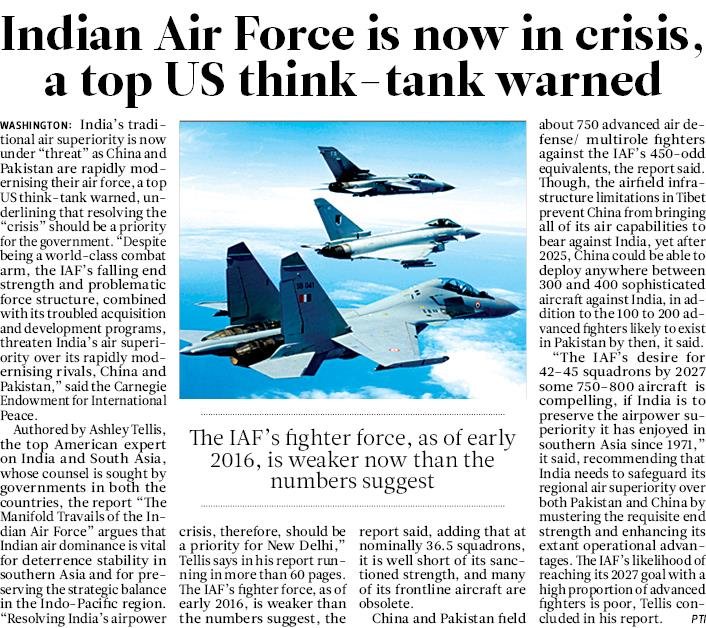
Relations between India and Pakistan continue to remain tense with Pakistan now looking to increase its aircraft fleet by trying to purchase more fighter jets from the US, Russia and France.The sale of eight F16 fighter jets to Pakistan by the US is now almost a done deal with the US Senate refusing to block the deal, which is now in its final stages. India made public its discomfort with the US decision but that did not deter the US from going ahead with the deal.Pakistan’s insecurity emanates from a desire to maintain parity with the Indian Air Force, which is planning to replace its existing fleet by 2020. Pakistan is already planning to buy 10 more F16 fighter jets from the US once the sale of the initial eight F16 is completed. The eight F16s that Pakistan is buying from the US include two single-seat F-16Cs and six twin-seat F-16Ds, along with associated equipment. The deal is expected to cost Pakistan $699 million.According to a report on Jane’s Defence Weekly, Pakistan is looking not just to the US but also to France and Russia to buy new fighter jets. The report quotes Pakistani officials as saying that “Pakistan Air Force needed to retire 190 planes by 2020, forcing the country to look for various options”.India has already gone ahead and decided to directly purchase 36 Rafale fighter jets from France. The liability issues and the pricing of the Rafale have time and again delayed the final contract but with India closer to upgrading its fleet, jitters in the Pakistan establishment were expected.































