Sanjha Morcha

Trains cancelled, buses off road

Nitish Sharma &Suman Bhatnagar.Tribune News Service.,Ambala February 20

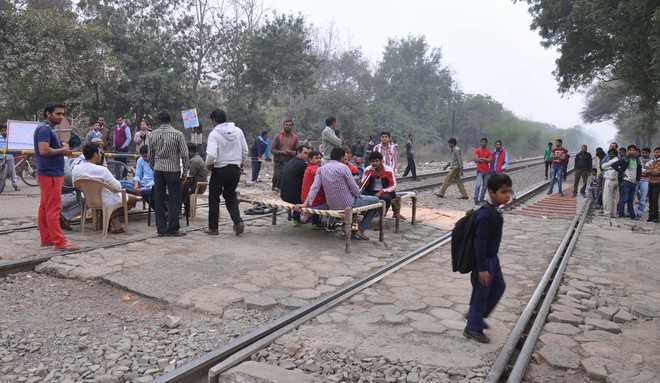
Several trains were cancelled and many buses remained off road today due to the Jat agitation.  The disruption in traffic inconvenienced thousands of people, especially the aged, infants and women.While buses on the roads were packed to capacity with people hanging out, the situation was no better at the Ambala Cantonment railway station, where people jostled to board the trains on the Saharanpur route. Only a few Uttar Pradesh bound trains arrived following the agitation.As many as 87 trains, including Shatabdi Express, Shan-e-Punjab Express, Heerakund Express, Rajdhani Express, Jhelum Express, Himalayan Queen, Sampark Kranti Express, Dadar Express, Jan Shatabdi Express and Howrah Express remained cancelled today. Some of the trains coming from Punjab were terminated at Ambala Cantt.Some of Bihar and UP-bound migrant passengers have been waiting for the trains for last 24 hours. The Railway officials were not able not give accurate information about when the service would be restored. Station master Hans Raj said a family of Ambala, who had reserved 25 seats for February 21 for Mumbai a few months ago for celebrating the marriage of their daughter there has to cancel the seats on Friday as none of the Mumbai bound train was available at Railway station. Some of the passengers bound to Panipat and Delhi hired taxis to reach their destination for which they have to pay two to three times the charges of train fare. Daily passengers faced difficulties to reach their offices in time. Sham Singh (50), a resident of Etawah, said: “We are nine persons, including four children, who had boarded Toofan Express on Thursday from Etawah for Abohar (Punjab). However, when we reached Delhi we were told that the train will not go further. From Delhi, we reached Sonepat on a passenger train and had to spend night there.”

Rohtak watches as buildings burn

Sunit Dhawan,Tribune News Service,Rohtak, February 20

Jat protesters today set ablaze more than 10 buildings, ransacked and looted showrooms despite curfew and shoot-at-sight orders.Group clashes were reported from several areas in which one person was killed and over 100 were injured.The Vita milk plant on the Gohana road near the Sukhpura chowk was also set ablaze. Following this, ammonia gas leaked from the plant and the residents of the Vita colony were moved to safer locations.In view of the situation, Army troops were airdropped at the Rohtak Police Lines. From there, they started a joint flag march with BSF and police personnel. However, in view of a massive assembly of protesters near the MDU gate number 2 on the Delhi road, they were directed to take a U-turn, so as to avert a clash.Later, the Jat protesters went on the rampage and set the BJP’s office, Meham police station, several hotels, restaurants, a petrol station, a shopping mall, showrooms, shops and other commercial establishments on fire. Several vehicles were also torched.Police personnel, who had vanished from the spots of violence yesterday, abandoned their police posts today and locked stations.A number of Punjabi and non-Jat businessmen, traders and shopkeepers alleged their showrooms and other establishments had been specifically targeted. Jat youths allegedly threatened members of the Punjabi and other non-Jat communities of raiding their houses during the nightOn the other hand, Jat residents of Sector 3 alleged threats of attack by members of Saini, Gujjar and Balmiki communities.The Principal Secretary to CM, RK Khullar, said he had noted the details and action would be taken. He, however, had no reply to the question why the Army had been unable to check the rioters. 

Agitation peaceful in YamunanagarYamunanagar: Jat agitators on Saturday blocked roads at several places in the district, but the protest passed off peacefully. The agitators blocked the road at Kail village, Chhachhrauli, Bilaspur, Sadhaura and Radaur towns. The blockades in Sadhaura and Radaur towns were lifted with intervention of Deputy Commissioner SS Phulia and Superintendent of Police Arun Singh. The protesters did not stop any ambulance or other emergency vehicles. The district administration had made arrangements to divert the traffic and as a result. The DC said the situation was under control in the district. — TNS

Two Roadways buses torched Bhiwani: Unidentified protesters torched two roadways buses parked at the Charkhi Dadri depot in the wee hours today after they threw crude petrol bombs. Fire engines were pressed into service and saved other buses from catching fire. Naresh Kumar, bus depot chowkidar, said nearly 10 youths barged into the bus depot on motorcycles and started pelting stones. Later, they threw crude petrol bombs on buses, he said. Vijaypal Singh, workshop mechanic, said the staff ran away after the youths created ruckus.   — TNS

Bhiwani remains shut; shops vandalisedNew Delhi: The Congress on Saturday adopted a twin stance on Haryana, with some state leaders appealing for restoration of peace and social harmony and others accusing the BJP-RSS of conspiring to divide the society on caste lines. Former Chief Minister Bhupinder Singh Hooda sought to adopt a statesman-like approach, suggesting the state government to find a solution on Jat reservation and not indulge in “petty politics”. Congress spokesperson Randeep Singh Surejwala said he was pained that the BJP-RSS was dividing Haryana on caste lines. — TNS

Anarchy prevails

  • Clashes reported for several areas. One killed
  • BJP office, shopping mall, police station, petrol station, markets gutted
  • Army troops airdropped at the Rohtak police lines
  • Flag march taken out by the Amry, BSF and state police personnel
  • Essential services such as ambulance and fire engines hit


27517 59169


Women in combat A major signal towards gender parity

President Pranab Mukherjee has announced the government’s intention to induct women in all military combat roles. Since time immemorial, men have apportioned to themselves the leading role in fighting and hunting. It has stayed that way with a variety of arguments and customs barring women entry into the armed forces of nation states. The main arrow in the quiver is the primordial fear of the enemy ‘violating’ captured women warriors. The other argument is of a modern make and makes the point that India is not culturally as advanced as the Nordic countries to have mixed dormitories and common toilets.Both fears against the entry of women in combat roles, one old and another of recent make, ignore the history of their participation in modern warfare. Lyudmila Pavlichenko was one of the deadliest snipers in World War II with 309 confirmed hits. Armies of the post-revolution Soviet Union, China and Cuba have accommodated women in combat roles. And women guerrillas have taken on men-only armies in Sri Lanka, Nepal and Colombia. Recently, women fighters of the Kurdish Peshmerga and the Syrian YPJ successfully took on the ISIS known for press ganging captured women into sex slavery.The third argument is that men are genetically programmed to kill and women balk at shedding blood. As women guerrillas and soldiers have shown, this is a misplaced notion.  Candidates are selected after a gruelling psychological examination for aptitude and the ones falling short are winnowed. Though women have been inducted into the fighter stream of the Indian Air Force, this was an easier decision. Air force bases are family stations and pilots operate from the cockpit where issues of cohesion, etc. are absent. It will be tough to create space in infantry and combat units or on warships. If the example of other countries is an indication, the number of women in combat units will be miniscule. This means the costs of additional facilities will not be much but the President’s declaration has succeeded in sending a clear signal that India will embark on the path of full gender parity in the armed forces.


Two jawans, five terrorists killed in fierce Kupwara encounter

Tribune News Service,Srinagar/Kupwara, February 13

2016_2$largeimg14_Sunday_2016_014346681gallery 2016_2$largeimg14_Sunday_2016_014347949gallery

Two soldiers of the Army’s elite counter-insurgency unit and five militants were killed today in a 20-hour encounter in North Kashmir’s frontier district of Kupwara. Two Army personnel, including a Major-rank officer, were injured in the gunfight in snowbound Marsarri Chowkibal, 115 km from Srinagar. The slain militants, attired in white, carried a snow axe and rucksacks, indicating they may have infiltrated recently, said sources.On Friday, a joint operation was launched by the 41 Rashtriya Rifles, 16 Grenadiers, 19 Maratha Regiment and the elite 4 Para, along with the Special Operations Group of the J&K Police and the CRPF, following intelligence inputs on the presence of militants in the area. “The terrorists were entrenched in an abandoned house. The encounter continued through the night and ended this noon. Five terrorists hiding in the house were eliminated,” said Brigadier SP Singh of Trehgam Brigade, under whose command the operation was carried out. “We lost Naik Shankar Chandrabhan Shinde (34) of Nasik, Maharashtra, and gunner Maruti Sahadev (26) of Bijapur, Karnataka. Two other Army men, one of them an officer, were injured. Their condition is stable.” Shinde is survived by his wife and two children. Sahadev, who was engaged, was to go on leave in a week.

63231 58821


Siachen hero loses battle for life

Siachen hero loses battle for life
Service chiefs pay tribute to Lance Naik Hanumanthappa Koppad in New Delhi on Thursday. PTI

Tribune News Service

New Delhi, February 11

Siachen braveheart Lance Naik Hanumanthappa passed away at the Army’s Research and Referral Hospital here today because of multiple-organ dysfunction after a three-day battle for life. He was rescued from the avalanche-hit Siachen glacier on February 8.“Lance Naik Hanumanthappa is no more. He breathed his last at 11.45 am,” a senior Army official said. The cremation will take place at Hubli in Karnataka tomorrow. The 33-year-old soldier of the 19th Battalion of Madras Regiment is survived by his wife Mahadevi Ashok Bilebal and a two-year-old daughter, Netra Koppad. A resident of Betadur village in Dharwad district of Karnataka, he had joined the Army 13 years ago. Hanumanthappa along with nine other Armymen, none of whom survived, were buried under the avalanche that hit the 19,600-ft high Sonam Post on February 3. He was found alive, but with serious complications on February 8. In Delhi, Prime Minister Narendra Modi, Defence Minister Manohar Parrikar, Army Chief General Dalbir Singh Suhag and Congress vice-president Rahul Gandhi were among those who paid homage to the soldier. “He leaves us sad & devastated. RIP Lance Naik Hanumanthappa. The soldier in you remains immortal. Proud that martyrs like you served India,” the Prime Minister tweeted.“In his life and his passing, Lance Naik Hanumanthappa has shown the world the meaning of perseverance & courage,” wrote Rahul Gandhi on Twitter.Dubbed ‘miracle man’, Hanamanthappa’s condition had deteriorated yesterday. “His circulatory shock is now refractory to all drugs in maximum permissible doses and his kidneys remained non-functional,” a health bulletin released by the Army earlier in the day had said. His pneumonia had worsened and the blood-clotting disorder showed no signs of reversal despite blood component support. 

ਸੂਰਬੀਰ ਹਨਮਨਥੱਪਾ ਮੌਤ ਤੋਂ ਜੰਗ ਹਾਰਿਆ

Posted On February – 11 – 2016

ਸਿਆਚਿਨ ਵਿੱਚ ਸੰਘਰਸ਼ ਦੀ ਗਾਥਾ ਦਾ ਉਦਾਸ ਅੰਤ

ਨਵੀਂ ਦਿੱਲੀ, 11 ਫਰਵਰੀ
ਸਿਆਚਿਨ ’ਚ ਬਰਫ਼ ਹੇਠਾਂ ਛੇ ਦਿਨਾਂ ਤਕ ਦਬੇ ਰਹੇ ਸੂਰਬੀਰ ਲਾਂਸ ਨਾਇਕ ਹਨਮਨਥੱਪਾ ਕੋਪਾਡ (33) ਦਾ ਅੱਜ ਦੇਹਾਂਤ ਹੋ ਗਿਆ। ਸਿਆਚਿਨ ਗਲੇਸ਼ੀਅਰ ’ਚ 19,600 ਫੁੱਟ ਦੀ ਉਚਾਈ ’ਤੇ ਬਣੀ ਚੌਕੀ ਬਰਫ਼ੀਲੇ ਤੂਫ਼ਾਨ ’ਚ ਤਬਾਹ ਹੋ ਗਈ ਸੀ ਅਤੇ ਉਸ ਸਮੇਤ 10 ਜਵਾਨ ਕਈ ਫੁੱਟ ਹੇਠਾਂ ਬਰਫ਼ ’ਚ ਦਬ ਗਏ ਸਨ। ਲਾਂਸ ਨਾਇਕ ਹਨਮਨਥੱਪਾ ਨੂੰ ਛੇ ਦਿਨਾਂ ਬਾਅਦ ਜਿਉਂਦਾ ਕੱਢ ਲਿਆ ਗਿਆ ਸੀ ਪਰ ਉਹ ਬੇਸੁਰਤ ਸੀ ਅਤੇ ਉਸ ਦੇ ਅੰਗਾਂ ਨੇ ਕੰਮ ਕਰਨਾ ਬੰਦ ਕਰ ਦਿੱਤਾ ਸੀ। ਸੈਨਾ ਦੇ ਸੀਨੀਅਰ ਅਧਿਕਾਰੀ ਨੇ ਕਿਹਾ ਕਿ ਲਾਂਸ ਨਾਇਕ ਹਨਮਨਥੱਪਾ ਨੇ ਅੱਜ ਸਵੇਰੇ ਪੌਣੇ 12 ਵਜੇ ਅੰਤਮ ਸਾਹ ਲਏ। ਆਰਮੀ ਰਿਸਰਚ ਐਂਡ ਰੈਫਰਲ ਹਸਪਤਾਲ ’ਚ ਜੀਵਨ ਲਈ ਸੰਘਰਸ਼ ਕਰ ਰਹੇ ਹਨਮਨਥੱਪਾ ਦੀ ਸਿਹਤਯਾਬੀ ਲਈ ਦੁਆਵਾਂ ਮੰਗੀਆਂ ਜਾ ਰਹੀਆਂ ਸਨ।
ਲਾਂਸ ਨਾਇਕ ਹਨਮਨਥੱਪਾ ਕੋਪਾਡ ਮਦਰਾਸ ਰੈਜੀਮੈਂਟ ਦੀ 19ਵੀ ਬਟਾਲੀਅਨ ’ਚ ਤਾਇਨਾਤ ਸੀ। ਪਰਿਵਾਰ ’ਚ ਪਤਨੀ ਮਹਾਦੇਵੀ ਅਸ਼ੋਕ ਬਿਲੇਬਲ ਅਤੇ ਦੋ ਸਾਲ ਦੀ ਬੱਚੀ ਨੇਤਰਾ ਕੋਪਾਡ ਰਹਿ ਗਏ ਹਨ। ਕਰਨਾਟਕ ਦੇ ਧਾਰਵਾਡ਼ ਜ਼ਿਲ੍ਹੇ ਦੇ ਪਿੰਡ ਬੇਤਾਦੂਰ ਦਾ ਵਸਨੀਕ ਕੋਪਾਡ 13 ਸਾਲ ਪਹਿਲਾਂ ਫ਼ੌਜ ’ਚ ਸ਼ਾਮਲ ਹੋਇਆ ਸੀ।
ਉਸ ਦੇ ਦੇਹਾਂਤ ਦੀ ਖ਼ਬਰ ਜਿਵੇਂ ਹੀ ਆਈ ਤਾਂ ਪੂਰੇ ਮੁਲਕ ’ਚ ਸੋਗ ਦਾ ਮਾਹੌਲ ਬਣ ਗਿਆ। ਉਸ ਦੇ ਪਿੰਡ ’ਚ ਲੋਕ ਸਡ਼ਕਾਂ ’ਤੇ ਆ ਗਏ ਅਤੇ ਭੁੱਬਾਂ ਮਾਰ ਕੇ ਰੋ ਪਏ। ਪ੍ਰਧਾਨ ਮੰਤਰੀ ਨਰਿੰਦਰ ਮੋਦੀ ਅਤੇ ਰਾਸ਼ਟਰਪਤੀ ਪ੍ਰਣਬ ਮੁਖਰਜੀ, ਰੱਖਿਅਾ ਮੰਤਰੀ ਮਨੋਹਰ ਪਰੀਕਰ ਅਤੇ ਥਲ ਸੈਨਾ ਮੁਖੀ ਜਨਰਲ ਦਲਬੀਰ ਸੁਹਾਗ ਸਮੇਤ ਹੋਰ ਆਗੂਆਂ ਨੇ ਲਾਂਸ ਨਾਇਕ ਦੇ ਦੇਹਾਂਤ ’ਤੇ ਡੂੰਘੇ ਅਫ਼ਸੋਸ ਦਾ ਪ੍ਰਗਟਾਵਾ ਕੀਤਾ ਹੈ। ਸ੍ਰੀ ਮੋਦੀ ਨੇ ਕਿਹਾ ਕਿ ਉਸ ਅੰਦਰਲਾ ਜਵਾਨ ਹਮੇਸ਼ਾ ਅਮਰ ਰਹੇਗਾ। ਉਨ੍ਹਾਂ ਟਵੀਟ ਕਰ ਕੇ ਕਿਹਾ ਕਿ ਸਾਨੂੰ ਮਾਣ ਹੈ ਕਿ ਤੁਹਾਡੇ ਵਰਗੇ ਸ਼ਹੀਦਾਂ ਨੇ ਭਾਰਤ ਦੀ ਸੇਵਾ ਕੀਤੀ। ਕਰਨਾਟਕ ਦੇ ਮੁੱਖ ਮੰਤਰੀ ਸਿੱਧਾਰਮਈਆ ਨੇ ਚੋਣ ਰੈਲੀ ਦੌਰਾਨ ਦੋ ਮਿੰਟ ਦਾ ਮੌਣ ਰੱਖ ਕੇ ਬਹਾਦਰ ਜਵਾਨ ਨੂੰ ਸ਼ਰਧਾਂਜਲੀ ਭੇਟ ਕੀਤੀ। ਉਨ੍ਹਾਂ ਦਿੱਲੀ ’ਚ ਕਰਨਾਟਕ ਭਵਨ ਦੇ ਅਧਿਕਾਰੀਆਂ ਨੂੰ ਕਿਹਾ ਕਿ ਉਹ ਹਨਮਨਥੱਪਾ ਦੇ ਪਰਿਵਾਰ ਨੂੰ ਹਰਸੰਭਵ ਸਹਾਇਤਾ ਮੁਹੱਈਆ ਕਰਾਏ ਅਤੇ ਉਨ੍ਹਾਂ ਨੂੰ ਸੂਬੇ ’ਚ ਲਿਆਉਣ ਲਈ ਵਿਸ਼ੇਸ਼ ਉਡਾਣ ਦੇ ਪ੍ਰਬੰਧ ਕੀਤੇ ਜਾਣ।
-ਪੀਟੀਆਈ

ਜੱਦੀ ਪਿੰਡ ਵਿੱਚ ਅੱਜ ਹੋਏਗਾ ਸਸਕਾਰ

ਬੰਗਲੌਰ: ਲਾਂਸ ਨਾਇਕ ਹਨਮਨਥੱਪਾ ਕੋਪਾਡ ਦਾ ਅੰਤਮ ਸਸਕਾਰ ਉਸ ਦੇ ਜੱਦੀ ਪਿੰਡ ਬੇਤਾਦੂਰ ’ਚ ਸ਼ੁੱਕਰਵਾਰ ਨੂੰ ਪੂਰੇ ਸਰਕਾਰੀ ਸਨਮਾਨਾਂ ਨਾਲ ਕੀਤਾ ਜਾਏਗਾ। ਉਸ ਦੀ ਦੇਹ ਨੂੰ ਸਵੇਰੇ 7 ਵਜੇ ਤੋਂ 10 ਵਜੇ ਤਕ ਨਹਿਰੂ ਗਰਾੳੂਂਡ ’ਚ ਆਮ ਲੋਕਾਂ ਦੇ ਦਰਸ਼ਨਾਂ ਲਈ ਰੱਖਿਆ ਜਾਵੇਗਾ। ਬਾਅਦ ’ਚ ਦੁਪਹਿਰ ਵੇਲੇ ਅੰਤਮ ਸਸਕਾਰ ਕੀਤਾ ਜਾਏਗਾ।
-ਪੀਟੀਆਈ

ਪਾਕਿਸਤਾਨ ਵੱਲੋਂ ਸਿਆਚਿਨ ਤੋਂ ਫ਼ੌਜਾਂ ਪਿੱਛੇ ਹਟਾਉਣ ਦਾ ਸੱਦਾ

ਨਵੀਂ ਦਿੱਲੀ: ਲਾਂਸ ਨਾਇਕ ਹਨਮਨਥੱਪਾ ਕੋਪਾਡ ਦੇ ਦੇਹਾਂਤ ਤੋਂ ਬਾਅਦ ਪਾਕਿਸਤਾਨ ਦੇ ਹਾਈ ਕਮਿਸ਼ਨਰ ਅਬਦੁੱਲ ਬਾਸਿਤ ਨੇ ਅੱਜ ਕਿਹਾ ਹੈ ਕਿ ਸਿਆਚਿਨ ਮੁੱਦੇ ’ਤੇ ਫ਼ੌਰੀ ਮਤਾ ਲਿਆ ਕੇ ਭਾਰਤ ਅਤੇ ਪਾਕਿਸਤਾਨ ਉਥੋਂ ਫ਼ੌਜਾਂ ਹਟਾਉਣ ਲਈ ਕੋਈ ਫ਼ੈਸਲਾ ਲੈਣ ਤਾਂ ਜੋ ਬਰਫ਼ੀਲੀ ਚੋਟੀ ’ਤੇ ਹੋਰ ਜਾਨਾਂ ਅਜਾਈਂ ਨਾ ਜਾਣ। ਉਨ੍ਹਾਂ ਕਿਹਾ ਕਿ ਇਸ ਮਸਲੇ ਨੂੰ ਗੱਲਬਾਤ ਕਰ ਕੇ ਸ਼ਾਂਤੀ ਨਾਲ ਵਿਚਾਰਿਆ ਜਾਣਾ ਚਾਹੀਦਾ ਹੈ।


Siachen tragedy: Soldier’s condition deteriorates

2016_2$largeimg10_Wednesday_2016_191831383
Lance Naik Hanamanthappa Koppad. — File photo

New Delhi, February 10

The condition of Lance Naik Hanamanthappa Koppad, the soldier who was pulled out from under 25 feet of snow in Siachen, has deteriorated, the Army said on Wednesday as doctors continue to make efforts to save him.

His condition remains fragile, with CT scans showing oxygen deprivation to his brain, a medical bulletin issued in the evening said.

His lungs also showed evidence of pneumonia.

“His multi-organ dysfunction state continues unabated. His condition has deteriorated despite aggressive therapy and supportive care,” the bulletin said.

Citical care specialists, HoD Dept of Medicine, senior nephrologist and senior neurologist from Army Hospital and team of experts from AIIMS, New Delhi continue to make efforts to save him.

“The entire team was in agreement with the management (of medical problems) that the patient had undergone till now, and concurred with the future plan of management for him,” the Bulletin said.

Hanamanthappa was among the Madras Regiment personnel who were buried under an avalanche that hit their outpost on Siachen glacier on February 3.

He was taken to Delhi by an IAF aircraft.

Woman offers kidney to soldier

A housewife today offered to donate a kidney to Lance Naik Koppad, who is battling for life.

Nidhi Pandey, who lives in Padaria Tula village, about 50 km away from Lakhimpur Kheri, UP, said she was sad to know about the soldier’s condition.

“It was being broadcast in the news channels that his condition is extremely critical as his liver and kidneys are not functioning properly,” she said, adding that she felt that something more should be done for the soldier apart from prayers.

She said that is the reason why she decided to donate her kidney, if required.

“With my husband’s consent, I expressed my wish to a news channel through its helpline number that flashed on the screen,” Pandey said.

She said she has taken the decision as it could benefit the soldier serving the nation. — PTI


SOLDIER FOUND ALIVE UNDER SIACHEN GLACIER AFTER 6 DAYS

JAMMU: An army jawan who was buried under 25 ft of snow following an avalanche in the Siachen glacier was on Monday miraculously found alive in a critical condition after six days of rescue efforts.

“It was a miraculous rescue, all efforts are being made to evacuate Lance Naik Hanaman Thapa to hospital,” Lt Gen DS Hooda, Norther n Army Commander, told PTI.

He said, “Five bodies have been recovered so far and four have been identified. All other soldiers are regrettably no more with us.”

A junior commissioned officer (JCO) and nine others of the Madras Regiment were buried after their post was hit by the avalanche at an altitude of 19,600 ft close to the Line of Control (LoC), where the temperature was minus 45 degrees Celsius.

Siachen miracle: Jawan found alive after 6 days

Jammu, February 8An Army jawan who was buried under 25 feet of snow following an avalanche in the Siachen glacier was today miraculously found alive in critical condition after six days of rescue efforts.”It was a miraculous rescue, all efforts are being made to evacuate Lance Naik Hanaman Thappa to the RR hospital in the morning,” Lt Gen D S Hooda, Northern Army Commander, told PTI.He said, “Five bodies have been recovered so far and four bodies have been identified. All other soldiers are regrettably no more with us.”He hoped that another miracle continues with Thappa, who hails from Karnataka.A Junior Commissioned Officer (JCO) and nine other ranks of Madras Regiment were buried after their post was hit by the avalanche at the altitude of 19,600 feet close to the Line of Control (LoC) with Pakistan where the tempreature was minus 45° Celsius. Siachen is the world’s highest active battlefield, contested by India and Pakistan since 1984 when India launched Operation Meghdoot. — Agencies

One Army Jawan found miraculously alive under snow


Joint drill by Indian, Chinese troops

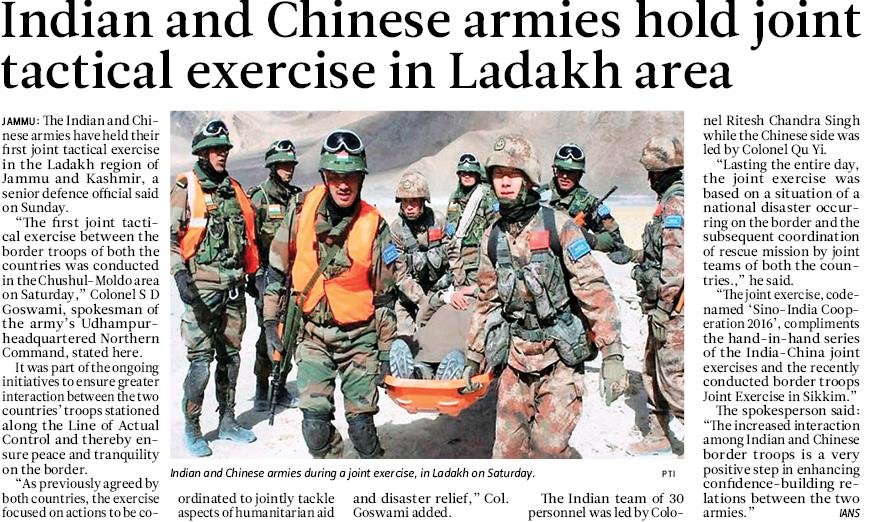
JAMMU: In a significant sign of increasing co-ordination between Indian and Chinese armies, the two held a first ever joint exercise at Chushul, in eastern Ladakh, where they had a face-off in the past.

PTI PHOTOIndian and Chinese army personnel during a joint exercise in Ladakh on Saturday.“The border troops of the two armies had the first joint tactical exercise at Chushul-Moldo on February 6. It is a part of ongoing initiatives to ensure greater interaction between troops stationed along the line-of actual-control (LAC) to ensure peace and tranquility on the border,” defence spokesperson Colonel SD Goswami said.

The two armies had decided to hold joint hand-to-hand exercises after Lt Gen DS Hooda, head of northern command, paid a threeday visit to China last December. The first exercise as part of the series was held in Sikkim.
“Holding joint exercise at Chushul is quite significant, reflecting that China intends to keep peace along the LAC and cooperate with the Indian army,” said a senior army official on condition of anonymity.

The two armies had a fierce engagement at Chushul in the 1962 Indo-China war. There have been many instances of Chinese incursion in this area in the past as well.

Army spokesperson said the Indian army team of thirty personnel was led by colonel Ritesh Chandra Singh while the Chinese delegation was led by Colonel Qu Yi. The day-long joint exercise was about co-ordination between the two armies in the event of a natural disaster.

Sources during Lt Gen Hooda’s visit said the two armies had agreed to have four more border-personnel -meeting (BPM) points, two in Ladakh and two in Arunachal Pradesh.

60794

A first: Chinese, Indian troops meet for disaster mgmt drill

A first: Chinese, Indian troops meet for disaster mgmt drill
The first joint Indo-China tactical exercise between border troops of both countries was conducted in the Chushul-Moldo area. Tribune Photo

Sumit Hakhoo,Tribune News Service

Jammu, February 7

The Line of Actual Control (LAC) in Eastern Ladakh, often in news for standoff between Indian and Chinese soldiers, saw the first-ever joint tactical exercise between the two armies to tackle natural disasters.The day-long humanitarian relief exercise conducted in sub-zero temperature in the remote Chushul-Moldo area of Jammu and Kashmir saw soldiers jointly conducting rescue missions, casualty evacuation and providing humanitarian aid in a situation of calamity striking areas close to the LAC.At the height of 4,360 m, Chushul is prone to cold and snow-related disasters. The exercise assumes significance in the backdrop of recent avalanche in Siachen. Soldiers guard remote outposts in the area and several small nomadic settlements are present on both sides of the LAC.The Indian team of 30 Army personnel was led by Colonel Ritesh Chandra Singh, while the Chinese team was led by Colonel Qu Yi.Chushul is one of the four officially agreed BPM (border personnel meeting) points for regular interaction between the two armies to defuse tension.“The joint exercise was based on a situation of a national disaster occurring on the border and the subsequent coordination for a rescue mission by joint teams of both countries. As previously agreed, the exercise focused on actions to be coordinated to provide humanitarian aid and disaster relief,” said a defence spokesperson.India shares 3,488-km de facto border with China and is divided into three sectors—western sector (between Ladakh and Aksai Chin plateau); central sector (between Uttarakhand and Tibet) and the eastern sector (covering Sikkim and Arunachal Pradesh). Jammu and Kashmir has seen frequent transgressions over the past few years.The joint exercise, Sino-India Cooperation 2016, complements the Hand-in-Hand series of India-China joint exercises and the recently conducted border troops’ joint exercise in Sikkim.

Border bonhomie

  • The day-long humanitarian relief exercise was conducted in sub-zero temperature in the Chushul-Moldo area of J&K
  • Thirty soldiers each from the People’s Liberation Army and the Indian Army took part in the exercise
  • The exercise was based on a situation of a national disaster and the subsequent coordination for a rescue mission, said a defence spokesperson


Modi’s Quest to Achieve India’s Great Power Status

Indian Prime Minister Modi invited French President Hollande to be the guest of honor at India’s Republic Day Celebrations in New Delhi last month. The seat is generally reserved for, and used by the office of the Prime Minister as, a signal of close and important state ties. Last year President Obama was Modi’s guest, which served as the start for a banner year of U.S.-India cooperation, on a broad range of economic, climate, and defense issues. Among others, Washington and New Delhi signed agreements aimed at developing India’s next generation aircraft carrier — an overt signal of joint concern about China’s emerging power in the Indian Ocean and, by extension, the South China Sea. Hollande’s presence is expected to have a similar result, particularly given that it is the world’s fourth largest arms exporter.

India has demonstrated that it has partners in multiple international camps. Some observers expected this year’s guest to be either Pakistan’s Prime Minister Sharif or perhaps even President Putin, to re-emphasize India’s historical orientation toward non-alignment. Thus far, Modi has signaled that India will remained non-aligned, but with the world’s most important arms exporters. In choosing Hollande this year, India may be shedding the strategic ambiguity that has long characterized its foreign policy, and starting to take steps that will ultimately result in it becoming a greater power in our G-Zero world.

As the second-most populous country in the world and its largest democracy, and having a young, energetic and impatient population that yearns to join the ranks of the world’s leading economies, India has all the basic prerequisites to become a Great Power, at least in its own region. Yet, for decades it has failed to live up to its potential, the result of a sclerotic government bureaucracy and extremely diverse ethnic, religious and linguistic composition. Having been founded on an anti-colonial platform, its founders’ distaste for imperial misadventures led to its membership in the Non-Aligned Movement, and modern India has historically been more interested in scolding Great Powers for hubris or exploitation than joining their ranks. Further, its post-independence poverty and self-defeating statist bureaucracy made it impossible for India to project power beyond its immediate periphery. For decades, the Indian political and military class have remained obsessed (to the point of paranoia) about threats from Pakistan, twisting its entire geo-strategic architecture towards its northwest neighbor, hobbling any inclination to look elsewhere for geopolitical opportunities.

Though the Indian government had made small overtures aimed at opening up to the world since the 1990s, its strategic reorientation has accelerated dramatically since the election of Narendra Modi in 2014. New Delhi had, over time, become unnerved by a substantially more powerful and assertive China, which did not share India’s democratic values and was eager to make its presence strongly felt in India’s backyard. The Indian government began to more fully appreciate its relative lack of strategic options, brought on by years of neglect. Modi swiftly began to patch up relations with India’s immediate neighbors, notably Sri Lanka, with Modi becoming the first Indian Prime Minister to visit the island in 28 years. He has been acting with remarkable calm and resolve to improve ties with Pakistan, recently making an unannounced stopover in the country on the occasion of Sharif’s birthday. Modi has also made his presence known in Myanmar, where he has made clear India’s interest in being ‘in the room’ as the new democracy evolves.

This has all afforded Modi the diplomatic space to begin to look farther afield for partnerships with other powers who support the idea of a more regionally-powerful India, and he has done so with enthusiasm. Obama’s presence at the Republic Day Parade was the start of a year of intense Indo-U.S. friendship, which saw a reciprocal visit by Modi to the U.S., a renewal of a nuclear agreement between the two states, and a visit by U.S. Defense Secretary Ash Carter to New Delhi, during which the U.S. indicated a willingness to transfer sensitive aircraft carrier technology to the Indian naval program. Coming on the heels of the Bush Administration’s 123 Agreement, which enhanced India’s civil nuclear program, Indian/U.S. relations have never been stronger.

At the same time, India began strengthening regional ties with Australia and Japan, who share India’s concern about China’s regional ambitions, and formalized procedures for joining them in recurring naval exercises in the Indian and Pacific Oceans, along with the U.S. Think tanks in New Delhi now write openly and regularly of the need to counter China’s growing presence, and the threat posed to Indian interests by Beijing. That said, India clearly still desires to keep more options open than closed.

It should be remembered that Modi also visited Russia and China last year, which, along with all his other travels, has already made him the most-traveled Indian Prime Minister in history. There was a good deal of speculation that Xi Jinping or Vladimir Putin might be Modi’s honored guest this year, making clear to the world that India was still a swing player, not beholden to any single camp. Modi is hedging his bets, however — in essence extending hands of friendship to a wide variety of potential partners while keeping a clenched fist behind his back. India’s historical political, economic and military ties to Russia remain firmly intact. Its growing defense budget continues to source a good deal of materiel from Russia, and the two countries have ambitions to achieve a trade relationship worth $30 billion by 2025.

Modi used Hollande’s visit to very publicly sign a deal for 36 Rafale fighter jets for the Indian Air Force (beating a Russian proposal for Sukhoi jets), as well as extend a 2006 defense cooperation agreement, and, in a historic first, invited a French contingent to march with Indian troops in the event. The message was not ambiguous. So while India’s strategic architecture remains small for a country of its size, the task of transitioning to Great Power status remains enormous, and the possibility for its derailment remains real. Much remains to be done.

Modi has, however, made clear by his repeated overtures to a series of strategic potential allies, that India is and wants to remain at the table. India’s new strategic thinking is coming into focus. For the first time, it is reasonable to imagine that a contingent of the Indian Brigade of the Guards could march down the Champs Elysees during Bastille Day. Modi’s message is clear: the days of strategic ambiguity will remain, but there is no ambiguity about its long-term economic, political, and military ambitions. While India is not Russia or the U.S. in terms of its global reach or strength, it is, apart from China, the emerging country with the most potential to achieve Great Power status this century. It will take a great deal of concerted reform, persistent effort, and devoted financial and military resources to achieve that, but Modi has set India on that path.

*Peter Marino is an international political analyst specializing in Northeast Asian affairs and international political economy. He produces and hosts the global politics web series Globalogues. Daniel Wagner is CEO of Country Risk Solutions and co-author of the forthcoming book “Global Risk Agility and Decision Making” (Macmillan, May 2016).


PATHANKOT ATTACK FALLOUT IAF bases in Western sector on alert; shoot-at-sight orders issued

2016_2$largeimg03_Wednesday_2016_183733882
Indian Air Force personnel stand on the roof of a building at the Pathankot base on January 4, 2016. — AFP

Indian Air Force personnel stand on the roof of a building at the Pathankot base on January 4, 2016. — AFP

New Delhi, February 3

The Indian Air Force has issued shoot-at-sight orders against anyone attempting to scale the walls of the bases under sensitive Western Air Command in the backdrop of the terror attack on the Pathankot air base in Punjab.

“All bases in the Western Air Command have been put on high alert. Shoot-at-sight orders have been issued against anyone attempting to enter the base by scaling the perimeter wall or through unauthorised access,” a senior IAF officer said.

The IAF has also asked the government to strictly impose the ban against construction within 100 metres of any air base and within 900 metres of its ammunition depot.

Replying to queries about an insider possibly having had a role in the Pathankot attack, he said that the NIA was investigating this angle but a preliminary probe by IAF has not found anything to substantiate such a suspicion.

Describing the Pathankot attack as a “learning experience”, the official said that IAF is in the process of finalising a Rs 8,000-crore comprehensive security proposal for its 54 main flying bases in the country.

That will include smart perimeter intrusion system, CCTVs, motion detectors, quadro drones, among other things. The cost will come to about Rs 100-150 crore per base, he said.

The officer said, “These proposals were already in the pipeline. Because of financial constraints, we are doing it in a phased manner. Our first focus was to protect the main assets and then move to the perimeter wall.” He said the government has told the IAF that there will be no financial constraints for these works.

“The proposal is being prepared. We hope to get it going as soon as possible,” he said, adding that the IAF is fast-tracking the process.

The IAF has completed a special audit of all its 950 flying and non-flying establishments.

He said two teams from the Directorate of Air Staff carried out the audit of the bases.

“No major weaknesses were found in the audit,” he said, adding that similar audits are conducted every six months.

The official explained that no two air bases were the same and the IAF will put in place a customised security system for each.

Asked whether the Western air bases will be given priority, he said that even the bases in the Eastern sector are under threat and modernisation would be done on the basis of threat perception.

The IAF would also be raising more Garud commandos and the perimeter wall would continue to be manned by personnel of the Defence Security Corps, he said.

The official added that another priority was to remove encroachments around the bases. — PTI


Days later, govt struggles with its own paralysis

Days later, govt struggles with its own paralysis

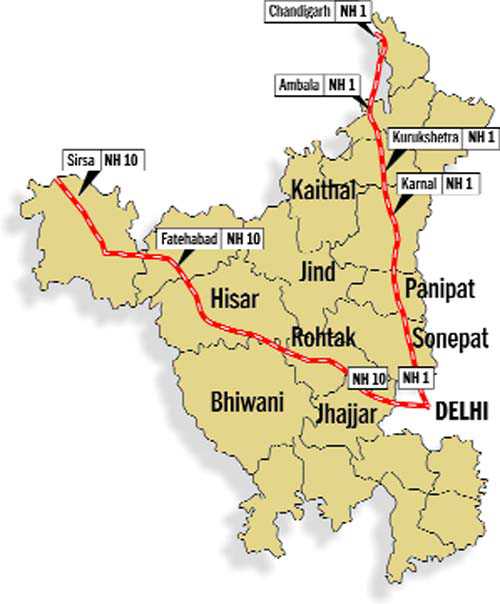
The fire that has scalded the traditional social and cultural ties between the chattis biradris was set off on Valentine’s Day, when the world was exchanging the message of love. Ever since Jats were perceived to be ‘displaced’ by the BJP’s non-Jat-dominated Manohar Lal Khattar government in October 2014, an uneasy calm has prevailed in the community. Many Jats found consolation in the promise by the chief minister to implement reservation in jobs and educational institutions.Fatigued by assurances, community leaders displayed restlessness as the government delayed its response following legal hurdles. Also, the BJP remained tongue-tied as its Kurukshetra MP Raj Kumar Saini openly chided the Jats. This is perceived as a precurser to the unprecedented anarchy across the state. Yet right from day one, the failure of the government machinery to deal with the emerging situation was visible. There was no heads-up for the “inexperienced” BJP leadership as to how to deal with the quickly unfolding volatile situation. Civil servants and district administration kept waiting for directions, which never came.”When Haryana was burning, the state police turned into mere information gatherers. All they did was brief their political bosses about the nature and the extent of damage. The advice of some officers, such as the IG Rohtak, forewarning the government about calling in paramilitary forces were ignored. In hindsight, the same officer has been transferred and suspended for dereliction of duty,” says a senior Haryana minister.The Jats’ Swabhiman rally at Sampla in Rohtak was a warning enough. The Hindi word ‘Swabhiman’ (self-respect) was chosen in response to a series of ‘invectives’ unleashed by Saini. Temperatures were rising as some youths were not ready to wait any longer for a government response to their ultimatum till March 31. This led to ‘direct action’ to block the National Highway-10.Moderates among the agitators demanded a Jat leader must assure them of reservation. Since both Jat leaders in the state cabinet, Captain Abhimanyu and OP Dhankar, were not available on February 14, no such assurance came. Yet the agitators agreed to lift the blocked if the district administration took their memorandum to the CM. The deputy commissioner spoke to some leaders on phone, but avoided a one-on-one. Humiliated, the agitators started blocking other roads. The agitation had by then began to be run by “invisible forces.” When Dhankar spoke to the CM in the presence of Captain Abhimanyu on February 15 in Rohtak amid the swearing-in of panches and sarpanches, Khattar announced that the government would wait till March 31 for the report of a committee set up to deal with the issue. The Jat agitators felt the government was merely buying time. They started blocking more roads. By Feb 17, Rohtak town came to the emerging might of the Jat protesters. The next day, non-Jats expressed their bitterness and frustration over road blockades and disruption of normal life. Local traders took out a procession that was seen as an ‘anti-reservation’ march. The government’s inability to assess the gravity of the situation set the stage for the havoc that followed. A small clash led to rumours about Jat agitators having been beaten up. Hundreds of Jats from adjoining villages gathered in Rohtak. The police cracked down on Jat students who they alleged had thrown stones at them. The police went inside Jat College and Neki Ram Sharma College and singled out the students after checking their identity cards. All this only added fuel to the fire. For the agitators, it was time to for ‘revenge’. They went to the local IG Office and damaged the property, vandalised the local RN Mall, looted guns and ammunition from a private armoury, burnt vehicles and finally set the house of Finance Minister Captain Abhimanyu, with his family members inside, on fire. The protesters also burnt down schools.The rioting then, shifted to neighbouring Jhajjar and Bhiwani. Meanwhile, the Centre realised that the situation was beyond Khattar’s control. BJP chief Amit Shah called Khattar on Feb 20 and told him to step back. The ‘war room’ shifted to Delhi where Finance Minister Arun Jaitley, Defence Minister Manohar Parrikar and Minister of State for Home Affairs Kiren Rijiju met at Home Minister Rajnath Singh’s residence. State BJP leaders also met separately and concluded that announcing reservation for Jats was the only way out. This was meant to douse the fire. Instead, another squabble began, this time within the BJP with the Jat and non-Jat ministers taking divergent views. Health Minister Anil Vij has let it be known that those who indulged in arson and violence cannot be given compensation. Education Minister Ram Bilas Sharma, while briefing the media, did not say anything about the compensation part. Even when his briefing was on, Dhankar tweeted that families of those killed will be given a job and Rs 10 lakh compensation besides protection against registration of false cases. Sharma came back to the media and repeated Dhankar’s tweet. Non-Jat ministers are opposed to this announcement, causing a vertical split in the Khattar cabinet.As normalcy returns, incidents of inhuman tragedy, tales of horrors like the Murthal gang-rape are coming out. The administrative machinery is clearly divided on caste lines with officials taking a stand based on their loyalty to political masters. The manner in which government machinery failed is apparent from the trail of destruction left behind.

Worst affected

  • Rohtak
  • Jhajjar
  • Bahadurgarh
  • Hisar
  • Bhiwani
  • Jind
  • Gohana
  • Sonipat
  • Kaithal
  • Karnal
  • Panipat

Death toll

  • Jhajjar 13
  • Sonepat 8
  • Rohtak 5
  • Jind 2
  • Kaithal 1
  • Hisar 1

Saw women being molested, say truckers

Tribune News Service

Chandigarh, February 27

More witnesses have mustered the courage to speak about the horror on NH-1 near Murthal in the wee hours of February 22 with four of them telling the media that they had seen women, their clothes torn, being dragged out of their vehicles and taken to nearby fields by armed goons.Police personnel have now been deployed at the Ghannaur-Murthal stretch where the women were allegedly raped. Chief Minister ML Khattar told mediapersons today that he was considering setting up a special team comprising women officer to look into the allegations.Meanwhile, the three-member team headed by DIG Rajshree today visited the “crime site”. One of the members said they had been receiving obnoxious calls after their phone numbers were made public yesterday.An eyewitness said not had he seen women being molested, but infants being roughed up too. They said the goons, some riding motorcycles, chased and attacked the terrified women as they cried out for help. But there was no policeman to rescue them. “Calls on 100 went unattended,” he alleged. Truck driver Yadvendra, a resident of Fatehgarh Sahib, said,“I was stranded near Apollo School on NH-1 on February 22. I saw youths  smashing windowpanes and setting vehicles ablaze.” He said he was robbed of his bag containing Rs 6,500. “As I ran towards the fields to save myself, I saw several goons molesting women,” he said.Trick driver Niranjan of Pathankot, who was also stranded near Apollo School, said: “I saw hooligans torching vehicles. Some youths asked stranded women to escape to nearby villages. This was a trap. I did not see women being raped, but their shrieks said it all.”Sukhwinder Singh, whose vehicle was torched, said: “It was near Pipli Khera village (near Ghannaur) that women were molested and their children dragged away.”Satbir Satti of Adampur, who was on his way to Delhi on February 22, said he saw two women (he later learnt they were NRIs)  running helter and skelter without slippers and dupattas as a mob chased them. Satti, whose Ertiga car was set ablaze, said: “While one woman was from Calgary, the other was from Edmonton. I heard people saying they had seen hooligans dragging women to nearby fields.”Satti’s neighbours said he had narrated the horrific incident to them on his return from Delhi on February 25. “My aunt, whom I was to drop at the airport, is yet to come to terms with what she saw that day. She too had to hide herself in a dhaba,” he said.(Inputs by Parveen Arora, BS Malik and Deepkamal Kaur)