Sanjha Morcha

‘Son’s martyrdom a proud moment’

‘Son’s martyrdom a proud moment’
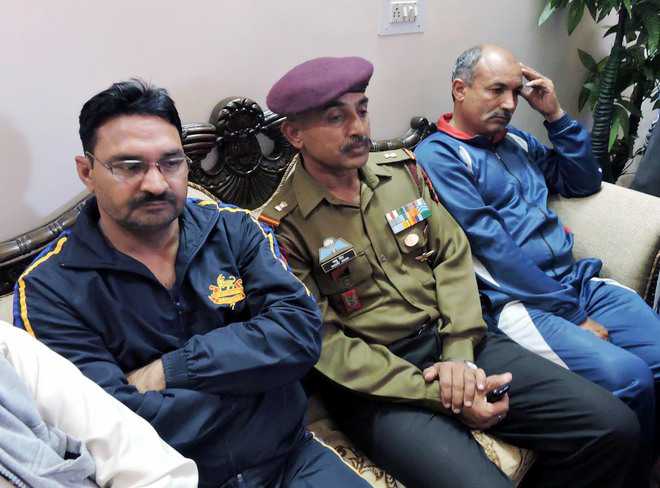
Capt Pawan Kumar Khatkar’s father (left) at his home in Jind.

N Kalia

Jind, February 21

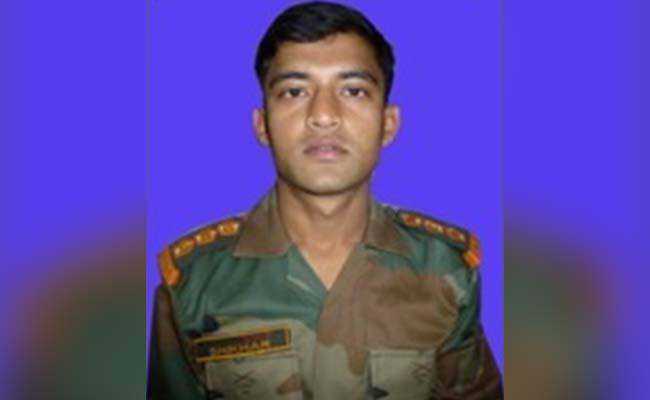
The family of Captain Pawan Kumar Khatkar is proud of the supreme sacrifice made by their son for the motherland. Captain Pawan Khatkar (23) of the 10 Para was killed in an encounter with militants in the Pampore area of Jammu and Kashmir in the wee hours today. He will be cremated at his native Badana village with full military and state honours on Monday. His body will be brought to Jind in an aircraft.Captain Pawan Khatkar was the only son of his parents. His father Rajbir Khatkar said it was a proud moment for them when they came to know about the martyrdom of their son this morning. The headmaster of Government School in Budha Khera village of Haryana’s Jind district, Rajbir said: “I received a phone call at 3 am and one of the colleagues of Pawan told me that my son had got injured in the encounter. Later, I received another call in the morning from the regiment headquarters, confirming his martyrdom.”“I talked to Pawan for the last time on Friday. He told me about the ongoing encounter with militants in the Pampore area,” said Rajbir. He said: “To join the Army was Pawan’s childhood dream. He was selected for the National Defence Academy, Khadakwasla, in 2009. Later, after being trained at the Indian Military Academy, Dehradun, he was commissioned into the Army in 2013.” “Initially, Pawan was recruited in the 7 Dogra Regiment but later joined the 10 Para. Pawan was serving in Jammu and Kashmir since September 2015 and it was his fourth operation against terrorists in the Valley,” he further said.“My son was very efficient and a brave officer. He was the first to join the Army in our family,” said Rajbir. “Last month, Pawan had come home on leave. It was our last meeting with him,” said Rajbir. 

Army appeals to Haryana for martyr’s funeral

  • As the agitation by Jats in Haryana rages on, the Army has appealed to the people of the state to extend their full support for a befitting farewell to Captian Pawan Kumar, who died fighting militants in J&K on Sunday. The mortal remains of the martyr will be flown to Jind on February 22 as the road traffic is disrupted due to the law and order situation in Haryana. The last rites with full military honours will be held at his native village on Monday. “I had one child, I gave him to the Army and to the nation. No father can be prouder,” said Rajbir Singh, Captian Pawan Kumar’s father.

Curfew in Jind after 5 rly stations torched

Curfew in Jind after 5 rly stations torched
The Army takes out a flag march in Jind on Saturday. Tribune photo

N Kalia

Jind, February 20,Curfew was imposed in Jind district after Jat protesters set afire Budda Khera, Pilu Khera, Uchana Mandi, Kinana and Jullana railway stations. To monitor the situation, Additional Deputy-General of Police (ADGP) BK Sinha rushed to Jind. At the Budha Khera railway station in Safidon subdivision, mobs carrying petrol cans ransacked the office of the Station Master and burnt the office record. Thereafter, the mobs targeted the Jullana railway station, the Jullana police station, fire station, market committee office and Haryana Roadways buses. At 2 pm the protesters ransacked the Kinana railway station. There was none to stop them. At 3 pm, the railway station at Uchanna Mandi was set ablaze and two railway engines  were destroyed.  The Pilu Khera railway station was also torched and an engine damaged.  Though senior Jat leaders met the DC in the morning and assured him that the stir would be peaceful, by noon a huge mob, including women, blocked the Gohana road and disrupted traffic. A group of protesters tried to enter the local bus stand but dispersed after the DC ordered shoot-at-sight orders. Later in the afternoon, demonstrators targeted Saini dharmshala and set afire a store room. Provoked, members of the Saini community came on to the roads and threw stones on Jat Dharmshala located in the same locality. Deputy Commissioner Vinay Singh and Superintendent of Police Abhishek Jorwal rushed to the site. Though the police resorted to a lathi charge, it failed to clear the street of the violent mobs.    The DC said the administration would act against the anti-social elements.

Curfew in Hisar, Hansi

Hisar: The incidents of violence were reported in Hisar and Hansi on Saturday. A man was injured in firing, while a motorcycle agency was set afire in Hansi.  The district administration imposed curfew from 8 pm on Saturday to 6 am in both towns. 

660 trees axed in Jind for road blockades
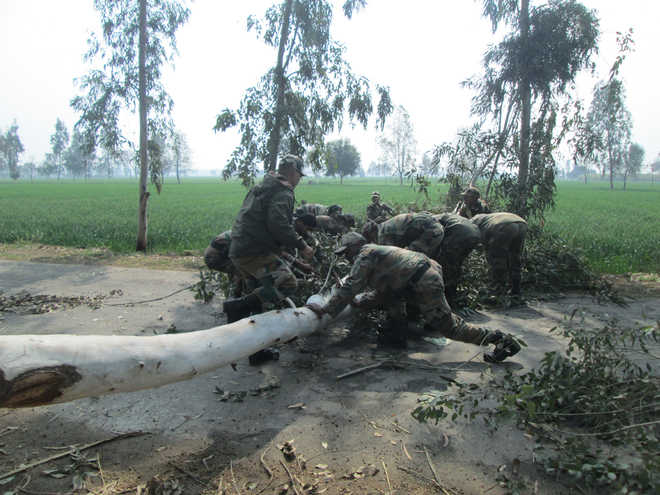
660 trees axed in Jind for road blockades
Army personnel remove a tree to clear the road in Madanheri village of Hisar. Tribune photograph

N Kalia

Jind, February 20

Jat protesters axed more than 660 trees for blocking roads in the district. The trees were felled mostly on the Jind-Bhiwani and Jind-Safidon roads.District Forest Officer (DFO) Ranbir Singh Dhull said it was unfortunate that various species of nearly 664 trees were felled illegally in the district. The number could increase after a detailed assessment, he said. “Forest guards are monitoring the situation and maintaining the record of the axed trees,” he said.Dhull said: “We will lodge complaints against the protesters responsible for cutting the trees and seek strict action against them.” Sources said some protesters were using the wood for their household purpose also.Apart from the Forest Department, the Jind depot of the Haryana Roadways was facing a revenue loss of Rs 9.5 lakh everyday. The public transport in the district was collapsed and around 180 buses were off the road and parked at the Jind, Narwana and Safidon bus stands.Jind depot General Manager Rahul Jain said: “We have totally suspended the bus service in Jind and Narwana. We tried to resume the service in Safidon subdivision this morning, but later suspended it.”Around 19 buses left for Delhi, Chandigarh, Panipat and Jaipur before 10.30 am, he said. “We have decided to suspend the service again after the agitation was intensified,” he said.

HARYANA BURNING

Dhankar’s house attacked in Jhajjar

Jhajjar: Four persons were killed and 10 others, including policemen, were injured in crossfire between Jat protesters and Army personnel near the Jahan Aara stadium in Jhajjar on Saturday. The injured have been admitted to the Jhajjar Civil Hospital, where the condition of some of them is stated to be critical. The mob attacked the local residences of Agriculture Minister Om Prakash Dhankar and BJP leader Anand Sagar. The protesters blocked Bhagat Singh Chowk for over an hour by placing the bodies there. The protesters clashed with Army and police personnel in the afternoon when they tried to stop them going ahead. They later set the Jhajjar police station, BDO office, PWD rest house, buses, DIPRO’s jeep and several vehicles on fire. Despite curfew in the city, some villagers took out a protest march and raised slogans against the government. TNSRohtak-Panipat toll plaza set on fire Panipat: Dahar toll plaza on the Panipat-Rohatk National Highway-71A was on Saturday set on fire by Jat agitators. They also set two motorcycles on the fire. A large number of Jats from neighbouring villages reached the Dahar toll plaza and set it on fire after breaking gates of the toll plaza. They also set two motorcycles on the fire. On the other hand, the protesters blocked the Panipat-Haridwar road at three places. They also blocked roads near Nimbri village, Ugrakheri and at Sanoli naka. TNSCabinet Secretary reviews law and order   New Delhi: Reviewing the law and order situation in Haryana where the pro-reservation protest by the Jat community is escalating, Cabinet Secretary PK Sinha on Saturday said that the safety of the people and protection of property should be given top priority. Sinha, who reviewed the law and order situation in Haryana via video conferencing with Chief Secretary Haryana and DG Police, said maintenance of peace and harmony should be of utmost priority. BJP president Amit Shah had earlier instructed the party’s Haryana Jat leaders to pacify the pro-reservation agitation in the state by holding talks with the protestors, sources said. The development came after the leaders of BJP’s Haryana unit Sanjeev Balyan, Om Prakash Dhankar, Anil Jain and Ram Lal held a meeting at party office today. TNS

Army vehicles stopped

Hisar: Jat protesters on Friday stopped Army vehicles going towards Rohtak from Hisar cantonment in Madanheri village of the Narnaund block. They were allowed to proceed towards Rohtak on Saturday after the village elders persuaded the protesters to lift the blockade. Sources said the Army personnel were on their way to Rohtak via an alternative route, as National Highway no.10 was blocked. When they reached Madanheri village, a group of youths blocked their way by felling trees on the road. They refused to give way the Army men due to which they had to stay in the village. TNS

Delhi water supply hit

Sonepat: The canal water supply to Delhi through Delhi branch of West Yamuna Canal and Delhi Parallel Carrier Channel was on Saturday stopped by Jat protestors. Both the channels are having water carrying capacity 1085 cusecs, which is released by removing the iron control panels installed near Garhi Bindroli village in the district. The protestors had even rooted out parts of iron control panels. According to irrigation department officials, the stoppage of supply will create drinking water problems in many areas of Delhi. OCHooda to go on fastNew Delhi: Former CM Bhupinder Singh Hooda said he would go on a fast at Jantar Mantar on Sunday to reiterate his call for peace in the violence-hit state.  “The agitation has taken such a turn that it’s not going to benefit anyone. Some people have been killed and I offer my condolences,” said Hooda. He also appealed to the protesters to fight against the “divisive forces” trying to create a gulf in the society. ANI

Dance clip goes viral

Chandigarh: A video showing a group of Jat youths dancing to the tune of a reservation song has gone viral on social media. The one-minute video shows youths putting up road blockades at Narwana in Jind district yesterday and dancing to a song “kaun Jat ne rokega, jo soch liya vo karna”. The youths could be seen dancing in the middle of the road, disrupting traffic. PTI

Flag march in Rohtak

Rohtak: The Army and the police staged a flag march from the Police Lines till the MDU campus in Rohtak where a large numbers of protesters were on dharna. The protesters did not budge despite repeated warnings. TNS

NH-1 blocked in Sonepat

Sonepat: Jat protesters today blocked National Highway no.1 (GT Road) near Nangal Kalan village in Sonepat district. Armed with lathis, a large number of agitators from different villages reached GT Road to strengthen the blockade. District Magistrate Rajiv Ratan has ordered curfew in Gannaur and Kundli for 24 hours.  In Gohana, three roadways buses, several shops and a petrol pump were set on fire. OCSarpanches seek action against ‘miscreants’ Gurgaon: Newly elected sarpanches in Gurgaon today urged Chief Minister Manohar Lal Khattar to deal strictly with the people, who were behaving like “miscreants”, destroying public property and firing at the security forces. Over five village heads of places close to Gurgaon city such as Sikanderpur (Badha), Shikohpur, Nakhraula, Manesar, Rampura and Tikli held a panchayat here. “It was unanimously decided that villagers will support the state government and we are ready to cooperate with the administration,” one of the organisers said. “Is it the right way to express one’s views and demand reservation in OBC category?” they asked. IANS

Lahore-Delhi bus service affected

1b303a66-5fc1-42c7-8e06-9330885184fe ef7f2774-4d80-40f5-a65d-8b3c98f7f26b


2016_2$largeimg21_Sunday_2016_010543150gallery 2016_2$largeimg21_Sunday_2016_010544967gallery 2016_2$largeimg21_Sunday_2016_010546639gallery 2016_2$largeimg21_Sunday_2016_010547605gallery 2016_2$largeimg21_Sunday_2016_010551204gallery 2016_2$largeimg21_Sunday_2016_010554687gallery


International Fleet Review 2016: Glimpses of Indian Navy’s majestic display

navy-fleet-759

Visakhapatnam: President Pranab Mukherjee accepting the guard of honour at the International Fleet Review and Flypast in Visakhapatnam on Saturday. PTI Photo(PTI2_6_2016_000053B) *** Local Caption ***
Visakhapatnam: President Pranab Mukherjee, Prime Minister Narendra Modi, Defence Minister Manohar Parrikar (L) and Chief of Naval Staff Admiral RK Dhowan (2nd L) at the International Fleet Review and Flypast in Visakhapatnam on Saturday. PTI Photo(PTI2_6_2016_000056B)
Visakhapatnam: Prime Minister Narendra Modi inspecting the Guard of Honour at the International Fleet Review in Visakhapatnam on Saturday. PTI Photo (PTI2_6_2016_000090B)
Indian aircraft carrier Vikramaditya is seen during the final rehearsal of International Fleet review in Vishakapatnam, India, Thursday, Feb. 4, 2016. Vikramaditya is a modified Kiev-class aircraft carrier which entered into service with the Indian Navy in 2013. Indian President Pranab Mukherjee, who is the supreme commander of the armed forces, will review a fleet of nearly 70 naval ships including several from foreign countries on Feb. 6, 2016.  (AP Photo/Saurabh Das)
Indian aircraft carrier Vikramaditya is seen during the final rehearsal of International Fleet review in Vishakapatnam, India, Thursday, Feb. 4, 2016. Vikramaditya is a modified Kiev-class aircraft carrier which entered into service with the Indian Navy in 2013. Indian President Pranab Mukherjee, who is the supreme commander of the armed forces, will review a fleet of nearly 70 naval ships including several from foreign countries on Feb. 6, 2016. (AP Photo/Saurabh Das)
Indian aircraft carrier Vikramaditya is photographed in the foreground during the final rehearsal of International Fleet review in Vishakapatnam, India, Thursday, Feb. 4, 2016. Vikramaditya is a modified Kiev-class aircraft carrier which entered into service with the Indian Navy in 2013. Indian President Pranab Mukherjee, who is the supreme commander of the armed forces, will review a fleet of nearly 70 naval ships including several from foreign countries on Feb. 6, 2016.  (AP Photo/Saurabh Das)
Indian aircraft carrier Vikramaditya is photographed in the foreground during the final rehearsal of International Fleet review in Vishakapatnam, India, Thursday, Feb. 4, 2016. Vikramaditya is a modified Kiev-class aircraft carrier which entered into service with the Indian Navy in 2013. Indian President Pranab Mukherjee, who is the supreme commander of the armed forces, will review a fleet of nearly 70 naval ships including several from foreign countries on Feb. 6, 2016. (AP Photo/Saurabh Das)
An Indian naval helicopter demonstrates a rescue operation in front of an Indian naval ship carrying Indian President Pranab Mukherjee, during International Fleet Review in Vishakapatnam, India, Saturday, Feb. 6, 2016. Mukherjee, who is the supreme commander of the Indian armed forces, reviewed a fleet of over 90 naval ships including several from foreign countries.  (AP Photo/Saurabh Das)
An Indian naval helicopter demonstrates a rescue operation in front of an Indian naval ship carrying Indian President Pranab Mukherjee, during International Fleet Review in Vishakapatnam, India, Saturday, Feb. 6, 2016. Mukherjee, who is the supreme commander of the Indian armed forces, reviewed a fleet of over 90 naval ships including several from foreign countries. (AP Photo/Saurabh Das)
Indian naval ships are seen during the final rehearsal of the International Fleet review in Vishakapatnam, India, Thursday, Feb. 4, 2016. Indian President Pranab Mukherjee, who is the supreme commander of the armed forces, will review a fleet of nearly 70 naval ships including several from foreign countries on Feb. 6, 2016.  (AP Photo/Saurabh Das)
Indian naval ships are seen during the final rehearsal of the International Fleet review in Vishakapatnam, India, Thursday, Feb. 4, 2016. Indian President Pranab Mukherjee, who is the supreme commander of the armed forces, will review a fleet of nearly 70 naval ships including several from foreign countries on Feb. 6, 2016. (AP Photo/Saurabh Das)
Indian sailors on Viraat aircraft carrier salute as Indian president's yacht moves past them during the final rehearsal of International Fleet review in Vishakapatnam, India, Thursday, Feb. 4, 2016. Indian President Pranab Mukherjee, who is the supreme commander of the armed forces, will review a fleet of nearly 70 naval ships including several from foreign countries on Feb. 6, 2016.  (AP Photo/Saurabh Das)
Indian sailors on Viraat aircraft carrier salute as Indian president’s yacht moves past them during the final rehearsal of International Fleet review in Vishakapatnam, India, Thursday, Feb. 4, 2016. Indian President Pranab Mukherjee, who is the supreme commander of the armed forces, will review a fleet of nearly 70 naval ships including several from foreign countries on Feb. 6, 2016. (AP Photo/Saurabh Das)
Visakhapatnam: President Pranab Mukherjee (C), Prime Minister Narendra Modi, Defence Minister Manohar Parrikar (L) and Chief of Naval staff Admiral R K Dhowan (2nd L) at the International Fleet Review and Flypast in Visakhapatnam on Saturday. PTI Photo(PTI2_6_2016_000070B) *** Local Caption ***

Finally, OROP implementation tables issued

OROP

he government had taken the historic decision to implement OROP in November, 2015. Ministry of Defence says OROP, the long-standing demand of the defence forces personnel for 42 years, will benefit over 18 lakh ex-servicemen and war widows. Here are some details of today’s order:  • The annual recurring financial implication on account of implementation of OROP at the current rate will be approximately around Rs 7500 crore. • The arrears from 01/07/2014 to 31/12/2015 would be approximately Rs10,900 crore. • 86 percent of the total expenditure on account of OROP will benefit the JCOs/ORs. • Payment of arrears and revision of pension under OROP is to be made by the Pension Disbursing Authorities in four instalments, except for family pensioners and pensioners in receipt of gallantry awards who will be paid arrears in one instalment. • The total increase in the Defence Budget for pensions is estimated to go up from Rs 54,000 crore (BE 2015-16) to around Rs 65,000 crore (proposed BE 2016-17), thereby increasing the Defence Pension Outlay by about 20 per cent. OneIndia News

Read more at: http://www.oneindia.com/india/finally-orop-implementation-tables-issued-2002368.html


The Army is more than war ready

Today’s military leadership is better trained with vast professional experience comprising counter-insurgency operations and high-altitude warfare. The Army has trained with world armies and UN peace-keeping missions. So to say the Army cannot conceive a conventional war is a figment of the imagination.

The Army is more than war ready
Soldiers of the Indian Army fire a Bofors gun during Exercise Sarvatra Prahar at Army’s School of Artillery in Devlali, Maharashtra. AFP

On February 15, in these pages, Pravin Sawhney had argued (‘The Army is not war ready’) that the Indian Army was distracted from its ideal readiness for war. Lt-Gen(retd) RS Sujlana gives a contrary view.A vast array of factors combine to ensure that an army is ready for war, but the tenacity of men and women who make up the force, their wherewithal and the will of the nation to war are the three main factors. Mr Sawhney has agreed that as the Army has not fought a conventional war after 1971 and has been involved in counter-insurgency operations (CI ops) for nearly a quarter century, the senior leadership of the Army cannot conceive the concept of  conventional war. In addition, having erected a fence along the Line of Control (LC) to limit infiltration, the Army has developed an inbuilt Maginot Line, or defensive mentality which today denotes the physical, mental and psychological limit of war-fighting! He questions whether the Army wishes to be a glorified Para-Military Force (PMF). If this was not enough the article goes on to state, “that the people of India do not know what the Army is supposed to do”. When the word Army is used it is a direct reflection on the officers, JCOs and other ranks of the entire force. Thus, a brief examination of how the Army (and its’ men) have stood and will stand for the nation and the issues raised to assess how wrong the starting premise is follows. The post-Independence military history bears testimony to the multi-tasking capability and true grit of the Army in handling crisis after crisis. Four months into freedom and the Army had a war at hand, the Indo-Pak War, 1947-48. The Army at that time was still reorganising itself, experience and numbers of military leaders were at a premium, but still the Army went forth to drive out the Pak intruders with tremendous credit. However, contrary to advice, the political leadership hurried into a ceasefire under the aegis of the UN, eluding a total victory. The political leadership still did not feel the necessity of strengthening the armed forces (opining that the nation could well do with just a police force). A laissez-faire attitude continued and as it cuddled up to China, no effort was made to rejuvenate the armed forces. This flawed policy saw the heart-breaking outcome of the 1962 War with China. The Army was ordered to throw out the Chinese. With what? No one could answer. Even the Air Force was kept out of action. But still, the Army fought resiliently and valiantly with archaic weapons, limited ammunition sans winter clothing to name a few; the war was lost but the enemy could not break the spirit of the Army. After this debacle, the Army started to expand in 1963. The Army’s tryst with counter-insurgency operations had already begun in Nagaland. In the midst of this expansion and training of new units, the Army (and the Air Force) fought the Indo-Pak War of 1965, defeating a Pakistan Army equipped with latest weapons (like the famous Patton tanks and Sabre Jets) and drove them to dust. However, the political leadership was again found wanting and all captured areas were returned to Pak without weighing their strategic significance. Something similar seems to be brewing up now with calls of pulling back from an expensive battleground — the Siachen Glacier. Guess, some people will never understand strategic concerns. In the ensuing six years, the Army’s involvement in CI in the North-East had increased manifold but come the 1971 War, the Army amazed the world with their blitzkrieg historic victory. The political leadership again failed to garner any leverage; over 90,000 Pak prisoners were returned without resolving any issue; rather the enemy played truant and retained 54 of our prisoners who never returned home. Today, they are totally forgotten by the nation. In construing the traits of the present lot of senior officers, it hints that they lack the offensive spirit. Far from the truth as this obviously implies that the resilience, offensive spirit, camaraderie and the will to fight and win is not required in battling at the highest battlefield in the world at Siachen (since 1984) and CI ops, as this is where the Army has fought continuously post- the 1971 War. How very wrong can they be, inherent in such ops are not only these traits but much more. If this was not so, Col Gurung, Commanding Officer, 19 Madras, with the unstinted support of his seniors, would not have personally directed the super-human effort to pull out his 10 men from below tonnes of snow at the staggering height of 20,000 feet. This included one still alive, the now-legendary Hanumanthappa. Does anything more need to be said about the required traits which made this happen and the officer-man relationship in the Army? Forgotten, perhaps, is also the victory in the 1998 Kargil War, where it was all blood, guts and offensive actions. Ironically, here too, the soldiers carried the day and fought with “whatever they had” in the words of General Ved Malik, the then Army Chief. Are the LC Fence and the Maginot line the same? Definitely no, their aims are/were poles apart. Let not the LC Fence be confused to be a part of the conventional defensive concept. Moreover, wherever there is an obstacle (like a minefield or wire obstacle) offensive plans exist to strike the enemy. So has this created a defensive mindset? The answer is again, “no.” Needless to say, the cost-effectiveness of the fence is indeed debatable.  Yes, without doubt there are large deficiencies in arms and equipment and these continue to grow by the day. These telling deficiencies are likely to continue in the near future, with the defence budget at an abysmal 1.74 of the GDP, almost at the same level as it was prior to the 1962 conflict.  The political leadership has to come out of the proverbial ostrich syndrome and show predilection for the armed forces and provide them not only the required wherewithal, but ensure their rightful status, dignity, pay and allowances. The Army can well do without being involved in CI ops, but to say that the Army is only training for CI ops is remissness. Regular and appropriate time is being spent on conventional roles, rather even in Jammu and Kashmir, the troops deployed along the LC on defensive positions remain acquainted with their conventional role which does have its’ fair share of offensive action plans. With regard to offensive actions like hitting terrorist camps in Pakistan Occupied Kashmir, it is for the government to decide and direct the Army to implement. Will the Government’s real politik allow this? It is not for the Army to decide. Criticism is important but when someone decides to outrightly condemn the Army or any other organisation, there is a need to balance out views. At the risk of being branded intolerant, some censorship is warranted. The Army is physically, mentally and psychologically prepared to fulfil its roles and offensive soldiering is their forte’! Let there be no doubt about their fighting competence. The writer is a former Commandant, the IMA and former Chairman of the PPSC.



Siachen tragedy: Soldiers brought home

2016_2$largeimg15_Monday_2016_171845197
Mortal remains of Sepoy Mustaq Ahmed who lost his live in Siachen avalanche brought to Hyderabad on Monday. — ANI photo

New Delhi, February 15

Remains of the nine soldiers buried alive in Siachen recently were flown back to their home states on Monday.

The Indian Army paid their respects to the soldiers at Delhi’s Palam Technical Airport. Minister of State for Defence Rao Inderjit Singh, Army chief Gen Dalbir Singh Suhag and IAF chief Air Chief Marshal Arup Raha were among those who attended it.

One of the nine who died waas Subedar Nagesha TT — a highly motivated Junior Commissioned Officer nicknamed ‘Rambo. Nagesha spent 12 of 22 years of his service in difficult areas and was of ‘Operation Parakaram’ and Operation Rakshak — a counter insurgency operation — at Mendhar in Jammu and Kashmir for two years. He volunteered to serve with Rashtriya Rifles in Jammu and Kashmir for two years.

Nagesha also volunteered to serve as Commando in the National Security Guard for three years and later, he went to North East from 2009 to 2012 to take part in ‘Operation Rhino’ where he was part of several successful operations against the militants as the ghatak platoon JCO, they said.

His colleagues remember him as ‘Rambo’, who would carry their weapons and his own. He was highly adventurous and also did a para-motor course with outstanding grading. He is survived by wife Asha and two sons Amit TN and Preetham TN aged six and four respectively.

Havildar Elumalai M, a non-commissioned officer (NCO) who always took initiative and was always willing to carry out any task assigned to him, was also among the dead.

He joined 19th Battalion The Madras Regiment on October 28, 1996 and ever since he became an inseparable part of the battalion. The NCO had always displayed high degree of courage and had conducted several successful small team operations against terrorists in both Jammu and Kashmir and North East during his nine years of field service, the officials said.

Because of his ability to motivate his juniors and lead them from front the NCO was selected to be part of Sonam Post which required men with nerves of steel and high level of physical fitness.

He attained Instructor grading in Weapon Course at Infantry School, Mhow and was posted as Instructor at The Madras Regimental Centre, Wellington where he trained several recruits and his work was praised by his superiors. He was also part of the Unit Training Team prior to induction of the unit to Siachen Glacier. — PTI


Mortal remains of avalanche victims brought to Siachen base camp

Mortal remains of avalanche victims brought to Siachen base camp
Soldiers search for survivors after an avalanche on the Siachen Glacier. Afp file photo

Ravi Krishnan Khajuria

Tribune News Service,Jammu, February 13

On the 11th day since a big avalanche wiped out an Army post on the Siachen Glacier at a height of 19,600 on February 3, mortal remains of nine soldiers were brought down to the Siachen base camp this morning and then taken to the Military Hospital at Hunder where their embalming was done.“Mortal remains of all the nine soldiers were brought down to the Siachen base camp this morning and taken to the Military Hospital at Hunder, near Parthapur, where embalming and other procedures were performed,” said a senior Army officer.Army Aviation copters, in a daring act, brought down all the nine bodies to the base camp, despite bad weather, he added.Helicopters are now kept on a standby to further transport the mortal remains to Leh tomorrow where 14 Corps (Fire and Fury Corps) and Lt Gen SK Patyal shall be laying wreaths on them at a brief ceremony before they are further transported in an IAF plane to New Delhi, he added.Though the weather between the Siachen base camp and Leh is not fit for air operations so far, but the weatherman has forecast a clear weather tomorrow.“At New Delhi, Army Chief General Dalbir Singh Suhag and political establishments shall be laying wreaths at another ceremony before the mortal remains are flown to cities close to their respective villages,” he said.A soldier, Lance Naik Hanamanthappa Koppad, buried under 25 feet of snow was found alive in a critical condition six days after avalanche hit the Sonam post on February 3. Nine other soldiers, however, were found dead under snow.The rescued soldier, Lance Naik Hanamanthapa, also succumbed to hypothermia among other ailments at Research and Referral Hospital at New Delhi on Thursday morning.The nine deceased soldiers have been identified as Subedar Nagesha TT of Tejur village in Hassan district of Karnataka, Havildar Elumalai M of Dukkam Parai village of Vellore district of Tamil Nadu, Lance Havildar S Kumar of Kumanan Thozhu village in Teni district of Tamil Nadu, Lance Naik Sudheesh B of Monroethuruth village in Kollam district of Kerala, Sepoy Mahesha PN of HD Kote village in Mysore district of Karnataka, Sepoy Ganesan G of Chokkathevan Patti village in Madurai district of Tamil Nadu, Sepoy Rama Moorthy N of Gudisatana Palli village in Krishna Giri district of Tamil Nadu, Sepoy Mustaq Ahmed S of Parnapalle village of Kurnool district of Andhra Pradesh and Sepoy (Nursing Assistant) Suryawanshi SV of Maskarwadi village in Satara district of Maharashtra.Among the 10 soldiers died, four were from Tamil Nadu, three from Karnataka (including Lance Naik Hanamanthappa) and one each from Kerala, Maharashtra and Andhra Pradesh.

Bodies of soldiers killed in Siachen flown to base camp

SRINAGAR: The bodies of the nine soldiers, who died after an avalanche hit their post at Siachen Glacier on February 3, were bought to the base camp on Saturday.

Army sources said the helicopters were on a stand-by to further transport the mortal remains of the soldiers to Leh. “The weather between Siachen base camp and Leh is not fit for transporting the mortal remains of the jawans. The bodies are being moved to military hospital, Hunder (near Parthapur),” an official from the Army’s Northern Command headquarters in Udhampur said.

Meanwhile, the meteorological department has predicted clear sky on Sunday and the bodies are likely to be transported then.

“The bodies are likely to be embalmed in Hunder, where a wreath laying ceremony may be held,” the official said. The bodies will then be transported to Delhi in an IAF aircraft.


Army makes all-out efforts to search its missing officer

PATHANKOT: The Indian Army has begun a multi-pronged search operation to locate one of its officers, Captain Shekhar Deep, who has been missing since February 7, 2016.

Captain Deep, son of Lt Col Anant Kumar, and a resident of Mahenderpur, Purnia, in Bihar, was posted at Rajouri in Jammu and Kashmir. He was on 30-day leave from January 11 to February 10, 2016, and was travelling from his native place by a train to join his duty when he went missing.

According to a press release by the army, he had boarded Mahananda Express (Train No 15483) from Katihar in Bihar to Delhi on February 6. The officer was travelling in coach AB-1 in AC-2 and had last contacted his family members on the intervening night of February 6-7.

“The luggage of the officer was found by the railway and army authorities in Delhi and nothing except for the cash from the wallet was missing from the luggage,” the release said.

“A Court of Inquiry will be ordered by the Army authorities as per the procedure and an FIR had been lodged by the relatives of the officer with the railway police in Katihar on February 8,” the release stated.

A second generation officer, his father Lt Col Anant Kumar is currently posted in Ranchi.

The unit of the officer has initiated numerous steps to trace him, including dispatching a party of a junior commissioned officer along with a noncommissioned officer to Katihar on February 9 to investigate the matter. “At this stage, criminal as well as accident angle cannot be ruled out. However, search and investigation by the state police, NIA, IB, railway police and army authorities is going on,” the release said.

No trace of missing Capt yet

No trace of missing Capt yet
Captain Shikhar Deep

Tribune News Service

Jammu, February 11

The Army has initiated massive efforts to trace an officer, Captain Shikhar Deep, who is missing since February 7.A native of Purnia district in Bihar, the officer was posted at the LoC in Rajouri district of Jammu region and was returning from leave to resume his duties.Defence spokesman Lt Col Manish Mehta said Captain Shikhar Deep, son of Lt Col Anant Kumar, aged 25 and was wearing black/brown blazer, off-white T-shirt, blue jeans and green jungle shoes.“The officer was on 30-day leave from January 11 to February 10 and was returning to duty via Mahananda Express from Kathihar in Bihar to Delhi on February 6. He was travelling on a reserved berth number 14 of AB-1, AC-2,” Lt Col Mehta said.He was last contacted by his relatives on the intervening night of February 6 and 7. “The luggage of the officer has been traced by Railway and Army authorities in Delhi and nothing except cash from wallet is missing from his luggage. A court of inquiry will be ordered by Army authorities as per the procedure,” Lt Col Mehta said.An FIR was lodged by the officer’s relatives at the Railway Police, Katihar, on February 8. The officer took keen interest in unit’s operational and administrative matters on the Line of Control and had availed 53 days of annual leave in 2015.His father is a serving Lt Col in the Army and is currently posted at Ranchi. Search efforts are on by Bihar DGP Pramod Thakur, Army units at Kanpur and Katihar, and the Railway Police of Delhi and Bihar.


Army officer missing under mysterious circumstances

Ajay Banerjee,Tribune News Service,New Delhi, February 11

An Indian Army officer, Capt Shikhar Deep, of Sikh Light Regiment, has gone missing under mysterious circumstances after boarding a train in Bihar.He was travelling on train Mahananda Express from Katihar to Delhi during the intervening night of February 6 and 7.The officer did not reach his destination and went missing during transit.His father Lt Col Anant Kumar has told the Army that his son had spoken to him from onboard the train on February 6 at 10.40 am.Sikhar Deep (25) has told his family that two persons who did not have confirmed tickets were in his compartment.The Captain’s relative arrived at Delhi station and did not find him but his belongings were in the train, this included shoes clothes and an empty wallet.The phone of the Captain was last at a location at a hotel in Bihar Sharief in Bihar in the morning on February 7 before being switched off.


Last-serving hero of key Siachen victory finally walks into sunset

NEW DELHI: Lachhman Dass was barely 22 when he faced formidable military challenges on the planet’s most unforgiving battlefield as a member of a hand-picked assault team assigned to capture the highest post on the Siachen glacier in June 1987.

getimage (1)

Subedar Major and Honorary Captain Lachhman DassThe team’s last serving soldier that carried out the dangerous mission against an enemy firmly ensconced in those heights will hang up his boots in April, bringing down the curtains on a magnificent chapter in India’s military history.

The death of 10 soldiers killed in an avalanche at Siachen’s 19,600-ft Sonam post last week has turned the spotlight back on the glacier and the hardships faced by the men defending it, aware of death lurking at every step. “There’s no guarantee you will come back alive. Soldiers have to endure an endless cycle of extreme conditions. But the job has to be done and we will do it no matter what the cost,” says Subedar Major and Honorary Captain Dass, who was awarded a Vir Chakra for capturing Pakistan’s Quaid post.

Dass is from 8 Jammu and Kashmir Light Infantry, a battalion designated as Bravest of the Brave for winning two highest gallantry awards. He gets goosebumps when he strings together the events that led to the capture of the Pakistani post perched at a height of 21,153 feet, a vantage position in the western Himalayas from where Indian military activity could be easily monitored.

Several attempts to take the post had failed, the battalion suffered casualties, guns were fro z en and soldiers deployed along icy peaks were frostbitten. “It was a scene from hell. We were fighting for our own survival and the enemy was holding high ground,” says Dass, part of one of the four teams formed to mount the final assault on June 24. The next 72 hours saw the battalion’s finest fighting men, including the legendary Bana Singh who was awarded the Param Vir Chakra, stretched to their limit.

Bana Singh, after whom the Quaid post was renamed, and Dass were in the same team. They used a rope to climb an ice wall standing more than 1,200 feet to get near the enemy. “There was only one approach to get closer to the post. Even a handful of soldiers at those dominating heights can hold out against an attack by 100 soldiers. We knew we had to produce a miracle,” he says.

Sonam and Amar posts were providing them cover fire but the soldiers went without food and sleep for three days before they crept up on the enemy bunker and lobbed grenades, killing almost eight Pakistani soldiers.

In 1987, soldiers deployed on the glacier received an avalanche allowance of a mere ` 100 a month.

The Seventh Pay Commission report has raised their hardship allowance from ` 14,000 to ` 21,000 and for officers from ` 21,000 to ` 31,500. However, bureaucrats will receive ` 55,000 to ` 75,000 a month as tough area allowance for serving in places like Leh and Guwahati, an anomaly that the three service chiefs have taken up with the government.

Parrikar regrets snow deaths

Visakhapatnam: Terming the death of 10 soldiers in an avalanche on the Siachen glacier “painful”, Defence Minister Manohar Parrikar on Sunday said the decision to deploy troops in the world’s highest battlefield was based on security needs, despite the hostile conditions there.”Decision about (deployment of troops in) Siachen is based on the security of the nation. If somebody wants to go there and they have to understand its importance, why we are maintaining it (security presence) in spite of hostile conditions…I think you will understand if you go to that place,” he told reporters on the sidelines of an international maritime conference here. PTI

05576ac5-7f92-46c0-b7fb-1191e6916c59