Sanjha Morcha

Black Diwali? Reject govt’s OROP notification, wish to return medals, say section of veterans

After the government issued notification for implementation of the One Rank One Pension scheme a section of protesting veterans said that they have rejected it. “This is injustice to the soldiers, we’ll fight with the government in court. This notification is not accepted. This is “One Rank Five Pension” and not “One Rank One Pension,” Major Gen(Retd) Satbir Singh said.
Some even said that the government may go ahead with the threat of returning their medals. “The desire to return medals will continue because this is more or less unacceptable,” Major Gen.(Retd) PK Sehgel.However, others were glad to know about the implementation notification but said that they would wait for the details. “We’re happy but till we receive entire details, we can’t say anything,” Colonel Kapoor on government issues OROP notification.

Bharatiya Janata Party National General Secretary Ram Madhav on Saturday confirmed that notification regarding One Rank, One Pension have been issued after addressing most of the contentious issue. “OROP notification issued. I am told that the most contentious issue of VRS has been removed thus addressing the major concerns of d veterans,” tweeted Ram Madhav on Saturday evening.

“The wait is over. OROP notification issued,” confirmed Sitanshu Kar, Ministry of Defence (MoD) Principal Spokesperson. In a series of tweets, Kar stated: “Pension of past pensioners would be re-fixed on the basis of pension of retirees of 2013 and the benefit will be from 1 July 2014. Pension will be re-fixed as per average of min and max pension of personnel retired in 2013 in same rank & same length of service. Pension for those drawing above the average shall be protected. Arrears will be paid in four equal half yearly instalments. All family pensioners including those getting Special/Liberalized family pension & Gallantry award winners to get arrears in one instalment. In future, the pension would be re-fixed every 5 years.”
“Personnel who opted to get discharged, now on, on their request will not get benefits of OROP. It will be effective prospectively. Govt. will appoint a Judicial Committee to look into anomalies and submit its report in six months. The ex-servicemen on Friday had announced that they would intensify their demand for early implementation of the OROP scheme as per the ‘approved and accepted’ definition. They had also threatened to return their medals, and would observe a ‘black Diwali’ on November 11.
Defence Minister Manohar Parrikar, however, had assured that the OROP scheme would be implemented before Diwali. “As you know it will happen before Diwali,” Parrikar told reporters on Friday.


More Kashmiri youth opting for career in army

From militant’s son to victims of terror, youngsters queue up to join army for a secure future amid few job options in Kashmir valley
23 OF THE 146 SOLDIERS IN THE LATEST BATCH OF THE JAK LI, WHO PASSED OUT LAST WEEK, ARE FROM KUPWARA, ONCE A HOTBED OF MILITANCY

SRINAGAR: From a militant’s son to a soldier in the Indian Army, 21-year-old Tahir Ahmad Mir has come a long way. Dressed in combat fatigues with closecropped hair, rifleman Mir was a picture of pride as he took the oath with 145 recruits to join the latest batch of the Jammu and Kashmir Light Infantry (JAKLI) last week.

/FILE PHOTORelatives congratulating a soldier after the passing-out parade at the Jammu and Kashmir Light Infantry regimental centre at Rangreth in Srinagar in March 2015.Mir, who hails from the frontier Vilgam area in North Kashmir’s Kupwara district, trained hard since December 19, 2014, to break many a barrier in his journey to becoming a soldier. In 1991 when militancy was at its peak, Mir’s father had crossed over to Pakistan to become a militant. Twenty-five years on, he was instrumental in inspiring his son to join the Indian Army. “My father never wanted a life for me that he had chosen for himself. He said I should not repeat his mistakes,” said rifleman Mir, adding that his father had given up the gun to run a fruit business.

JOB SECURITY AT EARLY AGE BIG DRAW

Interestingly, 23 recruits in Mir’s batch hail from Kupwara, once a hotbed of militancy in the Kashmir Valley. The overwhelming response to the recruitment rallies are an indicator of the growing number of Kashmiri youth opting for a career in the army. The aspirants aged between 18 and 23 years were bought up in the shadow of the gun but are now seeing a career in the army as a chance to a secure future, and a normal life.

The dearth of jobs in the valley and the security of a government job at a young age are factors that are driving the Kashmiri youth to the army.

Waseem Nabi, 20, who was a BSc firstyear student before he got recruited, says: “An army job means a respectable life at an early age. Besides, I don’t want to fight to take away life. I want to fight for life.” Nabi had turned up for the recruitment rally last year with 30 other youth from Hajvera village in Baramulla. Though he was the only one selected from among them, he says the rest will try again. “I have observed the army closely. Whether it was the 2005 earthquake or last year’s floods, the army came to our rescue. Donning the uniform gives me a sense of pride and a purpose in life,” says Yasir Bhat, 18, who hails from Qazigund in Kashmir’s volatile Anantnag district. Bhat is undergoing basic military training at the regiment’s Dansal centre, 60 km from Jammu.

“The army offers a decent salary with pension. I feel secure that my family will be taken care of even if something unfortunate happens to me,” says Mubassir Rashid Wani, 19, another recruit from Anantnag.

OVERWHELMING RESPONSE TO RECRUITMENT RALLIES

Trainers at the JAKLI training centre at Rangreth in Srinagar say that the response to the recruitment rallies held exclusively for relatives of soldiers from Kashmir generates an overwhelming response apart from the ones organised for general aspirants. “The three-day rally in March 2015 saw 40,000 Kashmiri candidates turning up for 50-odd vacancies. On Day 1 itself, there were 20,000 aspirants,” says Lt Col YK Pathak, the centre’s training in-charge. He clarifies that the number of recruitments depends on the vacancies created and retirements due so it’s not proportional to the number of aspirants turning up.

The centre is equipped to train 800 recruits at a given point. “In the past five years, our intake has been 3,500 soldiers and they are all between 20 and 25 years (born during militancy). At present, we are a regiment of 16,000 plus soldiers in the age group of 18 to 40 years,” Lt Col Pathak says. Army recruits far outnumber those joining militant ranks. This year, for instance, only 30 youth joined militants. The army says 60 local Kashmiri militants are active at present.

‘NO TRUST ISSUES, WE FOLLOW ARMY NORMS’

The long queue for recruitment might generate interest among onlookers today but trainers say that JAKLI has always been in demand, even in the peak of militancy. “We were never deficient even in the early ’90s,” says regiment training centre commandant Brigadier Suresh Chavan. “The 40,000 soldiers and veterans from this regiment bear witness to the fact that Kashmir has produced more soldiers than anti-nationals,” he said.

“There are no trust issues and no specific background checks required in Kashmir. We follow the qualification requirements and procedures that other regiments in the army follow. Besides, have you ever heard of a soldier from this regiment being involved in any anti-national activity?” Brig Chavan says. In fact, in February 2011, a few months after more than 100 youth were killed in street protests, 10,000 youth turned up for the recruitment rally.

Havaldar Sajad Ahmad from Qazigund in South Kashmir, who joined the army in 1995, says: “I felt it’s better to be a soldier than a militant.” Ahmad says his village has produced many officers as well.

MOVING UP THE RANKS

“In this training centre, more than 10 recruits in the past few years have gone on to become officers after taking internal exams,” says Lt Col Pathak.

Recruit Masood Ashraf Rather, 21, a graduate who left his post-graduation course in tourism to join the army, is being counselled to take the exams. “My aim was to qualify for the National Defence Academy (NDA) but I was over 18, while the cut-off age is 17-and-a-half, so I chose to become a soldier. Now my officers are guiding me to take the qualifying exam to become a captain,” says Rather, who has seen his uncle fall prey to militant bullets.

“The army has been my dream career and the uniform always fascinated me,” he adds. Brig Chavan admits, “Now there is acceptability. There was a time when our soldiers would call home before going on leave to check if it was safe. Many would cancel leaves during the peak of militancy.”

LACK OF OPTIONS DRIVING YOUTH TO ARMY JOB?

Hardline Hurriyat spokesman Ayaz Akbar says, “Youth are turning up for army recruitment rallies because of unemployment. There is a dearth of jobs in Kashmir. Long queues mean the youth have no option. It doesn’t mean they are disregarding their sentiments.”

Waheed-ur-Rehman Parra, the political adviser to J&K CM Mufti Mohammad Sayeed, says: “The youth in Kashmir have been always fascinated by jobs in security forces. We have been seeing youth turning up in large numbers for even police and CRPF recruitment rallies. There are very few career opportunities in Kashmir. Besides, now people are not averse to joining forces. We have J&K police with a strength of 1.25 lakh and the Territorial Army personnel are locals. The same is the case with the JAKLI.” Altaf Hussain, a former chief of bureau of the British Broadcasting Corporation (BBC) in Srinagar, says “It (the surge in Kashmiris joining the army) is a paradoxical situation which shines light on the dilemma of an average Kashmiri who harbours anti-India sentiment but is desperate for a job.”

URBAN KASHMIRI YOUTH YET TO WARM UP

Recruitments are higher from the hinterland, smaller towns and the rural areas of Kashmir. Youngsters from urban Kashmir such as Srinagar and areas such as the separatist bastion of Sopore are still to opt for a career in the army. Even officers believe that the real barrier would be broken when the army becomes a career option for the youth in urban Kashmir as well.


Dograi Brigade provides books, sports items to schoolchildren

Tribune News Service
Amritsar, November 26
2015_11$largeimg27_Friday_2015_002911116

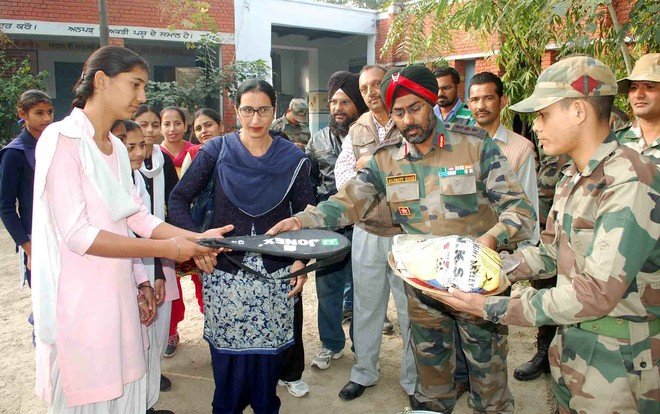
In order to mark the birth anniversary of first Sikh master Guru Nanak Dev, the Dograi Brigade distributed books, dictionaries, volleyballs and badminton sets among students of the Government Senior Secondary School at Gandiwind village here today.
Col Dilpreet Singh Bajwa of Dograi Brigade distributed the items among schoolchildren. Speaking on the occasion, Col Bajwa said that Indian Army was amongst the very few elite organisations, which always assisted citizens through humanitarian activities. He said, “Be it war or be it the peace, the Indian Army has always left its impression on hearts and minds of citizens.” He said the citizens residing in border areas had always been the focus of the activities undertaken by the Indian Army.
The Dograi Brigade celebrated the birth anniversary of Sri Guru Nanak Dev with the residents of border villages of Rajatal, Attari and Ranian on Wednesday. A high tea was organised by the brigade at Sarai Amanat Khan village, where residents, ex-servicemen, civilians and children interacted with each other. The brigade also organised langars (community kitchen) at gurdwaras in Atalgarh and Kakkad village.
As a goodwill gesture, the Dograi Brigade also carried out maintenance of playgrounds at the primary school in Gandiwind, Government Senior Secondary School in Attari and Secondary School in Lodhi Gujjar. The brigade also distributed stationery and sports equipment among the needy students.


Army pays tribute to slain soldier

Our Correspondent
Rajouri, November 24
2015_11$largeimg24_Tuesday_2015_235620036
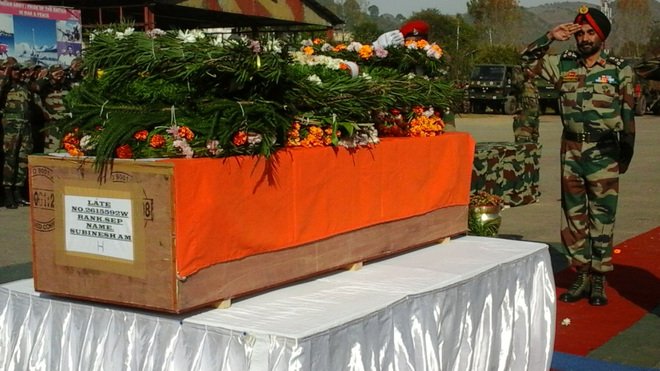
Tributes were today paid to Sepoy Subinesh of Madras Regiment by the senior officers of the Ace of Spades Division at the Army’s Advance Landing Ground in Rajouri.
Sepoy Subinesh was killed on Monday while foiling an intrusion attempt by militants in the Nowshera sector of Rajouri district.
“We paid ceremonial homage to our valiant soldier who was a part of an Army column which foiled an infiltration attempt on Tuesday on the Line of Control and attained martyrdom,” said Brigadier Satinder Singh, Deputy General Officer Commanding (GOC), Ace of Spades Division.
“Every attempt by the anti-national elements to step onto the Indian soil would be dealt with full force and appropriate action by our valiant soldiers,” Brigadier Singh added.
A senior Army officer of the Ace of Spades Division said: “Our soldiers prevented the terrorists from entering our soil and in the process and ensuing firefight, Sepoy Subinesh sustained a fatal gunshot injury and laid down his life in the line of duty in the highest traditions of the Army. Wreaths were laid on behalf of Lt Gen DS Hooda, General Officer Commanding-in-Chief, Northern Command, and Lt Gen RR Nimbhorkar, AVSM, VSM, General Officer Commanding, 16 Corps, as they paid rich tributes to the martyred soldier.”
Brigadier Satinder Singh and the Commander of the Nowshera Brigade also laid wreaths as a mark of respect to the braveheart.
A guard of honour was also presented to the martyred soldier and his mortal remains were airlifted to his native village for last rites.


The ‘mauli’ on General Sahib’s wrist…

22 NOV 2015

I regularly browse through Sainik Samachar, the journal of our armed forces published on behalf of the Ministry of Defence. In the latest issue, dated November 1-15, there is a photograph of Gen Dalbir Singh, Chief of the Army Staff, at Amar Jawan Jyoti during the Infantry Day (October 27) celebration. Infantry Day commemorates the landing of a battalion of the Sikh Regiment in Srinagar in 1947, to chase away the Pakistani intruders.
2015_11$largeimg21_Saturday_2015_223828860
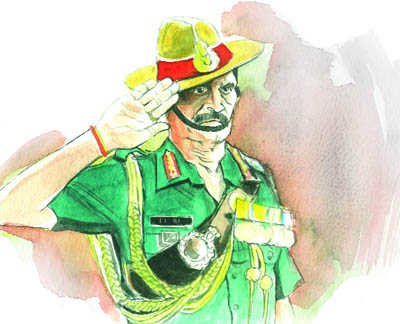
In the photograph, Gen Dalbir Singh is looking resplendent in his full uniform. But, jarringly enough, the good General is sporting a mauli on his right wrist.
2015_11$largeimg121_Saturday_2015_231243186gallery
The General is in good company. An inside cover photograph shows Lt Gen Aniruddha Chakravarty, and he too has a mauli on his right wrist.
And, then, there is a group photograph of “war veterans, colonels of Infantry Regiments and the serving officers” at India Gate. At least four officers in the front row can be seen wearing maulis.
This issue of Sainik Samachar has many photographs of the Defence Minister, Hon’ble Manohar Parrikar, also sporting a thick mauli. He is a politician and probably not subject to the rules and regulations or dress codes of the forces. And, these rules and regulations are clear, unambiguous and uniformly applicable to all ranks.
But, the Army Chief and other senior officers displaying a religious insignia is a different matter. And an unhappy lapse. It is totally at variance with the image of a professional army.
Earlier, very many people had felt disappointed that the Chief and some other officers had permitted themselves to be inducted in the Yoga Day celebrations. All said and done, that celebration was Prime Minister Narendra Modi’s political project.
2015_11$largeimg121_Saturday_2015_231242691gallery
Our armed forces have an honourable and glorious record of maintaining a respectful and professional distance from the political crowd. This tradition and discipline must not be allowed to get diluted for the sake of our republic’s long-term health.
The best gift I received this Diwali was from my friend Krishna Prasad, editor of Outlook magazine. Krishna is an old-fashioned, uncomplicated, open-minded soul who has ensured that the magazine remains a staunch and robust liberal voice. The gift he sent me is a slim volume of Tiruvalluvar’s The Tirukkural. It was re-published a few months ago as Aleph Classics.
The Tirukkural, as we know, is a Tamil classic, written more than 2,000 years ago and is regarded as one of the world’s greatest literary and philosophical masterpieces. This new version has been produced by Gopalkrishna Gandhi, who has thoughtfully rendered the model book accessible to the twenty-first century reader.
Gopalkrishna Gandhi is himself one of the wisest men around. He has had a distinguished public career and is now one of the sanest voices in national life. I came to know him rather well when he was Secretary to President KR Narayanan. The Narayanan presidency coincided with some of the most difficult days for the Indian republic and it must have been a great help to him to have had a sound man like Gopal as a counsellor.
What Gopal has now done is a remarkable example of what a public intellectual can or should do — producing books and essays, bringing the reader face to face with ideas and thoughts, which in turn help the reader make sense of a bewildering world around her. In this case, Gopal says he has “tried to render it into the English of our globalised times”. This is not a vain boast. The other day, on the train journey from Delhi to Chandigarh, I managed to finish the book. Made a sobering and absorbing reading.
The great Tiruvalluvar’s classic has been translated many a time. What Gopal has done is to give us an “interpretation in an English the twenty-first century might be happier with as a medium of its conversation with the nameless and ageless Wise One”.
In his introduction, Gopal pithily sums up: “The Tirukkural uses the pathways of analysis and contemplation to advance a state of balance in private living and public duty.”
The Tirukkural is a compendium of sane advice to kings and citizens alike. What was working 2,000 years ago seems to be applicable even today. Let Gopal tell it: “It shows that intrigue, slander, flattery and deceit are not new to Indian politics. Nor an itching royal palm. What is beyond comfort, and in fact, brings sheer joy, is Valluvar’s assurance that when a neglectful or corrupt ruler is hated by the people, his days are strictly numbered.”
The Tirukkural has that quality of great books: one can open it at any page and find a nugget of wisdom. For my money, Chapter 55, titled Just Rule, is remarkably helpful in understanding our current predicaments:
“All creatures look up to the sky for rain, All subjects for justice to the king’s domain.”
However, I am not sure if Chapter 90, labelled Not offending the great, would resonate with the temper of the modern times. Here the advice is:
“Slight not those in power or ‘the mighty’ as they’re called
If you don’t want to be blacklisted or worse, be blackballed.”
Perhaps, not in tune with the spirit of “the argumentative Indian” generation.
Talking of wise men, a few days ago, I met in Delhi my old friend Hans Raj Bhardwaj, a former law minister and one of the men most knowledgeable about the intricacies and nuances of the relationship between the judiciary and the executive. Bhardwaj had an interesting aside about the incoming Chief Justice of India, Mr Justice Tirath Singh Thakur.
Contrary to the prevailing perception that the judicial appointments in the country are a byproduct of internal networking, the young Thakur’s career has a different tale to tell. His judicial passage turned out to be rather difficult precisely because of his connections. According to Bhardwaj, Thakur’s elevation to the high court got embroiled in his father’s politics.
Mr Justice Thakur is the son of the late DD Thakur, who was an eminent lawyer and minister as well as adviser to Sheikh Abdullah. The senior Thakur was the Sheikh’s counsel when the Kashmir leader was arrested for so-called anti-national activities. Bhardwaj says that the Abdullah family’s enemies in Delhi were not all that excited about DD Thakur’s son getting a high court judgeship. And, they tried very hard to delay it as much they could, but eventually, sane voices prevailed.
So much for being ‘connected’.
I received the following succinct epigram, that is being widely shared on social media, from a reader, Hirdepal Singh, in response to last week’s Kaffeeklatsch about the terror attacks in Paris:
Notice the coverage of the Paris attack
Did you see any dead body or blood?
Did you hear any comments from the Opposition parties?
Did you see any media people trying to put words into the mouth of victims?
Did you see display of any chest beating by the relatives of the deceased?
Did you see any upmanship in broadcasting of news?
Did you see any mediaperson asking any stupid question to victims or their relatives?
Time for our media to learn ethics and discipline! Amen.
Coffee, what do you say?
kaffeeklatsch@tribuneindia.com


Manohar Parrikar ‘bridges’ gap between Bopkhel villagers, defence units

In a major breakthrough in the standoff between the villagers of Bopkhel and defence establishments College of Military Engineering (CME) and Ammunition Factory Khadki (AFK) following the closure of road passing through CME campus, Defence Minister Manohar Parrikar on Friday directed the AFK to accommodate the alternate route outside the CME and shift their explosive material to a more secure area within their premises. The defence minister wants the issue to be resolved before his next Pune visit scheduled on December 24.Bopkhel villagers had been using the 2.3-km-long road within the CME campus to reach Pimpri or Dapodi. The road was, however, closed for them earlier this year following a Bombay High Court order, which cited security reasons. After its closure, villagers had to take a 12-km detour via Dighi, Kalas, Shantinagar and Khadki. To help them, the CME had constructed a temporary bridge, but it was opposed by the Ammunition Factory, which again cited security reasons. On Friday, the minister, after holding a meeting with district officials and defence authorities, also asked the Pimpri-Chinchwad Municipal Corporation (PCMC) to float tenders for construction of a permanent bridge to replace the temporary one. The HC, which is still hearing the matter, had also directed the district administration and defence authorities to find an amicable solution to the problem. District collector Saurabh Rao said things would move ahead after directives by the defence minister. “The defence minister has asked the Ammunition Factory to accommodate the alternate route and shift its explosives somewhere else within its premises so that a permanent bridge can be constructed without villagers being exposed to the risk posed by explosives,” Rao said after the meeting. The defence minister has also asked the PCMC to go ahead and float a conditional tender for the bridge while waiting for an NOC from AFK. He said a survey would be conducted for the road after the bridge to connect villagers to the highway. “The survey would be jointly conducted by PCMC and AFK and the report will be submitted to the defence minister within a week,” said the collector. Push for Ghorpadi bridge project The pending project for Ghorpadi bridge or flyover too has got a push with the defence ministry asking the PMC to go ahead with the 33-metre width proposal it had come up with. –


Remember Rezang La: The unimaginable sacrifice of an Indian army unit during the 1962 war

November 18 marks the anniversary of the battle in which 124 members of a company of the Kumaon Regiment fought off Chinese invaders. Only 14 survived.

d92bd4e0-6bd5-4712-ae93-1714675798aa

One of the bitter ironies of life is that the greatest acts of heroism and valor mostly happen when the odds are hopeless and death and defeat are inevitable. Throughout history nations have always glorified such episodes in their ballads and poems, by honoring the heroes and commemorating the event. It is the common perception of these few and far in between episodes in a people’s history that forge a sense of nationhood. Why else would we celebrate the deaths of a Prithviraj Chauhan or a Tipu Sultan? Or a Porus or a Shivaji who battled great armies with little more than a handful of brave comrades and immense courage? Of course we rejoice in the triumphs of an Ashoka or Chandragupta or even an Akbar but that is about greatness and not heroism.

Even if it is true that the end of history is at hand, we can be sure that the annals of heroism will never cease being written. However endless these may be, the heroic stand of C Company of the 13 Kumaon at Rezang La in 18 November 1962 will always be among the more glorious chapters. The monument that stands at Chushul asks: “How can a man die better/ Than facing fearful odds/ For the ashes of his fathers/ And the temples of his gods.” C Company was fighting for neither ashes nor temples, for they were none at Chushul. The loss of Chushul would not even have had much bearing on the ultimate defence of Ladakh. But in those dark days of 1962 Chushul became a matter of national honor.

Chushul is only 15 miles from the border as the crow flies and even then had an all weather landing strip. It was the pivotal point of our frontier posts in this sector as it was astride the second route into Tibet from Leh about 120 miles further west. The road built after 1962 rises to nearly 17000 feet crossing the Ladakh range at the desolate and wind blown Chang La pass, steeply descends into Tangtse and then goes on to Chushul. Between the Chang La and Tangtse the road takes the traveler though the most beautiful scenery with matching beautiful wildlife. Golden marmots dart in and out of their holes and in the distance you can sometimes spot a snow leopard warily keeping an eye on man as it stalks Ibex on the craggy heights..

Chushul itself is at 14230 feet and is a small village in a narrow sandy valley about 25 miles long and 4 miles wide, flanked by mountains that rise to over 19000 feet. At the northern end it touches the Pangong Tso, a deep saltwater lake nearly a hundred miles long and that makes for one of natures most glorious sights. Also near Chushul is a gap in the mountains called the Spanggur Gap that leads to another beautiful lake, the Spanggur Tso that like the Pangong extends well into Chinese territory. The Chinese had built a road from Rudok in Tibet right up to the Spanggur Gap capable of carrying tanks. In the first phase of their assault on Ladakh in October 1962, the Chinese had overrun many of our major border posts on the line between Daulat Beg Oldi near the Karakorum Pass to Demchok astride the Indus on the border with Tibet. Chushul was the solitary Indian position east of the Ladakh range. Geography favored the Chinese and they were able to make a major concentration of men and material for an attack on Chushul.

Till September 1962, the defence of all of Ladakh was vested with 114 Brigade commanded by Brig. TN Raina (later General and COAS). It consisted of just two infantry battalions, the 1/8 Gorkha Rifles and 5 Jat. Initially, only the Gorkhas were deployed in the Chushul sector and when the gravity of the Chinese threat began to be realized 13 Kumaon, which was at Baramula in the Kashmir Valley, was sent in to reinforce 114 Brigade. In the first week of October the 3 Himalayan (later Mountain) Division was formed for the overall defence of Ladakh and the Chushul sector was entirely left to 114 Brigade. On 26 October, 114 Brigade set up its headquarters at Chushul and braced for the inevitable Chinese attack.

The newly arrived 13 Kumaon began deploying on October 24 in the lull that followed the first phase of the Chinese attack. The forward defenses of Chushul were on a series of hill features given evocative names like Gurung Hill, Gun Hill and Mugger Hill, but C Company of 13 Kumaon got Rezang La which was about 19 miles south of Chushul. Rezang La as the name suggests is a pass and is on the southeastern approach to Chushul valley. The feature was 3000 yards long and 2000 yards wide and at average height of 16000 feet. Digging defensive positions and building shelters was hard going for the men were still not acclimatized and cold wintry winds made life even more hard. At this altitude it took hours to bring a kettle to boil for tea and whatever fruit and vegetables that came were frozen hard. Let alone potatoes even oranges acquired weapon grade hardness. More than the thin air and cold the location of Rezang La had a more serious drawback. It was “crested” to Indian artillery because of an intervening feature, which meant that defenders had fight without the protective comfort of artillery. Both sides prepared feverishly, mostly within sight of each other, for the next Chinese attack. That attack came on that cold Sunday that was 18 November.

Most Kumaon battalions are mixed formations made up of hill men from the Kumaon Hills, Ahirs from Haryana and Brahmins from the northern plains. 13 Kumaon was the Kumaon Regiment’s only all Ahir battalion. The Ahirs who are concentrated in the Gurgaon/Mewat region of Haryana are hardy cattlemen and farmers. When the order to move to Chushul came, its CO Lt.Col. HS Dhingra was in hospital but he cajoled the doctors into letting him go with his men. Maj. Shaitan Singh, a Rajput from Jodhpur commanded C Company of 13 Kumaon. C Company’s three platoons were numbered 7,8 and 9 and had .303 rifles with about 600 rounds per head, and between them six LMG’s, and a handful of 2 inch mortars. The Chinese infantry had 7.62 mm self loading rifles; MMG’s and LMG’s; 120 mm, 81 mm and 60 mm mortars; 132 mm rockets; and 75 mm and 57 mm recoilless guns to bust bunkers. They were much more numerous and began swarming up the gullies to assault Rezang La at 4 am, even as a light snow was falling.

The Ahirs waited till the Chinese came into range and opened up with everything they had. The gullies were soon full of dead and wounded Chinese. Having failed in a frontal attack the Chinese let loose a murderous shelling. Under the cover of this intense shelling the Chinese infantry came again in swarms. C Company, now severely depleted, let them have it once again. Position after position fell fighting till the last man. C Company had 3 JCOs and 124 other ranks with Maj. Shaitan Singh. When the smoke and din of battle cleared, only 14 survived, nine of them severely wounded. 13 Kumaon regrouped and 114 Brigade held on to Chushul. But the battalion war diary records that they were now “less our C Company.”

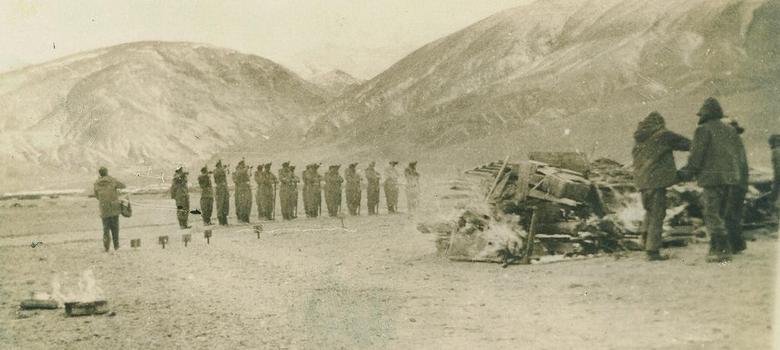
The Chinese announced a unilateral cease-fire on 21 November but little more than what the survivors had brought back was known about C Company. In January 1963 a shepherd wandered on to Rezang La. It was as if the very last moment of battle had turned into a tableau. The freezing cold had frozen the dead in their battle positions and the snow had laid a shroud over the battlefield. Arrangements were then made to recover our dead under International Red Cross supervision. Brig Raina led the Indian party, which recorded the scene for posterity with cine and still cameras. This tableau told their countrymen what actually happened that Sunday morning. Every man had died a hero. Maj. Shaitan Singh was conferred the Param Vir Chakra. Eight more received the Vir Chakra while four others the Sena Medal. 13 Kumaon received the battle honor “Rezang La” that it wears so proudly.

Few events in the annals of heroism can match this. C Company gave its all to defend Chushul, a small Ladakhi village, which for one brief moment in our history came to symbolize our national honor. At Thermopylae on 18 September 480 BC, 1200 Greeks led by King Leonides of Sparta died fighting the Persian King Xerxes’ mighty bodyguard called the Anusya or Companions. But Leonides was fighting for a great prize. In July 481 BC the Oracle of Delphi told him that in the next war with Persia either the King will die or Sparta would be destroyed. Leonides chose to die to save Sparta. But C Company willingly sacrificed itself to save a little village and that makes its sacrifice all the more glorious. That is why we must never forget Rezang La.This is an extract from India’s World: Essays on Foreign Policy and Security Issues by Mohan Guruswamy (Hope India).


Army team finishes rafting expedition

Tribune News Service
Dehradun, November 18
Living up to the grand tradition of indulging in adventure activities, the Indian Army successfully concluded an adventure white water rafting expedition at Rishikesh yesterday.
The expedition in the mighty Ganga was held from November 14 to 17. A team of 32 daring adventure enthusiasts comprising all ranks of the Indian Army, and led by Capt AJ Singh, were flagged off by Maj Gen Shammi Sabharwal, General Officer Commanding, Uttarakhand Sub Area, at Rudraprayag on November 14.
The team after traversing a treacherous 130 km stretch of grade III to grade V rapids was flagged in by Brig Sandeep Sood, Commander of the Guard Artillery Brigade, at Virbhadra Barrage yesterday.
Maj Gen Sabharwal said such expeditions were a litmus test of determination, grit and perseverance in the face of odds, executed with precision by the Indian Army team, which was a laudable achievement.


Explained: Why The Current OROP Arrangement Will Lead To A Bloated Officer Cadre In The Army

The current OROP structure does not provide for OROP to officers retiring prematurely. Read on to understand why this will adversely affect the army’s structure and functioning.

Even Prime Minister Nehru thought he knew everything which was good for national security, until…well until it hit him squarely in 1962. He had ventured to ignore his military, condemn it to the back rooms at the cost of a police force which he thought was sufficient for securing the nation. The Chinese delivered a lesson wrapped in the form of a military defeat for India which continues to affect our collective psyche.

History is seldom learnt by nations and leaders, especially regarding issues concerning the complicated management of Armed Forces. The latter are not some corporate house or public sector undertaking. They have awkward organizations, not easily understood and even more complex personnel management issues. Yet, leaders continue to ignore that and take decisions which are detrimental to long term health of the organization and thus to national security.

The reference for the above observations is the recently notified grant of One Rank One Pension (OROP) which sanctions the same for all personnel earning pension including those who proceeded on pre-mature retirement voluntarily and yet denies it to those who will prospectively choose this route to exit the service in future through premature retirement (PMR). The government may have its reservations on pension review every year, the quantum of outflow due to that, the intricacies of calculations etc but all that is negotiable as it does not have a direct bearing on the operational efficiency of the armed forces.

I am not looking at any other clause related to OROP but PMR as this is a case of sheer inability to understand the dynamics of personnel management and its effect. No IIM graduate or management consultant of repute can ever gauge the intricacies which make up military personnel management. Ninety percent officers of the Armed Forces themselves do not understand the nuances and prefer to ignore them.

Some basics are necessary to educate the public and decision makers alike. The Army (and other two Services) is a pyramidal organization both at the officer and the jawan level. Jawans get promoted by selection and accordingly can become non-commissioned officers (NCOs) or junior commissioned officers (JCOs). Appointments for NCOs and JCOs are obviously lesser than the total number of jawans; that means all jawans cannot be promoted. Retiring ages increase based upon the rank achieved as an NCO and then JCO. Jawans who do not get promoted serve the color service of 15 years and have an option to extend their service commitment to 17 years before they compulsorily exit. Jawans and NCOs/JCOs earn pension once they put in minimum 15 years of service. Mostly after 15 years if a jawan/NCO applies for PMR, it will be due to family problems which he cannot resolve while on active service. He goes home with a pension.

It is this pension that the government does not want to include as part of OROP because the jawan/NCO has moved out voluntarily. They forget that he has completed his contracted service, may not get a job at all, and may be stuck with family problems for ever. It is a misnomer and a flawed imagination that jawans exit by PMR to obtain better jobs. Do they not deserve OROP for the marginally lower quantum of service they render? The issue of cadre management does not apply as much to the jawans/NCOs/JCOs; it is just the welfare element and that is as important. No denying that.

Coming to officers, the pyramidal structure applies here more appropriately as does cadre management. Officers are commissioned in the rank of Lieutenant (Lt) and get promoted as per service, provided they have passed requisite examinations and successfully undergone the Young officers Course of their Arm/ Service. This happens till 13 years of service when officers get promoted to the rank of Lt Col. Thereafter it is a process of selection for the rank of Colonel and above. Obviously the structure of units and staff is such that there are gradually reducing vacancies as the ranks goes higher. For promotion from Lt Col to Col by selection only a limited number get selected; that figure varies as per Arm/Service and is subject of the Supreme Court case currently being fought by some officers for higher percentage of vacancies. However, that complicates this issue and is not referred further.

At the best approximately 55 percent Lt Cols promote to Colonel at an average of 16 years of service. Three looks are given for promotion but second and third looks are more cosmetic. This means by 18 years’ service or so, 45 percent Lt Cols and much more in case of some Arms/Services reach their last rank. At current rates of commissioning of 2200 per year, this translates to approximately 1000 to 1300 officers who reach last rank at 18 years of service.

Presuming average age of commissioning as 22 and retirement age for Lt Cols as 54, these overlooked/non-empanelled officers will serve an average of 14 years after being considered finally unfit for promotion. With a rotation policy of 2-3 years it means 5-6 postings and a commensurate number of appointments suited to their rank, status, specialization and social needs of not serving under officers junior to them. This is extremely difficult to manage in terms of cadre management and any glitches have a resultant effect on efficiency, discipline and morale.

The presence of a large number of non-empanelled officers in the cadre is always detrimental to the overall good of the service; hypothetically promotable or overlooked officers are all obliged to put in their best for the pay they earn but that is an idealistic view; functionally things do not work that way. Thus it is good to encourage non empanelled officers to leave the service voluntarily on final non empanelment at and after 18 years of service. There is no compulsion in this as the terms of service at the time of entry permit an officer service till age of 54 years, and more if he is promoted.

Some armies have a rule called ‘up or out’. This means compulsory exit after having held a rank for a pre-determined duration (mostly 4 years). In that case a non-empanelled officer is eased out of service after having held the rank for 4 years. Fresh intake is thus necessitated which keeps the cadre young and motivated. With low job opportunities in India this system has not been adopted so that officers are not left unemployed very early.

The irony is that officers from technical arms such as Corps of Signals are trained to a great degree but all cannot be absorbed in progressively senior ranks. Therefore many qualified officers who do not get promoted remain in service with appointments lower than their self-esteem permits.

With the OROP notification laying down that there will be no revision of pension for personnel leaving service prematurely, it virtually dictates that non empanelled officers would have no motivation to leave service to make way for younger intake and would continue serving the average residual 14 years till they retire at the authorized retiring age of 54 years. This applies as much to the non-empanelled Colonels and Brigadiers who would have been overlooked for promotion at ranks higher than Lt Col and would have marginally shorter durations to serve in non-empanelled status.

We need to remember that the Kargil Review Committee headed by Late Mr K Subramaniam had strongly felt that the age profile of officers be reduced and had held the higher age profile of Indian Army officers as one of the reasons for lower efficiency during Operation Vijay. The Ajay Vikram Singh Committee (AVSC) recommended increase of appointments — 20 Lt Gens, 75 Maj Gens, 222 Brigadiers and 1450 Cols — so that promotions could be speeded up. This was achieved gradually but as age profiles of ranks reduced the length of service of non-empanelled officers increased. Earlier Lt Cols were promoted at 20 years of service and officers were finally non-empanelled at 22/23 years’ service. With the AV Singh Committee appointments this got reduced to 15 years of service and 18 years respectively making the duration of service in non-empanelled status much longer.

It helps the system that officers not cleared for promotion leave service early so that a fresh intake is ensured. Now with new rules of OROP no non-empanelled officer will wish to lose the benefit of OROP and the cadre will remain bloated with these officers remaining in service till the last day of their contractual period.

Perhaps the government considered that with current shortages of officers it would be prudent to retain trained manpower. This is short sighted because the cadre strength is now improving (by 5 percent or so in the last three years) and once optimum cadre strength is reached the presence of disproportionately large strength of non-empanelled officers in the system will be detrimental to the Army. The government has to realize this. Perhaps it has just not consulted cadre managers of the Army.

The AVSC recommendations had specifically been approved by the Cabinet of the time. It categorically called for the Peel Factor (lateral absorption) to be introduced. This meant that a certain number of vacancies in Central Government organizations/services would henceforth be reserved to allow lateral absorption of some officers, especially those who could not be adjusted for promotion due to compulsions of the pyramidal cadre. The status of the recommendations remains approved to date but the same could not be executed due to lack of energy, interest, persuasion and obstinacy of other government services.

If this part of the recommendations has not been executed the government has little justification to differentiate between PMR cases and those who serve the full service. In many ways both, the failure of Peel Factor (lateral absorption scheme) and the lack of application of OROP to PMR cases prospectively, will ensure that a bloated cadre of non-empanelled officers continues thus having a negative effect on the efficiency of the Army.

OROP has been long in coming but it fails to meet the aspirations of the veterans as per definitions of the Supreme Court and the Koshiyari Committee. One can foresee another long bout of agitation and negotiation or perhaps legal recourse. That as it may be will definitely take a lot of time and patience. However, the PMR issue is simply non- implementable and the earlier the government gives a professional look the better. An ex Director General Manpower Planning (DGMP) could be a good consultant for the exercise of bringing realism to final effect.
timthumb
Lt. Gen Syed Ata Hasnain (Retd)
is the former Corps Commander of the Srinagar based 15 Corps, and is currently associated with Vivekanand International Foundation and the Delhi Policy Group, two major strategic think tanks of Delhi.



Centre notifies Orop scheme

New Delhi, Nov. 7 (PTI): The Centre tonight issued a notification bringing into force the one rank, one pension (Orop) scheme for retired soldiers, which will benefit over 25 lakh veterans and war widows.

Protesting ex-servicemen rejected the notification, saying their key demands had not been accepted and the government’s scheme amounted to “one rank, five pensions”.

Orop, a longstanding demand of ex-servicemen, seeks to ensure uniform pension to defence personnel who retire from the same rank after the same length of service irrespective of their date of retirement.

The veterans’ key complaint is that the government formula involves a five-year revision of their pensions instead of an annual revision.

The content of the notification is similar to the announcements made by defence minister Manohar Parrikar on September 5.

According to the notification, pensions will be re-fixed on the basis of the amount paid to those who have retired in the 2013 calendar year and the benefit will be effective from July 1, 2014.

The veterans had demanded that the period for pension should be the 2013-14 financial year, not the 2013 calendar year. They had also wanted that the benefit be effective from April 1, not July 1.

The notification said that in future, pensions would be re-fixed every five years. The ex-servicemen have been demanding a yearly revision.

Maj. Gen. (retd) Satbir Singh, the chairman of the Indian Ex-Servicemen Movement that is spearheading the protest, said: “The notification will not be acceptable to the rank and file”.

“It is not one rank, one pension but one rank, five pensions,” he said.

Another key element of the notification is that armed forces personnel who opt to get discharged on their own request would henceforth not get Orop benefits.

A defence ministry statement said the UPA government had earmarked Rs 500 crore for the Orop scheme.

“The present government undertook the task earnestly and realised that the actual additional annual expenditure would be Rs 8,000 to 10,000 crore at present and will increase further in future,” the statement said.

The notification said the pension would be re-fixed on the basis of the average of the minimum and the maximum pension of personnel retiring in 2013 from the same rank and after the same length of service. The ex-servicemen had demanded that the maximum pension amount be taken into account.

According to the notification, the pension of those drawing above the average shall be protected. It said arrears would be paid in four equal half-yearly instalments.

The government has decided to appoint a judicial committee to look into anomalies, if any, in the implementation of Orop. The committee will submit its report in six months.