



Sanjha Morcha

INDIA SUCCESSFULLY TEST-FIRES NUCLEAR CAPABLE PRITHVI II MISSILE

Prithvi_II
India successfully test-fired its indigenously developed nuclear capable Prithvi-II missile on Thursday, which has a strike range of 350 km, as part of a user trial by the army. The missile test was carried out from a mobile launcher from launch complex-3 of the Integrated Test Range (ITR) at Chandipur near here at 1210 hrs.

“The trial data of the missile conducted by the Strategic Force Command (SFC) shows positive results,” said a defence source. The surface-to-surface Prithvi-II missile is capable of carrying 500 kg to 1,000 kg of warheads and is thrusted by liquid propulsion twine engines. It uses advanced inertial guidance system with manoeuvring trajectory to hit its target.

Prithvi_Family_Missiles
“The missile was randomly chosen from the production stock and the entire launch activities were carried out by the specially formed SFC and monitored by the scientists of Defence Research and Development Organisation (DRDO) as part of training exercise,” a defence scientist said. “The missile trajectory was tracked by DRDO radars, electro-optical tracking systems and telemetry stations located along the coast of Odisha,” the source said.

The downrange teams on board a ship deployed near the designated impact point in the Bay of Bengal monitored the terminal events and splashdown, they said. Inducted into India’s armed forces in 2003, Prithvi II, the first missile to be developed by DRDO under India’s prestigious IGMDP (Integrated Guided Missile Development Program) is now a proven technology.
Prithvi_Ballistic_Missile_2
Such training launches clearly indicate India’s operational readiness to meet any eventuality and also establishes the reliability of this deterrent component of the country’s strategic arsenal, they said. The last user trial of Prithvi-II was successfully conducted on February 19, 2015 from the same test range in Odisha.

EX-SERVICEMEN UNFAIR TO GOVT ON OROP

The present government kept its promise within a year of coming to power by settling the 40-year-old one rank, one pension (OROP) issue raised by ex-servicemen. And to address anomalies, if any, they have appointed a judicial commission. It is a just and fair system and mechanism put in place. Returning medals, burning effigies and going on hunger strike has lowered the image of the disciplined soldier. Some disgruntled pensioners are misleading ex-servicemen with a view to creating an anti-government environment. Had they waited for the Seventh Pay Commission report, they would have got better results. Time has come to stop the agitation and sit across the table to settle issues, if any.
COL SK AGGARWAL (RETD), PANCHKULA


Most populated areas of India and China at greater risk, says report

Geneva, November 23
2015_11$largeimg24_Tuesday_2015_005157870
Weather-related disasters have grown more frequent over the past 20 years, killing more than 6 lakh people, the UN said today, issuing a further call for nations to strike a landmark deal on climate change.
The report from the UN agency for disaster risk reduction (UNISDR) said: “Floods, storms and other extreme weather events have killed 6,06,000 people since 1995, with an additional 4.1 billion people injured, left homeless or in need of emergency assistance.”
According to the UNISDR data, flooding accounted for 47 per cent of all weather disasters over the past 20 years, affecting more than 2.3 billion people, the vast majority of whom live in Asia.

A full 75 per cent of the 4.1 billion people affected were in either China or India, underscoring the extent to which densely populated areas in those countries were disproportionately vulnerable.

The report noted that while there was no way to establish how much increase in such disasters was caused by climate change, the link between the planet’s changing climate and extreme weather was clear.
“The contents of this report underline why it is so important that a new climate change agreement emerges from the United Nations Climate Change Conference (COP21) in Paris,” said UNISDR chief Margareta Wahlstrom, referring to crunch climate talks starting next week.
The talks that open in the French capital on November 30 are tasked with crafting a 195-nation pact to curb greenhouse gas emissions blamed for dangerous levels of climate change. — AFP


SC notice on Navy’s plea over permanent commission

R Sedhuraman
Legal Correspondent
New Delhi, November 20
The Supreme Court today issued notice on the Centre’s petition challenging the Delhi High Court judgment directing grant of permanent commission to all women officers in the Navy.
A Bench comprising Justices TS Thakur and V Gopala Gowda, however, restrained the Navy from releasing from service the women officers who had approached the HC, provided they had joined service prior to the permanent commission policy of September 26, 2008.
In its September 4, 2015 judgment, the HC had faulted the government’s decision to restrict permanent commission to women officers in three branches of the Navy — education, law and Naval construction — and to those joining service after the September 26, 2008 policy.
Seventeen Short Service Commissioned women officers, including Lt Cdr Annie Nagaraja, Urmila Bhat and Commander Pritika B Sharma, had approached the HC, challenging the government’s decision to restrict permanent commission to new recruits in three branches. Attorney General Mukul Rohatgi and Additional Solicitor General Maninder Singh said the HC had presumed that there was gender discrimination in the Navy.


Allow women to join Territorial Army: PIL in HC

New Delhi, November 15
A PIL has been moved in the Delhi High Court seeking recruitment of gainfully employed women in the Territorial Army, an organisation of volunteers who receive military training in order to be mobilised for the country’s defence in case of an emergency.

The petition said at present only gainfully employed men are recruited into the TA, the second line of defence after the regular Indian Army, and alleged that this amounts to “institutionalised discrimination”.

“At present, the Territorial Army (TA) recruits only males (gainfully employed). Due to this institutionalised discrimination, women are being deprived of their right to serve in the Territorial Army.

“This discrimination on grounds of gender is violative of fundamental freedoms and human rights of the women,” the plea, filed by lawyer Kush Kalra, stated.

Unlike the Indian Armed Forces, TA is not a profession, occupation or a source of employment and is meant for those who are already in mainstay civilian professions, the plea filed through advocate Jyotika Kalra said, adding gainful employment or self-employment in a civil profession is a pre-requisite for joining.

The role of the TA, in which actor Mohanlal and cricketers Kapil Dev and M.S. Dhoni are honorary members holding senior ranks, is to “relieve the regular Army from static duties and assist the civil administration in dealing with natural calamities….”

It also helps in maintenance of essential services in situations where life of the community is affected or the security of the country is threatened, and also provides units for the regular Army, the PIL states. — PTI


OROP: Veterans return their medals

Tribune News Service
Panchkula, November 10
2015_11$largeimg11_Wednesday_2015_020257276

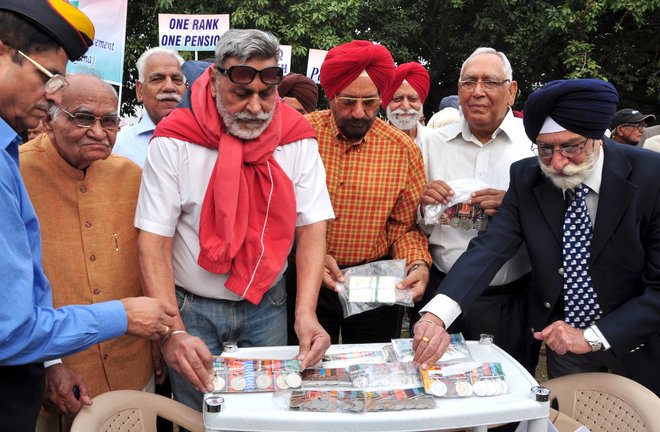
About 20 military veterans from the tricity and the adjoining areas handed over their medals to the Panchkula administration as a mark of protest against the “truncated” one rank, one pension (OROP) scheme here today.
Nearly 150 veterans assembled at Major Sandeep Sankhla Memorial in Sector 2 this morning and 20 of them put their medals, totalling about 150, in a box, which was later handed over to Panchkula Additional Deputy Commissioner (ADC) Hema Sharma at the district Secretariat. Those who participated in the event included two retired major generals — Maj Gen Pushpinder Singh and Maj Gen Dhillon, and an aged veteran, Col IJS Ahluwalia, besides several officers of the rank of Brigadier.
The veterans also handed over a memorandum to the ADC for onward submission to Prime Minister Narendra Modi along with the medals. The memorandum urged the Prime Minister to keep his repeated promises made earlier regarding implementing the OROP in letter and spirit as defined by the Parliament’s standing committee on defence and to ensure the well-being of the armed forces and its personnel to ensure national interest.
Brig Kiran Krishan (retd) said a majority of the military veterans from the region had already returned their medals in Delhi during an agitation for the implementation of the OROP. “The veterans are angry, and feel betrayed and cheated by a government that has been shouting from rooftops that it has given the OROP to the military and even issued a full-page advertisement in this regard. What the notification states is anything but the OROP in letter and spirit,” he said.


Parrikar lauds Indian Army for ‘digital army’ initiatives

2015110940L

New Delhi, Nov. 9 (ANI): Defence Minister Manohar Parrikar inaugurated the Central Data Centre, Army Cloud and Digi-Locker for the Indian Army here today.

Complimenting the Army for initiating such steps as a part of the Digital Army programme he said this can be of great use for faster documentation, information and speedy delivery of services. He emphasised the need to educate and sensitise every person in the force on the advantages of such services and technological upgradation. However, he also said that maintaining, checking and securing the system was equally important.

The facility under the Army Cloud includes a Central Data Centre, a Near Line Data Centre, both in the capital and a Disaster Recovery site for replication of its critical data along with virtualised servers and storage in an environmentally controlled complex.

This is similar to the Meghraj; the Cloud of National Informatics Centre (NIC) and will provide all Information Technology Infrastructure including servers for computing, storage, network and network security equipment centrally, for automation of Indian Army. The latest technologies in the field have been incorporated in the implementation of the first ever Software Defined Data Centre, wherein all the resources could be provisioned to different applications on the Cloud, on click of a button. It has already started providing Infrastructure as a Service (IaaS) to the pan Army users as the first Cloud service and will soon provide Software as a Service (SaaS).

With the launching of Digi-Locker, it will provide a secure and exclusive data storage space to all the units and formation headquarters of the Army over its dedicated data network. The Digi-Locker of Indian Army is similar to e-Locker of Digital India program and has all the advanced features like digital signatures and watermarking.

This is an important step towards implementation of cyber security as it precludes carriage of soft copies of data on CDs/DVDs and removable media. Users can store, share and access the data from anywhere any time on the Army Data Network. The infrastructure and platforms being made available for automation and digitisation will catalyse the pace of digitisation in all branches of Army and is a landmark towards transforming Indian Army from platform centric to a Network Centric Force, which would leverage the technology as a force multiplier.

In keeping with the national vision of Digital India, the Indian Army has launched a program for Digital Army with nine pillars for digitisation. Three of the nine pillars of this umbrella program, namely Broadband highways, Universal access to telephones and Army Data Network stress upon Information Technology Infrastructure development. Another three, namely e-governance, electronic delivery of services and online information for all, focus on delivery of services to all units and formation headquarters. For any modern army, the Network Centric Operations are essential for meeting enhanced challenges of asymmetry, lethality, fluidity and non-linearity in the present day battlefield. The Indian Army is addressing this key area comprehensively. (ANI)


What retirees will get

Pension to be revised every five years (ex-servicemen wanted revision every two years)
Past pensioners to get benefits on the basis of the ones being given to 2013 retirees
Scheme will be effective from July 1, 2014
Those taking premature retirement in future will not be entitled for OROP benefits
Arrears will be paid in four equal half-yearly installments


MoD mulls new policy on blacklisting foreign firms

Ajay Banerjee
Tribune News Service
New Delhi, November 28
In an effort to strike a balance between tackling corruption in defence deals and having a method to deal with foreign companies who pay bribes, the Ministry of Defence (MoD) will address the contentious issue of ‘blacklisting’ companies in the forthcoming new Defence Procurement Procedure (DPP).
The MoD is all set to do away with ‘uniform blacklisting’ of foreign companies which were found guilty of offering bribes.
A new policy is being considered and ‘blacklisting’ a firm may not be good option as it just forecloses options for India.
The challenge is from corrupt elements on the one side and cutting down on the delays in equipping the forces with the best equipment, weapons and aircraft on the other.
Defence Minister Manohar Parrikar today told an annual conference of the industry body PHDCCI, “The blacklisting issue will be addressed in the DPP”.
He said he would welcome positive criticism of DPP “which will help us correct it”.
A committee headed by former Union Home Secretary Dhirendra Kumar, after talking suggestions, submitted a report on DPP and suggested that misdeeds of an entity or its employees should not be visited on the equipment or system.
In other words, it has been suggested that there is no need to block the supply of equipment in case some bribery charge emerges.
The MoD banned the Bofors artillery gun in the late 1980s. Since then, there has been no artillery gun purchase. Recently, the purchase of AgustaWestland helicopters was stopped midway. In both cases, suspected bribery charges emerged.
The question before the MoD is how to deal with foreign companies who — despite being the best in their class — offer bribes or are forced to offer bribe to bag contracts in India.
There would be no ‘blanket bans’. This will be in line with the decision the MoD took in August last year when it did not blacklist Finmeccanica, which owns AgustaWestland but offered a solution of graded punishment which ensured that no ongoing project would suffer.
The company was contracted to supply 12 AW 101 helicopters for VVIP travel in India which was mired in allegations of kickbacks. The deal was stopped midway.
Then, the MoD took a decision that the company would go ahead with all other contracts under execution; continue supply of spares and upgrades to India.
However, all contracts in which the company had been declared lowest bidder after competition shall be put on hold till further orders. The MoD said that in case of fresh tender or request for proposal, Finmeccanica would not be invited.


READY TO COMBAT CHALLENGES IN MARITIME DOMAIN: NAVAL CHIEF ADMIRAL R K DHOWAN

Admiral_RK_Dhown_Indian_Navy_Chief
KANNUR: As the nation observes the seventh anniversary of Mumbai terror attacks, the Navy today said it has taken a “large number of measures” along with other agencies that operate in the maritime domain to deal with such threats from the sea route.

“As Navy, as maritime force, as lead agency which looks after all aspects of coastal, maritime security, we gear up ourselves for any kind of challenge or threat,” Chief of Naval Staff, Admiral R K Dhowan said.

He was talking to reporters after reviewing the Passing-out Parade of 330 cadets of the Indian Navy and the Indian Coast Guard and six cadets from friendly foreign countries at the Indian Naval Academy, Ezhimala, near here.

Navy, which has emerged as multi-dimensional network force, has taken “a large number of measures” along with all the other agencies that operate in the maritime domain to deal with such threats, Dhowan said, referring to the 26/11 attacks.

Seven years ago, 10 Pakistani terrorists had arrived in Mumbai by sea route and opened fire indiscriminately at people killing 166, including 18 security personnel, and injuring several others, besides damaging property worth crores.

The Navy chief also spelt out the steps taken by the Navy to strengthen the maritime-coastal security.

“Today we have 87 automatic identification system (AIS stations) all along our coast. We have 46 coastal radar stations,” he said.

“The Navy has set up National Command Control Communication and Intelligence Network with the Information Management Analysis Centre at Gurgaon, 51 nodes of the Navy and Coast Guard are integrated— all to provide a comprehensive maritime domain awareness … This is part of leveraging of technology,” he said on the steps taken by the Navy to prevent Mumbai model terror attack.

Besides, he said the Navy and Coast Guard have taken all steps to see that India’s 40 million strong fishermen community in nine coastal states is part of “our eyes and ears.”

“Because you can leverage technology. But you need to take everybody a part of the team and for that the Navy and the Coast Guard actually mapped every single coastal village of the West and East coast of India, spoken to the fishermen in their language, make them understand the importance of coastal security and how each one of them is an important member as eyes and ears of coastal service,” he said.

Noting that the registration of around 2.5 lakh fishing boats are in progress in nine coastal states and bio metric ID cards are being issued to fishermen, Dhowan said, “The aim is to have all these people, firstly all the agencies, then all our fishermen, anybody who operate in the sea as part of the security.”

“It is with these measures, we hope to have the seas around us safe and secure,” he said, responding to queries on steps taken to prevent Mumbai model terror attack.