Sanjha Morcha

What’s New

Click the heading to open detailed news

Current Events :

web counter

Print Media Reproduced Defence Related News

128 took up arms in Valley in 7 months Figure for entire 2017 surpassed; majority from south Kashmir

128 took up arms in Valley in 7 months

Majid Jahangir

Tribune News Service

Srinagar, August 9

In what may set the alarm bells ringing for security agencies, the number of local youths picking up arms in the Kashmir valley in the first seven months of this year has already surpassed the figures for the entire 2017.Police figures suggest that at least 128 youths have so far joined militant ranks this year. Last year, 126 youths had picked up arms, then the highest since 2010.While security forces are trying to woo back local militants, it seems to have had little impact on the ground. The highest number of recruits, nearly 90 per cent, has come from volatile south Kashmir districts of Pulwama, Shopian, Kulgam and Anantnag.Nearly two dozen new militants, mostly ill-trained in warfare, have been killed in various operations, a police officer said.J&K Police’s two wings — intelligence and zonal police — separately keep count of militancy-related data. Once a youth goes missing, either the family approaches the police or his picture with a gun surfaces on the social media. The police then crosscheck with sources before listing the youth as a militant.Twin districts of Shopian and Pulwama account for nearly 70 new recruits.The spurt in militant recruitment in south Kashmir follows two major gunfights on April 1 that left 13 local militants, including top local commander Saddam Paddar and professor-turned-militant Mohammad Rafi, dead. This year, the security forces have killed nearly as many militants in hinterland and the Line of Control in various operations. “We have carried many successful operations this year, but youths continue to get lured to militancy, which is worrisome,” a police officer said.The local recruitment started picking up after the killing of militant commander Burhan Wani in 2016.A majority of these youths have joined Hizbul Mujahideen, followed by Lashkar-e-Toiba. The Azhar Masood-led outfit Jaish-e-Mohammad has taken in at least 25 new recruits.“At least nine have joined Al Badr, which was almost defunct,” a police officer from south Kashmir said.Educated being lured 

  • In Jan, PhD scholar Mannan Wani joined militancy
  • 2 months later, MBA Junaid Sehrai took up arms
  • In May, KU asst prof Mohd Bhat joined militant ranks. He was killed in Shopian 36 hours later
  • IPS officer’s brother Shamsul  Mengnoo, pursuing BUMS, also joined militancy

India supplies Modern Combat boots to US Army, but our soldiers use ‘130-year-old’ designs

The Indian soldier’s wait for an essential part of his kit — a good-quality combat boot — doesn’t look like ending any time soon.

In a recent article, Lt. Gen. H.S. Panag (retd) wrote about the poor quality of combat boots soldiers have struggled with for decades.

“India manufactures some of the best shoes in the world, but the Indian Army wears the worst combat boot in the world, which has remained unchanged in design for 130 years, except for the DMS sole. That it costs only Rs 500-600 in the open market is a reflection on its quality!” Panag wrote.

But despite the fact that Indian manufacturers have been exporting boots, even to the US Army, ThePrint has learnt that the search for lighter and more durable combat boots is likely to be long-drawn. This is because the 13 lakh-strong Army is waiting for its last order of the old type of combat boots to be delivered — around 3 lakh pairs of ‘High Ankle DVS’ boots — by 2019.

A High Ankle DVS (Direct Vulcanized Sole) boot is a military combat boot, which, according to the Ordnance Factory Board website, can be used in all type of terrains and seasons.

Also read: In a first, India & Pakistan will be in wargames in China and Russia, troops leave next week

Also adding to the delay is a nod from the defence ministry to farm the existing order to private companies, a policy that the government adopted last year when it de-regulated a number of non-lethal equipment. Sources said private companies have also bid for the first time to make more flexible and better-designed, lightweight combat boots with polyurethane (PU) soles.

Modern combat boots are of different types, depending on the weather conditions of where the troops are placed. These include those with flame resistant material to those with shock-resistant rubber soles made with materials such as Gore-Tex, a lightweight fabric offering increased comfort and durability.
Other popular combat boots include hot-weather mountain combat boots, cold-weather boots for extreme conditions, and intermediate cold wet boots, for varying geographies and weather conditions.

Root of the problem ::

Alongside essentials like battle equipment and uniform, manufacturing combat boots for the Army has traditionally been the monopoly of the Ordnance Factory Board (OFB). Last year, the Ministry of Defence changed this, deciding to open up several of these products to procurement from the open market.

The various types of boots issued through the corps of ordnance are boot DMS (with a rubber sole), boot drill (with leather sole) and boot jungle — the last of which are basically canvas boots with rubber soles issued to troops operating in mountains and jungles.

There has been criticism and complaints from various quarters about the poor quality of OFB-manufactured boots, which many former officers and experts confirmed to ThePrint.

Panag himself said: “The quality of boots was not up to the mark with international standards. The boots were uncomfortable and most of the troops bought their own boots.”

He said despite boots being such an essential item, and the various demands for better quality over the years, governments and the Army itself failed to prioritise their procurement.

Another former Army officer, who did not wish to be named, said the boots were of “inferior quality”.

“They were heavy, the leather was hard; we often had to soften them with Dubbin, and the soles used to come off frequently,” the officer said.

“Time and again, there were questions raised on why the combat boots had to be manufactured by OFB — because they were, anyway, sub-contracting it to other smaller manufacturers. There was a whole Kanpur lobby at work here. This should have been opened for procurement from the civilian market long back.”

The officer added that the general quality of products from the OFB had only deteriorated over time.

Complex procurement process ::

Another reason for the delay in fixing this obvious problem is the Army’s long and complex procurement process.

Explaining the process, a former official said the Army first raises a proposal a couple of times, which then goes through the defence secretary and the defence minister.

“After the approval of the defence minister, the ‘request for information’ is invited, and based on the response, the ‘request for proposal’ is invited. Then the technical evaluation bids are opened, user trials are carried out, and only after that the commercial bids are opened,” the official said.

“Then it goes to the pricing and negotiation committee. In between, the proposal can oscillate between the Army and the MoD several times. This is a process that can take years,” the official said.

Another problem is that of the government’s inability to spend more, this official said. “There is a private company in Kanpur which manufactures good quality boots, which are exported to other countries, including the US. But they are much more expensive than the ordnance factory boots, and won’t find a place among the lowest bidders,” the official said.

However, former defence secretary Shashikant Sharma dismissed claims of government apathy. He said there were indeed some logistical difficulties, but funds were never a problem.
“It is unfair to say that the government did not do enough for providing basic necessities to the Army. I can’t say what happened before 2011, but the government was sensitive to the needs of the Army,” he said.

Army spokesperson Col. Aman Anand told ThePrint that the reason for the delay in procurement of High Ankle PU boots are complexities in the procurement process, a change in the competent financial authority for giving a go-ahead to the order (the Army can give a go-ahead to orders up to a certain amount, beyond which the MoD steps in) and several unwanted representations from various vendors for boots.

However, the former official quoted above said the Army is at fault for the delay.

“By ordering such a large number of boots in one go, the financial powers have gone to the MoD, and hence, there are chances it would be delayed again. For instance, if six lakh boots were ordered in one lot, the Army vice-chief would have retained the financial powers and the procurement could have been faster,” the official said.

Boots can nullify armies ::

A US Department of Defense report titled ‘Improvement of the US Army Intermediate Cold Wet Boot” on cold-weather footwear states that injuries caused to frontline troops due to poor footwear is recorded back to the 1700s.

“Even during World War II, 87 per cent of all US military cold-induced injuries were incurred by front line infantrymen, and in many cases, the combat effectiveness of entire infantry units was nullified,” the report had said.


MoD finally okays key ‘Make in India’ policy

MoD finally okays key ‘Make in India’ policy

Tribune News Service

New Delhi, July 30

Ending 14 months of wait, the Defence Acquisition Council (DAC) on Monday okayed the guidelines for operating the ‘strategic partnership model’ policy under which foreign companies can partner Indian companies to produce military equipment locally. Chaired by Defence Minister Nirmala Sitharaman, the Defence Acquisition Council is the highest decision-making body of the Ministry of Defence. The policy on strategic partnerships in defence sector was approved in May 2017 and it was made a part of defence procurement procedure (DPP), the guiding framework of making military equipment in India. To start off, the Defence Acquisition Council approved specific guidelines for procurement of naval utility helicopters. The Navy is looking for 111 such copters that will be based on ship-decks to replace the ageing fleet of Kamov copters.India’s attempt to join the nations producing world-class military equipment hinges on strategic partnership (SP) model. Production of four crucial military items fighter jets (both for the Navy and IAF), submarines, helicopters (for all three services) and new-generation tanks are listed under this model.All these items are cutting-edge equipment needed in a battle. The ‘SP model’ allows an Indian private company to collaborate with a foreign partner and produce military equipment in India.What guidelines say

  • Incentives for foreign companies that transfer niche technology and provide for higher indigenous content
  • All procurements under strategic partnership would be executed by specially constituted Empowered Protect Committees to provide focused attention and ensure timely execution

Pakistan Army crushes country’s judiciary, media to favour Imran Khan’s election bid as world watches by Lt Gen Syed Ata Hasnain

One of the most interesting electoral processes anywhere in the world is underway in Pakistan. Even by Pakistan standards, it gets murkier by the day. The latest is the remark by Justice Shaukat Aziz Siddiqui of the Islamabad High Court at an event hosted by the Rawalpindi Bar Association on Saturday. Siddiqui squarely accused the Army Chief and Pakistan’s intelligence agency ISI of interference in the legal process decrying that the agencies had no business to intervene in the affairs of other departments. The details of the scathing attack on the army and the ISI reveal more than just an emotional outburst. However, the Chief Justice of Pakistan Saqib Nisar appeared unimpressed and actually attempted to counter Justice Siddiqui’s allegations by stating that the judiciary was under no pressure. There is a history of Siddiqui having raised the accusatory finger earlier too, which has led to a misconduct reference. Apparently, Pakistan’s ISPR has demanded that an inquiry be conducted in the judge’s allegations. There could be some worry because Siddiqui made a specific reference to the ISI attempting to ensure that former prime minister Nawaz Sharif and his daughter Maryam Sharif’s arrest would not come up for hearing before the 25 July election.

It’s interesting to find a chink in Pakistan’s judiciary after the media has also attempted to strongly resist interference by the army and ISI. The popular news channel Geo TV, a subsidiary of the Jang group, went off the air for two weeks to make an apparent protest against interference and re-emerged with the promise to self-censor. The News, a print-based publication of the same group, has been censored and pressurised not to carry pieces by two popular writers, Babar Sattar and Mosharaf Zaidi. Both had written about a protest movement led by thousands of ethnic Pashtuns from the tribal areas against military operations and abductions. The Pakistan Army chief has called the movement, now in its third month, “engineered” pointing a finger at India and Afghanistan.

Pakistani politician Imran Khan, chief of Pakistan Tehreek-e-Insaf party, addresses his supporters during an election campaign in Lahore, Pakistan, Wednesday, 18 July, 2018. Pakistan will hold general election onJuly 25. AP

Pakistani politician Imran Khan, chief of Pakistan Tehreek-e-Insaf party, addresses his supporters during an election campaign in Lahore, Pakistan, Wednesday, 18 July, 2018. Pakistan will hold general election onJuly 25. AP

Pakistani politician Imran Khan, chief of Pakistan Tehreek-e-Insaf party, addresses his supporters during an election campaign in Lahore, Pakistan, Wednesday, 18 July, 2018. Pakistan will hold general election onJuly 25. AP

The army is obviously perturbed that its carefully crafted mission with the Pakistan higher judiciary to remove any chances of a Nawaz return to the political scene, has some unrealised resistance. With the media and the higher judiciary both under its complete control, the Pakistan Army was sitting pretty awaiting the results of the 25 July national election. From all indicators, there is no need for the Pakistan Army to await the results which have been engineered by it. It appears well known internationally that the results have been neatly packaged awaiting release, only the election process has to be undergone. To suddenly find an aberration in the mechanism, which has been in the making for long, should worry the Pakistan Army. The choreography thus far appeared quite flawless. The worry must also come from the fact that thus far there have been many commentaries in the international media on the nature of build-up to Pakistan’s national elections but no observation by any official international body, institution or nation about all that is happening internally in Pakistan. It’s well-known that Pakistan has taken little note of the observations of the Financial Action Task Force (FATF) which has placed it officially on the greylist on terror funding and other support to terror organisations.

Decode Pakistan Logo

In fact, as many as four well known hardline Islamist groups are contesting the election. Among these is Hafiz Sayeed’s (of the Jamaat ud Dawa or Lashkar-e-Taiba fame) Milli Muslim League (MML) which was not accorded official status of a political party by Pakistan’s Election Commission and is riding atop an organisation called the Allah-o-Akbar Tehreek, which has remained under the radar but has sanction as a political party. The three others are Tehreek-e-Labaik Pakistan (TLP) of Khadim Hussain Rizvi, Ahl-e-Sunnat Wal Jamaat (ASWJ) the party whose proscription was lifted on the very day of the FATF decree, and Muttahida Majlis-e-Amal (MMA) led by Fazlur Rehman which has been a registered party since 2002.

The Pakistan Army, which has worked with the Pakistan People’s Party (PPP) of the Bhuttos and the Pakistan Muslim League Nawaz (PML-N) in the past, has over the passage of time experienced both parties getting restive of the army’s controls.

It’s for that reason that it is orchestrating the potential election of Imran Khan’s Pakistan Tehreek-e-Insaf (PTI) party to perpetuate the army’s control over politics in Pakistan. Imran with his newfound Islamist orientation and long-held ambition considers this his best ever chance. The media and the higher judiciary had to be silenced for this experiment, an effort which has successfully been on for some time. The refusal to give Hafiz’s MML an official political status is part of a projection to retain positive international perception about the Pakistan Election Commission. Yet, as it usually happens with all planning of the Pakistan Army, it remains short of long-term vision. The presence of international election observers (including from India) is something ominous which has not been fully factored into the scheme of things. That is worrying the Pakistan Army, and it should. Justice Siddiqui’s diatribe against the agencies may just be the chink in the armour that may commence some snowballing protests and expose the grand plans. The media may find its true voice and someone else from the judiciary may join in to make it a chorus. Hence the army’s statement issued by ISPR — “In order to safeguard the sanctity and credibility of the state institutions, Honourable Supreme Court of Pakistan has been requested to initiate the appropriate process to ascertain the veracity of the allegations (by Siddiqui) and take actions accordingly.” The statement is loaded to influence the international community and election observers that the army is open and transparent while seeking impartial redress of the allegations of Justice Siddiqui.

The elections of 25 July 2018 by themselves are unlikely to act as the cutoff date to stop further developments in the interesting situation that is emerging in Pakistan. While the civil society is extremely weak and unlikely to get its act together to protest the murder of democracy, there are institutions which could yet rise and be counted. It is up to the international community to take serious note of the developments which will fuel further the empowerment of radical elements in Pakistan even as the FATF and election observers look on.

Updated Date: Jul 23, 2018 19:20 PM


Lt Gen Hasnain is CUK Chancellor

Lt Gen Hasnain is CUK Chancellor

Srinagar, July 13

Lt Gen Syed Ata Hasnain (retd) has been appointed Chancellor of the Central University of Kashmir (CUK) for a five-year term.The appointment was cleared by President Ram Nath Kovind. Hewill replace founding Chancellor Srikumar Banerjee.“The President of India in his capacity as a Visitor of central university of Kashmir has been pleased to appoint Lt Gen Syed Ata Hasnain, former Military Secretary of the Army, as the Chancellor of CUKfor the tenure of five years as per statute 1 of the Central Universities Act of 2009,” read the notification issued by the Ministry of Human Resource Development.Lt General Hasnain (65) has served in Kashmir in several capacities during his Army career. The last post he held was that of the Commander of the Srinagar-based 15 Corps. — TNS


Pak misguiding Kashmiri youth, says Army Chief SGPC approaches him over missing Sikh library manuscripts

Pak misguiding Kashmiri youth, says Army Chief

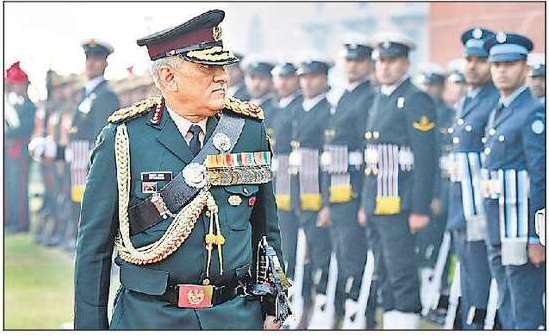
Chief of Army Staff General Bipin Rawat (left) and his wife Madhulika Rawat pay obeisance at the Golden Temple in Amritsar on Sunday. Tribune photo: Vishal Kumar

Tribune News Service

Amritsar, July 8

The Chief of Army Staff, General Bipin Rawat, along with his wife Madhulika Rawat paid obeisance at the Golden Temple on Sunday.Talking to mediapersons, he said to create tension in Kashmir, Pakistan had been playing a dubious role in misguiding the youth who indulged in stone-pelting.He said the existing strategy of the Army to tackle militancy in Kashmir was appropriate. “The involvement of Pakistan in creating disturbance cannot be denied,” he said.The Shiromani Gurdwara Parbandhak Committee (SGPC) presented him a replica of the Golden Temple, a siropa and kirpan.SGPC president Gobind Singh Longowal and chief secretary Dr Roop Singh raised the issue of missing documents and rare manuscripts of the Sikh Reference Library that were reportedly taken into possession by the Army during Operation Bluestar. General Rawat showed ignorance about it, but promised to look into the matter. “I have no knowledge about it, but will try to locate them,” he said.The SGPC also demanded that the control of Gurdwara Pathar Sahib in Leh, associated with Guru Nanak Dev, should be handed over to it.At present, the gurdwara and its arrangements are under the control of the Army.Later, the Army Chief, his wife and Major General DK Nautiyal visited the Partition Museum.Earlier, he visited the Punjab State War Heroes’ Memorial and Museum.


MoD restores technical allowance for armed forces

Tribune News Service

New Delhi, July 5

The Ministry of Defence has restored the ‘technical allowance’ paid to thousands of officers and jawans who work on the engineering side responsible to keep military equipment in running condition.The 7th Central Pay Commission had recommended abolition of the allowance. The services had represented to continue this to which the MoD has agreed and issued a detail order on eligibility.The allowance will be paid at Rs 3,000 per month for those who are B Tech-level and Rs 4,500 per month to those who are qualified at M Tech level.The weapons and equipment like submarines, fighter jets, radars, UAVs and missiles among others, need technical support. The Army has full-fledged Corps of Electronics and Mechanical Engineers (EME), a separate Corps for Signals. The Navy now recruits only science students at its training academies and all officers pass out as B Tech. The Indian Air Force, the fleet of planes and copters need engineering support and full-fledged maintenance command exists.


4 ‘IS’ men among 6 killed in Valley Cop, villager die too; militants ‘inspired by Islamic State ideology’

4 ‘IS’ men among 6 killed in Valley

Residents shift to safer places after an encounter at Srigufwara in Anantnag district on Friday. Photo: Amin War

Suhail A Shah &

Majid Jahangir

Tribune News Service

Anantnag/Srinagar, June 22

Four radicalised militants, a policeman and a civilian were among six killed in an early morning encounter at Nowshehra village of Srigufwara in south Kashmir’s Anantnag district on Friday. The dead included 33-year-old Dawood Ahmed Sofi, “commander of the Islamic State Jammu and Kashmir (ISJK)”.The J&K Police claim the four slain militants were “inspired by IS ideology” and had been active for the past few months. This is the first time that the police have admitted to “IS-inspired militants” operating in Kashmir.“All four were inspired by Islamic State ideology. The IS has no infrastructure or cadre here,” J&K Police chief Shesh Paul Vaid told The Tribune. However, IS-linked Amaq News Agency called the slain militants “soldiers of Islamic State”.Earlier this year, the Government of India had denied IS’ presence in Kashmir.The encounter broke out around 6 am when a cordon and search operation was launched after inputs about the presence of militants in Srigufwara. The gunfight continued till late afternoon.“As a joint patrol moved towards a suspected house, terrorists hiding inside opened fire, injuring a policeman and a civilian, both of whom succumbed to their injuries,” a police official said.The slain policeman has been identified as Ashiq Hussain, and the civilian, who owned the house, as Muhammad Yousuf Rather. Rather’s wife Rafeeqa Begum was also injured and admitted to a Srinagar hospital.Besides Dawood, a resident of Srinagar, the three slain militants were identified as Majid Manzoor Dar of Pulwama, Adil Rehman Bhat and Muhammad Ashraf Ittoo, both from Anantnag in south Kashmir.“Dawood was initially known to be affiliated with the Tehreek-ul-Mujahideen (TuM) terror outfit. This terror gang was active on the social media and targeted policemen on duty. Their social media profiles and inputs indicate they were inspired by the IS ideology,” the police spokesman said.A police officer said the slain militants were planning strikes and to carry out recruitment in south Kashmir.Around 20 people were injured as clashes erupted between locals and security forces near the encounter site. Clashes were also reported in Srinagar.

9 security men injured in Tral

Militants attacked a security forces party in volatile Tral in south Kashmir’s Pulwama district that left at least nine of them injured.The incident took place at about 3.20 pm.Police said militants fired upon the security forces when they were handling law and order in the area.“Terrorists lobbed a grenade, followed by firing on the security forces from a crowd when they were busy with law and order duties on Tral road resulting in injuries to the nine security personnel,” a police spokesman said.He said security forces exercised maximum restraint after being attacked to prevent any civilian casualties.Militant group Hizbul Mujahideen owned the responsibility for the attack.
Cop succumbs to injuriesA J&K policeman who was injured in a militant attack in Srinagar last week succumbed to his injuries on Friday.Head Constable Habibullah, a resident of north Kashmir, was injured in a militant attack at Karan Nagar locality on June 15 that also left another cop and three civilians injured.Habibullah, the lone bread-earner of the family, is survived by three daughters, two sons besides wife and aged parents. His elder daughter’s marriage was scheduled next week.Meanwhile, civil and police officers led by Director General of Police SP Vaid laid floral wreaths on the mortal remains of the two cops who died on Friday.


After Aurangzeb’s martyrdom, demand —for raising Gujjar regiment gains pace

Dinesh Manhotra

Tribune News Service

Jammu, June 17

After the martyrdom of Rifleman Aurangzeb, the demand for raising a Gujjar regiment in the Army has gained momentum to involve the patriotic nomadic Gujjar community in the ongoing fight against militancy in the state.Aurangzeb, who was abducted and brutally killed by militants on Thursday in the Kashmir valley for participating in anti-terror operations, was a Gujjar of Salani village of Poonch.“Since the eruption of gun culture in the state, Gujjars have been playing a critical role in fighting militancy, especially in inaccessible areas,” Choudhary Shah Mohammad, a prominent Gujjar leader, told The Tribune.Pointing towards the supreme sacrifice of Rifleman Aurangzeb, Shah Mohammad asserted, “Once again, a Gujjar soldier has established that our community is not behind others in sacrificing life for the nation.”A video of Aurangzeb, said to have been shot moments before his killing, surfaced on social media on Friday and became a source of inspiration for youth of the community to serve the nation. “It is high time the government engages patriotic and brave Gujjar youth in the Army to utilise their services in the real sense,” Shah Mohammad said.A Gujjar delegation has already given a memorandum to Union Home Minister Rajnath Singh and interlocutor Dinesh Sharma to raise a Gujjar regiment in the Army, but there has been no progress in this regard so far.Realising the importance of involving this nomadic community in eradicating militancy from the state, former Union Home Minister Rajesh Pilot had promised to raise ‘Gujjar Scouts’ on the pattern on Ladakh Scouts, but it could not materialise.Similarly, in 2003, the then NDA government had announced that a new force comprising Gujjars and Bakarwals of Jammu and Kashmir would be raised for deployment on the difficult terrains of the state.Gujjars played a very important role in containing militancy in the Hill Kaka area of Poonch district. Women village defence committees comprising Gujjar women were formed and they eliminated some dreaded militants active in areas once considered a safe haven for militants.Recently, Ishfaq-ur-Rehman Poswal, BJP leader, had also raised this issue before Army Chief General Bipin Rawat and had urged him to organise a special recruitment drive for Gujjar and Bakerwal youths in the country and raise a Gujjar regiment to fight Pakistan-backed militants and anti-India extremist forces in J&K.Earlier promises

  • A Gujjar delegation had given a memorandum to Union Home Minister Rajnath Singh and interlocutor Dinesh Sharma to raise a Gujjar regiment in the Army, but there has been no progress in this regard so far
  • Realising the importance of involving this nomadic community in eradicating militancy from the state, former Union Home Minister Rajesh Pilot had also promised to raise ‘Gujjar Scouts’ on the pattern on Ladakh Scouts, but it could not materialise
  • In 2003, the then NDA government had announced that a new force comprising Gujjars and Bakarwals of Jammu and Kashmir would be raised for deployment in the difficult terrains of the state

From soldier to officer, Bhiwani lad lives dream

From soldier to officer, Bhiwani lad lives dream

Lieutenant Jitender Singh with family at IMA Dehradun. Tribune photo

Deepender Deswal

Tribune News Service

Hisar, June 9

A soldier from Tigrana village in Bhiwani district, Jitender Singh, has realised his dream of becoming an Army officer by passing out as Lieutenant from the Indian Military Academy (IMA), Dehradun, on Saturday.Jitender Singh, 27, was recruited as a soldier in the Electronics and Mechanical Engineers (EME) Corp of the Army. He completed his matriculation from the Government Secondary School in his native village and Class 12 from TIT Senior Secondary School in Bhiwani town.Jitender got enrolled into the Army Cadet College (ACC) for graduation after clearing the written examinations during his service.Brother Mohit Singh said Jitender had been aspiring to be an officer right from his school days. “Our family has the tradition of serving the defence forces. My grandfather Jagroop Singh retired as Havildar, while my father Shripal Singh superannuated as Subedar,” Mohit said, adding Jitender got into the Army in his first attempt.“Because of his passion for the uniform, he grabbed the first opportunity that came by in 2010,” said Mohit, who along with parents attended the ceremony of his brother at the IMA.Jitender’s uncle Vijay Pal Singh said the family had a large number of serving members and ex-servicemen in the defence forces. “Around 35 persons from the extended family have served or are serving in the defence forces. Jitender has realised his dream with sheer hard work and dedication,” he said.Sarpanch Pradeep Singh said the village was proud of him.