Sanjha Morcha

What’s New

Click the heading to open detailed news

Current Events :

web counter

Print Media Reproduced Defence Related News

Naidu orders review of marshals’ uniform

Naidu orders review of marshals’ uniform
Rajya Sabha chairman M Venkaiah Naidu addresses Parliament during the winter session in New Delhi on November 18. Ani file

HT Correspondent and Agencies

letters@hindustantimes.com

New Delhi : Rajya Sabha chairman M Venkaiah Naidu on Tuesday ordered a review of the new military-style uniform of marshals in Parliament’s upper House amid criticism including from former Army chief General Ved Prakash Malik, who called the attire illegal and a security hazard.

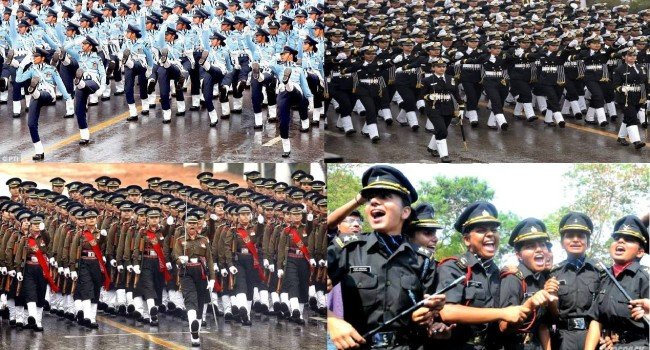
The marshals appeared in the Rajya Sabha on the first day of its 250th session on Monday in the deep blue winter uniform and peak caps similar to those senior army officers wear on ceremonial occasions. The uniform also has an aiguillette and braided cord similar to military uniforms. Earlier, the marshals wore bandhgala suits and turbans during winters and safari suits in summers.

“The secretariat of Rajya Sabha, after considering various suggestions, came out with a new dress code for the marshals. But we have received some observations from some political as well as some well-meaning people. So, I have decided to ask the secretariat to revisit the same” Naidu said.

Malik objected to the new uniform in a tweet on Monday. “Copying and wearing of military uniforms by non-military personnel is illegal and a security hazard.” Malik, who led the Army during the 1999 Kargil War, hoped Naidu and defence minister Rajnath Singh will take “early action”.

A Rajya Sabha official, who did not wish to be named, said that the request for the change in uniform came from the marshals, who complained that it was too cumbersome to “maintain their stiff turbans”.

“Several senior officials discussed it over time, and from a range of options, we choose one [new uniform],” said the official. The design, the official added, was finalised in-house and no external agency was involved.

The marshals were to wear a white uniform in summers similar to that of navy personnel as per the new dress code, according to people aware of the development. The green uniforms were meant for the winters. The new uniform also has epaulettes with stripes depicting the seniority of the marshals.

Congress leader Jairam Ramesh sought to speak about the change of the uniform in the Rajya Sabha on Monday. “It is a very significant change,” Ramesh said when the House was in the middle of a condolence motion for former Union minister Arun Jaitley, who passed away in August. Naidu stopped Ramesh, saying it was not the right time to make the point. “You always make significant points at an insignificant time,” Naidu told Ramesh on Monday.

Former vice Army chief Lt Gen AS Lamba welcomed the move to review the decision on the uniforms. “The sanctity of military uniform has to be preserved. It is good that it is being revisited.”


Rajnath holds talks with US Defence Secy; focus on Indo-Pacific region

Rajnath holds talks with US Defence Secy; focus on Indo-Pacific region
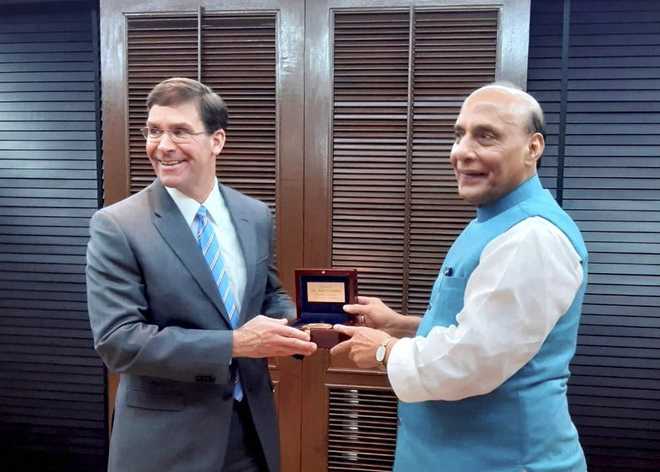
Defence Minister Rajnath Singh with US Secretary of Defence Mark T Esper on the sidelines of ADMM-Plus in Bangkok, on November 17, 2019. — Twitter/PTI photo

New Delhi, November 17

Defence Minister Rajnath Singh held talks with US Defence Secretary Mark T Esper in Bangkok on Sunday on a range of issues of strategic importance, including situation in the Indo-Pacific region and ways to further bolster bilateral security cooperation.

The meeting took place on the sidelines of the ASEAN Defence Ministers’ Meeting-Plus (ADMM-Plus), a platform comprising ASEAN and its eight dialogue partners including India, officials said here.

The Defence Minister also held a separate meeting with his Japanese counterpart Taro Kono with a focus on adding further momentum to bilateral defence cooperation.

In the meeting with Esper, Singh reaffirmed New Delhi’s vision for a free, open and inclusive Indo-Pacific region based on a rules-based order and respect for sovereignty and territorial integrity.

China has been fast expanding military and economic influence in the Indo-Pacific region, triggering concern in various countries of the region and beyond.

Singh said there has been a growing convergence between India and the US on the Indo-Pacific, adding the 10-member grouping of Association of Southeast Asian Nations (ASEAN) is central to New Delhi’s vision for the region.

“Had an excellent meeting with US Secretary of Defence, Dr. Mark T Esper in Bangkok today. We talked about ways to expand defence cooperation between India and the United States,” he tweeted.

Singh conveyed to his American counterpart that he was looking forward to have substantial discussions during the deliberations under the ‘two-plus-two’ foreign and defence ministerial dialogue between the two countries in Washington later next month, the Defence Ministry said in a statement.

The inaugural Indo-US ‘two-plus-two’ talks took place here in September last year.

Expressing happiness on the growing Indo-US ties, Singh said the cooperation between the two sides has grown across a wide range of sectors, including defence and security, economy, energy, counter-terrorism and people-to-people relationship.

Singh and Esper also discussed a number of key issues concerning regional security and bilateral defence cooperation.

The ADMM-Plus is also likely to review the evolving security scenario in the region, particularly in the maritime domain.

The inaugural ADMM-Plus was convened in Hanoi in 2010. The Defence Ministers then had agreed on five areas of practical cooperation to pursue under the new mechanism, including maritime security, counter-terrorism, humanitarian assistance and peacekeeping operations. PTI


Pall of gloom descends on village of jawan killed in avalanche

Pall of gloom descends on village of jawan killed in avalanche

HT Correspondent

letterschd@hindustantimes.com

BATALA : A pall of gloom descended on Fatehgarh Churian as the news of death of constable, Maninder Singh,28, of Punjab Regiment reached here late on Tuesday evening. Maninder Singh was among the four soldiers after an avalanche hit army positions in Siachen Glacier on Monday.

Gurvinder Singh, brother of deceased army jawan, said that his brother was recruited in Punjab Regiment around 12 years back and was deputed at Siachen Glacier from the past four months. On Tuesday evening, Gurvinder got a call from army headquarters that Maninder was hit by avalanche while escorting an ill Dogra regiment to the base camp.

The deceased is survived by his wife Akawinder Kaur and five-year-old son Ekamjot Singh. His body will be brought to his village from the Rajasansi airport on Wednesday afternoon. Another soldier from Punjab, sepoy Veerpal Singh was also killed.


What the Army Mess Taught Me About Life, Etiquette & Tipsy Pudding

A good read.  It transcends time and gets one into nostalgic memories of dinner nights, supper nights and  guest nights in defence academies  and officers’ messes.Tapshi is daughter of Maj Gen Deepak Dhanda.

Pineapple-cheese-cherry on a toothpick, too-thick rajma, and sweet cold coffee. Tapshi Dhanda finds the predictable uniformity of army mess food around the country a comforting anchor to life on the road.

I dunked three fingers into my father’s clear, fizzy drink while he chatted with a fellow officer at an army mess in Ambala. I reached for the small, pale-white, perfectly round onion that sat at the bottom of the glass and it bounced ever so slightly a few times, before I caught it and popped it whole into my mouth. It was tart. Vinegary. A bit salty. Curious, I took a sip of the drink and remember my eyes widening as I licked my lips. What was that! The year was 1994 and I was six.

I later learnt it was a gin cocktail, made army-style:
1 peg of gin
Half of that volume of lime cordial
Soda
A pinch of salt
Two drops of bitters
A cocktail onion or two

I never forgot that first taste. I still look for it in every bar I visit, but I’ve only ever found it in an army mess; in fact, I find it every army mess that I visit. Over the years and across the country, I’ve found it in a mess in Baramulla, Deolali, Mhow, Secunderabad, Ahmedabad, Pune, Shillong, Jalandhar, and Delhi. And once at a retired army officer’s home in Zirakpur, even there, made perfectly.

As a child, I believed the world operated like an army mess — everything had order, parties have dress codes, different cuisines demand their own cutlery, and gin is drunk with bitters and cocktail onions.

While the world may not in truth, work like this, every army mess in the country, reliably, does.

I’ve often tried to decode the ‘sameness’ that is present in the army, achieved almost effortlessly. This sameness was most apparent to me in the food that army messes served across stations in the country. I found it both fascinating and comforting that no matter which part of the country I was in, the food in the mess there tasted like food in any army mess anywhere. I began to reason that perhaps, like most things in the army, food is a matter of tradition and precision – neither of which is achieved by introducing change.

An army mess, home base for a regiment and its officers, is a magnificent institution whose walls are lined with glimpses of the operations of that unit, photographs of those who lead and serve the regiment, and mementos of valorous victories. An army mess is also where (dining) officers eat and stay. Every mess has dining and non-dining members – the former includes unmarried officers or those whose families are not in the station, while the latter comprises of officers posted in the station with their families. The mess caters for daily breakfast, lunch, evening tea, drinks and dinner for the dining members. On Sundays, breakfast and lunch are replaced by brunch, chhole bhature or ildi-dosa, complete with three types of chutneys and a thick, tangy sambar.

The menu in an army mess is set, not à la carte. The everyday menu usually includes two vegetables or a vegetable and meat dish, a dal, chapatis, rice, green salad and dessert or fruits. If it is a continental menu, expect macaroni, roast chicken, baked beans, garlic bread, dinner rolls, Russian salad and pudding. And on the rare days that a fauji will make an à la carte order, it will most certainly be anda bhurji and paranthas — nothing makes him happier.

As a child, before I understood the whys and hows of eating in an army mess, I would ask for my curry to be served in a bowl. The steward was always thrown off; he would pause, restrain his confusion, then return with one that was somehow never the right size. I noticed that nobody else ever asked for a bowl! You see, there is no concept of using a bowl for curry in an army mess. The dals and gravies are a thick-ish consistency on purpose. A no-bowl policy is essentially a no-fuss policy, so one can stand and eat if one needs to socialise, and one always needs to socialise in the army. It also prevents the cacophony of clanging and scraping that children and cutlery almost inevitably produce.

All chefs and stewards in the Indian army receive their training at the Army Service Corps (ASC) Centre in Bangalore. This has been the case for nearly 14 years now, before which the training centre was located in Gaya, Bihar. While there was a shift in the base, there has largely been no change in curriculum.

Chefs and stewards go through three levels of training. The 6-month long Level 1 course for chefs teaches them the basics of cooking and hygiene. Those who excel in Level 1 go on to become mess chefs and are immediately enrolled into a 3-month Special Training course where they learn to cook different types of starters, soups, mains and desserts that fall under Indian, Continental and Chinese cuisines. After the completion of the Special Training course, they are ready to return to their respective regiments, and join army messes situated across the country.

Sometime between 2-10 years of their tenure as a mess chef, they return to the ASC centre for training at Level 2 and 3. Each of these courses lasts 28 days, and teaches the chefs more about Continental, Chinese and regional Indian cuisines. Nearly every mess chef in the army can turn out dosa, sambar, biryani, noodles, fish curry, kadhi and rajma with the same amount of confidence, if not skill.

The stewards, in a similar training drill, are taught skills related to steward duties and responsibilities — how to make basic cocktails and mocktails; the many ways of folding a napkin; knowledge of cutlery and glasses, along with each specific purpose; how to serve beverages (always from the right) and food (from the left); whom to serve first (always the lady); how to set a table for an Indian, Continental or Chinese meal; nuances on the placement of cutlery if an officer wants to be served, is waiting for his senior to finish, or is done eating and hence has ‘closed the plate’, and so on.

Some of the most important lessons shared between the chefs, stewards and their instructors are about the formal parties that are organised every so often in an army mess. The quintessential example of elegance, tradition, order and precision, formal parties in the army are all the charm one needs to experience to be mesmerised by this life. The menus for these parties are curated with thought, the dishes named with ingenuity and the tables laid out with skill. The pristine white china is framed with a delicate gold border and, in some cases, stamped with the regiment monogram. The glasses are crystal. The menu is often continental; a tradition that was started during the British rule for the simple reason that it’s the least messy cuisine to eat with cutlery. Everyone closes their plate when the senior most officer is finished eating. And finally, dessert is served.


Army mess menu_1 (1).jpg
Army mess menu_2 (1).jpg

The menu for a formal party holds a special place in most army messes, as they represent craft and knowledge on the part of the mess committee that designs them. Sometimes old menus are referred to, to commemorate victories, recreate a bygone special dinner, or simply to please a guest. The menus are a matter of pride — even keepsakes. If you take a walk from one end of the dining hall in the National Defence Academy (NDA) to the other, you will see menus from pre-independence times and special occasions that hosted important dignitaries, kept safe on a bed of taut velvet and covered with glass.

It is how most ex-army men and their families keep their memories too, of their time in the Indian Army.

My lived experiences as an army kid, my interactions with officers and ladies who are now retired, and my conversations with those who continue to serve the organisation tell me that this sameness in food and otherwise, this consistency, becomes a collective memory. The shared landscape of our nostalgia translates into a sense of belonging so strong, it transcends age and geography. All army personnel and their families carry the same taste and culinary vocabulary. We navigate all the unknowns of a new station by stepping inside the familiarity of the army mess there. And we never quite forget any of it. Not the pineapple-cheese-cherry on a toothpick, not the too-thick rajma, not the sweet cold coffee, not the Tipsy pudding and definitely not the gin with bitters and cocktail onions.

Tapshi Dhanda is a freelance writer, essayist and editor based in Bangalore. She is interested in the everyday simplicities of life and hopes to someday compile a book of essays around the same theme.


Woman Army Official Knocks SC Door For Better Childcare Facilities

woman army official childcare

A senior woman army official has filed a petition in the Supreme Court against the Indian Army, accusing it of harassing her by temporarily posting her to a place around 1600 km away from her home despite her concerns of having a young child and the place being devoid of childcare facilities.

Lieutenant Colonel Annu Dogra (39), who is serving as an officer in the Judge Advocate General (JAG) department of the Indian Army in Jodhpur, registered her plea recently.

On 16 November, 2018, the DyJAG HQ Southern Commander, Brigadier Sandeep Kumar ordered Lt. Col. Dogra to move from Jodhpur to Kamptee, in Nagpur district for the Court Marshal duty on November 19, three days after Dogra received the order. It was only Dogra’s request that the time period was increased to 10 days, knowing that she would have to move along with her two years and five months old child.

Dogra’s husband, also an army officer in the rank of deputy JAG in Jodhpur, had to take leaves from his duty to support her and to babysit the child while she performed her professional duties. In her plea, which she filed through her counsel Aishwarya Bhati, Dogra wrote, her duties as a judge advocate takes up at least six hours until adjournment, then she has to get the typing done and frame the questions which take up another four to five hours after which she has to tend to her child.

He further notes that every time the court martial proceedings happens, she will have to move and this denies her the fundamental rights of “tending to her child by being sent to different locations from Jodhpur, which do not even provide the basic facility of crèche”.

The recent travels that Dogra has had to carry on in the case have led her to neglect her child because of the absence of family and community-based childcare arrangements at the current place of duty in Nagpur, she added.

ALSO READ: Misogyny Keeping Women Away From Combat Roles In Indian Army

Dogra refers to the National Policy for Children issued by the ministry of women and child development in 2013 and said in the petition that the Indian Army’s decision to move her with a child to a location that doesn’t have proper childcare facilities are in violation to the policy.

“The policy advocates to provide and promote crèche and day care facilities for children of working mothers, mothers belonging to poor families, ailing mothers and single parents. It also promotes appropriate baby feeding facilities in public places and at workplaces for working mother in public, private and unorganized sector,” the petition said.

Dogra’s contention is that she is not shirking her duties but is only asking for the rights of her child, who should not suffer just because her mother is in the Armed Forces

According to Dogra, the policy should be implemented throughout the country. Her contention is that she is not shirking her duties but is only asking for the rights of her child, who should not suffer just because her mother is in the Armed Forces.

Talking about Dogra’s plight, her counsel Bhati told SheThePeople.TV, “The manner in which she has been dealt with in terms of preponing the dates and not leaving any way out for her to travel to the place of court martial is inhuman. This is not war time where we can disregard all these things, here is an officer who has followed her duties and has an impeccable service record for last 15 years. But the point is that she is a mother of a very young child who is wholly dependent on her.”

“And it is not her inconvenience that counts but the child’s, who has been admitted to the hospital in Udaipur after they tried to travel by road because the flights very expensive.”

After Dogra filed the petition, she was asked to move again at 11.30 in the night on her own with her child to Kamptee for which she had to wait till 4.20 am at Jodhpur Railway Station.

“Being a mother is not a weakness for women, and children are the future of the country. We need to look at the provisions that developed countries have for working mothers who have young children. Those benefits help women take care for their children better. It is wrong to say that women are seeking relaxation or excuses from doing their duty but it is for the future generation who need better care,” Bhati said.

“We did not have crèches in Supreme Court till five years back. Earlier, people thought that it was not needed but what was happening was that young women lawyers were leaving their children behind to come to work. And with crèches at workplace, you are only empowering the mother to perform better. This is a basic necessity that the government itself recognizes in its policies, so they have to now provide it in its various segments to induct more women there.”

While the army inducts women in the forces, the policies and the rules remain highly masculine and fail to see working women’s duties with compassion. There needs to be better facilities and infrastructure in the army for it to become an enabling working space for both men and women.


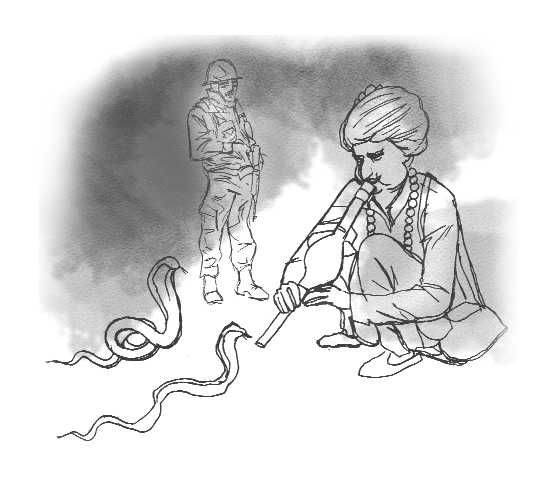
MILITARY MATTERS :A snake charmer’s kick to cure Lt-Gen RS Sujlana

A snake charmer’s kick to cure

Illustration: Sandeep Joshi
Lt-Gen RS Sujlana

Lt-Gen RS Sujlana

Kamarupa, the land of the cupid, Ahom of the medieval period and Assam of today, is known for its tantric religion and occultism, the famous Kamakhaya Temple, and carries a rightful tag of being a land of magic, charms, mystic, beauty and, of course, the famed tea estates.

Posted there to command a brigade, I enjoyed every bit of what Assam offered, including being witness to a mystic trickery. It was an encounter with a snake charmer, which had its share of drama, some reality, But, in the end, it turned out to be what we Indians love to do, topi pehnana (take someone for a ride)!

One morning, my staff officer, walked up and told me that an individual had come claiming magical powers to attract and catch snakes, besides having a cure for varied ailments, if nothing else, we could use his services to get rid of some slithering creatures, which were in plenty, around us .

Personally, wary of soothsayers, fortune-tellers, magicians and their ilk, I asked the officer to check out on this person’s credentials as we should not land up in trouble with the wildlife authorities over permitting unauthorised snake catching. This, he told me, had been checked, the individual had an official certificate permitting him to catch snakes. He also had photographic evidence of snakes caught from various government and military establishments and certificates appreciating his expertise and reliability. Lo and behold, he could even swallow a live snake!

Unbelievable! But there in front of me were revolting photographs of snakes of various sizes hanging out of his open mouth. No harm in seeing what he can do I thought, so we trooped to see him perform. Out came a bag, he picked out hands full of powder and throwing it around chanting strange sounding shalokas. He soon went into a hedge and came out with two snakes. Intrigued, but not convinced, I asked him to capture a pair of cobras living in the nearby pond and left. 

Next day, I queried about the cobras but was told that having caught some snakes and distributed curative charms, he left to attend to an urgent call and would be back soon. However, days past by and there was no sign of the mystery guy!

One evening in a party, I again queried about the snake charmer. I observed some mischievous smiles and knew something was amiss. On further probing the facts rolled out. This so-called snake charmer turned out to be a fraud. Snake catching was soon forgotten, he used his charm to convince many of his capability to cure ailments and then, having made a kill selling curative pseudo precious stones, he left with a neat sum and a promise to return.

One of the women joined in to relate what transpired with her husband, who was looking for the panacea for a recurring backache. The charmer sold her husband a costly stone, asked him to get two dozen bananas for a puja. In the final act, he asked him to bend forward holding the bananas and then came the surprise, a flying kick on his backside, and by the way, she added, ‘the backache persists!’ A loud round of laughter followed, but then I asked what about all those photographs with snakes hanging out of his mouth? ‘Photoshop, Sir, photoshop!’ Guess the charmer was much ahead of times. He had mastered this art to gain an aura over his audience. The only saving grace was that my apprehension and disbelief in such matters stood me good.


Major Satish Dahiya, braveheart to the core

Army Supply Corps officer was posthumously awarded Shaurya Chakra for exploits in Kupwara

Col Dilbag Dabas (retd)

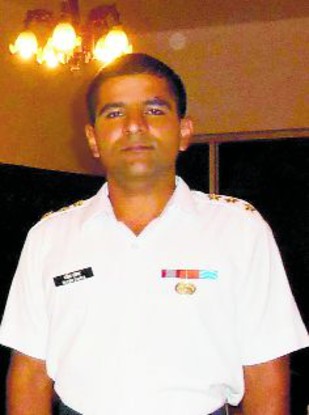
Satish Dahiya did not belong to a military family but always yearned to be a part of one. So, he resolved to start the glorious tradition in his village Banihari in Mahendragarh district of Haryana by becoming a torchbearer, and was commissioned into the Army Service Corps on December12, 2009.

Right from the time militancy engulfed the otherwise peaceful state of Jammu and Kashmir in the early Nineties, Kupwara, being a border district in Kashmir valley, had been the worst affected. And it is strongly believed that due to the false notion of being alienated by the state, the Kashmiri youth, to some extent, have covertly been assisting the militants exported by Pakistan. Every Rashtriya Rifles battalion has an Army Service Corps (ASC) officer posted on its war establishment who not only looks after the supply and logistics of the battalion, but also forms part of the fighting element of the battalion. Major Satish Dahiya, an ASC officer, was one such braveheart who, before laying down his life, exhibited the stuff he was made of. For his unmatched gallantry and supreme sacrifice fighting the militants, Major Satish Dahiya was posthumously awarded the Shaurya Chakra.

Sujata Dahiya, wife of Major Satish Dahiya, recalls that whenever she told Satish to take care while fighting the militants, his only reply in down-to-earth Haryanavi used to be “Nicky, tu nau haath ki sod (quilt) main so. Mere naam ki goli ib tanhi na bani sa.” Sadly, one goli existed in the armour of a militant which took its toll when the time came.

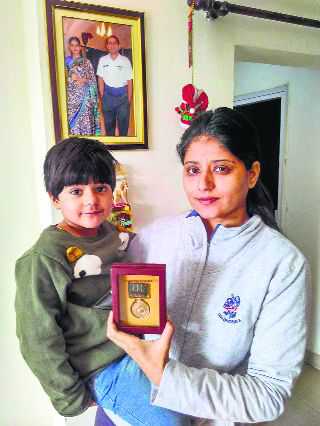
Mrs Dahiya, for the past almost two years, has not told her four-year-old daughter Priyasha that her father is no more. When asked as to how long will she hide the fact from her daughter, the Veer Nari responds without hesitation, “Sir, to date I don Satish’s combat fatigues which I have preserved as a treasure. I am preparing hard to fill the void created due to martyrdom of my husband. And I know Satish, watching from up there, would be the happiest soul when he sees that the combat fatigues he left behind are not just hanging on the wall.”

Battle account of bravery in War Diary of 30 RR reads…

“On February 14, 2017, Major Satish Dahiya of 30 Rashtriya Rifles was in charge of Cordon and Search Operation in Hajan village in Kupwara district. The village is located close to Hafruda and Rajbar forest, where the terrorists usually hide before proceeding to Baramulla or Sopore in North Kashmir. At about 5.30 pm, while he was placing the cordon at the identified site, the terrorists opened indiscriminate firing from close range. Major Dahiya and his party retaliated with accurate fire in which three terrorists were killed and the remaining fled downhill towards a nullah. Major Dahiya, unmindful of his personal safety, chased the fleeing militants and killed one more but he too was injured in his right thigh. Oblivious of his injury, he kept chasing the fleeing militants and killed one more but this time he was hit in the abdomen by a militant’s fire from close range and fell unconscious. The remaining militants, by then, had escaped in the thick jungle. Immediately, Major Dahiya, in an unconscious state, was put in an ambulance for evacuation to the battalion headquarters at village Langait where a helicopter awaited to evacuate the officer to Base Hospital, Srinagar. When the ambulance was a few kilometres short of the helipad, a mob gheraoed it and started pelting stones and did not let it move forward for almost half an hour till an armoured ambulance reach the site and dispersed the mob. Major Dahiya, though unconscious, was breathing when the ambulance reached the helipad but the officer breathed his last while being put in the helicopter.


Army man killed in fog-linked accident

Army man killed in fog-linked accident

Mangled remains of the Army vehicle that was hit by a roadways bus near Sriganganagar on Monday. Tribune Photo

Our Correspondent

Abohar, December 24

An Army jawan was killed and eight persons were injured in road accidents as dense fog engulfed Abohar and neighbouring Sriganganagar region on Monday.

Driver Rattan Singh (45) of Rajputana Rifles was killed as a Rajasthan Roadways bus hit Army Gypsy at 8.30 am near Rojari village while overtaking a truck that was parked on the roadside.

Major Rohit and Sepoy Jitender Singh, who sustained injuries, were shifted to the military hospital at Suratgarh. The police impounded the bus and the Army vehicle. A case has been registered against the bus driver. Deceased Rattan Singh belonged to Dhani Kotputali village.

In another mishap, Nand Lal and Sher Singh of Indira Nagari in Abohar and Manga Singh of Muktsar were hurt as two trucks collided head-on due to fog near Gidderanwali village on the Abohar-Sriganganagar stretch of the highway. The doctors at the Civil Hospital here referred Sher Singh to Faridkot.

Later, Ajit Singh of Tarmala sustained injuries as a car collided with a truck at the same place due to fog as the trucks involved in the previous mishap were not removed.
Pawan Kumar and Aladdin of Hisar were hurt as a pickup van collided with an SUV that carried the name plate of a government official based at Chhattisgarh in Rajasthan.

Meanwhile, power supply to some segments in Sriganganagar district was disrupted for a few hours as 220-kV power grid sub-stations in Padampur and the industrial focal point at Sriganganagar developed snag due to fog, officials said. The supply was suspended at 4 am and could be restored by 11 am. The Peelibanga segment in Hanumangarh was also affected due to the same reason. Officials said the fault was detected at 9 am and remedial measures were immediately initiated.


General, the slip is showing by Capt Amarinder Singh

Can’t lose sight of caution when it comes to Pakistan and its army

General, the slip is showing

A LONG WAY: It is one thing to be hopeful, another to be realistic. We need to be both.

Capt Amarinder Singh
Chief Minister, Punjab

IT is strange that two weeks after the ceremony of the Kartarpur Sahib corridor at Dera Baba Nanak, it dawns on five-time Chief Minister Parkash Singh Badal to insinuate that I am attempting to sabotage its opening. Had he read reports of my speech that day, or my letter to the Pakistan Foreign Minister, declining his PM’s invitation to their ceremony on November 28, it would have been crystal clear to him why I did so.

At Dera Baba Nanak on November 26, I made it clear that it was part of every Sikh’s ardas each morning that we should be united with our gurdwaras which remained in Pakistan after 1947. I welcomed this initiative between the governments of India and Pakistan, and said Punjab would do everything to hasten its construction. We have since set up Dera Baba Nanak Development Authority and will start acquiring land once the Ministry of Road Transport and Highways gives us its requirement.

To Mr Badal goes the credit for the 35,000 deaths in Punjab during the 80s-90s, and the destruction of our economy. Using gurdwaras for his politics, demolishing every vestige of constitutional propriety, creating massive unemployment, and putting himself before Punjab and our people has been his sole contribution — history is witness to it. 

For me, to be CM at a time that this corridor has come about, to open access to pilgrims from India to visit one of our holiest shrines, is a singular honour. My grandfather Maharaja Bhupindra Singh rebuilt Kartarpur Sahib from 1920 to 1929, after floods in the Ravi destroyed it. My father Maharaja Yadvindra Singh, in 1932, did sewa at Punja Sahib. In 2004, the then CM of Pakistan Punjab, Parvez Elahi, and I laid the foundation stone for a road linking Nankana Sahib to Wagah, for easy access to pilgrims from India.

However, I cannot forget that it is my duty as head of Punjab Government to secure my State against any agency or individuals who attempt, yet again, to create disturbed conditions. Punjab has been through terrible times from the 70s through the 90s. It was our security forces and the people who finally ensured an end to the prevailing madness. Having lived through that period, I was determined that I would never allow such a situation to again engulf my State. I therefore decided not to visit Pakistan, regardless of my personal loss in not visiting Kartarpur Sahib, till that country stopped its nefarious activity in my State and country.

Do we see light on the horizon? I think not. If the Pakistan government and its army want better relations with India, why not start by stopping cross-border fire, killing or wounding Indian soldiers every day? Why not rein in the ISI, which continues to weaponise and train terror outfits in Kashmir? Why attempt to start terror activities again in Punjab? Referendum 2020 is ISI’s new game. The frontman is a decrepit US-based lawyer called Pannu, who professes a peaceful referendum for Khalistan, which finds contradiction in a recently neutralised terror module’s confession to owing allegiance to this organisation.

The question arises: why did Pakistan army agree to the corridor now, after rejecting consistent attempts made over the years? For any student of ISI functioning, the reason is obvious: create a universal euphoria among the Sikh community and gain as much sympathy by any disgruntled youth or citizen, and thus widen its terror base with the objective of gaining support for the referendum.

Do not for once believe that the Pakistan army has any love lost for India. The army calls the shots in all spheres of government. Behind the figurehead civilian rule is the gun, and the gun today in Pakistan has a warped strategy. Its army today is engaged, in the north and west, in a war with the tribals, in what used to be the NWFP; in the south the Balochis keep it engaged; in the northeast it is Kashmir; and to the east it wishes to engage Punjab. Arrogance in the extreme — a four-front war!

In Pakistan, the army is the largest corporate body built from the post-war reconstruction fund, running virtually everything. The corps commanders, PSOs and the COAS, who call the shots, are more interested in furthering their monetary interests as retirement approaches. The COAS gets a million dollars as bonus on retirement, apart from land and housing on his way up the ladder. And all this while the core of the country is on the verge of collapse.

In our Punjab, each village is linked by a hard-top road, is electrified and has drinking water. Each village is connected by buses, and now each village is being provided piped gas, and CNG stations for gas-operated vehicles. Pakistan has none of the above. Karachi has become a slum, gas pipes were recently removed as gas could not be provided, and Lahore is close behind. The country be damned, the generals must survive, therefore divert public opinion away from these miseries. What better way than to rope in Punjab as well!

General Bajwa should understand that the Punjab he sees in India today is not the Punjab of the 70s. The Pannus of the so-called pacifist movement, or ‘Happy PhD’ advisers to terror outfits are of no consequence. Do not underestimate the Punjab of today. When trouble started in 1978, our police force was a fledgling one with a strength of 20,000, employed mostly in routine policing duties. Today, we have a 81,000-strong, highly professional and motivated force, prepared for any eventuality. In addition, we are backed by our paramilitary and defence services.


My suggestion to you, General, is that you should consider a hand in friendship, which would pay greater dividends, rather than continue with the current belligerence your ISI is executing. We have, since my government took charge in 2017, neutralised 20 ISI modules, arrested 95 operatives and seized caches of arms and explosives.

SFJ’S ISI LINK EXPOSED, SAYS AMARINDER

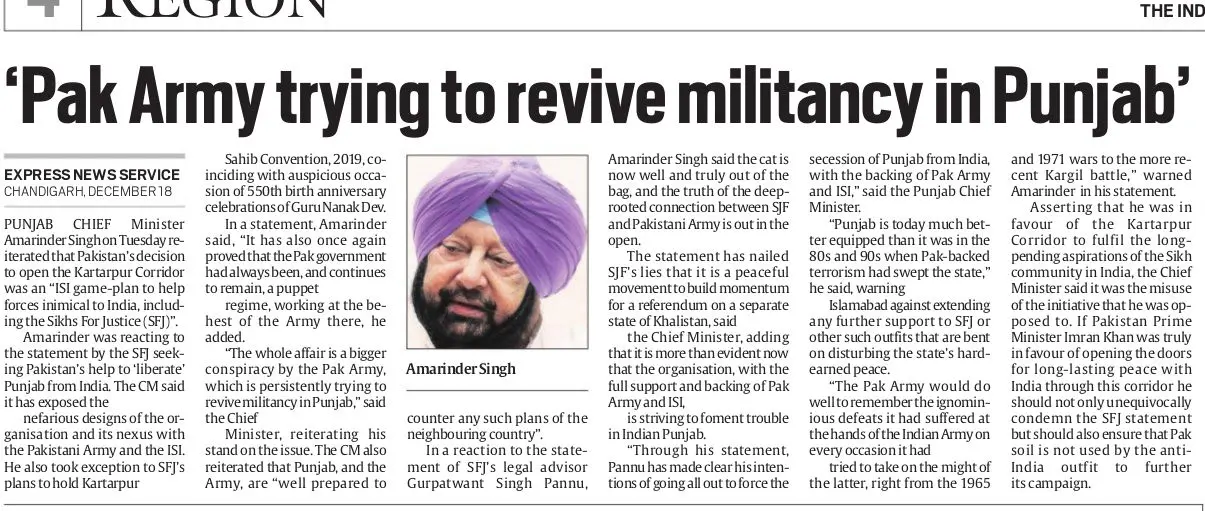
CHANDIGARH : The statement by Sikhs for Justice (SFJ) seeking Pakistan’s help “to liberate Punjab from India” has exposed the nefarious designs of the organisation and its nexus with the Pakistani Army and ISI, Punjab chief minister Captain Amarinder Singh said on Tuesday.

Reacting to the statement of SFJ’s legal adviser Gurpatwant Singh Pannun, the CM said, “The cat is now out of the bag and the truth of the deep-rooted connection between SJF and the Pakistani army is out in the open. It has lent credence to my fears that Pakistan’s decision to open the Kartarpur corridor was an ISI game plan to help forces inimical to India, including SFJ. It has also once again proved that the Pak government had always been, and continues to remain, a puppet regime.”

Amarinder also took strong exception to SFJ’s plans to hold the ‘Kartarpur Sahib Convention – 2019’, coinciding with the 550th birth anniversary celebrations of Guru Nanak, founder of Sikhism.

“If Pakistan Prime Minister is truly in favour of opening the doors for long-lasting peace with India through this corridor he should not only unequivocally condemn the SFJ statement but should also ensure that their soil is not used by the anti-India outfit to further its campaign,” he said.

Punjab is today much better equipped than it was in the 1980s and 1990s when Pak-backed terrorism had swept the state, the chief minister said.

clip


Surgical strikes successful tactical op: Gen Ranbir

Surgical strikes successful tactical op: Gen Ranbir

Lt Gen Ranbir Singh, Northern Command Chief, with students during the Old Boys’ Association Meet at Sainik School in Kapurthala on Saturday. Tribune Photo: Malkiat Singh

Jalandhar, December 8

The 2016 surgical strikes were a successful tactical operation which conveyed a clear message to Pakistan to stop any misadventure along the LoC, Army’s Northern Command Chief Lt Gen Ranbir Singh told mediapersons here on the sidelines of his visit to Kapurthala Sainik School, his alma mater, on Saturday.

His comments came a day after Lt Gen DS Hooda (retd), who was associated with the operation, said it was natural to have initial euphoria over the success, but the constant hype around the surgical strikes was unwarranted.

Lt Gen Ranbir Singh said all actions by the Army along the LoC were carried out in an extremely professional manner to meet the national aspirations and achieve military objectives.

However, he said, “As far as politicisation of the surgical strikes is concerned, I would not like to comment. That is in political domain.”

On whether the country could carry out surgical strikes again to counter the spate of recent infiltrations, he said there were many other options to check infiltration of terrorists. Surgical strike was only one of the options.

On possible attempts to revive militancy in Punjab, Lt Gen Singh said Pakistan was trying to extend the “arc of terrorism” beyond Kashmir and the Army was taking measures to arrest the spread. — TNS