Sanjha Morcha

What’s New

Click the heading to open detailed news

Current Events :

web counter

Print Media Reproduced Defence Related News

Lt Gen Repswal takes charge as Sapta Shakti Command chief

Lt Gen Repswal takes charge as Sapta Shakti Command chief

Tribune News Service

Bathinda, December 5

Lt Gen KK Repswal has taken over the charge of Chief of Staff of Sapta Shakti Command on Wednesday.

As per a release issued here on Thursday, Lt Gen Repswal is an alumnus of the National Defence Academy and the Indian Military Academy (IMA), Dehradun, the Defence Services Staff College, College of Defence Management and National Defence College. The officer passed out with the prestigious ‘sword of honour’ from the IMA, Dehradun, and was commissioned in Corps of Engineers on December 15 in 1984. He is an excellent sportsman and has done extremely well in all his courses. During his illustrious career, he has held various regimental, staff and command appointments. His instructor appointments include instructor at the IMA; College of Military Engineering, Pune; and Indian Military Training Team at Bhutan. The officer has held the appointments of Colonel General Staff (Planning) at Corps Headquarters, Deputy Director General at Engineer-in-Chief’s branch, Chief Engineer in Command and Chief of Staff in Corps Headquarters.

Lt Gen Repswal has commanded the Independent Field Company, Engineer Regiment and Chief Engineer (Andaman and Nicobar) Zone at Port Blair. He had the honour of commanding the Bengal Engineers Contingent during the Army Day and the Republic Day, where Bengal Sappers were declared the best marching contingent in 1988. The officer also had the honour of receiving the colours awarded to Bengal Engineers from the President of India in 1989. He has been awarded with the Sena Medal and the Vishisht Seva Medal.


Martyrs remembered at Chandigarh War Memorial

HT Correspondent

chandigarh@hindustantimes.com

Chandigarh : The former chiefs of the Indian Army, Navy and Air Force on Saturday paid tributes to the martyrs at the Chandigarh War Memorial to mark the Armed Forces Flag Day.

General VP Malik (retd) along with Air Chief Marshal BS Dhanoa (retd) and Admiral Sunil Lanba (retd) honoured the sacrifices of the fallen soldiers who attained martyrdom defending the sovereignty and integrity of the nation.

The guard of honour was presented by the Punjab Police contingent, while police jawans played the piper band.

The National Cadet Corps (NCC) cadets from Punjab and Haryana, students of city schools and residents paid tribute to the martyrs.

As many as 425 drivers and riders, including veteran and serving officers, took part in an anti-drug rally that flagged of at the Chandigarh Club in Sector 1 to urge the youth to shun drugs and live their lives with verve, vigour and dignity.

The riders were greeted with cheers as they drove through the city to their destination, Khetarpal Officers’ Institute at Chandimandir Cantonment. The blue straps on the shoulders of veterans symbolised respect.


SMVDU alumnus attends NCC course

SMVDU alumnus attends NCC course

Lt Dr Kamaldeep Kaur attends the NCC Refresher Course 58, at the Officers Training Academy in Gwalior.

Lt (Dr) Kamaldeep Kaur, alumni of Shri Mata Vaishno Devi University (SMVDU), at present working as Assistant Professor, Government Degree College (GDC), Udhampur, attended the NCC Refresher Course 58, at Officers Training Academy (OTA), Gwalior in Madhya Pradesh recently. After the successful completion of the course, she has been conferred with the promotion rank from Lieutenant to Captain. Dr Kaur was also adjudged the gold medalist of the course as she was placed first in order of merit for the overall performance in the course.


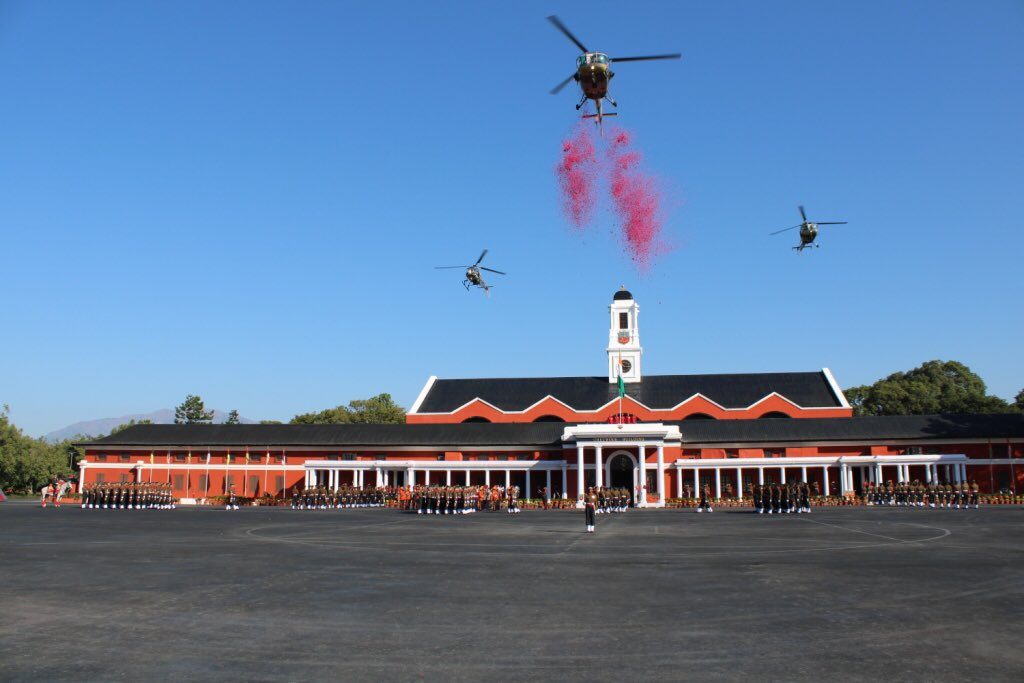
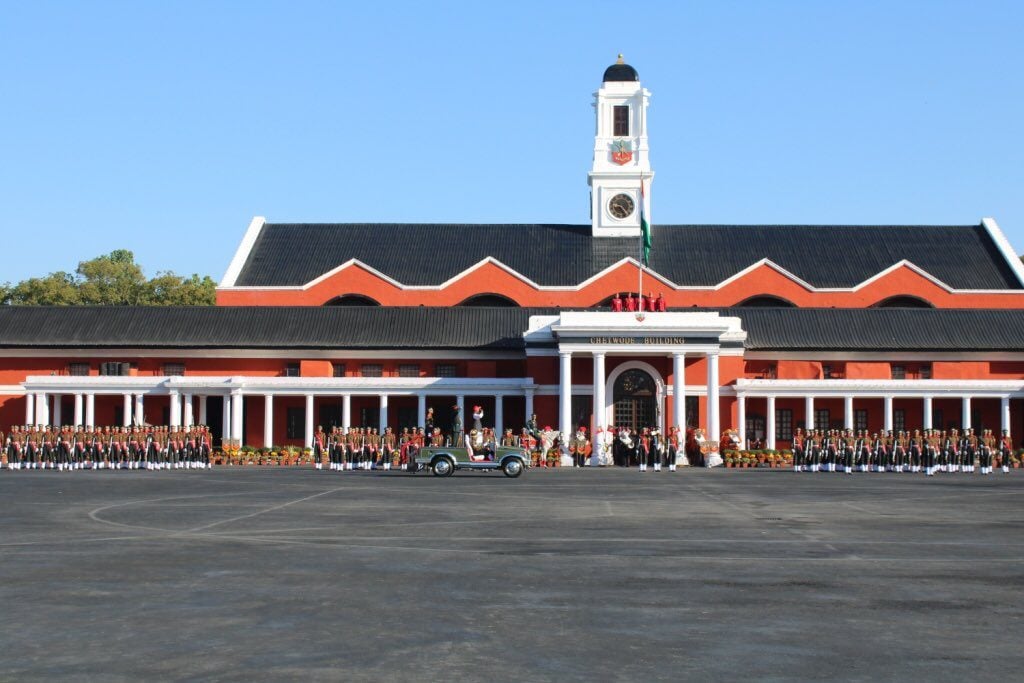
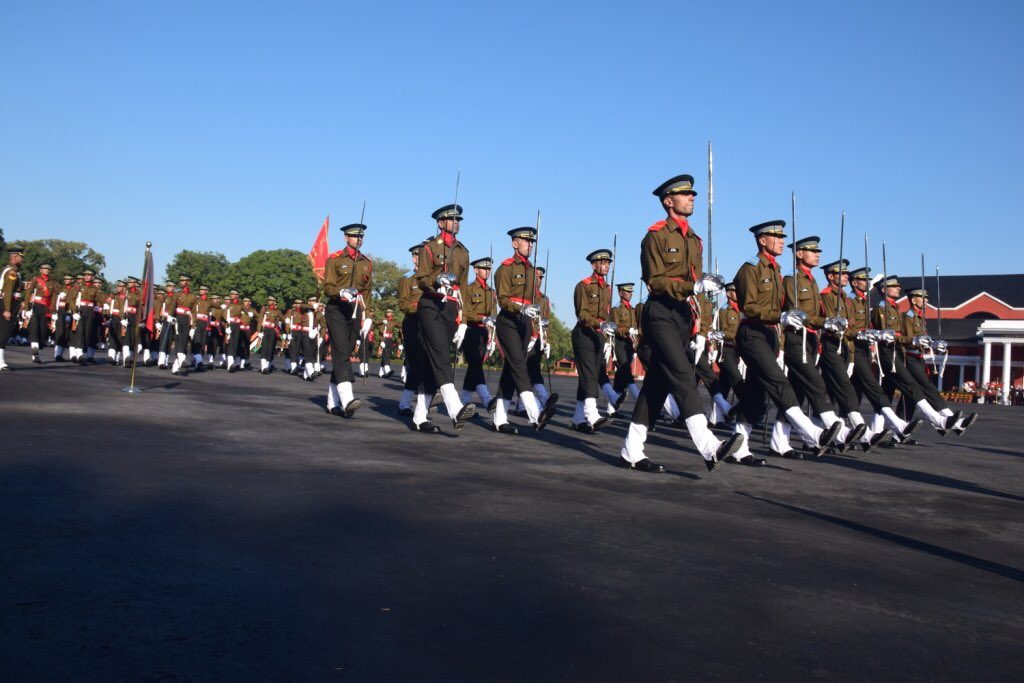
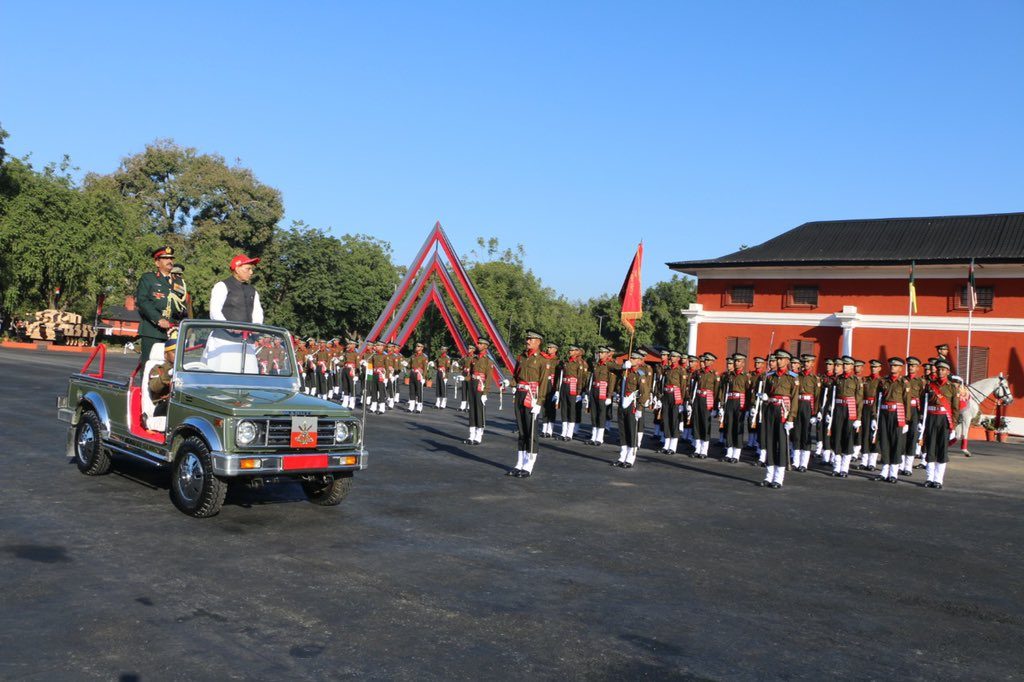
IMA Passing Out Parade 07 Dec 2019: IMA POP

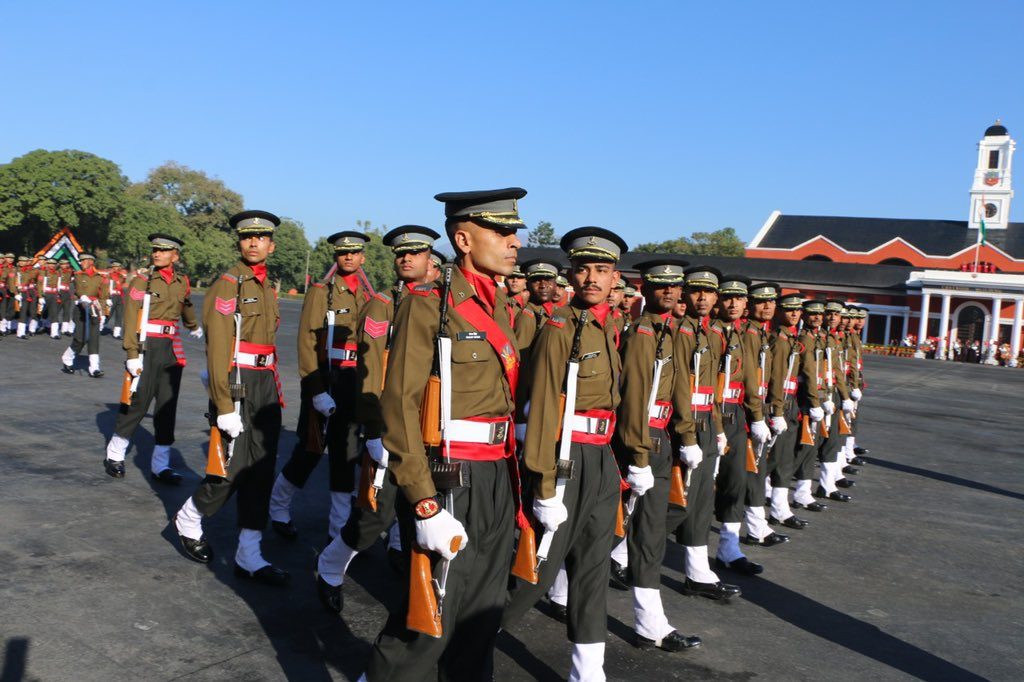
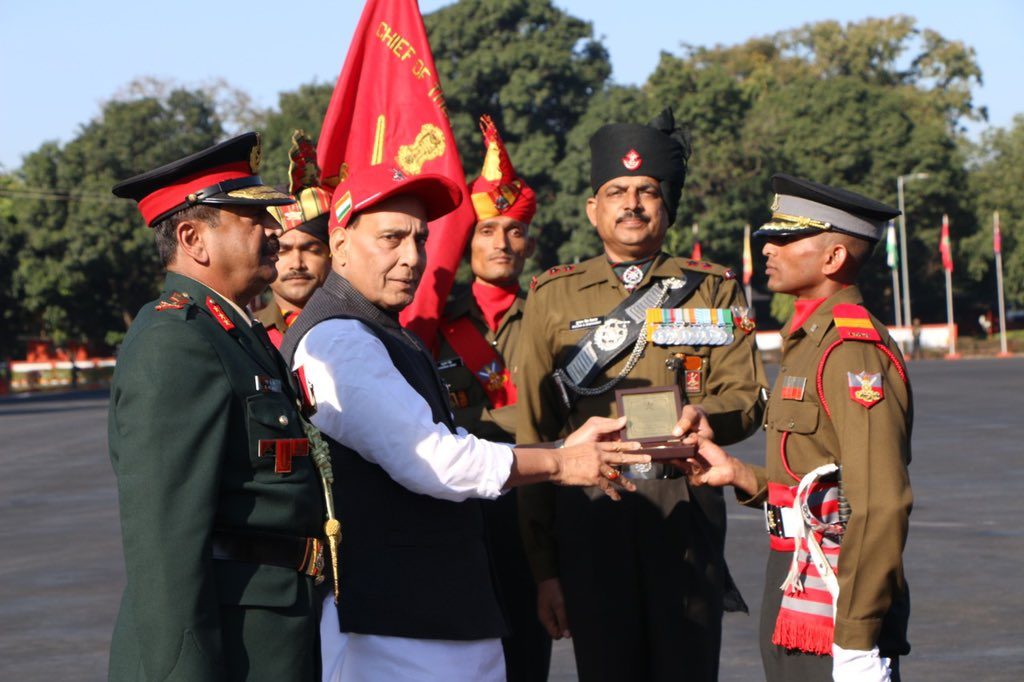
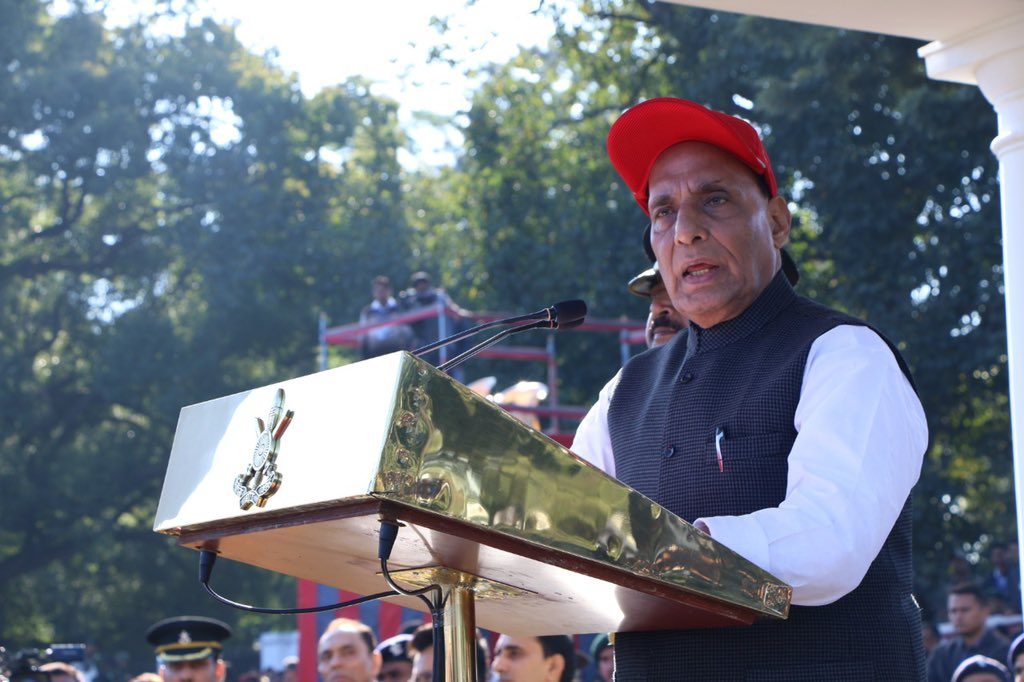
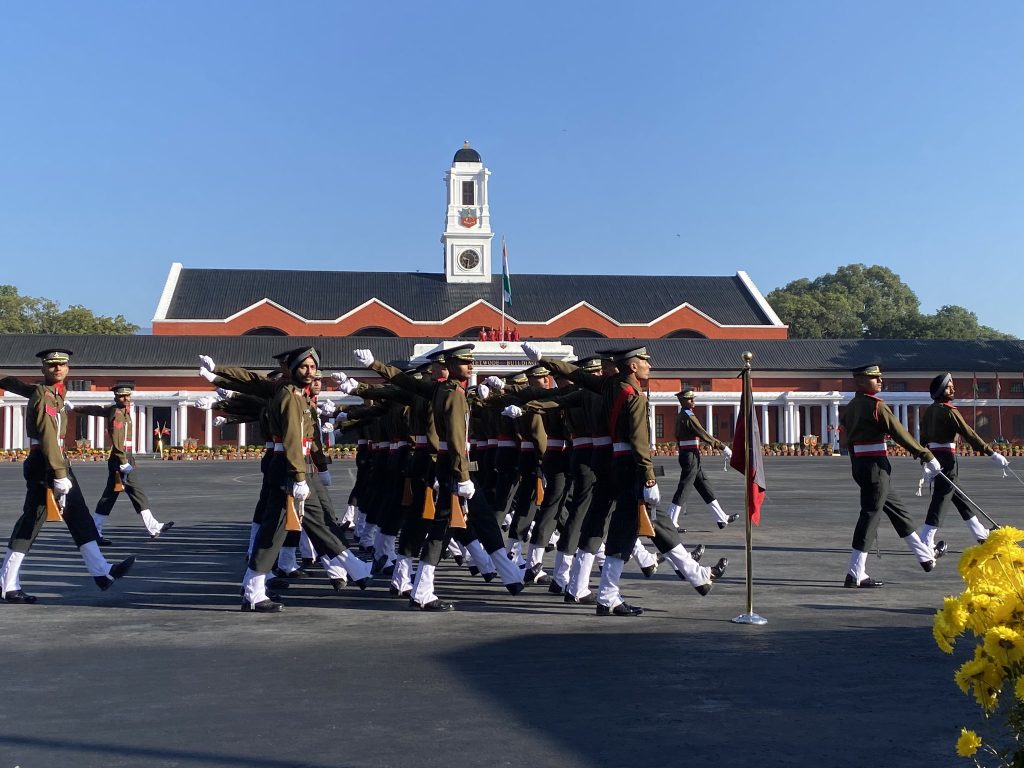
Defence Minister Rajnath Singh reviewed Passing out Parade of Indian Military Academy (IMA) in Dehradun on Dec 07. The passing out parade was being held on the occasion of Armed Forces Flag Day to honor India’s bravehearts. The event is held twice a year by the Indian Military Academy. The passing out parade is the most spectacular among the end-of-term events at Indian Military Academy. 377 Gentlemen Cadets of 145 Regular Course, 128 Technical Graduate Course, including 71 Gentlemen Cadets from ten friendly foreign countries passed out from the portals of Indian Military Academy, Dehradun on 07 Dec 2019.


Role of Sikh soldiers in World War I, II exemplary: British Army Brigadier

Role of Sikh soldiers in World War I, II exemplary: British Army Brigadier

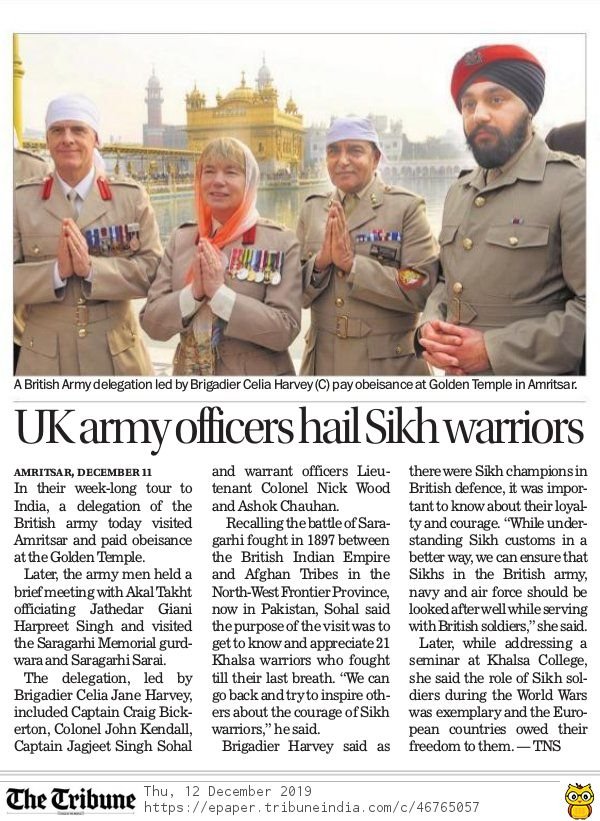
A British Army delegation led by Brigadier Celia Harvey (C) visits the Golden Temple in Amritsar on December 11, 2019. AFP

Amritsar, December 11

The role of Sikh soldiers during the World War I and II was exemplary and the European countries owe their freedom to the brave soldiers from Punjab, British Army Brigadier Celia Jane Harvey said here on Wednesday.

Speaking at a seminar on the ‘epic battle of Saragarhi’ at Khalsa College Public School here, Harvey showered praises on Sikhs and said the community is respected around the world for its bravery and immense sacrifices.

British Army delegation led by Brigadier Celia Jane Harvey (C) Col John Kendall (2L), Captain Craig Bickerton (L), Captain Jagjeet Singh Sohal (R) and Warrant officer Ashok Chauhan paying obeisance at the Golden Temple in Amritsar on Wednesday. Sameer Sehgal/ht

Harvey arrived here as head of the British Army delegation.

“Sikhs have sacrificed their lives for the protection of the oppressed, the helpless and other religions,” she said citing the example of ‘Saragarhi’ battle — a historic event in world history.

“Just 21 brave Sikh soldiers faced 10,000 Afghans tribal men and fought till the last breath,” said Colonel Johan Kendall, who was also part of the delegation.

Col Kendall said Punjabis living abroad have made a significant contribution to the prosperity of countries like UK, Canada and the US.

Earlier, Kuldeep Singh Kahlon, president of the Saragarhi Foundation, gave a detailed account of the Saragarhi battle.

He said in all the wars with Pakistan, the role of the Sikhs was unique and their service to the motherland is recorded in history. — PTI

1a04bf0c-277a-482e-93a8-470d35f33ed8


Congress CMs call for an environment free of fear and insecurities

Congress CMs call for an environment free of fear and insecurities
From left: Capt Amarinder Singh, chief minister of Punjab, and Bhupesh Baghel, chief minister of Chhattisgarh, at the Hindustan Times Leadership Summit in New Delhi on Saturday. Virendra Singh Gosain/HT PHOTO

HT Correspondent

letters@hindustantimes.com

New Delhi : Punjab chief minister Amarinder Singh and his Chhattisgarh counterpart, Bhupesh Baghel, both from the Congress, on Saturday opposed a pan-India National Register of Citizens (NRC) that the government has proposed to identify and deport illegal immigrants.

In a freewheeling session at the 17th Hindustan Times Leadership Summit, Singh and Baghel also spoke on a range of other issues, including the Citizenship Amendment Bill (CAB) that aims to fast-track Indian citizenship for religious minorities from Muslim-majority Afghanistan, Bangladesh and Pakistan, and the difficulties their governments confronted because of delays in compensation for a revenue shortfall from the Goods and Services Tax (GST).

Baghel, who led the Congress’s December 2018 comeback in Chhattisgarh after it lost three consecutive state assembly elections in the state, said that he is opposed to the NRC, and the exercise does not apply to his state.

Union home minister Amit Shah said in the Rajya Sabha in November that the NRC will be created for all regions in India, expanding an exercise that was recently carried out in Assam and led to the identification of 1.9 million people who face the risk of being labelled illegal immigrants.

“The NRC is a problem of border states, not of all states. This is being raised to deflect attention from main issues that the people are facing,” Baghel said.

Singh, who led the Congress to an election victory in Punjab in the 2017 assembly elections, and ensured that the national party won eight of the 13 seats in the state during the Lok Sabha elections this year, said he found the whole issue “strange” and that no one could ask any person to leave the country through such a unilateral decision.

“You have army men who have served the country for years, and then suddenly you say they are not Indians. You cannot just ask people to leave the country and take such a unilateral decision. I’m strongly opposed to this,” he said.

In the final NRC in Assam published on August 31, some members of the armed forces were among those excluded from the list.

While some states with Bharatiya Janata Party (BJP)-led governments, including Uttarakhand and Uttar Pradesh, have said that they would allow the creation of an NRC, Singh said that in Punjab, where his party has a two-thirds majority, the exercise will not take place.

Remarking on the CAB, which the Union cabinet cleared last week for tabling in the Parliament, Singh said, “There are many people of our state who are living or have been born abroad, and if they wish to come home, they are welcome. This is a free country. Why are we asking people [who have lived here] to leave? What if Bangladesh says that they don’t want them? What will you do?”

Baghel said that there was an atmosphere of fear among sections of the people, which needs to be removed.

“There is no space for fear in Indian tradition. All sections are feeling insecure. Reporters, doctors, industrialists — which section is not afraid? I am afraid to speak out. We are told, don’t talk against the government. This atmosphere of fear has to end. The media should be free to report, industrialists should be independent… When the Anna Hazare agitation against corruption broke out, every television channel reported on it live. If such an agitation were to happen today, would channels report on it?,” he asked.

Both chief ministers reacted to Union finance minister Nirmala Sitharaman’s comments at the HT Summit earlier on Saturday on the delay in compensating states for their revenue shortfall from the GST. She attributed this to a shortfall in the collection of cess charged to fund the compensation payment.

According to Singh, the finance minister did not understand what states were facing. “Our sources of revenue have been passed on to the GST, so it is the responsibility of the finance ministry [to pay us]. I have not received GST [compensation] since August, and I have had to borrow money to pay salaries. How can states function this way?”

Baghel said that in Chhattisgarh, which is more of an industry-heavy producer state, it is vital that money goes into the pockets of locals for it to reach the market and boost consumption. However, certain central policies were preventing that from happening, he added.

“In June 2014, the central government came out with a policy that if you give bonus to farmers then we won’t buy rice from you. We are not even asking for money [from the Centre], we only want permission to pay our farmers a bonus. When the money goes into the pocket of a consumer, it comes to the market. If they do not understand this aspect of economics, they should learn from [former Prime Minister] Manmohan Singh. We have also learnt from Manmohan Singh,” he said.

The Congress had, in its election manifesto in Chhattisgarh, promised to give a bonus to farmers for paddy procurement.

A clause in the Memorandum of Understanding signed by Chhattisgarh and the central government says that if the state government declares the bonus over and above the Minimum Support Price fixed by the Centre, the latter would limit the procurement for central pool to the extent of the requirement of rice for Targeted Public Distribution System/Other Welfare Scheme allocations of that state.

The Centre informed Chhattisgarh in November that the central pool stock was already much above buffer norms.

Sitharaman had said at the HT Summit that the Centre was committed to paying states the 14% compensation. “We will honour compact, there is no question about it,” she said.

The chief ministers’ comments come at a time when India’s economy grew at 4.5% July-September quarter, the slowest pace since March 2013.

Singh also spoke of Delhi’s pollution levels and said that Punjab could not be blamed for high levels of particulate matter in the air, as there was no stubble burning taking place at the moment.

While the Air Quality Index in the city was in the “very poor” category on Saturday, farmers of Punjab have in the past been blamed because of their practice of stubble burning to clear their field for the next crop cycle. This has often been attributed as a cause for spiked levels of pollution in the National Capital Region, which faced several days last month when the AQI was in the “severe” category. “When I left Punjab, there were clear blue skies.. but in Delhi, the visibility was only 400m. Where is this smoke coming from?” Singh asked.

When asked about who the next Congress president would likely be, Singh demurred from naming anyone, though the senior party leader has spoken out before in favour of giving young leaders a chance to lead the party. He said that the decision was the Congress Working Committee’s to make. Baghel, however, had no qualms in stating that he believed that Rahul Gandhi should be the next president.

Gandhi resigned from the post following the party’s rout in the Lok Sabha polls, in which it won 52 seats out 542, and Sonia Gandhi became the interim president, after weeks of the party being without a chief. “He [Rahul Gandhi] is not afraid to speak his mind, and he also took responsibility for the party’s performance,” Baghel said.



Free education for Class 11, 12 students at Maharaja Ranjit Singh Armed Forces Institute

Free education for Class 11, 12 students at Maharaja Ranjit Singh Armed Forces Institute
File photo for representation.

Chandigarh, December 10

Punjab Chief Minister Capt Amarinder Singh on Tuesday said the state government would bear the cost of education of poor students of Class 11 and 12 at Maharaja Ranjit Singh Armed Forces Preparatory Institute in Mohali.

The step was taken to facilitate aspiring economically backward students from the state to get into the armed forces, a government statement said.

The institute has tied up with a reputed private school in Mohali for education of students who clear its entrance examination.

Forty such students are currently selected for their senior secondary school education by the institute, but they are required to pay their own school fee of Rs 45,000 a year.

With the chief minister’s directive, poor and deserving students who are admitted to the institute basis on an entrance exam will also be able to join the Mohali school, the release said.

To meet the additional expenses thus incurred, Singh also asked the finance department to examine its proposal for additional funds of Rs 9.5 crore, in addition to Rs 8.5 crore, for making up the required corpus of Rs 18 crore.

In another move aimed at motivating and preparing youngsters to join the armed forces, the chief minister also directed the director general to formulate a proposal, in consultation with the secretary school education, to set up cadet training wings in select government schools, in line with the plan to establish such wings in some private schools.

He also asked the finance department to sanction requisite funds to establish the cadet training wings at the selected private schools in Patiala, Mohali, Sangrur, Beas and Nabha to impart training to the students for joining the National Defence Academy.

Incidentally, the-state-of-the art institute was started in 2011 with an intake capacity of 40 students.

As many as 134 cadets have been sent to various service academies so far from the first seven batches.

The institute has been credited with securing All India Rank 1 in NDA merit list on two occasions, besides once Rank 1 in the merit list of Officers Training Academy (OTA) in Chennai.

Fifty-eight cadets have been commissioned as officers so far and 25 have joined various academies. — PTI


Suspect in MP arms theft armyman: Cops

Press Trust of India

letters@hindustant

Bhopal : One of the two men who stole loaded INSAS rifles from the Army cantonment in Pachmarhi in Madhya Pradesh early Friday is a serving Army officer, a police officer said on Saturday night, adding that the duo have sneaked into neighbouring Maharashtra.

Earlier, it was believed that the duo posed as Army officers to commit the crime at the Army camp in Hoshangabad district.

In a major security breach, the two men had decamped with the rifles of sentries and ammunition in early hours of December 6, prompting police to issue a high alert. As per preliminary investigation, they spent nearly two hours at the cantonment where they misled the sentries into obeying their ‘orders’, according to another officer.

“According to our inputs, the location of the suspects was in Maharashtra some hours back. We don’t have the latest location now,” a high-ranking police officer privy to investigation said.

He said one of the duo who has been identified is a serving officer of the Army, while the identity of his accomplice is being established. “The Army officer has been absent from duty from an Army unit in Hoshiarpur in Punjab since October 14,” he said, adding that the runaway officer had undergone training at Pachmarhi for ten months.

The police officer, however, refused to explain how the two suspects managed to cross into Maharashtra at a time when a high alert was sounded in Madhya Pradesh.

Eleven years ago, Maharashtra’s capital Mumbai was attacked by fidayen terrorists from Pakistan.

According to sources in police, the duo had got down from the SUV at the cantonment in early Friday and ordered the sentry at the checkpost to summon other jawans for an assembly. They sent another sentry to call a JCO (Junior Commissioned Officer) from the camp.

While the two sentries rushed to obey the orders leaving the posts unguarded, the duo picked up their INSAS assault rifles loaded with magazines having 20 cartridges and fled, they said.


PU withdraws circular to Kashmiri students after Punjab CM’s tweet‘UNJUSTIFIED

@official PU – Kashmir and Kashmiris are an integral part of India.

@official PU – Kashmir and Kashmiris are an integral part of India. @officialPU should not seek any special declaration from Kashmiri students and the affidavit request is completely unjustified. Have taken up this issue with the VC to withdraw it.


Capt Amarinder Singh on Twitter

PU withdraws circular to Kashmiri students after Punjab CM’s tweet‘UNJUSTIFIED’ Varsity had sought undertaking on their non-involvement in unlawful activities in Valley

Dar Ovais

ovais.mushtaq@htlive.com

Chandigarh : The Panjab University on Tuesday withdrew its circular seeking self-attested affidavits from Kashmiristudents, testifying they were not involved in any unlawful activity during the clampdown in the Valley, following Punjab chief minister Amarinder Singh’s intervention.

On Tuesday, Hindustan Times had reported that the office of the dean university instructions (DUI) had issued a circular, addressed to allheads of departments, that they should allow Kashmiri students short on attendance to sit for examinations.

But, the circular also sought self-attested affidavits from these students, declaring that they were not involved in any unlawful activities in the Valley during their absence.

Taking exception to the circular, Captain Amarinder sought from PU authorities the rational behind seeking affidavits from Kashmiri students. He also asked the varsity’s vice-chancellor Raj Kumar to withdraw it.

Terming the circular unjustified, he said Panjab University should not seek any special declaration from Kashmiri students. “Kashmir and Kashmiris are an integral part of India. @officialPU should not seek any special declaration from Kashmiri students and the affidavit request is completely unjustified. Have taken up this issue with the VC to withdraw it,” the CM wrote in his tweet.

The circular also invited criticism on social media. Salam Anees Soz, a political commentator and son of Kashmiri politician Saifuddin Soz, tweeted: “Dear @capt-amarinder ji: why is Panjab University treating Kashmiri students in this manner? I urge you to help stop the spread of prejudice in this eminent incident.”

The university authorities later announced that they had withdrawn the circular. “The circular seeking affidavit from Kashmiri students has been withdrawn and all Kashmiri students will be allowed to appear in the examinations,” said university’s official spokesperson.

The directions from the DUI’s office had come after the Punjab higher education department wrote to PU and other educational institutes to help Kashmiri students appear in examinations in the wake of communication blockade in the Valley.

Punjab and Chandigarh are the most-favoured by Kashmiri students to pursue highereducation.

While around 6,000 Kashmiri students study in three universities and 26 educational institutes in Mohali district, about 300 are enrolled in Panjab University and its affiliated colleges in Chandigarh.

(WITH AGENCY INPUTS)


Get set for next trek to Siachen in August

Mir Ehsan

mir.ehsan@htlive.com

SRINAGAR : The first group of civilians successfully trekked to the world’s highest battlefield at Siachen Glacier and returned after a 21-day trip recently, taking adventure tourism to greater heights in the country. With defence minister Rajnath Singh giving the green signal to open Siachen to tourists, more civilians can look forward to heading for the icy heights in August 2020.

“Besides being fit to climb and trek in high altitude, the participant has to be an Indian citizen. Foreigners, not even Indians holding foreign passports, are eligible,” says Uma Sudhindra, who heads Go Magic Trail, the civilian adventure group, which organised the trip along with the National Adventure Foundation.

This was the first such trip to Siachen outsourced by the army to a civilian organisation. Sudhindra, who is from an army background, says the seven civilians who were part of the first trip saw how soldiers defend the frontiers under extreme conditions.

“Not many know what this terrain is all about. Being the highest battlefield in the world, it is a fantastic opportunity for people who are capable of climbing and reaching there,” she says.

“The next trip is going to happen by the middle of August next year. We will be announcing it on social media. We hope to take a bigger group next time,” she says, adding it’s subject to clearance from the army.

“This is a paid trip. We have to arrange everything from logistics to the food even camping equipment and trekking gear. This time, the expedition cost about Rs 85,000 plus GST which includes hotel expenses in Ladakh where we stayed for acclimatisation.”

Though the cost for next year’s trekking expedition is being worked out, Sudhindra says it could be higher.

A senior army officer posted in Jammu and Kashmir who has also served in Siachen says the army used to take civilians earlier. “The army used to provide special clothing and shoes and would take back the items once the adventurers returned to the starting point,” he says.

AUGUST TO OCTOBER WINDOW IS BEST TIME

Colonel Sunil Pokhriyal (retd), who has served in Siachen thrice, led the first civilian expedition. He described it a “smooth and wonderful experience”. “The civilians with us were not novices. They completed more than 120 km of trekking to the glacier without any problem,” he said.

They underwent acclimatisation at the snout of the glacier at an altitude of 12,300 feet. “After four days, we started the trip up to Kumar Post at 16,100 feet. From the base camp onward, the trekkers had to negotiate crevices and streams,” he said.

Major Kulwant Singh (retd), another army veteran, said, “The army only provided a liaisoning officer (LO) for radio communication and obtaining permissions and clearances.” Singh, who has served as the vice-principal of the Nehru Institute of Mountaineering, Uttarkashi, and the Himalayan Institute of Mountaineering, Darjeeling, says the best time to travel to the region for trekking is from August to October.

“This time, we began on September 21. Our members trekked from Camp 1 up to Kumar Post. In winter, the tour can’t be organised as temperatures go down to -35 to -40 degrees Celsius. The best time for this kind of activity is August,” he says.

Sudhindra says, “The expedition was announced on social media after the army gave permission for seven people to go up to Camp 4, Kumar Post. Each day, we used to cover more than 15km.” For permission to go the glacier, which was hitherto a no-go zone for civilians, Sudhindra says she liaisoned with the army’s adventure wing. “We work with them for permissions and clearances and initiate the process once the list of participants is finalised.”