Sanjha Morcha

What’s New

Click the heading to open detailed news

Current Events :

web counter

Print Media Reproduced Defence Related News

‘Soldiers deprived of snow glasses, boots, requisite food in Siachen and Ladakh’

'Soldiers deprived of snow glasses, boots, requisite food in Siachen and Ladakh'

CAG laid the report on Union Government (Defence Services)-Army in the Rajya Sabha but failed to lay it in Lok Sabha.Tribune file photo

New Delhi, December 14

Indian Army troops do not have snow glasses and multi-purpose boots to wear and requisite sanctioned food to eat in high altitude areas in Siachen and Ladakh, thus exposing them to inclement weather causing ailments due to extreme cold conditions, the Comptroller and Auditor General (CAG) has said in a report.

The CAG report on Union Government (Defence Services)-Army said Army troops are also deprived of the authorised daily consumption of food in the high altitude areas, sources said.

The report also states the calorie intake of the troops is compromised as high as 82 per cent.

CAG laid the report on Union Government (Defence Services)-Army in the Rajya Sabha but failed to lay it in Lok Sabha. This stopped Comptroller and Auditor General Rajiv Mehrishi from releasing the report.

But sources in Rajya Sabha, who accessed the report, claimed that the audit highlights the condition of Indian Army in high altitude areas.

The shortage in snow goggles is between 62 per cent to 98 per cent exposing soldiers’ faces and eyes to extreme weather in high altitude areas. Worse, the troops had to wear old and used multi-purpose boots after the force did not received boots between November 2015 and September 2016.

The situation is very pathetic, said sources adding that the troops who are deployed at high altitude guarding Indian borders are given old versions of face masks, jackets and sleeping bags. “The troops are deprived from the benefits of using improved products,” the CAG report stated.

The report also highlight that the lack of research and development by defence laboratories led to continued dependence on import.

Further, for the troops posted in high altitudes, special scales of rations are authorised to meet their daily energy requirements. But substitutes in lieu of scaled items were authorised on cost to cost basis, which resulted in supply of reduced quantity of substitutes.

This compromised the calorie intake of the troops by as high as 82 per cent.

At Leh station the CAG found that special ration items were shown as issued to troops for consumption without their actual receipts.

Military Literature Festival 2019 : Forts have very special role in shaping our present

Image result for Military Literature fest 14 dec 2019"

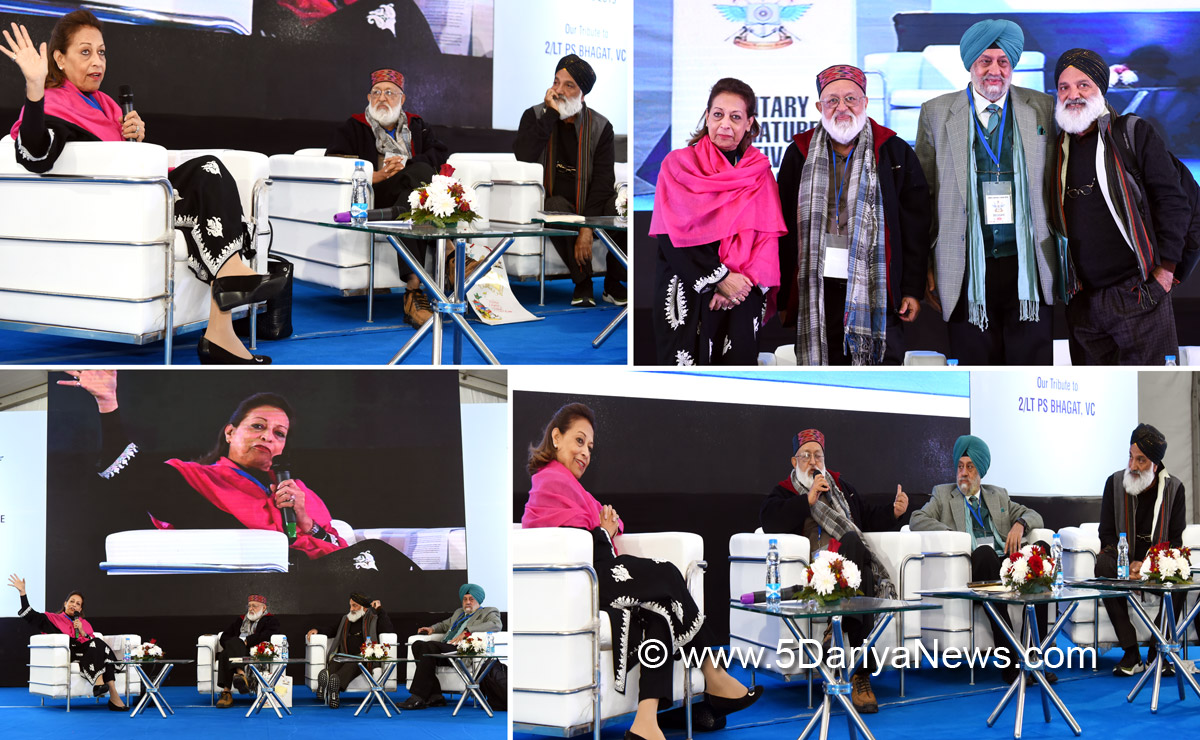
Safety measures for defense and safeguard of artillery and people were the key points for the construction of any fort and Indian forts were beautifully developed by ruling emperors minding these points. The panelists highlighted these points during Medieval Military Architecture – Forts of India, discussion held here at venue B on the first day of Military Literature Festival 2019. The panelists also discussed the role of forts in the history and development of the nation and asserted that forts have very special role in shaping our present. Documentary films were also showcased during discussion to make the people aware of the features of Kumbhalgarh fort and Daultabad fort.Renowned historian Amita Baig also highlighted the role of nature in the construction of fort in the region. She said that the forts in India were built with nature which is missing in today’s architecture. She added that the medieval techniques for the construction of forts were incorporated with both military and civil engineering as all the natural factors were used for the protection of the fort. She added that the architecture seems to be war with nature and the trend should be reversed.Ms. Baig also highlighted the attachment of Indian people with the forts in the way of religious sentiments as she shared a story of local people while the renovation of Qila Mubarak. She said that when the renovation process started in Qila Mubarak, the locals appealed the team to allow their access to the ‘Jot’ of Baba Ala Singh.

While inaugurating the discussion, moderator Professor Pushpesh Pant said that the first Indian fort was constructed in 2000 BC by the small armies. He added that every region had its specialty of constructing forts and main things like secure place, far visibility, appropriate defense mechanism, availability of water and land to be used in tough times.Meanwhile, Lt Gen DDS Sandhu elaborated the design of forts from the angle of military architecture and said that most of the Northern forts were constructed facing North to avoid the harsh effects of rain. He added that the emperors also put the dead bodies of people to give strong foundation as Khilji also put around 8,000 heads under the Siri fort.Lt Gen Sandhu added that the existence of natural water resource and land for agricultural were also the prime requirements for the construction of a fort at any place. He said that the diversion of water channel by the Mughals forced the Sikhs to urge Guru Gobind Singh to vacate the Anandgarh fort at Anandpur Sahib as they also blocked the supply of ration.Theatre artiste GS Channi also emphasized the need of the hour to preserve the culture and history of India lying in these forts. He added that there are miles long python like ramparts of the Kumbhalgarh fort which are believed to be second after Great Wall of China. He said that there is another believes that only a mosquito could reach in the fort without the permission of the then authorities as top kisses the clouds along with other defense techniques.


Brainstorming session held on topic of understanding the message of Balakot

Eminent experts today took part in a brainstorming session on Understanding the Message of Balakot here in the ongoing Military Literature Festival at the Lake club.Air Chief Marshall (Retd) BS Dhanoa, Squadron Leader (Retd.) Sameer Joshi, Defence Experts Mr Praveen Sahni and Ms Kristine Fair had detailed deliberations on the issue.  Air Chief Marshall (Retd) BS Dhanoa, Squadron Leader (Retd.) Sameer Joshi and Defence Expert Mr Praveen Sahni opined that the strike which was first of its kind non military preventive action in country’s history in last 47 years. They said that Pilots of the Indian Airforce were fully trained and ready to esnure no slip ups during the operation to destroy the terror camps. They said that Message of Balakot action was clear that any attempt to shelter or train militants against India would be dealt with sternly.They said that the operation was not to kill all and destroy all but was aimed for destroying terrorism training camps in Pakistan Occupied Kashmir (POK). They said that IAF conducted spice 2000 strike in Balakot and validated in live combat. They said that as a country Pakistan proved was habitual of misrepresenting the facts but India answered them that wherever they would go India would take them head on with its marvellous Indian Air Force.In her address Ms Kristine Fair said that lessons of the strike must be empirically studied on the basis facts. She said that certain claims being made by either sides were far from real and need to be studied deeply.Air Marshall (Retd) KK Nohwar acted as moderator of the session.


26/11 repeat will be fatal for Pak: Ex-RAW chief

26/11 repeat will be fatal for Pak: Ex-RAW chief

Tribune News Service

New Delhi, December 13

Vikram Sood, former head of the Research and Analysis Wing (RAW), on Friday said Pakistan cannot afford to launch a terror attack that is traced to them and added that the neighbour would be committing suicide if it tries to repeat 26/11.

‘Mumbai is always on terror radar’

We have multiple threats from Pakistan. They have elements which they can use against us. Mumbai has always been a target, be it 1993 blasts or 26/11.

Vikram Sood, raw ex-chief

He was speaking at the launch of Nitin Gokhale’s book RN Kao, Gentleman Spymaster. RN Kao, was founder of RAW, India’s external spy agency. Army Chief General Bipin Rawat released the book.

On being asked what should be the method of declassification, Sood said we need not follow the US model.

He argued that papers can be declassified after 40 or 50 years. However bright the civil services may be, they cannot have domain experts like cyber. We need to catch people early, take the example of Army. We need persons who can join after school. Gokhale said the book gives details of the times of the 1960’s and 1970’s when it was just Pakistan and China and there was no such thing as cyber or terrorism.

On political leadership understanding the work of spies, Sood reminded that in 1977 when Indira Gandhi lost elections, the new Prime Minister (Morarji Desai) had his own ideas on intelligence. Recruitment to RAW was stopped till 1983. The best arrangement is when intelligence chief has direct access to the Prime Minister. Gokhale said Kao and Gandhi had good relationship. Unnithan asked Gokhale if things attitudes within the agency which frowned after B Raman (former senior RAW official) wrote his book Kao boys of RAW.


Pak anticipated Balakot strikes

Pak anticipated Balakot strikes’Lessons of battles Former IAF chief says Pak air force happy with limited-period engagement over conventional war

Amanjeet Singh Salyal

amanjeet.singh@htlive.com

Chandigarh : Air Chief Marshall BS Dhanoa (retd) on Saturday said Pakistan was anticipating retaliation after the Pulwama attack in which 40 Central Reserve Police Force (CRPF) personnel died.

“There were only two questions — when does the retaliation take place, and where,” he said in a brainstorming session on ‘Understanding the Message of Balakot’ on the second day of the third Military Literature Festival at the Lake Club, Sector 1, in Chandigarh.

“As per my understanding, the Pakistan air force is not in the inner circle of the Pakistani establishment as they were not aware where the Inter-Services Intelligence (ISI) was running its terror organisation,” said Dhanoa.

“While the well-known Jaish-e-Mohammad (JeM) headquarters in Bahawalpur was adequately protected, the JeM training camp in Balakot was devoid of terminal defences, hence I believe the Pakistan air force was not in the loop,” he said.

He said that Balakot strikes happened because of decisive national leadership and the fact all three armed forces wing were at the ready.

“The government’s political objective is to tell the JeM and Pakistani establishment that such attacks would come at a cost and no matter where you are, be it PoK or Pakistan, and that is the message of Balakot,” Dhanoa said.

The former IAF chief also said that the biggest lesson one could learn from the limited period engagement was that technology matters and Pakistan air force is happy with such kind of engagement over conventional war.

“What about the responsibility of people who were to get this technology and kept negotiating for nearly 10 years to get the MMRCA (Medium Multi-Role Combat Aircraft)? What would have happened in the same engagement had Wing Commander Abhinandan (Varthaman) been flying Rafale aircraft instead of MiG 21-bison?” he asked.

Pointing towards the poor fiscal health of Pakistan, Dhanoa said that in February, the neighbouring country was reeling under severe financial crisis.

An opposing view

The panel saw a heated debate when Christine Fair, an expert on South Asian political and military affairs, questioned the claims regarding the Balakot and its aftermath.

“The lessons of the strike must be empirically studied on the basic facts. Certain claims being made by either side country were far from reality and need to be studied deeply,” said Fair, adding, “It does not matter whether you destroy that camp or not as Pakistan has thousands from an outside point of view. I don’t understand investment in this story because it matters that you sent ordinance in the Pakistani territory.”

Saying that India had lost credibility in the international point of view due to the way certain images were circulated on social media to show the extensive damage which was not there, Fair claimed that no F-16 was shot down either.


Army chief bats for ‘leaner and meaner’ force

Army chief bats for ‘leaner and meaner’ force

Mumbai, December 14

Stating that threats to national security are becoming more and more complex, Army Chief General Bipin Rawat on Saturday advocated a “leaner and meaner force” which can secure quick victories.

Delivering the inaugural Manohar Parrikar Memorial Lecture here, Rawat also said that India’s response to terror attacks in Uri and Pulwama was much more “robust” compared to “inaction” after the 2008 Mumbai terror attack.

“Threats are becoming complex day by day, and it is important that we adopt a ‘whole of nation’ approach,and every citizen must be involved in national security,” he said.

National security was no longer the domain of security forces alone, he said.

“Weapon systems have become lethal. You have to look at getting victory in short time if you don’t want your people to suffer maximum damage.

“To achieve victory in shorter time, we need leaner and meaner force which will inflict maximum damage on the adversary in a faster time frame and achieve objective of victory,” Gen Rawat said.

“Political objectives can also be met before international pressures come on to you to go in for ceasefire,” he added.

The country’s defence forces have transitioned from “balancing to leveraging power”, he said, pointing out that the response to Uri and Pulwama terror attacks was “significantly robust as against our inaction after 26/11 (Mumbai terror attack)”.

“In recent times we have proved that for far too long we were punching far below our weight,” he said.

At the same time, “there is need to temper military ambitions with the size of our economy and budgetary allocations,” he cautioned.

Maintenance of “strategic balance” is our key priority, he said, adding that strategic foreign policy objectives are being achieved “with smart levering of military pressure points often without a shot being fired”.

“We will continue to act and not react,” the Army chief said, referring to responses to provocations on the border with Pakistan.

“Space for all-out conflict is narrowing,” he said, adding, “Preparedness brings deterrence. Being prepared doesn’t mean you invite war.”

“We should have the largest army in terms of technology innovation,” he further said.

Batting for a holistic approach, he said “all three services will have to integrate along with the national resources if you have to win victory through quick combat”. — PTI


Cong, Centre spar on CAA, protests claim another life

ong, Centre spar on CAA, protests claim another lifeCong, Centre spar on CAA, protests claim another lifeNE ON EDGE Tanker driver dead; more SC pleas against law
People protest against the Citizenship Amendment Act at Jantar Mantar in New Delhi on Saturday. Ajay Aggarwal/HT

HT Correspondents

letters@hindustantimes.com

New Delhi/Guwahati/Ranchi : A fresh round of political slugfest broke out over the amended citizenship act on Saturday as top Congress leaders accused the National Democratic Alliance (NDA) government of trying to divide the country, inviting a sharp reaction from home minister Amit Shah, who accused the opposition party of stoking violence.

Protesters have clashed with the police in several areas of the North-east since Parliament approved the amended act earlier in the week, triggering a debate on whether grant of citizenship could be linked to religion. On Saturday, demonstrations continued in West Bengal and the North-east, which saw several incidents of arson and the killing of one person, taking the death toll in the protests up to three.

The new law allows citizenship to migrants from Hindu, Parsi, Sikh, Jain, Christian and Buddhist faiths fleeing persecution in Pakistan, Afghanistan and Bangladesh. It has roiled the North-east, which has for long demanded protections to safeguard its cultural identity.

Speaking at the Congress’s ‘Bharat Bachao’ rally at Delhi’s Ramlila Maidan on Saturday, party leader Rahul Gandhi said the North-east was burning after the government’s push for the new legislation.

“The BJP government works to divide and weaken the country,” he said.

Gandhi also criticised the government’s move to withdraw Jammu and Kashmir’s special status in August this year. “Go to Jammu and Kashmir, Assam, Nagaland and Tripura. They are burning,” he added.

Congress president Sonia Gandhi, too, hit out at the Centre, saying the citizenship amendment act (CAA) will “destroy and shred” the soul of India. “But the country will fight against the act. Suffering injustice is the biggest crime. It’s time to rise to save the democracy and Constitution. The time has come to save the country and we have to struggle hard for it,” she said.

At an election rally later in the day in Jharkhand, Union home minister Shah attacked the opposition party, accusing it of trying to fan violence in the North-east region.

“We have brought the amended citizenship act and the Congress got a stomach ache and is fanning violence against it,” he said.

The ruling Bharatiya Janata Party (BJP) president assured the people of the North-east that their culture, language, social identity and political rights will be not be affected by CAA.

But protests continued in the region on Saturday. People in the North-east states fear that the act will legitimise the rights of immigrants in the region, affecting local people and culture.

An oil tanker was set ablaze in Sonitpur district in Assam, which shares its border with Bangladesh, killing its driver. The empty oil tanker, on its way for refilling petrol from Sipajhar in Udalguri district, was set ablaze by a group of people at Dhekiajuli in Sonitpur on Friday night, the police said. A six-hour shutdown was observed in Nagaland against the legislation.

An indefinite curfew imposed in the wake of protests was relaxed for several hours in Dibrugarh and Guwahati in Assam, which has emerged as the epicentre of protests against the contentious piece of legislation.

In West Bengal, where the Trinamool Congress government has been opposing the legislation, arson was reported from various areas. Buses, a railway station and a toll plaza in Murshidabad were set on fire by protesters, the police said.

In the Capital, hundreds of people gathered at Jantar Mantar to protest against CAA. The Delhi Metro Rail Corporation closed entry and exit gates at Janpath metro station in view of the protest.

(With inputs from agencies)


Balakot message was to tell Pak there will be cost for terror attacks: Former IAF chief

Balakot message was to tell Pak there will be cost for terror attacks: Former IAF chief

Students take selfie with former Air Chief Marshal B S Dhanoa on the second day of 3rd Military Literature Festival in Chandigarh on Saturday. Tribune photo: Vicky

Chandigarh, December 14

The message of the Balakot air strike was to tell the Pakistani establishment and terrorist organisations that there will be a cost to pay for terror attacks in India which was effectively conveyed, said former Air Chief Marshal B S Dhanoa.

He was speaking during a discussion on ‘Understanding The Message of Balakot’ on the second day of the Military Literature Festival organised here by the Punjab government and the Chandigarh administration.

“The message of Balakot, therefore, was to tell Pakistani establishments and terror organisations that there will be a cost to pay for terror attacks in India which was effectively conveyed,” said Dhanoa.

However, he said, “on our side.. (there were) stupid mistakes for which remedial measures have been taken and people responsible will be punished.”

Dhanoa did not share any details about what the “stupid mistakes” were.

He also said, “We could not impose significant costs on PAF (Pakistan Air Force) on 27 of February (when the Pakistan Air Force retaliated a day after the Balakot strike).”

Dhanoa asserted that there was a paradigm shift in the way the Indian government responds to terrorist attacks involving mass casualties. He pointed out that there was no military response from the Indian state after the 1993 bomb blast in Mumbai and the 2008 Mumbai terror attacks.

“The first response came after terror attack at Uri in 2016 and it was retaliated by the Army with an attack on destroying terror launch pads inside Pakistan Occupied Kashmir,” said Dhanoa, who retired from service on September 30.

Pakistan got the message that the new government will respond militarily to a major terror attack on its soil, he further said.

Dhanoa said that after the Pulwama attack in February in which 40 people were killed, the Pakistani establishment had feared that there would be retaliation. “There were only two questions—when and where the retaliation will take place,” he said.

A decision was taken to strike a Jaish-e-Mohammad (JeM) terrorist training camp in Pakistan’s Balakot area as the terror organisation was behind the Pulwama attack.

“The government and political will was very clear to tell the Jaish-e-Mohammad and Pakistani establishment that such attacks would come at a cost and no matter where you are, be it PoK or Pakistan, we will get you and that is the message of Balakot,” Dhanoa said.

Pointing towards the poor fiscal health of Pakistan, Dhanoa said in February 2019, the neighbouring country was reeling under severe financial crisis.

“Their foreign reserves were USD 50 billion compared to USD 400 billion in our case. Had they gone to war with us, they would have literally eaten the grass,” he said.

The former IAF chief also said that the biggest lesson one could learn from the limited period engagement was that technology matters.

“What about the responsibility of people who were to get this technology and kept negotiating for nearly 10 years to get the MMRCA (Medium Multi-Role Combat Aircraft)? What would have happened in the same engagement had Wing Commander Abhinandan (Varthaman) been flying Rafale aircraft instead of MiG 21- bison?” he asked.

The Indian Air Force had struck a Jaish-e-Mohammad (JeM) terrorist training camp in Pakistan’s Balakot area on February 26 in response to the February 14 Pulwama terror attack in J&K in which 40 CRPF personnel were killed.

The Pakistan Air Force retaliated the next day by unsuccessfully targeting various military installations in Jammu and Kashmir. — PTI


Book by IAF Officer bats for sustainable campaign to augment the technological power of the IAF to counter any danger from PLAF of China

Book by former IAF Officer today advocated a sustainable campaign for augmenting the technological power of the Indian Air Force (IAF) to maintain its edge over the People’s Liberation Air Force (PLAF) of China. During discussion on the book ‘The Chinese Air Threat’ authored by Group Captain (Retd) Ravinder Chatwal at the ongoing Military Literature Festival at Lake Club, in which former Fighter Pilot Sameer Joshi also took part, it was opined that the Chinese had started  flexing their muscles in air power after the Gulf war. It was told that the Chinese were helped by the various experts from the former Soviet Union. They said that Chinese had effectively laid thrust on churning out large number of fourth generation aircraft that was effective for combatting US Air Force or any other technologically advanced country.It was opined that though there was a general notion that Chinese had huge Air Force and Army but as a fact of matter PLAF was not ten feet tall for India. It was told that though China have got 1700 aircraft but most of their airfields were on Russian or eastern coast side due to which it was difficult for China to make any solid air attack on India. It was informed that Air campaign against India was slightly difficult as they do not have enough airfields in Tibet.The experts said that PLAF suffers limitation against IAF adding that J-20’stealth aircraft was an asset for Chinese but Rafale aircrafts would be a big asset for India. They said that India has to maintain technological lead against the PLAF to safeguard its airspace in better manner. They said that India was far better equipped to combat the PLAF but this needs to be maintained in future.


Military Literature Festival-2019 : Book Discussion on ‘The Bugle Calls: A life in the Indian Army’

As part of the Military Literature Festival which started today, a book discussion on ‘The Bugle Calls- A life in the Indian Army’ threw light on the emotions of an officer on joining the forces besides bringing up other aspects related to the army way of life.The discussion included panelists Lt. Col (Retd) Naresh Rastogi, Kiran Doshi (Both Authors of the book) and Lt. Gen. (Retd) Harbhajan Singh. The discussion was moderated by Lt. Gen. (Retd) Vijay Oberoi.Recounting his days as a cadet and an officer in the Army, Lt. Col Rastogi said that the first part deals with his sentiments while serving in the Army while the second part deals with the India of the 1950s and 1960s era which was different from what it is today. Airing his views, Lt. Gen. (Retd) Harbhajan Singh said that the most important of the book pertains to the battle of Asal Uttar in 1965 war which the author was part of besides the 1971 war. He also recounted how the Pakistani armour offensive was blunted during the course of that battle.Highlighting another aspect, Lt. Gen. Harbhajan Singh said that the regimental system is the way of life in the Army and is the backbone of the institution with slight aberrations which need to be sorted out.