








Sanjha Morcha

What’s New

Click the heading to open detailed news

Current Events :

web counter

Print Media Reproduced Defence Related News

Martyrdom fortnight to be observed

Martyrdom fortnight to be observed

Tribune News Service

Chandigarh, December 15

Chief Minister Capt Amarinder Singh on Sunday announced that the state government would observe “Shaheedi Pandarwara” (martyrdom fortnight) from December 16 to 30 to commemorate the supreme sacrifice of the family Guru Gobind Singh.

The Chief Minister has appealed to people to observe the ‘Shaheedi Pandarwara’ as homage to Guru Gobind’s family and also to spread the message of their sacrifice across the world. It has been more than 300 years since the martyrdom of Guru Gobind’s mother Mata Gujri and his four sons — Sahibzadas Ajit Singh, Jujhar Singh, Zorawar Singh and Fateh Singh — but their sacrifice remains a beacon to inspire people across the globe, he added.

It has been decided to observe the somber and sacred occasion during the month of “Pauh”, which is dedicated to mourning the great souls of those who had passed away, said an official spokesperson.

According to the spokesperson, the government will organise various programmes such as seminars, discussions and exhibitions to disseminate the message of the unparalleled sacrifice of the Guru’s family, especially among the youth.

The Chief Minister described this as a humble effort, as part of his government’s endeavour, to create awareness among the younger generation about the lives of the Gurus and imbue them with the principles for which They lived and died.


Dedication, Commitment Of Israeli People Always Helped Them To Counter Attacks’

The dedication and committed of Israeli people for their country has always helped them to counter the attacks of Arab countries. Even in the war, they repaired and refurbished the tanks rapidly to fight against the superior armour of the enemy. The experts in ‘Defending Against Formidable Odds: The Golan Heights, 1973’ discussion on the concluding day of Military Literature Festival 2019 lauded the spirit of nationalism of Israelis. During the discussion speaker Major General Yosi Ben-Hannan also shared his experience of war with the help of motivating presentationWhile initiating the discussion, Moderator Lt General KJ Singh said that young Israelis are very keen to join the army to serve their nation and they don’t even hesitate to sacrifice their life on their motherland. He added that they are one of the best examples to follow if one wants to work for the safeguard of his or her country.Israeli Maj Gen Yoshi Ben-Hannan, while narrating his days in the war, said that he had only 10 tanks in the starting but as they started performing well by hitting enemy tanks, they were joined by the tanks from other battalions too. He added that with their 10 tanks, they had targeted more than 90 tanks of the enemy.Meanwhile, Lt General IS Singha also acclaimed that spirit of Israeli youth and informed that every year 60,000 boys and 60,000 girls qualify for the army service which is another inspiring aspect for the nations like India. He added that it is not the religion which is uniting them; it is their language which infuses the spirit of nationalism in them.While talking about the situation of war, Lt Gen IS Singha claimed that it requires 10 day advance notice for any army to get prepared for the war but Israel got only few hours notice due to the failure of intelligence agencies. He added that an Intelligence Officer should never be over confident as the result of the war depend lot upon his inputs.


MLF-2019: Martial Art & Dance Performances Steal The Show

The martial art and dance performances by various Army Regiments of the country on Friday emerged as the star attraction amongst the visitors on the inaugural day of the three-day Military Literature Festival-2019 organised at Lake Club here. The MLF-2019 is a joint venture of Punjab Government led by Chief Minister Captain Amarinder Singh and Governor of Punjab and Union Territory Administrator VP Singh Badnore in collaboration with Western Command of the Indian Army. The show, which left the visitors spellbound, was organised by the Unit 270 of the 474 Engineer Brigade under the leadership of Colonel Mohammad Rakib while Naib Subedar Bhupinder Singh was the in charge.Leading the show, 5 Madras Regiment led by Sepoy Ashok Kumar along with a team of 10 Army men enthralled the audience by performing martial art ‘Kalari Payattu’. ‘Kalari Payattu’ also known as Kalari is an Indian martial art and fighting system that originated in Kerala.On the other hand, a team of 21 performers led by Naib Subedar Nima Tshering Sherpa from 2/5 Gorkha Regiment (Front Fighters), 69 Indian Infantry Brigade (INF BDE) has shown their fighting skills using knives in Khukri Dance. Khukri is a knife, originating from the Indian subcontinent, associated with the Nepali speaking Gurkhas of Nepal and India.A team of 21 performers from 22 Punjab Regiment led by Subedar Dalwinder Singh and Naik Jagjit Singh has also shown their martial art skills by performing Gatka. Gatka is a famous Martial Arts associated with the Sikhs of Punjab.Concluding the show on the first day, a team of 40 teammates from 36 (Maratha) MED Regiment led by Subedar Hemant A Deore mesmerised the audience with their Jhanj Pathak dance performance.Naib Subedar Bhupinder Singh said that the show was organised to showcase the Martial Art skills of the Army persons, who are safeguards of the country. He said that the performances from different regiments will continue till Sunday.Meanwhile, visitors in large numbers enjoyed the food stalls of different states, weaponry exhibition, military art and photography exhibition. Whereas, students got an opportunity to interact with the Army persons during the Samvad Interaction and also watched informative documentaries and films on different Army forces at Clarion Call Theatre. The festival will continue for over the next two days.


Panel Discussion On Topic “Creation Of The Post Of Chief Of Defence Staff” Held On Concluding Day Of Military Festival PANELISTS WELCOME THIS STEP & EXPECT BETTER COORDINATION AMONGST THE ARMED FORCES

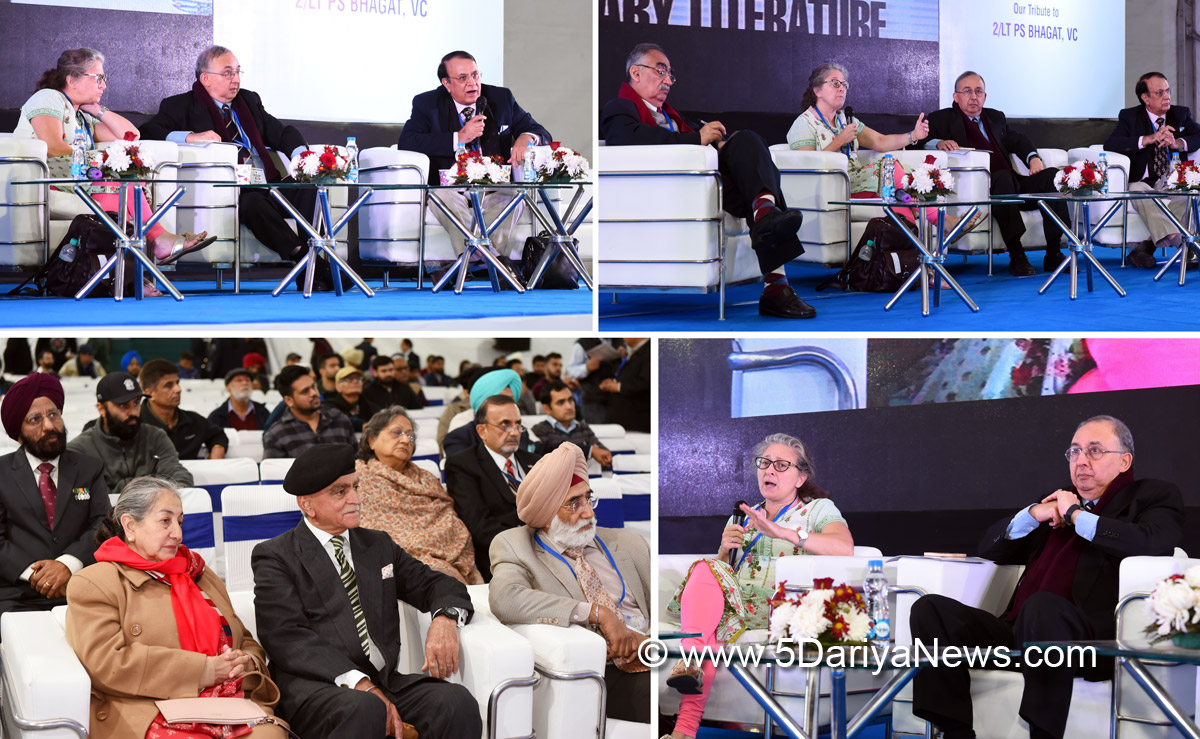
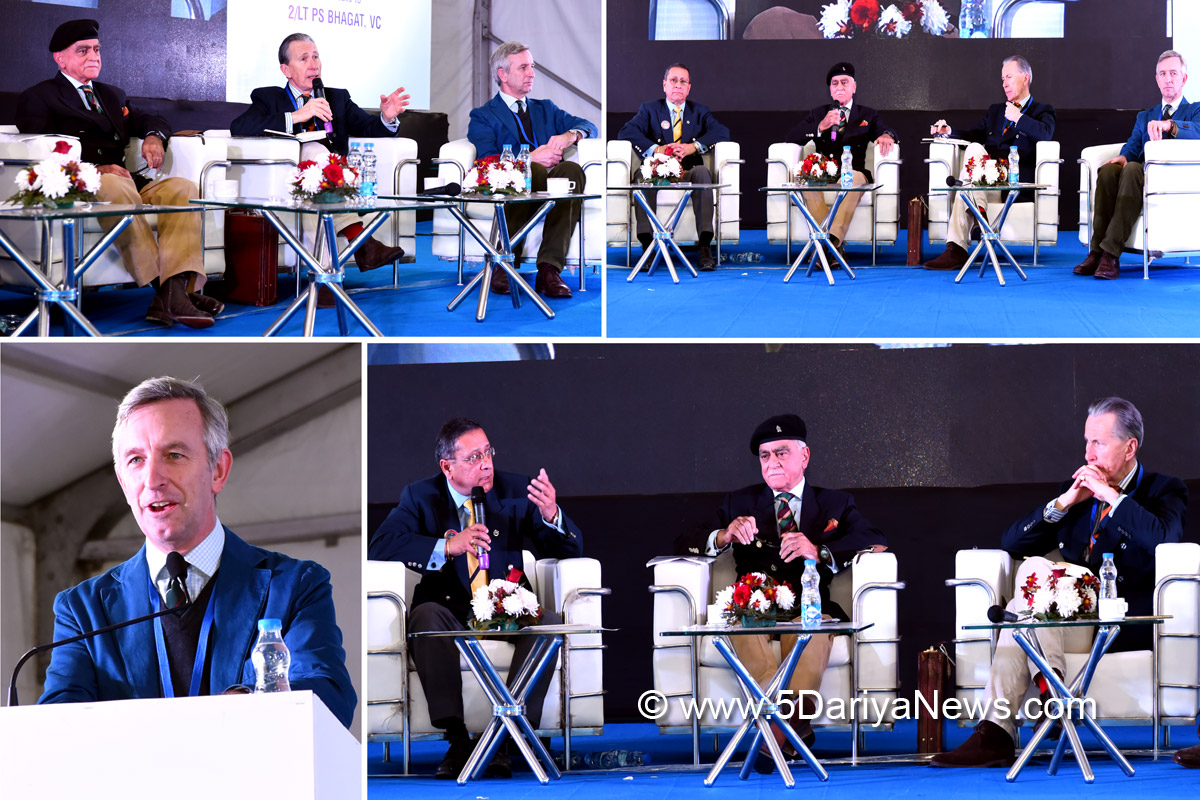
A panel discussion on the topic “Creation of the post of Chief of Defence Staff” was held on the third and concluding day of Military Literature Festival, here today. The panel discussion was moderated by Lt Gen (Retd) Aditya Singh and the other panelists included Air Marshal (Retd) Manmohan Bahadur, former defence secretary Shekhar Dutt, advisor to British High Commission New Delhi Brig Gavin Thompson and Lt Gen (Retd) Sanjeev Langer.During the discussion, all panelists welcomed this decision of the government and said that ever since the Kargil War got over in 1999, the Group of Ministers, in the year 2001, recommended the creation of the post of Chief of Defence Staff (CDS). Moderator Lt Gen (Retd) Aditya Singh said that the post of CDS is aimed at ensuring better coordination between the three services, the Indian Army, the Indian Navy and the Indian Air Force. He further said the CDS will act as the single-point advisor to the Government of India. The officer concerned will be in a position to advise on matters related to all the three services, Army, Navy and Air Force, thus making India’s armed forces integrated. The Chief of Defence Staff will be a ‘first among equals’, a fourth four-star officer who will be senior to the three other service chiefs.Former defence secretary Shekhar Dutt stressed the post of CDS has been created as it is necessary to have a professional body of the highest standing to facilitate ‘jointmanship’ and render single-point military advice to the government on matters of national security.

He said that this post has been created by keeping in mind the present day needs and the first CDS would be appointed in few days from now.Advisor to British High Commission New Delhi Brig Gavin Thompson said that a centrally decision making body, such as the CDS is need of the hour and it has been followed in the UK for several years. He also shared the working of the CDS in UK.Lt Gen (Retd) Sanjeev Langer gave a presentation and compared the system of command of armed forces in USA, China, France etc with that of the CDS in India. He said that uniformed men from the armed forces should be deputed permanently in the Ministry of Defence, and the CDS would play in fostering inter-services jointness in terms of budgeting, equipment purchases, training, joint doctrines and planning of military operations, an imperative of modern warfare.Air Marshal (Retd) Manmohan Bahadur stressed on the formation of a separate defence cadre in the country, whose officers should be deputed only in organisations related to national security. He also said that the CDS should be made a permanent members of all committees related to strategic policy group, nuclear command authority etc and should be made a part of all the inter-ministerial discussions that are related to matters of national security. At present, a bureaucrat heading the Defence Ministry formulates the operational plans for war fighting and Chiefs of Staff execute it. With the creation of post of CDS, it could be rectified now.Lt Gen (Retd) Satish Dua also shared his valuable experiences with the audience. A question answer session was also held in the end.


MLF 2019 : Students made aware of Indian submarines by experts

Retired Navy officers and experts today made school students aware about the submarines during the third and last day of the Military Literature Festival in the Panel Discussion titled–Run Silent, Run Deep, Strike Hard. Admiral Sunil Lanba was moderator during the panel discussion. The panelists discussion revolved around the modern technology, different models of submarines, its usage, advantages and manufacturing. They also talked about the capabilities of different types of submarines, various countries stretegic parternerships, deals and competitive bidding system to purchase the submarines. In his opening lecture, Commodore Anil Jai Singh gave 15 minutes digital presentation about different shapes, sizes of submarines equipped with weapons. He also informed about the commissioning of submarines into the Indian Navy in the historical overview.  He talked about different aspects of the submarine and its use in clandestine operations.  He also discussed the modern technology to be used in keeping a round the clock check under the water. He also discussed about the range, speed and endurance of different submarines and shared his views on modern technologies addressing the limitations.Vice Admiral A. K. Singh made the children aware about the basic principles of submarines equipped with nuclear weapons. He talked about the peculiar requirments of submarines and touched technical aspects. The Vice Admiral also threw light upon the strength and power of submarines which are in possession of India’s neighbouring countries.During his interaction with the students, Professor Bharat Karnad talked about Military indigenisation and India’s perspective on handling business deals and manufacturing of the submarines. He said that India has to be sovereign and minise its dependency on foreign suppliers.


Military Literature Festival-2019 : Even Young Readers love to read about ‘War Heroes’ – Rahul Singh

In the backdrop of the 2016 surgical strike and Balakot attack, now readers are more interested in military literature and they want to know more about the life of real War Heroes. These were the words of Mr.  Rahul Singh, author of the book ‘India’s Most Fearless-2’, who has participated in the discussion on his book on the third and concluding day of Military Literature Festival 2019.He said that numbers of military literature’s readers has been increasing eventually. Punjab Chief Minister Capt. Amarinder Singh was in the Army and he also penned books on military, which has made him a source of  inspiration for Punjabi young readers.Rahul Singh further revealed that he and Shiv Aroor, co-author of the book, have comprised the 14 original stories of courageous and brave soldiers.He said that the main objective of writing the book is to introduced the young readers to military men’s valour and sacrifices so that they can get inspiration from the life of our country’s real heroes.

During this discussion, Senior journalist Manraj Grewal Sharma was the moderator and writer Renee Singh was also present on the stage. Rahul Singh said that Marathas and the Punjabis have a glorious history as a reader, people of Maharashtra are very fond of military literature. He said that although the number of linguistic readers is high, it is easier to reach more readers with books written in English. Rahul Singh expressed hope that the military literature would go a long way to get more closer the young readers to the country’s rich military heritage.He said that his book, which had come under the same head earlier, was well received by a large section of readers and his book ‘India’s Most Fearless’ is a best selling book. Praising the courageous soldiers, he said that while covering the military beat as a journalist he observed closely the emotions and courage of the Jawans.It is worth mentioning that Shiv Aroor and Rahul Singh are both senior journalists and both have a long experience in military journalism. The authors have deep knowledge about military affairs, and their experience is reflected in the pages of the book.


Experts Say Revocation No Magic Bullet, Has Only Alienated People & Mainstream Kashmir Leaders

ARTICLE 370 SPELLS AND SOLIDIFIES OUR RELATION WITH JAMMU & KASHMIR, ITS ABROGATION PATENTLY UNCONSTITUTIONAL AND UNDEMOCRATIC, ECHO KASHMIR EXPERTS

Terming the present situation in Kashmir as one of a tinderbox waiting to burst, eminent Kashmir experts on Sunday castigated the Centre move to undemocratically revoke Article 370 as it spelled and solidified India’s relation with the state of Jammu and Kashmir. During a highly-charged panel discussion with RSS ideologue-cum-BJP National General Secretary Ram Madhav and Congress MP Manish Tewary as panelists on Article 370 and the Death Knell of Terrorism, the distinguished duo comprising former R&AW Chief AS Dulat and Manoj Joshi echoed that former PM Atal Bihari Vajpeyee’s approach of Insaniyat, Jamhooriyat and Kashmiriyat was the only way to ensure lasting solution to the vexed issue. The Kashmir is badly numb and residents of the state are feeling a sense of disappointment with Delhi, said Dulat in his opening remarks adding that the situation was grim and what we are witnessing is Quiet Disobedience which nobody knows would take what course in future. Taking part in the discussion, Ram Madhav said the revocation of Article 370 was done in most democratic fashion disclosing that political prisoners like the former Chief Minister Farooq Abdullah would be released soon. Shying away to put any timeframe, Madhav however added that process to keep the political activity going in Kashmir were on. We would restore the status of statehood to Jammu and Kashmir,  Madhav said clarifying there it was felt that there was need to put the bifurcated state under Central rule for sometime hence the creation of Union Territories. Taking strong exception to former RAW  Chief Dulat’s expression of Calm Disobedience, a visibly ruffled Madhav emphasised Kashmiris have never been known to be quiet and they are always up at the smallest provocation. Kashmiris have lived with article 370 for seventy years and now they are experiencing life without it. It is a bold step taken by the Government and I am sure the new situation will ensure development and complete integration of region with India.

Putting his point across, Senior Congress Leader Manish Tewari blamed the Centre for setting a dangerous precedent by dividing a state into a UT there by trampling the very spirit of our constitution. We are a Union of States and what has been done by bifurcating Jammu and Kashmir is the most obnoxious move entailing serious repercussions for our Constituion and polity. Echoing the views of both experts on the panel, Tewari further said that revocation had nothing to do with terrorism and had subverted all norms of due processes enshrined in Constitution. Terrorism, which the Central Government claims to put an end to with this one stroke, has had its genesis in dismemberment of Pakistan and creation of Bangladesh, said senior Congressman adding that our enemy neighbour had always followed the policy of bleeding India through thousand cuts. Underlining that there was something fundamentally wrong in this decision, he further said that Centre had with its mindless decision alienated mainstream Kashmiri leaders too adding that God forbid if the situation so warrants we now literally have nobody to talk to. Earlier replying to a question, Madhav clarified BJP alliance with PDP was purely on lines of development and security agenda mutually agreed upon. After working with Madam Mehbooba Mufti for an year and half, we felt some difficulties in furthering our security agenda in Kashmir and we as a party decided to quit and let president rule come into force. Taking part in the discussion, eminent journalist and state expert Manoj Joshi stated the goal of centre to homogenise everything was bound to fail as we are a nation of distinct state identifies. It’s possible in India to be proud of your cultural heritage and still feel equally proud of your nation. Even Hindus in Jammu and Kashmir have a different sense of Hinduism from Hindus living in other parts of the country, he emphasised. Elucidating the historical perspective, he said decision to assimilate Jammu and Kashmir immediately after Independence was effected under conditions prevailing at that time. We were a new nation and were not very capable of guarding our borders then, he said adding that certain concessions had to be made to merge Kashmir with India. He advocated a mix of both hard and soft power to achieve desired objective.


Robust Intelligence Network Must To Preempt Another Kargil Type Surprise: Experts

There is urgent need to further strengthen the existing intelligence mechanism to prevent another Kargil like situation, defence experts averred here on Sunday.Taking part in session titled Lessons learnt from the Kargil war and their  implementation, retired Defence Secretary Shekhar Dutt stated that we need to strengthen the intelligence and surveillance at Central as well as State level because no military operation would go successful without quick inputs. All penelist including Lt. General JS Cheema and Air Marshal Nirdosh Tyagi called for developing and generating more intelligence organizations to avoid surprise incidents like Kargil.Taking part in the discussion, Dutt said that Kargil demonstrated the surprise to Indian army that how could the specific intruders come and place their. He said that to avoid such incidents we have to develop the common channels of intelligence and surveillance so that actionable information could be provided to our arm forces to assured maximam level of preparedness.He said that national defence is a high priority of country and much more important than infrastructure so there is need to sanction more budget to establish strong mechanism of intelligence and to procure equipments for the purpose which would deliver the every suspicious activity to operation commander of arm forces.

Air Marshal Nirdosh Tiyagi displayed the two exclusive videos of the air force strikes of the Kargil war during the panel discussion. He also revealed that IAF was not properly equipped or trained for operations at such altitude and our Jets were also not designed for situation like Kargil. Tiyagi said that Kargill review committee elobrated that long time taken by army at apex level to realise how grave the situation was and severely affected the operation and deep interdiction could not be carried out due restriction on the crossing of LOC. He said Kargil war would have  ended 15 to 20 days earlier if the restriction of crossing the LOC was not there.Tyagi said that Kargil conflict demonstrated air power could be effectively utilised at such altitude and it has been also learnt that effective application of air power through proper army-air co-ordination resulted in reduce casualties and compressed time frame for successful ground operation’sPanelist Lt. Gen J S Cheema said that after 1999 Kargill war, indian army became more stronger and jointness is improved as there are batter opportunities to work amongst tri-services.


Red Corridor Shrinking but still exists in country- say experts

The experts today opined that the Red Corridor, precisely described as Naxal affected area of Andhra Pradesh to Nepal, was shrinking due to delusion of ideology but still exists in the country.During a discussion on the topic that ‘Does Red Corridor Exist’ during the Military Literature Festival here at the Lake Club, the experts Including Director Counter Insurgency Brigadier BK Punwar, former Director RAW Mr KC Verma and Professor of Sociology in Delhi School of Economics Ms Nandini Sunder said that from 231 districts of the country severely affected by the problem from Pashupati to Tirupati this corridor has been now confined upto 90 districts only. They said that with multi pronged strategy involving the specialised training to highly modernised and combat ready Police to development oriented policies of the government have been instrumental in resolving the problem to a great extent. They further said that even the passing away of senior leadership and moving of some leaders abroad along with dilution of ideology amongst younger cadres too have been instrumental in resolving the problem.They said that contrary to the notion spread in 2004-2005 by Naxals that power flows from barrel of gun most of them were now surrendering as they have been effectively cornered by the security forces.

Batting for Political, military, social and economical resolution of the issue, they said that Naxals came to prominence due to  tremendous failure of administration. They said that until and unless these issues were not resolved effectively the permanent resolution of this issue was not possible.The experts also said that extreme  poverty, exploitation of land and resources for vested interests, non implementation of fifth scheduled of constitution to safeguard the rights of ST and other reasons had aggravated the problem. They said that that due to naxalism these areas had Liberated from constitution and from Rule of law which was dangerous for the unity and integrity of country. They said that the essence of the success of naxalites was highly trained and motivated cadre which was diminishing now.Prof. Nandini Sunder also said that the budget of security forces in naxal affected areas was double than that of the development of these areas, which needs to be reversed for permanent solution of this problem. She also said that killings of innocent villagers on pretext of naxalites also needs to be checked with a firm hand . She also advocated provision of basic civic amenities to the people of these areas as a part of the Confidence Building Measures.On the occasion noted author Mr Ajay Sahni acted as the Moderator of the session.


MLF 2019 : Panel discussion held on Jallianwala Bagh MANISH TIWARI EMPHASIZED UPON TOUCHING ASPECTS OF MASSACRE

Jallianwala Bagh was the turning point of Indian Freedom struggle after which the Indian leaders resolved not to accept the repression of British Imprealism anymore. Stating this today during a panel discussion on the second day of MLF, Member of Parliament from Anandpur Sahib Manish Tiwari stressed upon the need of doing more research to reach at the depth of the Jallianwala Bagh Massacre.The panel discussion was moderated by historian Kishwar Desai and other panelists were historians Manoj Joshi, Walter Reid and Professor Sukhdev Singh Sohal from Guru Nanak Dev University Amritsar.Advocating more research, documentation and study of the entire incident specifically in the number of deaths, MP Manish Tiwari said that the repression of the British Imperialism was on its heights in those days and the civil unrest was continuously being suppressed by the Britishers.He said that when Mahatma Gandhi came back to India in 1915 the freedom movement took the shape of national movement and Punjab was extremely critical for British.The MP pointed out that Jallianwala Bagh incident did not occured all of a sudden but it was a part of the movement of continuous supression by the Britishers. It was an atrocity of different magnitude, he added. He informed that earlier too during the Kuka Movement in 1872 the Kuka leaders were blown away by the cannon mounts to supress their voice.

Tiwari stated that the body count during this massacare was assessed by the experts with 1560 bullets fired on the day of Baisakhi where unarmed people had gathered in the Bagh.Participating in the discussion, Professor Sukhdev Singh Sohal touched different aspects of Jallianwala Bagh massacare including the structure of Indian army in those days, designation and duty assigned to Brigadier-General Reginald Dyer. He also talked about the British policy adopted in India after the 1857 mutiny. The Professor also threw light upon the background of Dyer and stated that both General Dyer and the then Lieutenant Governor of of Punjab Sir Michael Francis O’Dwyer were Irish and cannot be seperated.  He also discussed about the ways and means adopted by the Britishers to keep the Jallianwala Bagh incident low profile for a long time due to which not much was shared about the massacre.Manoj Joshi spoke about the role of Mahatma Gandhi after the incident and also talked about the aftermath of the incident. He too pointed out that the incident was not properly documented even after independence.The panelists informed that though a ban was imposed in different parts of Amritsar but it was not announced around Jallianwala Bagh due to which large number of people gathered in the Bagh.Terming it a terrible thing happened, Kishwar Desai said that Jallianwala Massacre is worst example of colonial violence which shows an aggressive way of dissent and a bid of terrorising minds of protesters. She said that her book–Jallianwala Bagh, 1919-The Real Story, is homage to those who suffered specifically in Amritsar in the backdrop of Mahatma Gandhi’s mobilisation of Rowlatt Satyagraha across the country.

 Tags: Miltary , Manish Tewari