Sanjha Morcha

What’s New

Click the heading to open detailed news

Current Events :

web counter

Print Media Reproduced Defence Related News

Terrorists carried ammo capable of piercing bulletproof vehicles

Disclosure They had also left an IED under a hoarding on the highway to target security forces: J&K Police

Press Trust of India

letterschd@hindustantimes.com

Jammu : Three JeM terrorists, killed in a gunfight near a toll plaza here, had left an Improvised Explosive Device (IED) under a hoarding on the Jammu-Srinagar national highway which another member of the module was to use to target security forces, police said on Saturday.

The Jaish-e-Mohammed (JeM) terrorists also carried ‘armoured piercing steel core ammunition’ which can go through Level 3 protection bulletproof vehicles that police and other security forces use, they said. The ammunition was in large quantity and could have posed a grave threat, top police officials said.

The terrorists were killed in a fierce gunbattle with police at Ban Toll Plaza near Nagrota, about 28km from Jammu city, officials said. The operation was called off after eliminating all the three terrorists but vigilance will still be carried out in the area, they added.

The truck-borne terrorists carried with them a powerful ready-to-use IED from across the border to carry out attack against the security forces on the highway, they said. They had “dumped it at a convenient location” near a hoarding on the highway to be used by a third person of their module, who is currently in Jammu, they said. Truck driver Sameer Dar, conductor Asif Malik and another over ground worker (OGW) were arrested.

Based on the disclosure during questioning of the three OWGs, a police team and bomb disposal squad swung into action and defused the IED fitted with RDX, grenades and other material and placed under a hoarding at Nagrota on the Jammu-Srinagar national highway, the officials said.

Efforts are on track down the person of the Jaish-e-Mohammed module in Jammu who was to plantImprovised Explosive Device to target security forces, they said. The JeM terrorists also carried with them a deadly US-made sniper rifle, six rifles, five pistols, 11 hand grenades, explosives and high-end satellite communication phones and GPS. DGP said that JeM terrorists only carried such weapons, that too by its top commanders.

They said M4 sniper rifle was used by militants in Kashmir in 2018 in five incidents fatally targeting police personnel. The officials said that had the M4 carbine again fallen into the hands of militants, it could have proved disastrous for security personnel.

Three OGWs of the militants including their handler Sameer Dar, Sartaj Ahmed Mantu and Asif Malik, all residents of Kakpora, Pulwama, were arrested by police and have been shifted to safer location for sustained questioning as they were part of Jaish-e-Mohammed plot to cause wide spread disturbances in the Valley, the officials said.

SUBSIDY CUTS OUTWEIGH ACCESS TO FARM CREDIT

Highlights Slashed fertiliser subsidy is likely to impact farmers directly by increasing cultivation costs

Sayantan Bera

sayantan.b@livemint.com

New Delhi : The budget presented on Saturday promised to bring prosperity to farmers through a series targeted interventions, from improved market access to higher access to credit but slashed the fertiliser subsidy by ₹9,000 crore.

The food subsidy bill was also cut by a massive ₹69,000 crore, from ₹1.84 trillion in 2019-20 (budgeted estimate) to ₹1.15 trillion in 2020-21.

Lower provisioning toward food subsidy means that the Food Corporation of India (FCI), the central agency that procures cereals from farmers and supplies it to beneficiary households under the public distribution system, will be borrowing from the National Small Savings Fund to make up the deficit, said Siraj Hussain, former agriculture secretary.

Further, a cut in food subsidy implies that despite a deteriorating food security situation in rural India driven by joblessness, stagnating wages, and rising food inflation, coverage under the scheme is unlikely to increase.

In fact, the Economic Survey released on Friday advised the government to reduce coverage under the National Food Security Act, 2013, to the bottom 20% of India’s population, compared to the 67% now.

The survey also recommended raising the central issue price, or the price poor families pay to purchase subsidised food from ration shops, which now stands at ₹2-3 per kg.

The cut in fertiliser subsidy is likely to have a direct impact on farmers by reducing fertiliser availability and increasing the cost of cultivation, besides impacting the liquidity situation of the fertiliser manufacturers.

Apart from major subsidies like food and fertiliser targeted at rural India, the budget papers showed an incomplete roll-out of PM-Kisan, the direct cash assistance scheme for farmers launched ahead of the general elections last year.

In 2019-20 the government spent ₹54,370 crore under the scheme, compared to the ₹75,000 crore it had planned, saving a staggering ₹21,000 crore.

So far, only 84 million out of an estimated 145 million farm households in India have benefited under the scheme.


Army distributes 135 solar lights in Ramban district

Army distributes 135 solar lights in Ramban district

Our Correspondent

Jammu, January 30

The Army distributed 135 solar lights among the Gujjar and Bakerwal families residing in Sambar village and its adjoining areas in Ramban district on Thursday.

Most of the villages in the higher reaches of the mountainous Ramban district have no access to electricity and after sunset, these areas plunged into darkness.

As a step to lighting up these remotely located villages, a total of 135 portable solar lights were distributed by the Army among the Gujjar and Bakerwal families.

The initiative was launched by the Army after it was felt that electricity was the most critical requirement in far-flung areas during interactions with the locals, including the floating population of Gujjar and Bakerwal communities.

The execution of the project has genuinely uplifted the living standards of the rural population in high-altitude remote areas and has also led to better relations between the Army and the residents, said a local.

The villagers have expressed their gratitude towards the Army for taking care of people of remote areas who are in dire need of assistance in various aspects of life.


Ex-serviceman shows alertness, helps security forces nab suspect

Ex-serviceman shows alertness, helps security forces nab suspect

Security personnel at the encounter site at the Nagrota toll plaza, where militants travelling in a truck opened fire at a police team.

Ranjit Thakur
Ban Toll Plaza (Jammu),
January 31

Mustering courage and showing alertness amid the encounter between the security forces and militants at the Ban toll plaza on the Jammu-Srinagar national highway, an ex-serviceman, Kewal Sharma, on Friday helped securitymen capture one of the suspects who was allegedly involved in ferrying militants to Kashmir in a truck.

Sharma, who is working in a private security agency in one of Nandani tunnels, showed a great presence of mind while engaging the suspect.

Kewal Sharma

“I came to know about the terror attack at around 5.40 am at the Ban toll plaza, and alerted other security persons in the tunnel about this. Within a few minutes, a man was seen walking under suspicious circumstances. When I stopped him, he started inquiring about the route to Kashmir and Udhampur. I misled him and engaged him in talk by offering him water and tea.”

“He was in panic, but there was no weapon with him. He was speaking both local and Punjabi language. I felt something fishy about him and informed the tunnel supervisor who, in turn, informed the National Highways Authority of India (NHAI) and the police. Then, he was taken into custody,” Sharma said.

“We trapped him in tunnel number 2. We also checked his smart phone, but found his pictures, probably from Punjab or Rajasthan with the truck. However, in which truck he was travelling, we are not aware.”


After 2 hrs 40 min, fatigued FM cuts short her speech

After 2 hrs 40 min, fatigued FM cuts short her speech

Aditi Tandon

Tribune News Service

New Delhi, February 1

Finance Minister Nirmala Sitharaman had to curtail her Budget speech in the Lok Sabha today after a taxing 2 hours and 40 minutes’ delivery that left her exhausted.

She even had at hand ready referrals from two doctor MPs — BJP’s Sanjay Jaiswal and TMC’s Kakoli Ghosh. By the end of the speech, Sitharaman had broken her own record of delivering the longest ever Budget speech. In 2019 as India’s first full-time woman Finance Minister, Sitharaman had clocked a 2 hours and 15 minutes Budget presentation surpassing the previous record of 2.13 hours held by Jaswant Singh.

During her speech today, the FM laid on the table a generous serving of poetic and philosophical verses and some proposals that left the Opposition anxious and angry.

The loudest opposition disapproval came when Sitharaman projected a nominal GDP growth of 10 per cent for 2021. “What?” was the refrain sounded by TMC, NCP and DMK leaders while former Congress president Rahul Gandhi sat listlessly. His mother and Congress president Sonia Gandhi was absent today so was SP patriarch Mulayam Singh Yadav.

The Opposition’s energies were mostly spent on urging the FM to not repeat herself (Sitharaman read out several statements twice for effect).

The FM for her part marched on after commencing the presentation posts greetings to her family (daughter and father) who were seated in the visitors’ gallery and watched Sitharaman from a distance.

Among the poets the FM quoted today, the first was Sahitya Akademi winner Dinanath Kaul. As Sitharaman recited in Sharada script Kaul’s salutations to the Valley, Prime Minister Narendra Modi led the treasury line-up in offering a thunderous applause.

The FM’s invocation of poet-philosophers — Tamil woman saint Avvaiyar; Tamil philosopher Thiruvalluvar and Kalidasa — today also served well to break the monotony of Budget proposals delivered over a long duration.

It was only after 2 hours and 37 minutes that Sitharaman stopped to have water and few lozenges her colleagues Nitin Gadkari and Harsimrat Badal offered. By then the FM was too fatigued to continue and abandoned the speech with two of the 45 pages still to go.


Surpasses own record

By the end of her speech, Sitharaman had broken her own record of delivering the longest-ever Budget speech (135 min) in 2019

Invokes Thiruvalluvar

The FM laid on the table a generous serving of poetic and philosophical verses, invoking Tamil saint Avvaiyar, Tamil philosopher Thiruvalluvar and Kalidasa


Defence budget weighed down

Defence budget weighed down

Ajay Banerjee

Tribune News Service

New Delhi, February 1

India’s military budget is now literally “weighed down” by salaries and pensions. The defence budget, minus the pensions, was increased to Rs 3,37,553 crore, up from Rs 3,18,931 crore for the present fiscal ending March 31, 2020. This is a meagre 5.8 per cent hike.

The capital allocation used for purchase of new weapons, aircraft, warships and other military hardware like guns and new UAVs is Rs 1,13,626 crore. This means modernisation gets an increase of Rs 10,316 crore over this year’s allocation of Rs 1,03,310 crore.

On the other hand, the budget for pensions has been hiked by Rs 21,742 crore and is now pegged at Rs 1,33,819 crore. This year, a sum of Rs 1,12,077 crore is earmarked for pensions.

The combined budget for operations, salaries, pensions and capital for the next fiscal stands at Rs 4,71,372 crore and it works out to be 15.4 per cent of the country’s entire budget.

The services are literally weighed down by bulging “establishment” costs — euphuism for salaries. The salaries of the three services and the civilians concerned work out to be Rs 1,34,989 crore, which now form 39.99 per cent of the budget. In other words, salaries and pensions take up more money than what is allocated for modernisation.

The MoD is looking at “right-sizing” the forces and also at cutting costs within. The Army has already started the restructuring process.

Key outlays

Rs1,34,989 cr salaries

Rs1,33,819 cr pensions

Rs1,13,626 cr capital


Union Budget: Check out what is costlier, what is cheaper


Warning: count(): Parameter must be an array or an object that implements Countable in /home/u230810771/domains/sanjhamorcha.com/public_html/wp-includes/formatting.php on line 3507

Govt introduces five tax slabs with lower rates for those foregoing exemptions; raises customs duty

New tax regime optional; taxpayers have the choice to either remain in the old regime with exemptions or opt for the new reduced tax rate without those exemptions

Govt introduces five tax slabs with lower rates for those foregoing exemptions; raises customs duty

New Delhi, February 1

Finance Minister Nirmala Sitharaman on Saturday announced cuts in personal income tax, extended tax benefits for affordable housing and gave relief to companies on payment of dividend in the Union Budget for 2020-21 as the government looked to boost consumption to bring the economy out of the worst slowdown in 11 years.

The minister proposed raising customs duty on a variety of products ranging from tableware and kitchenware, electrical appliances to footwear, furniture, stationery and toys to give a level-playing field to domestic companies and boost ‘Make in India’.

Offering an optional lower rate of income tax to individuals, Sitharaman in her Budget for 2020-21 proposed new tax slabs of 15 per cent and 25 per cent in addition to the existing 10 per cent, 20 per cent and 30 per cent. The new I-T slabs would be for individuals not availing certain specified deductions or exemptions.

Under the proposed I-T slab, annual income upto Rs 2.5 lakh is exempt from tax. Those individuals earning between Rs 2.5 lakh and Rs 5 lakh will pay 5 per cent tax. Income between Rs 5 lakh and Rs 7.5 lakh will be taxed at 10 per cent, while those between Rs 7.5 and Rs 10 lakh at 15 per cent.

Those earning between Rs 10 lakh and Rs 12.5 lakh will pay tax at the rate of 20 per cent, while those between Rs 12.5 lakh and Rs 15 lakh will pay at the rate of 25 per cent. Income above Rs 15 lakh will be taxed at 30 per cent.

Individuals opting for taxation under new rates will not be entitled to exemption/deductions, including under Section 80C and 80D, LTC, housing rent allowance, deduction for entertainment allowance, professional tax, and interest on self-occupied/vacant property.

Also read: Manmohan Singh calls Nirmala Sitharaman’s Budget speech ‘too long to absorb’ 

Currently, annual income upto Rs 2.5 lakh is exempt from I-T. While a 5 per cent tax is charged for income between Rs 2.5 lakh and Rs 5 lakh. 20 per cent for income between Rs 5 lakh and Rs 10 lakh and 30 per cent for those earning above Rs 10 lakh.

“The new tax regime shall be optional for taxpayers,” she said.

Also read: FM Nirmala Sitharaman cuts short Budget speech after feeling unwell

“The proposed tax structure will provide significant relief to taxpayers and more so to those in the middle class,” Sitharaman added.

To boost growth, Sitharaman announced higher spendings on infrastructure, rural development and agri sector.

http://

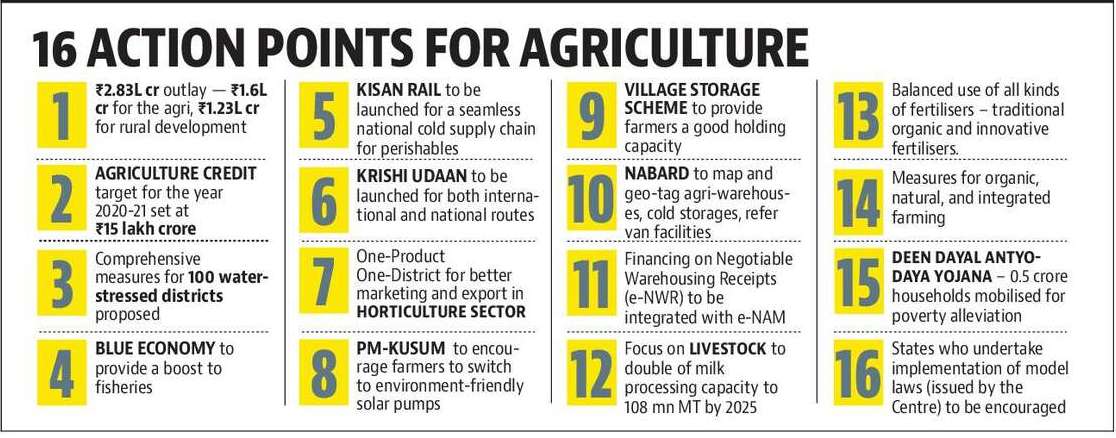
The Finance Minister said the government is proposing a 16-point action plan to boost agriculture and farmers’ welfare.

Also read: Moving toward lower tax rates with no exemptions: FM

Agricultural services needed copious investments, she said, adding that the government had insured 6.11 crore farmers under the Pradhan Mantri Fasal Bima Yojana.

With her post 2019-20 Budget corporate tax cut drilling a Rs 1.45 lakh crore hole in government revenues, the minister hiked the fiscal deficit target for current fiscal to 3.8 per cent of GDP, from 3.3 per cent.

http://


Lt Gen C P Mohanty assumes command of Southern Army

An alumnus of Rashtriya Indian Military College (RIMC), Dehradun, and National Defence Academy, Khadakwasla, the general is a June 1982-batch officer from the Rajput Regiment and is also the Colonel of the Regime.

An alumnus of RIMC and NDA, Lt Gen C P Mohanty is a June 1982-batch officer from the Rajput Regiment. Express

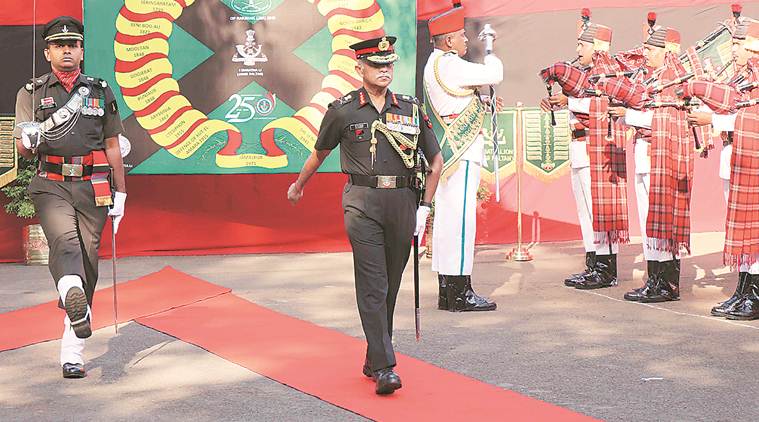
Lieutenant General C P Mohanty, an infantry officer with varied operational experience including in counter-insurgency environment, assumed command of the Southern Army on Thursday. In a wreath-laying ceremony at the National War Memorial in Pune, he paid tribute to fallen soldiers, followed by a traditional Guard of Honour at the headquarters of the Southern Command.

An alumnus of Rashtriya Indian Military College (RIMC), Dehradun, and National Defence Academy, Khadakwasla, the general is a June 1982-batch officer from the Rajput Regiment and is also the Colonel of the Regime. During his military career, Gen Mohanty has had vast operational, logistics and administrative experience in varied command and staff appointments. He commanded his battalion in Jammu and Kashmir and Northeast, a Mountain Brigade along the Indo-China border and a Mountain Division in counter-insurgency operations in Northeast. Later, he commanded a strategically important corps in the Eastern Theatre after the Doklam incident and also the Uttar Bharat Area at Bareilly.

Gen Mohanty has vast overseas experience of commanding a multinational brigade in the Republic of Congo, and also as the Military Adviser to the Government of Seychelles. He has held important staff appointments in an Armoured Brigade and Military Secretary Branch, besides being the Director General of Operational Logistics and Strategic Movement at Integrated Headquarters of Ministry of Defence (Army).

On the academic front, he has an MPhil and a management degree and has researched extensively on China, South Asia and northeast India, making him a domain expert of these regions. He is a graduate of Defence Services Staff College (DSSC), Wellington, and also an alumnus of National Defence College, Delhi.


200 years of the Bombay Sappers: ‘Ever-modernising engineering forces will remain crucial in future warfare’

The celebrations will culminate on February 1, when Chief of Army Staff General Manoj Naravane is slated to attend the function.

Bombay Engineer Group, also known as the Bombay Sappers, is a regiment of the Corps of Engineers of the Indian Army located at Khadki in Pune.

THE EVER-modernising engineering forces will remain crucial to future warfare, said Commandant of College of Military Engineering Lieutenant General Michael Mathews, at the occasion to mark 200 years of the Bombay Sappers.

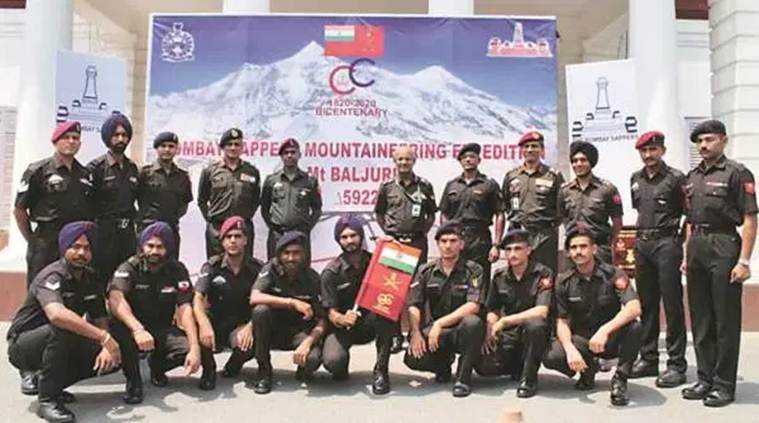
Bombay Engineer Group, also known as the Bombay Sappers, is a regiment of the Corps of Engineers of the Indian Army located at Khadki in Pune. The Group is completing 200 years in service this month. The bicentenary celebration commenced in style on Thursday with a para adventure display, including para drop, skydiving and para motors display by serving officers, troops and veterans and teams of Army Adventure Wing. The celebrations will culminate on February 1, when Chief of Army Staff General Manoj Naravane is slated to attend the function.

Lt Gen Mathews, who is also the seniormost officer of the Bombay Sappers, addressed the media on the sidelines of the para drop display.

“Sappers have key roles to play. One is to deny the enemy the mobility by laying mines and other obstacles. The other role is to facilitate and increase mobility when we go for an offensive, and that is by building helipads, tracks, bridges. The relevance of engineering elements in warfare is going to stay, irrespective of the form it takes. The process of modernisation is always on and we too keep evolving. In modern warfare, elements of Artificial Intelligence and robotics are bound to be there. Just as an example, in the College of Engineering, there are in-depth courses of subjects, so that we are ready for future security challenges. The practical application of AI and robotics is focused in these courses,” he said.

The para drop display event commenced with the para motors show by the Army Adventure Wing Parachute team from Parachute Regiment Training Centre, Bengaluru. This was followed by the para jump, in which senior serving officers and veterans took part. Some prominent names included Major General S K Jaswal (Retired); Deputy Chief of Army Staff (Planning and Systems) Lt Gen S S Hasabnis; General Officer Commanding of the Sudarshan Chakra Corps Lt Gen Yogendra Dimri; and Commandant Bombay Engineer Group and Centre, Khadki, Brigadier MJ Kumar. The event culminated with a skydiving display by Lt Gen R R Goswami (Retired) and Brig S R Mazagaonkar (Retired), among the pioneers in skydiving in India.