Sanjha Morcha

What’s New

Click the heading to open detailed news

Current Events :

web counter

Print Media Reproduced Defence Related News

PLA troops ‘completely move out’ of Galwan as India-China head towards total disengagement

File image of Indian soldiers in Ladakh | By special arrangement

File image of Indian soldiers in Ladakh | By special arrangement
Text Size:  

New Delhi: The Peoples Liberation Army (PLA) “completely moved out” of the Indian side of the Galwan Valley area Monday as India and China began disengagement in Ladakh after a 61-day intense stand-off, ThePrint has learnt. However, sources said the Indian Army remained cautious about sounding too optimistic.

While the Chinese have initiated disengagement steps at Gogra and in the Hot Spring Area, they continue to hold fort at Finger 4 at Pangong Lake. However, sources said the “movement of a few men and vehicles backwards was noticed” at Pangong Lake, where Chinese soldiers had come up to 8 km inside Indian territory. Government sources described the movement as “non-tangible”.

The disengagement exercise launched Monday came a day after the special representatives of India and China, National Security Adviser Ajit Doval and Foreign Minister Wang Yi, respectively, held a detailed phone conversation where they agreed on the “earliest complete disengagement of the troops along the LAC and de-escalation from India-China border areas for full restoration of peace and tranquility”.

This is the second attempt at disengagement — the first followed a meeting between corps commander-level officers on 6 June but culminated in the 15 June Galwan Valley clash, which killed 20 Indian soldiers, after the Chinese refused to fulfil their part of the agreement.

The whole process, sources said, will be long-drawn-out.

Sources underlined that it will be “premature” to say the stand-off is over as “any unfavourable” incident like that of 15 June can take place until “tempers on both sides cool down completely”. The leadership on both sides, the sources said, will continue to remain in contact 24×7.

Both India and China will begin a 72-hour verification process to make sure each side has fulfilled the commitment before the next round of disengagement is initiated.


Also Read: It’s time for China, Pakistan, even India to rethink the fantasy Modi called expansionism

 ‘Buffer zone’

Ladakh constitutes the western sector of the Line of Actual Control (LAC). Several spots along the border — Galwan Valley, Depsang Plains and Hot Spring — have been sites of stand-offs since April-May in light of Chinese incursions.

As part of the fresh disengagement, China has moved back by about 1.5-2 km in various locations, while the pullback by India is a “little less” since Indians were anyway in their own territory, sources said.

Both sides have agreed to what is being described as a “buffer zone”, which would be an area where neither side carries out any construction or patrolling activity and would differ from location to location, the sources said.

This means the Chinese troops will be closer to the LAC than Indian soldiers, and it will be some time before India can resume its normal patrols up to Patrol Point 14 in Galwan Valley, and patrol points 15, 17 and 17A in the Hot Spring area.

No specific time has been agreed upon regarding how long the buffer zone will exist, the sources added, saying it is a confidence-building measure for restoration of status quo as of early April.

The disengagement comes at a time when the flow in the Galwan river has increased due to snowmelt, according to inputs, making it difficult for both India and China to sustain troop build-up in the area.

At the Galwan Valley, government sources told ThePrint, the PLA has moved out completely from the Indian side of the LAC into their own territory.

The pullback region included the area called Y-Junction, which is located 1.5 km from the LAC. The Chinese had intruded into this area and built observation posts and numerous tents, the sources said.

The eventual gameplan of Chinese incursions in the Galwan Valley seemed to be to prevent India from carrying out any new construction beyond the confluence of the Shyok-Galwan river.

The Chinese also sought to restrict Indian patrols to the same point, located 4.5 km from the LAC, rather than until Patrol Point 14, which is 500 metres from the border (according to the 1960 claim line of China) and marks the status quo before the PLA incursions began in May.

In Hot Spring area and at Gogra post, the sources added, the Chinese had started dismantling tents and moving back men and vehicles from inside the Indian side of the LAC.

“The process will most likely be completed by tomorrow. Here, as per the schedule, they are supposed to move back about two km. Once they do this, they will be on their side of the LAC,” a source said.

Giving details about the Pangong Lake area, where the Chinese have occupied areas up to Finger 4, about 8 km inside Indian territory that starts from Finger 8, sources said there has “not been any tangible movement”.

“There has been some movement in terms of few vehicles and men going back from Finger 4. However, they continue to hold the position,” another source said.


Also Read: From Nathu La to Galwan, India has been trapped in reaction-mode to China’s aggression


Doval and Wang hold cordial talks’ 

Diplomatic- and military-level talks aimed at resolving border tensions had been underway between India and China since May. On Sunday, a telephone conversation was held between Doval and Wang, the special representatives appointed by India and China to discuss boundary-related matters.

Over an hour-long “cordial” phone call, the two are said to have held “a frank and in-depth exchange of views” on the border standoff.

According to sources, both the representatives discussed the Galwan Valley clash separately and assessed the reasons that led to it.

Their talks were “based on the commitment” reached by Prime Minister Narendra Modi and Chinese President Xi Jinping at the two informal summits of Wuhan (2018) and Mamallapuram (2019) when they vowed that differences should not be allowed to become disputes.

“They agreed that it was necessary to ensure at the earliest complete disengagement of the troops along the LAC and de-escalation from India-China border areas for full restoration of peace and tranquillity,” the Ministry of External Affairs said in a statement Monday. “In this regard they further agreed that both sides should complete the ongoing disengagement process along the LAC expeditiously.”

The two also agreed to the fact that it is critical to maintain peace and tranquility in the border areas and that it is “essential for the further development of our bilateral relations”.

According to the MEA statement, both Wang and Doval agreed to stay in touch to ensure “full and enduring” restoration of peace and tranquility. Bilateral agreements dating back to 1993 that lay down specific protocols on the LAC issue were discussed as well.

These pacts are: The Agreement on Maintenance of Peace and Tranquility along the Line of Actual Control in the India-China Border Areas, 1993; the 1996 Agreement on Confidence Building Measures in the Military Field along the LAC; the 2005 Protocol on Modalities for the Implementation of the Confidence Building Measures in the Military Field along the LAC; the 2012 Agreement on the Establishment of a Working Mechanism for Consultation and Coordination on India-China Border Affairs; and 2013 Border Defence Cooperation Agreement.

The two representatives also decided that “both sides should strictly respect and observe the Line of Actual Control and should not take any unilateral action to alter the status quo and work together to avoid any incident in the future that could disturb peace and tranquillity in border areas”.

The special representative talks had been under consideration ever since External Affairs Minister S. Jaishankar and Wang held a phone call on 17 June, sources told ThePrint.

The Chinese Foreign Ministry said in a statement on the Doval-Wang dialogue that both sides “should pay great attention to the current complex situation facing China-India bilateral relations, and work together to overcome and turn it around as soon as possible”.

“Not long ago, what happened in the western part of the border between China and India in the Galwan Valley is very clear. China will continue to effectively defend its territorial sovereignty and the border area and peace,” the Chinese Ministry of Foreign Affairs said Monday.

“Both sides should adhere to the strategic assessment that instead of posing threats, the two countries provide each other with development opportunities,” it added.

This is an updated version of the report


Naked expansionism Despite the PLA pullback, India has to be wary

Naked expansionism

China’s aggressive posture in claiming territory deep inside eastern Bhutan, close to the Arunachal Pradesh border, is a move towards keeping the entire India-China border active and unpredictable. Though the news of disengagement in Ladakh is welcome, the statement of the Chinese Ministry of Foreign Affairs regarding the Sakteng Wildlife Sanctuary in Bhutan dashes all hopes of a peaceful resolution of the standoff on the border. The telephone conversation between the Special Representatives of India and China has resulted in a pullback of the PLA troops away from the Galwan valley. But this might yet again yield the Chinese a net gain, using the salami slicing tactic of two steps forward and one back, unless India remains ever wary and watchful.

John Sawers, former chief of MI6, the British secret service, has interpreted the Chinese incursion in Ladakh as an instance of intimidation to prevent India from forging an alliance with the US, Japan and Australia for a common approach towards China, and also to bolster Chinese interests in Pakistan. Analysts like Sawers want Chinese leaders to understand that “they will pay a price”, if they impose their hegemonic aspirations on other nations.

China’s actions in Hong Kong, imposition of sanctions against Australia, its sinking of Vietnamese fishing boats in South China Sea, the Ladakh incursion and most recently its claims on the Sakteng Wildlife Sanctuary have all now prompted observers to arrive at an unambiguous understanding of China’s expansionist worldview, even in the context of the Belt and Road Initiative (BRI). India’s refusal to join the BRI or the Regional Comprehensive Economic Partnership had hastened the slide in Sino-Indian relations. So, a pullback of the Chinese troops from the Galwan valley, Hot Springs and Gogra to create a buffer zone should only be seen as a tactical move by China in its long-drawn-out strategic attempt to browbeat and subdue its neighbours into a client state status, as it has achieved in the case of Nepal and Pakistan. Chinese President Xi Jinping’s metamorphosis into a medieval monarch thirsting for battlefield glory and territorial overreach lies exposed, leaving Chinese enterprises vulnerable to political scrutiny.


India considering ITBP patrols in LAC ‘grey zones’ to keep the peace on China border

This could mean that Army will be away from grey zone areas of LAC, where forces from both India and China patrol and come face to face. At present, Army & ITBP jointly patrol grey zones.

An army convoy moving towards the Zojilla pass in Drass (representational image) | ANI

An army convoy moving towards the Zojilla pass in Drass (representational image) | ANI
New Delhi: Amid the India-China stand-off, the defence and security establishment here is considering a more prominent role for the Indo-Tibetan Border Police (ITBP) in LAC management with the Army then being in charge of border defence.

According to sources, this idea is being discussed at various levels in the establishment. If cleared it would mean that the Army will be away from the grey zone areas of the LAC, especially since both sides are creating buffer zones in Ladakh near the LAC.

The grey zones refer to areas where the forces from both India and China patrol and come face to face. Currently, the Army and ITBP jointly patrol the grey zones.

Under discussion also is the possibility that on the Chinese side, it would be the Border Defence Regiment (BDR) manning these grey areas, and not the Peoples Liberation Army (PLA). This, if approved, will be taken to the Chinese for further discussion to ensure peace and tranquility along the LAC.

“China is indulging in salami-slicing. It takes four steps forward and two behind to give an illusion of being accommodating. There is a need to clearly demarcate the LAC and the grey zones,” said a source familiar with the matter.

“The grey zone should ideally be handled by the border forces of the two countries. The agreements on patrol protocols should be followed there,” said the source.

If the idea finds acceptance, the Army would be deeper in areas that the country clearly controls, said the sources.

“The protocols won’t be applicable in this area. If anyone tries to come in there, they would be treated as per the Standard Operating Procedures of border defence,” the source quoted above said.

The idea has gathered some steam, especially after the 15-16 June Galwan clash where the Army lost 20 soldiers.

“The Army can be given a straight order to capture the grey zones and they will fight for it with their life. But then if it’s decided that such zones will exist till both sides work out border issues, then the ITBP should be given the role of border management,” said a second source.


lso read: Ajit Doval talks to Chinese foreign minister, both agree on ‘earliest complete disengagement’

 Tense situation

Following the initiation of disengagement process in Ladakh, China has moved back by about 1.5-2 km in various locations, while the pullback by India will be a “little less” since Indians were anyway in their own territory.

However, both sides have agreed to what is being described as a “buffer zone”, which would be an area where neither side carries out any construction or patrolling activity and would differ from location to location.

It will take time before India resumes its normal patrols up to patrol point (PP) 14 in Galwan Valley, and PP 15, 17 and 17A in the Hot Spring area.

All these posts fall in what has been described as a “grey area”, which both sides claim but have no permanent posts or structures in. Such grey zones are almost all along the LAC.

No specific time has been agreed upon regarding how long the buffer zone will exist, the sources added, saying it is a confidence-building measure for restoration of status quo as of early April.

‘Army men are taught to defend and attack’

A third source said the two sides will eventually “have to settle the border or have at least some kind of understanding about the LAC”.

“Army men are taught to defend and attack. A soldier who gets posted to LAC suddenly finds himself doing the opposite of what he has been taught — no use of firearms, banner drills among others,” the source said.

In September last year, Chief of Defence Staff General Bipin Rawat, who was then the Army chief, had said that officers forget that things being done at the Line of Control was for a different purpose and the deployment at LAC has a different purpose.

Rawat had then argued for creating reserves and using technology to monitor the LAC.
He had also stressed the need to increase capability against China saying that unlike Pakistan, a possible future war with China will be long-drawn, instead of a sustained, intense operation.


Also read: Army postpones mandatory annual, periodic medical tests of soldiers as Covid cases rise


ThePrint is now on Telegram. For the best reports & opinion on politics, governance and more, subscribe to ThePrint on Telegram.


Rs 50L ex gratia, job for kin of Samana Naik killed in J&K

Rs 50L ex gratia, job for kin of Samana Naik killed in J&K

Naik Rajwinder Singh

Tribune News Service

Chandigarh/Patiala, July 7

Chief Minister Capt Amarinder Singh on Tuesday announced Rs 50 lakh ex gratia along with a government job to a family member of Naik Rajwinder Singh of the 53 Rashtriya Rifles (24 Punjab), who laid down his life in the line of duty. The Army jawan was killed during a crossfire with militants in Pulwama, Jammu and Kashmir. He is being remembered in his native Samana town for his bravery.

Extending his sympathies to the family of the 29-year-old jawan, the Chief Minister said the state government would provide all possible help to the family. The news of the death of Naik Rajwinder Singh of Dodra village of Samana reached his home on Tuesday.

The 29-year-old’s father said he was proud that his son had laid down his life for the country.

Rajwinder Singh had joined the Army in 2011. Survived by his father Avtar Singh, mother Mahinder Kaur and wife Gurpreet Kaur, he had not visited home in the past six months. He was supposed to visit home in March, but could not come due to the imposition of the lockdown.

Inconsolable, his mother said she could not believe her son had died during the crossfire. Avtar Singh said, “My son has attained martyrdom. This has brought pride to the village and the state.”

The family had a word with him on Monday evening after which the gun battle took place.

Officials said Rajwinder had earlier served in Nagaland and had remained in the Ghatak Platoon as well. He later volunteered to be posted for counter-terror operations in the 53 Rashtriya Rifles and got posted in Jammu and Kashmir.

Member of Parliament Preneet Kaur, Cabinet Minister Sadhu Singh Dharamsot and officials of the district administration consoled the family.


India and China to formally verify disengagement in Ladakh by end of the week

India and China to begin next phase of disengagement only after formal verification of initial phase is complete. Verification being done through visual detection and drones.

New Delhi: India and China are set to carry out a formal verification of the first round of disengagement in Galwan Valley and Hot Spring Area, initiated Monday, by the end of this week before the next round is undertaken, ThePrint has learnt.

While Chinese soldiers have moved out from the Indian territory in Galwan Valley, the process is still on at Patrol Point 15, 17 and 17A in the Hot Spring Area.

“The whole process at PP (patrol point) 15 should be completed by tomorrow. PP 17A might be completed by Thursday. Verification is already on but there will be a formal verification once the first round of disengagement process is completed,” a source told ThePrint.

Once this is done, only then will the next round of disengagement begin, sources said, adding that the verification is being done through visible detection and use of drones.

“The two sides are constantly in touch with each other,” another source said.

This is the second attempt at disengagement between the two countries after border incursions began early May. The first followed a meeting between corps commander-level officers on 6 June, which eventually failed when soldiers violently clashed on 15 June, in which 20 Indian soldiers were killed. The skirmish was a result of the Chinese not holding up their end of the agreement.

 The fresh disengagement process saw China move back by about 1.5-2 km in various locations, while the pullback by India was a “little less” since the Army was already in its own territory, sources said.

Also read: Military talks with the Chinese must not wear India down. Plan B should be ready


India won’t resume patrolling upto PP14 immediately

Sources in the defence and security establishment said there was no buffer zone that has been created between the two sides in Galwan Valley, but admitted that normal patrolling activity will not take for some time, as reported by ThePrint Monday.

“One cannot call it a buffer zone. It is more of maintenance of safe distance between the two forces,” a source said.

While both sides moved back to a mutually agreed distance, the Chinese will be closer to the Line of Actual Control (LAC) than India.

The Print had reported that it will be some time before India can resume its normal patrols up to PP 14 in Galwan Valley, and PP 15, 17 and 17A in the Hot Spring area.

There will be no patrolling done by both sides in the area being maintained as a “safe distance” between the two armies.

“Restarting patrolling is a long process. The focus first is to ensure that there is total disengagement that takes place. Restoration of status quo ante will be the final aim,” a source explained.


Also read: Modi’s chest-thumping ministers, and not Congress, are an irritant in dealing with China


ThePrint is now on Telegram. For the best reports & opinion on politics, governance and more, subscribe to ThePrint on Telegram.

Subscribe to our YouTube channel.


Rajnath Singh inaugurates 6 bridges in J-K Four bridges were constructed on the Akhnoor-Pallanwala road in Akhnoor, while two bridges were built on the Tarnah Nallah in Kathua district

Rajnath Singh inaugurates 6 bridges in J-K

Defence Minister Rajnath Singh on Thursday inaugurated six bridges in border areas of Jammu and Kashmir. Image: Twitter/@rajnathsingh

New Delhi, July 9

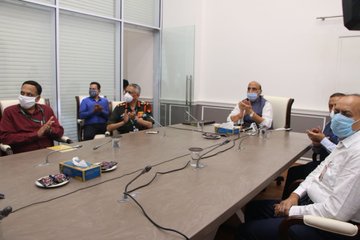
Defence Minister Rajnath Singh on Thursday inaugurated six bridges in border areas of Jammu and Kashmir, and asserted that development of remote areas in the region will continue to be a key priority for the NDA government.

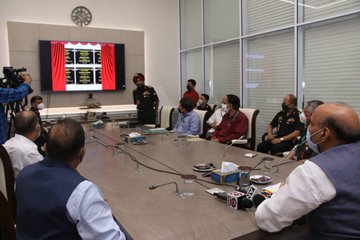
The defence minister dedicated the bridges through video conferencing in presence of Chief of the Army Staff Gen MM Naravane, Defence Secretary Ajay Kumar, Director General of Border Roads Organisation Lt Gen Harpal Singh among others.

Four bridges were constructed on the Akhnoor-Pallanwala road in Akhnoor, while two bridges were built on the Tarnah Nallah in Kathua district, the Defence Ministry said in a statement.

The total cost of construction of the bridges was Rs 43 crore.

The inauguration of the bridges, built by the Border Roads Organisation (BRO) comes at a time when India and China are engaged in a border row in eastern Ladakh.

Officials said the dedication of the bridges to the people of Jammu and Kashmir carries a bigger message that India will continue to develop key infrastructure in border areas notwithstanding hostilities by any adversary.

“Our government is committed to promoting infrastructure on our borders and necessary resources will be provided for this. Our government has a keen interest in the development of Jammu and Kashmir,” Singh said in his brief address.

“Keeping in mind the needs of the people of Jammu and Kashmir and Armed Forces, many other development works are also in the pipeline, which will be announced in due time. About 1,000 kilometre long roads are currently under construction in Jammu region,” he said.

Image

Image

Image

Dedicated to the nation six bridges constructed by BRO in J&K via video conferencing facility today. These bridges will facilitate movement of the Armed Forces in these strategically important sectors and also contribute towards the overall economic growth of remote border areas.

The defence minister said the government has ensured that sufficient resources are provided to the BRO for the construction of strategic roads.

Despite the COVID-19 epidemic, the government will not let the resources of the BRO fall short, he added.

According to the ministry, the annual budget of the BRO ranged from Rs 3,300 crores to Rs 4,600 crores during 2008 to 2016. However, the allocation was hiked to Rs 8,050 crore in 2019-2020.

The budget for the BRO for 2020-2021 is likely to be Rs 11,800 crore, the ministry said, adding the higher allocation will expedite the construction of strategic roads, bridges and tunnels along our northern borders.

In his remarks, Singh congratulated the BRO for construction of the bridges in “record time”.

He said that roads and bridges are the lifeline of any nation and play a vital role in the socio-economic development of far-flung regions.

Prime Minister Narendra Modi is regularly monitoring the progress of these projects and adequate funds are being provided for their timely execution, he added. —PTI


Raise costs for China India must convince it that using LAC as pressure tool will yield diminishing returns

Raise costs for China

he gap: What has encouraged the Chinese is the growing difference between the capabilities of the PLA and the Indian military.

Manoj Joshi

Distinguished Fellow, Observer Research Foundation, New Delhi

PM Modi has been to Ladakh, where he visited injured troops and addressed jawans. His style was somewhat theatrical, but he has raised the morale of the forces and the country. The tough talk was, no doubt, aimed at the domestic constituency; the Chinese go by deeds rather than words and so we are still left with the problem of a restoration of status quo ante as of May 4.

Reports now suggest that both sides have begun pulling back 1.5 km each in Galwan and Hot Springs/Gogra area; Pangong Tso remains a problem area. This is for the good, but can only be seen as a first step to fix the problem permanently, as was the stated intention of the 1993, 1996 and 2005 agreements.

The responsibility to set the situation right rests with Beijing because it is the party that has violated the long-standing agreements to maintain peace along the LAC. But equally, it is in our own interest to terminate this crisis which is exacting a huge price in terms of resources and effort, at a time when we are fighting the Covid-19 pandemic.

The choices before us are stark. It was the Galwan incursion that was the serious one because of its proximity to a key highway of ours. But there seems to be no agreement yet on two other important areas, in Depsang and Pangong Tso. And beyond disengagement there as well is the task of persuading China to permanently settle the differences over the LAC. In other words, delimit a line acceptable to both sides in detailed maps. Since this task has yet to be accomplished, we should continue to pursue a mix of policies using military, diplomatic or economic tools to push the Chinese to act on the issue.

Though we have built up a force of nearly four divisions in the area, well balanced with armour, artillery and air assets, we cannot contemplate a military riposte casually. Any action must factor in the possibility of a larger India-China conflict if we act to vacate the encroachments in the Ladakh region.

Making emergency acquisition of military material, as we have done, is not a good sign. For four successive years, the Services have received substantially lesser money than they asked for their modernisation. Some shortages have been set right through emergency acquisitions in 2017 and 2018, but there are others built into the system.

What has encouraged the Chinese is the growing gap between the capabilities of the PLA and the Indian military arising from the resource crunch we are suffering from. This is not something that has happened overnight, but has emerged over two decades.

Now, an additional burden will be imposed by the logistics of dealing with three additional divisions in Ladakh. Stocking for one division there is a trying task, but doing it for four will be very arduous and expensive. But a credible military posture will have its own payoff, provided we are clear-headed about the goal, which is not to fight a war, but by our deterrence capacity, force China to back off.

In this endeavour, economic policy is a force multiplier. The government has sent a tough signal by banning 59 Chinese apps, but they generate small profits for their parent companies. What will matter, is trade and investment. Total trade tops $90 billion, most of it in Chinese goods destined for the Indian market. Official figures put Chinese investment at $2 billion, the actual sum is likely to be several times that. We may be small-time players when it comes to trade with China, but the threat of tariffs on Chinese goods and restrictions on investment has a certain value, given the pushback China is facing on this account in the US and Europe. The steps we take must be carefully calculated and not impose greater costs on us, than on China. But even so, they should signal our serious intent to do whatever we can to influence Chinese behaviour.

The importance of a permanent fix to the LAC problem should not be underrated. We need to convince China that its policy of using the undelimited LAC as a means of pressuring India will now yield diminishing returns. For years, Modi has been trying to convince the Chinese of this point, because an unclear LAC has led to crises in 2013, 2014, 2019 and now in 2020, where it has led to a serious clash in which lives have been lost.

Disengagement by itself will not be enough, we need to ensure that the incursions are put to an end permanently, and this can happen if we clarify where the LAC runs, something both countries had signed on to do but have not done because of Chinese mendacity.

Ensuring peace and stability at the LAC has never been as important as it is today. The war against the pandemic has hit us hard, indeed, we do not even now know just how things will pan out since the infection is yet to peak in the country. Recovery will take years, and India will need more trade, more investments, lesser restrictions and a peaceful and stable periphery. In dealing with the crisis in Ladakh, we should not miss the wood for the trees.


Army jawan killed in Pak LoC shelling

Army jawan killed in Pak LoC shelling

ammu, July 10

An Army jawan was killed as Pakistan troops opened fire and lobbed shells from across the Line of Control (LoC) in Nowshera sector of Rajouri district late last night.

Sources said Pakistan resorted to shelling around 12.35 am in which a jawan received serious injuries. He was taken to hospital where he succumbed. The soldier has been identified as Havildar Sambur Gurung, a native of Nepal. — TNS

Soldier, woman injured in militant attack in Awantipora

Srinagar, July 9

A soldier and a woman were injured when militants fired upon an Army convoy in Awantipora sub-district this evening.

The Army said the militants fired at an ambulance, on its way to Srinagar from Khrew, around 6 pm. It was on casualty evacuation duty near Ladoo Morh Lethapora.

“The ambulance, with a quick reaction team, was targeted by terrorists near a mosque at Laddoo Morh, injuring a soldier. He was evacuated to the Army’s 92 base hospital and was reported to be stable,” an Army statement said.

A woman also sustained injuries in the crossfire. Soon after the incident, the area was cordoned off by joint forces to trace the attackers. — TNS


Naga peace talks stall as stakeholders dither

A positive closure of the Naga peace process would have ended the mother of all insurgencies in India and the world’s longest-running demand for secession, facilitating the end of residual insurgencies in Manipur and other armed movements scattered across the North-East and, most importantly, giving a fillip to India’s Act East policy.

Naga peace talks stall as stakeholders dither

Accord elusive: Mainstreaming Naga armed groups has been a challenge for New Delhi since Independence.

Maj Gen Ashok K Mehta (retd)

Military commentator

In a letter to Nagaland CM Neiphiu Rio on June 16, the government interlocutor with Naga entities and Governor RN Ravi virtually accused both the state government and the predominant Naga armed group NSCN-IM (National Socialist Council of Nagaland-Isak-Muivah) of undermining law and order and state legitimacy without naming any Naga group. He charged the armed gangs with running a parallel government and extorting taxes.

On June 27, the Isak-Muivah (IM) faction replied that the legitimate taxes it levies were not extortion as these sustain the Naga political movement and were not objected to by the earlier interlocutors. Rio said the law and order was much better than the pre-ceasefire period. Ravi has directed that all postings of law and order officials will require the approval of the Governor. This is the first time that such a step has been taken in the state. Mainstreaming Naga armed groups has been a challenge for New Delhi since Independence.

Last year, Ravi failed to secure a PM Modi-set deadline of October 31 for consummating a full and final settlement with the IM within the framework of the Constitution following the government’s success in J&K, nullifying Article 370. Modi was to have signed the follow-up to the 2015 Naga Framework Accord in Kohima on December 11 with Muivah.

Ravi told a newspaper on October 18 that the Naga peace process would be concluded by October 31 without a separate flag and the Constitution sought by the IM. The others were told that the Naga accord would be signed with or without the IM, hinting towards the more amenable group of seven Naga parties he began engaging in 2017. This Ravi-nursed NNPG did sign the accord, postponing the issue of flag and Constitution for later. But the Nagaland Framework Accord was between the IM and the Government of India and not with the NNPG.

A positive closure of the Naga peace process would have ended the mother of all insurgencies in India and the world’s longest-running demand for secession, facilitating the ending of residual insurgencies in Manipur and other armed movements scattered across the North-East and, most importantly, giving a fillip to India’s Act East Policy.

The most striking event of the Naga peace process occurred when Ravi inaugurated this January 17, the fifth session of the 13th Nagaland Legislative Assembly. According to the Nagaland Today, Ravi stated in the Assembly that negotiations between the Government of India and Naga political groups were successfully concluded. He referred to a meeting with the Joint Legislative Forum on Naga political issues held on November 13 which he said would facilitate a final solution to the prolonged Naga issue which is honourable, acceptable and recognises the uniqueness of the history of the Naga people. He asked the neighbouring states to help as the Naga peace process had reached a critical juncture.

In the discussion on the Governor’s address, the East Mojo Times of February 8 reported that Opposition lawmakers, Imkong Limshen and Vikheho Swu, questioned the veracity of the remarks of the Governor, his claiming that talks were successfully concluded but also saying that we are at a critical juncture while also asking the Nagas to unite or ‘miss golden opportunity’.

Swu said the Centre should not use the excuse of getting a favourable response from the neighbouring states in resolving the issues. The Governor in his reference to ‘successfully concluded negotiations’ with Naga political groups was correct, as he had signed an agreement with the NNPG on November 17, 2017. He excluded any mention of the IM with whom he reportedly signed an agreement on October 31 to sign a final peace deal later, keeping the dialogue process alive.

In the House, the Governor reassured the Nagas, who fear a J&K being done to them, that Nagaland enjoys Article 371A which protects identity and the customary law of the Nagas and the inner line provision of the Bengal Eastern Frontier Regulations of 1873 as both disallow Citizenship (Amendment) Act Bill or CAB 2019 in the state. Despite this, the Opposition in the Nagaland Assembly insisted that an anti-CAA resolution be passed in the House, like in West Bengal and Kerala. The Naga Opposition is worried about an influx of illegal immigrants because Assam, the gateway to the North-East, had not been entirely exempted from the purview of the law, making Nagaland susceptible to illegal immigration.

On February 28 this year, according to the South Asia Terrorism Portal, Ravi said in an interview that “delay in concluding talks is entirely on the part of IM which seems not prepared for a settlement and is using delaying tactics by giving new mischievous interpretations on the already agreed provisions of contentious issues.” The pan-Naga entity was mutually agreed to be a cultural body with no political role or executive authority. After the October 31 deadline, they want a pan-Naga body to have political and executive influence over the Nagaland government, precisely the reference he made in his June 16 letter.

Ravi will have to think out of the box to get the 86-year-old Thuingaleng Muivah to accept a solution within the framework of the Constitution of India. In his recent TV interviews to East Mojo and News Live, Muivah says the Nagas will not budge from their own flag and Constitution. Using the NIA or other coercive measures against an old warhorse and his group will not work.

While the IM has 7,000 armed fighters with a long legacy of insurgency pre-dating Independence, Kashmir has just 240 militants. Muivah’s Tangkhul Nagas are warning: Do not create another Kashmir, it will hurt your Act East Policy. Given the situation along the LoC and LAC, opening a third front against the world’s oldest insurgency will be harakiri.


2 militants killed as army foils infiltration bid on LoC in J-K’s Kupwara 2 AK-47 rifles were seized

2 militants killed as army foils infiltration bid on LoC in J-K’s Kupwara

Photo for representation only

Tribune News Service

Srinagar, July 11

Two militants were killed along the LoC in Nowgam sector of Kupwara district on Saturday, the Army said.

The Army said suspicious movement was detected by troops in the Nowgam sector in the morning. “Security forces swiftly launched an ambush, resulting in the elimination of two militants. Two AK-47 rifles and ammunition were seized,” the Army said in a statement.

Also read: 300 terrorists waiting to infiltrate into India: Army