Sanjha Morcha

What’s New

Click the heading to open detailed news

Current Events :

web counter

Print Media Reproduced Defence Related News

Independence Day celebrations to be muted amid Covid-19 pandemic

Fewer dignitaries will attend the event because of the social distancing norms, an official said. Only 150 to 200 of them will be seated in the VIP enclosure compared to almost 1,000 in previous years. Last year, 10,000 people attended the Independence Day function.

Prime Minister Narendra Modi inspects the guard of honour during the 73rd Independence Day celebrations at the historic Red Fort, in New Delhi on August 15, 2019.

Prime Minister Narendra Modi inspects the guard of honour during the 73rd Independence Day celebrations at the historic Red Fort, in New Delhi on August 15, 2019. (Vipin Kumar/HT Photo )

Independence Day celebrations are expected to be muted this year because of the Covid-19 pandemic and fewer VIPs are likely to attend the annual August 15 event at Delhi’s Red Fort while schoolchildren will skip it altogether, people familiar with the matter said on Tuesday. Corona winners, or people who have recovered from the disease, will be the highlight at the celebrations. Around 1,500 such people are expected to attend the function and listen to Prime Minister Narendra Modi’s speech from the ramparts of Red Fort, said one of the persons cited above.

The corona winners will include around 500 local policemen. The remaining will travel to Delhi from other parts of the country. The defence ministry, which plays a key role in organising the event, has asked the Union home ministry to implement the plan for inviting corona winners for the function.

Schoolchildren have traditionally been a part of the Independence Day celebrations. Thousands of them show up to hear the Prime Minister’s speech at the Red Fort. This time they will be missing at the event because of Covid-19, said a second official.

Modi mingled with over 8,000 children, who attended the Independence Day function at Red Fort last year, after his speech. The children enthusiastically crowded around him hoping to shake hands with him or speak to him.

Defence secretary Ajay Kumar, who visited the Red Fort last week to inspect the preparations for the function, gave clear directions that social distancing norms have to be strictly adhered to, said a third official. While schoolchildren will not attend the celebrations, cadets from the National Cadet Corps are expected to be a part of the function.

Fewer dignitaries will attend the event because of the social distancing norms, said the third official. Only 150 to 200 of them will be seated in the VIP enclosure compared to almost 1,000 in previous years. Last year, 10,000 people attended the Independence Day function.

In his sixth Independence Day speech from Red Fort last year, Modi highlighted the nullification of the Constitution’s Articles 370 and 35A to divest Jammu & Kashmir of its special status in August last year. He also spoke about the legislation that criminalised the practice of instant divorce among a section of Muslims, strengthening of anti-terror laws. Modi said the country was moving towards “one nation, one Constitution” while highlighting key accomplishments of his government in less than 70 days after it was voted back to power in May last year.

Modi also announced the creation of Chief of Defence Staff’s post for more effective coordination between the three services. This came after the proposal for the post remained in limbo for decades.

He also outlined India’s journey from 2014 to 2019 as one from disappointment to hope and urged citizen participation in environmental initiatives, water conservation, end of single-use plastic. He flagged the population explosion as a key concern.


Fourth round of Lt Gen-level talks between India and China on Tuesday Expected to finalise modalities for the next phase of de-escalation, disengagement

Fourth round of Lt Gen-level talks between India and China on Tuesday

New Delhi, July 13

The Indian and Chinese military are scheduled to hold their fourth round of Lt General-level talks on Tuesday with an aim to finalise modalities for the next phase of de-escalation and disengagement of troops in eastern Ladakh, government sources said on Monday.

The meeting is set to be held in Chushul on the Indian side of the Line of Actual Control (LAC) in eastern Ladakh, they said.

The two sides are also expected to finalise a roadmap for restoration of peace and tranquility in the high-altitude region that witnessed an eight-week bitter standoff between the troops of the two countries.

China’s People’s Liberation Army (PLA) has already completed pulling back troops from Gogra, Hot Springs and Galwan Valley and significantly thinned down its presence in the ridgeline of Finger Four in the Pangong Tso area in the last one week as demanded by India.

India has been insisting that China must withdraw its forces from areas between Finger Four and Eight. The mountain spurs in the area are referred to as Fingers.

The formal process of disengagement of troops began last Monday after a nearly two-hour telephonic conversation between National Security Advisor Ajit Doval and Chinese Foreign Minister Wang Yi the previous day.

On Friday, India and China held another round of diplomatic talks during which both sides resolved to push ahead with “complete disengagement” of troops in eastern Ladakh in a timely manner for “full restoration” of peace and tranquility.

At the meeting, it was decided that senior commanders of the two armies will meet “soon” to discuss further steps to “ensure complete disengagement and de-escalation”.

The two countries have already held three rounds of Lt General-level talks and the last one took place on June 30 during which both sides agreed on an “expeditious, phased and step wise” de-escalation as a “priority” to end the standoff.

The first round of the Lt General talks was held on June 6 during which both sides finalised an agreement to disengage gradually from all the standoff points beginning with Galwan Valley. However, the situation deteriorated following the Galwan Valley clashes on June 15 as the two sides significantly bolstered their deployments in most areas along the LAC.

The second round of talks took place on June 22.

The Indian and Chinese armies were locked in a bitter standoff in multiple locations in eastern Ladakh for over eight weeks since May 5.

The tension escalated manifold after the violent clashes in Galwan Valley in which 20 Indian Army personnel were killed.

The Chinese side also suffered casualties but it is yet to give out the details. According to an American intelligence report, the number of casualties on the Chinese side was 35.

Tensions had escalated in eastern Ladakh around two months back after around 250 Chinese and Indian soldiers were engaged in a violent face-off on May 5 and 6. The incident in Pangong Tso was followed by a similar incident in north Sikkim on May 9. PTI


Lt Col moves HC against Army’s social media ban

Lt Col moves HC against Army’s social media ban

New Delhi, July 13

A senior officer of the Army on Monday approached the Delhi HC challenging a recent policy banning armed forces’ officials from using social networking platforms, like Facebook and Instagram.

The petition, likely to come up for hearing on Tuesday, sought the court’s direction to the Director General of Military Intelligence to withdraw the June 6 policy. Under the norm, all Army members must delete their accounts from Facebook and Instagram and 87 other applications. Lt Col PK Choudhary, currently posted in J&K, pleaded that he used Facebook to connect with his friends and family. — PT


Crucial round of India-China talks today, troop withdrawal on table Generals to finalise de-escalation roadmap

Crucial round of India-China talks today, troop withdrawal on table

Army Chief Gen MM Naravane (C) visits a forward area in Jammu region.

Ajay Banerjee

Tribune News Service

New Delhi, July 13

Lieutenant General-level commanders of India and China will commence talks to draw the contours of the most important phase of the military de-escalation along the Line of Actual Control (LAC) in Ladakh.

45K soldiers lined up on either side

There has been no change in deployment. An estimated 45,000 troops have been deployed by either side along the 826-km LAC in Ladakh

Zero tolerance to Pak truce violations: Army

Army Chief Gen MM Naravane on Monday reiterated the stance of ‘zero tolerance’ against truce violations by Pakistan. 

The meeting is slated to commence at 11.30 am at Chushul (on the Indian side) in eastern Ladakh on Tuesday.

This will be the fourth such meeting. The earlier meetings were conducted on June 6, June 22 and June 30. India will be represented by Leh-based 14 Corps Commander Lt Gen Harinder Singh and China by Maj Gen Lin Liu, Commander of the South Xinjiang Military Division.

The two sides are expected to finalise a roadmap for de-escalation, which is the second stage of the three-step process agreed to by both armies to restore peace along the LAC. There could be multiple meetings before a consensus is reached on a timeline on withdrawing weapons and thousands of troops of each side.

Currently, there is no change in the deployment. Hundreds of artillery guns and tanks, deadly rocket launchers, missiles, fighter jets, airborne bombers and attack helicopters of both sides are lined up near the LAC. Long-range artillery guns, which can take 40-km shots, are deployed 2-3 km away from the LAC, said an official. Both sides have ensured “mirror deployment” (each side matching the other).

The first stage of the three-step process, which commenced on July 6, was to create a buffer of 3 km between troops of either side.


HT Editorial: What does China want? If it is serious about peace, the first step is clarifying the LAC

India is clear about where its perception of LAC lies. It has repeatedly asked Beijing to clarify its perception of LAC and exchange maps

ndia is clear about where its perception of LAC lies. It has repeatedly asked Beijing to clarify its perception of LAC and exchange maps(REUTERS)

The post-1988 framework of India-China ties rested on a simple principle. Both countries recognised they had a serious boundary dispute, but they agreed that the larger relationship should not be held hostage to the dispute. And therefore, while the border should be kept peaceful, and talks on the dispute could continue, pending a final settlement, India and China should continue to deepen ties in other spheres. This framework lasted three decades. Other elements of the relationship — high-level visits, trade and investment, cooperation on global issues — coexisted with the stalemate on the border dispute.

But to keep the border peaceful, the two countries also signed a range of agreements. In 1996, a pact on confidence-building measures in the military field along the Line of Actual Control (LAC) in border areas laid out a list of restrictions to reduce the possibility of a clash and build trust. It recognised that the implementation of the agreement would require both sides arriving at a “common understanding of the alignment” of LAC, and therefore, both India and China decided to speed up the process of “clarification and confirmation” of LAC — by clarifying the alignment in areas where there were differing perceptions, and then exchanging maps “indicating their respective perceptions”.

It has been 24 years since the pact. India is clear about where its perception of LAC lies. It has repeatedly asked Beijing to clarify its perception of LAC and exchange maps. This will not be a solution — but it will at least prevent Beijing from shifting goalposts at will, and engaging in aggression to change facts on the ground. But perhaps precisely because it wants to keep that option open, China has been obstinate in not moving ahead with the process of clarifying LAC, especially in the western sector. So here is the fix. A longer term boundary solution is difficult because of the seemingly intractable nature of the dispute, especially Tawang (China will not get it back, but will keep alive its claim because of its past association with Tibet) and Aksai Chin (India will not get it back, but accepting that publicly will have costs). And China is not willing to do what is required for shorter term peace — by clarifying LAC. This leaves room for doubt about Chinese intentions, and its claims of wanting peace. If Beijing is interested in sustaining the overall relationship, it should clarify the LAC, be reasonable about its claims and live up to past agreements. Otherwise, the old framework of the relationship cannot last.


To deal with China, focus solely on economic growth | Opinion

India needs to want economic success as badly as China does. If this desire is too mitigated by its desire to address many other issues such as retribution for past injustices, regional or linguistic reaffirmation, or fears about elite domination, the country may fall short of its optimal economic potential

India needs to want economic success as badly as China does. If this desire is too mitigated by its desire to address many other issues such as retribution for past injustices, regional or linguistic reaffirmation, or fears about elite domination, the country may fall short of its optimal economic potential(AP)

Much has been written about China following the clash between Indian and Chinese troops in the Galwan Valley. These discussions have often suggested that the Indian corporate sector should in some way exact retribution on China. The government has, perhaps, with some merit, banned a number of Chinese apps. Others have encouraged consumers to boycott Chinese goods. Neither address the basic issue that needs to be fixed, which was more accurately pinpointed by in jest by a senior Chinese media figure.

This gentleman commented that an economic dispute with China was farcical because there were no Indian goods that the Chinese could boycott. There is a deep resonance in this satirical remark. No mechanism to strengthen India’s influence with respect to China can be created without a unidimensional determination to become an economic superpower. There are choices to be made.

India must also, as China has done, build up financial reserves through the creation of industrial powerhouse companies. This requires a combination of cheap financing for domestic companies and possibly a devalued currency. India must substitute the mental hang-ups that have prevented it from systematically adopting these practices if it is to gain greater economic relevance.

Since great economic institutions require capital, we need to relook at the ease of business processes which attract capital. In the case of China, local governments have been incentivised to run their provinces in the manner most likely to attract foreign direct investment (FDI). Those who have done business in China speak of the overwhelming support they get from local governments. These include the identification of land, provision of ready lists of architects and contractors, free legal services, often to the point of providing dosa makers to encourage engineers to work there. The nature of factory inspections tends to be infrequent in contrast to the Indian licence-permit raj.

International capital has choices and will naturally flow where it is made most welcome. China is simply easier to do business in. India has followed a different growth path. That path influences how vigorously we can respond to Galwan.

Building economic powerhouses can also mean supporting national champion companies, as Japan and South Korea have done. India has been beset by concerns that such choices are prone to nepotism and the misuse of scarce national resources. It needs to enquire why these negative externalities of national choice were not equally applicable in Japan and South Korea. Even the United States (US), portrayed as a champion of market freedom, selectively awarded contracts for European/Iraqi reconstruction to a handful of chosen American companies. These policies did not result in the preferred companies falling to the lowest common denominator of quality. Instead, they often became world leaders in their chosen industries.

China has systematically sought to develop its soft power through investment, aid to countries, influence over multilateral institutions and the provision of research funding to universities around the world. It has chosen to be the driver behind the creation of banking institutions such as the Asian Infrastructure Investment Bank and the New Development Bank. While these banks or universities are all professionally-managed institutions, such largesse provides China with a degree of soft influence that others do not possess. Most meaningful infrastructure in Africa is today built by China with quid pro quos in play. These include preferential access to manganese, cobalt and other rare earth metals. China should not be blamed for this, as it is only copying the playbook used by European nations earlier. India is free to also make these choices. We need to introspect why, for instance, Indian apps could not become the world standard.

An argument may be made that in a democratic country, other policy choices are also important. Social justice has its place and economic growth cannot be the sole criteria for decision-making. These choices are not mutually exclusive or unique to us. It is India’s resistance to common sense reforms in labour, land or judicial processes has also led to an attenuation of economic wealth and the concomitant inability to push back against China.

India needs to want economic success as badly as China does. If this desire is too mitigated by its desire to address many other issues such as retribution for past injustices, regional or linguistic reaffirmation, or fears about elite domination, the country may fall short of its optimal economic potential.

At a philosophical level, it is entirely possible for a country to be successful and satisfied, with the kind of balance India has apparently sought, between being a mid-level economic power while also a disorganised democracy. However, in a world where the metric of power is largely Gross Domestic Product per capita, such a nation will need to accept a position of lesser influence. These choices can cause the angst of seeing others whom we may consider the “bad guys” finishing first. This government, more than others in the past, believes in an aligned pan-national vision around a common goal. This dispute with China provides an opportunity for policymakers to introspect about the choices we have made, as a nation. The road to victory in Galwan runs through the choices made in bureaucracy, the judicial system and the legislature.


US backs ASEAN on South China Sea, challenges China’s predatory world view

The US statement comes after Prime Minister Narendra Modi in his July 3 Ladakh speech made it clear that there was no space for expansionist regimes.

The US statement comes after Prime Minister Narendra Modi in his July 3 Ladakh speech made it clear that there was no space for expansionist regimes.(Reuters File Photo)

By calling China’s claims to off-shore resources in South China Sea (SCS) unlawful and championing a “free and open Indo-Pacific”, the United States has reversed its perceived “isolationist” policy and has reaffirmed its strong commitment to its ASEAN partners and key allies Japan and Australia.

The statement on “US Position on Maritime Claims in South China Sea” by US Secretary of State Mike Pompeo comes at a time when two US nuclear powered aircraft carriers – Nimitz and Ronald Reagan – with 120 fighters are exercising in South China Sea. The two super carriers are openly challenging the unproven might of PLA Navy by exercising near Paracel Islands off the Vietnam coast and north of Chinese nuclear submarine base at Hainan Islands.

Secretary of State Pompeo’s statement is not only a demonstration of enormous political will of US to stand by its allies in Indo-Pacific region but also reinforcement of SCS frontline. “The statement has turned the perception that Trump administration was only inward looking and isolationist on its head. By spelling out its SCS position in black and white, it is a doctrinal recommitment from the American side to this region. It indicates that US is standing firmly with its allies like Philippines and Vietnam and recognising the claims of Indonesia and Malaysia against Chinese bullying in the area,” said a China watcher.

The US statement that Xi Jinping’s predatory world view has no place in 21st century comes after Prime Minister Narendra Modi in his July 3 Ladakh speech made it clear that there was no space for expansionist regimes and future only belonged to those who believed in development. The Indian position of free and open South China Sea also synergises with Secretary Pompeo’s statement on Indo-Pacific.

India is expected to expand on its view about right to free navigation when Philippine President Rodrigo Duterte visits New Delhi later this year as his March trip had to be postponed due to coronavirus global pandemic.

The US statement has revived the Arbitration Tribunal at Hague rejection of China’s SCS claims on July 12, 2016. To remind China of its hubris, Secretary Pompeo has recalled a 2010 statement of then Foreign Minister Yang Jiechi, who told his ASEAN counterparts that it was a fact that China is a big country and others are just small.

The US has openly taken sides with Philippines on Scarborough Reef, Spratly Islands, Mischief Reef and second Thomas Shoal and called the Chinese claims unlawful and unilateral. The Chinese PLA has virtually declared the SCS as its backyard by contesting claims with ASEAN countries and exploiting the exclusive economic zone by simply bullying these countries militarily into submission. Beijing has also used its closeness with Laos, Cambodia and Myanmar to ensure nothing adverse comes out against China in the so-called Asian tiger forum.

Secretary Pompeo has totally rejected China’s claim over James Shoal near Malaysia and made it clear that the world will not allow Beijing to treat South China Sea as its maritime empire.

The US SCS statement has not only challenged China but also given steel injection of support to countries like Japan, Australia and South Korea, who haver decided to look the other way to Beijing’s expansion in the past.


Centre gives in-principle approval for tunnel under the Brahmaputra amid tension with China: Report

The proposed tunnel in India is going to be very important strategically as it will provide year-long connectivity between Assam and Arunachal Pradesh

India inaugurated the crucial Bogibeel bridge on the Brahmaputra in 2018 to improve connectivity.

India inaugurated the crucial Bogibeel bridge on the Brahmaputra in 2018 to improve connectivity.(PTI File Photo)

The Centre has given in-principle approval to construct a strategic tunnel under the Brahmaputra river, Hindustan Times’ sister publication Hindustan reported. The four-lane tunnel will link Gohpur and Numaligarh towns in Assam.

This is the first time that India will be constructing an under-river tunnel, Hindustan reported and it will close to the Chinese border. It will be longer than the under water tunnel being built by China below the Taihu Lake in Jiangsu province, it further reported.

The proposed tunnel in India is going to be very important strategically as it will provide year-long connectivity between Assam and Arunachal Pradesh. It will also help in transporting military supplies and ammunition as vehicles will be able to zoom past the tunnel at 80 kmph, Hindustan reported.

The National Highways and Infrastructure Development Corporation Limited (NHAIDCL) has roped in America’s Louis Berger company; in fact, the central government had approved its detailed project report in March, reported Hindustan.

It quoted a senior official of NHAIDCL to say that the construction of the 14.85 km long tunnel will begin in December. It will be built in three phases, Hindustan further reported.

The official further told Hindustan that the tunnel in China’s Jiangsu province will be 10.79 km long. He also said that various strong safety measures have been put in place in the design to stop water from entering the tunnel.

It will also have ventilation system, fire-fighting mechanism, footpath, drainage system, emergency exit etc, according to Hindustan. It will also be equipped with crash barriers.

The Army had asked the government to consider building tunnels akin to the English Channel under the Brahmaputra because bridges can be targeted by enemy forces.

This comes amid the tension between India and China along with Line of Actual Control (LAC) after a face-off between the soldiers of the two countries in Ladakh’s Galwan Valley. India had lost 20 soldiers in the skirmish; China officially did not announce the number of casualties.

Efforts have been on by both the countries since the June 15 clash to ease tensions. A fourth round of meeting between the Lieutenant Generals of the two countries is scheduled to take place today.


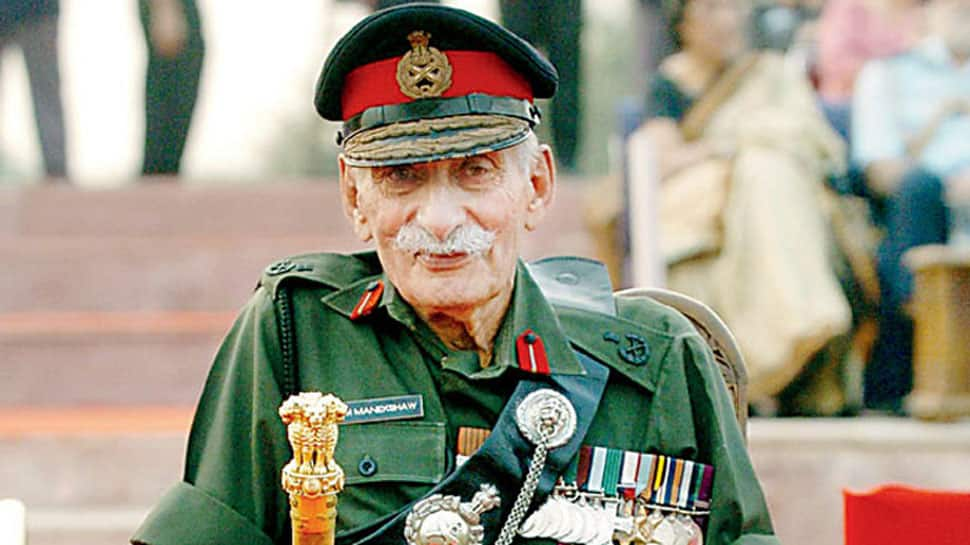
2008 फ़ील्ड मार्शल मानेक शॉ वेलिंगटन (तमिलनाडु) अस्पताल में भर्ती थे। गंभीर अस्वस्थता और अर्धमूर्छा में वे एक नाम अक्सर लेते थे – “पागी-पागी !” डाक्टरों ने एक दिन पूछ दिया “सर हू इज़ दिस पागी ?”

और सैम साहब ने खुद ही ब्रीफ़ किया…..

1971 भारत युद्ध जीत चुका था, जनरल मानेक शॉ ढाका में थे। आदेश दिया कि पागी को बुलवाओ, डिनर आज उसके साथ करूँगा ! हेलिकॉप्टर भेजा गया। हेलिकॉप्टर पर सवार होते समय पागी की एक थैली नीचे रह गई, जिसे उठाने के लिए हेलिकॉप्टर वापस उतारा गया था। अधिकारियों ने नियमानुसार हेलिकॉप्टर में रखने से पहले थैली खोल कर देखी तो दंग रह गए, क्योंकि उसमें दो रोटी, प्याज और बेसन का एक पकवान (गाठिया) भर था। डिनर में एक रोटी सैम साहब ने खाई और दूसरी पागी ने।

• उत्तर गुजरात के सुईगांव अंतरराष्ट्रीय सीमा क्षेत्र की एक बॉर्डर पोस्ट को रणछोड़दास पोस्ट नाम दिया गया। यह पहली बार हुआ कि किसी आम आदमी के नाम पर सेना की कोई पोस्ट हो साथ ही उनकी मूर्ति भी लगाई गई।

पागी यानी ‘मार्गदर्शक’, वो व्यक्ति जो रेगिस्तान में रास्ता दिखाए । ‘रणछोड़दास रबारी’ को जनरल सैम मानिक शॉ इसी नाम से बुलाते थे।

• गुजरात के बनासकांठा ज़िले के पाकिस्तान सीमा से सटे गाँव पेथापुर गथड़ों के थे रणछोडदास। भेड़ बकरी व ऊँट पालन का काम करते थे। जीवन में बदलाव तब आया जब उन्हें 58 वर्ष की आयु में बनासकांठा के पुलिस अधीक्षक वनराज सिंह झाला ने उन्हें पुलिस के मार्गदर्शक के रूप में रख लिया।

• हुनर इतना कि ऊँट के पैरों के निशान देख कर बता देते थे कि उस पर कितने आदमी सवार हैं। इंसानी पैरों के निशान देख कर वजन से लेकर उम्र तक का अंदाज़ा लगा लेते थे। कितने देर पहले का निशान है और कितनी दूर तक गया होगा सब एकदम सटीक आंकलन जैसे कोई कम्प्यूटर गणना कर रहा हो।

• 1965 युद्ध की शुरुआत में पाकिस्तान सेना ने भारत के गुजरात में कच्छ सीमा स्थित विधकोट पर कब्ज़ा कर लिया, इस मुठभेड़ में लगभग 100 भारतीय सैनिक शहीद ही गये थे और भारतीय सेना की एक 10 हजार सैनिकों वाली टुकड़ी को तीन दिन में छारकोट पहुँचना जरूरी था। तब ज़रूरत पड़ी थी पहली बार रणछोडदास पागी की ! रेगिस्तानी रास्तों पर अपनी पकड़ की बदौलत उन्होंने सेना को तय समय से 12 घंटे पहले मंज़िल तक पहुँचा दिया था । सेना के मार्गदर्शन के लिए उन्हें सैम साहब ने खुद चुना था और सेना में एक विशेष पद सृजित किया गया था ‘पागी’ याने पग अथवा पैरों का जानकार।

• भारतीय सीमा में छिपे 1200 पाकिस्तानी सैनिकों की लोकेशन और अनुमानित संख्या सिर्फ़ उनके पदचिह्नों से पता कर भारतीय सेना को बता दी थी, और इतना काफ़ी था भारतीय सेना के लिए वो मोर्चा फतेह करने के लिए।

• 1971 युद्ध में सेना के मार्गदर्शन के साथ साथ अग्रिम मोर्चे तक गोला बारूद पहुँचवाना भी पागी के काम का हिस्सा था। पाकिस्तान के पालीनगर शहर पर जो भारतीय तिरंगा फहरा था उस जीत में पागी की भूमिका अहम थी। सैम साब ने स्वयं ३०० रूपय का नक़द पुरस्कार अपनी जेब से दिया था।

• पागी को तीन सम्मान भी मिले 65 व 71 युद्ध में उनके योगदान के लिए – संग्राम पदक, पुलिस पदक व समर सेवा पदक !

• 27 जून 2008 को सैम मानिक शॉ की मृत्यु हुई और 2009 में पागी ने भी सेना से ‘स्वैच्छिक सेवानिवृत्ति’ ले ली। तब पागी की उम्र 108 वर्ष थी ! जी हाँ आपने सही पढ़ा….. 108 वर्ष की उम्र में ‘स्वैच्छिक सेवानिवृत्ति’ ! सन् 2013 में 112 वर्ष की आयु में पागी का निधन हो गया

• अब भी वे गुजराती लोकगीतों का हिस्सा हैं। उनकी शौर्य गाथाएँ युगों तक गाई जाएंगी। अपनी देशभक्ति, वीरता, बहादुरी, त्याग, समर्पण और शालीनता के कारण भारतीय सैन्य इतिहास में हमेशा के लिए अमर हो गए रणछोड़दास रबारी यानि हमारे ‘पागी’।


What China Might Be Aiming For In Ladakh?

The tensions on Indo-China border is increasing day by day. Both armies are facing eyeball to eyeball. They are backed with infantry, tanks, armored vehicles and air defense. It is not at all a good situation to face both the militaries in a combat ready mode. Defense experts have rightly pointed out that a small local angry incidence can flareup the battleground.
But the question is, why China is picking up this quarrel with India, knowing it will be very difficult to grab any more disputed land on LAC using force. 2020 India is not 1962 India to be humiliated. Indian armed forces are very well prepared to give a befitting answer to China.

China is also facing hostile situation on its South and South East side. American aircraft carriers are patrolling South China sea. China is having a big problem going on in Hong Kong plus it has picked up fight with Taiwan. Japan, Indonesia, Philippines, South Korea and Vietnam. They too are rattled with China’s expansionary policy.
When China is having problems on all its borders then why is it showing hostile posture with India? If the conflict really breaks out then China has more to lose than India. China has already earned bad reputation due to Chinese Virus (COVID19) and a war with India will isolate China internationally.
This is important to note, after 1962 war till now, China had highlighted border disputes on the North East border of India. They have raised objection about Arunachal Pradesh, Meghalay and Sikkim. They have never picked up a border dispute in the plains of Ladakh after 1962. But now they are picking up a fight in Ladakh….WHY?

Challenges on the of J&K border

Before we analyze WHY China is picking up fight in Ladakh, let’s first understand how the map has changed since 1947 between India, Pakistan and China in the Jammu & Kashmir region.

Pakistan Occupied Kashmir (PoK)

in 1947 entire princely state of Jammu and Kashmir was part of India. This included Jammu, Kashmir valley, Ladakh, Gilgit Baltistan and Aksai Chin regions.
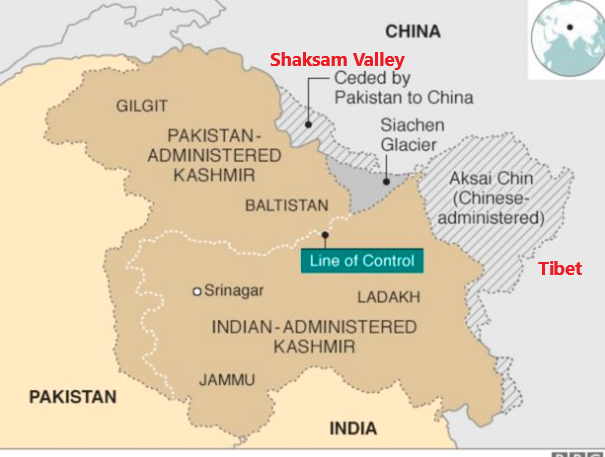
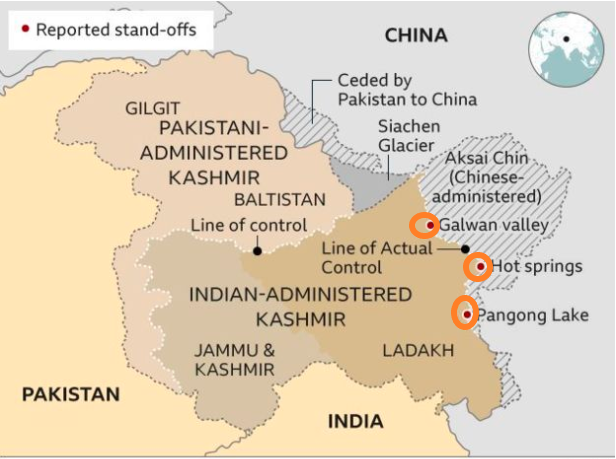
When Pakistan attacked India in 1947 and illegally occupied part of Kashmir, they snatched two parts of J& K, that is, very small portion of Kashmir valley and big mass of land of Gilgit Baltistan. India was left with Jammu, remaining part of Kashmir valley, Ladakh and Aksai Chin regions. The area marked as “Pakistan Administered Kashmir” is what Pakistan forcefully occupied in 1947.

Illegal occupation Aksai Chin

Then in 1950 China started building a road inside Aksai Chin w/o India’s permission. They wanted to grab Tibet and access to Tibet from mainland China is very difficult due to mountain ranges. Hence they started illegally occupying Aksai Chin to build roads to go to Tibet. This construction activity started in 1950, but was never detected by Indian military till 1957.
By the time it was detected, it was too late and Nehru ceded Aksai Chin to China saying, that land is useless because it is a cold desert and cannot grow even a single leaf of grass! But obviously Nehru missed the geographic importance of Aksai Chin. He surrendered to the Chinese bullying. He thought, his socialistic ideologue friend China would stop by taking Aksai Chin. But that was not China’s aim. They wanted Tibet and that is why they occupied Aksai Chin.

China’s forceful occupation of Tibet

Nehru realized China’s real intentions when China attacked Tibet, but by then it was very late. In 1962 India was dragged into a  war with China without military preparation. Nehru was not a firm, resolute and dynamic leader to lead this war. This fact has recorded by number of military experts and diplomatic experts. The moment he realized well prepared Chinese military is getting heavy on ill prepared Indian military, he started giving conflicting signals to the Indian military. As a result, Indian military faced heavy human losses and this demoralized the military. The situation was so grim that Chinese forces were about to enter Assam and Nehru had mentally accepted to give away Assam to stop Chinese forces.
By that time US had sent its forces to support India. China was aware about it and thus unilaterally declared ceasefire before US forces could reach India. They retained the hold on Tibet but vacated other captured parts of India. India was  defeated and humiliated by China in the war. As a result, India lost Aksai Chin and Tibet, both.

Pakistan’s gift of Shaksam Valley to China

After 1962 China war, Pakistan became more closer to China. Pakistan was always fearing that, one day or the other India will attack Kashmir Valley and reclaim PoK. To mitigate this risk, in 1963 Pakistan donated part of Kashmir to China. This part is marked in the map as “Shaksam Valley“. Pakistan thought that if China is made party into the Kashmir dispute then India cannot do anything as India cannot challenge China!!! This is how, China got foothold in Kashmir valley.

Strategic Importance of Siachin Glacier

If you see the map, there is a very small triangular portion that is between Shaksam Valley and Aksai Chin. This is Siachin Glacier. This small portion of Siachin Glacier is separating two Chinese illegal occupation, that is, Askai Chin and Shaksam Valley. If Siachin Glacier peaks are occupied either by China or by Pakistan then Kashmir valley would firmly connect with China mainland.
It is strategically so important that the whoever controls the peaks of Siachin Glacier, they would practically control activities happening in mainland China, Aksai Chin, Shaksam Valley and Pakistan’s PoK.
The Karokoram highway that connects China with Pakistan through road, passed through Siachin Glacier. Karakoram pass, which is one of the oldest trade route is also in the same region. The Karakoram Highway is so close to the Siachin Glacier peaks that normal machine gun fire can block the road. Hence it is a big threat to China and Pakistan.
Siachin Glacier is a very inhabitable, mountainous and rugged terrine, where living is not possible. This area is always covered with snow, freezing temperatures less than -30 degree Celsius, unpredictable winter storms and huge avalanches.  Due to these reasons, no one between Pakistan, China and India had claimed this region till 1984. It was practically no man’s land because all parties thought, it is impossible hold on to the occupation.
But this changed in 1984 when India captured Siachin Glacier and fortified it’s military position. After capturing, India fought number of battles with Pakistani army who tried to capture it back but they failed. Since then, Siachin Glacier is firmly controlled by Indian Army. Pakistani still wants to capture this region for the obvious strategic importance.
India has not only fortified all the mountain top ranges in the Siachin Glacier but even made the Daulat Beg Oldie Air Force base fully operational. This base is situated at 5.1 Kilo Meters height and temperatures are below -30 degree Celsius. Please see the map of Daulat Beg Oldie base to understand its strategic importance.
It is located at a very strategic point to cover China occupied Shaksam Valley, Aksai Chin, Mainland China and Pakistan occupied POK. From this air field Indian Air Force can attack deep inside Pakistan and China. The only challenge is, because of the height, IAF fighter planes have some limitations on carrying fuel and weapons. But that is a different topic to discuss.

China’s financial interests in this region…

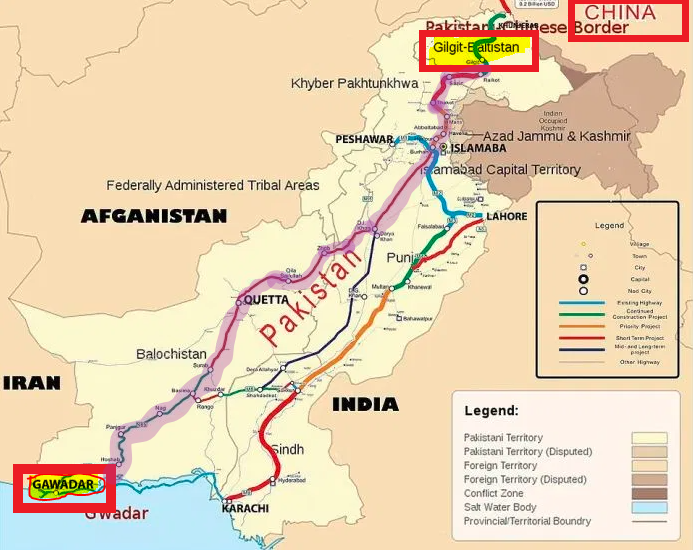
China had built Karakoram highway long back to connect Pakistan with China by road. This is their old trade route but it is very long and treacherous route. Plus it was not connecting to any seaports in Pakistan.
China’s crude oil supply from Arab countries and Africa is through oil tankers that travel from Arabian Sea, circling Sri Lanka, Malaysia, Indonesia, then into South China Sea and finally into China.
As you can see this route is very long and expensive to get crude oil into China. It is also expensive and time consuming to supply Chinese goods to the West Asia.  Every country needs cheap oil for its economic growth. High transportation cost for oil was hampering China’s economic growth plans. Hence they came up with Silk Routes and One Belt One Way policy. This plan is to connect 70 countries for the trade purpose.
As a part of this policy, China started China Pakistan Economic Corridor or CPEC initiative. Under this plan, China developed port of Gawader in Pakistan for oil pumping. Then created multiple highways inside Pakistan to link East, Central and West Pakistan. All these highways lead to one highway into Gilgit Baltistan. The plan is, get oil from Arab countries in tankers to Gawadar port and transport it to China using CPEC road. The bigger plan is to create pipelines from Gawadar port till China along the CPEC road.
Please see the map below to understand CPEC route and its use of Gilgit Baltistan.
China has invested more than 80 Billion dollars of its own money plus given 50 Billion dollars loan to Pakistan. This huge investment has so far not given tangible results to China due to variety of reasons. Hence China is risking losing 140 Billion dollars investment plus loss of opportunity.
On top of it, India has protested with China and Pakistan for illegally using Gilgit Baltistan area for CPEC. This is because, India claims entire princely state of J&K that joined India in 1947, is legally owned by it. India plans to reclaim this illegally occupied land from Pakistan and China.
And…this is where the current problem is.
 

China’s fear…

China is fearing, if India really reclaims Kashmir Valley, Gilgit Baltistan from Pakistan and reclaims Shaksham Valley and Aksai Chin from China then it will be a big jolt for China’s CPEC plans.
It will be cut off from Pakistan completely and thereby with Arab countries and African countries. This will disrupt their oil supply and goods trade route with West Asia. And on top of it, if India blocks sea route for Chinese ships in Arabian Sea then it will face huge problem.
It is because of this fear, China is showing aggression in Ladakh. China and Pakistan feels that if India is challenged on two fronts then India will not dare to reclaim POK and Gilgit Baltistan. They both want to grab more land of India so that their CPEC road connection is not threatened.

China and Pakistan’s Military Game Plan…

Look at the map where there is a current military conflict with China in Ladakh region.
The current conflict sites are;
1) Galwan Valley
2) Hot Springs
3) Pangong Lake
My estimate is, these hot spots are just the decoy. China and Pakistan wants India to look some other way so that they can achieve their goal.
I strongly think, the plan is something like this.
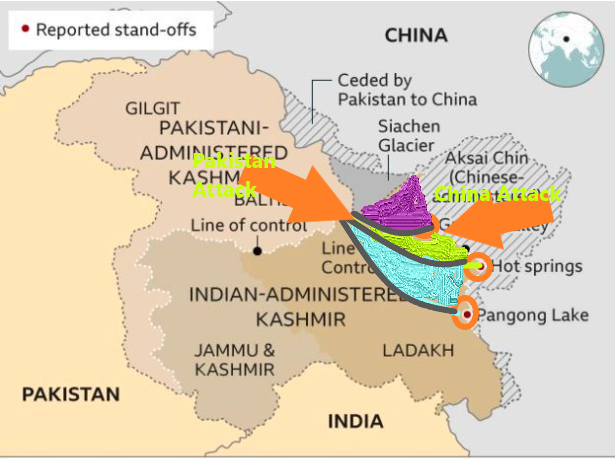
Pakistan and China wants to capture some more land of Ladakh, cut off Siachin Glacier and create a rock solid, wide connection between China and Pakistan.
Please see the map below to understand what may happen.
The military plan of China and Pakistan might be as follows.
Pakistan will attack Ladakh from Gilgit Baltistan.
China will attack Ladakh from Aksai Chin.
Both these forces would capture the portion of Ladakh; that could be in one of the three ways shown above (depicted in three colors).
The aim would be to cut off Siachin Glacier from India thereby ending India’s threat to China, Pakistan and CPEC from the peaks of Siachin Glacier.
Grabbing the land around Siachin Glacier would join Pakistan with China with solid mass of land and then, India cannot threaten Pakistan to reclaim PoK and Gilgit Baltistan.
This is the reason why Pakistan has moved its infantry in Gilgit Baltistan region instead of PoK. This is the reason why China is not ready to take back its forces from the three hot spots.
China may agree on the negotiating table to take back its forces from the three hot spots but in reality it will never pull back. China is known for such treacherous behavior and should never be trusted. They played the same game of negotiations with India in 1962. This time too, they will attack India when both Pakistan and China are ready to attack. Till then China will continue to come to the negotiating table with a statement for “peace”.

Conclusion….

India must be prepared to fight a big bloody war with China and Pakistan simultaneously.
China may open another front in the North East region of India to stretch India’s fighting forces.

Pakistan may open another front on India’s western border to further stretch Indian forces.

Pakistan may try to infiltrate terrorists in Kashmir Valley and start internal disturbances.
The war may start by August and take a very dirty turn. As they say, you can decide when to start the war but you cannot decide when to stop. Hence end date is not known.
Indians must get prepared…