Sanjha Morcha

What’s New

Click the heading to open detailed news

Current Events :

web counter

Print Media Reproduced Defence Related News

Ambala gets ready to receive first 5 IAF Rafale jets Three are single-seater and two twin-seater aircraft

Ambala gets ready to receive first 5 IAF Rafale jets

A Rafale aircraft prepares to take off from Dassault Aviation Facility, Merignac, in France, on Monday, July 27, 2020. PTI

Tribune News Service

Ambala, July 27

Ambala is getting ready to receive first five Indian Air Force (IAF) Rafale fighter jets, which took off from Dassault Aviation Facility, Merignac, France, on Monday morning.

No. 17 Squadron, the “Golden Arrows”, has been raised at IAF base in Ambala Cantonment to equip Rafale aircraft on Wednesday, a senior functionary of Ministry of Defence said here.

She said the first five IAF Rafales, arriving here, include three single-seater and two twin-seater aircraft.

The functionary disclosed that ferry of the aircraft was planned in two stages and will be undertaken by the pilots of the IAF, who have undergone comprehensive training on the aircraft.

The Air-to-Air Refuelling planned during the first leg of the ferry will be undertaken by these pilots with dedicated tanker support from the French Air Force.

“The aircrafts are likely to arrive at Air Force Station in Ambala on Wednesday subject to weather. No. 17 Squadron, the ‘Golden Arrows’, is being raised at this base equipped with Rafale aircraft,” she added.


Five Rafales take off from France Will cover about 7,000 km single stop in UAE

http://

The first batch of five Rafale jets on Monday took off from an airbase in the French port city of Bordeaux for India

The aircraft landed at Al Dhafra airbase in UAE after over seven hours. The jets will reach the Ambala airbase on Wednesday

It will take 10 hours flying from France for Rafales to reach home

Vijay Mohan

Tribune News Service

Chandigarh, July 27

Flying almost half way around the world from France to India, the IAF’s latest warbird, Rafale, would have spent over 10 hours in the air over two continents before landing its new nest at Ambala to provide a much need fillip to the country’s air power.

The direct distance on the map between Merignac in France to Al Dofra airbase in Abu Dabhi is 5,430 km. As IAF fighters are not going to overfly Pakistan, they will first hit the Gujarat coast after taking off from Al Dofra and then turn northwards.

The direct distance from Al Dofra to Jamnagar is 1,610 km and from Jamnagar to Ambala is 1,100 km.

This makes it roughly 8,140 km from the origin to the destination. Aircraft never fly directly between two places and the route comprises several waypoints, depending upon airspace availability, restricted areas, international treaties, etc., where they are supposed to make turns or change course.


Read also | In photos: First batch of 5 Rafale jets takes off from France for India

Ambala gets ready to receive first 5 IAF Rafale jets


Since the exact air traffic route that the Rafale aircraft are taking is known and they have to overfly several countries, the route would predictably be a bit longer than the direct distances between the aforementioned places.

According to a fighter pilot, the cruise speed of aircraft during long range ferry missions is about 14 km per minute, which translates to 840 km per hour. If the Rafales have to traverse a total distance of over 8,140 km, the pilots could end up spending over 10 hours in the cockpit, albeit in two phases. Start-up procedures, taxing time, overhead circling and approach also have to be considered.

The Rafale has a top speed of 2,223 kmph at high altitude and 1,390 kmph at lower altitude. Pictures of IAF Rafales taking-off from France have shown them to be equipped with three drop tanks for extra fuel – one under each wing and one on the underbelly centerline, giving them a ferry range of about 3,700 km. A French Air Force tanker would render mid-air refueling support during the Merignac – Abu Dabhi leg, which IAF officer estimate would be done over the Mediterranean Sea, closer towards the coast of Egypt or Israel.

The stretch from Abu Dabhi to Ambala, via Gujarat can be covered without mid-air refueling.

In recent times, IAF pilots have flown fighters over long distances on several occasions before when SU-30s and Jaguars have gone to Europe and North America for joint military exercises. IAF IL-78 aerial refuellers accompanied them. There have been instances in the past when newly purchases fighters have flown in from Europe after making several stops enroute.

Continuous flight in a fighter over several hours has physical, psychological and physiological implications for pilots. Unlike a transport aircraft, the cockpit of a fighter is cramped with no room for bodily movements and the physical and mental demands of flying a fighter and the endurance required are more than that in larger aircraft.

Once the five aircraft, three single seaters and two twin-seater trainers, touch down at Ambala Air Force Station and are inducted into No. 17 Squadron, the Golden Arrows, it would be all work.

While the first batch of the aircraft and the pilots and ground crew accompanying them are said to be fully operational, their immediate task would be to train and indoctrine additional pilots and ground crew as more aircraft come in. As the squadron begins forming and expanding more and more officers and airmen would be posted in.


Changing China’s conduct India adopted five strategies. They haven’t worked yet

It will be a tough year in Ladakh, but letting the Chinese have their way and losing territory is not an option.

It will be a tough year in Ladakh, but letting the Chinese have their way and losing territory is not an option.(Bloomberg)

The disengagement process between India and China at the Line of Actual Control (LAC) , initiated after conversations between special representatives on the border issue of both sides (national security adviser Ajit Doval and foreign minister Wang Yi) and military representatives, has hit a roadblock. China is not moving back from Pangong-Tso and Depsang. It hasn’t fulfilled its commitments to step back from Hot Springs and Gogra. Its military build-up remains intact, which means that the next step after disengagement — de-escalation — is a distant proposition. Both Chinese intentions and its capabilities make it clear that Beijing will continue to be belligerent.

India has attempted five strategies to counter this. The first was underplaying the nature of incursion. While the government should have been more transparent in April, May, and early June, it is understandable if New Delhi wanted to keep the public glare away from the border to be able to arrive at a quiet understanding and give the Chinese a “face-saver”. This did not work. The second strategy was to warn the Chinese that the border stand-off will have implications for the rest of the relationship. The ban on the Chinese apps, the decision not to award highway contracts to Chinese firms, the clear signalling that the 5G contract to Huawei was now in jeopardy, and the general message within the government to reduce interlinkages with China was meant to deliver the message. It had an impact, but not enough to change Chinese plans. The third was a military response — India has matched the military build-up at the border. Galwan showed India was willing to inflict costs on Beijing, though, to be sure, it incurred costs in the process too. The fourth has been to cement international partnerships, link Chinese actions to its aggression elsewhere, and mobilise international pressure — sometimes discreetly, sometimes publicly — on Beijing. This has been noted in China, but has not been a sufficient enough lever to change Chinese behaviour. And the fifth was a direct dialogue, which hasn’t yielded the desired results.

Given the Chinese intransigence, India will have to rely on all but the first option to an even greater degree. There is no point in underplaying the tension. But continue to make China pay economic costs; don’t let the guard down militarily; and be an active part of a coalition to contain Chinese belligerence while continuing the dialogue with Beijing. It will be a tough year in Ladakh, but letting the Chinese have their way and losing territory is not an option.


To Beijing, a message from the seas India and the US have sent a clear signal to China in the domain where it is vulnerable

An aerial view of USS Nimitz, one of world's largest air craft carriers. USS Nimitz’s joint exercise with the Indian Navy and the possible expansion of Malabar naval exercises will add to India’s strength

An aerial view of USS Nimitz, one of world’s largest air craft carriers. USS Nimitz’s joint exercise with the Indian Navy and the possible expansion of Malabar naval exercises will add to India’s strength(PTI)

A new low has been reached in the simmering United States (US)-China discord with the Donald Trump administration forcing the closure of the Chinese consulate in Houston, and Beijing vowing to retaliate at what it described as an “unprecedented escalation”. The foreign ministry in Beijing announced on July 22 that China planned to “react with firm countermeasures” if the Trump administration did not “revoke this erroneous decision.”

This unexpected US decision to raise the diplomatic heat on China comes in the wake of a US carrier strike group led by the nuclear-powered USS Nimitz exercising with warships of the Indian Navy’s eastern fleet on July 20 in the Indian Ocean. While this has been described as a routine “passex” (basic naval exercises when warships of two navies pass by each other in the oceans), the subtext points to a subtle demonstration of US-India partnership even as India and China are engaged in a slow disengagement process — which now appears to have hit a roadblock — after the Galwan incident.

As is now well-recognised, the altercation at Galwan in the Ladakh region of the Line of Actual Control (LAC), where the People’s Liberation Army (PLA) troops ambushed and killed 20 Indian soldiers, marked a different low point in the bilateral relationship between India and China. The template that framed Sino-Indian relations since 1993 and ensured an extended period of guarded “peace and stability” is no longer valid. Delhi is now exploring a new level of diplomatic mediation with layered military messaging.

The immediate objective for India is a return to the pre-Galwan status quo along LAC. It appears that PLA is unlikely to withdraw from the locations it has occupied and fortified in a swift and consensual manner. In reviewing other options, Delhi has revived certain naval/maritime possibilities and these include the likelihood of inviting Australia to join the India-US-Japan trilateral Malabar naval exercises towards the end of the year. This points to reviving the Quad — a group of four nations that came under one umbrella for the first time in the aftermath of the December 2004 tsunami.
It may be recalled that when India had mounted a Quad-plus Singapore five-nation naval exercise in 2007, China bristled at what it considered to be a latent threat. Delhi, then, chose to placate Beijing’s concerns by reverting to a bilateral Malabar with the US.

The abiding anxiety for China is what is referred to as the Malacca dilemma. This refers to Beijing’s perceived vulnerability in the Indo-Pacific given its enormous dependence on unimpeded merchant shipping, which is predicated on the freedom of the oceans and the sea-lines of communication.

One strand of this dependence is illustrated by the fact that in 2019, China imported an average of 10.1 million barrels of crude oil per day and most of this passes through the Malacca Strait. The vulnerability-leverage matrix can be suitably calibrated depending on the prevailing geopolitical context and Beijing is sensitive to this factor.
Consequently, Beijing has been seeking to mitigate this dilemma in various ways and an ambitious China-Iran strategic partnership is the latest initiative. It envisions a $400-billion Chinese investment in return for long-term hydrocarbon supplies and access to the Chabahar port. Along with Gwadar in Pakistan, this maritime connectivity and access, while ostensibly being part of the Chinese Belt and Road Initiative project, will enhance Beijing’s footprint in a strategic location near the Persian Gulf. In summary, the Indian Ocean is being differently animated by China and the US in the main. India has to evolve a short-term and long-term maritime orientation that will enable Delhi to protect and advance core national interests.

This is where the presence of the USS Nimitz offers an insight into the suasive nature of the naval capability and the spectrum of options it can provide in managing the relationship with a bellicose China. The US, in recent days, has upped the ante against China in relation to the South China Sea (SCS), and termed Beijing’s actions as “unlawful” and reiterated its commitment to a “free and open Indo-Pacific”.

It is instructive that the USS Nimitz carried out a freedom of navigation patrol in the SCS before exercising with the Indian Navy and Beijing would be reading the tea leaves carefully. Astute application of military/naval capability can enhance diplomatic efficacy and India needs to acquire the requisite material capability and the partnership with the US has been useful. In an innovative use of naval platforms, the US-supplied P-8I maritime recce aircraft have been deployed along LAC for surveillance and points to maximising limited assets in unexpected exigencies.
India’s predicament is resource allocation for the military when the GDP is expected to shrink dramatically due to Covid-19. A focused strategic dialogue with the US and other Indo-Pacific nations that share both anxiety about China’s bellicosity, and an aspiration to realise a rule-based maritime order, may offer some policy options that could be pursued both individually and collectively.

For now, how Beijing will “retaliate” against the US whether in relation to the Houston consulate, or the joint naval exercise in the Indian Ocean, will offer some cues about the nature of the India-China relationship in its post-Galwan phase.


Why India cannot be lax about securing its borders | Opinion

Army vehicles leave with troops leave for Leh, Kullu, July 24, 2020

Army vehicles leave with troops leave for Leh, Kullu, July 24, 2020 (ANI)

On Sunday, India marked the anniversary of Vijay Diwas, when it won a war in one of the most inhospitable terrains in the world, the heights of Kargil, 21 years ago. The valour displayed by soldiers was matchless. Every victory or defeat holds definite lessons. Did the establishment in New Delhi use the lessons of this war to its advantage?

Let’s take a look at the genesis of Kargil. After their setback in Siachen in the 1980s, the then director-general of military operations presented a plan to General Zia-ul Haq, the four-star general who was the president of Pakistan. As a part of this strategy, the army had to climb the peaks of Kargil in winter and cut off the Srinagar-Leh highway. But Zia did not want to do this as he was then engaged in Afghanistan at the behest of the United States (US) against the Soviets occupation.

When General Pervez Musharraf became army chief a decade-and-a-half later, he saw possibilities in this plan. The gang of four, General Musharraf, General Aziz Khan, General Mahmood Ahmad and General Shahid Aziz, revived the old plan. Musharraf was so sure of going ahead with this that, without informing former prime minister, Nawaz Sharif, he ordered the Northern Light Infantry to proceed. The operation was kept so well-guarded that even top officers of the airforce and the army were kept in the dark. When India launched its operations, much of the Pakistani establishment was shocked.

Until this time, Pakistan maintained that people occupying Indian posts were not regular soldiers. Musharraf grew anxious and Sharif was frustrated. On July 4, 1999, Sharif decided to approach the US. The then president Bill Clinton’s response was harsh. Sharif spoke of withdrawal with some conditions but Clinton refused to agree to any such thing. As a result, Pakistan’s troops had to return. Musharraf achieved nothing from this operation.

Even at that time, it was felt by those in authority that lessons must be learnt from such events. We have not been able to protect all of the borders adequately. We must also remember the 1962 war with China. From July 1999 to July 2020, the United Progressive Alliance (UPA) and National Democratic Alliance (NDA) both ruled for 10 years, but neither has been able to ensure that border security is foolproof.

The recent encroachment by China has opened old wounds, including those as a result of the aggression in Kargil and the terrorist attack in Mumbai. We can only successfully fend off incursions by both China and Pakistan if the borders are secure. China did to India in Ladakh what Pakistan did in Kargil. Pakistan’s soldiers had already reached the peaks of Kargil when then PM Atal Bihari Vajpayee was on the bus to Lahore with a message of friendship. Chinese President Xi Jinping was in India in October 2019. But it was only a few months later that Beijing appears to have given the green signal for aggression.

However, Beijing’s devious intentions were visible. Earlier the armies had a face-off at Doklam, and, before that, at other points in Ladakh. We should also have been more cautious because, for many years, the People’s Liberation Army (PLA) has been building posts and infrastructure along the Line of Actual Control (LAC). Their battalions have been exercising in these terrains. They are far ahead of us in terms of preparedness.

This time around, when PLA encroached, it was more difficult to send them back than it was with Pakistan in Kargil. Despite the assurance given by PM Narendra Modi, Opposition parties and many retired military and diplomatic service officials are unwilling to believe that China is in the process of vacating the area. But one thing is clear, Xi and his army did not expect such a strong response from India. On June 15, a number of our soldiers were killed in the Galwan Valley, but it is also evident that PLA suffered a large number of casualties. Since then, military and diplomatic talks have been ongoing.

At the time of Kargil, Pakistan had to bear the brunt of its misadventure. It lost the sympathy of the US and other world powers. China too is now facing stiff opposition for its lack of transparency on Covid-19 and its aggression in Ladakh and the South China Sea. Like in India, Chinese companies are now facing a backlash in many countries. It is being felt in many capitals of the world that the best way to stop China’s expansionist policies is to attack its business interests.

This is what much of the world community is doing. In an unprecedented move, the US has even asked China to close its consulate in Houston. Whatever Xi’s game plan, we have to take care to avoid our historical mistakes. India cannot be lax about securing its borders. The costs are far too high as we have seen from the past.


How the cold will alter the India-China power equation next month in Ladakh

According to accounts given by the survivors of the clash, a large number of Chinese PLA troops came in an armoured personnel carrier and soon started dropping down due to lack of oxygen at 16000 feet when the fisticuffs began between the two armies. If lack of oxygen did not get them, then the frozen Galwan river did the job.

Adverse weather conditions, including up to seven feet of snow, can put the PLA at a disadvantage because its army in Akasi Chin is largely made of conscripts.

Adverse weather conditions, including up to seven feet of snow, can put the PLA at a disadvantage because its army in Akasi Chin is largely made of conscripts.(Twitter/@proudhampur)

On June 15 evening when the Indian Army troops clashed with People’s Liberation Army (PLA) at Galwan, the temperature of the river was close to zero (and below it in some places) and a large number of troops on both sides fatally succumbed to hypoxia (low oxygen levels because of the altitude) and hypothermia (excessive cold), people familiar with the matter said.

According to Indian military commanders, this information is relevant because starting September, the weather will start taking a hand in Eastern Ladakh, where Indian and Chinese troops are still locked in a stand-off as an uneasy truce between the two countries plays out.

According to accounts given by the survivors of the clash, a large number of Chinese PLA troops came in an armoured personnel carrier and soon started dropping down due to lack of oxygen at 16000 feet when the fisticuffs began between the two armies. If lack of oxygen did not get them, then the frozen Galwan river did the job.

While the Chinese PLA has not revealed the number of troops from III mechanized infantry of Xinjiang Military District that lost their lives in the clash, these are more, and not less than that suffered by the Indian side which loses 20 soldiers, the military commanders added, asking not to be named. Throughout the intervening night of June 15 and 16, two Chinese PLA helicopters carted the dead and injured to nearby hospitals or to hyperbaric chambers in depth areas.

Although both sides decided to disengage after the Special Representative level dialogue on July 5, the exercise is long drawn out with winter ready to move into the theatre next month and firmly set in September in all the friction points. “ It is not the temperature that will kill but the wind which increases the chill factor. Add to this the rarefied atmosphere at Galwan, Gogra-Hot Springs and the weather takes a turn for the worse,” said a senior military commander.

The military commanders said adverse weather conditions, including up to seven feet of snow, could put the Chinese at a disadvantage because its army in Akasi Chin is largely made of conscripts, who were drafted for a three month annual summer exercise in Tibet and Xinjiang in return for the state taking care of their future education. The PLA conscripts are used to moving on armoured carriers in contrast to their Indian counterparts who not only patrol on foot but live in the worst of weather conditions whether in Siachen or in Sikkim or in Thag La ridge in Tawang, the commanders added.

The Indian Army has been fighting since 1984 in Siachen, Kashmir and North-east mountain theatre, the commanders pointed out. Even today, the Indian Army mans Indira Col west, the farthest point on Siachen Glacier, Sikkim finger area, Doklam, and posts in the mountain ridges in Arunachal Pradesh.

The Indian Army has specialized in high altitude warfare and has the capacity to take on the enemy from the front as it proved during the 1999 Kargil war, where it fought from heights of Muskoh to Chorbat La in the Gilgit Baltistan area, the commanders said .

As both India and China are fully deployed in Aksai Chin area and de-escalation is still some time away, the PLA will soon have to take a call on whether to end its aggression and restore status quo ante or be prepared to spend nights on Tibetan plateau where temperatures of 25 degrees below zero is normal, analysts said. Winter does not take toll on the troops alone but also on equipment with artillery barrels and engines freezing.

The other issue that the PLA will also have to keep in mind is that the Indian Army is deployed all along the 3488 km long Line of Actual Control between the two countries, while the PLA is only deployed in selected places, the analysts added. This includes Sikkim, where the Indian Army surrounds the Chumbi Valley from three sides


China calls on Afghanistan, Nepal and Pakistan to fortify ties

The video conference, organised by Beijing ostensibly to discuss the Covid-19 pandemic, was held against the backdrop of the months-long India-China border stand-off.

The video conference, organised by Beijing ostensibly to discuss the Covid-19 pandemic, was held against the backdrop of the months-long India-China border stand-off. (AP file photo)

China on Monday urged Afghanistan, Nepal and Pakistan to forge “four-party cooperation” to overcome the Covid-19 crisis and continue work on projects under the Belt and Road Initiative (BRI), including the China-Pakistan Economic Corridor (CPEC).

Presiding over a virtual meeting with his counterparts from the three countries, China’s foreign minister Wang Yi said the four states should work together to extend CPEC to Afghanistan.

The video conference, organised by Beijing ostensibly to discuss the Covid-19 pandemic, was held against the backdrop of the months-long India-China border stand-off. Given India’s currently strained ties with Nepal, the meeting is unlikely to go down well with the foreign policy establishment in New Delhi.

The online meeting was joined by Pakistan’s foreign and economic ministers, Shah Mahmood Qureshi and Khushro Bakhtiar, Nepal’s foreign minister Pradeep Gyawali and Afghanistan’s acting foreign minister Hanif Atmar.

Wang, one of China’s senior-most diplomats with the rank of state councillor, said the four states should give “full play to geographic advantages, strengthen exchanges and connections between the four countries and Central Asian countries, and maintain regional peace and stability”, according to a statement in Mandarin issued on Monday night.

The four countries should also “actively promote the construction of the China-Pakistan Economic Corridor and the trans-Himalayan three-dimensional interconnectivity network, support the extension of [CPEC] to Afghanistan, and further release the regional interconnection dividend,” he said.

Even for China, it is rare to call for four-party cooperation in South Asia without involving India. But the move fits Beijing’s current narrative.

The statement from China’s foreign ministry indicated Beijing is looking at a more permanent cooperation mechanism with the three South Asian countries than just working together to counter the pandemic.

The meeting added to Beijing’s own narrative that it is ready to play a bigger role in war-torn Afghanistan’s peace process. For Nepal, it was an opportunity to send out a message about its increasingly snug ties with China amid the strained relations with India.

As for Pakistan, Wang himself cited the example of “iron brother” ties between Islamabad and Beijing. Emphasising that having good neighbours is “good fortune”, Wang called on Nepal and Afghanistan to follow the example of Sino-Pakistan cooperation to fight the pandemic.

Wang said learning from the Sino-Pakistan cooperation, Afghanistan and Nepal should expand four-nation joint prevention and control of Covid-19 and make arrangements for epidemic prevention, resumption of economic activity and personnel exchanges.

He said under the principle of anti-epidemic cooperation, the four countries should open up “fast channels” and “green channels” for personnel and logistics as soon as possible.

They should also strengthen joint prevention and control in border areas, and frame jointly recognised standard operating procedures for epidemic notification, prevention, management and control, he said.

As part of post-pandemic recovery and economic development, Wang said, the other countries should firmly promote the joint construction of BRI, promote the resumption of key cooperation projects, maintain the stability of industrial and supply chains, and create new economic growth points in the digital field.


Review CAPF recruitment rules: Delhi HC to govt

The CAPF consists of seven forces — Assam Rifles (AR), Border Security Force (BSF), Central Industrial Security Force (CISF) Central Reserve Police Force (CRPF), Indo-Tibetan Border Police (ITBP), National Security Guard (NSG), Sashastra Seema Bal (SSB)— that come under the authority of the MHA.

The CAPF cadre officers have sought an amendment to the rules of recruitment and appealed that the vacancies of Senior Administrative Grade (SAG) should be filled by promotion and not by deputation of IPS officers.

The CAPF cadre officers have sought an amendment to the rules of recruitment and appealed that the vacancies of Senior Administrative Grade (SAG) should be filled by promotion and not by deputation of IPS officers. (PTI file photo)

The Delhi high court on Monday directed the ministry of home affairs (MHA) to review the recruitment rules of the Central Armed Police Forces (CAPF).

The CAPF consists of seven forces — Assam Rifles (AR), Border Security Force (BSF), Central Industrial Security Force (CISF) Central Reserve Police Force (CRPF), Indo-Tibetan Border Police (ITBP), National Security Guard (NSG), Sashastra Seema Bal (SSB)— that come under the authority of the MHA.

The CAPF cadre officers have sought an amendment to the rules of recruitment and appealed that the vacancies of Senior Administrative Grade (SAG) should be filled by promotion and not by deputation of IPS officers. In several writ petitions filed since 2009, the officers have contested that that the salaries and perks of CAPFs’ cadre officers, who are directly recruited, should be at par with IPS officers.

A bench of Justice Rajiv Sahai Endlaw and Justice Asha Menon directed the Ministry of Home Affairs (MHA) to immediately review the existing recruitment rules of each CAPF and place its decision in this regard before the Department of Personnel and Training (DoPT).

“We find merit in the contention of the senior counsel/counsel for the petitioners, that during the Cadre Review, the Cadre Officers of CAPFs are also required to be compulsorily given an opportunity of hearing and be heard. Even if IPS Officers are occupying any posts in CAPFs, grant of opportunity of hearing to them is not the same as grant of opportunity to the Cadre Officers of CAPFs. It is only the Cadre Officers of CAPFs who have grievances qua stagnation, residency etc. and the IPS Officers, even if manning some posts in CAPFs, are not aggrieved therefrom,” the court said.


5 Rafales head to India in boost to its air power

The jets — the first of the 36 Rafale jets purchased from French firm Dassault in a government-to-governent deal worth Rs 59,000 crore in September 2016 — have been specially tailored for IAF.

The first batch of Rafale aircrafts prepares to take off from Dassault Aviation Facility, Merignac, in France.

The first batch of Rafale aircrafts prepares to take off from Dassault Aviation Facility, Merignac, in France.(PTI)

Five Rafale fighter jets of the 36 ordered by the Indian Air Force (IAF) took off from Mérignac in France and will reach their home base in Ambala on July 29 after a stopover at the Al Dhafra airbase near Abu Dhabi — a move that will boost rapid deployment of the jets to upgrade India’s ageing air power amid tensions with neighbouring China and Pakistan.

The two-leg flight will involve the Rafales covering a distance of nearly 7,000km. The five fighters landed safely at Al Dhafra after a seven-hour flight from France on Monday evening.

“Real beauty and beast!” Indian ambassador to France Jawed Ashraf said while the planes were being flagged off in Bordeaux. “First five Rafale to India – swift, nimble, versatile, advanced and lethal,” he added.

“This also marks a new milestone in the strong and growing India-France defence cooperation,” the Indian Embassy said in a statement.

The new fighters — the first imported jets to be inducted into the IAF in 23 years after the Russian Sukhoi-30 jets entered service in June 1997 — will significantly enhance the offensive capabilities of IAF, which has for long planned to update its fighter jet force.

The jets — the first of the 36 Rafale jets purchased from French firm Dassault in a government-to-governent deal worth Rs 59,000 crore in September 2016 — have been specially tailored for IAF. India-specific enhancements on the Rafales include a helmet-mounted sight, radar warning receivers, flight data recorders with storage for 10 hours of data, infrared search and track systems, jammers, cold engine start capability to operate from high-altitude bases, and towed decoys to ward off incoming missiles. The twin-engine jet is capable of carrying out a variety of missions – ground and sea attack, air defence and air superiority, reconnaissance and nuclear strike deterrence. It can carry almost 10 tonnes of weapons on as many as 14 hard points.

The delivery of the remaining 31 fourth-generation-plus fighters will be completed by the end of next year.

The French air force refuelled the fighters — three single-seater and two twin-seater aircraft — using its Airbus A330 multi-role tanker transport (MRTT) aircraft on their way to Al Dhafra. Aerial refuelling support will be provided by the IAF’s Russian Ilyushin-78 refuellers for the second leg of the journey from Al Dhafra to Ambala.

The jets are being flown by Indian pilots who have undergone comprehensive training on the aircraft, the IAF said. The Rafales will be a part of the IAF’s No. 17 Squadron, which is also known as the “Golden Arrows”. The aircrew bringing the Rafales to India is headed by Group Captain Harkirat Singh, a decorated fighter pilot, who is the commanding officer of the No. 17 Squadron.

The first Rafale’s RB-001 tail number denotes the initials of the IAF chief: Rakesh Bhadauria. He led the complex negotiations for the Rafale deal. The Indian fighters will be equipped with Meteor missiles built by European defence major MBDA Missile Systems. The Meteor’s no-escape zone is touted to be three times greater than that of current medium range air-to-air missiles.

It’s a magnificent achievement to get a fighter of this class decades after the IAF inducted the Mirage-2000s from France in the mid-1980s, said Air Chief Marshal Fali H Major (retd), a former IAF chief.

“The Rafales bring tremendous capabilities to the table. We should now wait and watch how the fighter evolves in the Indian environment. I am sure it will meet each and every qualitative requirement of the IAF,” Major added.

France handed over to India its first Rafale fighter during a ceremony attended by defence minister Rajnath Singh and his French counterpart, Florence Parly, in Merignac on October 8 last year. Air and ground crews of the IAF have been in France for almost three years for the management of the Rafale programme.

The deal for the warplanes became controversial over allegations of corruption levelled by the Congress in the run up to the 2019 general elections, though the ruling National Democratic Alliance (NDA) government rejected the charge. The NDA government’s decision to buy 36 Rafales was announced in April 2015, with the deal signed a little more than a year later. This replaced the previous United Progressive Alliance’s decision to buy 126 Rafale aircraft, 108 of which were to be made in India by state-owned Hindustan Aeronautics Limited using parts imported from France. A Comptroller and Auditor General (CAG) audit tabled in February last year concluded that the new deal was 2.86% cheaper than the price negotiated by the UPA government. It did not disclose pricing details.

“I am strongly impressed by the amazing efficiency and determination of the IAF and Indian Ministry of Defense, despite this unprecedented world health crisis, to master rapidly all aspects of the Rafale for Indian sovereignty and contributing to the protection and security of Indian people,” said Dassault Aviation chairman Eric Trappier.

The IAF could deploy its new Rafale fighters in the Ladakh sector as part of India’s overarching plan to strengthen its military posture in the region, where Indian and Chinese forces are locked in a tense border confrontation and disengagement has turned out to be a challenging process, according to people aware of the developments.

A brutal clash at the Line of Actual Control in the Galwan Valley in Ladakh last month left 20 Indian and an unspecified number of Chinese soldiers dead. Tensions are also high with neighbouring Pakistan since India revoked the special status to Jammu & Kashmir in August last year.

IAF’s air and ground crews have undergone comprehensive training on the aircraft, including its highly advanced weapons systems and are fully operational. Efforts will now focus on swift operationalisation of the aircraft, a person familiar with the matter said.

Acting on a special request by IAF, France has accelerated the deliveries of Rafale fighters to India — five jets are coming instead of four that were originally planned to be delivered in the first batch. According to the original delivery schedule, the first 18 jets (including the four in the first batch) were to be delivered to the IAF by February 2021, with the rest expected by April-May 2022. However, all deliveries will be completed by the end of 2021.



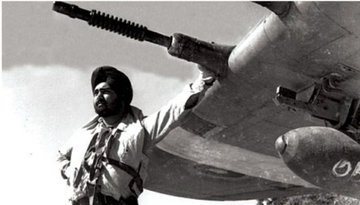
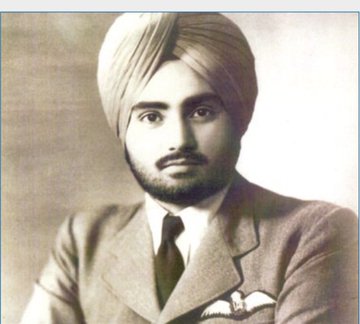
Oldest living IAF fighter pilot Dalip Singh Majithia turns 100, Air chief extends greetings

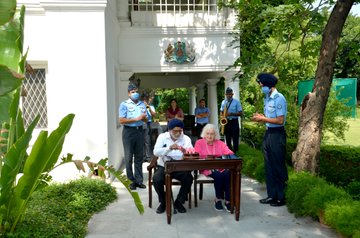
Air Chief Marshal Bhadauria conveyed warm greetings and heartiest congratulations to Retired Squadron Leader Dalip Singh Majithia on behalf of all air warriors, the IAF said.

IAF extended best wishes to Squadron Leader  Dalip Singh Majithia (retd) on his 100th birthday on Monday.

IAF extended best wishes to Squadron Leader Dalip Singh Majithia (retd) on his 100th birthday on Monday. (@IAF_MCC/Twitter Photo )

Retired Squadron Leader Dalip Singh Majithia, who holds the distinction of being the oldest living IAF fighter pilot, turned 100 on Monday.Air Chief Marshal RKS Bhadauria extended his greetings to the centenarian who had retired in August 1947 when India achieved Independence.

ImageImage

Image

“IAF extends its best wishes to Sqn Ldr Dalip Singh Majithia (retd) on his 100th birthday today. He retired in Aug 1947 & holds the distinction of being the ‘oldest’ IAF fighter pilot now,” the IAF tweeted.Air Chief Marshal Bhadauria conveyed warm greetings and heartiest congratulations to Majithia on behalf of all air warriors, the IAF said.

It also shared a short video clip on him on Twitter.

https://twitter.com/i/status/1287739242982985730