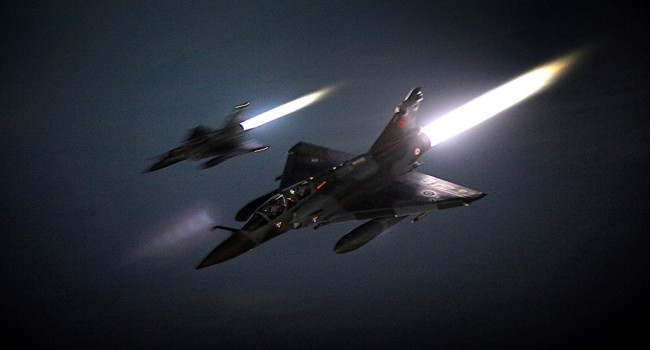
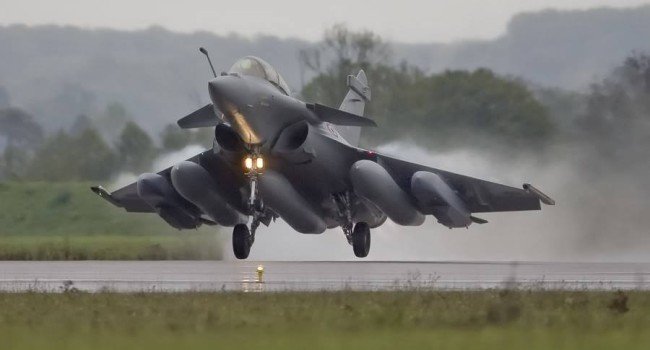
Five Rafale fighter jets that landed today at Ambala do not constitute even half a squadron. But their delivery once again brings back the spotlight on France which has remained India’s trusted partner through the Cold War and beyond.
Just two years after India’s Independence and a year before US President Dwight Eisenhower’s “Atoms for Peace” speech that opened the doors for multi-country civil nuclear collaboration, France and India had collaborated in a project to extract thorium from monazite sand. It was a dead-end, but it in turn led to a partnership that lasted till India conducted its first nuclear test in 1974.
While more Rafale jets will keep arriving and some may be assembled here, the ties between French President Emmanuel Macron and Prime Minister Narendra Modi may eventually lead to a stronger partnership in the maritime domain, especially in the Western Indian Ocean, where the Chinese threat is looming and the US is lukewarm about partnering with India.
But when India conducted its second nuclear test in 1998, Russia and France were the only major powers that did not succumb this time to the Anglo-US pressure to cancel military and security exchanges.
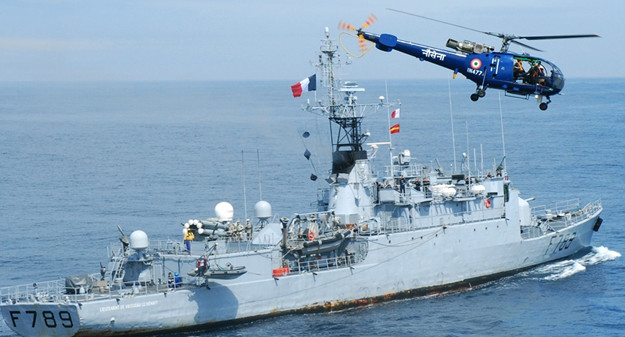
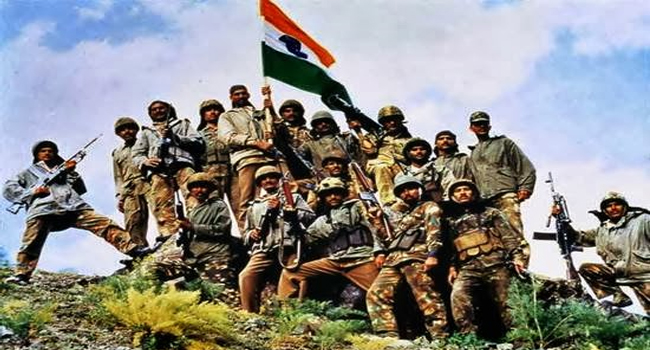
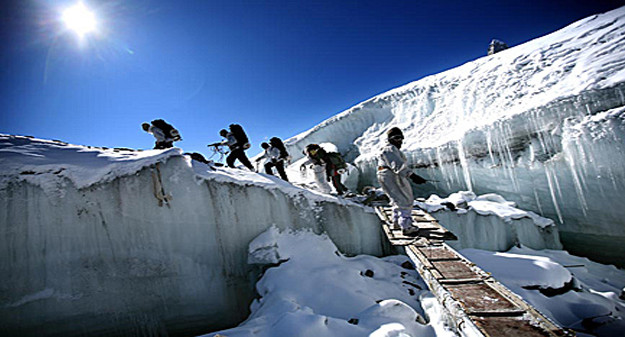
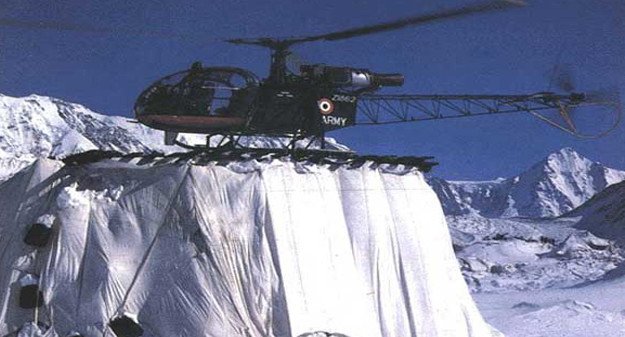
A year later, France made emergency supplies of ammunition during the Kargil War that was used by Mirage planes for accurate and debilitating strikes on Pakistani sangars on steep mountainsides. However, French military machines were doing yeoman service for the Indian armed forces much before the Mirages arrived. The Cheetah and the Chetak that feed and equip Indian soldiers in forbidding heights are also of French origin. However, military ties began just seven years after Independence. Over 100 Mystere fighter jets from France that joined the Indian Air Force were able to match the American Starfighters in dogfights during the 1965 Indo-Pak War.
While more Rafale will keep arriving and some may eventually be assembled here, the close personal ties between French President Emmanuel Macron and Prime Minister Narendra Modi may lead to a stronger partnership in the maritime domain, especially in the western Indian Ocean where the Chinese threat is looming and the US is lukewarm about partnering with India.
India and France have trodden that path before. Paris had helped install two listening stations on India’s western coast. These were to be linked with similar ones in Iran and France for a comprehensive coverage of the western Indian Ocean. But the 1979 Islamic revolution in Iran ended that initiative.
Soldiers killed in Galwan will be honoured at war memorial
Colonel B Santosh Babu, the commanding officer of 16 Bihar, was among the 20 soldiers killed in the seven-hour deadly conflict near Patrolling Point 14 in Galwan Valley, where outnumbered Indian troops inflicted heavy casualties on the Chinese People’s Liberation Army (PLA).
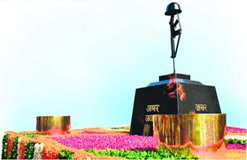
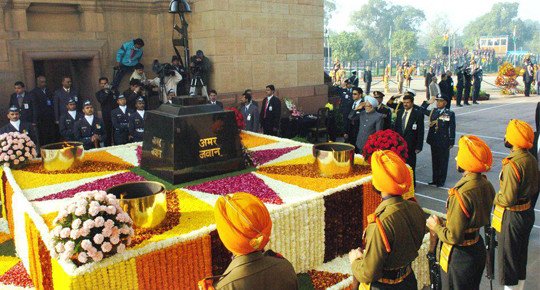
The names of all battle casualties are inscribed on the memorial.(HT photo)
The names of the 20 Indian soldiers killed in the brutal Galwan Valley clash with Chinese troops in eastern Ladakh on June 15 will be inscribed on the National War Memorial in Delhi, officials said on Wednesday.
The soldiers fought off numerically superior Chinese troops in the remote sector.
Colonel B Santosh Babu, the commanding officer of 16 Bihar, was among the 20 soldiers killed in the seven-hour deadly conflict near Patrolling Point 14 in Galwan Valley, where outnumbered Indian troops inflicted heavy casualties on the Chinese People’s Liberation Army (PLA).
The names of all battle casualties are inscribed on the memorial, the officials said.
During a recent visit to Ladakh, defence minister Rajnath Singh met and acknowledged the bravery of the soldiers from 16 Bihar in the presence of the military’s top brass.
Beijing has not disclosed the number of fatalities it suffered in the Galwan Valley clash but according to India’s assessment, the PLA suffered twice as many casualties.
Apart from 16 Bihar, soldiers from 3 Punjab, 3 Medium Regiment and 81 Field Regiment were involved in the first deadly conflict between Indian and Chinese troops along the contested Line of Actual Control (LAC) in more than five decades.
The Indian soldiers confronted the Chinese troops, who refused to remove their installations and vacate the area, triggering a violent clash that involved more than 600 rival soldiers at its peak.
News updates from Hindustan Times: Focus on Indian culture highlights RSS influence on New Education Policy and all the latest news
A boy walks as volunteers of Rashtriya Swayamsevak Sangh (RSS) stand before ‘Path Sanchalan’ (route march). (Pratham Gokhale/HT Photo)
Here are today’s top news, analysis and opinion at this hour. Know all about the latest news and other news updates from Hindustan Times.
Emphasis on Indian culture reflects RSS sway on New Education Policy
The renaming of human resource development (HRD) ministry as education ministry, and the emphasis on Indian arts, languages, and culture reflect the Rashtriya Syawamsevak Sangh (RSS)’s influence on the New Education Policy (NEP). Read more here.
‘Maintaining fitness levels at this time is the most important thing’: India Hockey captain Manpreet Singh | Exclusive
In an exclusive interview with Hindustan Times, Manpreet speaks on the life amid lockdown at SAI Center in Bengaluru, and the plans to prepare for Tokyo 2020. Read more here.
Antitrust hearing: Amazon, Facebook, Google grilled, Apple gets away a little easy
Compared to the Apple CEO, all the other three CEOs spent at least three times longer being questioned. While that’s great for Apple and Cook, it’s not that great for the businesses that build on Apple platforms. Read more here.
Ahead of Raksha Bandhan this year, Karnataka postal circle has introduced an online portal called Rakhi Post to deliver rakhis across the country amid the Covid-19 outbreak. This year Raksha Bandhan will be celebrated on Monday, August 3. Read more here.
On The Record | Matchmaking in India: Regressive or reality?
In the latest episode of On The Record, Hindustan Times’ Sunetra Choudhury speaks to filmmaker Smriti Mundhra on her latest Netflix release Indian Matchmaking. Watch here.
Abhishek Banerjee feels blessed to be an outsider: ‘Even the smallest of success becomes glory for me’
Paatal Lok actor Abhishek Banerjee says if he was a star kid, the pressure would have been 200% higher than it is now. Read more here.
IAF inducts Rafale today, here’s how the deadly fighter jets will boost India’s air power
Rafale is considered to be one of the finest fighters in the world. With its avionics, radars & weapon systems, it is the most potent aircraft in South Asia.
A Rafale taking off | Photo: Dassault Aviation
New Delhi: The five Rafale combat jets that will arrive at the Ambala Air Station Wednesday, after flying about 7,000 km from France, are the first foreign induction by the Indian Air Force (IAF) in 23 years into its mind-boggling inventory of fighters.
Known as the 4.5 generation aircraft, the Rafale is considered to be one of the finest fighters in the world and is described as an ‘omnirole’ aircraft that can take up several missions on a single flight.
With its avionics, radars and weapon systems, the Rafale is the most potent aircraft in South Asia, much ahead of the F-16s that Pakistan uses or even the JF-20, the 5th generation stealth aircraft of China, which is yet to see combat.
Rafale are combat-proven having been inducted into conflicts in Afghanistan, Mali, Libya, Iraq and Syria.
While India had ordered 36 Rafale fighters in 2016, the numbers are just too small for the IAF.
Even though the IAF is supposed to come out with a Medium Multi Role Combat Aircraft (MMRCA) 2.0 for 114 fighters, work on it has been rather slow with a formal tender yet to be issued.
In between all these, talks of additional 36 Rafale fighters have been doing the rounds for long in the defence corridors.
We are deeply grateful to our readers & viewers for their time, trust and subscriptions.
Quality journalism is expensive and needs readers to pay for it. Your support will define our work and ThePrint’s future.
The Rafale will also have 13 Indian specific enhancements, all of which will be integrated once the full delivery is done by 2022. These enhancements include Israeli helmet-mounted display, ability to start in very cold and high altitude areas like Leh, among others.
The first Rafale, with tail number RB 001, which was handed over in France in October last year, will be the last one to arrive in India since all tests and integration would be tried out on it.
‘RB’ on the trainer aircraft’s tail stands for the initials of Air Chief Marshal Rakesh Bhadauria, the IAF chief. It is a tribute to Bhadauria for working out the Rafale deal as the force’s deputy chief earlier.
The single-seater comes with initials of BS, which stands for former IAF chief Air Chief Marshal B.S. Dhanoa.
Rafale to be 7th type of fighter in Indian inventory
The Rafale will be the 7th addition to the types of fighters that the IAF has — a feat very unique to the force in comparison to major air forces in the world.
It was in 2001 that the IAF had first moved a proposal to buy MMRCA — for which Rafales were eventually selected in 2012.
The IAF was keen on buying the Mirage 2000s and its French maker, Dassault Aviation, had offered to shift the assembly line of aircraft from France to India. It had, at the time, decided to shut down the aircraft line to pave way for the Rafale fighter jets.
But the Indian bureaucratic system delayed a formal decision in the matter and, in 2004, it was decided to float a global tender for the MMRCA rather than manufacture the Mirage 2000.
It was only in 2007 that a global Request for Proposal was issued, in which Rafale emerged as the winner in 2012.
PM Modi struck deal for 36 Rafale
Even though Dassault Aviation, the manufacturer of Rafale, was shortlisted as the lowest bidder after having cleared all technical requirements along with the Eurofighter Typhoon, the negotiations went nowhere.
The entire deal was stuck at pricing point as state-run Hindustan Aeronautics Limited (HAL), which was to manufacture the aircraft locally, quoted 2.57 times more man-hours to build the fighter jets. This meant the price of each aircraft was turning out to be much higher than what the French had quoted.
Also, the French refused to take guarantee for aircraft manufactured by HAL.
Another issue was that the quotes by Dassault Aviation did not carry all costs of the aircraft as against the Eurofighter, which had included the cost of even armaments.
By the time the Narendra Modi government came to power in 2014, negotiations for MMRCA were stuck with no headway.
ThePrint has learnt that it was in January 2015 that India first approached the French side to know if a government-to-government deal could be worked out for a smaller number of planes that would be bought off the shelf.
Hectic talks soon took place between the two governments and Dassault Aviation.
When Prime Minister Narendra Modi travelled to Paris in April 2015, he announced a mega plan to buy 36 Rafale jets in fly-away conditions. It took close to 18 months for the deal to be finally sealed.
With a range of 3,700 km, Rafale comes with its 10-tonne empty weight. It is fitted with 14 hard points. Five of these hard points are capable of drop tanks and heavy ordnance. Total external load capacity is 9.5 tonnes, which means that the Rafale can lift the equivalent of its own empty weight in payloads.
The maximum take off weight is 24.5 tonnes and the fighter can carry 4.7 tonnes of internal fuel and up to 6.6 tonnes external.
With a maximum speed of nearly twice the speed of sound, the landing ground run is 450 metres without drag-chute.
Weapons on board the Rafale are real game-changers
The biggest force-enabler for the IAF is the weapon-carrying capability of the Rafale, which can be tuned for delivering nuclear weapons too.
The game-changing missile on-board the Rafale is the over Rs 20-crore worth Meteor air-to-air missile.
Manufactured by European firm MBDA, the Meteor is a long-range rocket and ram-jet powered, and its integration into the Rafale weapon system brings about a paradigm shift in air-to-air affairs since it has a range of over 150 km with a zero escape kill distance of 120 km.
It means an Indian Rafale jet will be able to shoot down an enemy aircraft, even if over 100 km away, without even crossing the Indian air space.
Neither Pakistan nor China possess a weapon as deadly as the Meteor.
Another key missile on-board the Rafale is the over Rs 40-crore worth Scalp long-range air-to-ground stand-off cruise missile.
Weighing 1,300 kg, the 5.1 metre-long Scalp can be carried in either one missile or two missiles configuration on the Rafale.
The missile has a 600-km range and is known for its precision. The Rafale will not have to cross the Indian airspace to hit a target that is about 600 km in enemy territory.
It is a strategic weapon that can be used in penetration, impact or airburst modes, and can even strike deep even in anti-access and area-denial scenarios.
In a bid to deploy the new Rafale aircraft quickly amid tensions with China, the IAF has opted for the French HAMMER air-to-ground precision-guided weapon system under emergency procurement.
The IAF had rejected this system eight years ago in favour of the Israeli Spice 2000 used in the Balakot air strikes in 2019.
HAMMER, which stands for Highly Agile and Manoeuvrable Munition Extended Range, costing nearly Rs one crore, consists of a guidance kit and a range extension kit fitted on standard bombs of different makes.
The original plan was to equip the Rafale with Spice 2000 kits, which have already been integrated into the other French aircraft in the IAF inventory — the Mirage 2000.
The Spice 2000 needs to be integrated into the Rafale aircraft. Keeping the cost of Spice, integration and testing in mind along with the time that the whole process will take, the IAF went in for the HAMMER.
The Rafale will also be equipped with the Mica air-to-air missiles. The IAF plans to further integrate the BrahMos NG missiles with the Rafale when it is finally made by the Indo-Russian joint venture.
The Indian Rafale comes with an Israeli Litening pod for sensor commonality across platforms in the Indian inventory and not the Thales TALIOS laser designator pod that France uses.
The Rafale comes with RBE2 Active Electronically Scanned Radar, which when compared to radars with conventional antennas, gives unprecedented levels of situational awareness with earlier detection and tracking of multiple targets.
Rafale also has the ‘Front Sector Optronics’ (FSO) system, which is immune to radar jamming while operating in the optronic wavelengths.
It also comes with Spectra-integrated electronic warfare suite that provides long-range detection, identification and localisation of infrared, electromagnetic and laser threats.
The system incorporates radar, laser and missile warning receivers for threat detection plus a phased array radar jammer and a decoy dispenser for threat countering, according to the MBDA, which had developed the system with defence contractor Thales.
The pricing of Rafale
A lot has been spoken and written about the pricing of the Rafale deal, struck at 7.878 billion euros.
Immense political slugfest had also ensued over the fighter jets’ pricing ahead of the 2019 general elections.
The vanilla price (basic aircraft) cost about 91 million euros each for a single-seater and about 94 million euros for a two-seater trainer aircraft, which works out to be about 3.42 billion euros. The weapons cost about 710 million euros, while Indian-specific changes are priced at approximately 1,700 million euros.
Associate supplies, including simulators, for the 36 fighter jets cost about 1,800 million euros while performance-based logistics cost about 353 million euros.
Under the performance-based logistics agreement, 75 per cent of the Rafale has to be available at all times for operation.
Since tensions in Ladakh began, three service chiefs have been meeting regularly to plan military strategies.
Representational image of Indian Navy ships | Photo: Commons
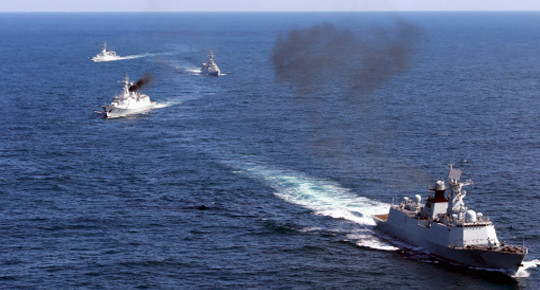
New Delhi: Amid the stand-off with China in Ladakh, the Indian Navy has deployed a large number of ships under the Eastern and and Western Naval Commands in the Indian Ocean region to send out a clear “message” to China, ThePrint has learnt.
Sources in the defence and security establishment said that the “message has been registered” by China.
They added that the three service chiefs have been meeting regularly since the border tensions in Ladakh started simmering from early May and all military strategies are being planned jointly.
As reported by ThePrint, the development comes as the Indian military is preparing to respond to Chinese aggression in a joint manner keeping in mind the possible collusion of China and Pakistan.
“India has reacted in all domains to counter China and to tell her that what she has done is unacceptable. This involves the Army, Navy, Air Force, diplomacy and even economics,” a top government official said.
The official added that the ships have been deployed to send out a message.
Asked if this message has been received by China, the official said: “Yes. China has picked up the message. It has registered”.
The official, however, refused to get into the details of what the message was and how he was sure that the message was received.
China has always been concerned about India possibly blocking the Malacca Strait through which 80 per cent of the Chinese goods travel by sea, including petroleum.
Sources said that the Indian Navy has not spotted any “alarming” movement by the Chinese PLA Navy so far.
ThePrint had earlier reported that additional ships have been deployed by the Navy, but the extent of the deployment could only be known now.
The Navy has also gone in for emergency procurement of “niche equipment”, details of which are being withheld for operational secrecy.
New plans for Andaman and Nicobar Command
Government sources said that one of the key bases for India is the Andaman and Nicobar Command (ANC), the only tri-service Command of India.
They said that a lot of plans are in the works to fully exploit the capability of the Command, which gives India closer accessibility to the Malacca Strait.
The Indian Air Force has also sent its maritime strike variant of Jaguar fighters to the Car Nicobar Air Base under the ANC as part of the preparedness.
From this Command, the Navy has the ability to dominate the Malacca Strait.
The Eastern Naval Command had earlier carried out a major exercise under the area of operation of the ANC and a Passex Exercise with the US in the same waters.
Air commodore Hilal Ahmad Rather has become a buzz name in Kashmir overnight.
Hilal saw off the first batch of Rafale jets which took off from France to India on Monday. Among other things, he has also been associated with the weaponisation of the Rafale aircraft for acclamitisation to Indian requirements.
Hilal is presently India’s Air Attache in France.
The career details of this officer of the Indian Air Force (IAF) read like the decoration scroll of the best flying officer anywhere in the world.
Born in the south Kashmir’s Anantnag district to middle class parents, Hilal’s father, late Mohammad Abdullah Rather retired as a deputy superintendent of police (Dy SP) in J&K police department.
He has three sisters and is the only son of his parents.
Hilal studied in Sainik School in Nagrota town of Jammu district. He was commissioned in IAF as a fighter pilot on December 17, 1988.
He became flight lieutenant in 1993, wing commander in 2004, group captain in 2016 and air commodore in 2019.
He graduated from defence services staff college (DSSC). He also graduated from air war college (USA) with distinction. He won sword of honour in NDA.
Hilal is recipient of Vayu Sena medal and Vishisht Seva medal.
With an impeccable record of 3,000 accident-free flying hours on mirage-2000, MIG-21 and Kiran aircraft, Hilal’s name will now forever be associated with Rafale in India. — IANS
On way to India, 5 Rafales re-fuelled mid-air by French tanker Rafale would be a game-changer in the current scenario when India is facing border tension with China
Midair refuelling of one of the five Rafale jets, which took off from France on Monday, on its way to India. PTI Photo
New Delhi, July 28
On their way to India from France, five Rafale jets were refulled mid-air from a French tanker at a height of 30,000 feet, according to photos released on Tuesday by the Indian Embassy in France.
The jets took off from the Merignac airbase in French port city of Bordeaux on Monday, and will be arriving in India on Wednesday afternoon after covering a distance of nearly 7,000 km.
“Indian Air Force appreciates the support provided by French Air Force for our Rafale journey back home,” the IAF tweeted.
On Monday evening, the Rafales landed at Al Dhafra airbase in the UAE after flying for over seven hours, officials said adding it was the only stopover by the jets while flying from France to India.
“Few shots from 30,000 feet! Mid air refuelling of #RafaleJets on their way to #India,” the Indian Embassy in France tweeted along with a number of pictures of the jets being refuelled mid-air.
The fleet, comprising three single-seater and two twin-seater aircraft, is arriving at Ambala airbase on Wednesday afternoon where they will be officially inducted into the IAF as part of its No 17 Squadron, also known as the ‘Golden Arrows’, said one of the officials.
The aircraft are expected to significantly boost the IAF’s combat capabilities at a time when India is locked in a tense border row with China in eastern Ladakh.
The IAF has already deployed all its frontline fighter jets in key airbases along the Line of Actual Control, the de-facto border between India and China.
India had inked a Rs 59,000 crore deal on September 23, 2016 to procure 36 Rafale jets from French aerospace major Dassault Aviation.
The first Rafale jet was handed over to the IAF in October last year during a visit to France by Defence Minister Rajnath Singh.
The first squadron of the Rafale jets will be stationed at Ambala air base.
Official sources said the Rafale jets are likely to be deployed in the Ladakh sector as part of IAF’s efforts to enhance its operational capabilities along Line of Actual Control with China in view of the border row with the country.
The aircraft is capable of carrying a range of potent weapons. European missile maker MBDA’s Meteor beyond visual range air-to-air missile and Scalp cruise missile will be the mainstay of the weapons package of the Rafale jets.
Meteor is the next generation of BVR air-to-air missile (BVRAAM) designed to revolutionise air-to-air combat. The weapon has been developed by MBDA to combat common threats facing the UK, Germany, Italy, France, Spain and Sweden.
The Meteor is powered by a unique rocket-ramjet motor that gives it far more engine power for much longer than any other missile, said an official.
The second squadron of Rafale will be stationed at Hasimara base in West Bengal. The IAF spent around Rs 400 crore to develop required infrastructure like shelters, hangars and maintenance facilities at the two bases.
Out of 36 Rafale jets, 30 will be fighter jets and six will be trainers. The trainer jets will be twin-seater and they will have almost all the features of the fighter jets. PTI
Midair refuelling of one of the five Rafale jets, which took off from France on Monday, on its way to India. The Rafale aircraft are covering a distance of nearly 7,000 km from France to India with a single stop in UAE. (PTI Photo)Midair refuelling of one of the five Rafale jets, which took off from France on Monday, on its way to India. The Rafale aircraft are covering a distance of nearly 7,000 km from France to India with a single stop in UAE. (PTI Photo)
Naval sky watch to monitor Chinese movement on LAC
After the Chinese build-up along the Line of Actual Control (LAC) in Ladakh, the Navy’s fleet of sophisticated surveillance planes, the Boeing P8I, has been regularly flying from Rajali near Chennai to scan the Himalayas and across.
Ajay Banerjee
Tribune News Service
New Delhi, July 28
After the Chinese build-up along the Line of Actual Control (LAC) in Ladakh, the Navy’s fleet of sophisticated surveillance planes, the Boeing P8I, has been regularly flying from Rajali near Chennai to scan the Himalayas and across.
The sky watch adds to the satellite and local UAV (unmanned aerial vehicle) imagery. The sweep and reach of the P8I is wider than that of a UAV. Also, it can be flown on demand at any time of the day or night, unlike the Indian satellites that have a schedule to cover.
Bharat Electronics Limited (BEL)-provided Data Link Communications allows the P8I to exchange tactical data live to ground stations, the South Block and the Navy data collation centre at Gurugram. The plane, designed for a maritime role, carries high-end electro-optical equipment that picks up minute details. It was also used during the Doklam standoff (June-August 2017) with China.
“The planes remain at their home base and have not been moved northwards,” a top functionary said. They have an extended range of flying some 3,500 km with additional fuel tanks, which means a plane or a pair of them can scan the Himalayas, land at any of the IAF bases in North India, refuel, and go back to Rajali. The Navy has been using the Boeing P8I planes since 2013 and now has a fleet of eight, another four are set to arrive anytime and six additional ones are being negotiated for. The US Navy, Australian Navy and several allies of the US use the same plane, modified from the Boeing’s commercial planes 737-800ERX.
Separately, the Indian establishment is making a push to provide assistance to Island countries in the Indian Ocean where China is facing a negative opinion due to the Covid-19 pandemic. India has sent doctors, medicines, PPE kits and food provisions to these islands amid the crisis. “To keep the Indian Ocean Region countries as cohesive as possible is the target,” said a top functionary. The presence of China in the Indian Ocean cannot be the new normal and the space created for human assistance due to the outbreak has to be filled up. Indian naval ships in the past two months have delivered aid to Maldives, Mauritius, Seychelles, Madagascar and Comoros.
Surveillance plane
The range of Boeing P8I is wider than that of a UAV
Boeing P8I are being regularly flown from Rajali near Chennai to scan the Himalayas
Designed for a maritime role, it carries high-end electro-optical equipment that picks up minute details
Rafale is a reminder | HT Editorial Focus on procurement and defence challenges
The importance attached to the Rafales and attempts to fast-track the subsequent batches is a reminder of the slowness of India’s procurement system and the question marks over its indigenisation drive(PTI)
The unusual fanfare surrounding the arrival of five Rafale fighters from France is a cautionary tale at many levels. The first is the context of the border confrontation with China. So long as Beijing refuses to restore status quo ante along the Line of Actual Control, India must retain a degree of military readiness as a bargaining chip or as a contingency for further violence. Two, the Rafales represent the first strategically significant upgrade in India’s air power in decades. While India is also fast-tracking the purchase of Russian MiGs and Sukhois, one has already been pensioned out of the arsenal and the other serves as a second stringer for the Chinese air force. Three, the importance attached to the Rafales and attempts to fast-track the subsequent batches is a reminder of the slowness of India’s procurement system and the question marks over its indigenisation drive.
India had the luxury of putting defence procurement and reforms on the backburner. After all, it enjoyed military superiority against Pakistan, and had a military restraint understanding with China. The Balakot dogfights showed that, at best, India had technological parity with Pakistan. Galwan Valley has shown Beijing no longer feels the need to be constrained by the past 45 years. The Indian political system has been more concerned about accusations of scandals regarding arms purchases than what the weapons meant for national security. It is telling that the Rafales are the first tangible result of a fighter contract that was first unveiled in 2007. To its credit, the Narendra Modi government has implemented several defence reforms. But the gap has been its focus on weapons indigenisation, where the Make in India focus may not be adequate to address the quality needs of the armed forces. But with the changed security environment, the question has to be asked whether, in the case of offensive platforms, this priority makes sense.
The new paradigm means the services also need to relook at their earlier convictions. Networking allows militaries to get more accurate bang for their buck but barely exists in even the most primitive form in the Indian military. A host of new technologies means older formulae need a rethink. The advent of the armed drone, for example, means the original 42-squadron air force goal of the Indian Air Force may be obsolete. The times they are a-changing in dangerous ways and mindsets need to be a-changing as well.
Indian Navy deepens watch to check China ambitions
the multiple routes that China could be looking at to enter the Indian Ocean are further south of Malacca and include the Sunda, Lombok, Ombai and Wetar straits, said a second Indian Navy officer who asked not to be named.
The Malacca Dilemma refers to China’s apprehension of major naval powers controlling the Malacca Strait between Malaysia and Indonesia and interdicting vital supply lines. (PTI file photo for representation)
The Indian Navy has stepped up surveillance and activities in the Indian Ocean Region (IOR), which, it believes, China will “inevitably” try to enter in its quest to become a global power, just as it has laid claim to large portions of the disputed South China Sea, according to a top officer aware of the developments.
It is to deal with this scenario that India reached out to neighbours in IOR — Maldives, Mauritius, Seychelles and Madagascar, to prevent China from expanding its footprint in the region by creating more bases — and like-minded navies, such as those of the United States and Japan, over the last two months, he added.
“It is inevitable that the Chinese People’s Liberation Army-Navy (PLAN) will come to IOR if China wants to become a global power. They are opening multiple routes to the Indian Ocean to overcome the Malacca Dilemma (China’s strategic weakness),” the officer said, speaking on the condition of anonymity.
The comments come at a time when there are heightened military tensions in eastern Ladakh — where Indian and Chinese forces are locked in a tense border confrontation and disengagement along the Line of Actual Control (LAC) has turned out to be a challenging process — and China is militarising the South China Sea.
The Malacca Dilemma refers to China’s apprehension of major naval powers controlling the Malacca Strait between Malaysia and Indonesia and interdicting vital supply lines. A significant volume (more than 80%) of China’s oil imports pass through the strait connecting the Indian Ocean and the South China Sea.
The multiple routes that China could be looking at to enter the Indian Ocean are further south of Malacca and include the Sunda, Lombok, Ombai and Wetar straits, said a second Indian Navy officer who asked not to be named.
“It’s a reality that the PLAN will deploy in the Indian Ocean once its power crosses a certain threshold. Right now, it’s good enough for the South China Sea,” said Admiral Arun Prakash (retd), a former navy chief.
India is keeping tabs on China’s aggressive moves in the South China Sea and taking steps to ensure that the Chinese navy doesn’t muscle its way into the Indian Ocean where combat-ready Indian warships are carrying out round-the-clock surveillance for any unusual activity, said the first officer.
Over the last one month, the navy has conducted joint drills with a US Navy carrier strike group, led by USS Nimitz, and Indian and Japanese warships have carried out exercises in the Indian Ocean, against the backdrop of the India-China border standoff in Ladakh.
The India-US exercise involving eight Indian and US warships took place a week ago at a time when tensions have mounted over China’s activities in South China Sea, where the US Navy recently conducted a major exercise that involved two carrier strike groups.
From carrying out naval drills with like-minded countries to reaching out to states in the Indian Ocean region, the Indian Navy is focusing on checking China’s rising ambitions in the region and sending out a strong message that Beijing’s power play in South China Sea cannot be replicated in the Indian Ocean.
“China is claiming almost 90% of the South China Sea. We don’t want that scenario unfolding in the Indian Ocean. We will not allow China to have it easy coming here,” said the second officer.
China’s step-by-step inroads into “territorialising” the South China Sea find echoes in some parts of IOR, not by trumped up claims because that would be blatant neo-colonialism but with more sophistication, said naval affairs expert Rear Admiral Sudarshan Shrikhande (retd)
“Its (China’s) diplomacy and economic influence when combined with port investments, logistics bases, all of which could be for dual-use and their sustained deployments in the IOR, are of serious concern,” Shrikhande said.
The stage is also set for Australia to be part of the next Malabar naval exercise conducted by India with the US and Japan, as reported by Hindustan Times on July 17. The next edition of Malabar, already delayed by the Covid-19 pandemic, is set to be held by the end of the year.
China has also been wary of the Quadrilateral security dialogue, or Quad, that was revived in late 2017 by India, the US, Australia and Japan, and these suspicions have increased since the four countries upgraded the forum to the ministerial level last year.
“We are already operating with these navies. We don’t need time to put the Quad into effect if the government gives us the go-ahead… It’s not that we are aligning with the US. Our actions are guided by national interest and what you see unfolding is issue-based convergence of interests,” said the first officer.
China began deploying troops to its first overseas naval base at Djibouti in the Horn of Africa in July 2017, in what some global experts said was the outcome of Beijing’s ‘debt-trap diplomacy’. Mounting debts have led countries such as Sri Lanka, the Maldives and Pakistan to give control of territories, which are of strategic significance, to China.
The base in Djibouti has shored up China’s capabilities to sustain naval units in the Indian Ocean.
“In recent months, with much of the world preoccupied with the Covid-19 pandemic, China has sharply escalated its coercive activities. In early April, a Chinese Coast Guard vessel sank a Vietnamese fishing boat close to islands claimed by both China and Vietnam. A Chinese marine survey vessel harassed a Malaysian oil exploration vessel off Borneo. This month, the [US] department of defense voiced concern about the Chinese navy’s decision to seal off an area around the Paracel Islands to conduct naval exercises. In response, the United States increased its own naval activities, including joint exercises by two aircraft carrier groups,” the New York Times said in an editorial on Monday.
The Indian Navy has been on an operational alert in the Indian Ocean where scores of warships are ready for any task in the aftermath of the border row. It has positioned warships along critical sea lanes of communications and choke points and the vessels could be diverted for any mission.
Indian warships are deployed from as far as the Persian Gulf to the Malacca Strait and northern Bay of Bengal to the southeast coast of Africa.
While the Indian Navy is keeping a sharp eye on the Indian Ocean, it is also playing a key role in the Ladakh sector.
The navy’s P-8I maritime patrol and reconnaissance aircraft, imported from the US, are being used for surveillance of the Ladakh sector and gathering intelligence on Chinese deployments across the contested LAC.
The primary role of the P-8Is encompasses carrying out anti-submarine warfare, anti-surface warfare, and intelligence, surveillance and reconnaissance of the oceans.
State Stalwarts
DEFENCES FORCES RANKS
ARMY, NAVY, AIRFORCE RANKS
FORMATION SIGNS
FORMATION SIGNS
ALL HUMANS ARE ONE CREATED BY GOD
HINDUS,MUSLIMS,SIKHS.ISAI SAB HAI BHAI BHAI
CHIEF PATRON ALL INDIA SANJHA MORCHA
LT GEN JASBIR SINGH DHALIWAL, DOGRA
SENIOR PATRON ALL INDIA SANJHA MORCHA
MAJOR GEN HARVIJAY SINGH, SENA MEDAL ,corps of signals
.
.
PATRON ALL INDIA SANJHA MORCHA
MAJ GEN RAMINDER GORAYA , CORPS OF
sanjhamorcha303@gmail.com
PRESIDENT HARAYANA STATE CUM COORDINATOR ESM
BRIG DALJIT THUKRAL ,BENGAL SAPPERS
PRESIDENT TRICITY
COL B S BRAR (BHUPI BRAR)
PRESIDENT CHANDIGARH ZONE
COL SHANJIT SINGH BHULLAR
.
.
PRESIDENT PANCHKULA ZONE AND ZIRAKPUR
COL SWARAN SINGH
PRESIDENT SAS NAGAR (MOHALI)
COL BALBIR SINGH , ARTY
INDIAN DEFENCE FORCES
DEFENCE FORCES INTEGRATED LOGO
FORCES FLAGS
15 Th PRESIDENT OF INDIA SUPREME COMMANDER ARMED FORCES
Droupadi Murmu
DEFENCE MINISTER
Minister Rajnath Singh
CHIEF OF DEFENCE STAFF (2nd)
General Anil Chauhan PVSM UYSM AVSM SM VSM
INDIAN FORCES CHIEFS
CHIEF OF ARMY STAFF(29th)
General Upendra Dwivedi, PVSM, AVSM (30 Jun 2024 to Till Date)