Sanjha Morcha

What’s New

Click the heading to open detailed news

Current Events :

web counter

Print Media Reproduced Defence Related News

Army chief Gen. Naravane to visit Saudi Arabia & UAE, in a sign of growing ties

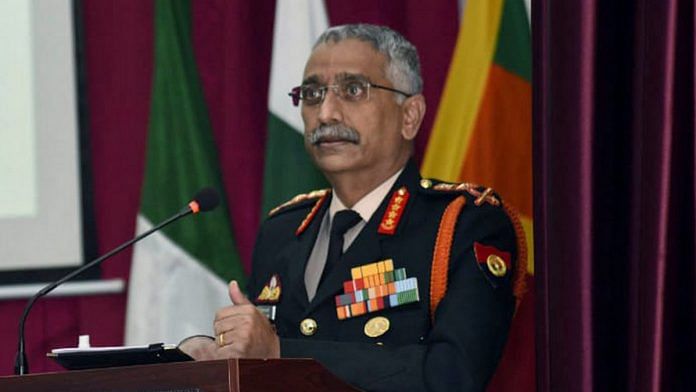
Army chief Gen. M.M. Naravane | File photo: ANI

Army chief Gen. M.M. Naravane | File photo: ANI

New Delhi: Army chief Gen. M.M. Naravane will be travelling to Saudi Arabia and the UAE next week, in an unprecedented move that is being seen as a sign of the growing ties between India and countries in the Middle East.

Sources in the defence and security establishment told ThePrint that Gen. Naravane’s visit will be four days long, during which he’ll meet his counterparts and other senior officials in these countries.

 The Indian Army chief will also be addressing the Saudi National Defence College.

Sources said this will be the first trip by an Indian Army chief to Saudi Arabia. Naravane’s visit to the UAE will follow close on the heels of one made by External Affairs Minister S. Jaishankar.


Also read: Army chief Naravane meets Nepalese counterpart, discusses ways to enhance friendship


Improving relations

Over the past few years, India’s relations with countries in the Middle East, especially with the UAE and Saudi Arabia, have grown, and Gen. Naravane’s visit is being seen as an extension of that.

The visit comes at a time when Pakistan’s relationship with the Saudi Arabia, once its strong ally, has plummeted.

Decades of close economic, political, and military ties between Saudi Arabia and Pakistan had hit a bump in August this year when the South Asian country’s foreign minister, Shah Mehmood Qureshi, criticised the West Asian country for failing to call a special meeting of the Organisation of Islamic Cooperation on the Kashmir issue.

Pakistan Army chief General Qamar Javed Bajwa’s visit to Saudi Arabia, to ease the diplomatic strain between the countries, ended with him being denied a meeting with Crown Prince Mohammed bin Salman.

Incidentally, Pakistan’s former army chief Gen. Raheel Sharif heads a Saudi Arabia-led Islamic military coalition.

On Tuesday, India had strongly condemned a missile attack that targeted an Aramco oil facility in Saudi Arabia’s Red Sea city of Jeddah last week.

Ministry of External Affairs spokesperson Anurag Srivastava had said India stands in solidarity with the government and the people of Saudi Arabia against such attacks.


Also read: Army needs to be more professional & not get carried away by ceremonials: Chief Naravane


Subscribe to our channels on YouTube & Telegram

Why news media is in crisis & How you can fix it

India needs free, fair, non-hyphenated and questioning journalism even more as it faces multiple crises.

But the news media is in a crisis of its own. There have been brutal layoffs and pay-cuts. The best of journalism is shrinking, yielding to crude prime-time spectacle.

ThePrint has the finest young reporters, columnists and editors working for it. Sustaining journalism of this quality needs smart and thinking people like you to pay for it. Whether you live in India or overseas, you can do it here.


Farmers charge cell phones from tractors; brought bikes from Punjab Sukhdev Singh from Sangrur added that a backup team has been set up village-wise

http://

Ravinder Saini
Tribune News Service

Rohtak, December 3

Farmers camping at Tikri-Bahadurgarh have completely prepared from Punjab. For the past five days, they have been charging their mobile phones by using the batteries of their tractors.

Farmers recharge cell phone from a tractor at Tikri-Bahadurgarh border in Jhajjar. Tribune Photo: Sumit Tharan.

They brought their motorbikes to get to one point to another point, since a stretch of 10 km between the Bahadurgarh bypass to Tikri border, Delhi is jam-packed with tractor-trailers, buses, and other vehicles.

They have set up a backup team at their village which ensures the delivery of essential items for protesting farmers.

“Cell phone is the only way, here, to get updates about the agitation, and the direction from top leaders. Since we knew that there would be no electricity connection at the dharna spot to charge cell phones, hence, we created charging points at our vehicles. We charge the phone and power bank at night from the tractor’s battery while the battery is charged by keeping the tractor started. This mechanism is being adopted by the majority of the farmers,” said, a protesting farmer, Jasprit Singh Walia.

Significantly, several farmers are using electricity from poles installed on the highway to charge their phones and power banks.

Magar Singh of Muktsar said, that a 10-km long stretch of the highway from Bahadurgarh to Tikri border was jam-packed with tractor-trailers, buses and other vehicles of the farmers.

“Hence we are using two-wheelers not only to go to one point to other but also buy medicines, eatables and other essential things from Bahadurgarh town as you cannot move in the four-wheelers through road blockade,” he said, adding, that hundreds of farmers had brought two-wheelers with them.

Sukhdev Singh from Sangrur added that a backup team has been set up village-wise.

“We daily update the team members about the agitation and also apprise them of our need about essential items like medicines, milk powder etc. The teams send the village youths here to deliver the items here. The youths then replace those who want to return,” he added.

Amit Nain, a young farmer, informed since the dharna spot was spread over 10 km hence two vehicles were being used to make the farmers updates from the latest development about the agitation.


Pak drones carrying arms spotted in Ajnala

Pak drones carrying arms spotted in Ajnala

Amritsar, December 3

At least five drone sorties carrying arms or contraband were made in past three days from across the border by Pakistan-based “anti-national forces” supported by the ISI in Kot Razada border village in the Ajnala sector here, police sources said.

The first attempt was made on the intervening night of November 30 and December 1 while BSF jawans heard buzzing sounds of drones in the area during next intervening night (December 1-2). They also fired indiscriminately to shoot it down, but they returned to Pakistan.

Though an initial search operation yielded nothing, intensive search operations are continuing in the area. According to sources, the sorties were made between 11.15 pm to 12.30 am on the intervening night of December 1 and 2 and between midnight to 12.40 am on November 30- December1.

Similar drone sorties were made in September this year to pump in around 80-kg weapons. This had come to light during the interrogation of an alleged terror module busted by the Punjab Police following seizure of weapons in Tarn Taran.

As the winter sets in and dense fog engulfs the region, the BSF faces a stiff challenge to check the movement of drones from across the international border.

The BSF officials said the issue of purchasing an anti-drone system with 360-degree surveillance capacity and GPS jamming system was being taken up at appropriate levels.

“Until then, we are working in close coordination with the Punjab Police to strengthen the second line of defence in order to check the movement of drones where they can drop the consignments of drugs or arms,” a BSF official said.

The BSF had been holding monthly coordination meetings with the Punjab Police in this regard, he added.

The use of drones first came to light in September last year when the police nabbed some alleged Khalistani operatives and recovered a burnt drone from their possession. — TNS


Injured Sukhdev firm to stay put in Delhi: Kin

Injured Sukhdev firm to stay put in Delhi: Kin

Sukhdev Singh’s photo of being lathicharged has gone viral.

Deepkamal Kaur

Tribune News Service

Jalandhar, December 3

Even as Congress leader Rahul Gandhi and BJP social media chief Amit Malviya have been slugging out over the photograph of Kapurthala-based farmer Sukhdev Singh (67), his family today confirmed that he had got injured after being hit by the police batons.

The photograph of Sukhdev Singh running to save himself from the police lathicharge had been posted by Rahul Gandhi a few days back on his Twitter handle, after which the BJP teams had counter-posted a short video to somehow show that he had not been hit. Today, the farmer’s testimonial video, who is stranded at the Singhu border, went viral. In the video, he showed injury marks on his left arm while also complaining that he got hit by the police on the back and lower legs.

Sukhdev’s family at Sanjogla village here said he had told them about the injuries on the very first day when he got hurt. “We told him to return if he was not feeling well because of his wounds but he was adamant to stay back. He said he had taken medicines for pain relief. He told us, ‘Hun tan morcha fateh karke hi aawanga’ (I will return only after our protest brings us victory),” said his 30-year-old son Sewa Singh.

Sukhdev’s wife Malwinder Kaur said, “My husband left here on Day 1 of the morcha. He neither belongs to any farmer association nor has he ever participated in any protests earlier but he was determined to go this time. He picked some clothes and ration and left in a trolley that ferried farmers from the village and told me that he may not return for a month or so.”


Army institutes award after Lt Fayaz Was killed by militants after being abducted from Kulgam in south Kashmir in May 2017

Army institutes award after Lt Fayaz

Cadet Vijay Bahadur of 139th NDA course receives the Lt Ummer Fayaz award in Khadakvasla, Pune. courtesy: twitter

Tribune News Service

New Delhi, December 2

In an honour for a fallen officer, the Indian Army has instituted a motivation award in the name of Lt Ummer Fayaz to be awarded to a cadet at the National Defence Academy in Khadakvasla, Pune.

The officer, who hailed from Kashmir, was abducted from his cousin’s wedding at Kulgam in south Kashmir in May 2017 and found dead a couple of days later.

The award will be called the ‘NDA commandant’s motivation award–Lieutenant Ummer Fayaz, trophy and silver medal for displaying overall improvement in performance during the training’. The award has been sponsored by the Officers Regiment, the Rajputana Rifles.

Lieutenant Ummer Fayaz was born at Sursunu village in Kulgam district of Jammu and Kashmir. He studied from Jawahar Navodaya Vidyalaya, Anantnag, and joined the 129th course of NDA to pursue his dream of becoming an Army officer.

During his training at NDA, he demonstrated outstanding improvement in his performance in all disciplines.

Lieutenant Fayaz was commissioned on December 10, 2016, into the 2nd battalion of the Rajputana Rifles Regiment. He was deployed in Akhnoor Sector of Jammu and Kashmir. In early May 2017, he had sought leave to attend the wedding of his cousin from where was abducted.

The life and sacrifice of Lieutenant Fayaz is seen as an inspiration for the youth, especially from rural areas in the Valley, for joining the armed forces. The winner of the first award is Cadet Vijay Bahadur of 139th NDA course.


Commissioned in 2016

Lieutenant Fayaz was commissioned on December 10, 2016, into the 2nd battalion of the Rajputana Rifles Regiment

His sacrifice is seen as an inspiration for the youth, especially from rural areas in the Valley, for joining the armed forces.


India-China border talks stalemated on ‘core’ issue: MEA India for complete disengagement and full restoration of peace and tranquility

India-China border talks stalemated on ‘core’ issue: MEA

India and China continue to maintain communication through diplomatic and military channels. Both sides have also agreed to have another round of senior commanders meeting. PTI file

Tribune News Service

New Delhi, December 3

The border talks between India and China remain stalemated on the “core issue” that both sides need to strictly follow the various bilateral agreements and protocols in their entirety, the Ministry of External Affairs said here on Thursday.

Indicating that India is prepared for the long haul, the MEA said these agreements required that there should not be amassing of troops. Each side should strictly abide by and respect the LAC and should not take any unilateral action to alter it.

The Indian objective is to ensure complete disengagement in all friction points along the LAC in the western sector and full restoration of peace and tranquility, MEA spokesperson Anurag Srivastava said at a media briefing.

Currently, the two sides continue to maintain communication through diplomatic and military channels. Both sides have agreed to have another round of senior commanders meeting at an appropriate time.

“As and when we have more information, we will share it with you,” said Srivastava.

Asked whether External Affairs Minister S Jaishankar’s called his Australian counterpart Marise Pyne at a time when Canberra and Beijing were involved in a social media war over the killing of 39 troops by Australian military, Srivastava said: “Given the depth and importance of our bilateral relations, naturally, we exchange views on regional and global developments as well as current issues of concern.”

He pointed out that India and Australia enjoy strong bilateral relationship and both were democracies with shared values while noting that the India-Australia bilateral relationship was in June elevated to Comprehensive Strategic Partnership.

Srivastava also noted that this year Australia had participated in the recently concluded Malabar joint naval exercises.


Eye on China, India to have 6 more subs

Eye on China, India to have 6 more subs

Ajay Banerjee

Tribune News Service

New Delhi, December 3

In a bid to match China, India is moving towards procuring a number of key assets, including six more submarines. It is also focusing on high-end unmanned systems or drones, all clearly aimed at tackling Beijing at sea.

Navy Chief for 3rd aircraft carrier

  • A third aircraft carrier is ‘absolutely necessary’ to expand its maritime prowess, said the Navy Chief
  • India has only one aircraft carrier — INS Vikramaditya, a Russian-origin platform
  • Indigenously built INS Vikrant will be fully operational by 2022

Addressing the media today on the eve of Navy Day, Chief of Navy Admiral Karambir Singh said: “We are going to the Defence Acquisition Council for issuing a request for proposal (second stage of the tender) for the submarines.” The DAC is the apex decision-making body of the Defence Ministry. It meets once in 3-4 weeks.

A foreign manufacturer will tie up with an Indian partner to make these six next-generation stealth submarines for nearly $7 billion. Indian and foreign partners have already been shortlisted.

The process for acquiring 30 more “Predator” drones — two were recently leased from US firm General Atomics and may be deployed over the Himalayas — was under way, the Navy Chief said.


Farmers protest: Heavy security cover at Delhi borders, traffic snarls reported

Farmers protest: Heavy security cover at Delhi borders, traffic snarls reported

Tractor trollies and other vehicles belonging to farmers at Singhu border during their Delhi Chalo march against the Centres farm reform laws, in New Delhi. — PTI

New Delhi, December 2

Farmers at the Delhi-Uttar Pradesh border in Ghazipur intensified their protest on Wednesday and police stepped up security as thousands blocked key gateways into the national capital for the seventh day on the trot, leaving commuters to face a harrowing time.

The protest at the Delhi-Uttar Pradesh border also led to the closure of a key route connecting the national capital with Uttar Pradesh on Wednesday.

“The Chilla border on Noida link road is closed for traffic due to farmers’ protests near Gautam Budh Dwar. People are advised to avoid Noida link road for going to Noida and use NH 24 and DND instead,” the traffic police tweeted.

While the police have kept the Haryana-Delhi border at Singhu and Tikri closed for traffic, the protest at Ghazipur, the city’s border with Uttar Pradesh, has also intensified, an official said.

Two more border points connecting the national capital with Gurgaon and Jhajjar-Bahadurgarh were also closed as precautionary measures on Tuesday. With this, five border points, including Singhu and Tikri, have so far been closed due to the protest.

The traffic police said the borders at Tikri, Jharoda and Jhatikra are closed for all kinds of “traffic movement”. The Badusarai border is open only for two-wheelers.

Available open borders to Haryana are Dhansa, Daurala, Kapashera, Rajokri NH 8, Bijwasan/Bajghera, Palam Vihar and Dundahera, it said.

As traffic spilled over to alternative routes, it led to long jams there as well. The commuters entering or exiting Delhi faced inconvenience as the protesting farmers blocked key entrances to the city.

Meanwhile, the Delhi border points remained under heavy police deployment with concrete barriers and multi-layered barricades in place as the farmers continued their agitation against the Centre’s new agriculture reform laws.

According to the police, checking of vehicles has also been intensified at the border points as a precautionary measure in view of the ‘Delhi Chalo’ protest march by farmers.

“Cemented barriers and multi-layered barricades have been put up besides heavy security personnel at Ghazipur border near UP gate where many farmers have been protesting since Saturday,” a senior police officer said.

The protest against the new farm laws is set to continue as talks between three Union ministers and farmer groups ended in a stalemate on Tuesday after they rejected the government’s suggestion of a new committee to look into the issues raised by agitating farmers.

The two sides, however, have decided to meet again on Thursday. — PTI 


Anomalies ail defence pension system

Sporadic military pension reforms that don’t satisfy pensioners are of no help. A dispassionate approach is necessary to oversee the burgeoning pension confusion. It could possibly include adopting a scheme along the lines of the New Pension Scheme, customised for retiring defence personnel in keeping with systems prevalent in militaries abroad.


Anomalies ail defence pension system

WAY FORWARD: There is a need to strike a balance between the government’s financial constraints and service personnel’s interests. PTI

Amit Cowshish & Rahul Bedi

Amit Cowshish, Ex-Financial Adviser, acquisition, MoD & Rahul Bedi Senior Journalist

THE harsh reality of the military pension structure is that few among the retirees and in the government really understand its complexity in totality. Recurring changes in pension configuration have resulted in such complex anomalies that implementing every new decision poses fresh, and at times, insurmountable challenges.

Consequently, the three pension sanctioning offices of the Defence Accounts Department (DAD) in Prayagraj, Mumbai and New Delhi have been braving the ire of thousands of military pensioners nationwide. And even though the DAD is neither responsible for policy decisions nor for the disbursement of monthly pensions to about 85% of the pensioners, it remains the retirees’ whipping boy.

One of the foremost incongruities regarding military pensions concerns civilian employees retiring from varied defence departments. For years, military pensioners have been railing against their civilian colleagues for cornering a substantial part of — and needlessly inflating — the fast-burgeoning defence pension budget that has escalated 585 times from Rs 228.52 crore in 1980-81 to Rs 1,33,825 crore in 2020-21.

While some of these ‘defence civilian pensioners’ have retired from establishments like workshops, depots and dockyards headed by military personnel, others have superannuated from ordnance factories and the Defence Research and Development Organisation. They have been clubbed with military pensioners because their salaries emanated from the services’ revenue budget whilst in service.

Other civilians, like those retiring from Ministry of Defence (MoD)-administered organisations like the Indian Coast Guard and the Defence Accounts Department, receive their pensions from a separate budget managed by the Ministry of Finance (MoF).

Successive governments’ inexplicable failure to maintain separate accounts of expenditure on military and defence civilian pensioners, however, has given rise to self-serving distortion of data on the latter. This, in turn, has buttressed outrageous arguments, frequently voiced on social media, that the latter are an ‘extortionate’ drain on overall defence pensions.

Many service personnel argue that this perceived anomaly can be resolved by simply shifting the civilian pension liability to the MoF-managed pension budget. But in reality, it makes little or no difference which budget these pensioners get paid from, as the money emanates from a common source: the Consolidated Fund of India. Therefore, shifting the liability from the MoD’s pension budget to that of the MoF’s will simply lead to the annual allocations being similarly adjusted in merely a deft accounting manoeuvre.

Several defence analysts and service personnel also speciously maintain that there is little need to employ so many civilians in military establishments, and that many of the jobs they presently perform can either be dispensed with, or better performed by uniformed personnel. If so, this culling should have been executed long ago, even though all three services had previously demanded an increase in their respective civilian and military manpower, paradoxically at odds with their enduring objections regarding pension payments.

In December 2016, the MoD-appointed Committee of Experts headed by Lt Gen DB Shekatkar (retd) for enhancing combat capability and rebalancing the armed forces’ expenditure had recommended the restructuring of the civilian workforce of the Military Engineer Services (MES) by managing their tasks via departmentally employed staff and by outsourcing.

This resulted in a cosmetic abolition of 9,304 MES civilian posts out of a total of 13,157 positions that were lying vacant, indicating that the entire work could be managed by the remaining 3,853 personnel. That is, indeed commendable, but nothing has been heard of since about abolishing posts in other defence departments, outsourcing work, or adoption of a government-owned-contractor-operated (GOCO) model for managing military workshops, depots and dockyards. Hence, in an ironic move reminiscent of ‘ghost’ jobs in numerous civilian sectors, all that the MoDs fiscal measures achieved was the termination of some 9,000 jobs that simply did not exist.

Such superficial steps focused on defence civilians can in no way resolve the problem of rising defence pension budgets. In any case, in time, retired civilian pensioners will cease to be a burden on the state exchequer, following the discontinuance of assured pensions for all civilian employees, including those in defence, paramilitary and police departments recruited on or after January 1, 2004, and they all mandatorily migrate to a market-driven New Pension Scheme (NPS).

Pensions for the uniformed personnel will, however, continue as before.

Therefore, the problem of a rising defence pension budget can only be resolved by focusing directly on military pensions and striking a balance between the government’s financial constraints, service personnel’s interests and overall financial practicality.

Sporadic military pension reforms that do not satisfy the pensioners and ill-conceived ideas of limiting the entitlement of one or the other of their categories that are routinely struck down by the courts are also of no help. The recent concept mooted by the Department of Military Affairs (DMA) to introduce a system of graded pensions, with only those retiring with at least 35 years of service being entitled to full pension, is a prime example of such an approach. This idea is inherently impractical, not only because of its impact on military morale, but also its legality.

Successive court judgments have held pension to be a legal right which a pensioner cannot be deprived of, even in part, except in accordance with the authority of law. It may not be easy to give a legal veneer to the CDS-proposed graded pension scheme and to successfully defend it in court, a challenge it is almost definite to face, even if sanctified through executive fiat. Besides, pursuing such a strategy, too, is unlikely to resolve any outstanding problem.

Pension is a basic right for services rendered. The amount payable or the quantum of periodic increase can neither be determined by the beneficiaries nor claimed self-righteously as a matter of right with disregard for overall financial implications.

More importantly, it is beyond the vast capability of information technology professionals to develop software programmes to capture, coordinate and administer all pension-related data, some of which may not even be available in existing records. The inbuilt anomalies in the complex system, too, are self-defeating for any credible software to competently manage pension payments that remain a riddle within an enigma.

Accordingly, a dispassionate approach is necessary to oversee the burgeoning pension confusion. It could possibly include adopting a scheme along NPS lines, customised for retiring defence personnel in keeping with systems prevalent in militaries abroad.



Despite facing teargas, farmer helps cop drink water; netizens all praise for it as video goes viral

Despite facing teargas, farmer helps cop drink water; netizens all praise for it as video goes viral

Tribune Web Desk
Chandigarh, November 28

Farmers faced teargas and water cannons along the Delhi-Haryana border. They clashed with police on Friday as they marched towards the National Captial as part of their ‘Delhi Chalo’ protest.

Despite such severe circumstances, a video clip filled with complete compassion has surfaced—proving that humanity is above all.

Farmers stepped forward to extend a helping hand to others, including the cops.

A clip showing a farmer offering, and helping a policeman drink water has gone viral.

Twitter user, Gurpreet S. Sahota, shared the clip, saying: “So what if policemen released cold water on farmers on a chilly day, that was their duty. Our Guru taught us to be humble, serve and share, what we have. It’s our duty.”

Netizens were touched by this thoughtful gesture, and appreciated farmers, and the Sikh spirit: