Sanjha Morcha

What’s New

Click the heading to open detailed news

Current Events :

web counter

Print Media Reproduced Defence Related News

Missiles, drones, defence shield — India has a series of military trials planned for 2021

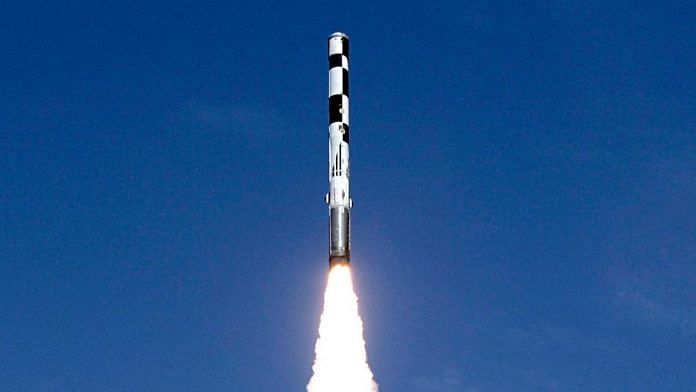
File image of a BrahMos supersonic cruise missile | ANI

ile image of a BrahMos supersonic cruise missile | ANI

New Delhi: India has a series of military tests and trials planned for 2021, including that of the Ballistic Missile Defence (BMD) shield, an Air-Independent Propulsion (AIP) system for submarines, and drones, besides a number of missiles, including a BrahMos with an 800-km range.

Sources in the defence and security establishment said one of the key systems to go under trial in the coming year would be the AIP, which is aimed for integration with India’s fleet of six Scorpene submarines during refit.

The trials for the indigenous AIP, which will allow conventional submarines to stay under water for a longer duration, is to begin in the first quarter of the new year, the sources added.

Another important trial that will take off is the one for phase 2 of the BMD, which aims to secure the country from all kinds of incoming missiles, including nuclear, and flying objects, through a multi-tier defence system. Phase 1 of the programme was completed last year.

Also on the agenda is the full-fledged trial of the indigenous Rustom 2 Unmanned Aerial Vehicle (UAV), which is scheduled to begin in the first half of 2021, after much delay.

Capable of carrying the synthetic aperture radar, electronic intelligence systems and situational awareness systems, depending on mission objectives, the UAV is a medium-altitude long-endurance system.

The current stand-off with China in eastern Ladakh has brought to light India’s dire need for indigenous drone systems against a country that has become one of the world’s largest exporters of armed UAVs.

The early part of 2021 will also witness fresh trials of the Indigenous Technology Cruise Missile (ITCM) Nirbhay, which has a range of 800-1,000 km.

The maiden trial of the 800-km range BrahMos supersonic cruise missile, meanwhile, is scheduled for mid-2021. The 400-km variant of this missile was successfully tested earlier this year.

Even as developmental trials take place, the services will continue with their firing exercises and re-validation of the missiles in their arsenal, the sources said.


Also Read: Ballistic missile submarine Arighat in final stages of trials, to be commissioned early 2021


Many trials in 2020 after Covid lull 

The year gone by also witnessed a number of key tests.

The coronavirus pandemic led to a lull, but the pace picked up after September. Among the major tests in 2020 was that of the Hypersonic Technology Demonstrator Vehicle (HSTDV) on 7 September.

India is only the fourth country in the world after the US, China and Russia to have the technology. The successful trial paved the way for India to develop missiles that can travel at six times the speed of sound.

This was followed by a test-firing of the nuclear-capable ‘Shaurya’ missile on 3 October, and the supersonic missile-assisted release of a torpedo on 5 October.

The Defence Research and Development Organisation (DRDO) also successfully conducted three flight tests of its indigenously developed anti-tank guided missile (ATGM) Dhruvastra from the Integrated Test Range at Chandipur in Odisha, in July. This is one of the most advanced anti-tank weapons in the world.

Meanwhile, the indigenous Active Electronically Scanned Array (AESA) radar, Uttam, has completed 100 hours of testing with additional 25 hours on Tejas aircraft for air-to-air mode and its sub-parameters.

On 9 October, the new-generation Anti-Radiation Missile (RUDRAM) was successfully tested on a radiation target located off the coast of Odisha. The missile was launched from a Su-30MKI fighter aircraft.

The year 2020 also saw the Quick Reaction Surface-to-Air Missile (QRSAM) achieve a major milestone on 13 November, with a direct hit onto a Banshee pilotless target aircraft at medium range and medium altitude.


Also Read: How Army’s artillery modernisation plan, stuck in a rut after Bofors, is picking up pace


IAF’s 1965 war hero and ace test pilot passes away He was battling cancer, died in Bangalore at 85

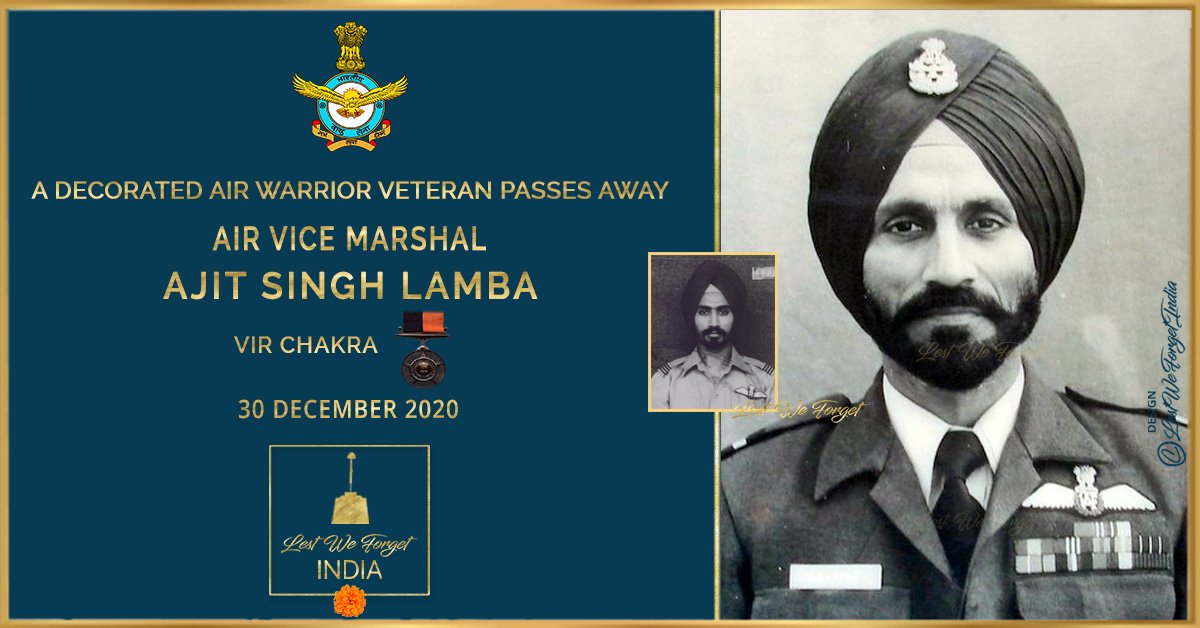
LestWeForgetIndia🇮🇳 on Twitter: "A Legendary & Gallant #IndianBrave AVM  Ajit Singh Lamba, #VirChakra (1965 War) passed away earlier today 30  December 2020 at Bengaluru #LestWeForgetIndia🇮🇳 one of the finest Air  Warrior and

Tribune News Service

Chandigarh, December 30

Air Vice Marshal Ajit Singh Lamba, who was decorated with the Vir Chakra for gallantry in teh1965 Indo-Pak war and an aviator who continued to fly even when he was in his eighties, passed away at Bangalore on Wednesday after battling cancer. He was 85.

Commissioned into the Indian Air Force in April 1955, he served with No.7 Squadron during the 1965 war. As a Hunter pilot, he flew 15 operational sorties, of which 11 were in close support of the army in the Kasur and Lahore sectors. On several of these missions he led formations of Hunter aircraft and showed great skill and determination in seeking out enemy targets and pressing home his attacks in spite of intensive ground fire and the presence of enemy interceptor aircraft, his citation states. In spite of heavy opposition, he successfully destroyed several enemy tanks and vehicles. His achievement in the destruction of enemy guns and armour near Harbanspura railway station was especially noteworthy because of the heavy defences surrounding these locations, the citation adds.

A graduate of the Test Pilot Course at Farnborough in the UK and later the National Defence College, he commanded No.22 Squadron, the Swifts, from July 1972 to January 1975

After two tenures at the Aircraft and Systems Testing Establishment (ASTE), Bangalore as Chief Test Pilot, he was posted as the Air Officer Commanding, 9 Wing at Halwara from January 1981 to January 1984. He served as Commandant ASTE from August 1986 till his retirement in 1991.

Having spent about 60 yeasr in the cockpit, including 36 during his service with the IAF, Lamba had flown over 100 different types of aircraft, logging about 7500 hours. He continued to fly even after retirement and also took part in flying displays during various editions of the Aero India as well as various expeditions.

A Legendary & Gallant #IndianBrave AVM Ajit Singh Lamba, #VirChakra (1965 War) passed away earlier today 30 December 2020 at Bengaluru
#LestWeForgetIndia🇮🇳 one of the finest Air Warrior and Test Pilot of #IndianAirForce, he kept his Flying status active till the very end 🏵

A veteran of #IndoPakWar1965, AVM Lamba was awarded #VirChakra for air combat missions over Pakistan during the war.
As a Test Pilot, his feats including flying over 100 different types of aircraft, including aerobatic displays #AeroIndia from 1996
Blue Skies forever Sir! 🏵

ANOTHER 1965 HERO GONE

AVM AJIT SINGH LAMBA VIR CHAKRA

A Legendary & Gallant #IndianBrave AVM Ajit Singh Lamba, #VirChakra (1965 War) passed away earlier today 30 December 2020 at Bengaluru
#LestWeForgetIndia🇮🇳 one of the finest Air Warrior and Test Pilot of #IndianAirForce, he kept his Flying status active till the very end 🏵

A veteran of #IndoPakWar1965, AVM Lamba was awarded #VirChakra for air combat missions over Pakistan during the war.
As a Test Pilot, his feats including flying over 100 different types of aircraft, including aerobatic displays #AeroIndia from 1996
Blue Skies forever Sir! 🏵


New ITBP pups named after flashpoints along LAC in Ladakh

New ITBP pups named after flashpoints along LAC in Ladakh

The pup-naming ceremony under way at Bhanu near Chandigarh on Wednesday. Tribune photo

Tribune News Service

Chandigarh, December 30

As a token of respect and gratitude to personnel guarding the treacherous border in Ladakh, the Indo-Tibetan Border Police Force (ITBP) has named its newborn pups in its K-9 establishment after sensitive locations and posts along the Line of Actual Control (LAC).

Junking the traditional western names for K-9s, the ITBP has, for the first time in any Central Armed Police Force history, given local names to its K-9 warriors.

Parents veterans of counter-terrorist ops

A “naamkaran ceremony” was held at the ITBP’s National Training Centre for Dogs in Bhanu near Chandigarh where 17 malinois pups were born a couple of months ago to ITBP dogs — Gala, the father, and Olga and Oleshya, the mothers. The parents are veterans of many counter-terrorist operations and other high-profile security duties.

A “naamkaran ceremony” was held at the ITBP’s National Training Centre for Dogs in Bhanu near Chandigarh where 17 malinois pups were born a couple of months ago to ITBP dogs — Gala, the father, and Olga and Oleshya, the mothers. The parents are veterans of many counter-terrorist operations and other high-profile security duties.

The names of the pups are Ane-la, Galwan, Sasoma, Chip-chap, Saser, Srijap, Charding, Rezang, Daulat, Sultan-chusku, Imis, Rango, Yula, Mukhpri, Chung-Thung, Khardungi and Shyok.

“By giving these K-9 Indian names, that too from the areas guarded by the force, it is for the first time since Independence that the K-9 wing of the country will acknowledge its own legacy and ethos,” an ITBP officer said.

The force is planning to name the next batch of pups after other prominent names of the icy frontiers where the ITBP is deployed, covering the entire 3,488-km-long border with China from Karakoram to Jechap La.

The ITBP has also received requests from other Central Armed Police Forces (CAPFs) for these pups to be used for their security duties.

The ITBP was the first force to deploy malinois dogs in left-wing extremism-hit areas a decade ago, and now it has also started scientifically breeding K9s to meet its own demands and also provide pups to other CAPFs and state police forces as mandated by the Ministry of Home Affairs.

The 90,000-strong ITBP was raised in 1962 in the aftermath of the Chinese aggression and apart from its primary duty to guard the China border, it is also tasked with carrying out various internal security duties, including anti-Naxal operations.


3 militants killed in J&K encounter Families contest cops’ claim, say 2 of them were students

3 militants killed in J&K encounter

A security official takes position during encounter in Srinagar. PTI

Srinagar, December 30

The police today claimed to have killed three militants in an overnight encounter in the city’s Parimpora area, but families of the slain youths claimed they had no connection with militancy and that two of them were students.

The families from south Kashmir’s Pulwama and Shopian districts staged a protest outside the police control room. They claimed those killed included a Class XI student, a university student and a carpenter.

A police spokesman said while one militant was killed in the early hours on Wednesday, two others were shot dead a few hours later. The militants opened fire on security forces during a cordon and search operation on Tuesday evening, he said.

The cordon was strengthened and there was an exchange of fire between the two sides. Firing went on throughout the night intermittently, the spokesman said.

The police have yet not disclosed the identity or age of the slain youths, but the protesting families claimed the youths were their kin and had no connection with militants or militancy.

The slain youths were Athar Mushtaq and Aijaz Maqbool, both students, and Zubair Ahmad, a carpenter, said the families, but did not disclose how old they were.

“My brother left for university at 11 am yesterday (Tuesday) as he had to fill some form there. He called me at 3.01 pm to say that he might have to stay at the university. Today, we got a call that he has been killed. He was not a militant,” Maqbool’s sister told reporters.

Maqbool is the son of a policeman posted in Ganderbal district, she said.

A relative of Mushtaq also made a similar claim and said he was just a teenager studying in Class XI.

Police officials did not respond to queries about the claims made by the families. However, an Army official said the slain youths were “hardcore terrorists” who used a lot of ammunition and grenades against the security forces during the encounter.

“We made several appeals to the youths to surrender. One of them was about to leave the building, but his colleagues fired and hurled grenades at security forces and pulled him back yesterday. In the morning, we again made appeals to them to surrender but then we realised that they were not going to surrender,” the official said.

“The quantity of ammunition they used makes it clear they were planning to carry out a major terror strike in the area,” the Army official added. — PTI


Undeterred by bitter cold, more leave for Delhi

Undeterred by bitter cold, more leave for Delhi

Farmers and their family members on their way to Delhi on a tractor-trailer in Patiala on Wednesday. Photo: Rajesh Sachar

Aman Sood

Tribune News Service

Patiala, December 30

It’s a foggy Wednesday morning and a re-purposed trailer, with almost dozen elderly men sitting cross-legged and singing morning hymns, slowly passes through Patiala. Following it are more such Delhi-bound vehicles, with the agitation flags flying on the front and the rear, and hundreds of young and the old shouting: “Nawa saal, Dilli naal.”

When the elderly people elsewhere are keeping themselves safe from the cold wave, farmers — both, the young and the old — continue to leave Punjab to camp at the Singhu border to welcome the New Year.

Undeterred by the bone-chilling conditions, hundreds of farmers are leaving for Delhi to show solidarity with protesters at the Delhi border. “We are 13 relatives going to back our farmer brothers and celebrate the New Year with them. Our tractor has everything from a makeshift bedroom to a kitchen”, says 21-year old Manpreet Singh of Baran village.

Niranjan Singh of Sanaur has packed a week’s clothing and woollens for his two boys and wife as he is ready to see the first sunrise of 2021 at the Delhi border. “When I was young I celebrated New Year at various places, but this will be special. It will be like a pilgrimage for the entire family,” says the septuagenarian.

Farmers have been protesting at different borders of the national capital since November 26 against the three farm laws. The protests have disrupted normal lives in Delhi-NCR as several borders linking Delhi to cities in Uttar Pradesh and Haryana are closed.

“I went there first on November 30 for three days and had to come back to take care of my ailing mother. As soon as my 83-year old mother got well, she ordered me to go to the border and return only when the agitation is over”, says Rajpura farmer Jasbir Singh. “If our mothers can be brave enough, there is no power that can stop us. I am going with four of my friends and we will do whatever work the farmers offer us. It will be our small contribution to this huge agitation,” he says.

The farmers insist they won’t settle for anything less than the withdrawal of the laws. “Amid thousands of protestors are a number of non-Sikh, non-Punjabi demonstrators from neighbouring Haryana, Uttar Pradesh, Madhya Pradesh, Kerela and Maharashtra. The protest in itself has proved that we are all brothers divided by petty politics. Farmers from Bihar will soon join and this would be one of the biggest peaceful protests witnessed ever in the country. And we are ready”, says Amarjang Singh, who is willing to spend his entire next week at the Delhi border.

“After every 10 days, we return home and then again leave for Singhu. It is more of a festival for us where minds across the country discuss nothing but farming,” he says.


Farmers plough back govt fund for protests in Capital Had received Rs2,000 each under PM-Kisan Samman Nidhi Scheme last week

Farmers plough back govt fund for protests in Capital

Langar being served at the Singhu border. Tribune photo

Ravi Dhaliwal

Tribune News Service

Gurdaspur, December 30

Last week, when Prime Minister Narendra Modi transferred the first tranche of funds under the PM-Kisan Yojana directly to farmers’ accounts, little did he know that these very funds would be ploughed back to sustain the protests being held on the outskirts of New Delhi.

On December 24, Rs 2000 each was directly credited to the accounts of 9 crore farmers. This was the first part of the Rs 6,000 annual package to be given to farmers under the Union Government’s mega-outreach plan.

Don’t help, repeal laws

Earlier, whenever villagers would receive the PM-Kisan scheme grant, they would feel happy. Now they are livid. They do not need this compassion. All they need is repeal of the farm laws. — Sehaj Pal Singh Randhawa, law student

A majority of villagers who received this money were quick to transfer it to the accounts of those protesting along Delhi’s borders.

Satbir Singh Sultani, general secretary, Punjab Kirti Kissan Union, led the way by donating Rs 2,000 to the community kitchen at Singhu. “We have enough funds to sustain ourselves. But then every bit counts.”

Sultani said he had received reports that hundreds of villagers were donating money received under the Central Government scheme to ensure ration at the kitchens did not run out.

Septuagenarian Hardyal Singh of Dorangla village, located near the international border, said he had transferred the money to his son’s account who is protesting in New Delhi.

“On the one hand we are fighting a proxy war instigated by Pakistan, but on the other our own PM is waging a bigger war against us. We do not need his money. We have better ways to keep the agitation going,” he said.

Sehaj Pal Singh Randhawa, a law student hailing from Khunda village, near Dhariwal, said he had been part of the Delhi protest for the past 15 days and was amazed at the farmers’ resolve to go in for a protracted battle.

“Never had I seen such determination and fortitude among my farming brethren. Earlier, whenever villagers would receive grants from the PM-Kisan scheme, they would feel happy. Now they are livid. They do not need this compassion. All they need is a total repeal of the farm laws,” he said.


Judiciary is getting ‘executivised’: Justice Madan B Lokur ‘No system for appointment of judges is perfect, including our collegium system

Judiciary is getting ‘executivised’: Justice Madan B Lokur

Justice Madan B Lokur (retd). Tribune file

Justice Madan B Lokur, who retired as a judge of the Supreme Court of India on December 30, 2018, has been one of the most vocal judges in India. Currently, he is serving as a judge of the Supreme Court of Fiji since August 12, 2019. In an interview with The Tribune Legal Editor Satya Prakash, Justice Lokur articulated his views on a host of issues confronting the Indian judiciary. Excerpts:

How do you see the role of the judiciary in India? What would you expect the constitutional courts to do? Have they performed the role you expect them to?

The judiciary is obviously a very important institution in a democracy. I believe the days of an ivory tower judiciary are now over. The judiciary must appreciate this and be proactive in taking forward the constitutional vision of justice – social, economic and political. I expect every judge, not only constitutional courts, to be proactive, without fear or favour, affection or ill will. By and large the judges have performed their role as expected, but I think some of them have been a bit tentative over the last few years.

In the recent past, you have been critical of the judiciary in general and the Supreme Court in particular. Why? Please elaborate.

I am sorry that by expressing my views, I seem to have conveyed this impression. I have and will continue to have great regard and respect for an independent judiciary. Certain events have transpired over the last few years that have dismayed me. For example, some of us felt that the then Chief Justice of India (CJI) was misusing his authority as Master of the Roster despite being cautioned. Four senior judges of the Supreme Court (including myself) spoke out against it. Matters did improve, but only temporarily. The next CJI went a few steps further down the slope in an unbelievable manner when he dealt with allegations of sexual harassment against himself.

Many (including myself) spoke out against what had happened. The Supreme Court then declined to give appropriate importance to some cases, such as those concerning electoral bonds, Citizenship (Amendment) Act, habeas corpus petitions, cases of alleged violations of fundamental rights and liberties such as free speech and freedom of the Press and so on, including the terrible hardships faced by migrants as a result of the lockdown.

A few months ago, about 20 senior lawyers of the Supreme Court addressed a letter to the CJI and all other judges articulating the Supreme Court’s “failure to protect the rights of the hapless millions of migrant workers in March and its failure to scrutinize the executive actions …. that severely and excessively impaired the fundamental rights of the poorest sections of our citizens”.

Even today, some lawyers are expressing their distress and dismay at some other developments.

The problem is that the High Courts and District Courts then begin to think that if the Supreme Court adopts a particular attitude or takes a particular stance, why should we take a different line. So, the judicial process down the line gets vitiated. That is troubling and in the overall context, it engenders the feeling that the Supreme Court and the judiciary is getting executivised.

There were questions raised over the manner in which the Supreme Court handled the situation arising out of the COVID-19 pandemic and the subsequent lockdown during which thousands of migrant workers were seen walking back home on foot? Did it fail in its constitutional duty of protecting citizens’ right to life enshrined under Article 21 of the Constitution?

The letter sent by the Supreme Court lawyers says it all.

The Legislature and the Executive often accuse constitutional courts of judicial overreach while activists feel the judiciary is not active enough to keep the other two organs of the State under check. What do you think?

It’s a mixture of both. Judicial overreach is when the Judiciary passes orders in areas which are beyond its jurisdiction. Legislative overreach is when the Legislature passes laws that are outside its jurisdiction. These laws are then declared unconstitutional by the judiciary, which is then accused of overreach. Executive overreach is when the Executive passes orders or gives directions that are beyond its jurisdiction. These are then struck down by the judiciary. This is a constitutional obligation of the judiciary and cannot be characterised as judicial overreach.

There have been instances when the Speaker of the House has not taken action under the anti-defection law for months or when there is what the Supreme Court described as horse trading of MLAs. In such situations, when a citizen approaches the Court, there are two options before the Court — one is to tell the litigant that it’s for the Legislature and the MLAs to sort out their problems. The other is to intervene in accordance with the Constitution and pass appropriate orders. If the Court keeps a hands-off attitude, it is accused of not being active enough. If the Court intervenes, it is accused of judicial overreach. This is an unfortunate dilemma.

Yet another problem is when the Legislature or the Executive is inactive. Why is it that no law was provided to protect women from sexual harassment at the workplace? Due to the silence of the Legislature, the Supreme Court was compelled to issue the Vishaka guidelines in 1998. Was it a case of judicial overreach? If yes, what was the alternative – to let women continue getting sexually harassed?

Even thereafter, the Legislature was silent for almost 15 years and ultimately enacted a law in 2013. Similarly, existing laws for the protection of children are not being faithfully implemented by the Executive. If the Supreme Court passes orders for the effective implementation of these laws, is that judicial overreach? In such situations, citizens and the Courts ask the question – to act or not to act. My view is that the Courts must act – the Constitution of India mandates it.

How do you see the relationship between the Government and the judiciary today?

If you read the full text of the letter sent by the Supreme Court lawyers, you will get the answer to your question.

More than five years have passed since the Supreme Court declared NJAC as unconstitutional. The Collegium system is under attack for being opaque and ignoring talent in elevation to the Bench. What kind of changes would you suggest in the judicial appointment system?

Recently, I participated in a webinar on judicial integrity and the appointment of judges came up for consideration. A judge from a court in Europe said that in Europe there were 50 different ways in which judges are appointed. Another European judge on the panel did not contradict him. So, there are ways and ways in which judges can be selected for appointment. No system is perfect, including our collegium system. At one time, I suggested five different changes in the functioning of the collegium to reduce opacity. These were immediately accepted by the CJI and other judges in the collegium.

Later, I gave another set of suggested changes to the concerned Registrar in the Supreme Court. I believe he handed over the suggestions to the CJI or brought them to his notice but they were not discussed. Changes are needed and should be made. Pinpointing them will need a separate discussion altogether. Yes, some outstanding lawyers have been side-lined for appointment and some outstanding judges have not been fairly treated.

In the recent past, the Supreme Court has initiated contempt proceedings against several persons, including advocate Prashant Bhushan and comedian Kunal Kamra. Do you think the Supreme Court is becoming averse to criticism or it’s being unfairly targeted by certain people? Should India do away with criminal contempt of court, particularly scandalising the court as defined under Section 2 © (i) of the Contempt of Courts Act, 1971?

I think the Supreme Court is being unnecessarily defensive. It has been criticised by senior politicians who have pejoratively used expressions like judicial activism and judicial overreach. The Supreme Court has not reacted to this criticism. Why take action against non-political individuals? It is not possible for every criticism to be fair, not is it possible for every judgment to be right. Listen, correct (if necessary) and move on.

A former Law Minister used rather intemperate language about the Supreme Court to the effect that “Antisocial elements i.e., FERA violators, bride burners and a whole horde of reactionaries have found their heaven in the Supreme Court.” The Supreme Court said that if it is true, it is a criticism of the laws. “If antisocial elements and criminals have benefited by decisions of the Supreme Court, the fault rests with the laws and the loopholes in the legislation. The Courts are not deterred by such criticisms.”

You were a part of the group of four senior-most judges who held a press-conference in January 2018 on the issue of the master of roster controversy. Do you think the system needs to be streamlined? How can it be fixed?

The Chief Justice of a High Court is also the Master of the Roster, but I have seldom heard of any misuse of power by any of them. Recently, Justice Rajinder Sachar of the Delhi High Court did mention, in his worth reading autobiography, of one case of such misuse by the Chief Justice in a case pertaining to the 1984 riots/pogrom in Delhi. He protested against it by going on leave. There might possibly be other stray instances, but nothing systematic, as far as I know. Obviously, these stray instances would have been sorted out one way or the other, with or without protest.

However, if the Chief Justice misuses the system and is adamant, unyielding and not willing to listen to reason, despite being advised by four senior judges, he or she is inviting a protest in some form or the other. Most judges in the Supreme Court have been Chief Justices in one or more High Court. The CJI can always consult them and streamline the system.

Pandemic has forced courts to function virtually and made it heavily dependent on information technology. What are the pros and cons of this switch over to technology? Has it affected the quality of justice delivery?

There are several pros and cons in embracing information and communication technology in justice delivery. I am certain that without the use of technology our justice delivery system will collapse. But there is a need to brainstorm so that communication is secure, robust and effective and lawyers don’t attend court in a vest. Under no circumstances should the use of technology leave out the poor and indigent litigant or those having little or no access to ICT – that would be disastrous. As yet, there is no study or evidence to suggest that online justice delivery has affected the “quality of justice”. It’s a little premature to comment.

Over the years, the pendency of cases has been one of the biggest problems faced by the judiciary? How can it be tackled? What ails the Indian judiciary?

These two questions require a long and detailed discussion. But let me quote Lord Devlin: “If our business methods were as antiquated as our legal system, we would have become a bankrupt nation long back.” He added, with reference to some deficiencies, that they are indeed “a subtle threat to the independence of the judicial system.” Reforms are certainly needed and they are needed now. Let us start with case management and process re engineering.



Agreement on 2 points, next talks on January 4 Penal provision for farm fires to go | No headway on repeal of laws, MSP | Unions defer tractor march

Agreement on 2 points, next talks on January 4

Leaders of various farmer unions at Vigyan Bhawan after the meeting. Tribune photo: Manas Ranjan Bhui

Tribune News Service

New Delhi/Chandigarh, December 30

The government and protesting farm unions reached some common ground today to resolve farmers’ concerns over rise in power tariff and penalties for stubble burning, but the two sides remained deadlocked over the main contentious issues of the repeal of three farm laws and a legal guarantee for MSP.

After nearly five hours of negotiations between three Union ministers and a 41-member group representing thousands of farmers protesting on Delhi borders, Agriculture Minister Narendra Singh Tomar said resolution had been reached on two of the four points on agenda.

Speaking to the media outside Vigyan Bhawan, Tomar said discussions would recommence on the remaining two points on January 4 at 2 pm. The concerns of the farmers on the draft Electricity (Amendment) Bill and the Air Quality Management Ordinance (containing penal provisions for stubble burning) had been addressed, he said.

Tomar lauded the farm leaders for maintaining peace and discipline during their protest, but urged them to send the elderly, women and the children back home due to the extreme weather. He said the union leaders insisted on repealing the laws, but the government side tried to explain to them the benefits of the Acts and sought to know the specific points they feared. On legal guarantee for MSP (minimum support price), the minister said the government had already declared that it was ready to give a written assurance. Tomar was accompanied by Railways Minister Piyush Goyal and Minister of State for Commerce Som Parkash.

Farm union leaders Balbir Singh Rajewal, Ruldu Singh and Gurnam Singh Charuni said after the meeting that they had decided to defer tomorrow’s tractor march from Singhu to Tikri via the Kundli-Manesar-Palwal Expressway. The farm leaders, however, said they had made it clear to the government that decision on repealing the laws would be key to ending the impasse.

While the three ministers joined the farm leaders to share their ‘langar’ during the lunch break, the union representatives accepted the beverage offered by the government during the evening tea break. In the last five meetings, farmer leaders had refused to accept even water offered by the government.


China deployed heavily at LAC but we stopped them in their tracks — IAF chief Bhadauria

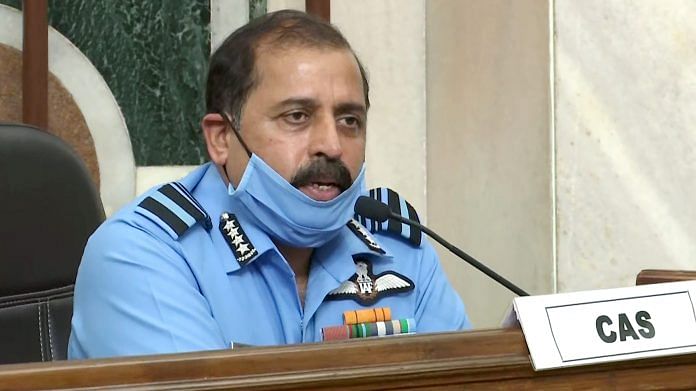
Chief of Air Staff Air Chief Marshal Rakesh Kumar Singh Bhadauria briefs media, in New Delhi on Friday | ANIPix

ile image of Chief of Air Staff Air Chief Marshal Rakesh Kumar Singh Bhadauria | ANIPix

New Delhi: The most important national security challenge facing India is understanding China’s intention in Ladakh and its “deepening and evolving” relationship with Pakistan, Indian Air Force (IAF) chief Air Chief Marshal R.K.S. Bhadauria said Tuesday.

Speaking at a seminar organised by the Delhi-based think tank Vivekananda International Foundation, the IAF chief also stated that the Chinese have deployed heavily in Eastern Ladakh, but the counter-actions taken by the Indian armed forces have ensured that the People’s Liberation Army (PLA) have “stopped in their tracks and they continue to remain there”.

Discussing the ongoing border standoff between India and China in Ladakh, he questioned if the Chinese aggression in the area is simply military signaling, or dominance efforts focussed in the region with adequate escalation control.

“What could be possible Chinese objectives for their action in the North (Ladakh)? It is important that we recognise what they have really achieved,” he said.

“Was it deployment and training of the western defence forces (Western Theatre Command) in real war-like scenarios where the Galwan incident was an overreach? Or was it fine-tuning and enhancing their military technology and recognise and fill their gaps to get their forces to synergise in new structures and new technology and whatever they have introduced?” he added. “Was it a planned escalation to start border talks from new positions… In any case, what has actually happened is all of the above.”

Everyone is aware, he said, that China’s main aspirations are clearly on the global front and regional domination is part of the route to global leadership that they aspire for. However, he added that any “serious India-China conflict isn’t good for China at the global front”.

“If Chinese aspirations are global, then it doesn’t suit their grand plan,” he said, lamenting the fact that the rule-based international order is being challenged, and that “a policy of contestation” is being given preference over traditional tenets of cooperation and collaboration by some countries.


Also read: China appoints new military commander for India border, but no change expected in stand-off


‘Pakistan a pawn in Chinese policy’

“Evolving uncertainties and instability” have provided China with an opportunity to demonstrate its growing power, and also indirectly brought to the fore the inadequate contribution of major powers to global security, Bhadauria said.

He added that Pakistan has increasingly become a pawn in Chinese policy, and noted that the US’ exit from Afghanistan has opened up increased options for China in central Asia, both direct and through Pakistan.

He said the Chinese aggression in Ladakh could also be a totally military-dominated misadventure that escalated amid a rapid decrease in trust in the post-Covid world.

“But the important issue is that we recognise what they have really achieved and whatever 4-5 points I mentioned have been auctioned in the real sense,” he said.

Asked what is the lesson learnt by India in terms of PLA force mobilisation and air asset deployment around the Line of Actual Control (LAC), he said they have deployed heavily in support of the army.

“They have deployed fully and have a large presence in the second tier and a large presence of radars and surface-to-air missiles and surface-to-surface missiles in the reckonable area,” he added. “So their deployment has been very strong.”


Also read: India has forced a stalemate in Ladakh. That’s a defeat for China


Govt approves export of indigenous Akash missiles as UAE, Vietnam among others show interest

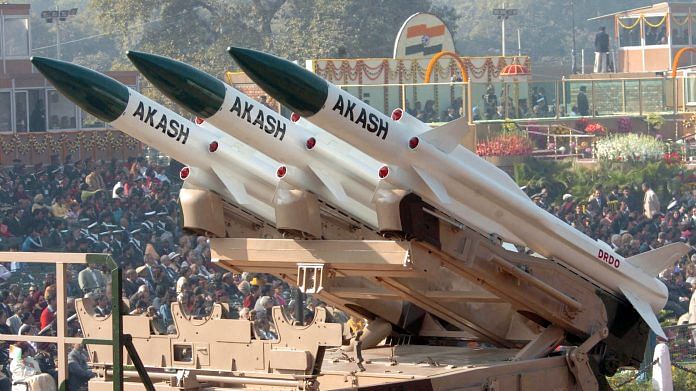
File photo of Akash super sonic cruise missile with a range of 25km. | Commons

file photo of Akash super sonic cruise missile with a range of 25km. | Commons

New Delhi: The Narendra Modi government Wednesday approved export of the indigenously manufactured Akash surface-to-air missile system.

The decision was taken at a meeting of the Cabinet Committee on Security headed by Prime Minister Modi.

The government has also created a high-ranking committee comprising the defence minister, the external affairs minister and the national security advisor for faster export approvals.

Sources in the defence and security establishment told ThePrint that at least a dozen foreign countries, including the UAE, Vietnam and Philippines, have shown interest in acquiring the Akash system.

“After its induction in the Services, interest is shown in Akash missile by many friendly countries during International Exhibitions/Def Expo/Aero India. The Cabinet approval will facilitate Indian manufactures to participate in Request for Information/Request for Proposal issued by various countries,” a statement by the defence ministry noted.

“This Committee would authorise subsequent exports of major indigenous platforms to various countries. The Committee would also explore various available options including the Government-to-Government route,” the statement added.

It also noted that the export version of Akash will be different from the system currently deployed with the Indian armed forces.


Also read: Missiles, drones, defence shield — India has a series of military trials planned for 2021

 at least a dozen countries interested in Akash

With a range of 25 km, the Akash missile was inducted in the Indian Air Force in 2014 and in the Indian Army the following year. About 96 per cent of the system is indigenously manufactured.

The system can simultaneously engage multiple targets in Group Mode or Autonomous Mode. It has built in Electronic Counter-Counter Measures (ECCM) features and the entire weapon system has been configured on mobile platforms.

Besides Akash, there is also interest in other major platforms like coastal surveillance systems, radars and air platforms.

Defence Minister Rajnath Singh said the Cabinet’s decision will help improve defence products in the country.

“So far, Indian defence exports included parts/components etc. The export of big platforms was minimal. This decision by the Cabinet would help the country to improve its defence products and make them globally competitive,” Singh tweeted Wednesday.

He added that the government intends to focus on exporting high-value defence platforms, to achieve the target of $5 billion defence exports and improving strategic relations with friendly foreign countries.

According to sources, the Akash missile system will be the first weapons platform to be exported from India. The country has previously built fast patrol vessels and helicopters for foreign countries besides radar and ammunition.

The missile is manufactured by Bharat Dynamics (BDL) while Bharat Electronics Limited produces its phased array radar.


Also read: India, Vietnam to conduct 2-day naval exercise in South China Sea