Sanjha Morcha

What’s New

Click the heading to open detailed news

Current Events :

web counter

Print Media Reproduced Defence Related News

Army’s revised SOP leads to surrenders of terrorists in Valley Four units of receive Rashtriya Rifles awarded COAS commendation on Army Day

300-400 Pak-trained terrorists ready to infiltrate into J&K: Army chief

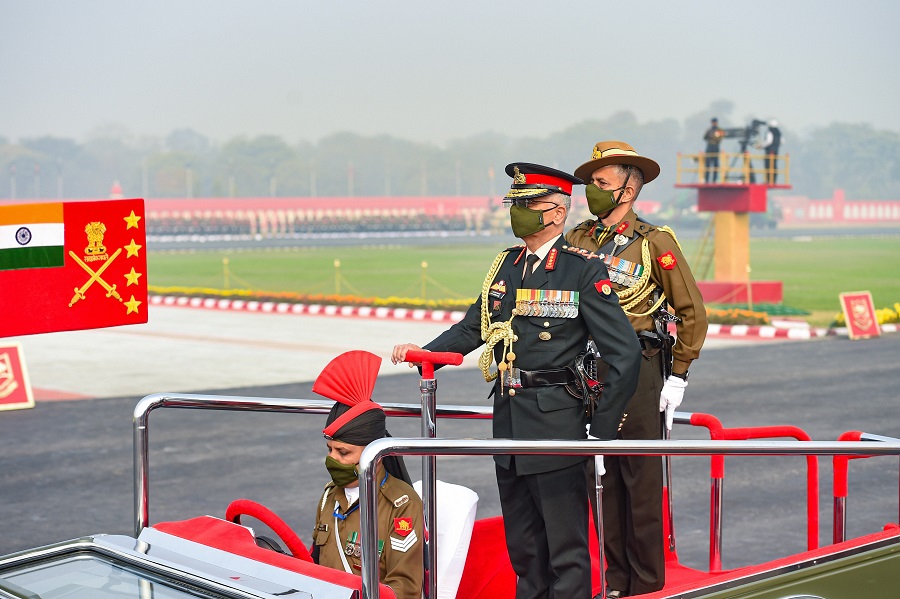
Chief of Army Staff Gen Manoj Mukund Naravane inspects the guard of honour during the 73rd Army Day Parade, at Parade Ground in New Delhi on Friday. PTI

New Delhi, January 15

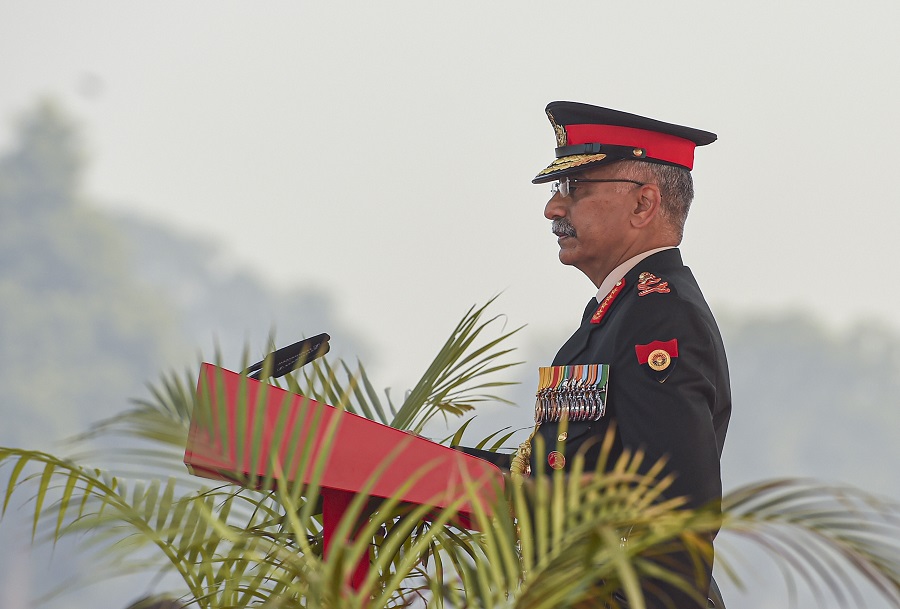
Around 300-400 terrorists trained in camps across the Line of Control (LoC) are ready to sneak into Jammu and Kashmir, Army Chief General MM Naravane said on Friday.
Army's revised SOP leads to surrenders of terrorists in Valley

In his speech during the Army Day Parade, he also said that there had been 44 per cent increase in ceasefire violations, which reflects Pakistan’s sinister design.

Pakistan often provides cover fire to help terrorists sneak into Jammu and Kashmir.

General Naravane said India’s active operations and strong counter-infiltration grid not only inflicted heavy losses on the enemy but they contained infiltration attempts as well.

He said the Army killed over 200 terrorists in counter-terror operations and on the LoC last year, adding these measures have provided people of Jammu and Kashmir relief from terrorism.

“Strong response is being given to the enemy on the other border. Pakistan continues to provide safe haven to terrorists. In the training camps, across the LoC around 300-400 terrorists are ready to infiltrate,” he said.

“There was an increase of 44 per cent in the ceasefire violations last year which is proof of Pakistan’s sinister plans. There were also attempts to smuggle weapons using drones,” he added.

There were efforts to smuggle weapons into India from across the border using drones and tunnels, he mentioned.

General Naravane said the Indian Army was working towards reorganisation and modernisation in order to increase its war fighting capability.

Awantipora, January 15

The Indian Army has changed its standard operating procedure (SOP) for anti-terror operations in Jammu and Kashmir to now focus on ensuring surrenders during live encounters notwithstanding the threat to the lives of its personnel – a policy that has helped save the lives of 17 youths in the last six months.

On the occasion of Army Day on Friday, four Rashtriya Rifles (RR) units working under the Victor Force, which combats terrorist activities in south Kashmir and parts of central Kashmir, were awarded the coveted Chief of Army Staff (COAS) Unit Citation.

The units – 50 RR, 44 RR, 42 RR and 34 RR – have been involved in multiple counter-terrorism operations and have ensured seven surrenders since September last year when it was decided to make efforts to bring the misguided youths back to the mainstream.

The citations to the four units drawn from Kumaon, Rajput, Assam and Jat regiments of the Army were presented by Chief of Army Staff Gen MM Naravane in the national capital.

Videos of some of the surrenders, accessed by PTI, show that in spite of grave risks, the Army brought parents of the terrorists to the encounter site and convinced them to drop arms.

In one of the videos, a terrorist, Zahid, has an emotional reunion with his father, who is seen weeping and telling his son that it is a rebirth.

General Officer Commanding of the Victor Force Major General Rashim Bali, who has been supervising surrenders during live encounters, feels that this has generated tremendous goodwill among the local population.

This has given a reassurance to the local terrorists that the avenue of their return to the national mainstream is open. “For those who want to join the national mainstream, we are committed to accept surrenders, even by putting our lives at great peril,” he said.

At the same time, Major General Bali made it clear that relentless operations will continue against those who pick up guns and resort to violence.

In some of the videos, surrendered terrorists could be seen praising the Army for providing them an opportunity to shun the path of violence.

The new strategy of the Army came into effect last year when Shoiab Ahmed Bhat of the Al Badr terror group expressed his desire to lay down arms during an ongoing encounter.

He was part of the group which had killed a jawan of the Territorial Army in south Kashmir’s Shopian district, but this did not deter the Army personnel in ensuring his surrender and handing him over to police after questioning. PTI
Chandigarh couple camps at Singhu with infant Firm on staying put till laws are repealed

Chandigarh couple camps at Singhu with infant

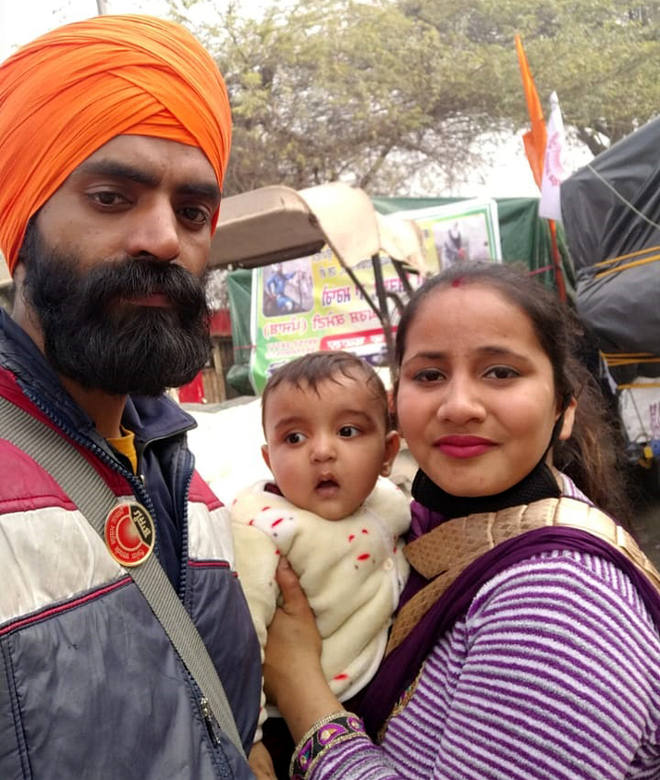
Gurpreet Singh and Gurpreet Kaur with their eight-month-old son at Singhu. Tribune photo

Archit Watts

Tribune News Service

Muktsar, January 15

Gurpreet Singh (28) and Gurpreet Kaur (22), residents of Sector 47, Chandigarh, are camping with their eight-month-old son Ashmeet Singh at the Singhu border for over a month now.

They had reached Singhu border on December 13 by boarding a tractor-trailer from Rajpura town in Patiala district. Speaking over the phone, cab driver and theatre artist Gurpreet Singh said, “Saade kol zameen nahi, par zameer hai (We don’t own land, but we have conscience). We are followers of Guru Gobind Singh. We have come here to create history. Initially, my wife and some relatives had some fear in their minds, but now, they are proud of my decision. We have celebrated my son’s first Lohri here and my birthday as well. Initially, we stayed in a trailer, but later got a waterproof tent. We clean other tents here as sewa.”

He added, “My mother is 76 years old and a widow. She is staying alone in Chandigarh. Though some neighbours daily tell her to call us back home due to the prevailing cold weather, she says we should come back only after the black laws are repealed.”

About his earnings, Gurpreet said, “I used to drive a cab and earn Rs 20,000 a month. I am not working presently, but I think that if the farmers won’t be able to survive, how will we survive? This is the protest for everyone’s survival.”

His wife Gurpreet Kaur said, “We are here to show Prime Minister Narendra Modi that we are Punjabis and know very well how to fight for our rights and win.”

Meanwhile, some people are giving them ‘shagun’ to keep their spirits up. “The protest has created history as from 95-year-olds to eight-month-old kids are present here for the past two months. I go to meet Ashmeet daily to know about his well-being, which infuses a positive energy in me,” said Ravneet Brar, spokesperson, Bhartiya Kisan Union (Kadian).


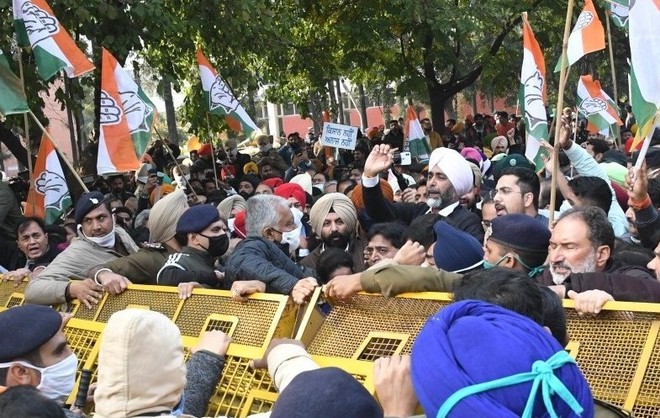
March to Raj Bhawan foiled, Cong protests at party office

March to Raj Bhawan foiled, Cong protests at party office

Congress leaders stopped by the police at a barricade during a march in Chandigarh. Photo: Vicky

Tribune News Service

Chandigarh, January 15

Led by Punjab Pradesh Congress Committee president Sunil Jakhar and joined by several ministers and legislators, a large number of Congress workers today set out on a protest march from the Congress Bhawan here to Punjab Raj Bhawan, demanding the repeal of farm laws. However, they were immediately stopped by the cops from marching towards Raj Bhawan, forcing the party leaders to stage a dharna near the Congress Bhawan.

Addressing the protesters, Jakhar said the central government was behaving in an arrogant manner and did not have any respect for democratic practices and public opinion. “It is the arrogance of the central government that is preventing it from repealing the laws which have been outrightly rejected by the farming community across the country,” Jakhar said, while warning against the prolonged stalemate on the issue.

He said it was after a long struggle by the Congress that constitutional institutions had been set up and strengthened, and now the BJP was trying to undermine all such institutions as it had hardly any value or respect for them. “Arrogance of the central government was not only challenging but undermining the democratic and constitutional institutions of the country,” he said.

Paying glowing tributes to the farmers who laid down their lives during the ongoing protests, party leaders said they were the martyrs of the movement and held the Modi government responsible for their martyrdom.

“The way the central government was responsible for pushing our soldiers into the death trap in Galwan heights by the lack of will and planning, in a similar way the government is accountable for pushing our farmers to death,” he said.

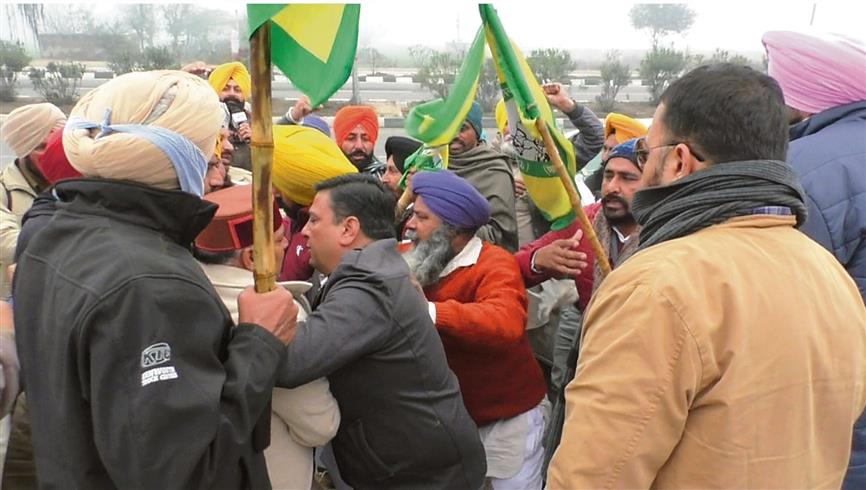
BJP leaders gheraoed for 3 hrs

Won’t let them hold any meet: Farmers

BJP leaders gheraoed for 3 hrs

Farmers heckle BJP leaders in Bhawanigarh town of Sangrur on Friday. Tribune photo

Sangrur, January 15

Farmers today allegedly gheraoed senior BJP leaders for around three hours at Aggarwal Bhawan in Bhawanigarh town of the district. While BJP leaders said they had gone to meet an ailing party member, the farmers alleged they were there for a meeting in support of the farm laws.

“BJP leaders have been trying to create law and order problems in Punjab by organising meetings despite being fully aware farmers would not allow them to hold such events. We gheraoed them for three hours,” said Harjeet Singh, a BKU (Ugrahan) leader.

The BKU leaders were holding a meeting at the Kalajhar toll plaza when they learnt BJP’s state general secretary (organisation) Dinesh Kumar along with district president Randeep Deol, district general secretary Deepak Jain and party state executive member Sunil Goyal had reached Bhawanigarh for a meeting. The farmers halted their meeting and rushed to the BJP venue in Bhawanigarh.

As the police reached the spot, the BJP leaders tried to leave, but the farmers gheraoed them, forcing them to return to the building.

“Farmers are sitting on the Delhi border and if BJP leaders want to meet them, they can talk to them there. However, they are coming to Punjab to create trouble. We let them go after they apologised,” claimed Harjinder Singh, a BKU leader. Deol, however, denied having apologised to farmers. — TNS


Chargesheet filed against Saini, Umranangal in police firing case Claims they were part of conspiracy to shoot protesters at Behbal Kalan

Chargesheet filed against Saini, Umranangal in police firing case

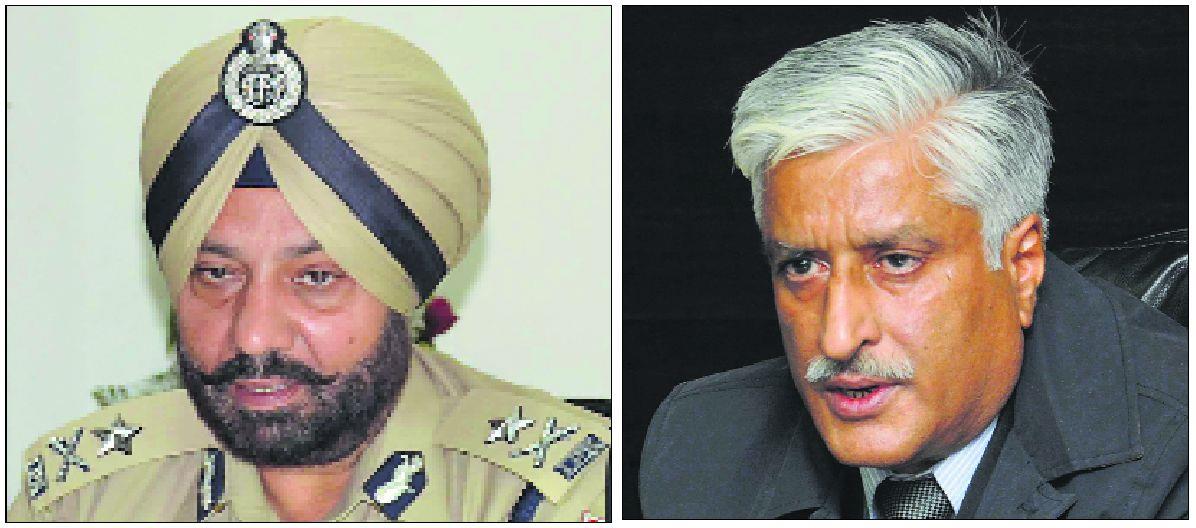
Paramraj Singh Umranangal and Sumedh Singh Saini

Tribune News Service

Faridkot, January 15

A Punjab Police special investigation team (SIT) probing the 2015 police firing incidents today filed a chargesheet against former DGP Sumedh Singh Saini and IGP Paramraj Singh Umranangal in connection with the Behbal Kalan firing incident in which two protesters were killed on October 14, 2015.

While many other accused, including former SSP Charanjit Singh Sharma and two SP-rank police officers, have already been chargesheeted by the SIT, the supplementary chargesheet against the former DGP and IGP has been filed in the court of the JMIC, Faridkot, today. The court has summoned both accused police officers on February 9.

The SIT had nominated Saini and Umranangal as accused in the case of murder and attempt to murder of Behbal Kalan in September 2020. In the chargesheet, the SIT claimed both police officers had been found guilty in the case on the basis of documentary evidence and the statements of witnesses. A week after the killing of two Sikh protesters in police firing at Behbal Kalan on October 14, 2015, an FIR was registered on October 21, 2015, at the Bajakhana police station under Sections 302, 307 and 34 of the IPC and Sections 25, 27, 54 and 59 of the Arms Act. The complainant in the FIR was Iqbal Singh Sahota, director, bureau of investigation-cum-chairman, SIT, which was constituted on the directions of the Punjab DGP.

Earlier, no police officer was nominated as an accused in the FIR but later, the SIT had nominated many police officers as accused in the case.

In the supplementary chargesheet, the SIT has relied upon 22 phone calls, allegedly made between the then DGP Sumedh Singh Saini and IGP Paramraj Singh Umranangal, to buttress its claim that the former DGP was a part of the conspiracy of “unprovoked” firing on protesters.

The firing on the protesters at both places was a part of an already hatched conspiracy. The accused police officers did not procure necessary permission from the duty magistrate or SDM before resorting to unprovoked firing on the protesters, the chargesheet alleged.

The SIT claimed that its investigation had found that Umranangal was in constant touch with Saini and after getting directions from him, he told then SSP Charanjit Singh Sharma and others to use force on the protesters.


Misconceptions being spread about January 26 tractor march, says Samyukta Kisan Morcha Morcha leaders condemn inflammatory statements by ‘Sikhs for Justice’

Misconceptions being spread about January 26 tractor march, says Samyukta Kisan Morcha

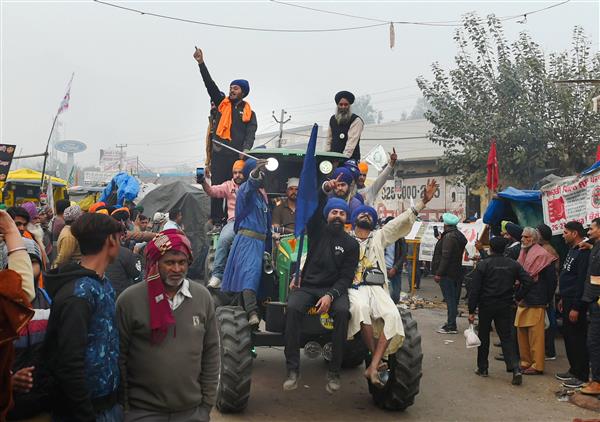
Nihangs ride a tractor during farmers ongoing agitation over the new farm laws, at Singhu border in New Delhi on Friday. PTI file photo

Vibha Sharma
Tribune News Service
New Delhi, January 15

The Samyukta Kisan Morcha said on Friday that “misconceptions” are being spread about the proposed tractor march on January 26 and that their “motive is not to harm the Republic Day parade”.

“We are making it clear that we have no motive to harm the parade of the Government of India by this parade of farmers.  The detailed plan for this parade will be delivered only after a meeting of farmers’ organisations on January 17 and the hearing of the Supreme Court on January 18,” Dr Dashan Pal said.

Balbir Singh Rajewal also urged everyone to maintain peace and harmony and not pay heed to “false and unfounded inflammatory propaganda and rumour-mongering” like “unfurling the national flag at the Red Fort etc”.

“Misconceptions/false inflammatory propaganda is being spread about the January 26 movement. Some people are saying that the national flag should be hoisted at the Red Fort, some are saying the Parliament will be stormed,” Rajewal said, accusing “anti-farmer forces and government agencies” of trying to malign and scuttle the peaceful agitation of farmers and common people.

Morcha leaders also condemned inflammatory statements by an organizstion called ‘Sikhs for Justice’

“We urge farmers to be aware of such organisations which are breaking the unity among us,” they said.

Though Samyukta Kisan Motcha leaders said they are yet to finalise the contours of January 26 tractor march, BKU leader from Uttar Pradesh, Rakesh Tikait, has already announced programme for the day. He said on Thursday that farmers will hold a simultaneous parade from Red Fort to India Gate on Republic Day.

“The Republic Day Parade has been cut short, it will now be from Rastrapati Bhawan to India Gate, I am told. Farmers will march from Red Fort to India Gate and meet the Republic Day parade there. Jawans marching from one side and kisans from the other and meeting at the Amar Jawan Jyoti (at India Gate), It will be a historic moment,” Tikait said.


Led by Rahul, Priyanka, Cong workers gherao Raj Niwas Party holds nationwide protest against central farm laws

Led by Rahul, Priyanka, Cong workers gherao Raj Niwas

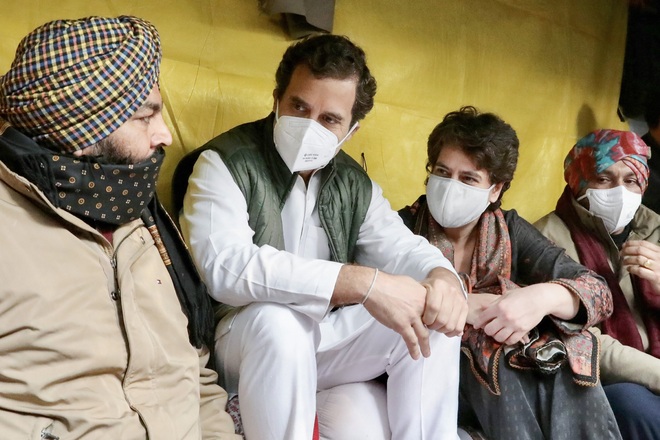
ahul Gandhi and Priyanka Gandhi with protesting Congress leaders from Punjab at Jantar Mantar in New Delhi on Friday. PTI

Tribune News Service

New Delhi, January 15

Congress leaders Rahul Gandhi and Priyanka Gandhi Vadra on Friday led protests outside the Delhi Raj Niwas in solidarity with the agitating farmers and demanded repeal of farm laws.

As the Congress marked ‘Kisan Adhikar Divas’ by gheraoing Governor houses across India, several of party leaders offered arrests, including in Delhi where Congress leaders from Punjab were detained and kept at the Mandir Marg police station for long hours.

Congress MPs from Punjab Ravneet Singh Bittu, Gurjeet Aujla, JS Gill and MLA Kubir Jira were among those detained from Jantar Mantar, where they have been sitting in solidarity with the farmers for 41 days.

Govt helping corporates

The Central farm laws have been drafted to aid corporates like Ambani and Adani. The government had earlier attempted to usurp farm land by bringing in the new land acquisition Act. The Congress foiled that attempt. —Rahul Gandhi, Congress leader

Priyanka also joined the protesting Congress leaders from Punjab at Jantar Mantar and said the party would not withdraw until the laws were repealed.

“We will stand with the farmers till the black laws are repealed…the government will have to budge,” said Rahul. “The laws are meant not to help farmers, but to destroy them. They have been drafted to aid corporates like Ambani and Adani. The Congress will continue to stand with the farmers. The government had earlier attempted to usurp farm lands by bringing the new land acquisition Act. The Congress frustrated that attempt. Now the BJP and their corporate friends have again made a bid to attack the farmers and we will again stand against the government,” he said before going to Jantar Mantar, where he said the Prime Minister did not respect the farmers and wanted to tire out the protesters in battle with the Centre.

AICC general secretary KV Venugopal later said water cannons were used against Congress workers in Chandigarh while they were trying to gherao the Punjab Raj Bhawan. Uttar Pradesh leaders of the party were detained when they were trying to march towards Raj Bhawan in Lucknow. “Haryana leaders, including state chief Kumari Selja, held a protest march and courted arrest. Reports of protests also came in from Bihar, West Bengal, Jharkhand, Odisha, Chhattisgarh and Rajasthan,” Venugopal said.


Supreme Court panel on farmers’ stir in limbo Experts feel the four-member committee needs to be reconstituted

Supreme Court panel on farmers’ stir in limbo

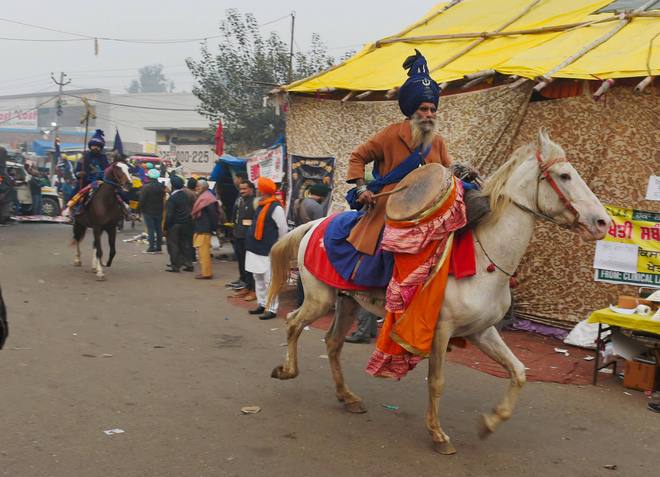
Nihangs during farmers’ agitation in New Delhi on Friday. PTI

Satya Prakash

Tribune News Service

New Delhi, January 15

The Supreme Court’s four-member committee on farmers’ agitation appears to be in limbo after the lone farmers’ representative and Bharatiya Kisan Union national president Bhupinder Singh Mann recused himself in view of criticism from his own union which sacked him from its primary membership.

Legal experts told The Tribune that the panel can’t start its work until it was reconstituted and the vacancy filled.

“The SC will have to nominate some other person to the committee. Since setting up of the committee is a unilateral action on part of the court, only it can find a replacement for Mann,” senior counsel Vikas Singh, who is appearing a PIL petitioner seeking guidelines on agitations, said.

Advocate Virag Gupta said, “The SC may modify its previous order and allow the committee to continue with only three members or name Mann’s replacement. Since kisan unions have expressed their willingness to continue talks with the government it may keep its order on hold or even refer it to a Constitution Bench.”

While staying the implementation of the three farm laws, a three-judge Bench headed by Chief Justice of India SA Bobde had on January 12 set up a four-member committee to hear stakeholders’ views.

Besides Mann, the other three members of the committee were Pramod Kumar Joshi (Director, South Asia international Food Policy), Agricultural Economist Ashok Gulati and Shetkari Sanghatana leader Anil Ghanwat.

They were mandated to talk to the agitating farmers on the Farmers (Empowerment & Protection) Agreement of Price Assurance & Farm Services Act 2020, Farmers Produce Trade & Commerce (Promotion & Facilitation) Act & Amendment to Essential Commodities Act and file a report before the court in two months.

Advocate AP Singh, who is representing some farmers’ bodies in the case, said, “it was bound to happen as most of the members were pro-farm laws and their views were already known”.


Govt needs to handhold Army’s support cadre

The Tour of Duty (ToD) for select government officials from both the Centre and the states in the defence forces for four to five years and giving them benefits for this service in their civil service is an option in consonance with the recommendations of the parliamentary committee report. This modified version of ToD appears viable because there is no need for a second career option or a severance package.Govt needs to handhold Army’s support cadre

CONSTRAINT: The youth don’t find it attractive to join the defence forces for a shorter duration because of lack of opportunities for a second career option. PTI

Lt Gen Gyan Bhushan (retd)

Former South Western Army Commander

THE Army has come out with an out-of-the-box solution for overcoming its systemic shortage of manpower and consequently reducing the pension burden. There has never been a dearth of men and women willing to serve in our Army as officers. However, the challenge has been about quality and not about quantity.

As per reports, the Tour of Duty (ToD) will provide a glimpse of Army life to the public for a short period. It can prove to be a golden chance for those who are not interested in taking up defence forces as their career, but want to have a feel of the real experience.

It is in this backdrop that the Army is looking at the induction of a select few to start with maybe a truncated training period and service for three years. Proposals are still at a nascent stage.

Human resource management in the Army has become a Herculean challenge because of a pyramidal structure, non-grant of the non-functional financial upgradation (NFU) and limited avenues for deputations, leading to anxious moments for the Army hierarchy at all levels.

All professional armies in the world have a lean main cadre that serves for a longer duration and a larger support cadre which peels off after serving for a shorter duration. For better management of human resources, this ratio should generally be 1:1.5.

Any proposal by the Army for the support cadre will need some guarantees from the government in terms of the peel factor, lateral absorption in government jobs/PSUs and/or an attractive severance package.

Many studies have been conducted to achieve this goal, but lack of support from the government for improving the terms and conditions of the support cadre has been a stumbling block. The youth do not find it attractive to join for a shorter duration and peel off thereafter because of lack of opportunities for a second career option and meagre compensation for hardships faced during a short Army career.

The retention of more officers of the support cadre in service after the mandatory period results in a large number of aspirants in the main cadre for promotions to a extremely limited number of vacancies in higher ranks, leading to frustration, disgruntlement and an increasing number of court cases.

The Short Service Commission (SSC) has been the main support cadre of the Army. Initially, the mandatory period of service was five years, which could be extended for five years and thereafter for further four years. Around 2006, the system was changed, making the initial tenure of 10 years mandatory, which could be further extended by four years.

The higher age of exit for SSC officers reduces their chances of a second career option. An enhancement in the mandatory service period to 10 years has made SSC less attractive because various recommendations for job reservations, lateral absorption, industrial attachment, lucrative study leave, better severance package etc. have remained on paper and never been implemented.

Ameliorating measures for the support cadre like the peel factor, deliberated at length by the AV Singh committee, and lateral absorption have been non-starters because of lack of government support. Even various pertinent and viable recommendations of the Standing Committee of Parliament on the issue have been ignored. The recent recommendation of the Standing Committee suggesting compulsory military training for all those who want subsequent employment with the government is an enhanced version of a recommendation of the 1990s when it was recommended that the induction of all officers in the Central Armed Police Forces (CAPFs) be through the Army after an initial term of five years. All these options are viable, but need the government’s backing. The recent recommendations of the Standing Committee of Parliament are extremely viable and a variation of the ToD.

In the recent proposal of the ToD of three years, after six to nine months of training, the participants will have around two years plus residual service in the units. Since they will serve only in operational areas, some on-the-job formation-related operational and leadership training will be essential for serving in active areas like Jammu and Kashmir and the Northeast. Therefore, the period of engagement needs consideration and deliberations so that active service in the units is for three years.

It is hoped that these well-trained young personnel with a military background will find good job opportunities in the industry, Central and state government services, police and the CAPFs. Without attractive career guarantees and a good severance package, no proposal for the support cadre can be attractive enough to draw the right material for our armed forces.

However, the experience of previous recommendation reports indicates that no proposal of a second career option for the support cadre will succeed without the government’s intervention and directions or a statute passed by Parliament.

The ToD for select government officials from both the Centre and the states in the defence forces for four to five years and giving them benefits for this service in their civil service is also an option in consonance with the recommendations of the parliamentary committee report. This modified version of ToD appears a viable option because there is no need for a second career option or a severance package. This will help develop discipline in these government officials.

The support cadre has to be made attractive to the youth with a fairly good second career option, some job guarantees in the industry, government jobs (as was done for emergency commission officers and for initial batches of the SSC) and a good severance package. There are several studies on the subject, including detailed deliberations in the AV Singh Committee report, but there has been no will to implement it.

The Army can find many ingenious and practical ways of addressing the issue, but rather than aiming for a resolution at the departmental level, it has to be fully supported by the government by ensuring guarantees.


Cabinet Committee on Security approves Tejas deal worth Rs 48,000 crore

Cabinet Committee on Security approves Tejas deal worth Rs 48,000 crore

In a major decision, the government on Wednesday approved the procurement of 83 indigenously developed light combat aircraft Tejas for the Indian Air Force (IAF) at a cost of Rs 48,000 crore.

The decision was taken at a meeting of the Cabinet Committee on Security (CCS) chaired by Prime Minister Narendra Modi, Defence Minister Rajnath Singh said.

In a tweet, Singh said the deal will be a “game-changer” for self-reliance in defence manufacturing in India.

“The CCS chaired by PM Sh. @narendramodi today approved the largest indigenous defence procurement deal worth about 48000 crores to strengthen IAF’s fleet of homegrown fighter jet ‘LCA-Tejas’,” he said.

The defence minister said Tejas is going to be the backbone of the fighter fleet of the Indian Air Force in years to come.

Around three years back, the IAF had issued an initial tender for procurement of 83 Tejas aircraft, a four-and-half generation combat jet.

“LCA-Tejas incorporates a large number of new technologies many of which were never attempted in India. The indigenous content of LCA-Tejas is 50 percent in Mk1A variant which will be enhanced to 60 percent,’ Singh said.

The defence minister said that aircraft maker Hindustan Aeronautics Ltd (HAL) has already set up second-line manufacturing facilities at its Nasik and Bengaluru divisions.

“Equipped with the augmented infrastructure the HAL will steer LCA-Mk1A production for timely deliveries to the IAF,” he said.

Singh said the Tejas programme would act as a catalyst for transforming the Indian aerospace manufacturing ecosystem into a vibrant, self-sustaining one.

“I thank the Prime Minister Shri @narendramodi for this historic decision taken by the CCS today, “ the defence minister said. PTI