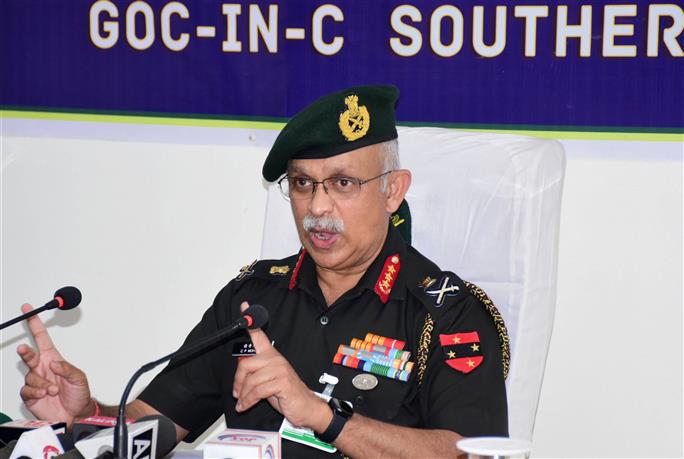
Vice-Chief of Indian Army Lieutenant General Chandi Prasad Mohanty. PTI file
Pune, January 23
Newly-appointed Vice Chief of Army Staff Lt Gen Chandi Prasad Mohanty on Saturday said the Armed Forces are taking progressive steps to increase integration between the three services to create a “joint theatre command”.
Lt Gen Mohanty, who is currently the Southern Command chief, will take over from Lt S K Saini after he retires on January 31.
Speaking to reporters here, Lt Gen Mohanty said, “We are working towards integration. Right now, we all function in different domains and coordinate our resources as when the need arises.”
However, the moment a joint theatre command comes in, there would be integration in terms of planning, training and operations, he said.
“We are studying modern models available all over the world and a best-suited model will be adopted for the Indian Armed Forces in due course of time and will be executed in a phased manner,” he said.
The Indian Army is also looking at new technologies available with the most modern armies in the world, he said.
The army commander further said maritime and amphibious capabilities of the Indian Army need to be developed.
“We are a regional power and I am sure that there will always be requirements of more amphibious corps, enabled troops in every sphere,” he said.
To ensure the security and integrity of India’s off- shore islands, the amphibious capabilities need to be improved, Lt Gen Mohanty said.
Asked about fresh threats emerging in the southern sectors, Lt Gen Mohanty said the intelligence and security agencies are working round the clock to keep citizens safe. PTI
India working on 5th-gen fighter, some 6th-gen capabilities will be incorporated in it: IAF chief
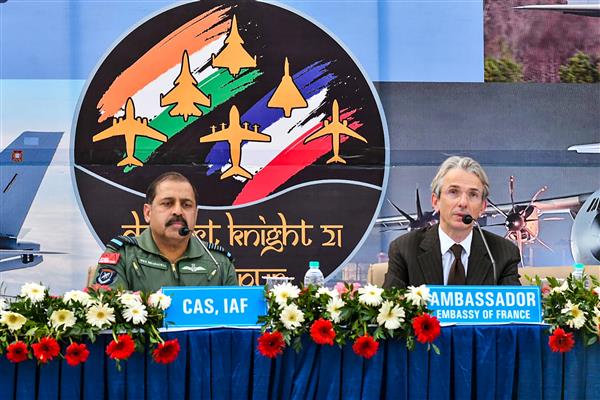
Chief of Air Staff Rakesh Kumar Singh Bhadauria with Ambassador of France to India Emmanuel Lenain during a joint air force exercise between India and France, codenamed Desert Knight-21, at Jodhpur air force station, on Saturday, January 23, 2021. PTI
Jodhpur, January 23
Eight Rafale aircraft have already arrived in India and three more are expected by the end of this month, Air Chief Marshal Rakesh Kumar Singh Bhadauria said here on Saturday.
The IAF chief was speaking at a press conference after the conclusion of ‘Exercise Desert Knight-21’ held in Jodhpur by the air forces of India and France.
He said IAF has initiated a fifth-generation fighter aircraft programme with the Defence Research Development Organisation (DRDO) and plans to incorporate some sixth-generation capabilities in it as well.
“Our present vision is to incorporate all the latest technologies and sensors in our fifth-generation aircraft,” Bhadauria said.
“We started work on fifth-generation aircraft a little late. So technologies and sensors contemporary to that period of development would be added into fifth-generation fighters,” he added.
Bhadauria said when IAF received the Rafale aircraft, the first priority was to operationalise it and integrate it with the existing combat fleet.
“It has already been done, and the current exercise Desert Knight was the result of that,” he said.
“We have some Indian pilots training in France and some in India itself. We have enough pilots to have a right pilot-cockpit ratio,” the Air Chief Marshal said, adding that the entire induction would be completed by next year.
Earlier, Bhadauria congratulated both the air forces for successfully completing the exercise in just four days. Desert Knight-21 was scheduled to be held over five days.
“It is not in terms of interoperability which has been learnt in this exercise, but employment of best practices, operational philosophies and mutual as well as professional interaction,” he said.
Later, talking to the media, French Ambassador to India Emmanuel Lenain said bilateral cooperation between the two countries has been going on ever since the first French aircraft landed in India in 1953.
“Now Rafale is the reflection of this strengthened cooperation and partnership,” Lenain said.
He said this partnership has persisted through good and bad times.
“When India faced difficulties during its atomic test in Pokran in 1998, we were at your side while other countries opposed and objected. And we were also by your side in cooperational manner when you had difficulties with one of your neighbours,” the ambassador said.
He said this exercise would further help in building mutual trust and pave the way for more cooperation. PTI
How Army and Navy are keeping Republic Day parade participants safe amid Covid
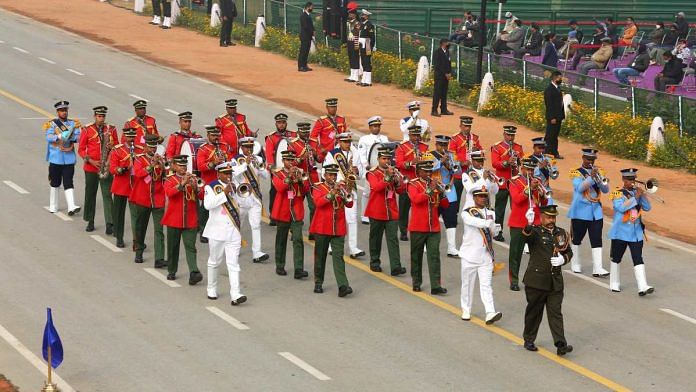
Bangladesh armed forces contingent during the full dress rehearsal for the upcoming Republic Day Parade, in New Delhi on Saturday | ANI
New Delhi: From the Navy booking 14 hotels in Delhi’s Karol Bagh to the Army creating a bio bubble in the heart of the cantonment in the national capital, armed forces are taking every step to deal with the Covid-19 pandemic as they prepare for the Republic Day parade.
An additional task cut out for those involved in the planning of the parade was to ensure that the Bangladeshi contingent taking part in it remained safe amid Covid.
“It was a herculean task as the contingents and bands came from across the country. But we have managed to ensure that everyone is safe,” Chief of Staff, Delhi Area, Major General Alok Kacker said, replying to a query by ThePrint on how tough the Covid challenge was.
He was briefing reporters on the preparations for the Republic Day parade on 26 January.
In November, when the Army contingent and bands started arriving in the capital, a total of 260 tested positive, out of about 3,000 who had landed.
“The Delhi area was the first to set up quarantine facilities. We ensured that all soldiers were tested and those who were positive were treated,” Kacker said.
He also mentioned that the Army had created a bio bubble at the parade ground in the Delhi Cantonment to prevent the spread of coronavirus.
‘Here to have a better friendship’
The Navy, meanwhile, booked 14 hotels in Karol Bagh to house sailors, who have come from across the country.
Navy sources said one of the hotels was turned into a central kitchen, which served meals to everyone in other hotels.
“Dedicated buses are there for them to be picked up and dropped back from training. Nobody steps out because of the Corona pandemic,” a source said, explaining the steps taken to counter the pandemic.
The over 120-member Bangladeshi delegation was tested for Covid before they left for India, and they have been put up in a five-star hotel and every Covid protocol is being followed.
“We are here to have a better friendship,” said Colonel Mohtashim Hyder Chowdhury, who led the delegation.
The Modi government had last month kicked off the celebrations to mark the golden jubilee of the 1971 Bangladesh Liberation War.
On 16 December — the day when Bangladesh got liberated in 1971 — Modi lit the ‘Swarnim Vijay Mashaal’ from the eternal flame of the National War Memorial in New Delhi, marking the beginning of the golden jubilee celebrations.
India needs free, fair, non-hyphenated and questioning journalism even more as it faces multiple crises.
But the news media is in a crisis of its own. There have been brutal layoffs and pay-cuts. The best of journalism is shrinking, yielding to crude prime-time spectacle.
ThePrint has the finest young reporters, columnists and editors working for it. Sustaining journalism of this quality needs smart and thinking people like you to pay for it. Whether you live in India or overseas, you can do it here.
With P8I aircraft, Navy takes part in Quad anti-submarine warfare exercise in Guam
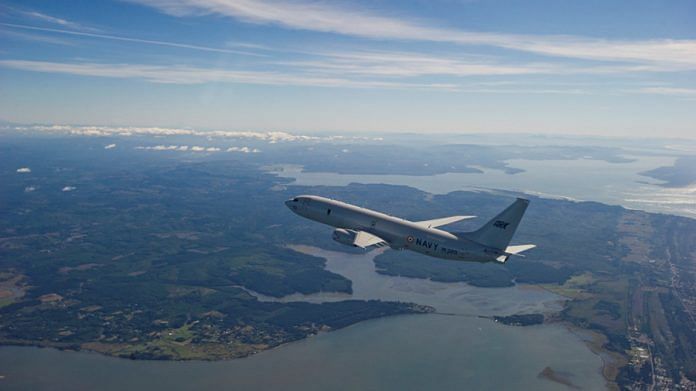
he P-8I is equipped for long range anti-submarine warfare, anti-surface warfare, intelligence, surveillance and reconnaissance | Photo: Boeing
New Delhi: The Indian Navy is participating in a multinational anti-submarine warfare exercise with the ‘Quad’ countries, along with Canada, which began in Guam in Western Pacific earlier this month.
The exercise, titled Sea Dragon 2021, is taking place nearly two months after the conclusion of Exercise Malabar involving the Quad countries — India, Japan, the US and Australia.
The Navy has deployed one anti-submarine warfare aircraft, the P8I, for the exercise, which is set to continue till 28 January. The exercise involves drills aimed at tracking submarines.
Naval Base Guam is a strategic US naval base located on Apra Harbor.
Defence officials told ThePrint the Navy’s participation bears testimony to the level of interoperability achieved by the force enabling it to take part in exercises across the globe.
Sea Dragon 2021 centres on anti-submarine warfare training and excellence to include 125 hours of in-flight training — ranging from tracking simulated targets to the final problem of finding and tracking USS Chicago, a US Navy Los Angeles-class nuclear submarine.
During training sessions, pilots and flight officers from all countries will build plans and discuss incorporating tactics, capabilities and equipment for their respective nations into the exercise. Along with the US, the Royal Australian Air Force, Canadian Air Force, Indian Navy, and Japan Maritime Self-Defense Force are participating.
Vice-Admiral Anup Singh (retired), former commander-in-chief of the Eastern Naval Command, told ThePrint that participating in a high-level exercise with an anti-submarine focus makes a lot of sense in today’s day and age, particularly in the current geopolitical scenario.
“Guam is one of the largest US naval bases, and the region is of great interest to us. Exercising there with the US will help the Navy to acclimatise with the area, thus adding to the confidence. There is also a lot of global interest in that part of the pacific,” he said.
The Navy veteran further said that what adds to the experience is exercising with contemporary systems like the P8I, which is a modern aircraft that also has a great amount of maritime reconnaissance and surveillance capabilities.
“Very few platforms today have these detection systems against submarines,” he added.
India’s other global exercises
India has remained tight-lipped about the exercise, while the US has been giving out information about its participation.
In November, India concluded the 24th edition of joint maritime ‘Exercise Malabar 2020’, which saw Australia’s participation for the first time in 13 years, along with the US and Japan.
The Malabar series of exercises had begun as an annual bilateral naval exercise between India and the US in 1992. In the past few years, the annual maritime exercise has been conducted off the coast of Guam in the Philippine Sea in 2018 and the coast of Japan in 2019.
The Indian and the French air forces are also carrying out a five-day bilateral air exercise, Exercise Desert Knight-21, which began on 20 January that will include aircraft such as Rafales, Mirage 2000s, Sukhoi-30s, mid-air refuellers, and airborne warning and control system platforms.
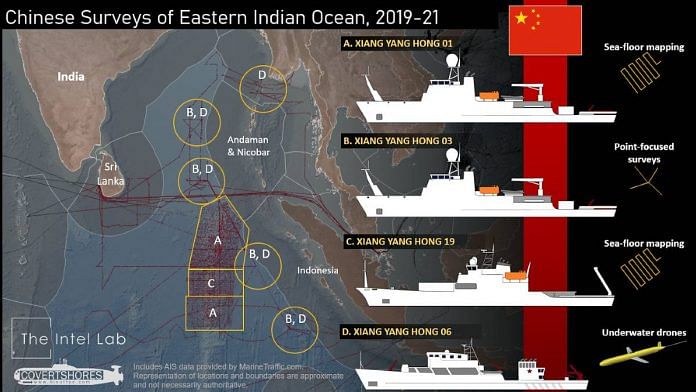
New Delhi: A Chinese government survey ship, the Xiang Yang Hong 03, is currently operating in the Indian Ocean and carrying out a search pattern west of Sumatra, the latest satellite and open source intelligence (OSINT) has revealed.
This same vessel was last week accused of ‘running dark’, i.e., operating without broadcasting its position, in Indonesian territorial waters.
China’s Xiang Yang Hong survey ships are suspected of operating underwater gliders in the Indian Ocean to map the sea bed.
“The suspicion is that, as well as conducting civilian research, these ships may be gathering information for naval planners — currents, bathymetry, salinity of the water — which are all relevant to submarine warfare,” H.I. Sutton, defence and OSINT analyst told ThePrint. He added that hydrographic data is civilian-defence agnostic, which means that it can be used for both civilian and military purposes.
“The eastern Indian Ocean is likely to be of particular interest to the Chinese Navy as they expand their submarine capabilities. The data from these surveys may help submarines navigate, or improve their chances of remaining undetected,” Sutton said.
In an article published on NavalNews, Sutton wrote that some of the survey activities, nearer to Indonesia and the Andaman and Nicobar islands, could relate to finding the US Navy’s reputed ‘fish hook’ sensor networks.“These are designed to track Chinese submarines entering the Indian Ocean. Naturally this cannot be confirmed,” he said.
ThePrint in November 2020 reported that two Chinese research and survey vessels in Sri Lankan waters had caught the attention of the Indian Navy, which sees them as possibly being part of a larger ploy to gather data.
A note prepared by the defence establishment at the time said that survey and research vessels primarily gather data vital for conduct of naval operations, especially that of submarines.
“Such unencumbered and suspicious activity within Sri Lankan waters will surely raise the hackles of other nations in the region and also has the potential to upset the delicate maritime balance in the IOR,” the note had said.
Sutton said that four of the Xiang Yang Hong (‘Facing the Red Sun’) research ships have been particularly active over the past two years — Xiang Yang Hong 01, 03, 06 and 19.
“The ships are operated by the State Oceanic Administration (SOA). In December 2019, Xiang Yang Hong 06 deployed at least 12 underwater gliders in the Indian Ocean. These long-endurance uncrewed underwater vehicles (UUVs) gather data on currents and the water properties. Their data is also civilian-defense agnostic, and particularly relevant to submarine warfare,” he said.
Incidentally, the gliders deployed were of the Sea Wing (Haiyi) type, which is the same model found in the Indonesian waters.
“This raises the possibility that as well as the Xiang Yang Hong 06, other Chinese ships may be deploying the gliders. It is difficult to determine the launch point for the gliders found in Indonesian waters. But it is not a great leap to suggest that China has deployed more in the Eastern Indian Ocean,” Sutton said.
HAL successfully test fires smart anti-airfield weapon from Hawk-i aircraft
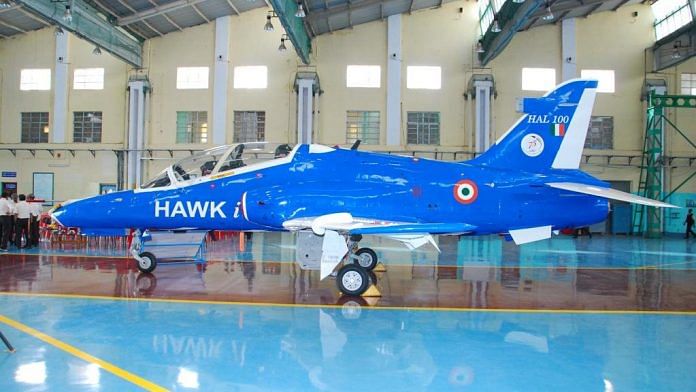
HAL test fired smart anti airfield weapon from a Hawk-i aircraft in Odisha on 21 January | Representational image | Twitter: @ANI
Bengaluru: State-owned Hindustan Aeronautics Limited on Thursday successfully test fired a Smart Anti Airfield Weapon (SAAW) from the Hawk-i aircraft off the coast of Odisha.
The aircraft flown by HAL test pilots Wing Commander (Retd) P Awasthi and Wg Cdr (Retd) M Patel executed the weapon release in a text book manner and all mission objectives were met.
The indigenous stand-off weapon, developed by Defence Research and Development Organisation’s Research Centre Imarat (RCI), is the first smart weapon fired from an Indian Hawk-Mk132, the HAL said in a statement.
The telemetry and tracking systems captured all the mission events confirming the success of the trials.
“The Company owned Hawk-i platform is being extensively used for certification of systems and weapons developed indigenously by DRDO and CSIR labs,” R Madhavan, CMD, HAL, said.
Arup Chatterjee, Director, Engineering and Research and Development, HAL said HAL is indigenously enhancing the training and combat capability of Hawk-i.
The HAL said it was in discussions with Indian Armed Forces for integration of various weapons on Hawk platform.
Under watch: Pakistan will try for a favourable FATF decision but it will be hard for it to dissuade international opinion about its tactical reliance on terrorism. Reuters
Shalini Chawla
Distinguished fellow, Centre for Air Power Studies
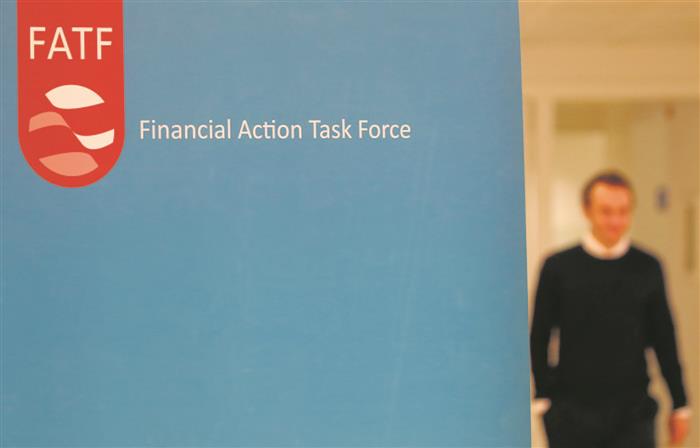
The Financial Action Task Force (FATF) pressure is increasing on Pakistan with the global anti-terror watchdog all set to evaluate Pakistan’s progress in counter-measures against terror financing. The group’s findings will be presented at the Asia-Pacific Joint Group meeting and the decisive plenary session scheduled in February. Pakistan was put on the grey list of FATF in June 2018. News-breaking and eye-catching counteractions from the Pakistani regime have gained momentum sequentially in the last few months with the decisive deadline of February 2021 issued by the FATF approaching. Islamabad certainly does not want to be on the blacklist of the FATF. It anxiously wants to move out of the grey list which would relax the international financial aid and investment channels for the country, giving a breather to Pakistan’s frazzled financial situation. Even though the all out assistance from its iron brother, China, has been lavish for Pakistan, and Beijing recently rescued Pakistan by helping it to repay a substantial part of the Saudi loan of $1 billion, Pakistan needs external financial assistance to revive the ailing economy.
In a much predictable move, Pakistan claims that its actions of targeting UN-designated terrorists should not be linked to the FATF deadline. But the fact remains that Pakistan waited and pushed the required actions till the last moment in the hope that it might somehow be
rescued from adhering to the strict FATF guidelines. Pakistan’s response to the suggested FATF compliances has been on three fronts: First, in mid-2020 (even though it was placed in the grey list in mid-2018), parliament passed two bills after much uproar from the Opposition parties — the Anti-Terrorism (Amendment) Bill 2020 and the United Nations (Security Council) Amendment Bill 2020.
Secondly, the FATF, in its plenary meeting held in June last year, decided to sustain Pakistan on the grey list given its failure to control financial transactions of the terror groups, including Lashkar-e-Taiba (LeT) and Jaish-e-Mohammad (JeM). The final meeting is due next month and we see a surge in actions by the Pakistani regime. A number of UN-designated terrorists have been arrested and convicted. An arrest order has been issued against Masood Azhar, chief of Jaish-e-Mohammad, in a terror-financing case (not for an act of terrorism). Other important arrests on the charges of terror financing include that of 26/11 attacks mastermind Zaki-ur- Rehman Lakhvi.
Thirdly, Pakistan has been very active in recent months in revising its anti-India narrative. For decades, Pakistan built and sustained the narrative of victimhood and positioned India as a major threat to its sovereignty. In recent months, Pakistan’s India narrative has been focusing on projecting India as a dangerous state being run on a Nazi ideology under the BJP government and as a sponsor of terrorism in Pakistan. It submitted a terrorism dossier against India in the United Nations and blamed India for the January 3 terrorist attack in Balochistan which has been claimed by the Islamic State. By adopting an offensive posture with a revised anti-India narrative, Pakistan is attempting to counter India’s position on Pakistan’s strategy of terrorism.
Narratives have been a critical part of Pakistan’s strategic posturing at the international level to build alliances and seek military assistance from major powers, attract support from the Muslim world and build consensus amongst the Pakistani diaspora all across globe. At the domestic level, the anti-India narrative supports continued military dominance, significant investment in the military and nuclear build-up at the cost of the nation’s development and justifies the use of sub-conventional war. Two recent developments have further added to Islamabad’s discomfort: first, the US move to redesignate Lashkar-e-Jhangvi and Lashkar-e-Taiba as terrorist groups, and second, India being scheduled to chair the Counter-Terrorism Committee in 2022 as a non-permanent member of the United Nations Security Council.
While Pakistan will actively try to swing the FATF decision in its favour, the international community needs to realise that these actions are not reflective of a change in Pakistan’s strategic reliance on terrorism. Pakistan is attempting to intensify its covert war strategy in Kashmir with the freshly formed “The Resistance Front”.
Pakistan’s linkages with the Al-Qaeda are well acknowledged and it was not too long ago when Prime Minister Imran Khan, in parliament, addressed Osama bin Laden as a ‘martyr’. Pakistan continues to rely on a dual policy in Afghanistan where, on the one hand, it proudly takes the credit for facilitating the US-Taliban agreement, and on the other, continues to support terror groups and create instability in Afghanistan with an objective of establishing a pro-Pakistan regime in Kabul. Prime Minister Imran Khan, during his maiden trip to Afghanistan late last year, was greeted by anti-Pakistan slogans and demonstrations in Afghanistan. According to a UNSC report, approximately 6,500 Pakistani terrorists are operating in Afghanistan.
Although recent legal actions in Pakistan have been targeting global terrorists, Pakistan’s strategic calculus remains unaltered. However, the positive side of the recent FATF-instigated actions is that for the first time, Pakistan has recognised and accepted the presence of these terrorists within the country and their role in terrorism-related activities!
Away from home, with a bigger family One doesn’t get many opportunities to celebrate due to exigencies of service. That’s compensated by the love, affection and camaraderie of those around you, a hallmark of the armed forces
I WAS posted as an instructor in Ahmednagar and was detailed on temporary duty to teach the Technical Staff Course at the Institute of Armament Technology, Pune, for a month. Our 10th wedding anniversary on January 16, 1987, fell in the middle of the week. I knew there was no chance of getting back home to celebrate it with my wife and kids. We had reconciled to the fact, like on several previous occasions due to some service commitment or the other. On January 15, as I asked all the other Instructors to join me for a small get-together the following evening, I was told by a colleague to push off home; he volunteered to take my class.
Come morning, I was off on a bus to Ahmednagar, a three-hour journey, hoping to surprise my family. As I reached home around midday, I found my kids playing outside. They looked at me with shock and surprise. When I told them I had come to celebrate our anniversary, they laughed, “But mom left in the morning for Pune.” Apparently, when she went to Army School, where she was teaching, carrying a cake to celebrate with the other teachers, the principal asked her to take the day off and go to Pune. Those were days when there were no cellphones and it was near impossible to get through on landlines too. So we were both stuck in opposite cities.
Fortunately, I managed to convey a message to the staff at IAT to ensure she stayed put, as I headed back to Pune in the first bus I could hop on to. We then landed up at my former regimental officer’s house late in the evening. The couple were equally shocked and surprised to see us both, but made sure we were served and toasted in style. Our 10th was a memorable one, the military way.
Fifteen years later, in 2002, was our silver jubilee. I was posted as a Brigade Commander along the Line of Control in J&K. Leave was planned, but things started hotting up along the LoC and any chance of getting home was dashed. The staff did make plans for celebrations and thought about calling the COs for lunch, but I vetoed the idea and instead asked for all the young officers manning the forward-most posts to be invited, with the proviso that they stay for the next couple of days.
But then, it started snowing at night and continued till the morning, with two feet of snow all around. Accordingly, a message was sent to the units that the youngsters be held back and we went ahead with a small get-together. Around 1 pm, we heard a knock at the door of the Officers’ Mess. In walked a young Lieutenant, drenched in snow, all wet and shivering away. We quickly got him next to the fireplace and gave him brandy to warm him up. This boy’s post was the furthest from the Brigade HQ and he had to leave early along with his patrol so as to make it in time. He was already on the move before his post could be informed about the cancellation.
Before he left to change his clothes, he came up to me, saluted smartly, shook my hand, and wished me a very happy anniversary. Then, to the complete surprise and bewilderment of all of us, he dug into his vest, pulled out a dry card from under his otherwise drenched clothes which read, ‘Happy anniversary from CO and all ranks, 6 Mahar (Borders).’ There were moist eyes all around as I hugged the boy — the most precious card ever received, which lay next to the warmth of his heart for six hours of his journey.
During service, one doesn’t get many such occasions to celebrate due to exigencies, but when you do, they are memorable ones. And in places where there is more love, affection, warmth and camaraderie, a hallmark of our armed forces.
A word about our youngsters — they not only deliver cards on such occasions, they deliver in each and every operation that they are called upon to, putting their lives in the line of fire. They make us proud.
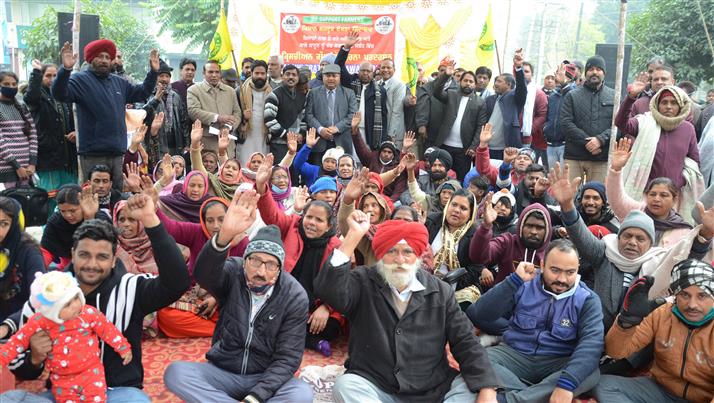
Punjab Christian Community members hold protest in favour of the farmers in Jalandhar on Friday. Photo Sarabjit Singh
Jalandhar: Priests and heads of various Christian organisations on Friday held a protest against the Centre for not repealing the three agri laws. They supported agitating farmers and urged the Central Government to consider the demands of protesting farmers. Members of various Christian bodies flayed the style of functioning of the government. They said law and order situation can get affected if the Centre continues to stick to its stance. Arch Bishop of Pentecostal Diocese of Punjab PJ Soloman, chairman of Rashtriya Masihi Sangh Fares Masih, Punjab Christian United Front chief George Soni, Punjab Christian Movement chief Hamid Masih, Pastor Ashok Masih and Pastor Surinder Gill of the United Pastors’ Association were present on the occasion. TNS
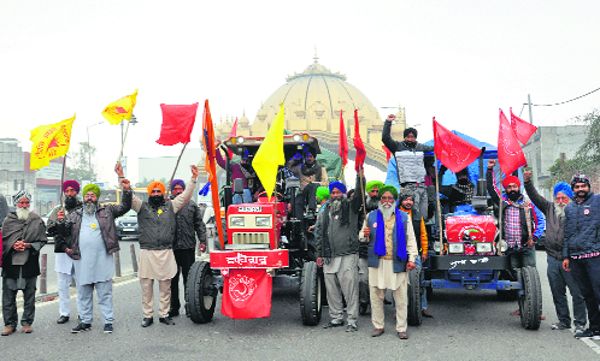
We are agitated, but not aggressive’ Farmers’ cavalcade leaves for Delhi to join tractor parade on January 26
United we stand Farmers leave for Delhi to participate in the January 26 tractor parade from Golden Gate in Amritsar on Saturday. Photo: Sunil kumar
Manmeet Singh Gill
Tribune News Service
Amritsar, January 23
A large cavalcade of tractor-trailers, buses and cars left for Delhi from the Golden Gate here on Saturday to participate in the January 26 tractor parade being organised by farmers’ associations to oppose the controversial agriculture laws.
Farmers from many villages also joined the cavalcade at different points on the GT Road till Beas. Before initiating the march from here, farmers paid tributes to Netaji Subhas Chandra Bose on his birth anniversary.
Speaking on the occasion, many leaders said the government is trying to end the agitation by using unfair means. They also reiterated their resolve to remain peaceful and said the government, instead of using malpractices to end the protest, must listen to farmers and repeal the controversial laws.
The leaders also hailed the sacrifice of Subhas Chandra Bose. Joining in the protest, Prof AS Sidhu (retd) spoke on the life, struggle and sacrifice of Netaji. He said Bose sacrificed his life while fighting against the communal forces of the country.
He said the farmers of the country were not less than freedom fighters and they are fighting to save country from the slavery of the corporate houses.
“Netaji’s ideology is even more relevant during the current times, as the government is hell-bent upon destroying the social fabric in society by bringing various black laws in the country,” he said.
Leaders including Rattan Singh Randhawa, Parkash Singh, Baldev Singh, Balwinder Singh and Harieet Singh also addressed farmers. “Given the choice, nobody wants an 18-hour long tedious and back-breaking journey. If farmers are responding to the call, it means they are agitated. We are agitated, but we are not aggressive or violent,” said Rattan Singh Randhawa. They said after reaching Delhi they would pitch their tents, get a good night’s sleep and be ready for the tractor parade on January 26.
State Stalwarts
DEFENCES FORCES RANKS
ARMY, NAVY, AIRFORCE RANKS
FORMATION SIGNS
FORMATION SIGNS
ALL HUMANS ARE ONE CREATED BY GOD
HINDUS,MUSLIMS,SIKHS.ISAI SAB HAI BHAI BHAI
CHIEF PATRON ALL INDIA SANJHA MORCHA
LT GEN JASBIR SINGH DHALIWAL, DOGRA
SENIOR PATRON ALL INDIA SANJHA MORCHA
MAJOR GEN HARVIJAY SINGH, SENA MEDAL ,corps of signals
.
.
PATRON ALL INDIA SANJHA MORCHA
MAJ GEN RAMINDER GORAYA , CORPS OF
sanjhamorcha303@gmail.com
PRESIDENT HARAYANA STATE CUM COORDINATOR ESM
BRIG DALJIT THUKRAL ,BENGAL SAPPERS
PRESIDENT TRICITY
COL B S BRAR (BHUPI BRAR)
PRESIDENT CHANDIGARH ZONE
COL SHANJIT SINGH BHULLAR
.
.
PRESIDENT PANCHKULA ZONE AND ZIRAKPUR
COL SWARAN SINGH
PRESIDENT SAS NAGAR (MOHALI)
COL BALBIR SINGH , ARTY
INDIAN DEFENCE FORCES
DEFENCE FORCES INTEGRATED LOGO
FORCES FLAGS
15 Th PRESIDENT OF INDIA SUPREME COMMANDER ARMED FORCES
Droupadi Murmu
DEFENCE MINISTER
Minister Rajnath Singh
CHIEF OF DEFENCE STAFF (2nd)
General Anil Chauhan PVSM UYSM AVSM SM VSM
INDIAN FORCES CHIEFS
CHIEF OF ARMY STAFF(29th)
General Upendra Dwivedi, PVSM, AVSM (30 Jun 2024 to Till Date)