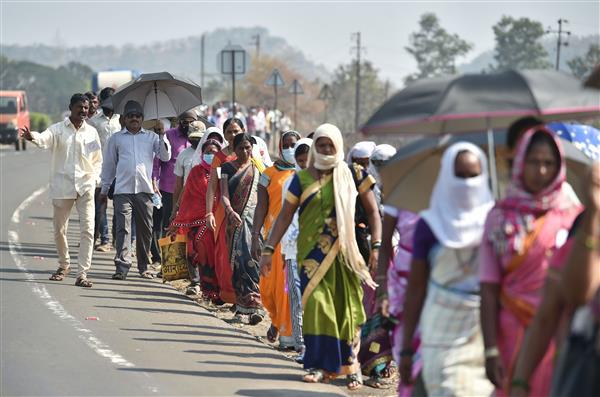
Farmers from Nashik district walk along the Nashik-Mumbai Highway to participate in the protest march in Mumbai on January 24, 2021. — PTI
Mumbai, January 24
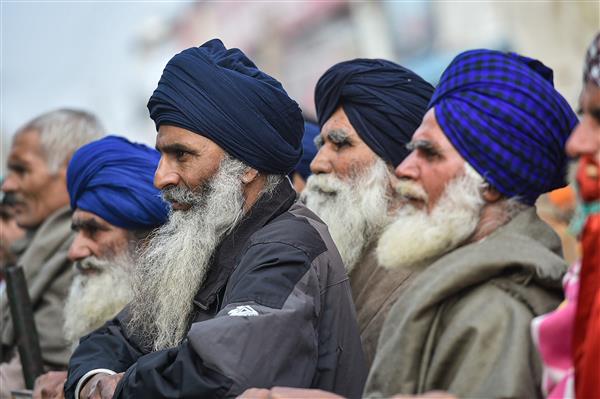
Thousands of farmers have left for Mumbai from Maharashtra’s Nashik district for a rally to demand repealing of the Centre’s three new farm laws.
The rally organised by Akhil Bharatiya Kisan Sabha will be held in Mumbai on January 25, a statement issued by the organisation said on Saturday.
The rally will be addressed by former Union agriculture minister and NCP chief Sharad Pawar, state Congress president Balasaheb Thorat and Shiv Sena leader Aaditya Thackeray.
A delegation will also present a memorandum to Governor Bhagat Singh Koshyari, the release said.
The farmers owe allegiance to over a 100 organisations under the umbrella of Samyukta Kisan Morcha (SKM), which has given a nationwide call for similar agitations between January 23-26, including taking out rallies to Raj Bhavans in all states.
From Sunday, thousands of farmers will stage a 3-day ‘sit-in’ protest at Azad Maidan in Mumbai in which the ‘vehicle morcha’ will also join them, All India Kisan Sabha (AIKS) president Dr. Ashok Dhawale said.
Enacted in September last year, the three laws have been projected by the Centre as major reforms in the agriculture sector that will remove middlemen and allow farmers to sell their produce anywhere in the country.
Thousands of farmers, mostly from Punjab, Haryana and western Uttar Pradesh, have been camping at several border points of Delhi since November 28 last year, demanding a repeal of these laws.
Multiple rounds of talks between the government and farmer unions have failed to break the impasse so far, while the Supreme Court has appointed a panel for resolution. Agencies
Soldier succumbs to injuries caused in Pak firing along LoC Third Army personnel to die in ceasefire violation by Pakistan this month
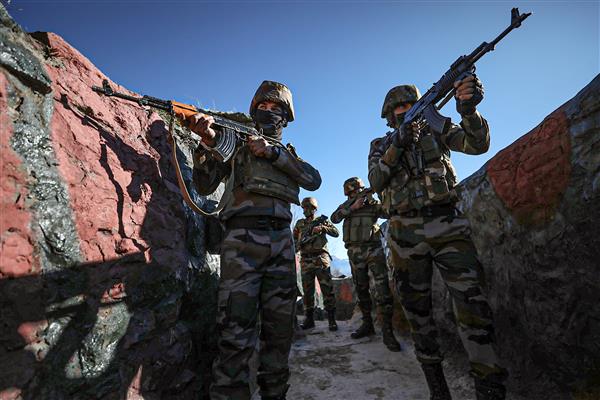
ndian Army soldiers patrol Line of Control (LOC), in Rajouri district. PTI file
Jammu, January 24
An Army soldier, who was critically injured in Pakistani firing along the Line of Control (LoC) in Rajouri district last week, succumbed to injuries in the command hospital in Jammu and Kashmir’s Udhampur district on Sunday, a defence spokesperson said.
He is the third Army personnel to have died in the ceasefire violations by Pakistan this month.
“Pakistan Army had resorted to unprovoked ceasefire violation on the LoC in Sunderbani sector on January 18, which was responded to strongly by Indian troops. In the incident, Naik Nishant Sharma of 10 JAK RIF was critically injured and was under treatment at command hospital,” the spokesperson said.
However, he said the Non-Commissioned Officer succumbed on Sunday.
“Naik Sharma was a brave, highly motivated and a sincere soldier. The nation will always remain indebted to him for his supreme sacrifice and devotion to duty,” the spokesperson said.
Earlier, two Army personnel were killed in separate ceasefire violations by Pakistan along the LoC in Rajouri and Poonch districts on January 1 and 21.
Last year, Jammu and Kashmir recorded 5,100 instances of ceasefire violations by Pakistan along the LoC, the highest in the past 18 years with an average of 14 cases daily.
In these ceasefire violations, as per official data 36 people, including 24 security personnel, were killed and over 130 injured. PTI
Farmers’ protest: Delhi police remove boulders from Tikri border Barricading to be removed completely before Republic Day to allow tractor parade, says farmer union leader
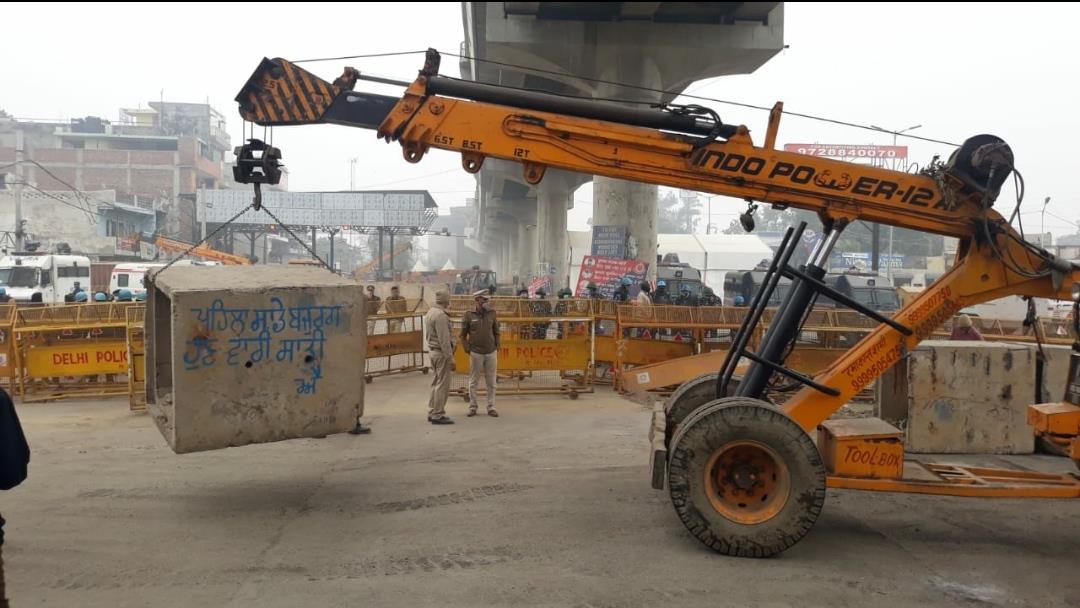
Boulders being removed from Tikri border on Sunday. Tribune photo
Ravinder Saini
Tribune News Service
Jhajjar, January 24
Two days ahead of Republic Day, the Delhi police on Sunday initiated work to clear the Delhi-Rohtak highway at Tikri border with removing boulders from cranes there.
The boulders were placed to prevent entry of protesting farmers who have been camping there for the past around two months. The police also lifted the sand dumped on the highway. However, two-layer simple barricading on the border is yet to be removed.
Purushottam Singh Gill, a leader of Bharatiya Kisan Union (Lakhowal), said the Delhi police had assured to lift the barricading completely before the Republic Day in view of tractor parade to be taken out by protesting farmers on January 26 following the call given by the Sankyukt Kisan Morcha. The route for the tractor parade had been finalised and the parade would be peaceful, he added.
Vikas Sisar, another farmer leader from Haryana, said farmers were enthused over the tractor parade and were gearing up to participate in it. “Volunteers have been roped in to manage the parade. They will be issued identity cards and given special jackets for their recognition,” he added.
Meanwhile, a large number of people from Punjab in buses, cars and tractor-trailers reached Tikri border to join the Tractor parade on Tuesday. Those who have been working in the private sector or doing business have also come here to express solidarity with the farmers.
Jhajjar SP Rajesh Duggal said 25 companies of Paramilitary and Indian Reserve Battalion (IRB) along with local police had been deployed at Tikri-Bahadurgarh border and proposed route of the tractor parade to facilitate the farmers and to remove traffic congestion during the tractor parade.
“We have talked to farmers’ leaders who have assured us to take out the tractor parade peacefully,” Duggal added.
High Court: No sexual assault if no skin-to-skin contact
Groping a minor’s breast without “skin-to-skin contact” cannot be termed as sexual assault as defined under the Protection of Children from Sexual Offences (POCSO) Act, the Bombay High Court has said.
Justice Pushpa Ganediwala of the Nagpur bench of the Bombay High Court, in a judgment passed on January 19, the detailed copy of which was made available now, held that there must be “skin to skin contact with sexual intent” for an act to be considered sexual assault. She said in her verdict that mere groping would not fall under the definition of sexual assault.
Justice Ganediwala modified the order of a Sessions Court, which had sentenced a 39-year-old man to three years of imprisonment for sexually assaulting a 12-year-old girl. — PTI
Marathon military talks on Ladakh standoff PM mum on chinese occupation: rahul
India and China on Sunday held the ninth round of military talks
New Delhi, January 24
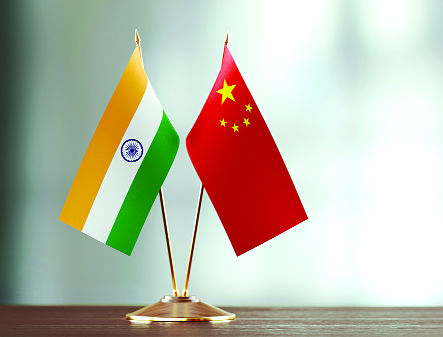
After a gap of over two months, India and China on Sunday held the ninth round of military talks specifically focusing on ways to move forward on the long-negotiated disengagement process in eastern Ladakh as thousands of their troops remained deployed at friction points under freezing conditions.
The Corps Commander-level meeting began around 10 am at Moldo on the Chinese side of the Line of Actual Control (LAC) in eastern Ladakh and was continuing late till night, sources said.
People familiar with the negotiations said India insisted that the onus was on China to carry forward the process of disengagement and de-escalation at the friction points. India has been maintaining that the disengagement process has to start simultaneously at all friction points and a selective approach was not acceptable to it.
Close to 1 lakh Indian and Chinese troops are deployed in eastern Ladakh as both sides have been holding on to their ground and showing readiness for a long haul amid continuing diplomatic and military talks to find an amicable solution.
Sunday’s talks took place nearly two weeks after India handed back to China a soldier of the People’s Liberation Army after apprehending him on the southern bank of the Pangong Tso in eastern Ladakh. It is learnt that India’s gesture generated a positive atmosphere. The Indian delegation was led by Leh-based 14 Corps Commander Lt Gen PGK Menon. — PTI
Pullback Onus on Beijing: India
The ninth round of talks were aimed at initiating steps to disengage troops from all friction points in eastern Ladakh
The eighth round of talks on November 6 , 2020, had broadly discussed disengagement from specific friction points
Close to 1 lakh Indian and Chinese troops are deployed in eastern Ladakh
Terrorist groups and their handlers from Pakistan are switching to new applications
Srinagar, January 24
Amid a raging debate over privacy offered by messaging platforms like WhatsApp, terrorist groups and their handlers from Pakistan are switching to new applications, officials here said.
The three new applications came to light after evidence was collected following encounters with terrorists or those who surrendered before the Army gave details about their mode of radicalisation by Pakistan-based terrorist groups, they said. The names of the messaging apps have been withheld for security reasons.
Slow internet no bar
Names of the apps have been withheld for security reasons
One of these is owned by a US firm, second is from Europe and third by a Turkish firm
Can work with the slowest Internet connections
While one of the applications is owned by a company based in the United States, the second is from Europe. The latest is an application developed by a Turkish company that has been frequently used by terrorist group handlers and their prospective recruits in the Kashmir valley.
The new applications have the ability to work with the slowest Internet connections where Enhanced Data for Global Evolution (EDGE), used in the late 2000s, or 2G is in operation.
The government suspended Internet across Jammu and Kashmir after the abrogation of the special status of the erstwhile state in August 2019. Early last year, 2G Internet services were restored. Terror groups had virtually stopped using WhatsApp and Facebook Messenger. Later, it was found that they had switched over to new applications available free of cost, a security official said.
One of the new messaging apps used by terrorists to radicalise the youth in the Valley does not even ask for phone numbers or emails for enabling complete user anonymity, officials said.
Efforts are on to block such applications in Jammu and Kashmir, they added. — PTI
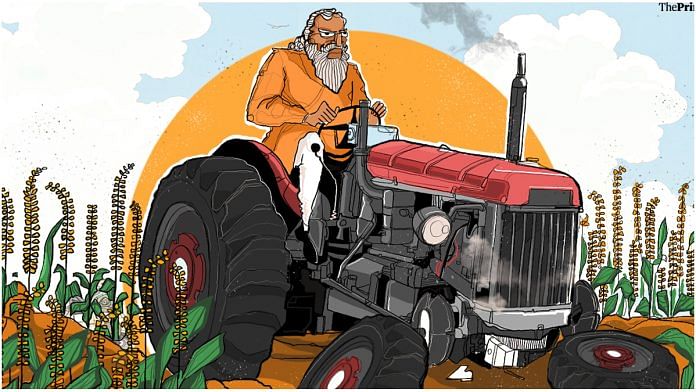
7 reasons why Modi govt is in retreat on farm reform laws Farm reform could’ve been high point of Modi’s second term. But lack of patience, understanding and contempt for history have turned it into a disaster.
Cop-out, mission abandoned, cold feet, tactical retreat, stalemate. You choose the description for the Modi government’s predicament on its farm reform laws. It is a setback if not an outright defeat or surrender. Which is tragic, because these laws are reformist, bold, and would help farmers by and large, rather than harm them.
Nevertheless, all substantive reform has to be marketed politically. The days of incremental reform by stealth are over. There isn’t any low-hanging fruit left in the reform orchard. That’s why it is important that we understand what went wrong here. Because, an idea is only as good or as bad as those most affected find it.
In our view, here are the seven main reasons why the Modi-Shah BJP has failed to convince the farmers.
– They cannot accept that there is a non-Muslim state in the north where Narendra Modi doesn’t hold the same magisterial sway over public opinion as in the Hindi heartland.
– Because they do not accept it, they never saw the need for a local ally. That’s why they dumped the Akalis so contemptuously. The Sikhs of Punjab are not like the Hindus of Assam who will vote for Modi even when you marginalise their pre-eminent regional party and steal its leaders.
– We have said this before in a National Interest, they do not understand the Sikhs. They see them essentially as Hindus if sartorially different. Fact is, they are, and yet they aren’t. But understanding subtleties isn’t exactly the Modi-Shah BJP’s strong point.
– They never appreciated the deep Left influence among the Punjab peasantry, going back to the early 20th century, since even before Bhagat Singh. Sikhism, the institution of the gurdwara, has a unique tradition of community mobilisation. Add to that the organisational skills and political savvy of the Left. That is what Narendra Singh Tomar and Piyush Goyal face session after session.
– It is because of a combination of these that the Modi government didn’t bother to market the reforms ideas early on. You do not tell surplus-producing farmers of the Green Revolution states that the very regime under which two generations have prospered is broken, and make three laws to fix them.
– You cannot use force against the Sikhs. To put it more rudely, you can’t treat them like Muslims. And you can’t question their patriotism. You do the first, the entire country will protest. You do the second, the Sikhs would laugh at you and the rest of the country would ask what’s wrong with you. This crisis denies you all your usual weapons: Force, agencies, propaganda, hyper-nationalism and so on.
– And finally, there is the Modi-Shah BJP’s hallmark: Contempt for history. Because, you presume history of the Republic only began in the summer of 2014 and anything that happened before that was a disaster and not worth learning from.
Let’s discuss the seventh point in some detail. If the post-2014 BJP leaders had not been so caught up in the headiness of power and adulation, they would have asked somebody to fill them in on some earlier experiences of India. Besides all the supposed follies of Jawaharlal Nehru they’d been taught about in the “Sangh”. They would then have known how a supremely powerful leader, at the peak of her popularity, can go wrong and be forced to retreat.
Because then, Narendra Modi would have known how Indira Gandhi erred in 1973, by nationalising all of India’s grain trade. This was her socialist peak, she was riding her post-Bangladesh ‘Durga’ crest and could do nothing wrong. This is also when the economy, reeling from the ravages of war, her dictatorial socialism and then the oil price shock following the Yom Kippur War, was in a tailspin and inflation had reached 33 per cent. A good account of the period is found in historian Srinath Raghavan’s essay in Builders of Modern India, edited by Ramachandra Guha.
This was also when Mrs Gandhi had ushered in her perfect world — a Soviet-style socialist utopia in which prices of everything, including cars, were fixed. Business Standard’s editorial chairman T.N. Ninan described this period in this 2014 article, and called grain trade nationalisation Mrs Gandhi’s greatest folly.
The short version of the story is, she was persuaded by her deep pink counsels, especially her chief commissar and Planning Commission deputy chairman D.P. Dhar, that the best way to control prices was to take the markets out of grain trade by nationalising it. Of course, no public opinion was built. What’s the point of being a strong, supremely popular leader if you still have to do those tedious things?
This led to a disaster. Farmers, traders and consumers were all furious. Further, prices went up, grain shortages were back and farmers were driven deeper into poverty. The one person in her ‘system’ who saw the looming disaster and tried to caution her was a noted economist and, predictably, a Punjabi: B.S. (Bagicha Singh) Minhas, a graduate of Khalsa College, Amritsar, who also studied at Panjab University and got a PhD from Stanford. He knew the farming business and the farmer’s mind. But he was overruled.
This was the only major decision that Mrs Gandhi was forced to withdraw, when she had no political challenge. Once she blinked, it gave impetus to her opponents, and Jayaprakash Narayan’s Navnirman Movement picked up momentum.
We do accept the contrasts in the two situations. Mrs Gandhi tried to take the private markets away from farmers and lost. Modi is bringing more markets to the farmers, and they don’t want them.
In terms of the philosophical direction of the economy, the two situations are contrary to each other. But there is no contradiction politically. In each case, unassailable, supremely powerful and popular leaders failed to see their limitations. Mrs Gandhi, then, of 352 seats in the Lok Sabha; Modi, now, of 303.
Even in a classical dictatorship, like China or Russia today, there are limits to a leader’s powers. India is nowhere near that league. In a diverse democracy, there are also limitations to any leader’s popularity. That’s why leaders have to know the art of persuasion.
Which Modi knows well. That’s why his government talks of ‘nudge’ economics. Or, to put it more accurately, a ‘nudge’ approach to political economy. Modi did it where it was easy, as say with the ‘Give It Up’ LPG campaign, when much larger populations were involved, including his base. He neither enjoys the same popularity in Punjab nor the unquestioning trust that he’s used to in Gujarat and the Hindi heartland.
If his dispensation wasn’t so overconfident, if there was still a culture of his political aides and bureaucracy intervening with some counsel and caution, he might have understood that this situation was different. And the need for persuasion, nudge, preparing the ground. In politics, if your objective is only winning elections, just Chanakya neeti (strategy) might do. For governance, you need both Chanakya neeti and Ram rajya (listening to others, give-and-take). You can neither beat up the farmers into submission, nor dismiss them as ‘Khalistanis’. We cannot answer these questions. But it is evident that this ground work was missing.
It is from this lack of patience and non-understanding the limitations of personal popularity in Punjab that we face this looming disaster over farm laws. This explains the first six points listed by us.
This deserved to be the high, reformist point of Modi’s second term after a messed-up economy in the first. But, as we well know, what is economics in a democracy if not politics by another name?
This article has been updated to correct the fact that D.P. Dhar was the deputy chairman of the Planning Commission during grain trade nationalisation and not P.N. Haksar. The error is regretted.
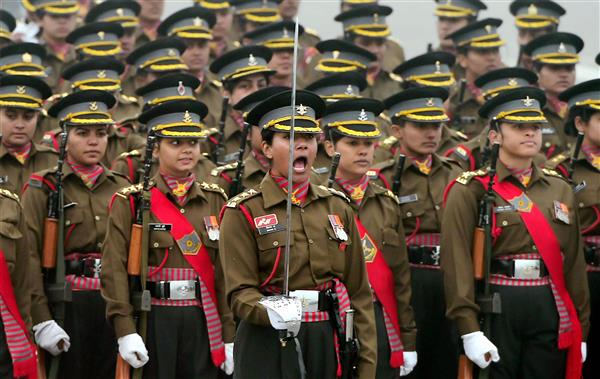
Women army officers once again move SC for grant of permanent commission, promotions and benefits Petition says court’s direction last February not complied with n ‘letter and spirit’
Eleven women army officers have moved the Supreme Court seeking compliance of its February last year directions to the Centre for grant of permanent commission, promotions and consequential benefits to them “in an inclusive, fair, just and reasonable manner”.
In a plea, Lieutenant Colonel Ashu Yadav and 10 other women Army officers alleged that the directions were not being complied with in “letter and spirit”.
The procedures for grant of permanent commission is “vitiated with arbitrariness, unfairness and unreasonableness”, they alleged in the petition, which is scheduled to be taken up for hearing by a bench headed by Justice D Y Chandrachud on January 27.
“The respondent institution is not leaving any possibility of thrusting their stand of unequal treatment to the women officers indirectly by trapping them into technical and procedural formalities and consequential denial of their rights,” it said.
The conduct of the Centre suggests that it is “playing a psychological warfare with these women officers” to avoid every possibility of granting them the benefits of permanent commission, promotion and consequential benefits, which is in clear violation of the order dated February 17, 2020, the plea said.
“Hence, it is most humbly prayed before this court to direct the respondent institution to determine a fair, rational road map and a well-reasoned policy for women officers on all the aspects, including grant of Col (Colonel) TS (time scale) rank and long outstanding financial dues, so as to promote inclusiveness rather than elimination techniques,” it said.
The plea challenged the general instructions, dated August 1, 2020, regarding the requisites of Special Board-5 (SB-5) for grant of permanent commission to short service commissioned (SSC) women officers.
It has also challenged the absence of any policy for organising the SB-3 board which is the promotion board for women officers who will be approved by the permanent commission board.
The plea also questioned the terms regarding substantive promotion by time scale on the rank of Colonel to women officers after completing 26 years of reckonable service in light of the terms of a notification dated December 21, 2004.
Pointing out the shortcomings of the SB-5 board criterion, the women officers said that the general instructions of August 1 last year, “are a set of arbitrary norms/criterion and pre-requisites, for the consideration of women officers by the SB-5 board that is the board for granting permanent commission”.
It said that the medical criterion laid down in the general instructions is inconsistent with the basic tenets of equality as laid down in Article 14 of the Constitution of India.
The general instructions released by the Indian Army on August 1 last year are “full of ambiguities as it contains provisions which seek to eliminate the women officers rather than giving them a fair chance or opportunity of permanent commission”, the plea said.
The petitioners said that it is apprehended that applying such procedure on women officers is only to render them unfit.
“For instance, women officers above 45 years (approaching menopause) and unmarried women officers were also made to undergo pregnancy test overlooking their age and marital status,” they claimed in their plea.
The plea said that women officers subjected to the permanent commission board include those who have continued in service beyond 14 and 20 years performing all such duties that have been performed by their male counterparts without any obstruction due to physiological changes.
“Thus, the medical conditions not being an impediment in career progression and promotions for male officers in the similar service length bracket cannot be so for the women officers,” it said.
The petitioners said that in a hierarchical organisation like the army, where stiff competition exists for each vacancy in promotion boards (SB-3), objectivity of ACRs of senior women officers having been rendered by male counterparts who were many batches junior to them, in some cases their students, cannot be considered at such a belated stage or for that matter at any stage to avoid unparalleled prejudices.
“It will be in clear breach of the provisions of the Army Order… consisting of the terms of protection of rights of a batch,” the plea said.
The officers submitted that they have been deprived of the provision for time-scale promotion recognised by the Indian Army which was introduced through the notification of December 21, 2004, wherein all officers who have completed the service period of 26 years without promotion to the rank of Colonel by selection shall be so promoted by time scale.
They said that the purpose of filing the plea is to “highlight the remaining hurdles to the battle of permanent commission, promotion and consequential benefits which has been fought and won over a period of 15 years with a hope of achieving their rightful claims”.
On February 17 last year in a landmark verdict, the top court had directed that women officers in the Army be granted permanent commission, rejecting the Centre’s stand of their physiological limitations as being based on “sex stereotypes” and “gender discrimination against women”.
The apex court had directed that within three months, all serving SSC women officers have to be considered for permanent commission irrespective them having crossed 14 years or, as the case may be, 20 years of service.
Farmers agree to hold Republic Day rally on Delhi’s inner roads Unions say tractor rally to steer clear of Outer Ring Road
Farmers at Singhu border during their ongoing agitation against the new farm laws in New Delhi on January 22, 2021. PTI file photo
Vishav Bharti Tribune News Service Chandigarh, January 23
Farmers’ unions and Delhi Police have reached a consensus over a Republic Day Tractor Parade that farmers will hold on January 26—a development that comes after several rounds of talks.
According to the new arrangement, farmers will steer clear of the Outer Ring road on January 26 and will instead hold their rally on the inner roads of the city, Rajinder Singh Deep Singhwala, vice-president of Kirti Kisan Union who was part of a meeting between farmers’ unions and Delhi Police, said.
The parade will now take place in five routes and on a stretch of over 60 km, at least 30 of which will be inside Delhi.
The routes, he said, will be announced later.
The breakthrough came after Delhi Police have agreed to remove their barricades from Singhu and Tikri borders to allow the rally to enter Delhi, the leader said.
Police intelligence reports estimated 70,000 to 1 lakh tractors to be part of the farmers’ rally, the leader said.
“They said that it may take 48 hours to complete the march and asked us to reconsider the route as it may sabotage the official Republic Day parade,” Singhwala said.
Delhi Police and farmers had been stuck in an impasse over routes for the past few days. Farmers had previously announced that they were holding the parade in the Outer Ring Road, causing Delhi Police to worry about the impact it would have on the central government’s Republic Day Parade.
Dr Darshan Pal, Yogendra Yadav, Gurnam Singh Charuni, and Raminder Singh Patiala represented the farmers in the meeting with Delhi Police’s Special Commissioner Dipender Pathak and Joint Commissioner Surender Yadav.
Sources said that the farmers’ leaders who had gone for the meeting had been told to not walk out of the negotiations.
“In a breakthrough with police officials of Delhi, Haryana and Uttar Pradesh, Samyukt Kisan Morcha leaders were able to jointly finalize routes for the Kisan Republic Day Parade. Preparations are in full swing for disciplined conduct of the same. Response from farmers and their supporters has been tremendous from all over the country,” the Samyukt Kisan Morcha said in a statement.
“Farmers across the country supported the call of the Samyukta Kisan Morcha to celebrate Netaji Subhash Chandra Bose’s birthday as “Azad Hind Kisan Diwas”. Today, farmers protested in different places for demanding the repeal of three farm laws and legalising MSP,” the statement, which bore the name of Darshan Pal Singh, said.
“So far at least 151 peoples (sic) have lost their lives in this movement. We extend our deep condolences to all martyrs,” the statement said.
Veterans hold roadshow, say will join protesters at Delhi borders on R-Day Condemn Centre’s stance, demand repeal of farm laws
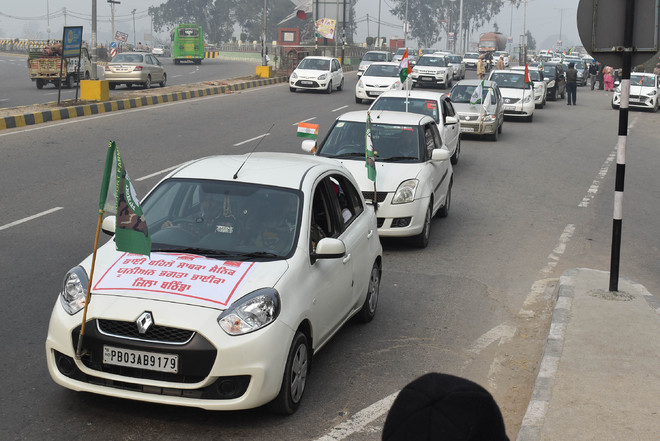
A cavalcade of ex-servicemen’s vehicles proceeds from Bathinda to Mansa on Saturday. Tribune photo
Tribune News Service
Bathinda, January 23
Ex-servicemen from Bathinda and Mansa districts today. carried out a roadshow from Bathinda to Mansa in support of the farmers’ agitation against the central agricultural laws.
Responding to the farmer unions’ call for Republic Day, they announced that they would be participating in the parade in the national capital in a show of solidarity with the protesters. The cavalcade of vehicles started from the Thermal Lake in Bathinda and after crossing through several parts of the city reached Mansa.
Darshan Singh, an ex-serviceman from Mansa, said: “We stand shoulder to shoulder with farmers in their struggle against the new agricultural laws. We strongly condemn the obdurate stance of the central government and firmly stand with farmers’ demand for the rollback of the new laws.”
Captain Jeet Singh (retd) said: “We are also making plans to join farmers on Republic Day at Delhi borders. We also appeal to the union government to make payments of pending DA installments to retired armed forces personnel and other central government employees.”
Ex-servicemen stated that the farmers’ agitation needed to be strengthened further. They appreciated farmers for keeping their protest apolitical and, most importantly, peaceful. Ex-servicemen extended their full support to farmers for keeping the agitation peaceful in the future as well.
State Stalwarts
DEFENCES FORCES RANKS
ARMY, NAVY, AIRFORCE RANKS
FORMATION SIGNS
FORMATION SIGNS
ALL HUMANS ARE ONE CREATED BY GOD
HINDUS,MUSLIMS,SIKHS.ISAI SAB HAI BHAI BHAI
CHIEF PATRON ALL INDIA SANJHA MORCHA
LT GEN JASBIR SINGH DHALIWAL, DOGRA
SENIOR PATRON ALL INDIA SANJHA MORCHA
MAJOR GEN HARVIJAY SINGH, SENA MEDAL ,corps of signals
.
.
PATRON ALL INDIA SANJHA MORCHA
MAJ GEN RAMINDER GORAYA , CORPS OF
sanjhamorcha303@gmail.com
PRESIDENT HARAYANA STATE CUM COORDINATOR ESM
BRIG DALJIT THUKRAL ,BENGAL SAPPERS
PRESIDENT TRICITY
COL B S BRAR (BHUPI BRAR)
PRESIDENT CHANDIGARH ZONE
COL SHANJIT SINGH BHULLAR
.
.
PRESIDENT PANCHKULA ZONE AND ZIRAKPUR
COL SWARAN SINGH
PRESIDENT SAS NAGAR (MOHALI)
COL BALBIR SINGH , ARTY
INDIAN DEFENCE FORCES
DEFENCE FORCES INTEGRATED LOGO
FORCES FLAGS
15 Th PRESIDENT OF INDIA SUPREME COMMANDER ARMED FORCES
Droupadi Murmu
DEFENCE MINISTER
Minister Rajnath Singh
CHIEF OF DEFENCE STAFF (2nd)
General Anil Chauhan PVSM UYSM AVSM SM VSM
INDIAN FORCES CHIEFS
CHIEF OF ARMY STAFF(29th)
General Upendra Dwivedi, PVSM, AVSM (30 Jun 2024 to Till Date)