FASTag will be mandatory from February 15 midnight and any vehicle not fitted with it will be charged double the toll at toll plazas.
A government order said all lanes at electronic toll plazas on national highways will be declared “FASTag lanes” with effect from February 15 midnight.
The Ministry of Road Transport and Highways said the aim was to promote fee payment through digital mode, reduce waiting time and fuel consumption and provide for a seamless passage.
All central government employees to attend office on working days: Personnel Ministry
All central government employees have been asked to attend office on working days, according to a Personnel Ministry order.
The decision comes amid a significant decline in the number of active COVID-19 cases in the country, including in the national capital.
However, all officers and staff residing in containment zones shall be exempted from coming to office till their containment zone is de-notified, the statement said.
Until now, officers of the level of Under Secretary and above were only attending office due to the coronavirus-induced restrictions imposed in March.
The Centre had in May asked 50 per cent of its employees below the level of Deputy Secretary to work from their offices, while implementing different time slots in its effort to further check the spread of the coronavirus.
The officers/staff shall follow staggered timings to avoid over-crowding in offices/workplaces as decided by the heads of department, it said.
“The government servants at all levels are to attend office on all working days without any exemption to any category of employees,” said the order issued late Saturday to all the central government departments.
Biometric attendance shall continue to be suspended until further orders, it said.
The officers and staff who are residing in the containment zone shall work from home and shall be available on telephone and electronic means of communications at all times, it said.
Meetings, as far as possible, may continue to be conducted with video-conferencing and personal meetings with visitors, unless absolutely necessary in public interest, are to be avoided, the order said.
The Personnel Ministry, in another order, said that “all departmental canteens may be opened”.
According to the Union Health Ministry data updated on Sunday, the COVID-19 active caseload remains below 1.5 lakh.
In Delhi, the active case tally on Saturday dropped to 1,041 from 1,053 the previous day. PTI
Former Defence Minister AK Antony today alleged that the terms of disengagement in both Galwan valley and Pangong Tso areas and the creation of a buffer zone was a “surrender” of India’s interests. He accused the Centre of appeasing China by “agreeing to dis-engagment on China’s terms”.
Addressing a press conference, he said, “Please understand the gravity of the situation, disengagement is good but it cannot be at the cost of national security.” He asked the government to disclose its plan to restore status quo ante as on April 2020 along the LAC.
“The government is not realising the danger of creating such buffer zones,” he said. The Army had occupied Kailash range in south of Pangong Tso. “In negotiations, we have agreed to withdraw from there. It could have been a bargaining chip,” he said.
“The area between Finger 4 and Finger 8 was disputed and both armies used to patrol it. There had been incidents of jostling among troops of both countries, but India always maintained it claim up to Finger 8,” he said.
Quoting Defence Minister Rajnath Singh’s statement in Parliament, he said, “Now, we have agreed to come back to Finger 3.”
“Our Army has a post at Finger 4, why has that been vacated and why has the right to patrol up to Finger 8 been surrendered,” he said.
“Galwan was never a point of dispute. It was always a part and parcel of India. For the first time, a buffer zone has been created there,” he said.
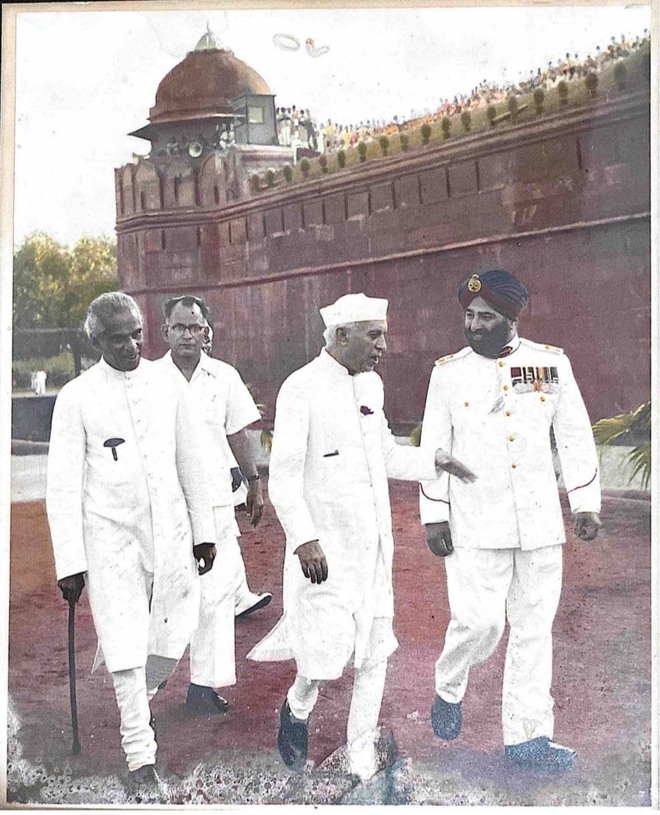
Lt Gen Bikram Singh with former PM Jawaharlal Nehru.
Aparna Banerji
Tribune News Service
Jalandhar, February 12
On November 22, 1963, the day the former US President John F Kennedy was assassinated, a numbing incident also unfolded here in India. A copter crash at Poonch in Jammu consumed five senior commanders of the Indian Army and the Air Force.
Lieutenant General Daulat Singh, General Officer Commanding In Chief, Western Command, Lieutenant General Bikram Singh, General Officer Commanding, 15 Corps, Air Vice-Marshal Erlic Wilmot Pinto, Air Officer Commanding, Western Command, Major General Nalin Kumar Dhirajlal Nanavati, Military Cross, General Officer Commanding 25 Infantry Division, Brigadier SR Oberoi, Military Cross, Commander 93 Infantry Brigade and Flight Lieutenant SS Sodhi were the victims.
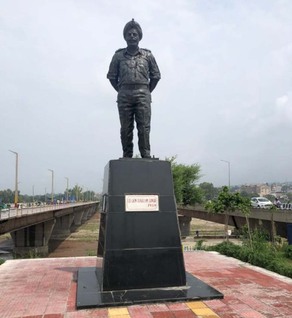
Lt Gen Bikram Singh’s statue in Jammu.
The generals were en route a reconnaissance mission and the accident impacted a protocol change wherein senior generals of the army were banned from traveling together in future. “This was the first major accident in which Indian Army and Air Force officers lost their lives,” Brig (retd) Onkar Singh Goraya says.
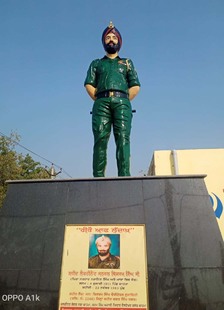
A native of the Kahma village in Nawanshahr, Lt Gen Bikram Singh, also famous as the ‘hero of Ladakh’ is all set to get a memorial at his ancestral village (Nanka pind) of Siana (in Nawanshahr). Last year on November 22, Finance Minister of Punjab Manpreet Badal unveiled a statue and laid the foundation stone of a library and museum in his memory there.
“In think in the crash we lost a future army chief. He was a hero. The government of Punjab thinks people ought to have a sense of history to get a sense of destiny. We want the future generations to remember him. The government is installing a statue and setting up a library in his memory. We are open to contributions of documents and other memorabilia from the Rajput Regiment and his family as well for the memorial,” the minister says.
Lost in obscurity, this revival of his legacy has triggered nostalgia among people. In Jammu and Ladakh, his portraits can still be found in houses, while grocers, dhabas and paan walahs don’t charge money, as a token of respect, from the family whenever they visit and a Jammu committee still fights to get his statue shifted to a more prominent location of the town. A gurdwara at Bikram Chowk (named after him) in Jammu is also graced by his portrait.
Lt Gen Bikram Singh’s statue at his ancestral Siana village.
Brig (retd) Goraya, tells, “The general perception among people was that he saved Ladakh. I was posted as a second lieutenant in the early 60s. The first time I travelled to Kashmir Bikram Singh was the Corps Commander at the headquarters in Udhampur. He was worshipped by most of the Kashmiris because he maintained peace and was apolitical. They were very happy with him and many households had his photographs hung.”
Lt Gen HS Panag talks about his departed counterpart. “Bikram Singh had a sterling reputation as a general in Ladakh. People were quite happy to see him. There is no doubt that Ladakh was a much better battle than the one fought in NEFA. However, the withdrawal from Chushul remained controversial.”
Twin committees keep him alive
Two separate committees – Lieutenant General Bikram Singh Society at Kahma village and the Lieutenant General Bikram Singh Yadgaar Committee in Jammu – hold ceremonies, akhand paths, blood donation camps among other events to remember him.
Lalita Sharma, chairperson of the Shaheed General Bikram Singh Yadgaar Committee, Jammu, says: “His statue is at the Bikram Chowk by the Tavi. We had asked the govt in 2007-08 to shift his statue to a more prominent place. We made the committee 20-25 years ago. Now, they have made a chowk here. Every family has people he has helped. His cremation was also held at Bikram Chowk because locals wanted to conduct his last rites here. His mother herself approved of the ceremony because people loved him.”
Rs 4 lakh was spent by the Kahma village committee for the museum and statue at Kahma village. Jaswinder Singh, a resident of village, shares, “In 2007 and 2008, we started camps and memorial ceremonies. In 2011, we held his 100th birth anniversary. Siana is his ancestral village. He was born here and we would hear his stories as kids.
Mahatma Gandhi’s granddaughter visits farmers’ protest site in Ghazipur Urges government to ‘take care’ of the farming community
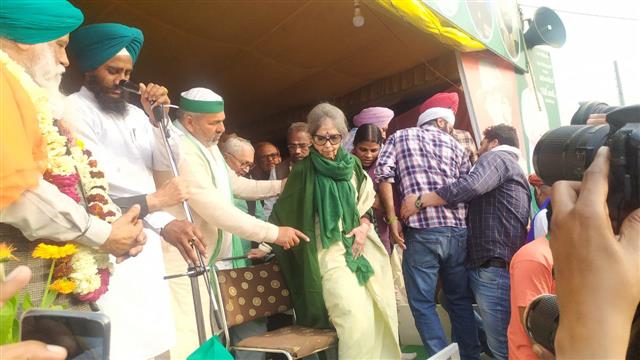
Mahatma Gandhi’s granddaughter Tara Gandhi Bhattacharjee at Ghazipur border during their ongoing protest against Centre’s farm laws, in New Delhi. Tribune photo
Ghaziabad, February 13
Mahatma Gandhi’s granddaughter Tara Gandhi Bhattacharjee on Saturday visited Ghazipur on the Delhi-Uttar Pradesh border to extend support to the farmers’ movement against the Centre’s contentious farm laws, according to a BKU statement.
The 84-year-old Bhattacharjee, who is also the chairperson of National Gandhi Museum, exhorted farmers to remain peaceful in their protest and urged the government to “take care” of the farming community.
She was joined by Gandhi Smarak Nidhi chairman Ramchandra Rahi, All-India Sarv Seva Sangha managing trustee Ashok Saran, Gandhi Smarak Nidhi director Sanjay Singha and National Gandhi Museum director A Annamalai.
“We have not come here as part of any political programme. We have come here today for the farmers, who have fed all of us our whole life,” Bhattacharjee said, according to the statement by the Bharatiya Kisan Union (BKU), the farmers union leading the protest here.
“We are because of you all. In the benefit of farmers lies the benefit of the country and all of us,” she was quoted as telling the protesters, who are camping at Ghazipur since November with a demand that the Centre repeal the three new farm laws and make a new one to guarantee minimum support price (MSP) for crops.
She recalled that the first fight for independence from the British rule in 1857 had also started from Meerut in western Uttar Pradesh.
Bhattacharjee said she has come to the protest site to pray for the farmers, according to the statement issued by BKU’s media in-charge Dharmendra Malik.
“I want that whatever happens, farmers should be benefitted by it. Nobody is unaware of the hard work that the farmers do and it is not to be said again that in the benefit of farmers lies the benefit of our country, and all of us,” she said.
Thousands of farmers are camping at Delhi’s border points of Singhu, Tikri and Ghazipur since November in protest against the three farm laws enacted by the Centre in September.
They claim that the new laws and lack of a law on MSP would hurt their livelihoods while the government has maintained that the legislations are pro-farmer. The impasse continues even after 11 rounds of formal talks between the government and farmers. PTI
Forgotten hero who brought Tawang under Indian Union to be honoured Khathing’s son, other family members will be present at the function
Major Ralengnao Bob Khathing, who was instrumental in bringing Tawang in Arunachal Pradesh under the Indian Union, will be honoured for the first time on Sunday here in presence of Chief of Defence Staff General Bipin Rawat, two chief ministers, a central minister and a governor.
As an assistant political officer of the erstwhile North East Frontier Agency (NEFA) and present-day Arunachal Pradesh, Khathing had carried out an audacious operation to bring Tawang under the Indian Union in the early 1950s under the direct supervision of the then Assam governor Jairamdas Daulatram.
Arunachal Pradesh Chief Minister Pema Khandu, Meghalaya Chief Minister Conrad Sangma, Union Sports Minister Kiren Rijiju, Arunachal Pradesh Governor Brigadier (Retd) B D Mishra and General Rawat arrived here this afternoon to attend the foundation stone laying ceremony of Major Ralengnao Bob Khathing Memorial at Kalawangpo auditorium.
“Khathing was one of the most significant heroes of India whose immense contribution cannot be forgotten. A due recognition will be given to Khathing, who was so far neglected,” Rijiju told PTI.
Khathing’s son John, a retired IRS officer, and other family members will also be present at the function.
Khathing, who was a Naga from Manipur, was given order by Daulatram to march towards Tawang with 200 soldiers of Assam Rifles and 600 porters on January 17, 1951.
Before World War II, Tawang was under the administrative control of the then independent Tibetan government.
Despite several attempts, the British could not annex it.
According to historical accounts of the NEFA, when Khathing and his men arrived in Tawang, he called a meeting on a high-ground near the Tawang Monastery for meeting local tax officials, village elders and prominent people of Tawang.
He used diplomatic skills to win over the locals. He soon realised that the local Monpa community was struggling under the harsh taxes imposed by the Tibetan administration. He told the local people about India, its democracy and assured them that India will never impose unjustified tax on them.
Soon, with the Assam Rifles men, Khathing took control of Tawang, tricolour was hoisted in Tawang and Bumla and the area became part of India. PTI ACB
Farmer deaths: They would have died anywhere, says Haryana Agriculture Minister in controversial remarks
Deepender Deswal Tribune News Service Hisar, February 13
Haryana Agriculture Minister Jai Prakash Dalal said 200 farmers who died during the ongoing protests would have died anywhere—remarks that could be seen as insensitive.
Dalal, who was addressing a press conference in Bhiwani, said the farmers who died during the protests would have “died even if they were home (ye ghar par hote toh bhi marte)”.
He followed up this remark by saying that one only had to look at the data on deaths to know this.
“They have died in the same ratio of deaths. Would 200 people have not died in a lakh or two in the last few months,” he said, adding heart failures and illnesses usually caused deaths.
He then accused the protesters of having been spurred on “Left activists who dance on China’s tunes to create a hostile environment” to drive out investment.
He also called Bharatiya Kisan Union’s national spokesperson Rakesh Tikait a ‘sadak chhap’ (vagabond) leader with vested interests.
He claimed another leader from Western Uttar Pradesh was brewing trouble in Haryana. Although he did not name anybody, he seems to be hinting at Yashpal Malik.
How does PLA see India’s strategic ambitions? Chinese military document holds clues
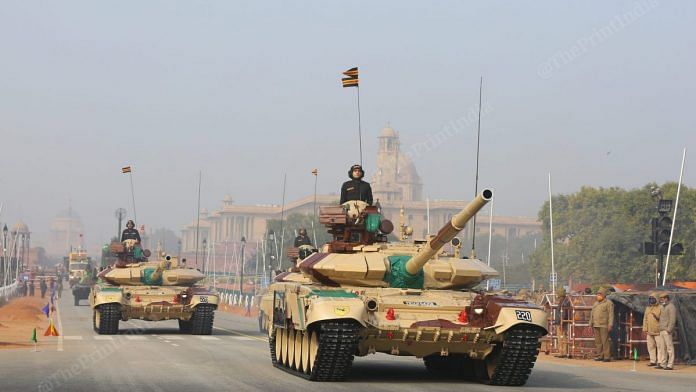
Representational image | Indian Army tanks at the Republic Day parade | Suraj Singh Bisht | ThePrint File Photo
New Delhi: India has always seen itself as a regional power and has wanted to dominate the Indian Ocean Region — this is how Beijing perceives New Delhi’s strategic ambitions, according to a recently translated document on China’s military strategy.
The US-based China Aerospace Studies Institute (CASI) translated a 2013 document, which is a doctrine of China’s Academy of Military Sciences.
The document traces the evolution of India’s strategic thought — as perceived by China — and gives a broad outline of the People’s Liberation Army’s military strategy. Of note is the fact that such documents are drawn up only once in about every 13 years.
In episode 682 of Cut The Clutter, ThePrint Editor-in-Chief Shekhar Gupta analyses the aspects of the document that talk about India, using it as a unique opportunity to look at India from the lens of its biggest adversary.
According to the document, China sees India’s strategic thought as having developed in multiple stages after Independence.
The first stage is ‘Limited Offensive Strategy’, between 1947 and 1960, occurring right after Independence, when India was a young, economically backward and militarily weaker nation.
According to the Chinese, India laid major emphasis on building its economy rather than defence. However, since Pakistan remained a threat, there was limited offence but increased deployment on the Western front, and movement to the northern frontiers along Tibet, which, from the Chinese perspective, is south of the McMahon line.
“Essentially, what that means is that India asserted control over new regions of Arunachal Pradesh, or what the Chinese call South Tibet. But I suspect this is also an oblique reference to the fact that it was in this period that India went up to Tawang and asserted control,” said Gupta. By 1958, according to the Chinese, India gained control over all contested areas near the India-China border.
Between 1960 and 70, the paper says India’s strategy focused on expansion on two fronts, especially after the 1962 war, when the country started building its military power. In 1964, it started a defence modernisation plan with the first defence five-year-plan, pegged at Rs 5,000 crore. The paper says this led to two things — it gave India greater strength for its operations in the West, and provided in-depth defence against China.
In the next two decades, between 1970 and the late 1980s, the paper notes, India’s objective was to maintain land and control the sea. According to it, India had contained Pakistan at this point and its focus shifted towards gaining control over the sea, particularly the northern part of the Indian Ocean. India started focusing on building its Navy to gain power in South Asia.
In the 90s, the focus shifted from regional offence to regional deterrence. By this time, the paper says, the traditional view of annihilatory war had changed. So, India tried to build influence in an entire region on the back of a strategy of regional deterrence, from the Himalayas to the Indian Ocean, from Iran in the West to Myanmar in the East.
By the 21st century, India’s economy boomed, making it stronger than its South Asian neighbours, and leading to its strategy evolving again. The paper also notes that India’s strategy became two-pronged — practising defensive deterrence against China and punitive deterrence with others.
Characteristics that define India’s strategic thought
The Chinese paper notes that there are four inter-woven characteristics to India’s strategic thought. It says India has a strong geopolitical core since the nation believes it’s the heart of Asia, and its region of influence is South Asia. The paper also says Pakistan and China are India’s biggest obstacles in achieving its geopolitical goals.
Indo-centricism has been identified as another objective, one the Chinese think India has inherited from the British. India considers itself the heart of the continent, and regions at its peripheries, including Kashmir, Assam, Bangladesh, Sikkim and Bhutan, are its internal line of defence. The country also wants Tibet as a buffer zone with China. The paper says India relies on the Chanakyan philosophy, dealing with peripheral nations as rivals and regions that are far off as friends.
According to China, India wants to dominate South Asia and the Indian Ocean Region, and rise as a first rate world power for which a strong but limited offensive is needed. The paper also says India has been ‘nibbling’ away at Chinese territory in the meantime.
“Chinese say this ‘nibbling’ has been done rather carefully, to turn defence into offence during war time,” Gupta said.
Finally, the paper says, India’s strategic thought emphasises deterrence in all directions. This analysis breaks India’s deterrence strategy into two distinct halves — ambition for dominance and ambition for deterrence.
“India knows that its military power is limited, so for the second one, India has reached out to countries like the US and Japan, and improved its relations to get more people into the tent… you can see that the Chinese scholars had foreseen the coming up of the Quad in 2013,” Gupta said.
State Stalwarts
DEFENCES FORCES RANKS
ARMY, NAVY, AIRFORCE RANKS
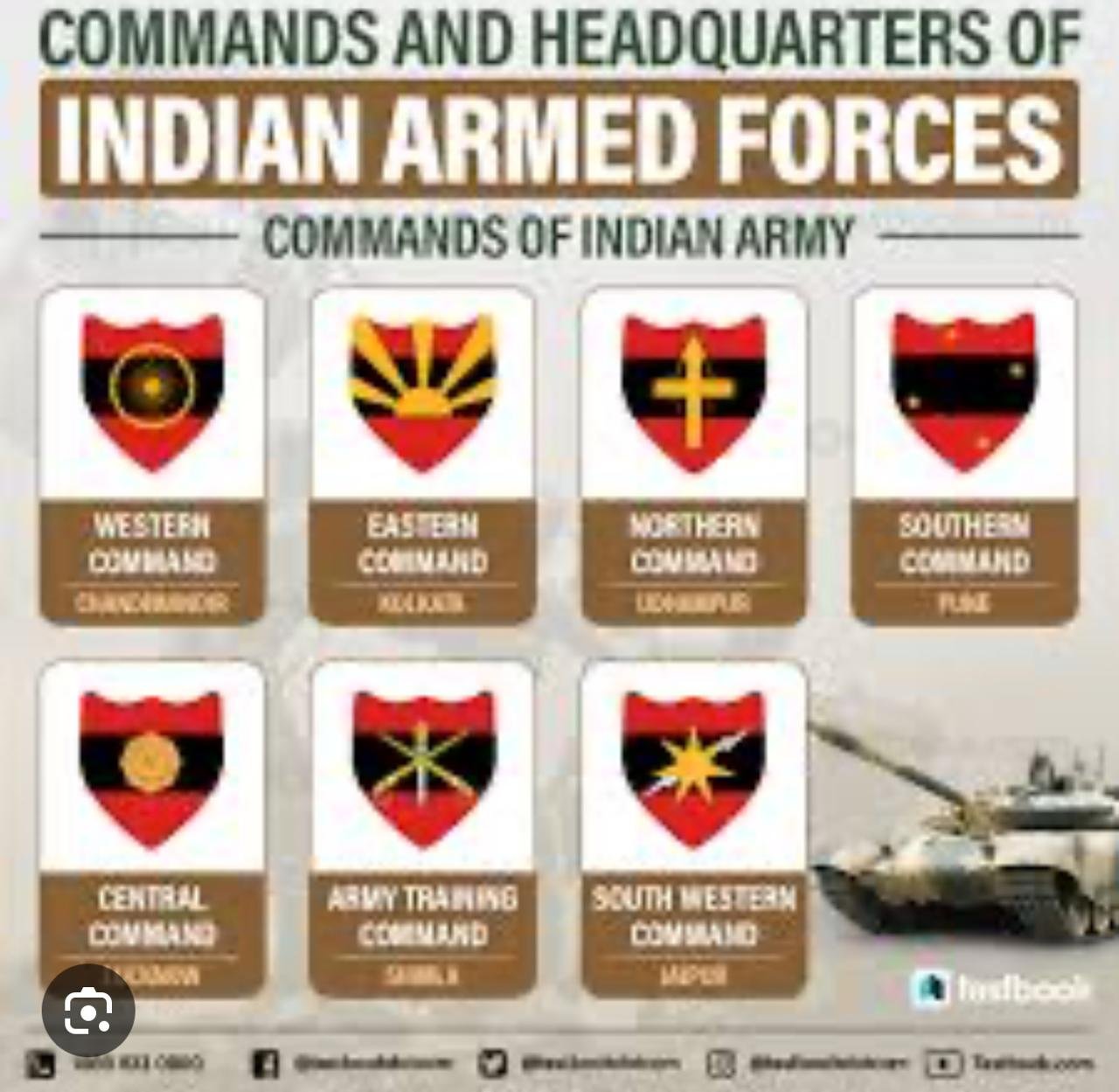
FORMATION SIGNS
FORMATION SIGNS
ALL HUMANS ARE ONE CREATED BY GOD
HINDUS,MUSLIMS,SIKHS.ISAI SAB HAI BHAI BHAI
CHIEF PATRON ALL INDIA SANJHA MORCHA
LT GEN JASBIR SINGH DHALIWAL, DOGRA
SENIOR PATRON ALL INDIA SANJHA MORCHA
MAJOR GEN HARVIJAY SINGH, SENA MEDAL ,corps of signals
.
.
PATRON ALL INDIA SANJHA MORCHA
MAJ GEN RAMINDER GORAYA , CORPS OF
sanjhamorcha303@gmail.com
PRESIDENT HARAYANA STATE CUM COORDINATOR ESM
BRIG DALJIT THUKRAL ,BENGAL SAPPERS
PRESIDENT TRICITY
COL B S BRAR (BHUPI BRAR)
PRESIDENT CHANDIGARH ZONE
COL SHANJIT SINGH BHULLAR
.
.
PRESIDENT PANCHKULA ZONE AND ZIRAKPUR
COL SWARAN SINGH
PRESIDENT SAS NAGAR (MOHALI)
COL BALBIR SINGH , ARTY
INDIAN DEFENCE FORCES
DEFENCE FORCES INTEGRATED LOGO
FORCES FLAGS
15 Th PRESIDENT OF INDIA SUPREME COMMANDER ARMED FORCES
Droupadi Murmu
DEFENCE MINISTER
Minister Rajnath Singh
CHIEF OF DEFENCE STAFF (2nd)
General Anil Chauhan PVSM UYSM AVSM SM VSM
INDIAN FORCES CHIEFS
CHIEF OF ARMY STAFF(29th)
General Upendra Dwivedi, PVSM, AVSM (30 Jun 2024 to Till Date)