Current Events :






A screen grab of the video.
Srinagar, February 19
A militant gunned down two unarmed policemen in broad daylight in an upmarket Srinagar area, an incident witnessed by several people and captured on CCTV cameras, police said on Friday, two days after a similar shooting targeting the son of the owner of a city eatery.
The two policemen were on duty at Baghat on the high-security airport road when they were attacked. The militant, identified as Saqib, can be seen pulling out an assault rifle hidden inside his ‘pheran’, a loose over-garment worn during winters, and pumping bullets at them at close range.
The attacker can be seen fleeing from the spot as people scatter around in horror.
“We have identified the militant and we will soon catch hold of him,” Director-General of Jammu and Kashmir Police Dilbagh Singh told PTI here.
The two policemen were rushed to SMHS hospital. Constable Suhail was the first one to succumb while his colleague, constable Mohammed Yusuf, lost the battle of life as he was being wheeled into the operation theatre, police said.
Immediately after the incident, police teams rushed to the area and took into their possession recordings from CCTVs installed by shops and houses. This led them to identify the militant as Saquib from Barzulla area in the city. His affiliations were not immediately known.
This is the second attack in the city in three days.
On Wednesday evening, militants shot at and injured the son of a popular eatery owner in the city’s high security Durganag area.
“We have identified some people and they are being questioned by the police. I am sure the case will be cracked soon,” Singh said.
The attack in the city came as a 24-member delegation of envoys from various countries visited Jammu and Kashmir on Wednesday to assess the ground situation in the union territory. PTI
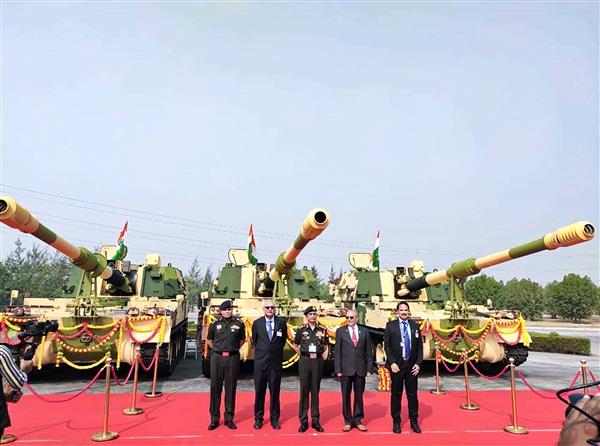
Indian Army Chief General M M Naravane flagged off the 100th K-9 Vajra-T during his visit to Larsen & Toubro (L&T) Defence, Hazira, Surat. PTI
New Delhi, February 18
Chief of Army Staff Gen MM Naravane on Thursday flagged off the 100th K-9 Vajra tracked self-propelled howitzer from a production facility of its maker Larsen and Toubro at Hazira near Surat.
The Indian Army said Larsen and Toubro (L&T) has supplied 100 units of indigenously made K-9 Vajra-T 155 mm/ 52 calibre self-propelled guns to it so far.
In a statement, L&T said with the flagging-off of the 100th howitzer, the company has successfully completed delivery of all guns under the existing contract awarded to it by the Ministry of Defence in May 2017.
The company said it has maintained its track record of “ahead of time deliveries” of complex platforms.
Defence Minister Rajnath Singh had flagged off the 51st K9 VAJRA in January last year from Hazira.
As a part of its ‘Make-in-India’ initiative, the company established a green-field manufacturing-cum-integration and testing facility at its Hazira manufacturing complex near Surat to produce the guns.
The ‘Armoured Systems Complex’ at Hazira was dedicated to the nation by Prime Minister Narendra Modi in January 2018.
L&T Defence produced the ‘K9 VAJRA’ under a contract awarded to it through global competitive bidding. L&T was the prime bidder for the programme with South Korean defence major Hanwha Defence, the original equipment maker of the world’s top rated howitzer the ‘K9 Thunder’, as its technology partner.
“The production of complex platforms like the K9 VAJRA contributes to the Indian economy with a large multiplier effect, creates new job opportunities and plays a significant role in enhancing India’s industrial ecosystem,” said J D Patil, Whole-Time Director and Senior Executive Vice President (Defence and Smart Technologies) of L&T.
“With the experience, track-record, skills, capabilities and infrastructure that L&T has built, we are ready to indigenously develop, and build India’s future capabilities,” he said.
Patil said with the supply of 100th K9 VAJRA howitzer, L&T have created an industry benchmark by delivering the only in-service equipment of its class, a major land-based programme ahead of schedule.
“We hope and believe that under the Aatmanirbhar Bharat policies of the Government of India, the national asset created in the form of the Armoured Systems Complex to execute this ambitious contract, will provide sustenance to the painstakingly built supply chain of more than 1000 MSME partners,” he said.
The company said ‘K9 VAJRA’ systems are delivered with more than 80 per cent indigenous work packages and above 50 per cent indigenisation (by value) at the programme level.
It said the project involved local production of over 13,000 components per system through a supply chain spread across the states of Gujarat, Maharashtra, Karnataka and Tamil Nadu. PTI
On February 10, China’s Defence Ministry spokesman announced that the Chinese and Indian frontline troops at the Pangong Lake in eastern Ladakh started synchronised, organised disengagement
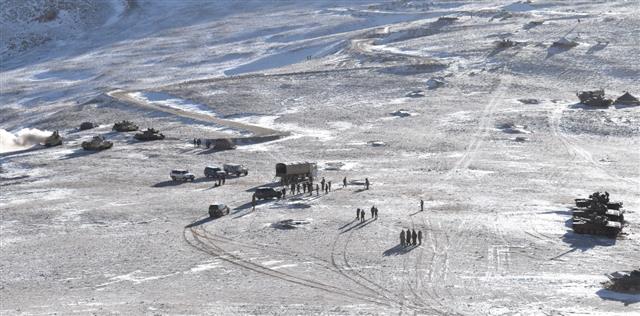
A handout photo released by Indian Army on February 16, 2021, shows the disengagement process between Indian Army and China’s Peoples Liberation Army from a contested area in the western Himalayas, in Ladakh region. Indian Army/Handout via REUTERS
Beijing, February 18
China on Thursday said the disengagement process of the Chinese and Indian frontline troops at the eastern Ladakh border was progressing smoothly and expressed hope that both sides will make concerted efforts to achieve the goal.
On February 10, China’s Defence Ministry spokesman Senior Colonel Wu Qian announced that the Chinese and Indian frontline troops at the South and North banks of the Pangong Lake in eastern Ladakh started synchronised and organised disengagement.
“To my knowledge, things are progressing smoothly in general. We hope both sides will continue to move towards each other, strictly comply with the consensus reached and agreements signed, and ensure the smooth completion of the disengagement process,” Foreign Ministry spokesperson Hua Chunying said when asked how the disengagement process is proceeding.
“Based on the consensus reached by the Chinese and Indian sides in rounds of consultations through diplomatic and military channels, frontline troops of both sides in the Pangong Lake area started on February 10 to organise disengagement in a synchronised and planned manner,” she said.
About the timeline of the disengagement of the troops, she said: “I don’t have any at the moment and refer you to the military.”
After nine months of border standoff in eastern Ladakh, the two armies reached an agreement on disengagement in the North and South banks of Pangong Lake that mandates both sides to cease forward deployment of troops in a “phased, coordinated and verifiable” manner.
The Indian Army on Tuesday released short videos and photographs showing thinning down of troops and dismantling of bunkers, camps and other facilities by the Chinese military in the areas around the Pangong lake in eastern Ladakh in line with the agreed disengagement process between the two sides.
The visuals also showed the Chinese People’s Liberation Army (PLA) using a bulldozer to flatten some structures, and vehicles with troops and equipment preparing to retreat to rear bases as part of the infantry disengagement. PTI
Chandigarh, February 18
Farmers on Thursday sat on railway tracks at many places in Punjab and Haryana as part of the four-hour ‘rail roko’ protest against the Centre’s three farm laws, with officials saying trains were halted at stations as a precautionary measure.
Normal movement of trains on various rail routes was disrupted as farmers squatted on tracks.
The Samyukta Kisan Morcha (SKM), an umbrella body of farmer unions which is spearheading the protest, had last week announced the nationwide rail blockade to seek the repeal of the three farm laws.
The farmers sat on tracks as part of the ‘rail roko’ agitation from 12 noon to 4 pm.
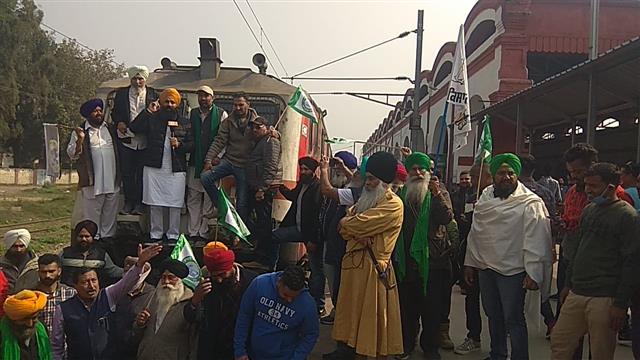
Farmers at Kurukshetra in Haryana climbed on the locomotive of the Gita Jayanti Express train, which had been stopped at the station.
“The train was scheduled to leave from the Kurukshetra station after 3 pm,” a railway official in Kurukshetra said, adding the farmers did not allow the train engine to change its end for some time.
Also read:
Farmers not going home, will head to Kolkata soon: Rakesh Tikait
Negligible impact of ‘rail roko’ call on train services: Railways
In Punjab, protesters sat on tracks at many places on the Delhi-Ludhiana-Amritsar railway route, officials said.
They blocked the Jalandhar Cantt-Jammu railway track in Jalandhar.
Farmers also squatted on railway tracks at Mullanpur, Dakha and Jagraon on Ludhiana-Ferozepur rail route in Ludhiana, said officials.
Bathinda-Delhi rail track in Bathinda, Delhi-Amritsar track in Amritsar, Amritsar-Tarn Taran track were also blocked by protesters.
In Haryana, protesting farmers, including women, squatted on railway tracks at many places, including those in Ambala, Kurukshetra, Panipat, Panchkula, Rohtak, Sonepat, Hisar and Fatehabad districts, the officials said.
At some places, including those in Jind and Fatehabad districts, farmers could be seen smoking ‘hookahs’ while sitting on tracks.
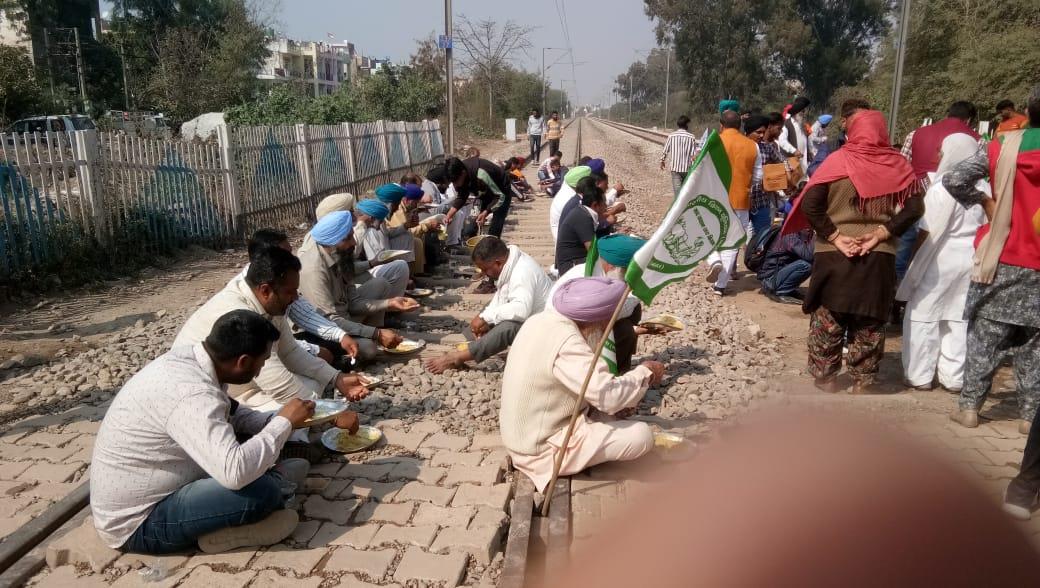
On the Ambala-Delhi railway section, a group of farmers led by Bharatiya Kisan Union (BKU) leader from Ambala, Gulab Singh Mankpur, squatted on a track at Shahpur village, about 2 km from the Ambala Cantt station.
“Our protest will continue in a peaceful manner till the farm laws are repealed,” said Manakpur.
Security was beefed up in both Haryana and Punjab with the government railway police and state police personnel having been deployed at many places in the two states, officials said.
Ferozepur’s Divisional Railway Manager Rajesh Aggarwal said farmers are staging ‘dharnas’ at around 50 places.
He, however, added that neither any train was cancelled nor diverted because of farmers’ agitation.
The Ferozepur division of the Northern Railways halted some trains at stations so that passengers face less inconvenience during the ‘rail roko’ protest.
The halted trains included Malwa Express at Phagwara railway station, Super Express train at Jalandhar Cantt (in down direction), Malwa Express (up direction) at Pathankot Cantt station and Paschim Express at Ludhiana railway station.
Trains which were to run between 12 noon and 4 pm, were also halted at their respective stations, he further said, adding such trains included Dhanbad Express stopped at Ferozepur Cantt and Shahid Express at Amritsar.
Railway officials said train services would be resumed with necessary security protocols as and when farmers’ dharna’ is lifted.
The officials said the movement of trains to their destinations would be delayed because of the farmers’ rail blockade.
In Haryana, besides railway police personnel, the Haryana Police had deployed its staff in large numbers near protest sites and at various railway stations.
Divisional Railway Manager, Ambala Division, G M Singh said no train had been cancelled due to the rail roko’ agitation.
The Ambala DRM, however, said mail and goods trains were stopped at Saharanpur (UP), Ambala (Haryana) and Sirhind (Punjab).
These three railway stations fall in Ambala Railway Division of the Northern Railways.
In Jind, the railway tracks were blocked near Barsola village, where a large number of farmers, including women, squatted on them.
In Yamunanagar railway station, farmers squatted on Yamunagar-Jagadhri rail track while in Bahadurgarh, farmers, including women, with many of them carrying tricolour in their hands, sat on tracks.
In Sirsa too, farmers sat on railway tracks. Carrying placards, some of which read “Kheti Bachao, Roti Bachao” in their hands, they raised slogans against the government demanding the repeal of laws.
Farmers staged dharnas also on Hisar-Sadulpur, Hisar-Bhiwani, Hisar-Sirsa and Hisar-Jakhal rail tracks.
Protesters including women sitting on rail tracks and carrying flags of farmers’ bodies shouted slogans against the Centre and sought repeal of the farm laws.
BKU (Ekta Ugrahan) general secretary Sukhdev Singh Kokrikalan said they blocked railway tracks at 22 places, including at Nabha, Mansa, Barnala, Bathinda, Ferozepur, Jalandhar and Tarn Taran, in Punjab.
Haryana BKU chief Gurnam Singh Chaduni had earlier appealed to the farmers to assemble at designated spots in their respective districts to make the protest a success.
He had also appealed to the farmers to protest peacefully. PTI
Officials stop Malwa Express at Phagwara and Super Express at Jalandhar Cantt
MOGA: Farmers staged protests on rail tracks at 50 locations falling under the Ferozepur railway division in Punjab and Jammu and Kashmir, said senior railway authorities.
Rajesh Aggarwal, divisional manager, said the farmers protested at 50 locations due to which the railway authorities stopped Malwa Express at Phagwara and Super Express at Jalandhar Cantonment.
Similarly, the trains were also stopped at Pathankot, Ludhiana, Barhi Brahman, Kathua and Vijaypur towns.
He said the trains were stopped at their stations of halt at noon, and would be regulated later in the evening.
The Dhanbad Express has been regulated from Ferozepur Cantonment railway station, Shaheed Express from Amritsar and Begampura train from Jammu Tawi railway station.
Aggarwal said the trains halted at various railway stations would be allowed to commence their journey after 4 pm by following all protocols of security.
No train has been cancelled or diverted from their original route, he clarified. TNS
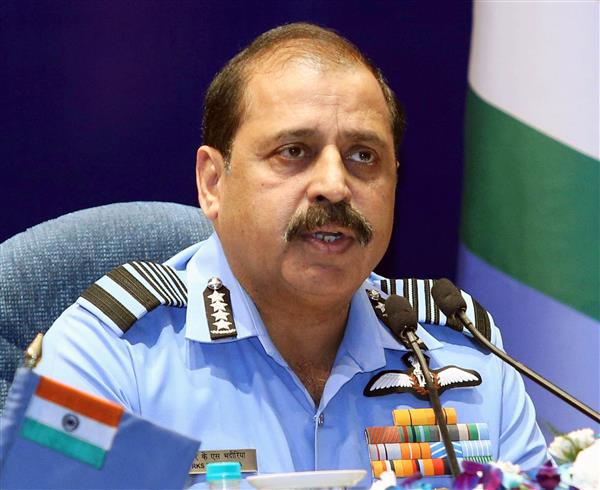
Indian Air Force (IAF) chief Rakesh Kumar Singh Bhadauria. — File Photo
New Delhi, February 18
Recalling the decisive Battle of Longewala, IAF chief Air Chief Marshal R K S Bhadauria on Thursday said the plan of armoured thrust by the Pakistan army was “brilliant” and could have changed the course of the 1971 war, but the only thing it probably forgot to factor, was India’s air power.
The Pakistan army forgot what half a squadron of Hunter aircraft sitting in Jaisalmer could do, and that was probably their “only mistake”, he said.
India is celebrating the 50th anniversary year of the country’s victory over Pakistan in the 1971 war.
The Indian Air Force (IAF) chief was speaking at the launch of a book ‘The Epic Battle of Longewala’ authored by Air Marshal (retd) Bharat Kumar at the IAF Museum at Palam.
The dais and chairs for audience was placed centrally in an open courtyard flanked by two T-59 tanks of the Pakistan army damaged during the battle, and Hunter and Krishak and other aircraft, which played a critical role during the battle.
“A lot has been said about the Battle of Longewala. And, the plan of armoured thrust by Pakistan army itself was brilliant in terms of the area and axis chosen, the Longewala-Jaisalmer axis, and if it had succeeded, it would have changed the course of the war on the western front and the final result,” Bhadauria said.
“The only thing the Pakistan army probably forgot to factor, was India’s air power. And, they thought what half a squadron of Hunter aircraft sitting in Jaisalmer could do, and that was probably their only mistake,” he said.
The IAF chief also said the Battle of Longewala brings to light a scenario where air power can bring “asymmetric results if time and place chosen correctly”.
“On air power, over the decades, we have learned our lessons well, and graduated to a stage where it has been incorporated deep into our plan, synergy and interaction with the services,” he said.
The IAF chief said it was important that stories of valour are documented in books and passed on to the next generations. — PTI
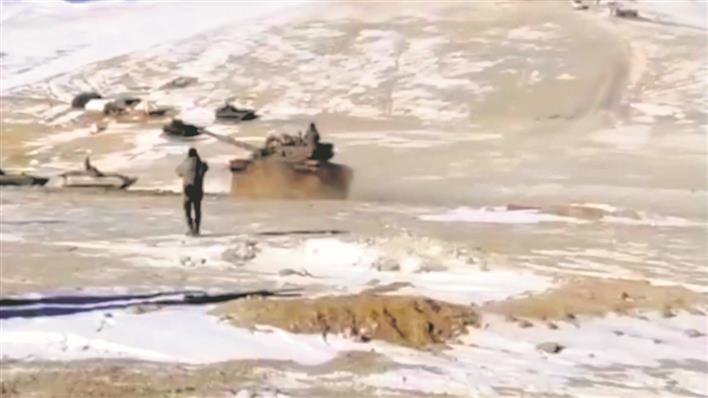
Indian and Chinese troops pulling back in eastern Ladakh. PTI File
New Delhi, February 18
The disengagement process between India and China in eastern Ladakh is in final stages and on the brink of completion, top officials of the country’s defence establishment told a parliamentary panel during a meeting on Thursday.
The meeting, said sources, turned “stormy” amid several questions asked by opposition members, including Congress leader Rahul Gandhi.
Chief of Defence Staff Gen Bipin Rawat, top officials from the three armed forces and Defence Secretary Ajay Kumar on Thursday deposed before the Parliamentary Standing Committee on Defence chaired by BJP leader Jual Oram.
The meeting witnessed an argument between Oram and Gandhi when the Congress leader asked some specific questions to the officials deposing before the panel, which the chairman felt was not on the agenda of the meeting, sources said.
Also read: China says disengagement of Chinese, Indian troops in eastern Ladakh going on smoothly
The agenda of the meeting was to examine demands for grants of the Defence Ministry in this year’s Budget.
In the presentation before the panel, officials informed that Indian Air Force (IAF) for the year was planning to acquire Light Combat Helicopter (LCH), Avro transport aircraft replacement, upgrade of UAV systems, Harop (P-IV), Avionics upgrade of IL-76, IL-78 among others, according to sources.
The committee was also informed that the 83 Tejas aircraft, acquisition of which was approved by Union Cabinet last month, will be inducted in four squadrons. Induction of these aircraft would augment the present overall fighter squadron strength of IAF and would partially offset the phasing out of MiG-21 and MiG-27 squadrons, said sources.
Responding to members’ question, top officers from armed forces also informed the panel that the disengagement between armed forces of India and China in eastern Ladakh was in final stages and on the brink of completion, sources in the panel said.
Earlier in a statement given to both Houses of Parliament during the first part of the Budget Session, Defence Minister Rajnath Singh had said India and China have reached an agreement on disengagement in the north and south banks of Pangong lake in eastern Ladakh to “cease” forward deployment of troops in a “phased, coordinated and verifiable” manner.
Singh had also assured that India has not conceded anything in the sustained talks with China and it will not allow even an inch of its territory to be taken away by anyone. PTI
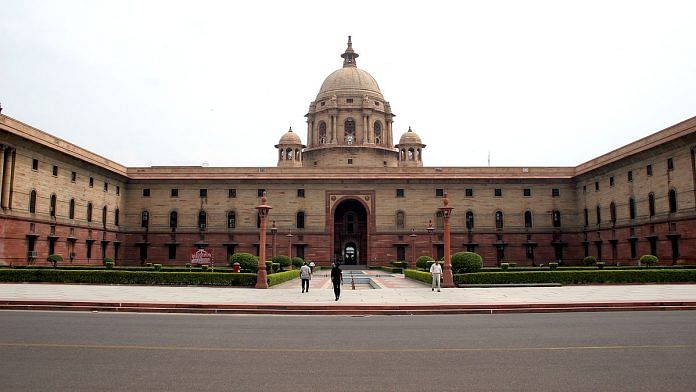
New Delhi: The Union Cabinet on Wednesday approved financial powers to clear projects worth up to Rs 200 crore to the deputy chiefs and command heads of the armed forces for capital procurement projects, officials said.
The financial powers have been approved for projects under the ‘Other Capital Procurement Procedure’ category, they said.
Financial powers to clear projects worth up to Rs 200 crore have been delegated to Deputy Chief of Army Staff, Air Officer Maintenance and Deputy Chief of Integrated Defence Staff as well as to additional director general of Indian Coast Guard.
“This delegation of powers within service headquarters and up to command level for items of capital nature such as overhauls, refits, upgrades etc. will enhance the utility of existing assets and will facilitate faster processing and implementation of projects,” the defence ministry said.
As per the approval, financial powers for capital procurement projects worth up to Rs 100 crore have been delegated to General Officer Commanding-in-Chief (GOC-in-C), Flag Officer Commanding-in-Chief (FOC-in-C), Air Officer Commanding-in-Chief (AOC-in-C) at services commands and regional commands, officials said.
Also read: India must allow armed forces to raise own finances. Defence budget will never be enough
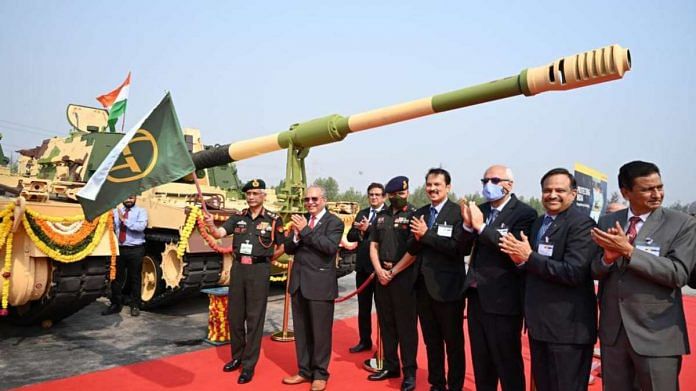
New Delhi: Leading Indian private defence major Larsen and Toubro (L&T) Thursday successfully completed delivery of the last and 100th K9 Vajra 155mm/52 calibre Tracked Self-Propelled Howitzer, which was flagged off by Army Chief General M.M. Naravane at Hazira near Surat in Gujarat.
With the company delivering ahead of schedule the massive Armoured Systems Complex (ASC) at Hazira, which has its own track, it is likely to go into hibernation mode with no new contract expected in the immediate future.
The ASC is spread over 40 acres within the L&T’s 755-acre Hazira Manufacturing Complex.
Sources in the defence and security establishment said the Defence Research and Development Organisation (DRDO) and the L&T are in talks with each other to possibly convert the Tracked Self-Propelled Howitzer into a light or medium-weight tank that could be used in mountain regions like Ladakh.
Three of its howitzers have already reached Leh for high-altitude trials, which could eventually pave way for the Vajras to be converted into a tank.
While India currently operates the T-72 and T-90 tanks, it is felt that there is a need for lighter tanks, which can operate more easily in mountainous terrains.
The Army is internally looking at the possibility and the practicality of having a light tank, which could come handy in situations similar to the Ladakh stand-off.
But the Army, sources said, is unlikely to go in for the more formidable K9 Vajras as the plan was to have only five regiments, which are meant for the desert area.
L&T had in 2017 won the Rs 4,500-crore contract to supply 100 units of K9 Vajra under the ‘Make in India’ initiative for which they had signed a transfer of technology contract with South Korean company, Hanwha Corporation.
Also read: How Army’s artillery modernisation plan, stuck in a rut after Bofors, is picking up pace
Talking about the possible ‘Vajra tank’, defence sources said the idea is to replace the heavy 155 mm gun with a 105 mm or 120 mm gun.“The chassis or the hull remains the same. The massive 155 mm gun can be replaced by a 105 mm or even 120 mm gun, which will reduce its weight drastically as the design of the turret also changes,” a source said.
“More weight reducing technology and material can be used, which will bring down the weight by at least 10 tonnes. This means that the Vajra tank can actually weigh around 30 tonnes or somewhere close, which can be deployed in the mountains,” the source added.
Lt Gen. P.R. Shankar (retd), who is the former Director General of Artillery, had last year pitched for the Vajra to be turned into a light tank, saying the current China-Indian stand-off has highlighted the lack of a suitable tank for high altitudes.
Meanwhile, J.D. Patil, whole-time director and senior executive vice president (defence and smart technologies), L&T, said in a statement, “We hope and believe that under the Atma Nirbhar Bharat policies of the Government of India, the national asset created in the form of the Armoured Systems Complex to execute this ambitious contract, will provide sustenance to the painstakingly built supply chain of more than 1,000 MSME partners.”
He added that the production of complex platforms like the K9 Vajra contributes to the Indian economy with a large multiplier effect, creates new job opportunities and plays a significant role in enhancing India’s industrial ecosystem.
“With the experience, track-record, skills, capabilities and infrastructure that L&T has built, we are ready to indigenously develop, and build India’s future capabilities,” he said.
The company added that the K9 Vajra systems are delivered with more than 80 per cent indigenous work packages and above 50 per cent indigenisation (by value) at the programme level.
It added that L&T had started indigenisation, right from the inception of the programme by replacing 14 critical systems in the Korean ‘K9 Thunder’ with indigenously developed and produced systems for the trial gun fielded for user evaluation trials.
Also read: Artillery weapons including K9 Vajra & M777 howitzers to be inducted into India’s defence