Sanjha Morcha

What’s New

Click the heading to open detailed news

Current Events :

web counter

Print Media Reproduced Defence Related News

Tackle Maoists with a top-down approach

One way out is to get the Army to depute senior officers (from colonels to generals) with experience in counter-insurgency operations to command the CRPF paramilitary men under the Home Ministry. If the Army can provide officers for the NSG and Establishment 22, which are under the Home Ministry or the PMO, then why not for anti-Maoist operations?
Tackle Maoists with a top-down approach

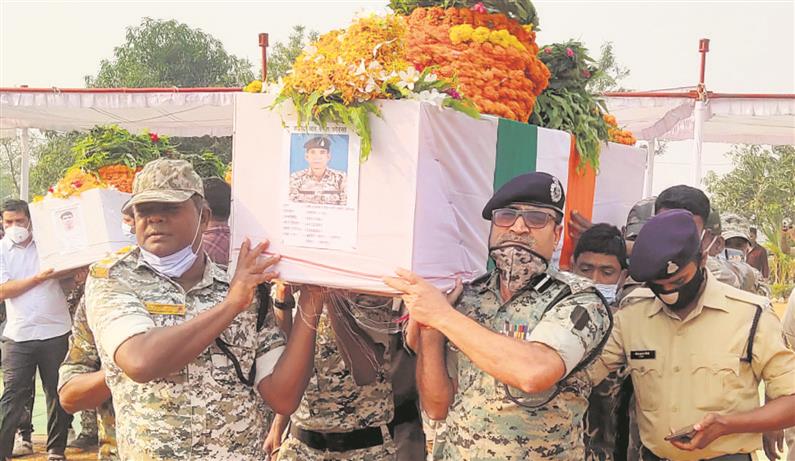
SIMILAR PATTERN: Hundreds of policemen from various cadres have been killed in attacks by Maoists, mostly in the past two decades. PTI
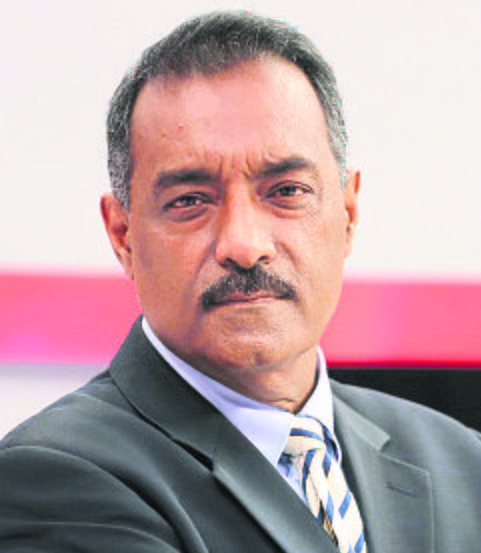
Maroof Raza

Senior Journalist

The latest ambush by Maoist rebels on a large contingent of security personnel in Bastar is yet another well-planned and ruthlessly executed attack in a long line of similar attacks in the Maoist-infested regions of central India.

Hundreds of policemen from various cadres have been killed in attacks, mostly in the past two decades, by well-armed Maoist rebels in the region. Often, the pattern of their ambushes is similar to that of the past. It’s either on a large posse of security personnel making their way back to camp after a tiring few days of operations in the jungles and when their guard is down. Or, it is an attack on a police camp, which can never be quite completely fortified.

But there are ways to prevent such massacres. This requires a top-down approach, and not a bottom-up one, to address the challenges across the several states where insurgency has existed for at least three decades, much like the way the Indian Army has been deployed in the north-eastern states.

Maoist insurgents have been expanding their footprint across the heartland over the past three decades and their red line of rebellion now runs from Pashupati (in Nepal) to Tirupati (in south India). At its height, the Maoist insurgency was visible in over 200 districts across, most severely, in central India.

And though our earlier Prime Minister Manmohan Singh has stated on record on more than one occasion that the Maoist insurgency “was the single biggest internal security challenge ever faced by our country”, Delhi’s efforts then and now have been a piecemeal exercise.

One problem is the federal nature of India, and the resistance of state governments. It limits what the Central government can do to tackle the challenges comprehensively. One state’s insurgent cannot be a vote bank for another state! Sadly, politics often takes precedence over the safety of citizens, and, in this case, the overstretched policemen operating in these areas, without an adequate senior police leadership.

A decade ago, a DGP of the CRPF had told me that it was a challenge for him to get enough CRPF senior officers (IGs and DIGs) to move out of the comfortable cities that they were based in to command their forces on the battlefields. Since IPS officers neither have the experience nor the inclination to battle insurgencies, they are reluctant to be based in operational areas and their troops are devoid of effective leadership, unlike the Army officers who have to command their troops from operational areas.https://5bf0bad335ac4e31633b1db594d17f2a.safeframe.googlesyndication.com/safeframe/1-0-38/html/container.html

One way out is to get the Army to depute senior officers (from colonels to generals) with experience in counter-insurgency operations to command CRPF paramilitary men under the Home Ministry. If the Army can provide officers for the NSG and Establishment 22, which are under the Home Ministry or the PMO, then why not for anti-Maoist operations? Moreover, with the Army being so top heavy, the opening of new avenues for officers will be an opportunity for them, many of whom are doing the job that one brigadier or major-general did decades ago in the corps/command/Army headquarters. And those JCO/NCOs retiring at a relatively young age, with experience in CI Ops can be offered the opportunity to serve in the Maoist-infested zones.

There would be the usual objections — from the Army headquarters and the CRPF — about how this can create inter-service manpower and budgeting issues, but if there is a will, there will be a way. A year ago, a Chinese incursion on the LAC led us to abandon the plans and doctrines that seemed to have been etched in stone. What will it take us to wake up to the threats posed on the lives and limbs of the policemen who are sent into the jungles, again and again, to be slaughtered? A decade ago, the then Home Secretary RK Singh wanted to up the ante by asking for 30,000 men from the Army’s Rashtriya Rifle units and helicopters. But he had run into opposition in Delhi, with the Army Chief reluctant to apply “quick-fix-solutions” by using excessive force.

And with the Maoists having shot down an IAF helicopter in Chhattisgarh’s Sukma district a decade ago, the reluctance to use helicopters — even for non-aggressive operations like reconnaissance and movement of troops to reinforce operations — gathered momentum in New Delhi. This must now be reviewed.

Historically, insurgencies have been contained and eliminated by a three-part strategy that involves: (a) The use of necessary military force to counter the aggressiveness of insurgents; (b) and while military operations are being enforced — although this could take from a few months to few years — the government must have ideas and initiatives ready, with plans for infrastructure upgrades that would address the basic grievances of the alienated people, who took to arms in the first place. (c) finally, when military operations are reduced to a minimum and the ground situation is under control with the implementation of such initiatives, then ‘talks’ must be initiated to address the political demands of the locals, with fixed timelines for political deliverables.

Essentially, there are two ways to confront insurgencies. One is to manage it at a low-key level, like New Delhi has done for decades in the North-East. The other is to go hammer and tongs, as the Sri Lankan forces eventually did against the LTTE, to finish off any serious resistance by the Tamil militants.

Above all, to successfully battle an insurgency, all major governmental agencies must be on the same wavelength. For the armed forces to distance themselves from the challenges of this grave challenge by claiming that this is not their battle (while the insurgencies in the North-East and Kashmir are) shows double standards. The PM and the National Security Adviser would do well to exercise their authority to get the forces to participate in and collectively address a problem that cannot have a knee-jerk approach, notwithstanding strong political warnings that translate to little on the ground.

Chhattisgarh attack

Centre, state must work in sync to quell Maoist insurgency

Chhattisgarh attack

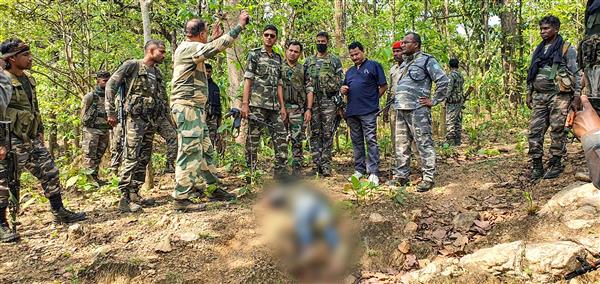
Even as the powers that be are busy sticking the ‘urban Naxal’ label on all kinds of people, be it students or protesting farmers, the real Naxals keep striking deep in the forest at regular intervals. – File photo

Even as the powers that be are busy sticking the ‘urban Naxal’ label on all kinds of people, be it students or protesting farmers, the real Naxals keep striking deep in the forest at regular intervals. Twenty-two security personnel were killed and 31 others injured in a Maoist ambush in Chhattisgarh’s Bastar region on Saturday. Bastar has been the epicentre of major Maoist attacks in recent decades, including the deadliest one that claimed the lives of 76 CRPF men in April 2010. Several other states are also grappling with the menace. In May 2019, insurgents had triggered an improvised explosive device in Maharashtra’s Gadchiroli district, killing 15 members of a police quick response team.

According to reports, an unverified intel input lured the security forces into the Maoists’ lethal trap. This grave lapse needs to be probed thoroughly so that responsibility can be fixed and another disaster avoided. The Chhattisgarh incident has elicited the usual platitudes from the state and Central governments about giving a ‘befitting response’ and ‘never forgetting the sacrifices of the martyrs’. Undoubtedly, the killings have belied the tall claim that Maoist insurgency is on its last legs.

Naxal/Maoist violence has claimed more than 12,000 lives in the country, including those of around 2,700 security personnel, in two decades. There is no denying that a lot has to be done to break the back of the terrorists, right from snapping their supply of money, arms and ammunition and ensuring development in the infested areas to giving a cutting edge to the security forces in terms of intel, training and equipment. It’s also imperative to weaken local support for the insurgents by providing adequate education and job opportunities to residents. The blame game between the state and the Centre is uncalled for. Both have to work in close coordination to root out insurgency. At the same time, the noxious practice of raising the bogey of Naxalism to vilify protesters has proven to be counter-productive while targeting real culprits.

Covid surge

An alarming second wave demands adult vaccination

April is all set to be a challenging month for the people and government alike with Covid-19 restrictions getting expanded and lockdown measures reintroduced in some states. A sudden surge in coronavirus cases, the steepest since September 16 last year, with the country recording over one lakh cases on Monday, has meant that a return to normalcy is going to take a while longer, ironically when the trajectory was expected to head south aided by vaccine optimism. But with only 10 states accounting for a majority of the cases, the government has preferred instead a national campaign beginning today to ensure community participation, Covid-appropriate behaviour, personal hygiene and sanitation to check the spike even as some countries like France and Bangladesh have seen a weeklong lockdown being implemented. The rise in infections itself has been attributed to a severe decline in Covid protocol, pandemic fatigue and lack of effective containment measures. The impact on employment in business and industry will also unfold gradually, with restrictions impacting the workforce and output. Railway stations in states like Maharashtra have witnessed a rush of migrant workers bound for their home states.

The government, unwilling to fritter away the gains of managing the pandemic, has deputed health teams to visit the states witnessing a surge, with directives to curb the mortality rate and ramp up healthcare infrastructure. Faced with the task of rejuvenating the economy, emphasis is being laid on testing, tracing, treatment and vaccination to prevent the situation from getting out of hand that makes the task of protecting the economically vulnerable groups even more onerous.

The health authorities should get down to micro-managing the vaccination, zeroing in on regions witnessing the spike and taking steps that are required to avoid disruption to life. While the Centre has delegated to the states the discretion to take decisions based on local conditions in this case, frequent resort to restrictive measures will call for scrutiny. A fair bit of responsibility will also lie with the people by ensuring that they abide by the desired norms.


Haryana arhtiyas oppose DBT, may boycott purchase

Haryana arhtiyas oppose DBT, may boycott purchase

Additional Chief Secretary Sumita Misra at the Karnal grain market on Monday. Tribune photo

Parveen Arora

Tribune News Service

Karnal, April 5

Arhtiyas have opposed the Direct Benefit Transfer (DBT) to farmers against the payment for grain procurement and threatened to boycott wheat buying from April 8 if the payment was not resumed through them.

In a state-level meeting of arhtiyas held here, the Haryana State Anajmandi Arhtiyas’ Association also demanded dues of the last paddy season, 12 per cent interest on the delay in releasing the payment and permission to farmers residing in border areas to sell their crop in Haryana.

Ashok Gupta, state president of the association, said: “The state government had told us that the payment will be transferred as per the will of farmers. A majority of farmers have already given their consent to transfer their payment through arhtiyas while registering their crops on the Meri Fasal, Mera Byora portal. In spite of this, the government has said it will credit the payment in the bank accounts of farmers.”

“The state government has time till April 7 to meet our demands, otherwise we will boycott the procurement from the next day,” he said.

The state government has assured arhtiyas that they would continue to get their commission even if farmers are directly paid for their produce. This, however, is not the concern of arhtiyas.

Gupta said: “Arhtiyas are like ATMs to farmers, who borrow money from us in times of crisis. They pay off the debt after having sold their crop. If the state government pays farmers directly, we won’t get our money back. Payment through arhtiyas is a guarantee that we will get out money back.”

Rajnish Chaudhary, president, Karnal Arhtiyas’ Association, raised another concern related with the DBT scheme. “Last season, the Agriculture Department had transferred the payment to wrong bank accounts. Till now, farmers have not received the money,” he said.

He further said payments were pending because “I” forms were not available online. “The state government should start a portal on the lines of CM window to address the grievances of arhtiyas and farmers.”

After the state-level meeting, a delegation of arhtiyas led by Gupta left for Chandigarh for a meeting CM Manohar Lal Khattar. After having met the CM, Gupta said arhtiyas were adamant on their demand.


Govt’s assurance

The state government has assured arhtiyas that they would continue to get their commission even if farmers are directly paid for their produce. This, however, is not the concern of arhtiyas.


Won’t allow Guru Teg Bahadur’s statue in Delhi, Sikh bodies tell Centre

Say idol worship against tenets of religion

Won’t allow Guru Teg Bahadur’s statue in Delhi, Sikh bodies tell Centre

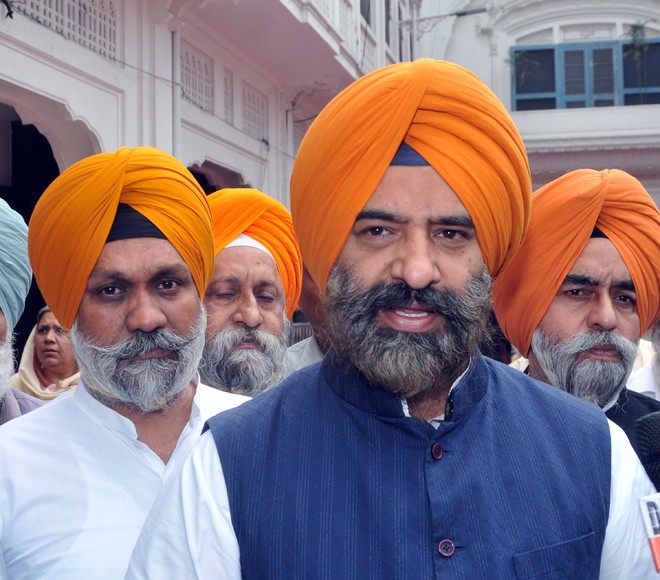
Manjinder Singh Sirsa, DSGMC chief

GS Paul

Tribune News Service

Amritsar, April 4

The Centre’s proposal to set up a ‘memorial’ or a ‘statue’ dedicated to the 400th birth anniversary of Guru Tegh Bahadur outside Gurdwara Sis Ganj Sahib, Chandni Chowk, in old Delhi, has triggered a controversy.

Live Gurbani kirtan from Amritsar’s Gurdwara Guru Ke Mehal begins

Following reports in this regard, the Delhi Sikh Gurdwara Management Committee (DSGMC) has lodged its protest with the Prime Minister’s Office (PMO) asking it to immediately drop the proposal of erecting a statue or any kind of structure outside Gurdwara Sis Ganj Sahib or anywhere else in Delhi.

Not consulted

We will never allow the Centre to have direct intervention in our religious matters. Neither the SGPC nor the DSGMC was taken into confidence before planning this proposal. — Manjinder Singh Sirsa, DSGMC chief

The DSGMC and Shiromani Gurdwara Parbandhak Committee (SGPC) said the installation of the statue of the Guru would defy the Sikh ‘rehat maryada’ which prohibits creating idols of Gurus.

Delhi Sikh Gurdwara Management Committee president Manjinder Singh Sirsa has shot off a letter to PM Narendra Modi contesting that the statue of Guru or any memorial could not be built without taking the Sikh body into confidence.

Special coins, stamp to mark 400th anniversary of Guru Tegh Bahadur

“We will never allow the Centre to have direct intervention in our religious matters. Nothing can be built outside the historic shrine. The statue culture is certainly against our tenets and any kind of structure about which we don’t have an idea will create unrest. Such a proposal will end up hurting Sikh sentiments and hence this proposal should be withdrawn. Ironically, neither the SGPC nor the DSGMC was taken into confidence before conceptualising a proposal that directly relates to the Sikh religion,” he said.


Withdraw land record term for purchase: BKU

Seeks legal action for below MSP buy

Withdraw land record term for purchase: BKU

Photo for representation only

Ludhiana, April 5

In response to a call given by the Samyukt Kisan Morcha, activists of BKU (Ekta Ugrahan) today laid siege to a FCI godown in Malaud village.

BKU general secretary Sudagar Singh Ghudani said they wanted the government to withdraw the condition of producing jamabandi (of land) for the purchase of wheat. Stressing the need for purchase of all crops at MSP, farmers demanded that provisions be made for strict legal action against those purchasing wheat, paddy and other crops below decided prices.

They also urged the government to ensure all purchase centres, including FCI, remained operational and adequate funding be provided to all procurement agencies. — OC

Farmer unions protest outside FCI offices

Farmer unions protest outside FCI offices

Farmers protest outside the District Food and Civil Supplies Controller’s office in Amritsar. Vishal Kumar

Tribune News Service

Bathinda, April 5

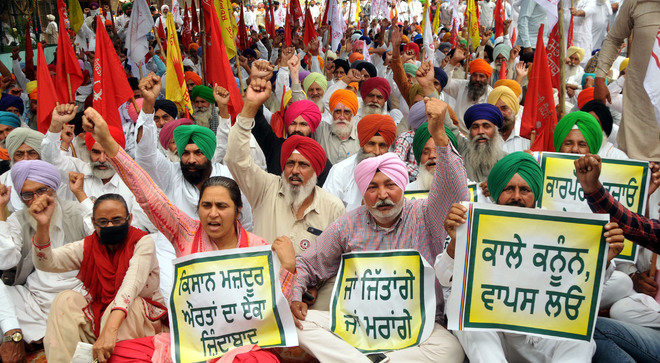
Farmer unions staged protests outside FCI offices against new procurement norms and quality specification announced by the government in Bathinda and Mansa districts. Protesters also raised slogans against the central government for its move regarding the direct transfer of payment for procurement of crops into farmers’ bank accounts.

Scores of farmers, under the banner of Ugrahan, Sidhupur, Dakonda and Lakhowal factions of the Bhartiya Kisan Union (BKU) and other organisations owing allegiance to Samyukt Kisan Morcha, particpated in the protest.

BKU (Sidhupur) general secretary Baldev Singh Sandoha said: “We strongly condemn the Centre’s new procurement norms. These will affect many farmers as a large quantity of wheat would not fall under the moisture content limits fixed by the government. They, therefore, would be coerced to sell it to private agencies on low rates. These are devious plans of the government that is trying to give reins of agriculture sector in the hand of private players. If the decision is not revoked, protests would be intensified in the coming days.”

BKU (Ugrahan) president Ram Singh Bhaini Bagha said: “With such moves, the Centre wants to weaken the government procurement agencies and end the public distribution system (PDS) and APMC mandis. This is being done to help private players enter the market to not only fix the prices as per their business interests, but also exploit the agriculture sector at the expense of farmers. If the decision with regard to DBT and revised procurement norms for wheat are not revoked, we will start the gherao of government procurement agencies’ officials in the coming days.”


CM reiterates support to farmers, arhtiyas

CM reiterates support to farmers, arhtiyas

Capt Amarinder Singh, CM

Tribune News Service

Ludhiana, April 5

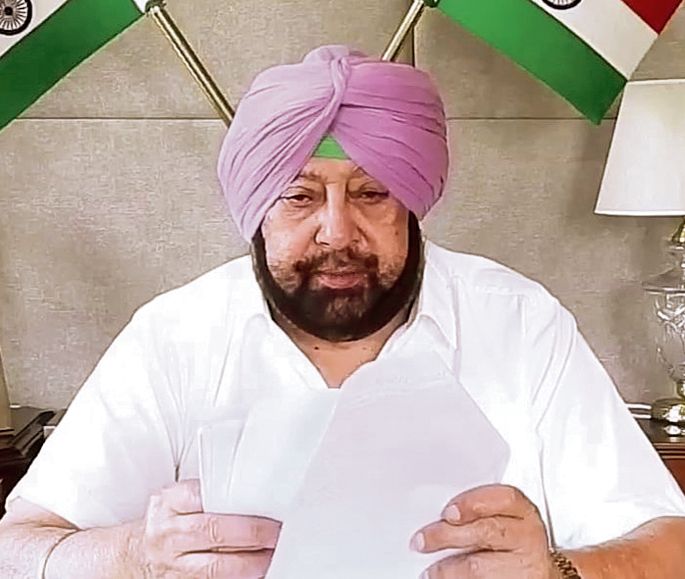
Reiterating his full support to farmers and arhtiyas, Chief Minister Capt Amarinder Singh on Monday flayed the central government for “encroaching upon the rights of the states in its bid to dominate them” and castigated it over forcible imposition of the farm laws and the direct benefit transfer (DBT).

“States never faced such problems earlier,” he said, slamming the Centre for allegedly trying to destroy the existing relations and systems that have worked well for more than 100 years in the name of so-called reforms.

Punjab’s farmers and arhtiyas have age-old cordial ties, which the Centre was hell bent on damaging, he said, terming its tough posturing and ill-conceived decisions against the basic spirit of federalism. He said during his earlier tenure, he enjoyed the full confidence of Late PM Atal Bihari Vajpayee and Dr Manmohan Singh in all major policy decisions and development issues related to Punjab.

Centre not sincere

Had the Centre been sincere about finding a workable solution to the problem, it would have either consulted the Punjab Government or farmers. —Capt Amarinder Singh, CM

Virtually launching the two-day kisan mela organised by Punjab Agricultural University (PAU), Ludhiana, the Chief Minister expressed his solidarity with the farmers against the farm laws and stressed the Centre should have taken them into confidence before their enactment.

The Chief Minister categorically said Punjab, which was initially not even a part of the deliberations on the agricultural reforms, was included in the high-powered committee only after he wrote to the Centre. Even after that, there was no mention of these laws at the committee’s meetings.

Pointing out that 144 farmers have died so far during the agitation, he said his government was giving Rs 5 lakh and a job to the next of kin of the deceased farmer, while the Centre continued to be insensitive.

On the growing problem of scarcity of surface as well as underground water, he urged the farmers to go for drip irrigation in a big way to save the state from becoming a desert in the near future. “The fast depleting water table is a major challenge for the state and the only solution is to get out of the paddy-wheat cycle to save this precious resource,” he said. He further stressed efforts should be made to adapt to horticultural crops which have a global market with chances of enormous profitability.


Won’t purchase wheat, warn arhtiyas

Demand payment to farmers through them, not DBT I Union leaders lend support

Won’t purchase wheat, warn arhtiyas

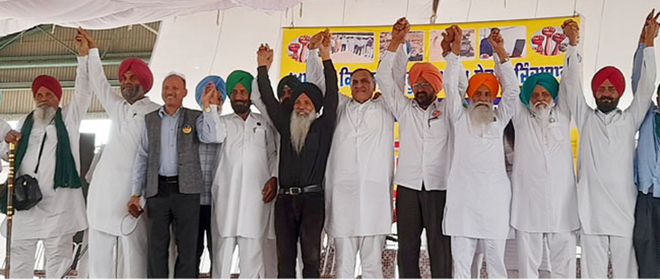
Arhtiyas and farm leaders during the ‘mandi bachao mahasammelan’ in Moga. Tribune Photo

Tribune News Service

Baghapurana (Moga), April 5

Up in arms against the Centre over the direct payment to farmers on purchase of foodgrain, arhtiyas in association with the farmer unions have decided to intensify their stir against the three farm laws.

Addressing the “mandi bachao mahasammelan” in Moga on Monday, arhtiyas’ association state president Vijay Kalra declared that the arhtiyas in Punjab would completely boycott the markets from April 10, if the balance of Rs 131 crore was not paid to them by the Food Corporation of India (FCI). “We won’t lift the wheat from the markets until the balance payment is cleared,” he said.

Labourers will lose jobs, govt revenue

There are four lakh laboures in the mandis. They will lose their jobs. The state government will lose mandi fee and rural development funds. It will impact the development in the rural areas. —Balbir Singh Rajewal , BKU (Rajewal) President

Keeping in view the agitation mood of farmers and arhtiyas, the Punjab Government has already deferred the wheat procurement from April 1 to April 10. A total of 130-lakh tonnes of wheat is expected to arrive in mandis, which is purchased at the minimum support price (MSP). The entire procurement is done through arhtiyas and in return they get 2.5 per cent commission.

Arhtiyas stand to lose a foothold as earlier farmers got money from them after deduction of loan amount. Arhtiyas feel if farmers get money directly into their accounts, they will have to visit them to get back the loan.

Lashing out at the FCI’s directive to farmers giving details of their land, Kalra urged peasants not to give jambandi (land registry) to any food procurement agency.

Association vice-president Amarjit Singh said it was practically impossible for the farmers to provide land records because nearly 50 per cent of them do contract farming on land owned by NRIs settled abroad. “The problem is that the online payment will go into the accounts of the original land holders and not the farmers,” he said.

Ruldu Singh Mansa state president of Punjab Kisan Union said that the bond between arhtiyas and the farmers was very strong. “The social and economic relationship between them is the basis of the very existence of the poor and marginal farmers; therefore, we cannot afford to lose it at any cost,” he said. Dr Satnam Singh Ajnala, president, Jamhuri Kisan Sabha; Paramjeet Kaur, leader, Mazdoor Mukti Morcha; Gurnam Singh Chaduni, president of BKU (Haryana); and Nirbhai Singh Dhudike, president, Kirti Kisan Union among others supported the arhtiyas’ demand.


After Delhi, Tikait threatens tractor agitation in Gujarat

The BKU leader is on a two-day tour of Gujarat

After Delhi, Tikait threatens tractor agitation in Gujarat

Bharatiya Kisan Union leader Rakesh Tikait shows his passport outside the Gandhi Ashram in Ahmedabad. PTI

Ahmedabad, April 5

Bharatiya Kisan Union leader Rakesh Tikait on Monday threatened to start a farmers’ tractor agitation in Gujarat after Delhi, and said time has come to gherao the state capital Gandhinagar and also break barricades if needed.

Talking to reporters outside the Sabarmati Ashram here, Tikait claimed farmers in Gujarat were unhappy and suffering.

Hundreds of farmers have been camping at Delhi’s borders since November last year against the Centre’s three agriculture reform laws. They are demanding a repeal of the three laws along with a legal guarantee for Minimum Support Price (MSP) for their produce.

The protesting farmers took out a tractor rally in Delhi on January 26.

“Farmers will conduct an agitation in Gujarat using their tractors. Time has come to gherao Gandhinagar and block roads. If needed, we will have to break barricades too,” Tikait said.

The BKU leader is on a two-day tour of Gujarat since Sunday to campaign against the Centre’s three farm laws.

On the second day of his visit, Tikait, accompanied by former Gujarat Chief Minister Shankersinh Vaghela, paid tributes to Mahatma Gandhi at the Sabarmati Ashram.

“Farmers are suffering because there is no agitation here. There is no backing from courts also. Farmers are compelled to say they are happy and making profit. Please give us that technology which is helping Gujarat’s farmers to reap benefits,” said Tikait.

He claimed farmers of Banaskantha are compelled to sell potatoes for Rs 3 per kilogram.


Naxal ambush: Families of martyred personnel from Andhra to get Rs 30 lakh

Naxal ambush: Families of martyred personnel from Andhra to get Rs 30 lakh

Army personnel pay tribute to the troopers who were martyred in the Bijapur Naxalite incident in Jagdalpur police line. PTI photo

Naveen S Garewal 
Tribune News Service 

Hyderabad, April

Andhra Pradesh has announced a grant of Rs 30 lakh to the families of two state residents who died in the Naxal attack in Chhattisgarh. The state Chief Minister YS Jaganmohan Reddy announced financial assistance while expressing shock at the incident. 

The two paramilitary personnel from Andhra Pradesh who were martyred in the attack are Rowthu Jagadish of Gajularega in Vizianagaram district and Sakhamuri Muralikrishna of Gudipudi in Guntur district. Both died in an exchange of fire with the Naxals while conducting a combing operation in the forest along the border of the Bijapur and Sukma districts of Chhattisgarh.  

Meanwhile, both Andhra Pradesh and Telangana police have beefed up vigil and security in areas adjoining Chhattisgarh. Officials said that an alert had been sounded and combing operations have been intensified in the areas bordering Chhattisgarh. 

The Telangana police have increased vigil particularly in Bhadradri Kothagudem and Mulugu districts. “We are alert and regular combing operations are going on and security has been beefed up in areas a senior police official said. 

He said police had been carrying out checking, cordon and search operations as part of the measures taken to prevent Maoists from entering Telangana. 


China against sole focus on border tensions

Must not keep eye on one aspect of relationship, says Chinese envoy

China against sole focus on border tensions

Sandeep Dikshit

Tribune News Service

New Delhi, April 5

A day after India insisted on disengagement and de-escalation from all the flash points in Eastern Ladakh as a pre-condition to improvement in bilateral ties, Chinese Ambassador to India Sun Weidong said both sides “must not keep our eyes only on one aspect of it”.

Sun wanted India and China to view bilateral relations from an “overall, long-term and strategic perspective” and did not want them to be bogged down by any specific incident or a short period of time.  “This is not the way we should do,” he said in a virtual interaction with Sudheendra Kulkarni, aide of former PM Atal Bihari Vajpayee, on Sunday.

India, on the other hand, is clear that the development of bilateral ties depends on maintenance of peace and tranquillity along the LAC. In his conversation with Wang Yi, External Affairs Minister S Jaishankar had said disengagement and de-escalation must be the first steps towards restoring normalcy.  “The disturbance of peace and tranquillity, including by violence, will inevitably have a damaging impact on the relationship,” he had told Wang on February 25.https://33a81a8bd10ffdc56cec2ab725ecbe64.safeframe.googlesyndication.com/safeframe/1-0-38/html/container.html

Since then there has been no word from China on India’s proposal for holding a joint meeting of diplomats and army commanders to chart the way forward along the LAC.

The Chinese ambassador admitted there were difficulties on the border but did not point a way to the future. He merely said the recent disengagement of front line troops in Panging Tso area was conducive to building mutual trust and further easing the situation on the ground.

In the virtual interview, the Chinese envoy spoke on the common challenges facing both countries, which he identified as food security, employment and low per capita GDP. These require both countries to focus on development and concentrate on doing its own business well.

While China had huge production capacity and consumption potential, India is rich in human resources and has robust market demand. “We should jointly run in the marathon of development for good results. The key point is to manage differences through dialogue and consultation and find a peaceful solution,” he suggested. Cooperation in various fields should start from easier issues to gradually “accumulate conditions” for further improvement of bilateral relations. 



Reiterating Beijing’s formulation, Sun said the political cornerstone of India-China ties should be to commit to the Modi-Xi consensus that the two countries are neither competitive rivals nor threats, but cooperation partners. Also, both need to manage differences through dialogues while respecting each other’s core interests and major concerns.