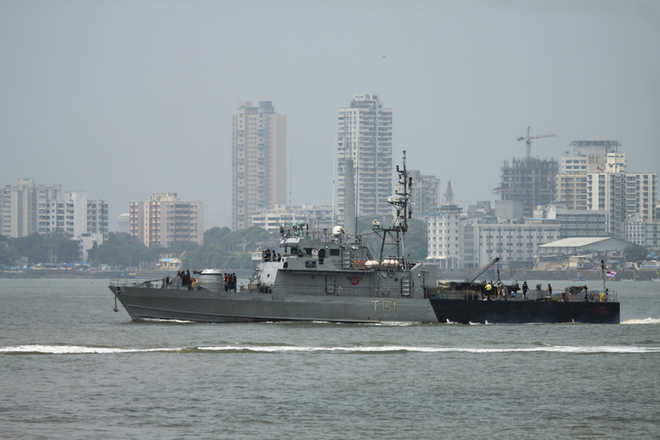
The ‘Passage’ exercises are regularly conducted by the Indian Navy with friendly foreign navies
Photo for representation only. Source: iStock.
New Delhi, May 8
The navies of India and Indonesia on Saturday carried out a military drill in the Southern Arabian Sea with a focus on further improving their interoperability, officials said.
The Indian Navy was represented at the ‘Passage’ exercise by INS Sharda, an offshore patrol vessel (OPV), and the Indonesian Navy was represented by KRI Sultan Hasanudin, a corvette, they said.
“The exercise was aimed at improving interoperability and understanding between both the friendly navies,” said an Indian Navy official.
The ‘Passage’ exercises are regularly conducted by the Indian Navy with friendly foreign navies.
Under the framework of comprehensive strategic partnership between India and Indonesia, the two navies share a strong partnership of operational cooperation.
ONLY BILATERAL TALKS WITH PAKISTAN PLEASE: BRIG ARUN BAJPAI
It is a world known factor that what Indian armed forces achieve on the battle field our Netas lose it on the discussion table. Cases in point are our victories in 1965 & 1971 wars against Pakistan leading to Tashkent agreement and Shimla agreement respectively. In Tashkent Agreement talks we gave back to Pakistan strategically important Hajji Pir Pass and other territories occupied by India, in Shimla Agreement we, when Pakistan was totally defeated and we had their elite Army’s 93000 prisoners, still all we could achieve was a vague promise by then Pakistani Prime Minister Bhutto that he will convert LOC as IB in a futuristic perspective instead of permanently solving Kashmir problem once for all. It was lucky that Pakistan agreed to hold all India Pakistan talks bilaterally. Recently in a virtual program organised by American Stanford University , foreign minister of UAE, the interior minister made a statement that he is doing middleman’s job between India and Pakistan. Why he said so when he was not even asked is something he will know better but the fact remains that this is not possible. This does not mean that India and Pakistan are not doing some back room diplomacy. But it will not be trilateral talks. Indian PMs have always been ready for permanent peace between Pakistan and India. Mr Lal Bahadur Shastri the Indian PM while returning from Kahira had broken his journey in Karachi, Pakistan to meet Ayub khan then Pakistani president, but next year only in 1965 Pakistan attacked India. Similarly Indian PM Vajpayee went to Lahore in a bus to speak with Nawaz Sharif then PM of Pakistan in 1999 but Pakistan then attacked Kargil. In other words this Pakistan cannot be depended upon. India has been telling Pakistan that all talks between India and Pak should be held bilaterally but Pakistan has been always trying to make it trilateral or multilateral so that it can pressurize India and if the talks succeed then Pakistan can claim victory to its own people. Indian stand as professed by Bajpai and followed for last seven years by Indian PM Modi, that bilateral talks and terror sponsored by Pakistan cannot go together. Pakistan is refusing to let go terror despite Modi ji initially making a un scheduled halt at Lahore to attend marriage of Nawaz Sharif daughter. While Pakistani current PM Imran khan and his foreign minister Qureshi has made an official statement that talks of any kind with India are only possible if India reverses its decision to remove Art 370 and 35A from Kashmir. very recently Pakistani PM Imran Khan and his Army Chief Qamar Bajwa had said that they will resume trade with India which this duo had stopped after removal of Art 370 from Kashmir in 2019, but then within two days they made a U turn. Truth is that all countries who may like to mediate in this India-Pakistan dispute in Kashmir tend to see things from their own point of view. Let us not forget that Indian PM Nehru against advice of Indian Army had taken the case of Kashmir to UN on advice of Mountbatten in 1948 and had mad internationalised Kashmir issue. Now Pakistan is bound by Shimla Agreement to hold bilateral talks with India on issue of Kashmir due to Shimla Agreement. Under no circumstance we should lose this advantage that we have over Pakistan. We must stick to this stand come what may. We do not want America or any other country interfering in this bilateral matter, with their own axe to grind. Brig Arun Bajpai (Retd) is a distinguished Defence and Strategic Analyst. Views expressed are of the author and do not necessarily reflect the views of IDN. IDN does not assume any responsibility or liability for the same
Provide responsible leadership, own up mistakes, Lancet tells Modi govt
Leading international medical journal The Lancet on Saturday called upon the Modi-led government to “own up to its mistakes, provide responsible leadership and implement a public health response that has science at its heart to contain Covid”.
In its editorial today, The Lancet said India squandered its early successes in controlling Covid-19 and till April, the government’s taskforce had not met in months.
Global medical journal’s observations
Government’s attempts to stifle criticism inexcusable
Even before the 2nd wave, govt declared it was Covid ‘endgame’
Its actions falsely suggested that India had reached herd immunity
Despite warnings, it allowed huge political rallies, events
It said even before the second wave began in early March, Indian Health Minister Harsh Vardhan declared that the country was in the “endgame” of the pandemic.
Citing Institute for Health Metrics and Evaluation, says india’s death toll may touch 1 mn by August 1
“The impression given was that India had beaten Covid after months of low case count, despite warnings of the second wave danger and emergence of new strains. Modelling suggested falsely that India had reached herd immunity. At times, the Modi government seemed more intent on removing criticism on Twitter than trying to control the pandemic,” the editorial dedicated to India said. It took note of how the Modi government allowed religious festivals and huge political rallies giving a message that Covid-19 was essentially over.
“This slowed the start of India’s vaccination campaign, which has covered less than 2 per cent of the population,” said the Lancet, adding that at a federal level, India’s vaccination plan fell apart as the government “abruptly shifted course expanding vaccination to everyone older than 18 years, draining supplies”.
The Lancet advised India to rationalise the vaccine policy and implement it with due speed now.
“Genome sequencing needs to be expanded to better track and understand more transmissible variants,” the comment elaborated, noting, “Modi’s actions in attempting to stifle criticism and open discussion during the crisis are inexcusable.
Citing a grim estimate by the Institute for Health Metrics and Evaluation that India will see 1 million Covid deaths by August 1, The Lancet said if that were to happen, the government would be responsible for presiding over a self-inflicted national catastrophe.
4,645 CEASEFIRE VIOLATIONS BY PAK IN 2020, OVER 11,000 IN 17 YEARS
Amidst growing tensions in India’s immediate neighbourhood, it has come to light that there were as many as 11,424 ceasefire violations (CFVs) by Pakistan against India in the seven years of the Narendra Modi-led NDA government. An RTI has revealed that the border infringements, year-wise, shot up astronomically from just 1 in 2004 to a staggering 4,645 in 2020. The RTI information sought by Pune based activist Prafful Sarda reveals that Pakistani troops committed the highest number of ceasefire violations in the last 17 years along the border in Jammu and Kashmir. This amounts to 13 such violations daily. The Ceasefire Agreement in November 2003 was a landmark in the strained bilateral relations between India and Pakistan. It came after a long cycle of violence along the 725-kilometer-long Line of Control (LoC) that divides Jammu and Kashmir into two parts. It followed a framework of military confidence-building measures (CBMs) that kept the artillery pieces at least 20 km away from the LoC, thus promising a sustained halt to heavy firing. Not only did the ceasefire help the implementation of non-military CBMs such as cross-LoC bus service and trade, but it also came as a huge relief for tens of thousands of people living along the LoC. However, numbers show that the calm was shattered by a string of actions by Pakistani troops. “Ministry of Defence has replied to my RTI with year-wise data and it’s unbelievable to see how alarmingly CFVs have increased from one CFV in 2004 to 4645 in 2020,” said Sarda. During the UPA government of Prime Minister Manmohan Singh between 2004-2013, there were a total of 523 CFVs on the border, starting with just 1 in 2004, 6 the next year and 3 the following year, reveals the RTI. The RTI further suggest that the CFVs entered the double-digit number and kept fluctuating with ups and downs, starting with 21 in 2007, jumping to 77 in 2008, down to 28 in 2009, spelling relief. The CFVs, according to the RTI, kept soaring each year, starting with 44 in 2010, 51 (2011), 93 (2012), and 199 in 2013, almost till the end of the UPA government’s second term. Moreover, in the Bharatiya Janata Party-led NDA’s first couple of years, things appeared bright, with CFVs dropping from 199 the previous year (2013) to 153 in 2014 and 152 (2015). From then, there was no looking back and the CFVs kept soaring each year, starting with 44 in 2010, 51 (2011), 93 (2012), and 199 in 2013, almost till the end of the UPA government’s second term. In the BJP-led NDA’s first couple of years, things appeared bright with CFVs dropping from 199 the previous year (2013) to 153 in 2014 and 152 (2015). In 2016, there were 228 ceasefire violations after which there has been a major jump to 860 CFVs in 2017, thereafter a staggering increase to 1629 in 2018, 3,233 in 2019 to 4645 in 2020, and some 524 in the year 2021 till February month. However, the RTI response from the Ministry of Defence’s Brigadier V. K. Bhat, CPIO refuses to share information on Doklam and LAC as per section 8(1) in the RTI, 2005. This states that information disclosure will prejudicially affect the sovereignty and integrity of India, the security, strategic, scientific or economic interests of the State, relation with foreign States or lead to incitement of an offence. Lieutenant General Satish Dua said that the ceasefire violations have not only to do with military dynamics but also with the relations between the two countries. He pointed out a pattern that exists in the year of these CFVs. “Since the time ceasefire has been signed between the two countries, there have been ups and downs, meaning every year CFVs would go down in winter then an upsurge would be seen in summer, a pattern observed and that has to do more with infiltration attempt that happens more in summers and in winters the passes are closed due to heavy snowfall thus to aid infiltration they start firing weapons across the LOC,” said Dua. “It also depends on either side of LOC that’s military to military dynamics or also at times on the relation between two countries. After 2016 when the elimination of Burhan Wani happened and the Uri incident and surgical strikes were carried out, the number of ceasefire violations have gone up,” “After August 2019 action taken by the government on Article 370 its abrogation and bifurcation of state into two UTs after that also the number of CFVs have increased. At the present moment till last February CFVs have held and the last statements by both the countries in February month that they both will be committed to Ceasefire Agreement.” Lieutenant General Dua further said, “Now is the real test when summers are here, snow melts, higher passes of Himalayas open, it remains to be seen whether it will hold through the summer or it has happened several times in the past that ceasefire has been forgotten and such activities of violation are more seen on the other end. On being asked about the preventive and immediate action taken by the Indian Army to stop ceasefire violations at LOC, MOD responded by saying, “Incidents of ceasefire violations are taken up with Pakistan military authorities at the appropriate level through the established mechanism of hotline and flag meetings. These violations are also taken up through diplomatic channels by MEA with Pakistan to put pressure to cease such violations and maintain peace and tranquillity along the LoC.”
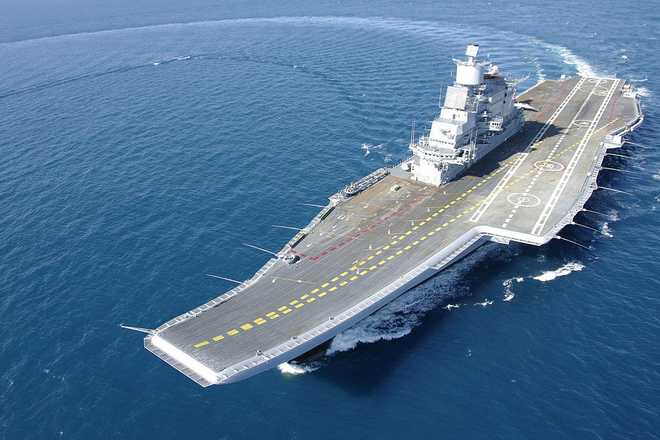
There was a minor fire on board India’s aircraft carrier INS Vikramaditya on Saturday morning, a Navy spokesperson said.
The fire was doused and all personnel on board are safe, the spokesperson said in a statement here. “The duty staff observed smoke emanating from the part of the warship having accommodation for sailors. The duty personnel acted promptly to fight the fire,” the statement said. — PT
CHALK AND CHEESE: WHY CHINA HAS LOST INDIA’S TRUST AND NEW DELHI SHOULD HAVE NO RESERVATIONS ABOUT BOOSTING TIES WITH TAIWAN
A year has passed since Indian and Chinese troops clashed in eastern Ladakh that lead to a nosedive in their bilateral relationship. The Galwan Valley clashes on June 25 had seen casualties on both sides with 20 Indian Jawans killed. There was massive build-up of the two militaries at the Line of Actual Control, India started viewing China as its No.1 strategic rival and New Delhi started warming up to the idea of the Quad grouping as a counterbalance to Beijing, exemplified by the Malabar naval exercise in November that saw the Indian, American, Japanese and Australian navies jointly participate for the first time in over a decade. Thus, the events of last year truly broke trust between India and China and the relationship with Beijing is expected to be viewed through the prism of suspicion for the foreseeable future. The idea that India and China could collaborate to usher in an Asian century has been buried for good. Clearly, China today doesn’t see India as an equal partner. In fact, under the leadership of Chinese President Xi Jinping, the Chinese Communist Party seems to have fallen back on the old Chinese adage that “Two tigers can’t live on the same mountain” and has put India in the category of countries that can be pushed around to serve internal party politics. True, there was some easing of tensions in February this year when Indian and Chinese troops finally disengaged in the Pangong Tso area. But since then the Chinese side has flatly refused to pull back from other incursion points such as Gogra, Hot Springs, Demchok and Depsang Plains. Even in Pangong, the temporary truce prevents Indian troops from going up to their traditional patrolling points. And with reports coming in of the Chinese PLA reinforcing its military positions in the depth areas along the LAC, it’s amply clear that Beijing has no intention to de-escalate at the border anytime soon. Therefore, as things stand, it is China that undermined the bilateral relationship with India and it is China that has to walk the extra mile – and a very long mile at that – to repair two-way ties. But that is unlikely to happen as China today is in “wolf warrior” mode and can’t be seen to be weak. As I have written before, this aggressive Chinese posture is part of Xi’s plan to use nationalism and show strategic gains as a cover for effecting a massive reorganisation and centralisation of power within the Chinese party-state to prolong the life of the Chinese Communist Party. In other words, Xi is reinforcing the authority of the party over all levers of the Chinese state and indeed erasing the space between party and state to ensure that the party itself doesn’t collapse from within. Seen from this perspective, Xi’s priority of prolonging the life of the Chinese Communist Party takes precedence over everything else, including relations with India. Of course, China doesn’t want to be in a perpetual state of conflict with India. Which is why it has offered help to India to fight the Covid-19 pandemic jointly – an offer that New Delhi has rejected so far. Basically, China wants to relegate India to second-class status in Asia – while Beijing arrogates to itself the No.1 spot — and raise temperatures or cool them down as and when it pleases. But China can’t be killing our soldiers at the border and intruding into Indian territory and then seek commercial cooperation and offer help on the pandemic. True, Indian private companies are importing Covid-related medicines and oxygen concentrators from China. But that is just the nature of the global economy where trans border commercial ties can’t be completely cut off. However, this doesn’t mean that at the government-to-government level India and China will get along, and that in turn will reduce the overall potential of the bilateral relationship. In fact, as things stand, India should no longer be overly concerned about Chinese political interests. And one area where India should abandon caution is in relations with Taiwan. The latter too is doing its best to help India in its time of crisis and this week delivered critical medical supplies to India including the first batch of 150 oxygen concentrators and 500 oxygen cylinders. Plus, Taiwan has done a remarkable job of controlling the pandemic within its borders and as of April 30 had just 1,128 Covid cases with 12 deaths. Moreover, Taiwan and India share democratic values with Taipei willing to share its medical expertise with the rest of the world. In this regard, there is a growing chorus within the international community to include Taiwan in the upcoming World Health Assembly – the decision making body of the WHO — at a time when all global stakeholders are required to cooperate to fight the pandemic. In fact, France’s senate just passed a resolution in support of Taiwan’s participation in international organisations, including the WHO, after G7 foreign ministers issued a joint communique to support Taiwan’s WHO participation earlier in the week. Therefore, India too should not hesitate in clearly supporting Taiwan’s participation in the upcoming World Health Assembly, setting aside any political objections China might have. Again, China has lost India’s trust while there is great independent logic in ramping up New Delhi-Taipei ties. Beijing should accept that India and China will be like chalk and cheese for the foreseeable future.
Brilliant, unconventional, fearless, Group Captain Chandan Singh, seniormost IAF officer to be awarded MVC
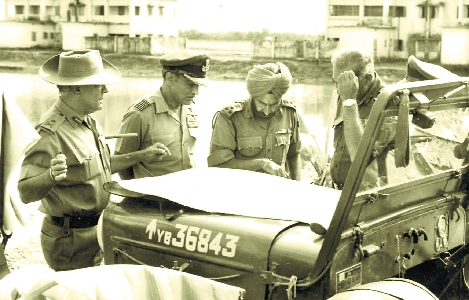
Spectacular jointmanship: Gp Capt Chandan Singh (second from left) with Lt Gen Sagat Singh (extreme right), Maj Gen Hira (extreme left) and Brig Sodhi. The legendary Air Force officer was the orchestrator of the first ever large-scale heli-landed operations in Independent India. Photo courtesy: Major Chandrakant, biographer of Air Vice Marshal Chandan Singh
Air Vice Marshal Arjun Subramaniam (Retd)
As 57 Mountain Division, 23 Division and 8 Mountain Division under Major Generals Ben Gonsalves, RD Hira and KV Krishna Rao found themselves on the east banks of the rivers Meghna and Surma, respectively, their Corps Commander, Lieutenant General Sagat Singh, was searching for innovative solutions to seriously threaten Dacca by the end of the first week of operations in his IV Corps zone. Turning to his IAF Task Force Commander, Group Captain Chandan Singh (later Air Vice Marshal), he remarked, “Chandan, do what you have to but get me into Sylhet and across the Meghna river to put pressure on the Dacca Garrison. If there is a window of opportunity, I want to be the first into Dacca.” If there was anyone in the IAF who could match up to Sagat’s energy and his ability to convert operational ideas into outcomes, it was his fellow Rajput, Chandan Singh.
Group Captain Chandan Singh was already a legend in the IAF’s transport fleet when he was called upon to perform extraordinary feats in 1971. He proved to be the ideal air commander who understood the land battle as no one else did
Commissioned as a fighter pilot, a serious accident on Spitfires during an emergency landing in 1949 almost wrote off Chandan’s flying career. Determined to get back into a cockpit, he soon commenced flying Dakotas and then the C-119 Packet before converting onto An-12s just as Ladakh was flaring up in the early 1960s. Squadron Leader Chandan Singh led the air-dropping missions over Ladakh to sustain forward posts and came back with his aircraft riddled with 19 bullet holes on the first day of the 1962 conflict; he then flew in tanks to the Chushul airfield. Awarded a Vir Chakra for his exploits in the 1962 conflict with China, Group Captain Chandan Singh was already a legend in the IAF’s transport fleet when he was called upon to perform extraordinary feats during the ‘Lightning Campaign’ in December 1971.
Chandan’s exploits in the 1971 conflict saw him wearing two hats and demonstrating organisational brilliance and personal courage. As the Station Commander of Air Force Station, Jorhat, he was entrusted by Air Chief Marshal Lal with setting up Kilo Flight, the forerunner to the Bangladesh Air Force. Manned by a few selected pilots, including Group Captain Khandker and Flt Lt Sultan Mahmud (both future Air Chiefs in the Bangladesh Air Force) and airmen who had defected from the Pakistan Air Force, a few accomplished IAF helicopter and transport pilots were chosen to clandestinely train them. Among them was Flying Officer Karandikar (later Air Commodore), who recalls his association with Chandan Singh with awe and reverence. He recalls that the team was equipped with the Dakota, the slow-moving Otter aircraft and Alouette helicopters, with the Otter and Alouette modified for weapon delivery and armed with rocket pods and a machine gun operated by a gunner firing sideways out of an open-door hatch. Chandan shifted them to Dimapur, a satellite base, from where they gained proficiency in night flying and weapon delivery before they were moved to Kumbhigram and then forward to Kailashahar in early December to support IV Corps operations.
Karandikar recalls flying the Dakota solo on a few occasions as he flew some fuel and armament stores from Kumbhigram to Kailashahar, an unconventional decision which only a risk-taker like Chandan would authorise. Chandan Singh’s magnanimity was evident when he ensured that the Bangladeshi pilots were given the opportunity of firing the first shot at the enemy on December 3 as he tasked the Otter with a rocket attack on the oil tanks at Narayanganj, and the Alouette to attack the oil tanks at Chittagong just after midnight. Chandan often flew with Kilo Flight and they did a great job throughout the campaign by flying missions at night against several targets.
Encouraged by its initial success, Lt Gen Sagat Singh agreed to Chandan’s suggestion that Kailashahar, right on the Tripura-East Pakistan border, should emerge as the aviation hub of Sagat Singh’s IV Corps and Chandan Singh was unofficially re-designated as Task Force Commander. This is where he wore his second hat as the orchestrator of the first ever large-scale heli-landed operations in Independent India if one discounts the heli-landed operation at Aizawl during the Mizo insurgency of 1966. Strategising extensively with Sagat at IV Corps HQ in Teliamura, Chandan soon had a large complement of battle-proven Mi-4 helicopters from 110 Helicopter Unit (HU) at Kailashahar, supplemented by a few IAF and army Alouette light helicopters. While the former were primarily troop carriers, the latter would prove immensely useful in the recce and scout roles.
Responding to the first call into action, Chandan Singh himself flew a mission to Sylhet on the morning of December 7 to investigate reports from Indian Army intelligence that the Pakistan army wanted to surrender. Met with a fusillade of machine gun fire and receiving several hits on his Mi-4 helicopter, Chandan reported back to Sagat that it was a trap. Reacting coolly, Sagat asked Chandan whether he could cross the Surma river and land a battalion under fire and seize the initiative by surprising two Pakistani brigades which would be anticipating a larger conventional assault by several brigades. The rest is history as 110 HU heli-landed 4/5 GR commanded by Lt Col Harolikar under fire at the gates of Sylhet in a display of spectacular jointmanship. Supported by airstrikes by IAF fighters and Kilo Flight under FAC control and receiving continuous waves of Mi-4s, the Gorkhas fought valiantly for over a week, preventing the brigade from reinforcing Dacca and coercing it sufficiently to surrender on December 16.
Emboldened by the success of the Sylhet operation, Sagat urged Chandan to push his weary helicopter crew, who had flown non-stop for over 48 hours, to heli-land several brigades of 57 and 23 Division at multiple points across the wide and mighty Meghna river by December 13. Relocating to Agartala, 110 HU was reinforced with more helicopters and crew from two more units to cope with the volume of lifting an entire brigade with its complement of engineers and light artillery to chosen landing zones at Raipura, Narsingdi and Narayanganj from the divisional forward HQ of Brahmanbaria. 4 Guards was the second unit after 4/5 GR to participate in the operation and came out with flying colours despite hardly any preparatory time for the operation. Here again, leading from the front emerged as a key force multiplier as Sagat and Chandan Singh insisted on carrying out the first recce of the proposed landing ground at Raipura in a Chetak helicopter. Flying into heavy ground fire, the co-pilot was shot through the leg and over 30 bullet hits were counted after the sortie. Executing a series of crossings, the helicopter task force landed over two brigades on the west bank of the Meghna in an operation that is termed as ‘vertical envelopment’. By doing so, they cut off any possible reinforcement routes to Dacca from the other garrisons and facilitated a multi-pronged advance that forced the surrender of Dacca.
While the pilots and crew of 110, 105, 111 HU, Kilo Flight and the Chetaks performed magnificently during the nine-day relentless operation, the IV Corps battle was a commanders’ battle with the senior leadership leading from the front. Complementing the drive of Sagat, Ben Gonsalves, Krishna Rao and Hira, Chandan Singh proved to be the ideal air commander who understood the land battle as no one else did. For his exceptional leadership in multiple operational tasks, personal courage, daring risk-taking ability and motivational charisma, Group Captain Chandan Singh was the seniormost IAF officer to be awarded the Maha Vir Chakra during the 1971 war.
PAKISTAN URGES UN TO PRESS INDIA FOR RELEASE OF POLITICAL PRISONERS IN KASHMIR: TURKISH MEDIA
KARACHI: Pakistan conveyed its “deep” concern to the UN over the death of jailed pro-freedom Kashmiri leader Ashraf Sehrai and called for the release of all political prisoners in the Indian-administered Kashmir, the country’s UN envoy has said. Munir Akram, Pakistan’s permanent representative to the UN, said on Saturday in a letter to UN chief Antonio Guterres, urging him to ask New Delhi to immediately release all prisoners illegally detained in the disputed Himalayan valley. Sehrai, 77, died at a hospital in the Indian-administered Kashmir earlier this week. He was the chairman of the Tehreek-e-Hurriyat, one of the constituent parties of the Hurriyat Conference, Kashmir’s biggest pro-freedom group. Sehrai “spent his life struggling for the legitimate right of self-determination of #Kashmiris and suffered persecution at the hands of Indian occupying forces,” Akram said in a series of tweets. Like hundreds of other Kashmiri political prisoners, Sehrai was kept in jail far from his hometown of Srinagar. He was incarcerated since July 2020 at the Uhdampur jail, more than 200 kilometres (125 miles) from the region’s capital. He was already under house arrest when he was detained under the Public Safety Act, which has been described as a “lawless law” by global rights group Amnesty International. With hundreds of prisoners having tested positive for COVID-19 across India, activists and family members of incarcerated individuals have repeatedly appealed to the Indian government to release ailing prisoners from overcrowded jails. Akram said Pakistan has urged the UN chief to ask the government of India to immediately release all illegally detained prisoners in view of the prevailing COVID-19 crisis and deteriorating humanitarian situation in the disputed region. Kashmir is held by India and Pakistan in parts and claimed by both in full. Since they were partitioned in 1947, the two countries have fought three wars, two of them over Kashmir. Some Kashmiri groups have been fighting against Indian rule for independence, or unification with neighbouring Pakistan. According to several human rights organizations, thousands of people have been killed in the conflict in the region since 1989.
A total of 6,738 oxygen concentrators, 3,856 oxygen cylinders, 16 oxygen generation plants and about three lakh Remdesivir vials received as aid from foreign countries have been delivered or dispatched to various states and union territories between April 27 and May 8, the Union Health Ministry said on Sunday.
Reflecting the solidarity and goodwill towards India, the global community has extended a helping hand in supporting its efforts in the fight against COVID-19, the ministry said.
The Government of India has designed a streamlined and systematic mechanism for effective allocation, and prompt distribution and delivery of the support supplies received by India.
This will help supplement the medical infrastructure of the tertiary care institutions and recipient states and UTs, and strengthen their clinical management capacities for effective clinical management of the hospitalised COVID-19 patients.
The Government of India has been receiving international donations and aid of COVID-19 relief medical supplies and equipment since 27 April from different countries/organisations.
Cumulatively, 6,738 oxygen concentrators, 3,856 oxygen cylinders, 16 oxygen generation plants, 4,668 ventilators/BiPAP, about 3 lakh Remdesivir vials have been delivered/dispatched from April 27 to May 8, the ministry said.
“Effective immediate allocation, and streamlined delivery to the recipient states and UTs and institutions is an ongoing exercise. This is being comprehensively monitored by the Union Health Ministry on a regular basis,” the ministry said.
Professor Randeep Guleria, Director AIIMS, New Delhi thanked all for sending foreign aid in form of medical equipments—ventilators, oxygen cylinders and concentrators—to fight a huge surge of cases. He also expressed his deep gratitude to everyone who have helped in fighting the pandemic. PTI
State Stalwarts
DEFENCES FORCES RANKS
ARMY, NAVY, AIRFORCE RANKS
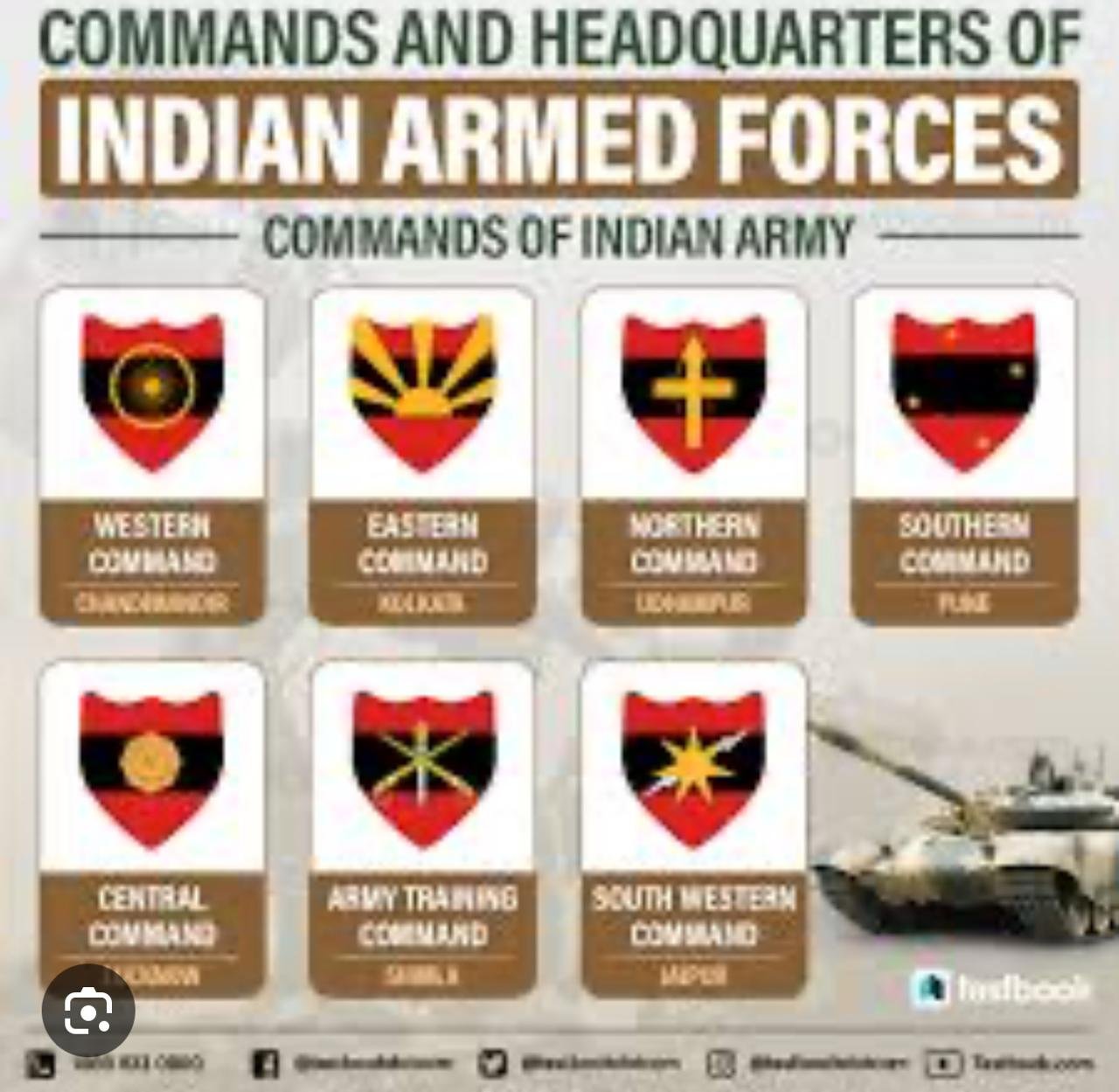
FORMATION SIGNS
FORMATION SIGNS
ALL HUMANS ARE ONE CREATED BY GOD
HINDUS,MUSLIMS,SIKHS.ISAI SAB HAI BHAI BHAI
CHIEF PATRON ALL INDIA SANJHA MORCHA
LT GEN JASBIR SINGH DHALIWAL, DOGRA
SENIOR PATRON ALL INDIA SANJHA MORCHA
MAJOR GEN HARVIJAY SINGH, SENA MEDAL ,corps of signals
.
.
PATRON ALL INDIA SANJHA MORCHA
MAJ GEN RAMINDER GORAYA , CORPS OF
sanjhamorcha303@gmail.com
PRESIDENT HARAYANA STATE CUM COORDINATOR ESM
BRIG DALJIT THUKRAL ,BENGAL SAPPERS
PRESIDENT TRICITY
COL B S BRAR (BHUPI BRAR)
PRESIDENT CHANDIGARH ZONE
COL SHANJIT SINGH BHULLAR
.
.
PRESIDENT PANCHKULA ZONE AND ZIRAKPUR
COL SWARAN SINGH
PRESIDENT SAS NAGAR (MOHALI)
COL BALBIR SINGH , ARTY
INDIAN DEFENCE FORCES
DEFENCE FORCES INTEGRATED LOGO
FORCES FLAGS
15 Th PRESIDENT OF INDIA SUPREME COMMANDER ARMED FORCES
Droupadi Murmu
DEFENCE MINISTER
Minister Rajnath Singh
CHIEF OF DEFENCE STAFF (2nd)
General Anil Chauhan PVSM UYSM AVSM SM VSM
INDIAN FORCES CHIEFS
CHIEF OF ARMY STAFF(29th)
General Upendra Dwivedi, PVSM, AVSM (30 Jun 2024 to Till Date)