Seizures up post Op Sindoor | 362 recoveries compared to 81 last year
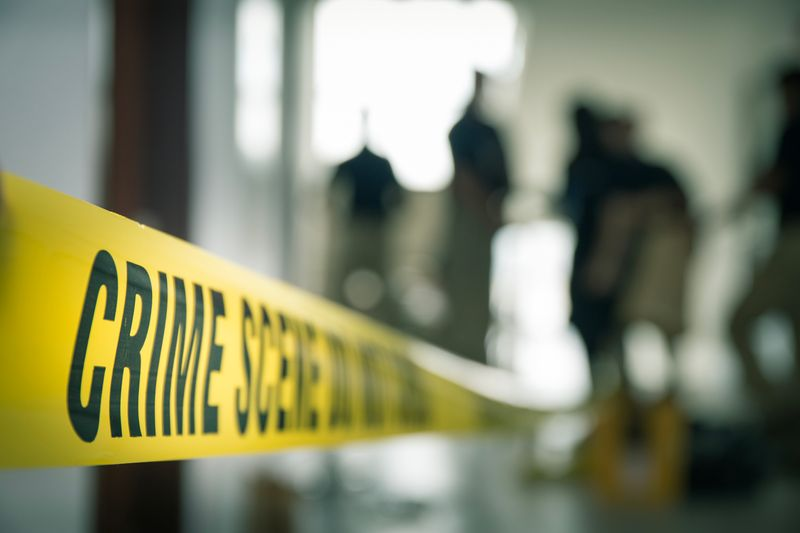
A five-fold surge has been witnessed in smuggling of arms from Pakistan through the Punjab border, with 362 weapons, including AK-47 rifles, grenades and improvised explosive devices, seized so far this year compared to just 81 last year.
A security expert attributed the sharp rise to the precision strikes carried out by India during Operation Sindoor on terror hideouts in Pakistan and Pakistan-occupied Kashmir. The expert said Pakistan’s Inter-Services Intelligence (ISI) appeared to have launched a retaliatory campaign by stepping up arms smuggling in an attempt to destabilise Punjab. Nearly one-third of the seizures have occurred after Operation Sindoor.
Over 50 persons had been arrested, some caught collecting weapons dropped via drones while others were the intended recipients tasked with carrying out terror strikes, said an official.
For the first time in three years, three AK-47 rifles were seized, highlighting how sophisticated weaponry was infiltrating the state. The last such seizure was in October 2022 when six AK-47s were recovered.
Speaking to The Tribune, Director General of Police (DGP) Gaurav Yadav emphasised the severity of the situation. “We have managed to pre-empt the smuggling of sophisticated weapons and thwarted several terrorism plans hatched from across the border,” he said.
The DGP said the seizures had been possible due to coordinated efforts by the Punjab Police, its counter-intelligence unit, including the Special Services Operation Cell, Border Security Force and central agencies.
Investigations revealed that gangsters and terrorists operating from the US, Canada and other countries were not only arming the operatives of terror outfits like the Babbar Khalsa International, but also fuelling organised crime.
“The ISI is leveraging a nexus of gangsters, drug smugglers and terrorists to sow chaos in Punjab, with recovered arms linked to violent crimes such as extortion, targeted killings and inter-gang rivalries,” said an official.
This strategy, the official said, was part of a broader ISI agenda to vitiate law and order and create conditions conducive to the secessionist ideology of Khalistan. “The proliferation of violent crimes is also raising fears that these armed gangs could serve as foot soldiers for future terror attacks,” he said.
The official said the scale of smuggling this year exceeded the combined total from 2021 to 2024.
The recovered weapons include sophisticated models like 9mm Glocks, PX5 pistols, .30 bore, .32 bore and .315 caliber firearms, often accompanied by magazines and live cartridges. Since 2022, Glocks and PX5 variants, sourced directly from Pakistan, have dominated hauls, designed for high-impact terrorist and criminal operations.
Smuggling methods have also evolved significantly. While traditional ground couriers, border facilitators and riverine routes were once the norm, recent years have seen a shift towards drone-based deliveries, a trend that began in 2019 with the first documented drone smuggling case. Riverine routes remain a preferred method during the monsoon season, exploiting increased water flow and reduced visibility along the border. These technological and seasonal adaptations had made interdiction more challenging, requiring constant vigilance from security forces, said a security official.
Officials said smuggling networks were heavily concentrated in Punjab’s border districts of Amritsar, Tarn Taran, Ferozepur, Fazilka and Batala, which accounted for a majority of the small arms recoveries since 2022. These areas, often tied to ISI-directed modules, served as critical entry points for the illicit arms trade, the officials said.
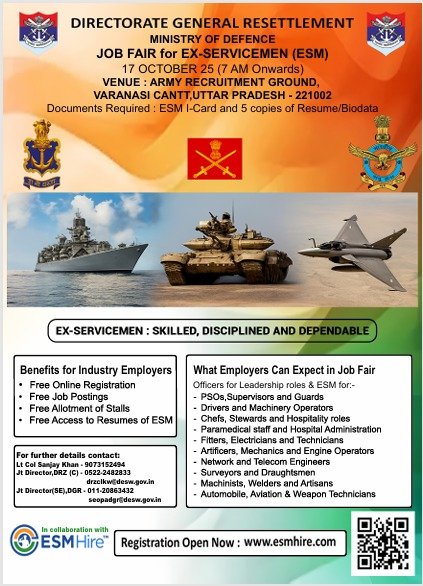
Directorate General of Resettlement (DGR) will be organising an “Ex-Servicemen Job Fair” in #Varanasi, Uttar Pradesh. The Ex-Servicemen Job seekers may avail this opportunity for hassle-free recruitment.
Date: 17 October 2025.
Venue: Army Recruitment Ground, #Varanasi, Uttar Pradesh.
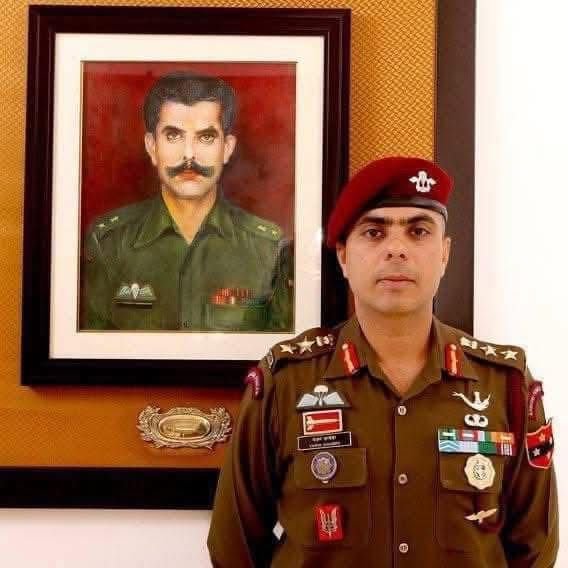
“My father cherished a dream — to one day command this elite unit. I only hope he sees his dream come true through his son.” — Col Varun Chhabra, who was nine when his father, Lt Col Arun Kumar Chhabra, SM, laid down his life in Sri Lanka on this day in 1989.
It was #OperationPawan. A hard, complex mission in a foreign land, undertaken for regional peace and the honour of the uniform. As second-in-command and designate CO of 10 Para (Special Forces), Lt Col Chhabra led a daring assault on a fortified LTTE position. He and his men surrounded the stronghold, eliminated two militants, and kept pressing under withering fire. Gravely wounded but unrelenting, he neutralized enemy commander, ensuring the success of the mission and fell moments later, his courage undimmed on this day in 1989.
His story, like those of many who served during that difficult campaign, stands as a reminder of the sacrifice, discipline, and honour with which Indian soldiers fought and fell, even on foreign soil, upholding the glory of the uniform beyond borders.
Decades later, the boy who grew up on his father’s story fulfilled the dream. Col Varun Chhabra went on to command 10 Para (Special Forces), the very battalion his father was set to lead, carrying forward his name, his ethos, and his creed.
Father and son — two warriors, one legacy! Both bound by the same creed of the Special Forces: “Men apart, every man an emperor.” Both served not for glory, but for the honour of the uniform and the oath they took when they first donned the maroon beret.
Defence personnel do not have absolute right to premature release from service: AFT rules
Junking the petition of a Flight Lieutenant challenging the rejection of his application for pre-mature release, the Bench relied on an earlier SC ruling that held that the interests of the service are of paramount importance
The Armed Forces Tribunal has ruled that members of the Armed Forces seeking premature release from service for personal reasons do not have an absolute right to leave the service on their own will.
“It is now a well settled proposition of law that grant of premature release to a member of the Armed Forces is not a right but is based on various schemes and polices and requirement of the service,” the Tribunal’s Bench comprising Justice Rajendra Menon and Rear Admiral Dhiren Vig ruled.
Junking the petition of a Flight Lieutenant challenging the rejection of his application for pre-mature release, the Bench relied on an earlier ruling by the Supreme Court that held that the interests of the service are of paramount importance. The Apex court had said that though Air Force orders provide for a balance between the interests of the service with situations involving requests by persons, individuals cannot assert a general right to act in breach or defiance of those orders.
The officer had sought premature separation from service on extreme compassionate grounds after having rendered about four years of commissioned service. He had claimed that after losing his father in 2016, he was the sole earning member of his family and had to take care of his ailing mother, aged grandparents and two elder sisters as well as look after family assets.
In his petition, he claimed that the action by the Air Force authorities to reject his request for premature separation twice by the Air Force authorities in 2023 and 2024 was vitiated by personal nepotism leading to his victimisation and was in violation of Articles 14 and 16 of the Constitution. He also claimed that due to his circumstances, his work performance was being adversely affected.
The Bench observed that during evaluation of the officer’s case, it was assessed by the six-member Board of Officers headed by an Air Vice Marshal that the organisation had made a substantial investment in his training and development, commencing from his days at the National Defence Academy and continuing through his initial flying training and subsequent training as an air traffic control officer.
Resultantly, the officer had demonstrated exceptional performance and had achieved a high level of proficiency in his role, considering his relatively young seniority. Besides, he was granted a home zone posting which would have enabled him to balance his professional responsibilities with his personal requirements, the Bench further noted.
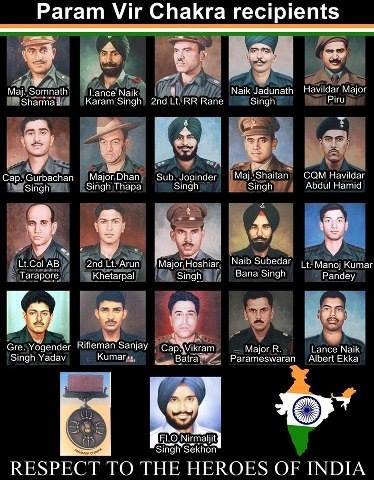
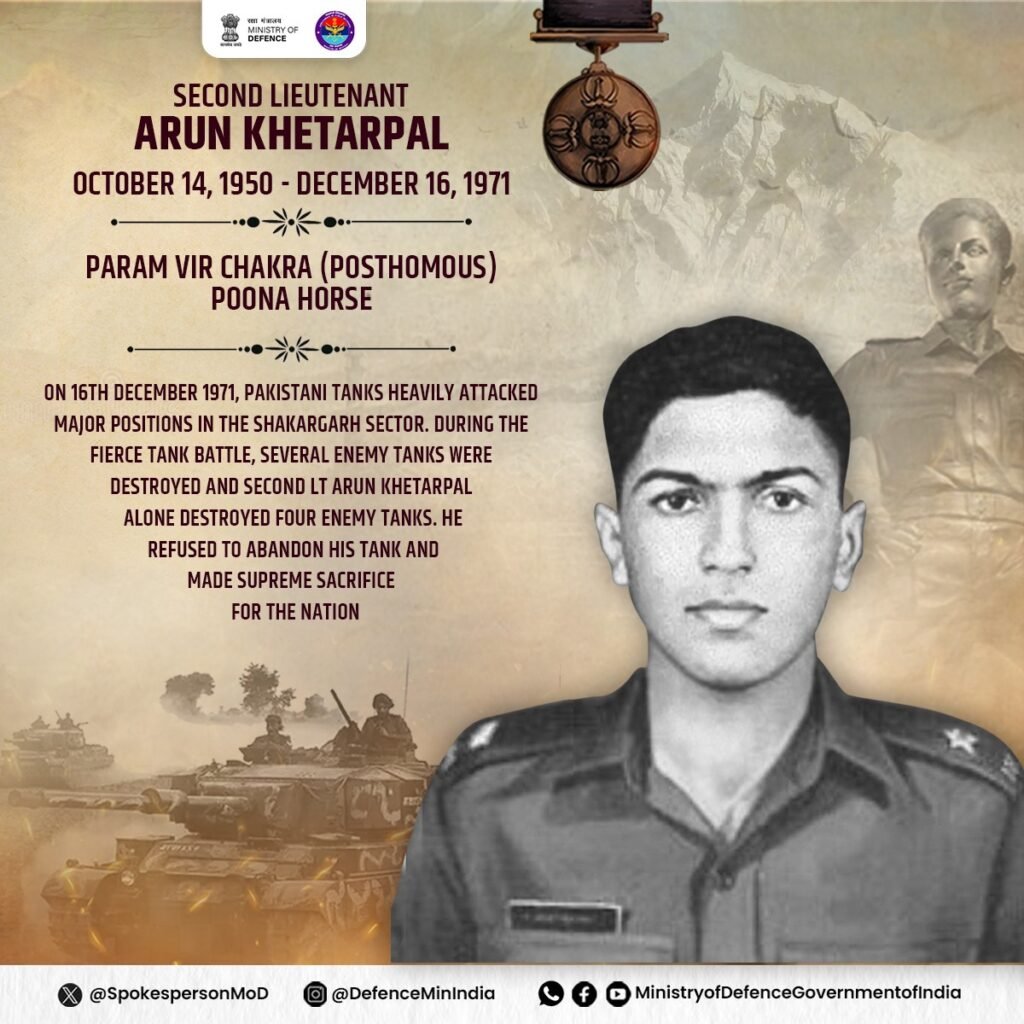
Second Lieutenant Arun Khetarpal displayed exemplary courage and leadership during the 1971 Indo-Pak War. Leading a fierce tank assault against the enemy, he refused to retreat even after being hit, making the supreme sacrifice in the line of duty. For his unparalleled bravery, he was posthumously awarded the Param Vir Chakra. On his 75th birth anniversary, we honour and remember his enduring legacy that continues to inspire generations of Indians. 🇮🇳🫡
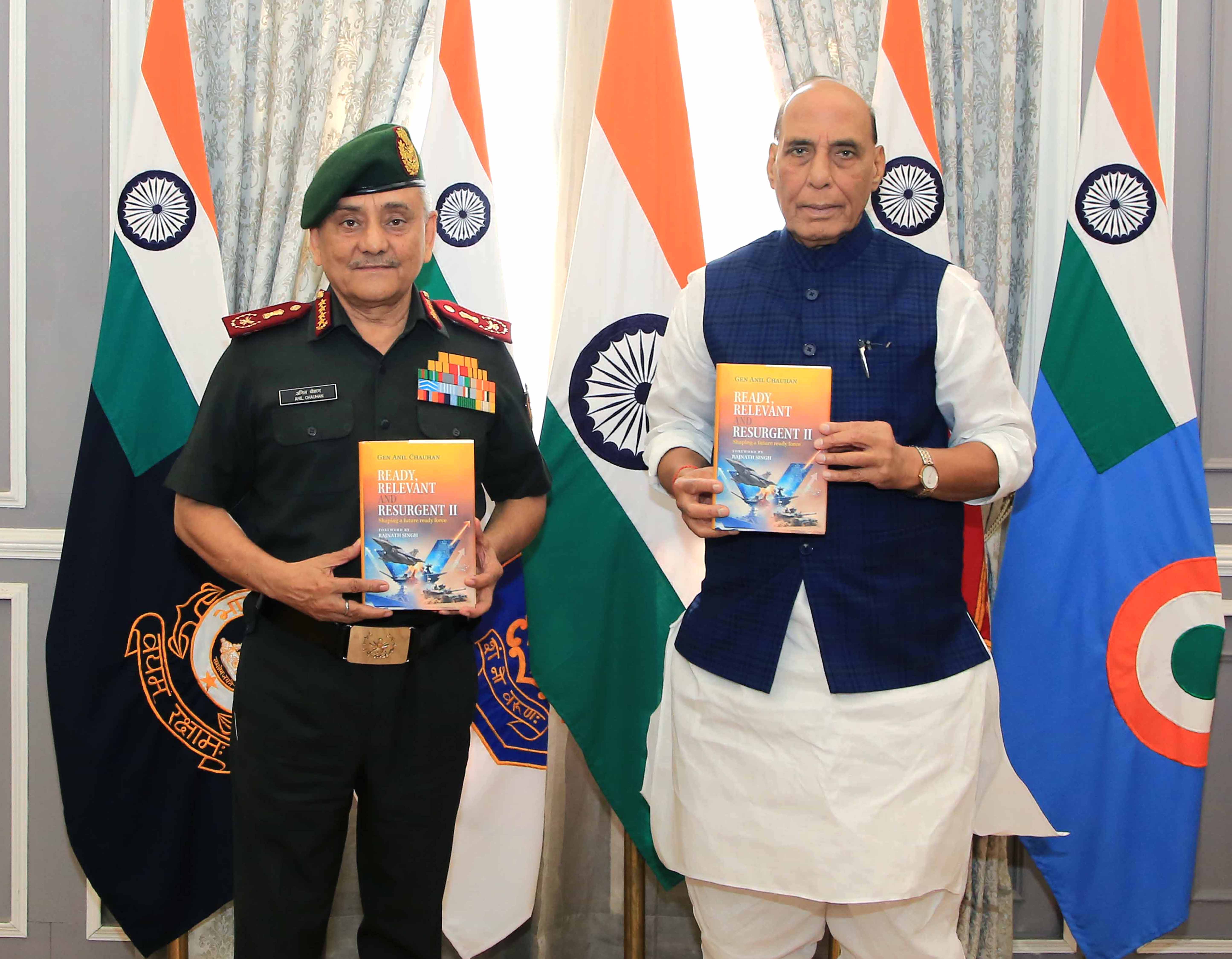
Raksha Mantri releases a book titled ‘Ready, Relevant and Resurgent II: Shaping a Future Ready Force’ authored by CDS
Raksha Mantri Shri Rajnath Singh, on October 14, 2025, released a book titled ‘Ready, Relevant and Resurgent II: Shaping a Future Ready Force’ authored by Chief of Defence Staff General Anil Chauhan. The book presents a comprehensive and future-oriented blueprint for shaping India’s Armed Forces for making them future-ready. It makes an in-depth analysis of warfare’s changing character and provides an evolutionary overview of war, while focusing on emerging frontiers such as cyberspace, space-enabled operations, cognitive warfare, and their growing relevance for the Indian Armed Forces.
Highlighting the necessity for robust military leadership and institutional strength, the book offers a bold reimagination of India’s military future, one rooted in historical wisdom, driven by technological advancement and anchored in the vision of a ready, reliable, and resurgent India. The release event was attended by Director General of the Centre for Joint Warfare Studies Maj Gen (Dr) Ashok Kumar and the publisher from Pentagon Press Shri Rajan Arya.
“Nations with advanced technological & financial capabilities need to enhance support for sustainability of peacekeeping ops”
“Reformed multilateralism which reflects realities, gives voice to all stakeholders, addresses contemporary challenges & focuses on human welfare is must for today’s interconnected world”
“Indian women officers serve in missions across Africa & the Middle East are a global symbol of empowerment”
“Some nations openly violate international rules, India while advocating for reforms in outdated international structures upholds rules-based order”
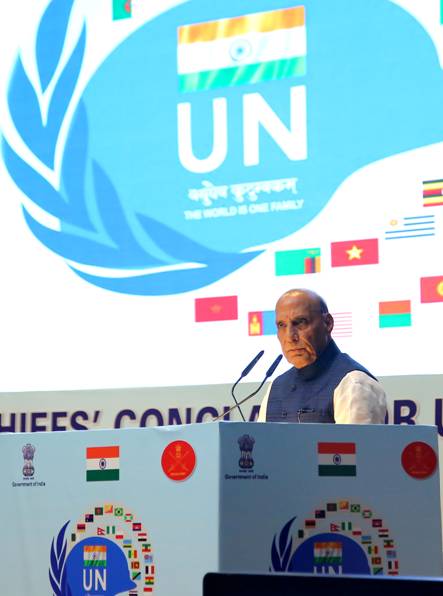
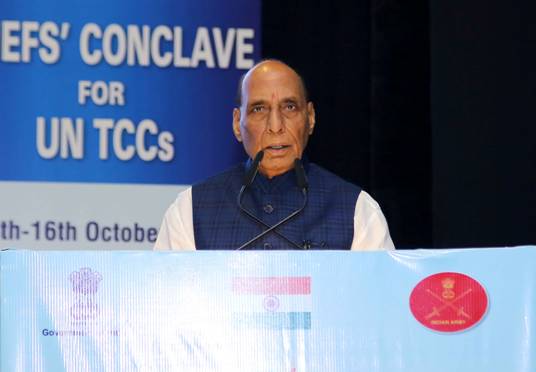
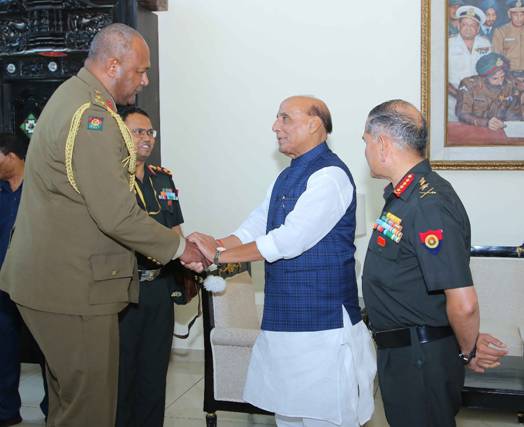
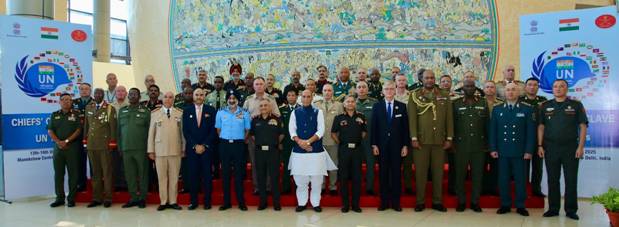
ksha Mantri Shri Rajnath Singh has propagated enhanced Consultation, Cooperation, Coordination & Capacity Building – a 4C formula – as a guiding principle for the countries contributing towards United Nations peacekeeping to tackle emerging challenges and ensure global peace. He was addressing the senior military leadership of United Nations Troop Contributing Countries (UNTCC) during the inaugural session of the Chiefs’ Conclave, being hosted by India for the first time, at Manekshaw Centre, New Delhi from October 14-16, 2025.
Raksha Mantri highlighted the growing complexities of the challenges being faced by the peacekeepers today – from deployment in volatile environments where asymmetric warfare, terrorism, and fragile political settlements coexist to operating amid humanitarian crises, pandemics, or natural disasters, and confronting misinformation campaigns. For the sustainability of peacekeeping operations, he urged the member states, especially those with advanced technological and financial capabilities, to enhance their support through troops, police, logistics, technology and specialised capacities. He stressed that innovations such as secure communications, surveillance systems, and unmanned platforms can make missions safer & more effective.
“Meeting the emerging challenges demands, more than bravery, adaptability, innovation on part of the troop contributing countries and a comprehensive mission level approach taking onboard relevant political actors, finance contributing countries, and other key players influencing the conflict environment to achieve the mandate. These operations often fall short due to delayed deployment, inadequate resources, and an insufficient mandate to address the root causes of conflicts. We cannot fight today’s challenges with outdated multilateral structures. Without comprehensive reforms, the UN faces a crisis of confidence. For today’s interconnected world, we need a reformed multilateralism: That reflects realities; Gives voice to all stakeholders; Addresses contemporary challenges; and focuses on human welfare,” asserted Shri Rajnath Singh.
Raksha Mantri pointed out that India has always stood firm with the UN in its mission to maintain international peace & security, and it remains steadfast in this commitment. “Over the decades, nearly 2,90,000 Indian personnel have served in more than 50 UN peacekeeping missions, earning global respect for professionalism, courage, and compassion. From the Congo and Korea to South Sudan and Lebanon, our soldiers, police, and medical professionals have stood shoulder to shoulder with the international community to protect the vulnerable and rebuild societies. We are ready to contribute troops, share expertise, and support reforms that make peacekeeping more effective & accountable. Through cooperation and technology sharing, we can build missions that are better equipped, more adaptive & more humane,” he stated.
Adding that the success of peacekeeping depends not only on numbers but on preparedness, Shri Rajnath Singh mentioned about the Centre for United Nations Peacekeeping in New Delhi which has trained participants from over 90 countries. He pointed out that India has the necessary credentials to impart training and developing interoperability between peacekeepers from friendly countries to build the mutual understanding that is essential for mission success.
Raksha Mantri added that under the Aatmanirbhar Bharat vision, India has developed cost-effective indigenous technologies which strengthen peacekeeping missions in the from of land mobility platforms, secure communications, surveillance systems, unmanned aerial vehicles and medical support solutions.
Shri Rajnath Singh described the growing participation of women as one of the most inspiring transformations in peacekeeping, stating that their presence enhances the mission’s effectiveness, builds trust with local populations, and brings empathy into operations. “India has been a pioneer in this domain. Our all-women Formed Police Unit deployed to Liberia in 2007 became a global symbol of empowerment. Their professionalism and compassion inspired a generation of Liberian women to join their national police. Today, Indian women officers serve in missions across South Sudan, Golan Heights and Lebanon, leading patrols, engaging with communities, and mentoring local women and youth. They represent the best of what modern peacekeeping can achieve — inclusion, respect, and trust. In 2024, an Indian Army woman peacekeeper was awarded the United Nations Military Gender Advocate of the Year Award for her exemplary service with the UN peacekeeping mission in the Democratic Republic of Congo,” he added.
On the participation of medical peacekeepers, Raksha Mantri said Indian medical teams have treated thousands of civilians and peacekeepers in UN field hospitals across Africa. “Their service, often under challenging adversities, embodies the finest traditions of the Indian peacekeepers and ethos of the UN in the spirit of humanity,” he said.
Shri Rajnath Singh also underlined the fact that India’s aspiration to become a Vishwa Guru is not an assertion of dominance but a call for collaborative and inclusive progress. He voiced India’s belief that by sharing its heritage of non-violence and inner peace, UN peacekeeping and peace-building operations can be enriched, fostering a world order where harmony prevails.
“Now-a-days, some nations are openly violating the international rules, some are trying to undermine it, while some want to create their own rules and dominate the next century. In all this, India, while advocating for the reformation of outdated international structures, stands strong in upholding the international rules-based order. India is land of Mahatma Gandhi, where peace is deeply rooted in our philosophy of non-violence and truth. For Mahatma Gandhi, peace was not merely the absence of war, but a positive state of justice, harmony, and moral strength,” added Raksha Mantri.
In his welcome address, Chief of the Army Staff General Upendra Dwivedi highlighted India’s long-standing contributions to UN peacekeeping. He reaffirmed the Indian Army’s resolve to provide operational excellence, technological innovation and capacity building through institutions like the Centre for UN Peacekeeping, New Delhi.
The Chief of the Army Staff stressed on the need for innovation, inclusivity and interoperability in peacekeeping. He underlined India’s Aatmanirbhar initiatives in defence as scalable solutions for global partners.
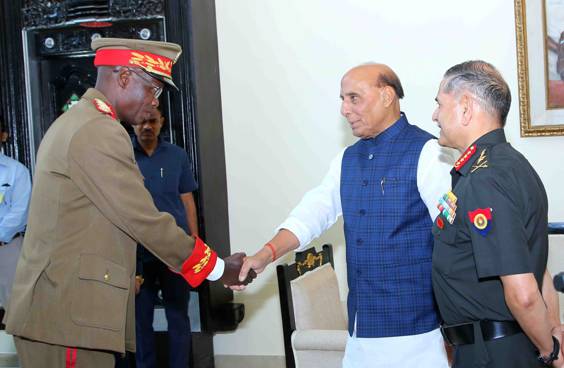
Chief of Defence Staff General Anil Chauhan, Chief of the Air Staff Air Chief Marshal Amar Preet Singh, Under-Secretary-General for Peace Operations Mr Jean Pierre Lacroix, Permanent Representative of India to the UN Ambassador Parvathaneni Harish, and senior serving officers and bureaucrats witnessed the inaugural day’s events along with other distinguished invitees to collectively chart the future of global peace operations.
The UNTCC Chiefs’ Conclave, hosted by Indian Army, brings together senior military leadership from 32 nations that play a pivotal role in UN peacekeeping operations. The conclave is witnessing the participation from Algeria, Armenia, Australia, Bangladesh, Bhutan, Brazil, Burundi, Cambodia, Egypt, Ethiopia, Fiji, France, Ghana, Italy, Kazakhstan, Kenya, Kyrgyzstan, Madagascar, Malaysia, Mongolia, Morocco, Nepal, Nigeria, Poland, Rwanda, Sri Lanka, Senegal, Tanzania, Thailand, Uganda, Uruguay and Vietnam. The conclave also features defence exhibitions for shared capacity building.
The UNTCC serves as a vital forum to address operational challenges, evolving threats, interoperability, inclusivity in decision-making and the role of technology & training in strengthening UN peacekeeping. As one of the largest contributors to UN missions, India is convening this high-level forum to deliberate on operational challenges, evolving threats, share best practices and build shared understanding on future peacekeeping. The Conclave reflects the ethos of Vasudhaiva Kutumbakam (the world is one family).
*******
Petty Officer Vs Havildar : Need to Re-designating Indian Army Ranks
The rank structure of the Indian Army, particularly for its Non-Commissioned Officers (NCOs) and Junior Commissioned Officers (JCOs), has been a subject of discussion regarding its suitability in the modern military context and its impact on the dignity of the personnel. Ranks like Subedar, Havildar, and Sepoy trace their roots to old Mughal terminology used during the Islamic reign, which some veterans argue is historically significant but less aligned with the contemporary roles and status of these soldiers.
The demand for redesigning these ranks is rooted in the belief that the current nomenclature, especially for the high-ranking NCOs, does not accord the respect and dignity commensurate with their critical roles and responsibilities, particularly when compared to equivalent ranks in the Indian Navy and Air Force, and other developed nations armies.
The Dignity Concern: The Case of ‘Havildar’
The rank of Havildar presents a central case for re-evaluation.
Role and Status in Indian Army: A Havildar is the highest-ranking Non-Commissioned Officer (NCO) before promotion to the Junior Commissioned Officer (JCO) cadre. They are the backbone of the unit, responsible for the training, discipline, and immediate command of a section or platoon’s sub-units. Their role is supervisory, leadership-oriented, and tactically crucial.
Civilian Misconception: In various civilian government organisations, the term equivalent to ‘Havildar’ is often associated with roles like a Chowkidar (guard) or similar lower-status positions, leading to a perceived degradation of the Army rank’s status in public perception.
Comparison with Sister Services: The rank structure of the Indian Air Force and Indian Navy primarily uses the term ‘Officer’ in their equivalent NCO/JCO ranks (e.g., Warrant Officer, Petty Officer), suggesting a higher perceived status in nomenclature.
Proposed Alternatives and Global Alignment
To restore the dignity and better reflect the responsibilities of the Havildar rank, various suggestions have been put forth:
Suggested New Rank
Rationale
Sergeant
Most common equivalent in global armies; aligns with professional military terminology.
Junior Officer
Directly elevates the perceived status by aligning it closer to the commissioned/junior commissioned officer structure.
Junior Commander
Emphasises the command and leadership role performed by the individual.
A detailed study reveals that a vast majority (approximately 95%) of developed countries’ armies use the term “Sergeant” for the rank equivalent to the Indian Army’s Havildar. This global consensus strongly supports its adoption for standardization and immediate recognition of the rank’s status.
Comparative Ranks: Havildar Equivalent in Developed Armies
The following table provides a comparison of the Indian Army’s Havildar rank, which is a Senior Non-Commissioned Officer (SNCO) position, with its approximate equivalents in the ground forces of major developed nations, demonstrating the global prevalence of the “Sergeant” nomenclature.
Country
Indian Army Equivalent Rank
India
Havildar
United States Army (USA)
Sergeant
British Army (UK)
Sergeant
French Army
Sergent
Canadian Army
Sergeant
Australian Army
Sergeant
German Army (Bundeswehr)
Stabsunteroffizier / Feldwebel
Note on Indian Army OR-4/OR-5: The Indian Army ranks of Naik (OR-3) and Havildar (OR-4) are generally seen as equivalent to Corporal and Sergeant respectively in the British/Commonwealth system, which many developed armies follow.5 However, in some contexts, the Havildar is compared to US Army’s Sergeant (E-5/OR-5) or even Staff Sergeant (E-6/OR-6) given the depth of their experience before JCO promotion.
Conclusion
The argument for re-designating the rank of Havildar (and potentially other ranks like Subedar and Sepoy) is compelling, resting on the need to:
Eliminate Confusion and Undignified Comparisons: Remove the ambiguity and demeaning comparisons that arise from the current rank’s association in the civilian domain.
Standardise with Global Norms: Align the rank nomenclature with approximately 95% of the world’s developed armies, where the term Sergeant is universally accepted for this crucial leadership role.
Restore and Elevate Dignity: Bestow a rank that explicitly reflects the high degree of training, responsibility, seniority, and leadership expected of a Senior Non-Commissioned Officer in the modern Indian Army.
Accepting the suggestion of Sergeant as the new rank for Havildar would be a decisive step towards re-establishing the due dignity of these senior soldiers, ensuring both national pride and international recognition of their professional status.
All Exservicemen Association and veterans may approach the concerned authorities addressing the concerned issue for consideration and redesign the rank to restore dignity of Senior NCO rank of the Indian Army
State Stalwarts
DEFENCES FORCES RANKS
ARMY, NAVY, AIRFORCE RANKS
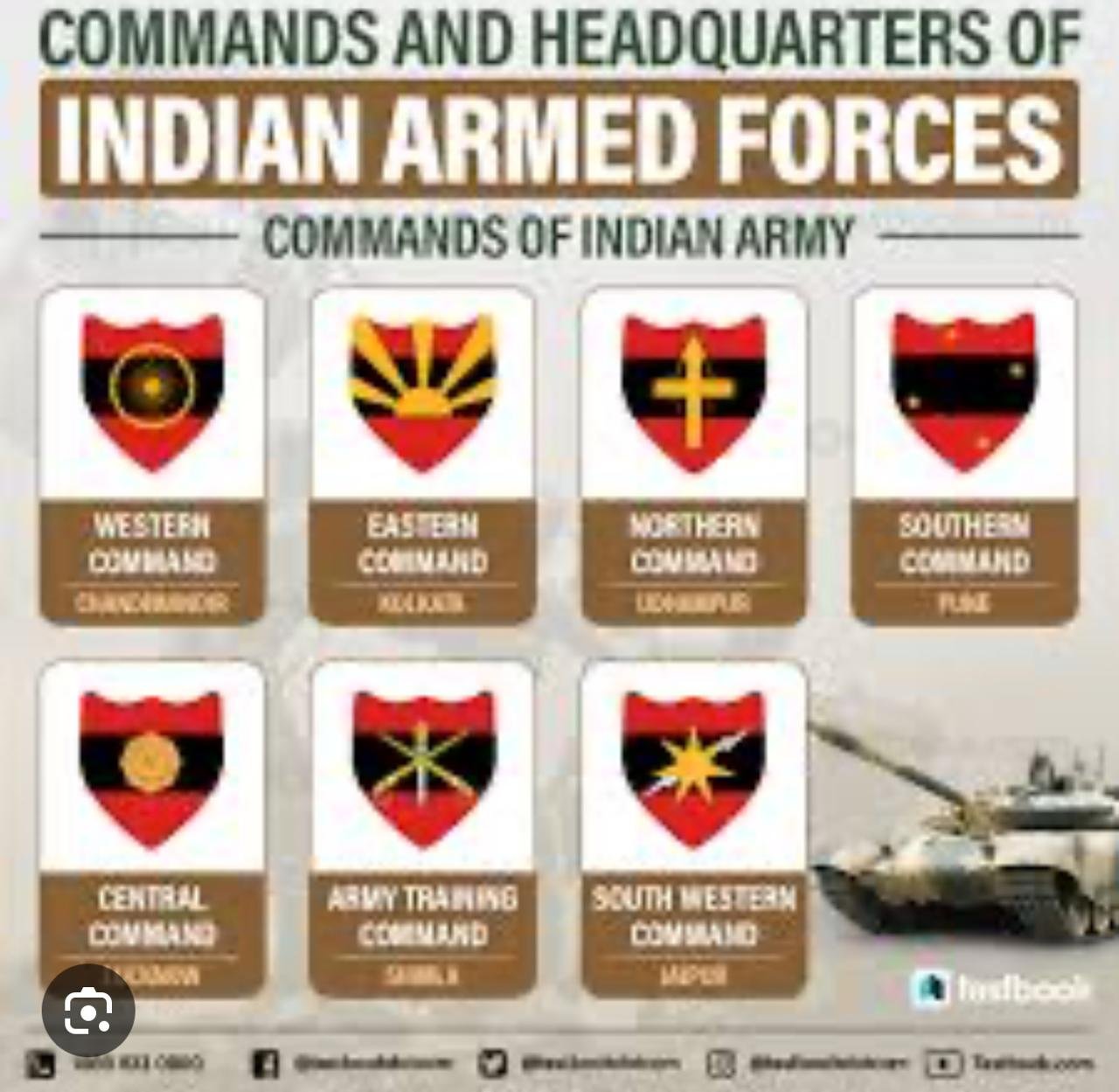
FORMATION SIGNS
FORMATION SIGNS
ALL HUMANS ARE ONE CREATED BY GOD
HINDUS,MUSLIMS,SIKHS.ISAI SAB HAI BHAI BHAI
CHIEF PATRON ALL INDIA SANJHA MORCHA
LT GEN JASBIR SINGH DHALIWAL, DOGRA
SENIOR PATRON ALL INDIA SANJHA MORCHA
MAJOR GEN HARVIJAY SINGH, SENA MEDAL ,corps of signals
.
.
PATRON ALL INDIA SANJHA MORCHA
MAJ GEN RAMINDER GORAYA , CORPS OF
sanjhamorcha303@gmail.com
PRESIDENT HARAYANA STATE CUM COORDINATOR ESM
BRIG DALJIT THUKRAL ,BENGAL SAPPERS
PRESIDENT TRICITY
COL B S BRAR (BHUPI BRAR)
PRESIDENT CHANDIGARH ZONE
COL SHANJIT SINGH BHULLAR
.
.
PRESIDENT PANCHKULA ZONE AND ZIRAKPUR
COL SWARAN SINGH
PRESIDENT SAS NAGAR (MOHALI)
COL BALBIR SINGH , ARTY
INDIAN DEFENCE FORCES
DEFENCE FORCES INTEGRATED LOGO
FORCES FLAGS
15 Th PRESIDENT OF INDIA SUPREME COMMANDER ARMED FORCES
Droupadi Murmu
DEFENCE MINISTER
Minister Rajnath Singh
CHIEF OF DEFENCE STAFF (2nd)
General Anil Chauhan PVSM UYSM AVSM SM VSM
INDIAN FORCES CHIEFS
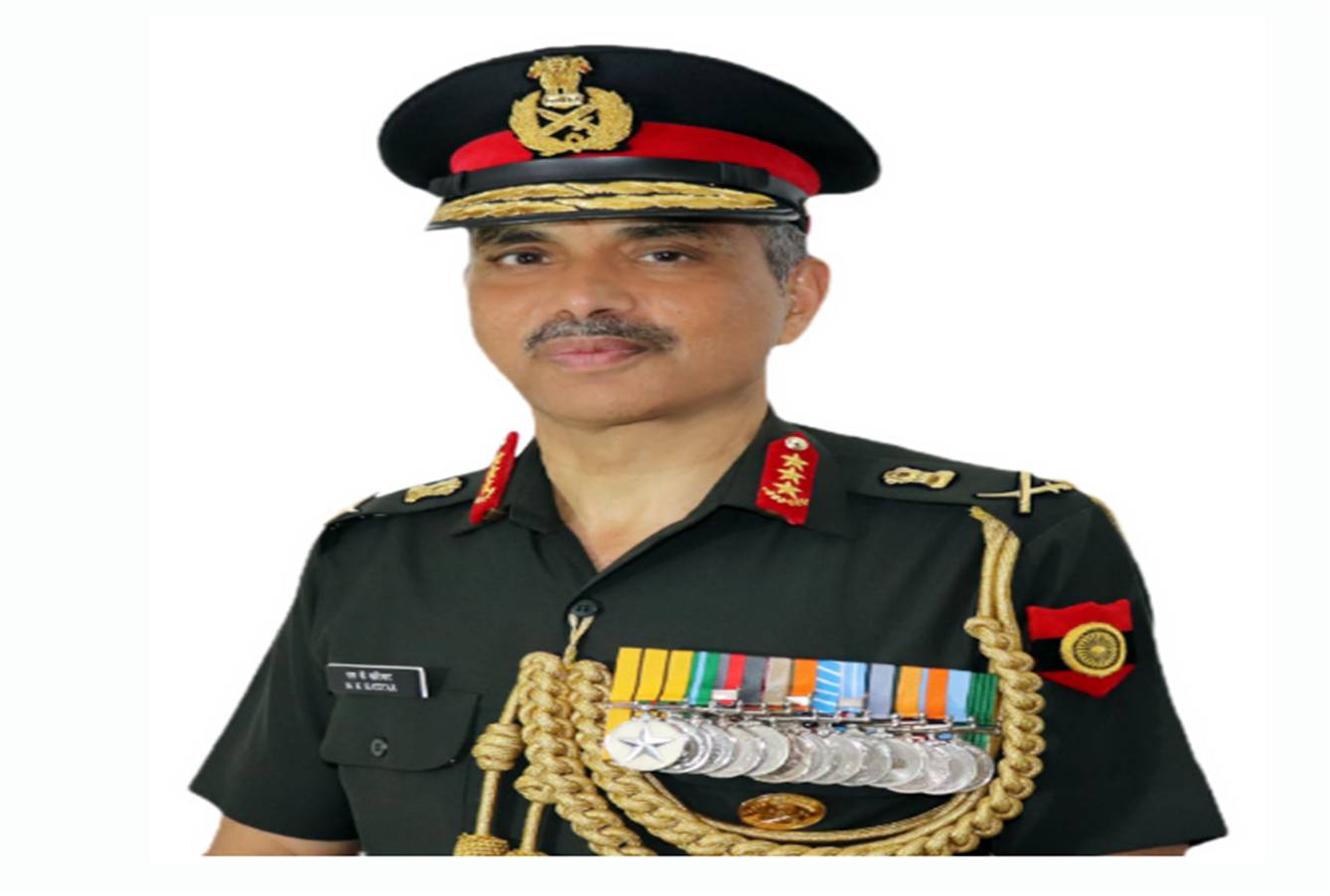
CHIEF OF ARMY STAFF(29th)
General Upendra Dwivedi, PVSM, AVSM (30 Jun 2024 to Till Date)