Sanjha Morcha

What’s New

Click the heading to open detailed news

Current Events :

web counter

Print Media Reproduced Defence Related News

Army revisits Capt Salaria’s bravery, urges UN to revise peacekeeping rules

Hailing from Gurdaspur, Punjab, Capt Salaria not only saved the UN Force Headquarters in Congo, but also effectively isolated the rebels

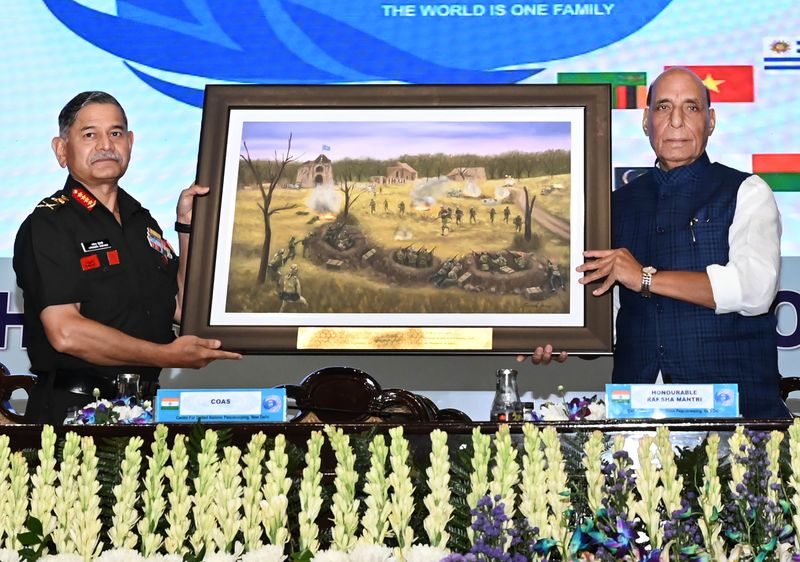
Through a painting of the 1961 Congo clash, the Army has sent out a quiet yet powerful message — urging the United Nations to modernise its peacekeeping mandates in tune with today’s conflicts, while honouring Capt Gurbachan Singh Salaria’s ultimate sacrifice in defence of the fledgling nation.

Capt Salaria, hailing from Gurdaspur, Punjab, was posthumously awarded the Param Vir Chakra (PVC) for his gallantry. He not only saved the UN Force Headquarters in Congo, but also effectively isolated the rebels — the Katanga Gendarmerie — who were attempting to disrupt operations in the African nation.

Army Chief Gen Upendra Dwivedi, while hosting a conclave (October 13-16) of countries contributing troops to UN peacekeeping missions, presented a painting each, on separate days, to Defence Minister Rajnath Singh and External Affairs Minister S Jaishankar. Military chiefs or their representatives from 32 troop-contributing countries attended the event.

India, the largest contributor of troops to UN peacekeeping missions, is seeking a broader operational mandate for such forces. The painting carried a strong message — that peacekeeping is a dangerous task, as rebels and non-state actors are often well-armed and operate outside international norms.

Jaishankar today said, “Troop-contributing countries as well as host states must be consulted while formulating mandates of peacekeeping missions.” Singh had echoed similar sentiments at the same event on October 14.

The painting depicted how Capt Salaria’s small team of about 16-18 troops was tasked with clearing a roadblock set up by secessionist Katanga gendarmes. They faced a superior enemy force of about 90 well-armed men supported by two armoured cars strategically placed to disrupt UN operations.

Commissioned into the 3rd Battalion of the 1st Gorkha Rifles in 1957, Capt Salaria launched a daring assault with his men. With the Gorkha war cry “Aayo Gorkhali!” (The Gorkhas are here!), they charged the enemy position, leading to fierce hand-to-hand combat.

Capt Salaria’s citation reads: “He led a charge with bayonets, khukuris and grenades, supported by a rocket launcher. Capt Salaria killed 40 of the enemy and knocked out two armoured cars.” His audacious action broke the resolve of the rebels, but he was fatally hit by automatic weapon fire.

Maj Gen Ian Cardozo (retd), in his 2003 book “Param Vir: Our Heroes in Battle”, wrote that Capt Salaria was born on November 29, 1935, in Janwal village near Shakargarh (now in Pakistan). His family moved to India during the Partition of 1947 and settled in Jangal village near Dinanagar in Gurdaspur district.

In the early 1960s, newly independent Congo was engulfed in a civil war after the secession of its mineral-rich Katanga province. With foreign commercial interests fuelling the unrest, the Congolese government appealed to the UN for help, leading to a peacekeeping mission being sanctioned in July 1960.

AI pilot’s father moves SC, seeks fair probe into crash

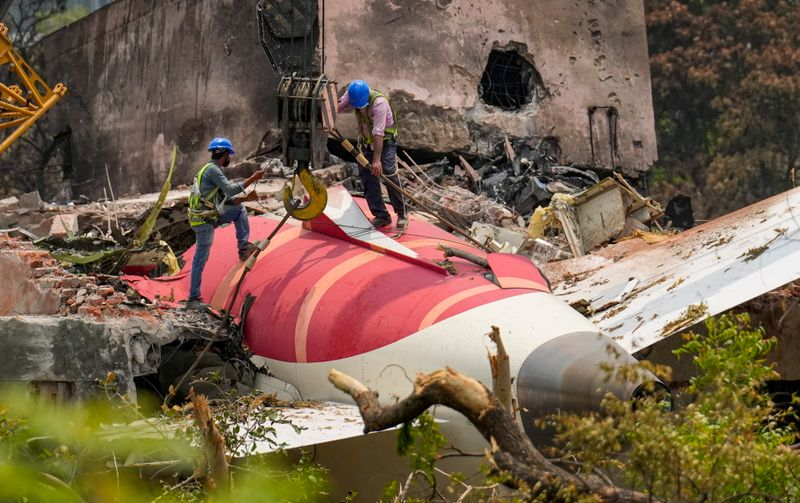
265 people had died in Ahmedabad

The father of Captain Sumeet Sabharwal — the pilot who died in the June 12 crash of Air India flight AI171 in Ahmedabad — and the Federation of Indian Pilots (FIP) have moved the Supreme Court seeking a court-monitored probe into the accident in which 265 people, including both pilots and crew members, died.

Filed under Article 32 of the Constitution by Pushkaraj Sabharwal and the FIP, the petition seeks a court-monitored committee comprising a retired judge of the Supreme Court and independent aviation and technical experts to conduct a fair, transparent and technically robust probe into the crash.

It urged the top court to direct that all investigations carried out so far, including the preliminary report dated July 12, be treated as closed and all records, data and evidence be transferred to the new inquiry panel to be set up.

Terming the ongoing probe “incomplete, biased and technically unsound”, the petitioners said it undermined India’s obligations under International Civil Aviation Organisation (ICAO) Annexe 13, which mandated an independent investigation authority.

The current five-member team is dominated by officials from the Directorate General of Civil Aviation (DGCA) and the Aircraft Accident Investigation Bureau (AAIB), the very entities responsible for regulatory oversight, thereby violating the principle of nemo judex in causa sua (no one should be a judge in their own cause), they alleged.

The AAIB report predominantly focused on the deceased pilots, who were no longer there to defend themselves and that the report failed to examine or eliminate other more plausible technical and procedural causes of the crash, the petitioners submitted.

Accusing the authorities of selectively leaking the contents of the Cockpit Voice Recorder (CVR) to the media, they said it violated Rule 17(5) of the Aircraft (Investigation of Accidents and Incidents) Rules, 2017.

These leaks, they claim, fuelled a “malicious media campaign” attributing fault to the deceased pilot without corroborative evidence, amounting to state-facilitated defamation and violation of the family’s right to dignity under Article 21.

This is the second petition filed in the top court on the June 12 plane crash. The Supreme Court had on September 22 asked the Centre, the DGCA and the AAIB to respond to a PIL filed by the Safety Matters Foundation seeking an independent, fair and expeditious probe into the June 12 Air India plane crash at Ahmedabad.

Expressing concern over the selective leak of the preliminary inquiry report, which led to a media narrative blaming pilot error for the crash of the London-bound Air India Flight AI171, a Bench led by Justice Surya Kant had noted that certain aspects of the July 12 AAIB preliminary report indicating lapses on the part of the pilots were “irresponsible”.

Calling the attribution of pilot error “implausible” and “procedurally unjust,” the petitioners argue that the failure to probe design or software integration failures in Boeing’s Common Core System amounts to non-application of mind and suppression of material facts.

Sabharwal’s father said his son had an “unblemished career spanning over 30 years, with 15,638 hours of incident-free flying, including 8,596 hours on Boeing 787-8 aircraft, without a single reported lapse or incident causing fatalities or otherwise.”

The petition pointed to several technical lapses in the preliminary report.


HEADLINES :16 OCT 2025

Indian army shares Upendra Dwivedi-Kazakhstan’s counterpart photos, internet spots this painting

Join the ranks: Agniveer recruitment rally in Shimla from October 17

MoD doubles 3 grants for ex-soldiers, families

Army to get new missiles, ‘night sights’ for rifles

IAF, UK navy jets hold joint drills over Indian Ocean

Ladakh violence: Restrictions in Leh lifted after 22 days

Tri-services multi-domain exercise on futuristic warfare concludes at Northern Command

Punjab sees 5-fold rise in arms smuggling from Pak


Indian army shares Upendra Dwivedi-Kazakhstan’s counterpart photos, internet spots this painting

Pakistan’s Gen AAK Niazi signed the instrument of surrender of East Pakistan after defeat to India. Over 93,000 Pakistani troops surrendered to the Indian Army on December 16, 1971.

The painting of Pakistani army surrender of 1971 in the background (Image: X/@adgpi)

A photograph shared on X during a recent high-level military meeting between India and Kazakhstan has drawn attention online, as it prominently features the iconic mural of the 1971 India-Pakistan war surrender in the background.

Chief of the Army Staff General Upendra Dwivedi met Major General Mereke Kuchekbayev, Chief of Land Forces of Kazakhstan, on the sidelines of the United Nations Chiefs of the Counter-Terrorism Conference (UNTCC) 2025.

The Indian Army shared the image of the meeting on X from its official handle and wrote, “On the sidelines of the #UNTCC2025, #GeneralUpendraDwivedi, #COAS met with Major General Mereke Kuchekbayev, Chief of Land Forces, Kazakhstan.”

The post said that the meeting reaffirmed the enduring defence partnership between the India and Kazakhstan, with a focus on training cooperation, capacity building and continued engagement for regional peace and stability.

The mural hanging on the wall in the background caught attention online due to its historic significance and the heritage of Indian Armed Forces.


Join the ranks: Agniveer recruitment rally in Shimla from October 17

The Army Recruiting Office, Shimla is set to organise the ‘Agniveer Recruitment Rally’ for the Indian Army in Prithi Military Station, Averipatti in Rampur Bushahr, Shimla from November 17 to 24 for the youth of Shimla, Solan, Kinnaur and Sirmaur districts of the state. This was stated by Shimla Deputy Commissioner (DC) Anupam Kashyap while he chaired a meeting regarding the upcoming recruitment rally here.

During the meeting, he appointed Rampur Sub Divisional Magistrate (SDM) as the Nodal officer to ensure the successful rally. The DC instructed him to inspect the rally site along with the officials concerned within this week to ensure all the timely completion of all preparations for the recruitment rally.

He said a controlroom will be set up at the main entrance of the rally site, where police and revenue department officials will be deployed. The DC also directed the police department to ensure adequate deployment of police personnel, PCR vans, proper traffic management, checkpoints and other necessary security arrangements at the venue so that the youth do not face any inconvenience during the rally.

The SDM also instructed the PWD officials to ensure the maintenance of the ground as well as to construct temporary toilets. He also directed the Jal Shakti Department officials to ensure sufficient drinking water supply during the rally besides directing the Electricity Board to ensure uninterrupted power supply.

The SDM said doctors along with an ambulance will be stationed at the rally site. “Additionally, officials from the Education and Sports Departments will also be deployed during the rally. Arrangements for accommodation will be made in Panchayat Bhawans, school buildings, dharamshalas, etc.” he said.


MoD doubles 3 grants for ex-soldiers, families

Defence Minister Rajnath Singh has approved a 100 per increase in financial assistance for ex-servicemen and their dependents under schemes implemented by the Department of Ex-Servicemen Welfare through the Kendriya Sainik Board.

Enhanced assistance

The penury grant has been doubled from Rs 4,000 to Rs 8,000 a month, providing sustained lifetime support to ex-servicemen who did not qualify for pension 

The education grant has been increased from Rs 1,000 to Rs 2,000 a month per head for up to two dependent children from class 1 to graduation

The marriage grant has been raised from Rs 50,000 to Rs 1,00,000, applicable to up to two daughters of the ex-servicemen and for widow remarriage

As per the list of enhanced benefits released by the Ministry of Defence, the penury grant has been doubled from Rs 4,000 to Rs 8,000 a month per beneficiary, providing sustained lifetime support to aged ex-servicemen who did not qualify for pension. The grant will also apply to their widows above 65 years of age.

The penury grant is for those who don’t have the financial means and applies to officers and jawans who served less than 20 years and 15 years, respectively.

The education grant has been increased from Rs 1,000 to Rs 2,000 a month per head for up to two dependent children from class 1 to graduation. For widows of soldiers, this will be extended for pursuing a two-year postgraduate course.

The marriage grant has been raised from Rs 50,000 to Rs 1,00,000 per beneficiary. It is applicable for up to two daughters of the ex-servicemen and for widow remarriage.

The revised rates take effect for applications submitted from November 01, 2025 onwards, with an annual financial implication of approximately Rs 257 crore to be met from the Armed Forces Flag Day Fund (AFFDF). These schemes are funded through the ‘Raksha Mantri Ex-Servicemen Welfare Fund’, which is a subset the AFFDF.

The MoD said the decision strengthened the social security for non-pensioner soldiers, widows, and dependents from lower-income groups, reaffirming the government’s commitment to honouring the service and sacrifice of the veterans.

Ministry of Defence

azadi ka amrit mahotsav

Raksha Mantri approves 100% increase in financial assistance for Ex-Servicemen & their dependents

Posted On: 15 OCT 2025 11:52AM by PIB Delhi

Raksha Mantri Shri Rajnath Singh has approved a 100% increase in financial assistance for Ex-Servicemen (ESM) and their dependents under schemes implemented by the Department of Ex-Servicemen Welfare through Kendriya Sainik Board. The approved enhancements are as follows:

  • Penury Grant has been doubled from Rs 4,000 to Rs 8,000 per month per beneficiary, providing sustained lifetime support to aged and non-pensioner ESM and their widows above 65 years of age with no regular income.
  • Education Grant has been increased from Rs 1,000 to Rs 2,000 per month per head for up to two dependent children (Class I to Graduation) or widows pursuing a two-year postgraduate course.
  • Marriage Grant has been raised from Rs 50,000 to Rs 1,00,000 per beneficiary. Applicable for up to two daughters of ESM and for widow remarriage, for marriages solemnised after issuance of this order.

The revised rates take effect for applications submitted from November 01, 2025 onwards, with an annual financial implication of approximately Rs 257 crore to be met from the AFFDF. These schemes are funded through the Raksha Mantri Ex-Servicemen Welfare Fund, which is a subset of the Armed Forces Flag Day Fund (AFFDF).

The decision strengthens the social security net for non-pensioner ESM, widows, and dependents from lower-income groups, reaffirming the Government’s commitment to honouring the service and sacrifice of the veterans.


Army to get new missiles, ‘night sights’ for rifles

Two separate contracts were signed today to enhance the operational readiness of the Army — one for procuring a new-type of missiles and other for adding ‘night firing’ capability to assault rifles.

The Army’s Corps of Army Air Defence today signed a contract with Thales UK for procurement of light weight modular missile (LMM) system that will add to the air defence systems. Procurement of these missiles for £350 million was announced on October 9 when Prime Minister Narendra Modi and his British counterpart Keir Starmer met in Mumbai for a bilateral meeting.

Adding firepower

The light weight modular missile (LMM) system is effective against all types of aircraft, helicopters and UAV’s to a range greater than 6 km in all-weather conditions

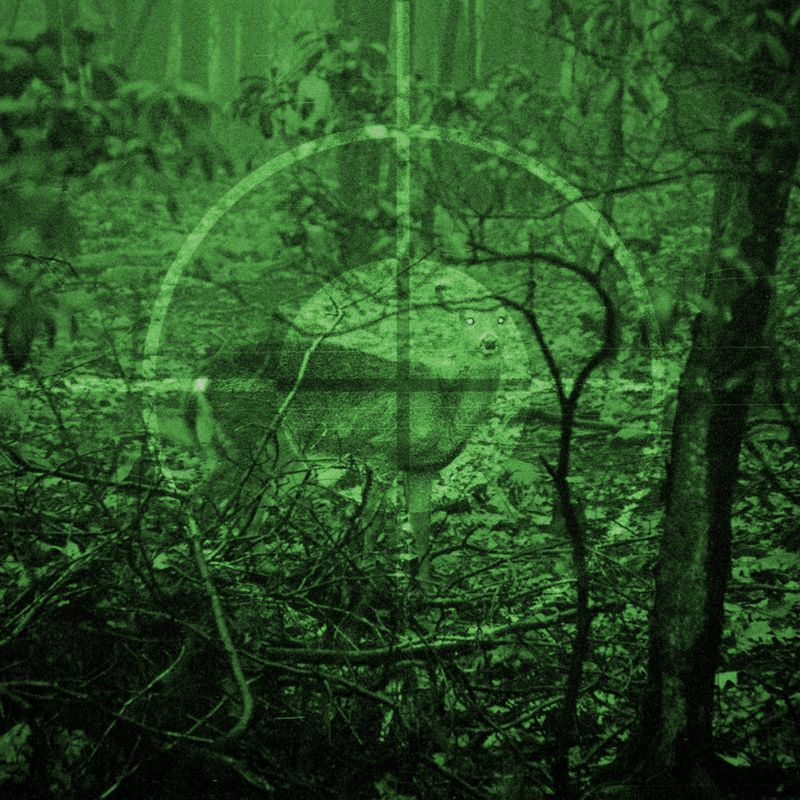
Advanced ‘night sights’ are being procured for 7.62 x 51mm assault rifles to enable soldiers to precisely aim and fire at targets at night. It is useful along the LoC

The LMM is a light weight and man-portable missile system which can be deployed in operational areas, including the high-altitude areas. The missile operates on laser beam riding principle and is resistant to evasive actions taken by modern day aerial platforms.

The missile is effective against all types of aircraft, helicopters and UAV’s to a range greater than 6 km in all-weather conditions. The missile has a high single-shot kill probability due to advanced sighting system, incorporation of proximity fuze and high explosive warhead.

The missile system has been procured post Operation Sindoor to detect and destroy high value drones and UAVs.

The second deal is a Rs 659.47-crore contract the Ministry of Defence signed for procurement of advanced ‘night sights’ for the Army’s 7.62 x 51mm assault rifles.

‘Night sights’ enable soldiers to precisely aim and fire at targets at night. It is useful along the Line of Control to stop infiltration.

The Ministry of Defence said the ‘night sight’ would enable soldiers to fully exploit the longer effective range of the ‘SIG 716 assault rifle’.

These sights are capable of engaging targets up to an effective range of 500 metres, even under starlit conditions and provide a significant improvement over the existing Passive Night Sights (PNS).

This procurement, has more than 51% indigenous content, is a major step towards aatmanirbharta (self-reliance) in defence manufacturing. The initiative will also benefit the MSMEs involved in manufacturing of components and supply of raw material.


IAF, UK navy jets hold joint drills over Indian Ocean

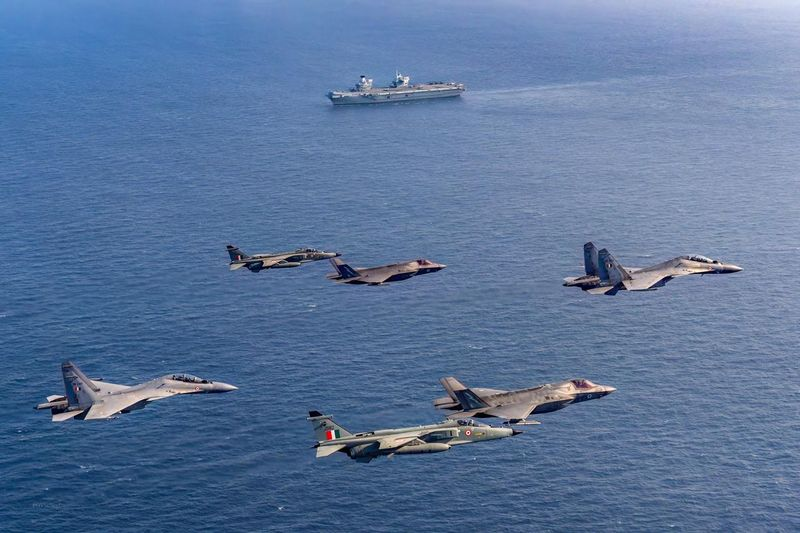
In a display of growing defence cooperation between India and the United Kingdom, the Indian Air Force (IAF) has carried out a joint exercise with the UK Royal Navy over the Indian Ocean.

The UK Royal Navy’s F-35B stealth combat jets, termed as ‘fifth-generation’ planes produced by the US company Lockheed Martin, participated in the exercise. The IAF used

the Russia-made Sukhoi 30-MKI and the British origin-Jaguar which have a maritime role.

The F-35B jets are based on the deck of the 65,000-tonne UK Navy carrier, the HMS Prince of Wales. The IAF jets took off from land bases to carry out the drills.

The IAF, on Wednesday, posted pictures of the exercise and said, “On 14 Oct, IAF’s Sukhoi-30 MKIs, Jaguars, AWACS & AEW&C aircraft joined Royal Navy F-35Bs from HMS Prince of Wales for a joint exercise over the Indian Ocean Region.”

The use of AWACS and AEW&C is crucial. The AWACS (airborne warning and control system) is an aircraft-mounted radar system designed to detect and track aircraft, ships, missiles and other vehicles at long ranges. The AEW&C (airborne early warning and control) is also a radar system designed to detect and track aircraft, ships and then direct own forces to respond. It is flying command and control centre.

The IAF added “the training strengthened interoperability, mutual trust, and collective commitment to regional stability”.  The objective of this aerial drill was to enhance capacities on both sides to operate together.

The UK’s Carrier Strike Group, led by HMS Prince of Wales, since April, is on an eight-month-long deployment under ‘Operation Highmast’ and highlights the UK’s increasing focus on the Indo-Pacific.

India and the UK have a “India-UK 2030 Roadmap” and the “India-UK Vision 2035,” which aim to elevate the bilateral relationship through strategic partnerships in technology and defence.

The two sides announced an agreement for cooperation in military training, under which IAFflying instructors will serve as trainers with the UK’s Royal Air Force.

Last week, the Indian Navy and UK’s Royal Navy concluded maritime exercise ‘Konkan-2025’ with ‘carrier strike groups’ led by the INS Vikrant and HMS Prince of Wales, respectively. It included fighter jets and copters on deck of the aircraft carrier, which is accompanied by other warships and submarines, getting live situational feed from surveillance planes and satellites.

The exercise involved maritime operational drills focusing on anti-aircraft, anti-surface, and anti-submarine exercises, flying operations and other seamanship evolution.


Ladakh violence: Restrictions in Leh lifted after 22 days

Statehood protests had left four people dead and over 80 others injured

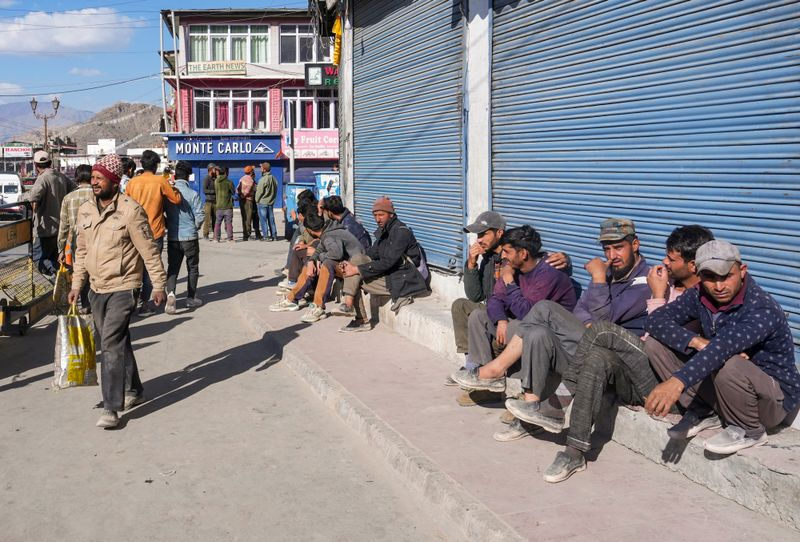
Authorities on Wednesday lifted the restrictions in Leh district of Ladakh, 22 days after they were imposed following violence during the statehood protests that left four people dead and over 80 others injured.

The district administration had on September 24 promulgated prohibitory orders under Section 163 of the Bharatiya Nagarik Suraksha Sanhita (BNSS) in Leh, banning the assembly of five or more persons.

No incident of violence had been reported since then, officials said.

“I do hereby withdraw the restrictions imposed vide this office order dated September 24 with immediate effect,” District Magistrate Leh, Romil Singh Donk, said in an order on Wednesday.

He said certain restrictions were imposed under Section 163 of the Bharatiya Nagarik Suraksha Sanhita, 2023, to prevent any breach of peace and disturbance to public tranquillity.

The Senior Superintendent of Police, in a report submitted on Wednesday, said that there is no imminent apprehension of breach of peace and public order and recommended withdrawal of the restrictions under Section 163 BNSS, the DM said.

Police arrested climate activist Sonam Wangchuk on September 26, two days after clashes between security forces and protesters demanding Ladakh’s statehood and Sixth Schedule status left four people dead and 90 injured. He was detained under the National Security Act (NSA) for allegedly inciting the violence and shifted to Jodhpur jail.

Wangchuk, a leading voice of the Leh Apex Body (LAB) and the Kargil Democratic Alliance (KDA), has been spearheading a five-year-long agitation demanding statehood and constitutional safeguards for the residents of Leh and Kargil.


Tri-services multi-domain exercise on futuristic warfare concludes at Northern Command

Simulation of futuristic conflict scenarios for improved coordination among different agencies was exhibited at the exercise

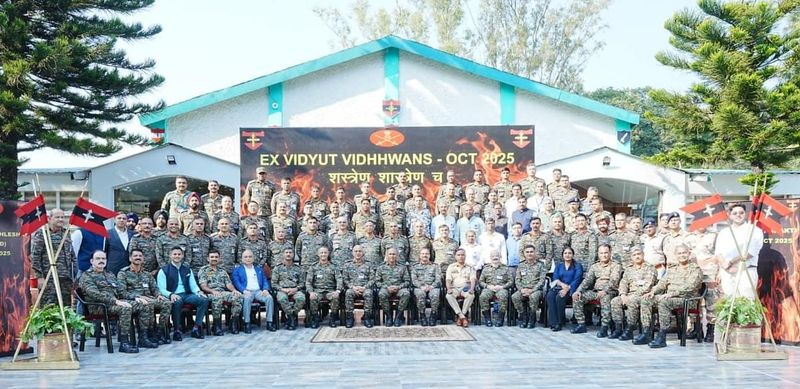
A tri-service exercise under the aegis of Northern Command headquarters in which simulation of futuristic conflict scenarios for improved coordination among different agencies was exhibited concluded on Wednesday.

“Over four days imbued with simulation of intense futuristic conflict scenario and display of astute leadership, a tri-service multi-domain exercise has concluded under aegis of HQ Northern Command, with new lessons, improved reflexes and setting of new benchmarks in India’s preparedness for next-generation conflicts,” an official spokesperson of Army said.

He said the exercise challenged commanders, staff and troops with futuristic threats in cyber, space, electromagnetic and cognitive domains. “CAPFs, sister services, central government agencies and private sector players participated jointly, underscoring the importance of integrated and whole of a nation approach to continuously evolving security landscape. Participation by indigenous defence industry players set a new benchmark towards achieving jointness, Atmanirbarta and innovation,” the spokesperson added.

During the exercise, troops deployed in the forward areas practiced in situations like cyber intrusion, spectrum saturation, electronic jamming, spoofing and cognitive attacks.

Interacting with the troops, Northern Army Commander Lt Gen Pratik Sharma said, “In modern warfare, the lines are blurring between domains, so we need to leverage niche technology and keep innovating. A whole of nation approach is required to protect our territorial integrity and critical assets and also unleash punitive action on adversary if the situation so demands.”

The exercise demonstrated that readiness for future warfare begins with open minds and seamless teamwork. The Northern Command now stands better equipped, united and prepared to defend against emergent threats with strategic foresight and multi-domain synergy, the spokesperson added.