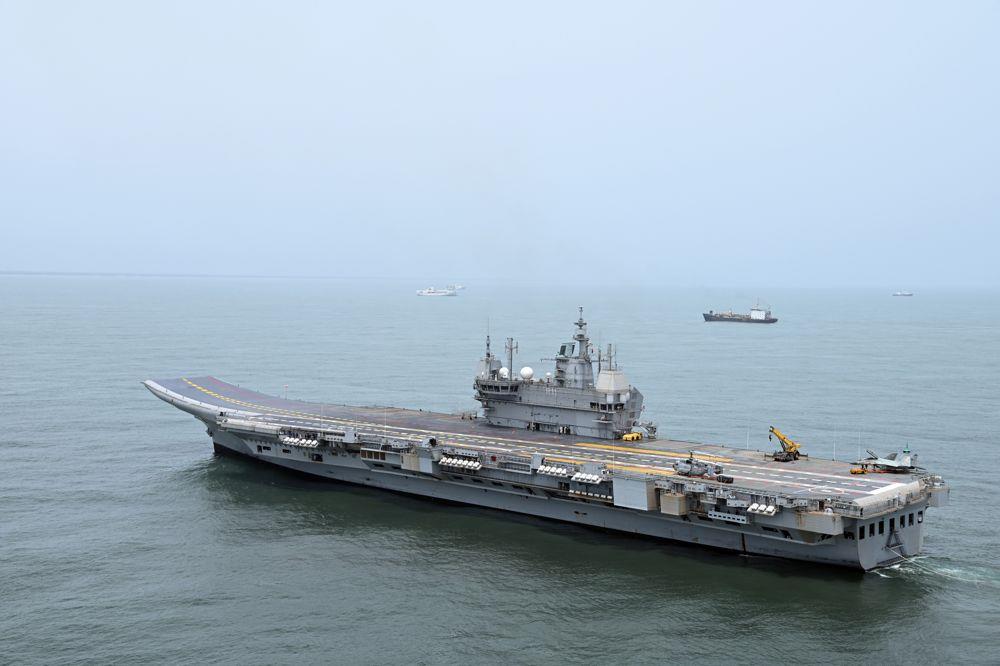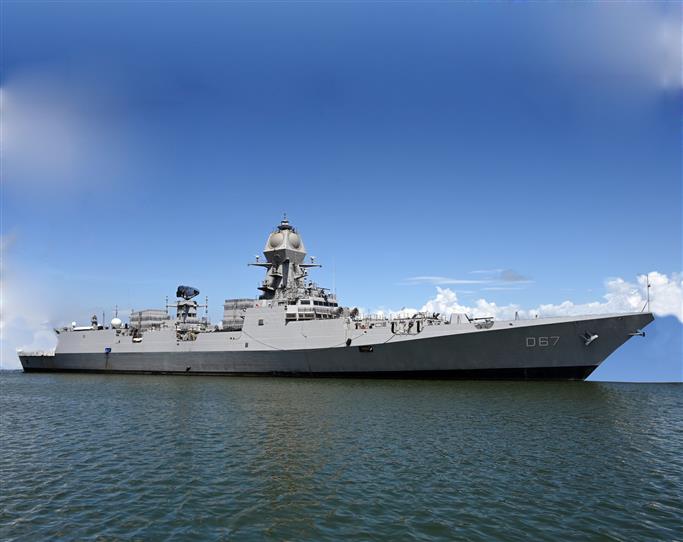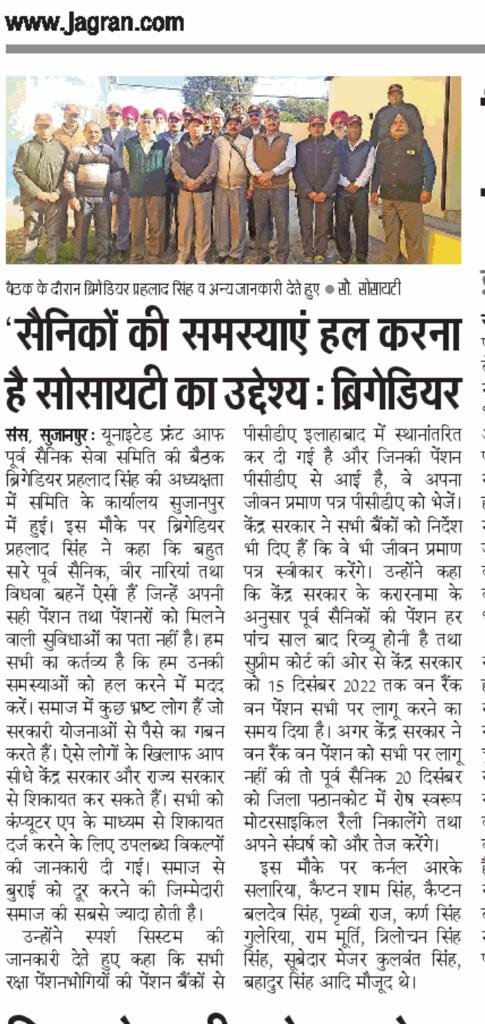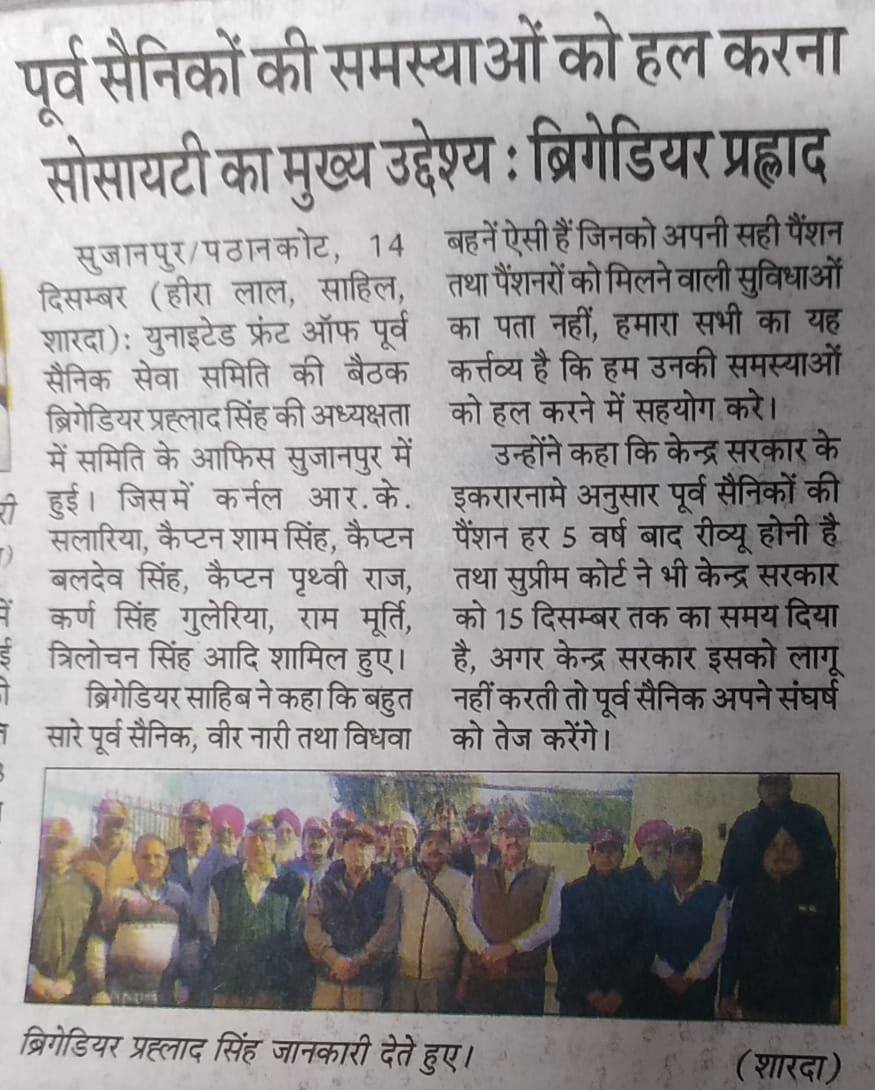




New Delhi: The Armed Forces and different organisations of the Ministry of Defence will be conducting various events across the country to commemorate the 75th anniversary of India’s Independence, being celebrated as ‘Azadi Ka Amrit Mahotsav’. Defence Minister Rajnath Singh will formally launch various major events virtually from New Delhi on Friday. Following are the events to be launched in the run-up to Independence Day 2021: Unfurling of National Flag at 75 Passes/Places: To commemorate 75 years of Independence, Border Roads Organisation (BRO) will unfurl the National Flag at 75 important passes and places in the country, displaying their resolve in developing border infrastructure. 75 teams of BRO will depart on August 13, 2021, to these remote passes. The most prominent among them is ‘Umlingla Pass’, which is the highest motorable road in the world at 19,300 feet, in Eastern Ladakh. The national tri-colour will also be unfurled at prominent infrastructure landmarks like Atal Tunnel, Rohtang and Dhola Sadiya Bridge in the Northeast, besides in friendly foreign countries. Unfurling of National Flag in Islands: Indian Coast Guard will be unfurling the National Flag at 100 islands Pan-India on August 15, 2021, as part of ‘Azadi ka Amrit Mahotsav’. The proceedings will start on August 13, 2021. Freedom Run: Indian Navy personnel and their families will participate in the freedom run at Naval Officers Mess in Varuna, New Delhi. The Defence Minister will virtually flag off the freedom run, which is part of the Fit India Freedom Run 2.0 being launched across the country on August 13, 2021, to celebrate the 75th Independence Day. Army Expedition: To instil a sense of pride and confidence among citizens that the Indian Army is committed to protecting the country in all types of terrain and climate, the teams of the Army will scale 75 mountain passes to mark this momentous occasion. The passes include Saserla Pass in Ladakh region, Stakpochan Pass in Kargil region, Satopanth, Harshil, Uttarakhand, Phim Karnla, Sikkim and Point 4493, Tawang region of Arunachal Pradesh. The Raksha Mantri will flag off the event on August 13, 2021.
The UK, Germany, France and India have deployed warships that have transited or will transit the South China Sea. Many say this convergence is intended to demonstrate their collective and coordinated will and capability to defend the existing “international order” against China’s illegal claims and bullying. But while Washington may have thought – or wanted the world and Americans to think – that these countries were in united support of its crusade to contain China, they each had their own motives and their messages were mixed. But before analysing the details of the messaging, it is important to clear up some confusion regarding the purpose of these deployments. Some have implied that they are freedom of navigation operations (FONOPs) challenging China’s claims. They are not. FONOPs are formal pre-programmed operational challenges with warships and warplanes against claims the US believes are inconsistent with the UN Convention on the Law of the Sea (UNCLOS), such as prior permission to enter a territorial sea, closing baselines around the Paracels, or claims to low-tide features. Whatever it is that Beijing is claiming with its nine-dash line, it has no objection to normal passage of warships through the South China Sea. To imply that such passages are a challenge to China’s claims or FONOPs is inaccurate. The confusion stems in part from the United States’ disingenuous conflation of freedom of commercial navigation with its military priorities there – freedom to probe China’s defences and to attempt to intimidate it into abandoning its claims. The US implies that China’s objection to its military probes and FONOPs is a threat to commercial navigation. But – other than temporarily closing off high seas for the safety of navigation during military exercises – China has not interfered with commercial freedom of navigation and is unlikely to do so in peacetime. China, however, does object by word and deed to what it perceives as the US military’s abuse of “freedom of navigation,” its violations of UNCLOS and its intimidation and coercion in enforcing its own interpretation of UNCLOS provisions – even though it is not a party to that treaty. The US has for many years been pressuring others in and outside the region to join its FONOPs there, without success. US allies including Australia, Japan and the Philippines have so far declined such US requests. They all have their own particular reasons for doing so but a common one is that they do not see China’s claims as a threat to commercial traffic or their security, despite Washington’s dire warnings to the contrary. The UK is the only country that has answered the call – and that was a unilateral one-off. In 2018, HMS Albion undertook a FONOP that violated China’s closing lines around the Paracels, one of Beijing’s most egregious claims. Perhaps London was trying to please the Americans but avoid serious provocation by refraining from challenging China’s sovereignty claims to low tide features. In any event, given the political and economic blowback from China, it is unlikely to do so again under current circumstances. In September 2020, France, Germany and the UK jointly submitted a note verbale to the United Nations emphasizing “the importance of unhampered exercise of the freedom of the high seas” in the South China Sea. Given this context, the deployments certainly send a collective political and strategic signal – the latter intended or not. Beijing perceives the South China Sea as being well within its “sphere of influence.” For China, it is a historically vulnerable underbelly that must be turned into a “natural shield for its national security.” It also provides relative “sanctuary” for its second-strike nuclear submarines. They are its insurance against a first strike – something the US, unlike China, has not disavowed. So to China, these deployments mean that the US and its allies want to deny it the defensive buffer and sanctuary of the South China Sea. The strategic problem is that China’s military controls its near seas including the South China Sea and the Taiwan Strait, and the US and its allies will not be able to get to a conflict there in time. Given this background, what specific messages did the deployments send in terms of what they are willing and capable of doing about that? The US Pacific Command organized joint exercises with the militaries of Australia, Japan and the UK in the Philippine Sea. According to the Pacific Command, this Large Scale Exercise 2021 signalled “to our competitors [that] the US military remains ready for the high end of warfare expressly because of its global commitments.” This was the largest military exercise in the area since the Cold War. The US clearly intended to demonstrate its capacity and will to both China and to its allies and friends in Asia. It hoped that its partners would do the same. UK Treads Cautiously But did they? The UK sent its premier aircraft carrier HMS Queen Elizabeth and its strike group to sail through the South China Sea. China warned it not to undertake any “improper acts” – and it complied. It explicitly avoided sailing within the 12-nautical-mile territorial seas of China’s claimed features. The UK’s actions and reassurances diluted the United States’ intended message by not challenging China’s claims to some of the disputed features that the US says are illegitimate. The UK also announced that the strike group would not sail through the sensitive Taiwan Strait, an act that China would consider politically provocative. Ironically, under UNCLOS it has the right to do so – but unlike the US, which seems to enjoy provoking China, it chose not to. In sum, the message sent by the UK naval deployment was definitely mixed and muddled. Further confusing the message, US Defence Secretary Lloyd Austin questioned the wisdom of Britain undertaking such a mission so far from its own region where its capabilities could be more efficiently and effectively applied. He seemed to be cautioning the UK to be careful and not start something it cannot finish. Germany Plays Both Sides Germany’s message was even more tentative and mixed. For the first time in nearly 20 years, Germany deployed a warship, the frigate Bayern, to the region and through the South China Sea. As it set sail, German Foreign Minister Heiko Maas said, “We aim to be involved and to take responsibility for maintaining the rule-based international order.” Defence Minister Annegret Kramp-Karrenbauer declared, “The message is clear, we are raising the flag for our interests and values.” This is “important” because “for our partners in the Indo-Pacific, it is a reality that sea routes are no longer open and secure….” This was nonsense both in fact and in intent. In truth, Germany tried to hedge to please both the US and China. It sent the Bayern because of pressure from the US. But it assured China that it would not undertake any provocations or confrontations. It pledged to confine its transit to traditional sea lanes and that it would not enter the Taiwan Strait. It also pointedly said it would not participate in the massive US-organized joint exercises in the Philippine Sea. It even went one step further to mollify China by requesting a port visit in Shanghai. But because that port call would have occurred before it entered the South China Sea (on its return journey from Japan), it conveyed to some that Germany was implicitly requesting China’s approval of the transit. Ironically, China rejected the request pending a better explanation of why Germany was sending the Bayern to the region in the first place. So Germany’s hedging backfired, and it now may be forced either to further muddle the message or anger China. India Wary of Red Lines Now India is sending a naval task force to the South China Sea. “The deployment of the Indian Navy ships seeks to underscore the operational reach, peaceful presence and solidarity with friendly countries towards ensuring good order in the maritime domain,” the navy said. The vessels will have individual military exercises with Vietnam, the Philippines, Singapore and Indonesia and then join those of the US, Japan, Australia in the annual Malabar exercises. But India’s participation in a security arrangement against China is not certain. India is steadfastly non-aligned and moreover does not measure up to US preferred standards of democracy and human rights. These differences could present serious obstacles to a closer security relationship. Moreover, China can use its economic might and pressure on its disputed land boundary to prevent India from being actively involved in a security grouping against it. The deployment may be a counter to China’s pressure on their common border in Ladakh. But India is unlikely to cross a red line and challenge Beijing’s claims in the South China Sea. Despite the political and strategic signalling, China is unlikely to be militarily intimidated by the occasional transits of a few naval vessels sending mixed messages. In response, Beijing announced a simultaneous large-scale military exercise in the north-western South China Sea involving a variety of services and weapons. There is a rumour that it may even include test firing of its “carrier-killer missiles” as it did last year in the same area. That would be an escalation of the messaging “war.” Where is this mixed messaging contest likely to go – and end? It certainly is not going in the right direction, and mixed messaging only contributes to the risk of conflict.

WHAT MAKES THE INDIAN ARMY’S PARACHUTE BRIGADE SO SPECIAL?
The regiment has been deployed in every conflict since Independence and is the army’s emergency rapid response team by Sandeep Unnithan New Delhi: In the afternoon of December 11, 1971, Brigadier Abdul Qadir Khan and his officers stood on the veranda of the white Circuit House in Tangail, a town 78 km north-west of Dacca. It was a week after the Indian Army’s ‘race to Dhaka’ had been launched, a three-pronged ground offensive to capture the capital of East Pakistan. A Pakistani flag fluttered atop the building. Khan, the 93 Brigade commander and his officers were, in the words of Major Siddique Salik, ‘waiting for some bright idea to come. What came instead, were enemy aircraft, which started dropping men and machines.’ There was dismay as the skies darkened with the silhouettes of IAF An-12s, C-119s and Caribou. As a piece of equipment descended beneath its parachute, an officer exclaimed, ‘My God! That looks like a 3.7-inch howitzer!’ The officers watched as the 2nd battalion of the Indian Army’s Parachute Regiment, over 1,000 paratroopers led by their CO Colonel Kulwant Singh Pannu, carried out a textbook parachute landing. Later that evening, 2 Para linked up with the advancing 1 Maratha Light Infantry to cut off the 93 Brigade’s retreat towards Dhaka. Five days later, the entire East Pakistan military garrison surrendered to the Indian Army, as recounted in minute detail by Lt General A.A.K. Niazi’s public relations officer Major (later Brigadier) Salik, in his 1977 book, Witness to Surrender. On August 13 this year, the 50th Parachute Brigade displayed its air-dropped jeep-mounted anti-tank units, artillery pieces and paratroopers at its home base in Agra. Present at the occasion were Lt General Yogendra Dimri, GOC-in-C of the Central Command and Para Brigade commander Brigadier P.K. Singh. Seventy-five parachutists jumped from IAF aircraft to commemorate India’s diamond jubilee celebrations. Appropriately so as the parachute regiment has seen action in all of India’s wars. Raised in 1941, it was deployed during the 1947-48 Kashmir War, the 1961 Liberation of Goa, the wars of 1962, 1965 and 1971 and the Kargil conflict of 1999. Several countries around the world have airborne forces— described as infantry units carried into the combat theatre by aircraft and air-dropped into battle zones. Few outside the five members of the UN Security Council have the vast aviation assets required to launch such special units into the theatre. The Indian Army’s Parachute Brigade relies on IAF C-17, C-130s and IL-76s for deployment in battle. The Brigade is the army’s smallest force, comprising all arms and services and completely optimised for air insertion. It can also be ground-inserted, or moved across the seas on troop transport ships giving the army a versatile force and an instrument of what an army officer describes as ‘lethality, survivability and mobility’. The Para Brigade comprises three battalions of around 800 soldiers each, backed by BMP-2 Infantry Combat Vehicles, a field artillery regiment, anti-tank and air-defence units, a field hospital, army engineers, signals, ordnance and provost units. The Brigade is fully self-contained because they are designed to be inserted behind enemy lines and hold out until they are joined by the main body of troops. They are designed to be airlifted at a few hours’ notice, the reason why the army almost always reaches for them in an emergency. In 1988, when the Maldives was besieged by mercenaries, president Maumoon Abdul Gayoom dialled then Indian prime minister Rajiv Gandhi for assistance. The Indian Army flew the Para Brigade towards the atoll to repel the coup. During the Nepal earthquake on April 25, 2015, the Brigade’s field hospital and engineer company were the first foreign aid units to land in Kathmandu. Lt General P.J.S. Pannu (no relation), a former deputy chief of army staff, recalls picking up the phone and asking for the Para Brigade commander. “I asked for the 60 Para field hospital to be deployed immediately, in self-contained mode for 15 days.” Looking ahead, the Para Brigade offers valuable lessons for the army. A modernisation plan currently under way will see army divisions being replaced with Integrated Battle Groups (IBGs)– brigade-sized formations with artillery and armour. These compact all-arms and services fighting units are key to the Army’s ‘Cold Start’ war fighting strategy. They are designed to swiftly launch cross-border assaults in hours as opposed to days and weeks. IBGs will replace the infantry division with 12,000 soldiers as the primary striking arm of its field formations. More than just an idea whose time has come, the Parachute Brigade could be an idea which never really went away.
TROOPS DISENGAGED BUT NOT WITHDRAWN, CHINA’S LAC BUILD-UP WORRIES INDIA
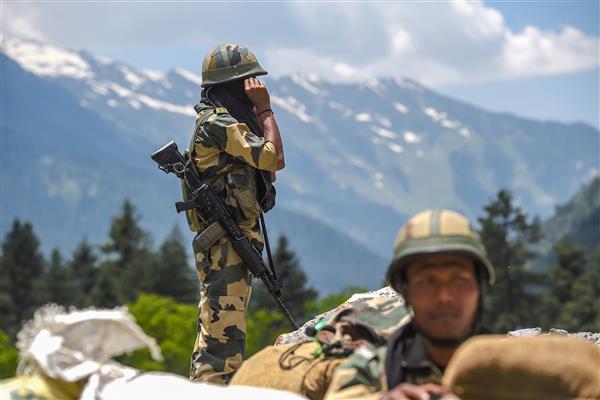
Tanks pull back from the banks of Pangong Tso lake, in Ladakh along the India-China border The Chinese want Indian Army to move out soldiers deployed after the May 5, 2020, standoff which began with clashes at Finger 4 on the north bank of Pangong Tso NEW DELHI: Disengagement from Gogra (Patrolling Point 17 A) at Line of Actual Control in Eastern Ladakh has not changed troop deployment in the vicinity. What worries Indian Army is the permanent construction of infrastructure on the Chinese side of the LAC. “Both sides have moved back troops but there is no decrease in the number of troops in the vicinity,” said a source. Bigger worry is the construction of infrastructure, habitat and defences, the source added. Indian Army had said on August 6 that disengagement was carried out and troops of both sides had moved back to their permanent bases. Another source said the Chinese have troops with equipment all along the Western Highway. “Their troops are at a distance of 150 km from Depsang, 100 km from Chushul and 60 km from Demchok.” India has maintained that only after complete disengagement, de-escalation will begin. There have been major parlays to sort this out. And this time, the number of contentious locations along the LAC in Ladakh has increased. The Chinese want Indian Army to move out soldiers deployed after the May 5, 2020, standoff which began with clashes at Finger 4 on the north bank of Pangong Tso. It spread to multiple points including Hot Spring, Gogra, Galwan and Depsang. Disengagement has taken place from Galwan (Patrolling Point 14), both banks of Pangong Tso and Gogra (PP 17A). The standoff continues at Depsang Bulge (PPs 10, 11, 11A, 12 & 13) along around 972 sq km on both sides.
Hockey is back in the news, thanks to the superb performance of the Indian men’s and women’s teams in the Tokyo Olympics. Dhyan Chand is in the news too as the Khel Ratna Award has been named after him. This year’s Independence Day marks the 85th anniversary of India’s hockey gold at the Berlin Olympics in 1936.
In 2016, we marked the 80th anniversary of the triumph with an exhibition during my tenure as India’s Ambassador to Germany. The India-Germany final was scheduled for August 14, 1936, but it was put off by a day due to rain. India, which had not conceded any goal in the run-up to the final, faced the motivated German team, which had trained for two years. Dhyan Chand, the Indian captain, came into his own in the second half. After changing his shoes, the hockey wizard powered India to an 8-1 rout of Germany. This was the third successive gold for India in hockey. At Tokyo 2020, it was again a win over Germany, as in 1936, that brought India back to the podium.
We did extensive research for our exhibition with the help of the German media and the hockey association. The Punjab Regimental Centre provided memorabilia that was showcased at the Indian embassy in Berlin. Dhyan Chand’s son Ashok Kumar was most helpful.
Though the exhibition coincided with the I-Day celebrations, we went ahead with it on August 15 to mark the 80th anniversary of the 1936 victory. Since most of Germany is on holiday in August, the prospects of getting a high-profile guest for the event were bleak. Luckily, we were introduced to the brother-sister duo of German hockey players Natascha and Florian Keller. She was part of the team that won the hockey gold in 2004, while her brother had done it in 2008.
What linked them to the event was their grandfather, Erwin, a member of the 1936 team that played against India. At our exhibition, our chief guests saw him in a German team photo for the first time.
There was always chatter about the Indian team not giving Hitler a raised-arm salute. The offer of an army commission to Dhyan Chand by Hitler is also part of the folklore. Indeed, the Indian team did not give a Nazi salute during the march past. A rare film from the archives confirmed it.
No mention of the army offer was found. Dhyan Chand’s autobiography, Goal, has no reference to it. If the offer had been made, he would have mentioned it. After all, he was a sharpshooter on the hockey turf, as none other.
Without doubt, today’s naval game is between the US and China’s PLA Navy in the western Pacific Ocean, which indisputably was the ‘Lake of America’ post World War-II, deployment of Soviet submarines during the Cold War notwithstanding. However, defence experts have identified severe defects in the US system which severely diminished the strength of its navy.
Changing equation: The US had replaced Great Britain’s pre-eminence at sea only to now confront a formidable challenge from China in the ocean. Reuters
Abhijit Bhattacharyya
Commentator and Author
As many as 76 years after US air power compelled Japanese sea power to unconditionally surrender by dropping atom bombs on Hiroshima and Nagasaki in August 1945, another August — in the 21st century — is seeing a mega escalation of tension and deployment of a fleet of combat vessels of the Australasian-American combination in the Indo-Pacific region. Purportedly, the July 2021 declaration of British Defence Secretary Ben Wallace suggests that the aim of deployment is: “We are committed to working with partners (in Indo-Pacific region) to defend democratic values, tackle shared threats and keep our nations safe.”
That sounds lofty, subject, however, to clarification pertaining to lack of definition or explanation. What are ‘democratic values’? How does one assess ‘shared threats’? Do ‘democratic values’ imply non-existence of ‘non-democratic values’? How many countries follow one and eschew the other? Aside, what are ‘shared threats’? Are these threats to economy, military, territory, sovereignty, trade, commerce, polity, air, water or cyberspace?
Whereas the deployment of the navies of the US, Japan, Australia and India till now lacks solidity (despite verbal solidarity), except for some ‘exercise’ here and there, the fresh entry of the UK, Germany, France and New Zealand has one fundamental commonality. All of them are deploying their forces far from their home base, several thousand kilometres away. Secondly, all heavily depend on bilateral trade/commerce with China. And thirdly, China has already entered deep into their economy, commerce, trade and industry through mass-scale indigenous production, thereby making herself a virtual monopoly producer-cum-supplier of essential, non-essential as well as critical finished and consumer goods.
How do then things play out? Owing to Chinese opaqueness? Reportedly, the real reason for all these dramatic deployment owes essentially to “Beijing’s militarisation”. That’s understandable. But can a rival’s militarisation, all by itself, be the sole cause of a potentially imminent and inevitable kinetic action on the waterfront? Is the militarisation of the ocean by the Communist Party of China (CPC) something new? Has it happened overnight? If not, then what were those deploying their battleships to ‘curb’ the Beijing flotilla today, doing thus far? Let’s do a rudimentary exploration of the scenario of naval expansion and expedition in the Indo-Pacific.
Without doubt, today’s naval game is between the US and the CPC-controlled PLA Navy in the western Pacific Ocean which indisputably was the ‘Lake of America’ post Second World War, deployment of Soviet submarines during the Cold War (1950-1991) notwithstanding. It was the age of Yankee Gulliver’s blue-water navy, surrounded by mud-water tiny deployable boats of the CPC coast guard.
The US could then boast of being the sole super sea power state, under President Ronald Reagan (1980s) when the Soviets were busy fighting a Vietnam-type war in the deathtrap, landlocked terrain of Afghanistan wherein Moscow had no use for its formidable fleet. By now, the USA had replaced Great Britain’s position of pre-Second World War “sea command and control” naval power.
After 30 years, however, one of the principal architects of the US navy doesn’t feel much about his country’s state of preparedness facing the Beijing fleet in its back bay. John F. Lehman, US Navy Secretary (1981-87), promoter of the idea of 600-ship navy, is dismayed. His words sound melancholic. “After a succession of Presidents ignorant of and uninterested in naval affairs, there’s an emerging realisation around the world that the US no longer possesses naval superiority and could lose a war at sea… It’s a result of… decades of catastrophic mismanagement.”
In fact, several prominent public figures of the US too hold a dim view of their once mighty fleet arm. They have identified severe defects in the US system which not only stymied the strategic role, but severely diminished the strength of its navy. It is owing to several generations of “lacklustre naval leaders” that the naval supremacy has dwindled dramatically. The American apprehension is so acute that Lt General David Nahom of the air force told the Congress: “China offensive threat is growing faster than projected. The threat is accelerating much more than we thought back in 2018.”
Is the US General right? No, he isn’t fully right. The decay began more than three decades ago. Thanks to complacent “democratic” world, led by the US’s monumental misjudgment to detect, confront and curb the secret and steady rise of an ‘autocratic’ CPC. It was all cash, commerce, capital and profit for the ‘democratic world’, convinced by one ‘autocratic’ state.
Warnings came from Jane’s Fighting Ships 1987-88: “The importance of the Pacific area as a strategic centre is slowly percolating into European minds… Any passage between Vladivostok and the South China Sea passes the doorsteps of Chinese navy… The Chinese naval air force and marine corps outnumber the total British naval personnel… The modernisation of Chinese navy is gathering momentum.”
Jane’s Fighting Ships 1988-89 gave another advance info: “Of all the world’s navies, the most difficult to assess is the Chinese. Decades of isolationism combined with preoccupation with coastal defence have restricted things. Yet, if a navy employs three hundred thousand people…it is a shame that it’s so difficult to acquire reliable information.”
Nevertheless, as “China now is willing to embrace more western technology, it is to be hoped that she will assist in giving a more accurate account of an expanding navy of which she can be justifiably proud, but which has a lot of catching up to do to achieve the Western standards of operational effectiveness”.
How misguided were the world’s ‘democratic’ nations which now regret their collective myopia and misjudgment, having woken up when water flows not under the hull of the fleet, but the waves pass overhead!
Now, let New Delhi also hear the wailing Tony Abbott, the former Australian PM who hosted CPC supremo Xi Jinping in 2014 and concluded the Canberra-Beijing bilateral free trade deal in 2015.
He wrote in The Australian: “China exploited West’s goodwill and wishful thinking to steal our technology and undercut industries…The basic problem is that China’s daunting power is a consequence of the free world’s decision to invite a communist dictatorship into global trading networks… In the process, China became much more powerful than the old Soviet Union ever was, because it is now rapidly developing a military, and spoiling for a fight over Taiwan.”
Is it better late than never? Is it ‘late’ or is it ‘never’? Hope, looking only at the sea doesn’t result in a debacle in the Asian heartland? As was thought of by US Naval Secretary John F. Lehman in the 1980s? To counter or attack the Soviet Union through the Siberian land-front, to penetrate the main Leningrad-Moscow-Stalingrad axis! So, ‘democracy’ needs be careful. Just as Taiwan, the South China Sea axis is the CPC fulcrum, the heartland Belt and Road Initiative (BRI) too cannot be ignored by the free world.
Trained by Army veterans, selected people with disabilities will undertake an expedition from here to Siachen Glacier on Independence Day to create a new world record for the largest team of people with disabilities to reach the world’s highest battlefield. Meanwhile, Defence Minister Rajnath Singh virtually launched a series of events to mark 75 years of Independence. — TNS
Navy’s Submarine Rescue Unit airlifted to search for Army helicopter that crashed in Ranjit Sagar Dam
Dhruv helicopter from an Army Aviation Corps squadron based at Pathankot had taken off on a routine sortie when it crashed into the dam
The unit will explore the digitally located wreckage at the depth of approximately 80-100 meters.
Vijay Mohan
Tribune News Service
Chandigarh, August 14
The Army has intensified the search operations for the wreckage of its Dhruv helicopter that had crashed into the Ranjit Sagar Dam on August 3 by flying in a Submarine Rescue Unit of Indian Navy to the crash site near Kathua in Jammu region. The bodies of the two pilots, a Lieutenant Colonel and a Captain, are also yet to be retrieved.
The unit will explore the digitally located wreckage at the depth of approximately 80-100 meters. The Indian Air Force lifted the heavy equipment for underwater search and rescue from Vishakhapatnam to Air Force Station Pathankot on the intervening night of August 13 and 14.
Earlier, a small area of 60 meters by 60 meters had been localised and special sonar equipment flown in from Kochi was employed to enable the search operations to enter the final phase. On August 11, the Army had stated that the wreckage had been identified at a depth of approximately 80 meters from the surface of the reservoir.
The Indian Army and all other agencies to include Indian Navy, Indian Air Force, NDRF, Ranjit Sagar Dam Authority, local District Authorities including locals are sparing no efforts for bringing the operations to a final conclusion. The reservoir is 25-km long, 8-km wide and more than 500-foot deep.
“Experts, specialised equipment and divers are being continuously flown in and international assistance is also being sought,” the Army’s Western Command had said. Divers from the Navy and the Army’s Special Forces have been involved in the search operation, along with multi-beam sonars, side scanners, remotely operated vehicles and underwater manipulators which have been flown in from Chandigarh, Delhi, Mumbai and Kochi.

The search continued unabated in spite of bad weather and rain. This deep underwater operation is especially challenging due to the near-zero visibility below 50 meters, owing to the colloidal nature of water in this season which adversely impacts accuracy of sonars and other sensors.
The Dhruv helicopter from an Army Aviation Corps squadron based at Pathankot had taken off on a routine sortie when it crashed into the reservoir. Only a part of the helicopter’s wreckage was recovered in the initial phase of the search. The Army has not officially released the names of the missing persons.
Sources said that this is the second incident involving Dhruv helicopters from the same squadron in the past about six months.
Another Dhruv from a different unit, also based at Pathankot, made a forced landing last week after suffering an oil leak, sources added.
Navy cancels Independence Day flag hoisting on Goa island as locals object
CM requests it to go ahead with programme and warns the islanders that ‘anti-India activities’ will be dealt with an ‘iron fist’
Pramod Sawant. File photo
Panaji, August 14
The Navy has said that it has cancelled its plan to unfurl the national flag on Sao Jacinto island in South Goa on the Independence Day after local residents objected to it, following which state Chief Minister Pramod Sawant requested the naval authorities to go ahead with the Tricolour hoisting programme and warned the islanders that “anti-India activities” would be dealt with an “iron fist”.
Sawant said it was “unfortunate and shameful” that some people on the island were objecting to the hoisting of the flag, and added that his government would not tolerate such acts.
As a part of ‘Azadi ka Amrit Mahotsav’ to commemorate 75th Independence Day, the Ministry of Defence has planned unfurling of the national flag on islands across the nation between August 13 and 15, officials have said.

A spokesperson of the Navy’s INS Hansa base in Goa had said on Friday that a team from Goa Naval Area visited islands of Goa including Sao Jacinto island as part of this pan-India initiative.
“However, the plan at Jacinto island had to be cancelled as the same was objected to by the residents,” he said.

The island is located near Vasco town in South Goa district of the coastal state.
The naval official said that the nationwide ‘Azadi ka Amrit Mahotsav’ initiative had been undertaken to instil a sense of patriotism and celebrate the run-up to the 75th year of Independence.
Reacting to the Navy’s announcement of cancelling the flag-hoisting programme, CM Sawant said on Twitter on Friday, “It is unfortunate and shameful that some individuals at St Jacinto Island have objected to Hoisting of the National Flag by the Indian Navy on the occasion of India’s Independence Day. I condemn this and want to state on record that my Government will not tolerate any such acts.”
“I have requested the Indian Navy to go ahead with their original plan and have assured full cooperation from Goa Police. These attempts of Anti-India activities shall be dealt with an iron fist. It will always be Nation First,” he added. PTI

Afghan’s Ashraf Ghani promises to ‘prevent further instablity’ as two more towns fall to Taliban advance
Pul-e-Alam, 70 km from Kabul, and Sharana in eastern province fall to advancing insurgents; capture follows fall of key cities Kandahar, Heart; 3,000 US troops to arrive in Kabul by Sunday
A Taliban fighter looks on as he stands at the city of Ghazni, Afghanistan, on August 14, 2021. Reuters

Kabul, August 14
Afghanistan’s President Ashraf Ghani said he was in urgent talks with local leaders and international partners as Taliban rebels captured two more towns, one of them a gateway to the Capital, Kabul.
“As your President, my focus is on preventing further instability, violence, and displacement of my people,” Ghani said in a brief televised address as the United States and other countries rushed in troops to help evacuate their embassies.
Ghani gave no sign of responding to a Taliban demand that he resign for any talks on a ceasefire and a political settlement, saying “re-integration of the security and defence forces is our priority, and serious measures are being taken in this regard”.
He spoke soon after the insurgents took Pul-e-Alam, the Capital of Logar province that is 70 km (40 miles) south of Kabul, according to a local provincial council member.
The Taliban did not face much resistance, the provincial council member told Reuters on condition of anonymity.
The gain of the city, a key staging post for a potential assault on Kabul, comes a day after the insurgents took the country’s second- and third-biggest cities.
American troops have begun flying in to Kabul to help in the evacuation of embassy personnel and other civilians, a US official said.
Taliban also captured the capital of the Paktika province bordering Pakistan, an AP quoted an Afghan lawmaker as saying.
Khalid Asad, a lawmaker from the eastern province, says the local capital, Sharana, fell to the insurgents on Saturday.
The Taliban have rapidly advanced across northern, western and southern Afghanistan in recent weeks and now control most of the country’s provincial capitals. The Taliban are currently battling government forces some 11 kilometers (7 miles) south of the capital, Kabul.
Their lightning advance comes less than three weeks before the US plans to withdraw the last of its forces.
Meanwhile, the Pentagon has said two battalions of Marines and one infantry battalion will arrive in Kabul by Sunday evening, involving about 3,000 troops.
“They have arrived, their arrival will continue ’til tomorrow,” the official told Reuters on condition of anonymity.
An infantry brigade combat team will also move out of Fort Bragg, North Carolina, to Kuwait to act as a quick reaction force for security in Kabul if needed, the Pentagon has said.
Britain and several other Western nations are also sending troops as resistance from Afghan government forces crumbles and fears grow that an assault on Kabul could be just days away.
An Afghan government official confirmed on Friday that Kandahar, the economic hub of the south, was under Taliban control as US-led international forces complete their withdrawal after 20 years of war.
Herat in the west, near the border with Iran, also fell to the hardline Islamist group.
Kandahar’s loss was a heavy blow to the government. It is the heartland of the Taliban ethnic Pashtun fighters who emerged in 1994 amid the chaos of civil war – and is close to the town of Spin Boldak, one of the two main entry points into Pakistan and a major source of tax revenues.
Burning documents
A US defence official said before the fall of Pul-e-Alam that there was concern that the Taliban—ousted from power in 2001 after the September 11 attacks on the United States—could make a move on Kabul within days.
“Kabul is not right now in an imminent threat environment, but clearly … if you just look at what the Taliban has been doing, you can see that they are trying to isolate Kabul,” Pentagon spokesman John Kirby said.
Some embassies have begun to burn sensitive material ahead of evacuating, diplomats said.
The US embassy in the Afghan capital informed staff that burn bins and an incinerator were available to destroy material including papers and electronic devices to “reduce the amount of sensitive material on the property”, according to an advisory seen by Reuters.
United Nations Secretary-General Antonio Guterres warned that “Afghanistan is spinning out of control” and urged all parties to do more to protect civilians.
“This is the moment to halt the offensive. This is the moment to start serious negotiation. This is the moment to avoid a prolonged civil war, or the isolation of Afghanistan,” Guterres told reporters in New York.
Many people in the capital were stocking up on rice and other food as well as first aid, residents said. Visa applications at embassies were running in the tens of thousands, officials said.
The explosion in fighting has raised fears of a refugee crisis and a rollback of gains in human rights. Some 400,000 civilians have been forced from their homes this year, 250,000 of them since May, a UN official said.
Of Afghanistan’s major cities, the government still holds Mazar-i-Sharif in the north and Jalalabad, near the Pakistani border in the east, in addition to Kabul.
The speed of the Taliban’s gains has led to recriminations over the US withdrawal, which was negotiated last year under the administration of President Joe Biden’s Republican predecessor, Donald Trump.
Biden said this week he did not regret his decision to follow through with the withdrawal. He noted Washington has spent more than $1 trillion and lost thousands of troops over two decades, and called on Afghanistan’s army and leaders to step up.
Opinion polls showed most Americans back Biden’s decision, but Republicans criticised the Democratic president’s handling of the US withdrawal. — Agencies
State Stalwarts
ALL HUMANS ARE ONE CREATED BY GOD
HINDUS,MUSLIMS,SIKHS.ISAI SAB HAI BHAI BHAI
CHIEF PATRON ALL INDIA SANJHA MORCHA
LT GEN JASBIR SINGH DHALIWAL, DOGRA
SENIOR PATRON ALL INDIA SANJHA MORCHA
MAJOR GEN HARVIJAY SINGH, SENA MEDAL ,corps of signals
.
.
PATRON ALL INDIA SANJHA MORCHA
MAJ GEN RAMINDER GURAYA ,MADRAS REGIMENT
sanjhamorcha303@gmail.com
PRESIDENT SOUTH ALL INDIA SANJHA MORCHA
COL SS RAJAN BOMBAY SAPPERS,
PRESIDENT SAS NAGAR ALL INDIA SANJHA MORCHA
GROUP CAPT AMARJIRT SINGH
PRESIDENT UTTARAKHAND ALL INDIA SANJHA MORCHA
COL B M THAPA ,BENGAL SAPPERSS
PRESIDENT HARAYANA STATE CUM COORDINATOR ESM
BRIG DALJIT THUKRAL ,BENGAL SAPPERS
PRESIDENT TRICITY
COL B S BRAR (BHUPI BRAR)
PRESIDENT CHANDIGARH ZONE
COL SHANJIT SINGH BHULLAR
.
.
PRESIDENT PANCHKULA ZONE AND ZIRAKPUR
COL SWARAN SINGH
joint PRESIDENT SAS NAGAR (MOHALI)
COL BALBIR SINGH , ARTY
INDIAN DEFENCE FORCES
DEFENCE FORCES INTEGRATED LOGO
FORCES FLAGS
15 Th PRESIDENT OF INDIA SUPREME COMMANDER ARMED FORCES
Droupadi Murmu
DEFENCE MINISTER
Minister Rajnath Singh
CHIEF OF DEFENCE STAFF (2nd)
General Anil Chauhan PVSM UYSM AVSM SM VSM
INDIAN FORCES CHIEFS
CHIEF OF ARMY STAFF(29th)
General Upendra Dwivedi, PVSM, AVSM (30 Jun 2024 to Till Date)