In all, 127 individuals from the local communities benefited from this initiative
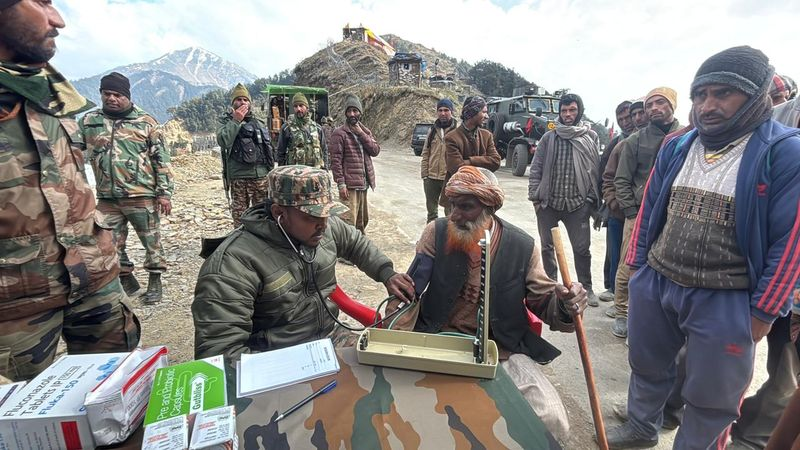
The Indian Army organised a medical and veterinary camp at Chattergala for the Gujjar and Bakkarwal communities as part of the ongoing “Sadbhavana” project.
An Army spokesperson said the initiative aimed to provide essential healthcare and veterinary services to these communities, particularly in the remote areas, enhancing civil-military cooperation and fostering goodwill.
“The camp offered free health check-ups of community members. Essential medicines were distributed among them. Veterinary care was also offered for their livestock, including vaccinations and treatments. Additionally, awareness drives on health, hygiene and the importance of proper livestock care are held to improve the overall well-being of both the people and animals in the region,” the spokesperson said.
In all 127 individuals from the local communities benefited from this initiative, receiving necessary medical attention and care for their livestock. “The camp’s success underscores the Army’s commitment to support the rural communities, ensuring access to vital healthcare services and strengthening the bond of trust between the military and the Jammu and Kashmir people. The initiative reflects the Army’s role in fostering sustainable development of the marginalised communities,” the spokesperson added.
Security forces across Jammu division have stepped up vigil along the borders and in the hinterland ahead of Diwali following inputs suggesting that Pakistani terrorists might attempt to disrupt the celebrations.
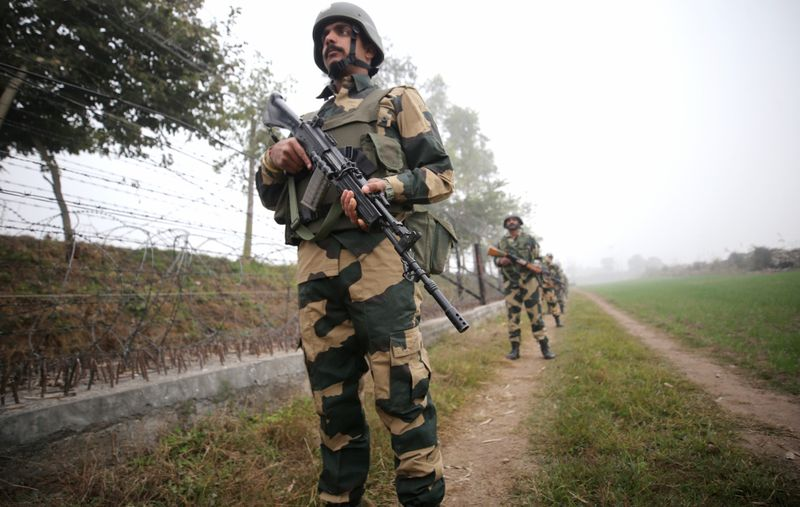
While the Army and police continue to monitor forested areas where terrorists are suspected to be hiding, the Border Security Force (BSF) is maintaining a tight vigil along the International Border (IB) in Samba, Kathua and Jammu districts to prevent any infiltration attempts.
Deputy Inspector General (DIG) of Jammu, Samba and Kathua range, Shiv Kumar Sharma, conducted a comprehensive review of security arrangements in Kathua district. He also inspected operational preparedness, particularly in Billawar and Basohli, where intelligence inputs regarding terrorist movement are frequent.
An official said the DIG met police personnel and Village Defence Guard members in sensitive areas to discuss various security issues and directed the establishment of joint checkpoints for greater coordination.
The DIG was briefed on the border security grid, vulnerabilities, surveillance infrastructure and coordination between the J&K Police and other security agencies. His visit also aimed to assess terrain conditions, visibility and defensive layouts in forward areas.
He later visited several Border Police Posts and instructed officials to “remain extra vigilant” and to strengthen checkpoints, especially during night hours.
Meanwhile, the BSF has intensified night patrolling along the border. “Technology has been installed along the border to ensure that no infiltrator can cross over, even at night,” an official said.
“To ensure peaceful festivities, the BSF personnel have been instructed not to leave any stone unturned. Strict vigil is also being maintained on drone activity along the border,” the official added.
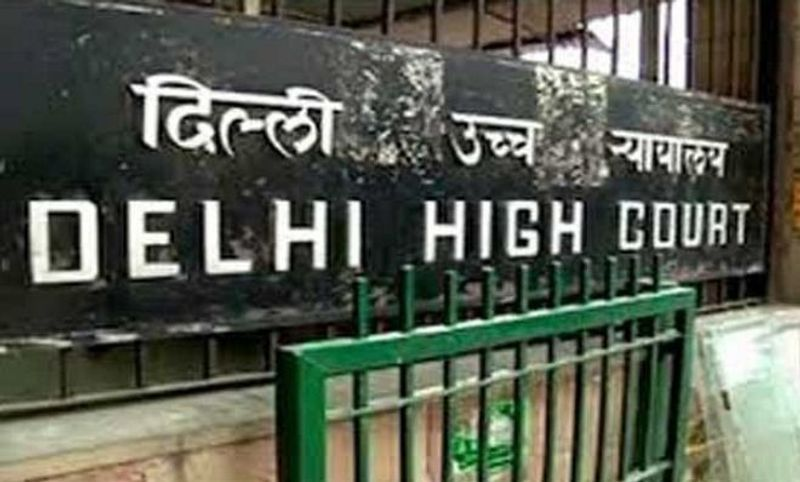
Delhi High Court imposes costs of Rs 15,000 on woman IAF officer for misrepresenting facts to claim disability benefits
The officer had claimed that the seizure disorder which was the basis of her being invalided out of service developed after she had joined military service
The Delhi High Court has imposed costs of Rs 15,000 on a woman ex-Air Force officer for misrepresenting facts while claiming disability benefits after she was removed from service on medical grounds for suffering from seizures.
The officer had claimed that the seizure disorder which was the basis of her being invalided out of service developed after she had joined military service and, therefore, it could not constitute a ground to invalid her out of service.
“On seeing the record, we found that there was a specific entry by the medical specialist who examined the petitioner, to the effect that she had similar episodes in childhood. We, therefore, were of the view that the disorder could not be said to be one which had emerged after the petitioner had joined military service,” a Division Bench comprising Justice C. Harishankar and Justice Om Prakash Shukla observed in their order of October 16.
The Bench was hearing a review petition filed by the officer against an earlier judgement of the same court dismissing the officer’s plea for disability pension.
She had been selected for Short Service Commission in the Education Branch of the Indian Air Force and her training commenced in July 2013 at the Air Force Academy, Dundigal. During training, she was admitted to the hospital after loss of consciousness.
In March 2014, she was transferred to Command Hospital, Bengaluru, for review and neurological opinion, where it was concluded that she was unfit to undergo the stress and strain of service.
A show-cause notice was issued in May 2014, informing her that she would be placed in low medical category for epilepsy and invalidated out of service on medical grounds. An Invalid Medical Board thereafter assessed her disability at 20 per cent for life, opining the disability to be neither attributable to nor aggravated by service. She suffered from the disability after completion of eight months of training.
She also sought sheltered appointment which was rejected by the authorities on the grounds that her disability was neither attributable to nor aggravated by service. She also lodged an online grievance on the Public Grievance Portal for disability pension, which was also rejected, following which she moved the High Court.
“We regret our inability to grant relief in this case. Here, there is a subjective difference, in as much as the certificate of the doctor on the basis of which who had examined the petitioner specifically states that the petitioner had a history of episodes of seizure during childhood. As such, no fault can be found with the decision of the respondents in refusing to treat the seizure as attributable to or aggravated by military training,” the High Court had earlier ruled.
The Bench also took exception to the petitioner’s action of filing a review petition through a different counsel, saying that it was not proper for one counsel to argue the main writ petition and for another counsel to argue the review petition and that the Supreme Court has also critically commented on this aspect.
On the review petition, the Bench observed that the new counsel first submitted that there is no medical record to the effect that the petitioner had suffered similar episodes of seizures in childhood, which was obviously incorrect. Then the counsel tried to rely on certain submissions contained in respondents’ counter-affidavit and in the petitioner’s declarations at the pre-enrolment stage.
“We fail to understand how these can constitute a basis for us to disbelieve a medical record which specifically pertains to the petitioner. This review petition is, therefore, clearly an attempt at a second bite at the cherry, after changing counsel,” the Bench ruled.
23 Indians rescued after fire on LPG tanker off Yemen coast
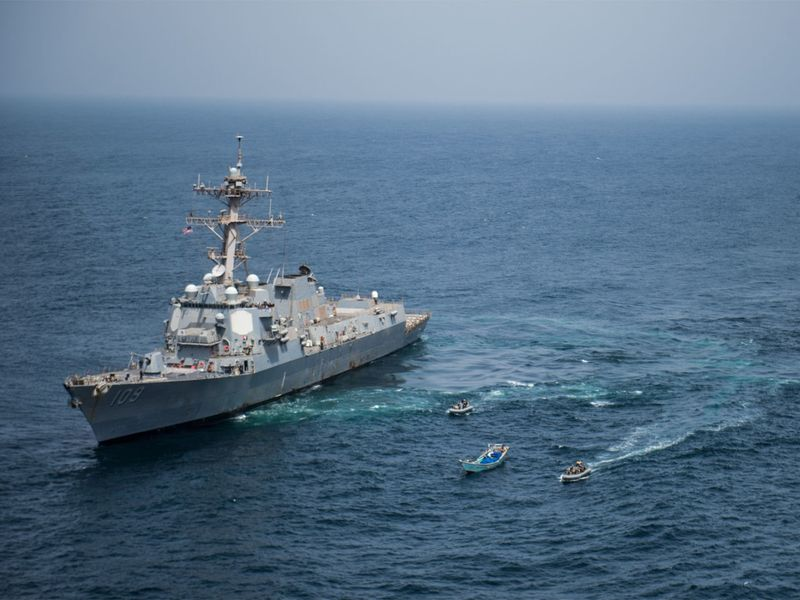
Twenty-three Indian crew members have been rescued after a fire broke out on board the Cameroon-flagged LPG tanker MV Falcon, following an explosion, off the coast of Aden, Yemen.
The incident took place on Saturday, October 18, at 07.00 UTC (local time), when the ship was sailing about 113 nautical miles southeast of Aden on its way to Djibouti. The vessel went adrift after the blast, and about 15 per cent of the ship was on fire. Early reports suggest the explosion was accidental, but the exact cause is still being investigated.
According to British security firm Ambrey, the MV Falcon was travelling from Oman’s Sohar Port to Djibouti when the explosion occurred. Radio communication suggested that the crew was preparing to abandon the vessel as a search-and-rescue operation was launched.
Following the incident, the EU Naval Force Operation Aspides launched an immediate search and rescue (SAR) operation.
According to updates, 24 crew members had initially abandoned the vessel, and 23 of them, all Indians, have been safely rescued. Two crew members remain missing, while one was still onboard MV Falcon when the reports last came in.
Due to the risk of additional explosions, since the tanker was fully loaded with liquefied petroleum gas, Aspides advised nearby vessels to maintain a safe distance from the carrier.
“The fire on board is increasing,” Aspides said in a statement. “MV Falcon represents a navigational hazard. Everyone in the area must exercise caution.”
A private company has now taken charge of the salvage operation for the damaged tanker, the European Union’s naval force Aspides said in a statement.
The incident occurred as Yemen’s Houthi rebels continue targeting commercial vessels passing through the Red Sea corridor, which they claim is in solidarity with Palestinians amid Israel’s ongoing war in Gaza, according to Al Jazeera.
EU Naval Force’s Aspides is a defensive maritime operation tasked with protecting civilian ships and crews sailing through the Red Sea and the Gulf of Aden.
7 planes were shot down during India-Pakistan conflict, claims Donald Trump
The US President once again claims to have resolved the India-Pakistan war
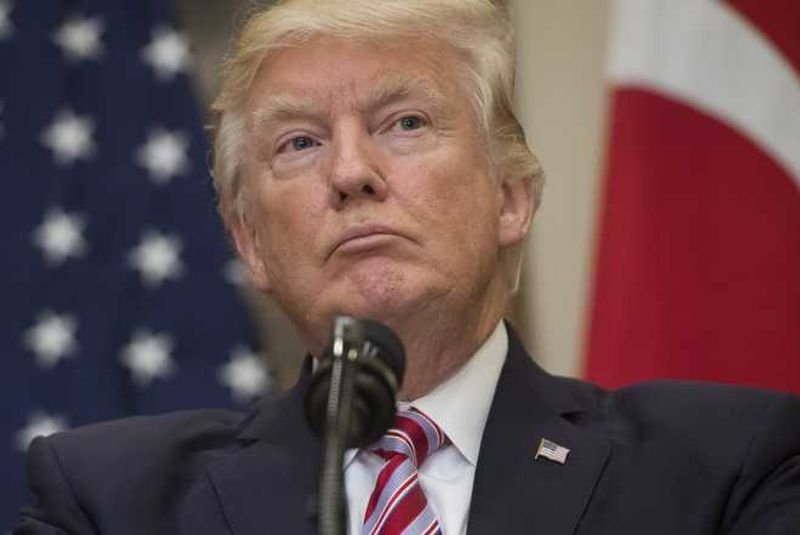
US President Donald Trump once again claimed to have resolved the war between India and Pakistan, saying that seven planes were shot down in the firing between the two countries without specifying to which nation they belonged.
Speaking in an interview with Fox News broadcast on Sunday, Trump claimed that the “threat of tariffs” forced India and Pakistan to stop the war.
“The threat of tariffs, as an example, kept India and Pakistan, two nuclear nations, from going at it. They were going at it. Seven planes were shot down; that’s a lot. And they were going at it. And that could have been a nuclear war,” the US President said.
Trump said Pakistan’s Prime Minister Shehbaz Sharif praised him for saving millions of lives.
“The Prime Minister of Pakistan actually just said, Donald Trump, President Trump, saved millions of lives by getting that,” he said.
The US President said he threatened to impose 200 per cent tariffs on India and Pakistan, which forced them to stop the war.
Trump said he told both countries, “We’re going to put on 200 tariffs, which will make it impossible for you to deal, and we’re not going to do business with you.”
“And after 24 hours, I settled the war,” the US President said.
Since May 10, when Trump announced on social media that India and Pakistan had agreed to a “full and immediate” ceasefire after a “long night” of talks mediated by Washington, he has repeated his claim dozens of times that he “helped settle” the conflict between India and Pakistan.
India has consistently maintained that the understanding on cessation of hostilities with Pakistan was reached following direct talks between the Directors General of Military Operations of the two militaries.
India launched Operation Sindoor on May 7, targeting terror infrastructure in Pakistan and Pakistan-occupied Kashmir in retaliation for the April 22 Pahalgam attack that killed 26 civilians.
India and Pakistan reached an understanding on May 10 to end the conflict after four days of intense cross-border drone and missile strikes.
The BSF on Sunday morning apprehended 21 illegal infiltrators — 11 Bangladeshi nationals and 10 Rohingya migrants — from different locations in Tripura.
Based on specific intelligence inputs, the BSF teams detected suspicious movement at the Agartala railway station, where 11 individuals were found to be Bangladeshi nationals who had illegally entered India and were attempting to travel further within the Indian territory, the BSF official said.
In a separate incident in North Tripura, the BSF personnel intercepted 10 Rohingya migrants, including women and children, who were attempting to cross over to Bangladesh.
Preliminary questioning revealed that they had travelled from Delhi and Jammu and intended to reach Moulvibazar, Bangladesh.
Amid the ongoing festive season, the BSF has heightened its vigil along the Bangladesh border in the entire eastern command, as incidents of illegal infiltration and human trafficking and other trans-border crimes normally escalate.
Last week, Special Director General, BSF (Eastern Command) Mahesh Kumar Aggarwal was on a four-day operational tour to BSF Frontier, Meghalaya, from October 13 to 16 to review the border security architecture and assess operational preparedness along the Indo–Bangladesh International Border.
In Shillong, IG BSF Meghalaya, OP Upadhyay, along with senior frontier officers, had made a comprehensive operational briefing before Aggarwal, outlining the dynamic security scenario along the international border, including challenges posed by rugged terrain, cross-border smuggling, infiltration attempts and emerging transnational threats.
The IG had also highlighted strategic countermeasures undertaken by BSF to strengthen border domination, upgrade technological surveillance systems and enhance tactical mobility of troops.
During the visit, the Special Director General had also toured several Border Outposts (BOPs), halted overnight with troops, and interacted with field commanders and jawans deployed in forward areas.
Later, Aggarwal had also called on Meghalaya Chief MInister Conrad Sangma and Chief Secretary Shakil P Ahammed, for in-depth deliberations on joint security mechanisms, intelligence sharing, and inter-agency synergy to ensure foolproof border management.
Army Chief visits forward posts in Uttarakhand, reviews troop readiness
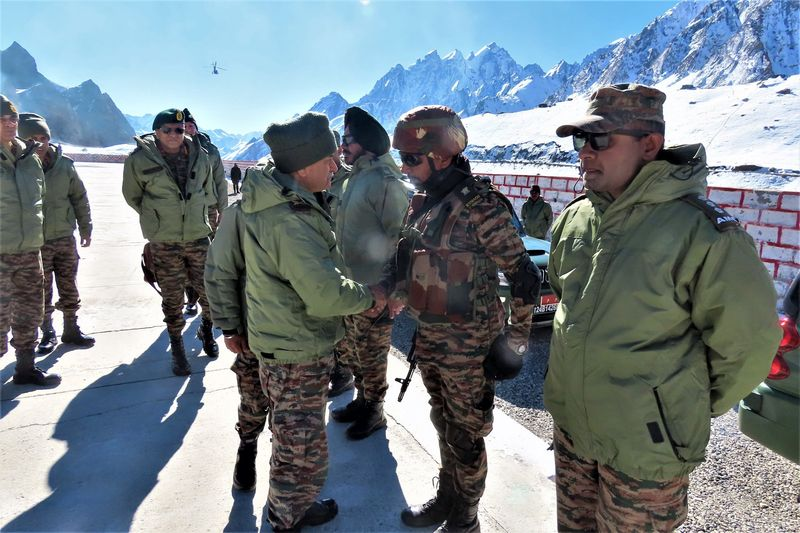
Army Chief Gen Upendra Dwivedi on Sunday visited forward posts in Uttarakhand along the Line of Actual Control (LAC) with China.
He reviewed the operational preparedness of an Army brigade and celebrated Diwali with troops deployed in the high-altitude areas of Pithoragarh district and other forward posts. The Kumaon region, where these posts are located, borders China to the north and Nepal to the east.
Gen Dwivedi was briefed on ongoing capability enhancements, including advanced surveillance systems, specialist mobility platforms, integration of next-generation technologies and the use of reconnaissance assets in coordination with other security agencies.
Interacting with personnel stationed in remote areas, the Army Chief commended their resilience, courage and commitment to duty under extreme climatic conditions and difficult terrain. He reaffirmed the Army’s full preparedness to meet evolving security challenges and emphasised the strategic importance of the Kumaon region as a gateway to the borders with Nepal and China.
Gen Dwivedi also reviewed initiatives under Operation Sadbhavana and the Vibrant Villages Programme, including tent-based homestays in Garbyang and Kalapani. He also took stock of road infrastructure, hybrid power systems, medical camps and agricultural support through poly-house cultivation.
Truce after Doha talks, Pak-Afghanistan tensions ease
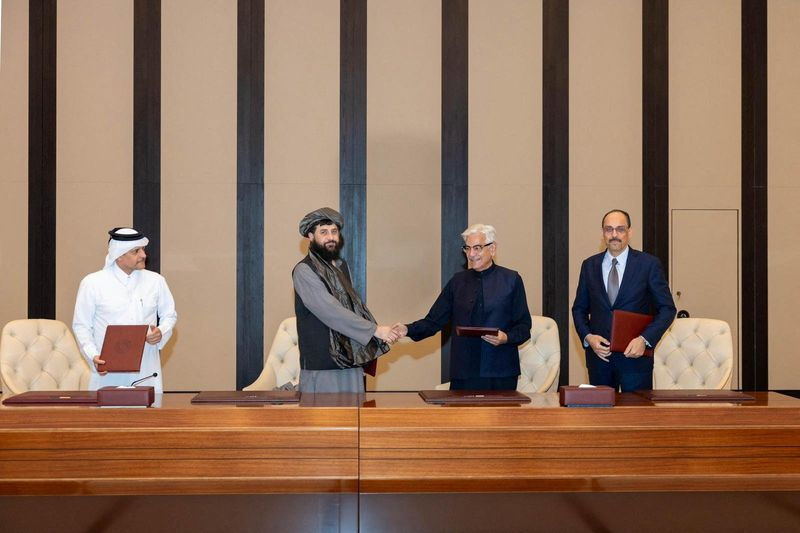
Pakistan and Afghanistan have agreed to an immediate ceasefire and setting up of “mechanisms” to ensure lasting peace after days of violent clashes along the border that left several soldiers, civilians and terrorists dead on both sides, officials said on Sunday.
The breakthrough came following negotiations between Pakistan’s Defence Minister Khawaja Asif and Afghanistan’s acting Defence Minister Mullah Yaqoob in Doha, facilitated by Qatar and Turkiye, according to a statement issued by Qatar’s Foreign Ministry.
“During the negotiation, both sides agreed to an immediate ceasefire and establishment of mechanisms to consolidate lasting peace and stability between the two countries,” the statement read.
The two neighbours also agreed to hold “follow-up meetings” in the coming days to ensure the implementation and sustainability of the truce “in a reliable and sustainable manner” to achieve security and stability in both countries, it said.
The development comes amid heightened tensions along the Pakistan-Afghan border, triggered by cross-border clashes after alleged Pakistani airstrikes near Kabul last week.
The Doha talks began on Saturday with Pakistan urging the Afghan Taliban authorities to take “verifiable action” against the Tehreek-i-Taliban Pakistan (TTP), which Islamabad accuses of launching cross-border terrorist attacks from Afghan soil.
The Foreign Office in a statement on Saturday said Pakistan had stressed the need for the Afghan authorities to honour their “commitments to the international community” and to address Islamabad’s “legitimate security concerns” by taking verifiable action against terrorist entities.
“Pakistan appreciates the mediation efforts of Qatar and hopes these discussions contribute to peace and stability in the region,” it said.
Relations between Pakistan and Afghanistan have remained strained since 2023, with Islamabad repeatedly raising concerns over the use of Afghan soil by militants carrying out cross-border attacks.
The situation further deteriorated following repeated terrorist attacks by TTP, including one in the restive Khyber Pakhtunkhwa’s Orakzai district recently, which claimed the lives of 11 military personnel, including a Lt Colonel and a Major.
The Foreign Office on Wednesday announced that a temporary ceasefire had been agreed with Afghanistan for the next 48 hours amid the recent border hostilities. Later on Friday, the ceasefire was extended.
However, hours after Islamabad and Kabul extended their two-day ceasefire, Pakistan launched fresh air strikes targeting terrorist hideouts in Afghanistan late Friday. Three Afghan cricketers were among several people killed in the strikes, which followed a terror attack at a military installation in North Waziristan, claimed by TTP.
Following the incident, the Afghanistan Cricket Board withdrew from participating in the upcoming Tri-Nation T20I Series involving Pakistan, scheduled to be played in late November.
On Saturday, Army chief Field Marshal Syed Asim Munir warned Afghanistan to choose between “peace and chaos” as it asked Kabul to take firm and immediate action against terrorists using Afghan soil to launch attacks inside Pakistan.
State Stalwarts
DEFENCES FORCES RANKS
ARMY, NAVY, AIRFORCE RANKS
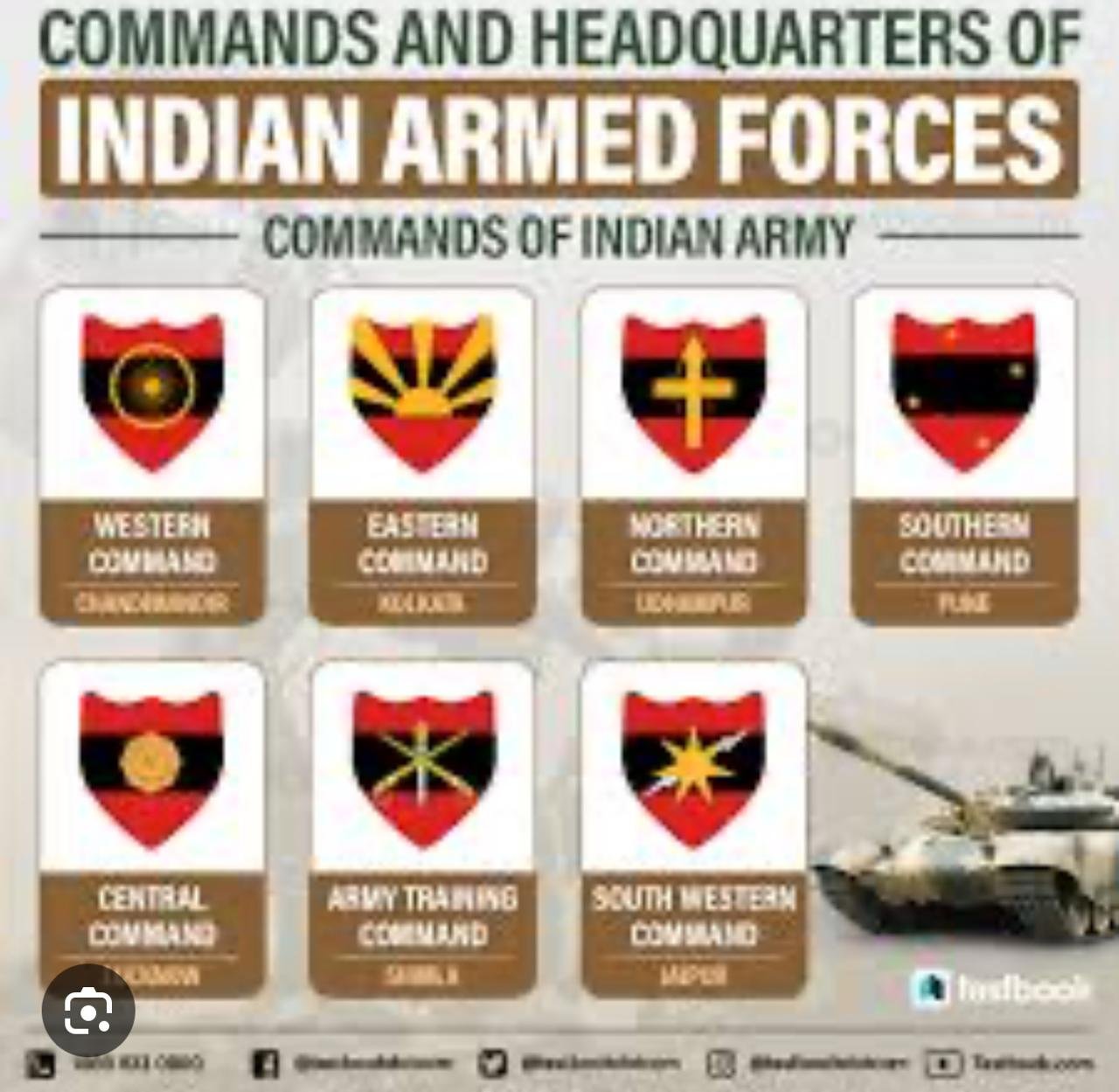
FORMATION SIGNS
FORMATION SIGNS
ALL HUMANS ARE ONE CREATED BY GOD
HINDUS,MUSLIMS,SIKHS.ISAI SAB HAI BHAI BHAI
CHIEF PATRON ALL INDIA SANJHA MORCHA
LT GEN JASBIR SINGH DHALIWAL, DOGRA
SENIOR PATRON ALL INDIA SANJHA MORCHA
MAJOR GEN HARVIJAY SINGH, SENA MEDAL ,corps of signals
.
.
PATRON ALL INDIA SANJHA MORCHA
MAJ GEN RAMINDER GORAYA , CORPS OF
sanjhamorcha303@gmail.com
PRESIDENT HARAYANA STATE CUM COORDINATOR ESM
BRIG DALJIT THUKRAL ,BENGAL SAPPERS
PRESIDENT TRICITY
COL B S BRAR (BHUPI BRAR)
PRESIDENT CHANDIGARH ZONE
COL SHANJIT SINGH BHULLAR
.
.
PRESIDENT PANCHKULA ZONE AND ZIRAKPUR
COL SWARAN SINGH
PRESIDENT SAS NAGAR (MOHALI)
COL BALBIR SINGH , ARTY
INDIAN DEFENCE FORCES
DEFENCE FORCES INTEGRATED LOGO
FORCES FLAGS
15 Th PRESIDENT OF INDIA SUPREME COMMANDER ARMED FORCES
Droupadi Murmu
DEFENCE MINISTER
Minister Rajnath Singh
CHIEF OF DEFENCE STAFF (2nd)
General Anil Chauhan PVSM UYSM AVSM SM VSM
INDIAN FORCES CHIEFS
CHIEF OF ARMY STAFF(29th)
General Upendra Dwivedi, PVSM, AVSM (30 Jun 2024 to Till Date)