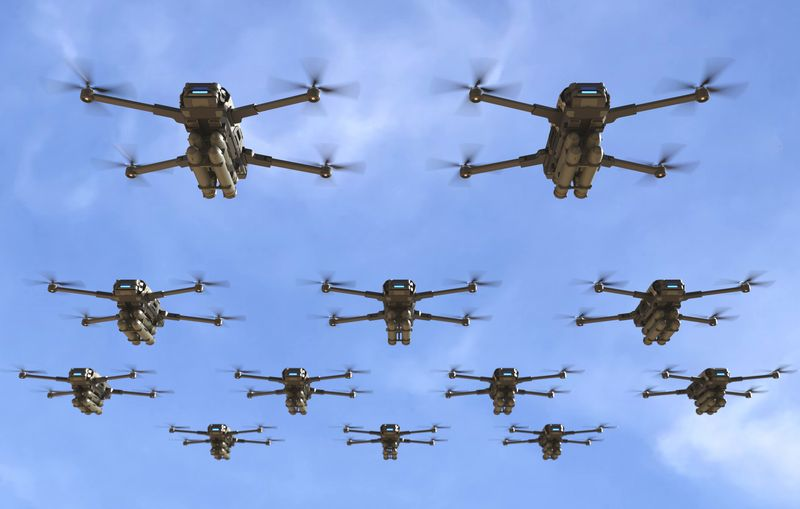
The Indian Air Force (IAF) has projected a requirement for 800 medium-range Swarm Unmanned Munition Systems (SUMS) to meet its operational need for remotely engaging hostile targets at ranges over 350 km.
Each system will comprise a swarm of at least 20 drones, capable of being launched in quick succession to loiter for a minimum of 30 minutes beyond 350 km and autonomously search, detect and identify both static and moving targets.
“Swarm drones are effective as they saturate enemy air defence systems, confuse enemy radars and provide IAF decision-makers the option to deploy in a couple of hours against hostile command and control targets,” states a request for proposal (RFP) issued by the Ministry of Defence on October 25.
The IAF has specified that the drones should be fixed-wing and powered by a hybrid jet-engine and battery pack, with the ability to carry at least 30 kg of ordnance, in addition to sensors, electronic countermeasures, communication gear and navigation aids.
They must be operable from sea level up to 16,000 feet, capable of launch and recovery from unprepared surfaces and ship decks, and functional in temperatures ranging from –20°C to 50°C.
Drones of varied types and capabilities have become central to modern warfare. Their use in both offensive and defensive roles was particularly underscored during Operation Sindoor in May this year.
Cariappa & Manekshaw : Field Marshals who defined courage
AFTER 1947, among India’s first six Army chiefs, two were, in the literal sense, sons of the soil: schooling and college in India, one, KM Cariappa, commissioned from the temporary Cadets Facility in Daly College, Indore, and the other, SFJ Manekshaw, from the inaugural session of IMA, Dehradun; both graduated from the Defence Services Staff College, Quetta; both were blooded and distinguished over battlefields during WW II, the first was thrice decorated for distinguished service — in Iraq, Persia and Burma — with a Mention-in-Despatches and an OBE, the second with MC for Valour in Burma and Padma Vibhushan and Padma Bhushan for Services in India.
Scheduled to be held from November 7 to 9 at Sukhna Lake
A wreath-laying ceremony to pay tributes to martyrs and a “Bravehearts” motorcycle rally were held here today as a precursor to the 9th edition of the Military Literature Festival (MLF) scheduled to be held from November 7 to 9 at Sukhna Lake here.
Floral tributes were paid at the Chandigarh War Memorial by Governor of Punjab Gulab Chand Kataria, followed by former Chief of the Army Staff Gen VP Malik, former Chief of the Air Staff, Air Chief Marshal BS Dhanoa; Lt Gen TS Shergill, chairman of the MLF Association, and other veterans.
A ceremonial guard from the Punjab Police reversed arms as a mark of respect to the fallen soldiers while buglers sounded the Last Post. A large number of NCC cadets were also present.
The Governor flagged-off the motorcycle rally that passed through Chandigarh, Mohali and Panchkula to commemorate the services, sacrifices and achievements of the heroes of the 1965 Indo-Pak War, before culminating at Chandimandir.
Over 650 riders, including members of various bike clubs from the region and 16 veterans, participated in the rally. Amongst them were around 100 riders from three all-women groups, Mitran Di Motorcycle Mandali led by Shalini, One Biker Divas led by Harneet Kaur and The Motorcyclists (Women) led by Hardeep Singh.
Bhairav — 1st specialised commando battalion to take charge by Oct-end
The newly raised ‘Bhairav’ specialised commando battalion will be deployed along the border by the end of October.
Sources said five of these battalions would be deployed in critical areas in the Northern Command, including Ladakh, and Srinagar. The western sector and the eastern hilly regions facing China would also get a battalion each.
The army has set a target to raise an additional 20 such battalions in the next six months.
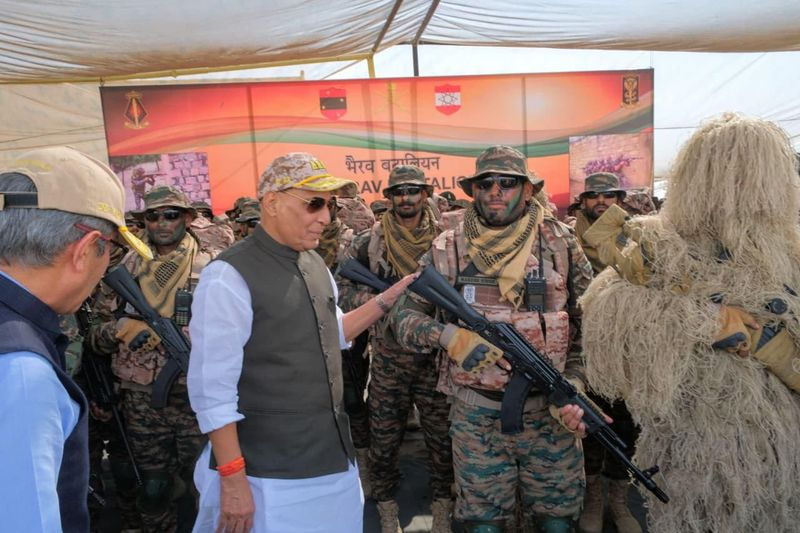
On October 24, the army released first pictures of the troops of the Bhairav battalion during their interaction with Defence Minister Rajnath Singh along the forward area in Rajasthan.
The Defence Minister had witnessed a dynamic “capability demonstration exercise”, showcasing integrated employment of the new organisation.
Each battalion would comprise 250 specialised commandos equipped with weapons and technology to bring down anything and strike deep inside the enemy territory.
These battalions would integrate fighting components and have weapons, equipment and vehicles used by infantry, artillery, Special Forces, Signals and Unmanned Aerial Systems (UAS).
The tasking of each such unit would be done at the level of Corps Commander. Each Bhairav battalion would be standalone and not part of any infantry unit.
These units would be “lean, lethal and highly mobile” and would operate as a force between conventional infantry and the elite Para (Special Forces).
These batallions would be tasked to conduct rapid, high-impact tactical operations, especially along the border with China and Pakistan. Thus, freeing up the Special Forces for more strategic and high-risk missions.
Unlike traditional infantry battalions, troops have been drawn from several arms of the army, including infantry, artillery, air defence and Signals.
Creation of Bhairav battalions is part of a wider modernisation drive in the army, which also includes the formation of “Rudra” all-arms brigades and “Ashni” drone platoons for enhanced technological warfare capabilities.
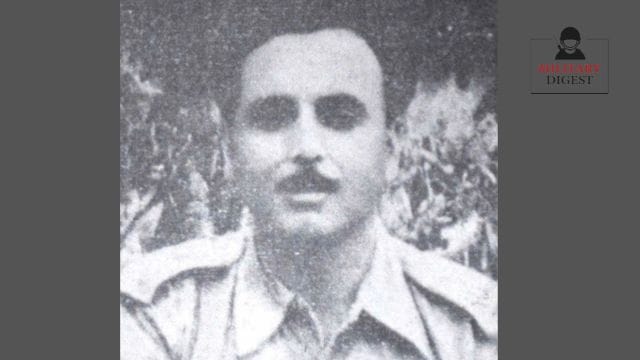
Military Digest | Infantry Day: remembering Lt Col Dewan Ranjit Rai, Maha Vir Chakra, killed in battle in Kashmir
On the occasion of Infantry Day, marking the arrival of first Indian troops in Jammu and Kashmir in October 27, 1947, it is fitting that the memories of the commanding officer of the first battalion that landed at Srinagar, Lt Col Dewan Ranjit Rai of 1 Sikh, are refreshed and that the sacrifice he and his gallant troops made in the defence of the Srinagar airfield are never forgotten.
Surprisingly for an important figure in the realm of Indian military history, very little is known about Lt Col Dewan Ranjit Rai other than some basic, frittered information about his military career and personal life. No attempt has been made to research his life and put all the facts together in a cogent form, despite his being the first senior officer of newly Independent India to have died in battle and who received the first-ever Maha Vir Chakra, the nation’s second highest gallantry award.
Lt Colonel Rai was born on February 6, 1913, in Gujranwala in Punjab, now in Pakistan, and went to Bishop Cotton School in Shimla. General P N Thapar, his maternal uncle, was the chief of Army staff. He showed an inclination towards the Army, and when the Indian Military Academy was established in October 1932, he was among the first cadets who joined.
Among his course mates were S H F J Manekshaw, who rose to become the Army chief; and a field marshal, Kanhayya Lal Atal, who too received a Maha Vir Chakra in the 1947-48 war with Pakistan in Zojila while commanding a brigade and later died in an accident; and Nripendra Singh Bhagat, elder brother of Lt Gen Premendera Singh Bhagat, Victoria Cross in Second World War.
Commissioned in February 1935 with IC Number 12, he served a year with the King’s Shropshire Light Infantry, as was the norm for all Indian officers before they went on to serve in Indian regiments. He was allotted the 5th Battalion of the 11th Sikh Regiment a year later and served in various regimental appointments before being appointed as commanding officer of 1 Sikh in the rank of lieutenant colonel. He was earmarked to be posted as a military attache in Washington, US, before fate and events overtook the affairs, and he ended up in Srinagar fighting a battle.
Incidentally, it was not 1 Sikh that was the original choice of the Indian battalion to be dispatched to Srinagar. The first choice was a Gorkha battalion. However, Lord Mountbatten, the viceroy and later the first governor-general of India, decided that the question of the use of Gorkha troops, who were essentially Nepalese citizens, in a conflict without first clearing their use with the Nepalese authorities would not be proper, and hence the nearest available battalion was chosen.
Lt Gen SK Singh (retd), writes in his memoirs that the British commander of the Delhi and East Punjab Command, Lt Gen Dudley Russel, had been mightily impressed with Lt Col Dewan Ranjit Rai during a visit to his battalion, which was deployed in aid to civil authorities due to post-partition rioting around Gurgaon, and hence thought him to be the correct man to lead the first Indian troops in Kashmir.
Moved at short notice and arriving late in the evening of October 26/morning of October 27 at the Palam airfield, the operational order for Lt Col Rai read: “Your battalion less two companies will concentrate Palam airfield by 0400 hours on 27 October. One battery 13 Field Regiment in infantry role being placed under your command. Be prepared to fly on an operational mission ex-Palam morning 27 October. Remainder battalion will be flown 28 October.”
Further instructions were given to Lt Col Rai by then Major S K Sinha, including to secure Srinagar airport and the civil wireless station, drive Pakistani tribesmen away from Srinagar, and aid the local government in the maintenance of law and order in Srinagar.
Supreme self-confidence
Sinha mentions that Lt Col Rai was exceptionally calm as he went about issuing orders to his troops and showed no agitation. Radiating supreme self-confidence, he left the task of making a load table to his second in command and Major Sinha and proceeded to catch whatever little sleep he could before he and his troops departed to Srinagar by air.
Lt Col Rai carried out the operational orders to capture and secure the Srinagar airfield, but realising the fact that the enemy advance must be checked before more Indian troops arrived, he correctly decided to advance to Baramulla to stop the Pakistani raiders from getting any further. He was killed at Pattan, between Srinagar and Baramulla, by a mortar shell while directing battle and organising a fallback to a more secure position.
Very little is known about the personal life of this gallant soldier other than that he had a son and a daughter and that he was an exceptional dancer well acknowledged in Lahore and Shimla. On this Infantry Day, on October 27, let’s spare a thought about Lt Col Dewan Ranjit Rai, Maha Vir Chakra (Posthumous).
From hills to trenches: The Dogra who won Victoria Cross
FEARLESS TALES: Was awarded the highest gallantry decoration of the British Royal Forces for his exceptional bravery during World War-I
Lala Ram, a decorated soldier from Parol village in Bhoranj subdivision of Hamirpur district, was awarded the Victoria Cross, the highest gallantry decoration of the British Royal Forces, for his exceptional bravery during World War I. His courage under impossible odds was a testament to the indomitable spirit and unwavering loyalty of Indian soldiers who fought on foreign soil.
His heroic act at the Battle of Hanna in Mesopotamia (now Iraq) on January 21, 1916, not only earned him the prestigious medal but also inspired generations to remain steadfast in adversity and fearless in service to the nation.
Path to historic bravery
Born on April 20, 1876, into a martial Rajput family, Lala Ram was encouraged by his father, Dhinag Ram (popularly known as Ramditta), to pursue a life of discipline and courage. A keen footballer, he joined the Indian Army in 1901 at the age of 25, despite having little formal education. He was, however, proficient in Hindi, English and Urdu — a rarity for soldiers of that era.
Over a century ago, his gallantry during the fierce Mesopotamian campaign earned him the Victoria Cross for “most conspicuous bravery”, making him one of the most celebrated soldiers of his regiment.
A legacy remembered
Lala Ram was married to Gurdei, but the couple had no children. He passed away on March 23, 1927, due to polio. His widow, Gurdei, lived on and was cared for by his nephew, Captain Bhagat Ram, who also served in the Indian Army. The family’s legacy continues through Bhupinder Singh, Bhagat Ram’s son, who remains the custodian of Lala Ram’s memories.
Bhupinder Singh recalls that much of what the family knows about Lala Ram came from Gurdei’s own stories. “Till she was alive, the family used to receive invitations from the British government, but now there is hardly any communication,” he said.
He added that during the tenure of Dr YS Parmar, Himachal’s first Chief Minister, the village school was named Lala Memorial School and a link road leading to the village was also christened in his honour. “However,” Bhupinder laments, “not enough has been done to make people aware of such great warriors. Heroes like Lala Ram deserve chapters in school history books.”
The Battle of Hanna
The act that earned Lala Ram the Victoria Cross remains one of sheer heroism. Serving with the 41st Dogra Regiment (now 3rd Dogra), his unit was deployed in Mesopotamia to secure vital oil fields from Turkish forces.
On January 21, 1916, amid relentless shelling and freezing weather, Lala Ram repeatedly ventured into open fire to rescue wounded soldiers stranded just 100 yards from enemy trenches. He saved six men, including his Adjutant, Captain ELE Lindop, MC, who later succumbed to his wounds but recounted Lala’s unmatched bravery.
Praise from commanders
Sir George Younghusband, who commanded the 7th Division, noted in his memoir A Soldier’s Memories of Peace and War that “Lala was out all day and most of the night and earned his VC a dozen times.”
He added, “The Victoria Cross had only recently been granted to Indian soldiers and perhaps there is no worthier wearer of the badge of honour than Lance Naik Lala of the Dogras.”
Lala Ram was later commissioned as Jamadar in 1923 and retired from service in 1926, leaving behind an enduring tale of courage and devotion.
Honour yet to find its place
Jagjit Thakur, Lala Ram’s great-grandson, shared that repeated efforts have been made to include the stories of Victoria Cross (VC) and Gallantry Cross (GC) winners in school curricula, but such heroes are yet to receive their rightful space in textbooks.
“Children should grow up knowing about warriors like Lala Ram,” he said. “Their courage is part of our history and deserves to be remembered.”
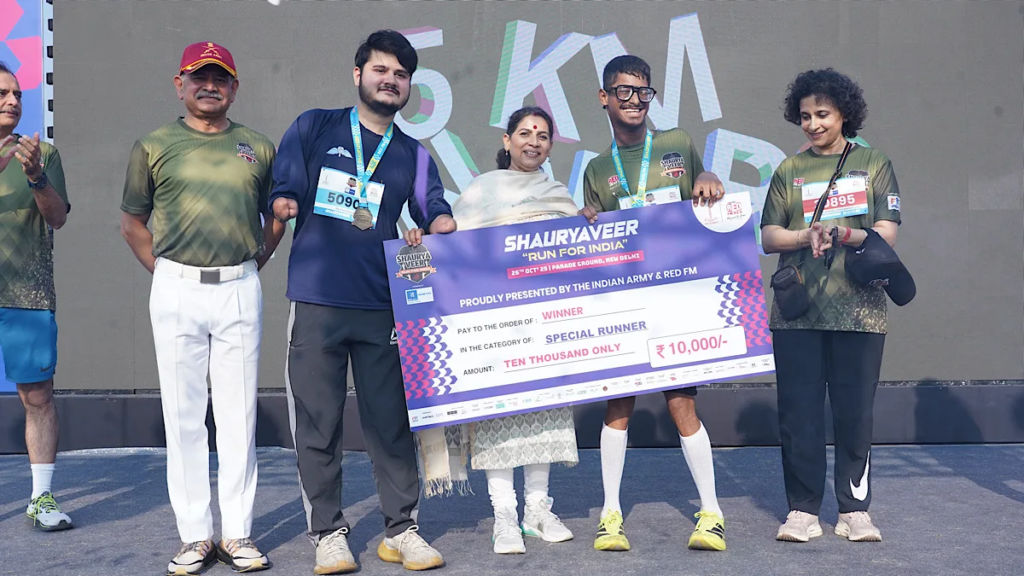
Chief of Army Staff Flags Off Shauryaveer Marathon Honouring Indian Armed Forces’ Bravery
Over 10,000 participants, ranging from Army officers and soldiers to professional athletes, fitness enthusiasts, and members of the public, came together for the ‘Shauryaveer – Run for India’ event held here on Sunday. The run was organised by the Indian Army to commemorate the 79th Shaurya Diwas (previously known as Infantry Day) celebrations.
ver 10,000 participants, ranging from Army officers and soldiers to professional athletes, fitness enthusiasts, and members of the public, came together for the ‘Shauryaveer – Run for India’ event held here on Sunday. The run was organised by the Indian Army to commemorate the 79th Shaurya Diwas (previously known as Infantry Day) celebrations.
The run was flagged off by Chief of Army Staff General Upendra Dwivedi. During his address, the Army Chief expressed gratitude to the participants for their enthusiastic response and participation. The event included several race categories: a 21 km competitive run for experienced runners aged 18 and above, a 10 km timed open run for participants over 10 years old, a 5 km People’s Run for individuals above 10, and a 3 km family-friendly run open to all participants aged 10 and above.
“I would like to thank all of you for coming here in such large numbers. This time for Shauryaveer, the marathon race we organised included distances of 21 km, 10 km, 5 km, and 3 km,” he said.
“The most important thing is the tremendous support we received from the people of India for the Indian Army; it has truly encouraged us. This time, out of the 8,000 people who participated in the run, two-thirds were civilians who supported the Army. In fact, we had to stop our personnel because the registrations were overflowing,” he added.
The Shauryaveer run was organised at 21 locations across the country.
Shaurya Diwas is commemorated every year on 27th October to pay tribute to the courage and unwavering spirit of the Indian Armed Forces. On this day in 1947, Indian Army infantry units were the first to reach Srinagar, successfully pushing back invaders and safeguarding Jammu and Kashmir from a Pakistani assault.
The Story of Kashmir War Martyr Lt. Col. Dewan Ranjit Rai, Maha Vir Chakra Awardee
Non-coercive paradigm : India’s discipline lies in ending wars on principle, not applause. ANI
The wise commander ends the war within victory, not beyond it. Arthashastra tradition
WARS seldom end where they stop; they pause where proportion begins. From Versailles to Gaza, Baghdad to Kyiv, every unfinished war repeats the same lesson: victory without restraint plants the seeds of its own undoing. When triumph turns to humiliation, peace collapses. India has long known this truth. From Dhaka to Kargil to Op Sindoor, the Republic’s victories have carried an unmistakable civility, the ability to stop not from fatigue but from foresight. Restraint is not withdrawal; it is judgment, courage with conscience, power with proportion. To end well is the hardest act of command.
The Trap of Unmeasured Victory
As the world bleeds across continents and creeds, restraint stands almost orphaned. Wars now outlast reason, and peace has no constituency. In this moral vacuum, India’s inheritance of proportion becomes more than a virtue, it becomes a counter-narrative to the age of excess. Unmeasured victory is the oldest trap of power. Versailles birthed Hitler; Iraq’s dismemberment birthed ISIS. Retaliation without reflection changes only the uniform, not the animus. The pursuit of total victory often ensures total loss in the next generation. India’s discipline lies in ending wars on principle, not applause.
A Challenge to the Architects of Fracture
The architects of the current world order, those who equate alliance with obedience, have created the very fracture they now lament. For those who criticise autonomy as isolation or neutrality, the response is simple: bloc loyalty has failed. India’s discipline is not just a domestic virtue; it challenges the failing model of power, offering a non-coercive paradigm where autonomy and restraint become the highest forms of strategic choice.
The Grammar of Modern Power
Restraint cannot remain an heirloom. Power today is exercised not only through arms but through algorithms, finance and influence. The grammar of statecraft has changed. Supply chains are siege lines, data the new territory, and narrative the most contested frontier. The next battles are curated, not declared, fought through perception, precision and patience. The state that ends well is the state that endures. For India, the challenge is dual: to preserve its civilisational temperament while adapting to the speed of the century. Principle must pair with preparedness, ethics with agility, patience with precision. The art of restraint must now be woven into technology, diplomacy and communication.
Strategic Autonomy:
The Balm That Heals
When the UN stands emasculated, the P5 crippled by the veto, a bleeding world simply bleeds on. Trade becomes a weapon and peace prizes seek sponsors before causes; who then steers the ship? No one. It is in such drift that India’s civilisational ethic steps in, not to command, but to exemplify. To show that power need not dominate to define; that restraint, walked open-chested, can still steady the storm. This is strategic autonomy in a fractured world, the principled third way that eschews bloc politics, a balm that heals without applause.
Restraint Reimagined
Restraint, having mastered consequence, must now master context. It begins where power ends, and responsibility begins. It is foresight expressed through proportion and conviction through composure. Beyond power and purpose lies the governance of impulse, the discipline to act with precision even when provoked, to uphold order without imitation, to preserve identity without isolation. The Armed Forces have long practised this discipline, from the ceasefire at Dhaka to the Sindoor principle: silent preparation, precision without publicity, and power without excess. Diplomacy has mirrored it, preferring calibration to confrontation. The next frontier is artificial intelligence, where technology must serve transparency, not tyranny. The Republic that can humanise its algorithms will not only command power but trust. India’s instinct to balance velocity with veracity in the digital realm may be its greatest strategic gift.
The Test of Calm
Such balance demands vigilance. The world stands fractured, the region is in upheaval; old alignments shift, and China’s quiet entry is masked by a manufactured thaw. In this engineered calm, subterfuge travels beneath diplomacy. This is where restraint must think, not just wait, where composure pairs with clarity. We reclaim our region not by outshouting others, nor by joining rigid blocs, but by outlasting them, through the steadfast choice of partnership and the quiet authority of example. The age of outrage demands subtler courage: the ability to think slowly in a fast world, to stand still when the algorithm insists on motion. When the volume rises, restraint must speak in frequency, not fury.
Commanding Trust: The New Frontier of Statecraft
The true measure of modern statecraft is not the speed of its reaction but the mastery of its own impulse. The Republic that trades wisdom for velocity will stumble; strength lies in calm purpose, in the discipline that governs outrage. The psychological frontier has become the real domain of power. India’s resilience flows from a vast and vocal society where dissent refines conviction and the rumble of democracy steadies the Republic’s course: unity in diversity. Sindoor demonstrated: restraint with readiness, civility with resolve. That is the strategic message, and the moral one.
The Next Chapter
It will not be a treaty or a truce; it will be a tempering of power itself. It will belong to those who can innovate without intimidation, defend without domination, and lead without spectacle. In that balance lies the design of tomorrow’s peace. It will be India’s contribution to the grammar of deterrence.
Closing Reflection: The Unflinching Flame
When the world is quiet, restraint is mistaken for hesitation and autonomy for aloofness. But when the world burns, as it does now, and a civilisational requiem is revealed in moments like Sindoor, the true nature of power stands bare. In the scramble for peace prizes, when the vanquished rush to underwrite what is not theirs, India stands apart. Its civilisational restraint and strategic autonomy are not mere legacy; they are the two defining strengths of its enduring character, the only hands steady enough to hold the flame without feeding the inferno.
India — the fulcrum of a fractured world.
Lt Gen SS Mehta (retd) is ex-Western Army Commander and Founder Trustee, Pune International Centre.
State Stalwarts
DEFENCES FORCES RANKS
ARMY, NAVY, AIRFORCE RANKS
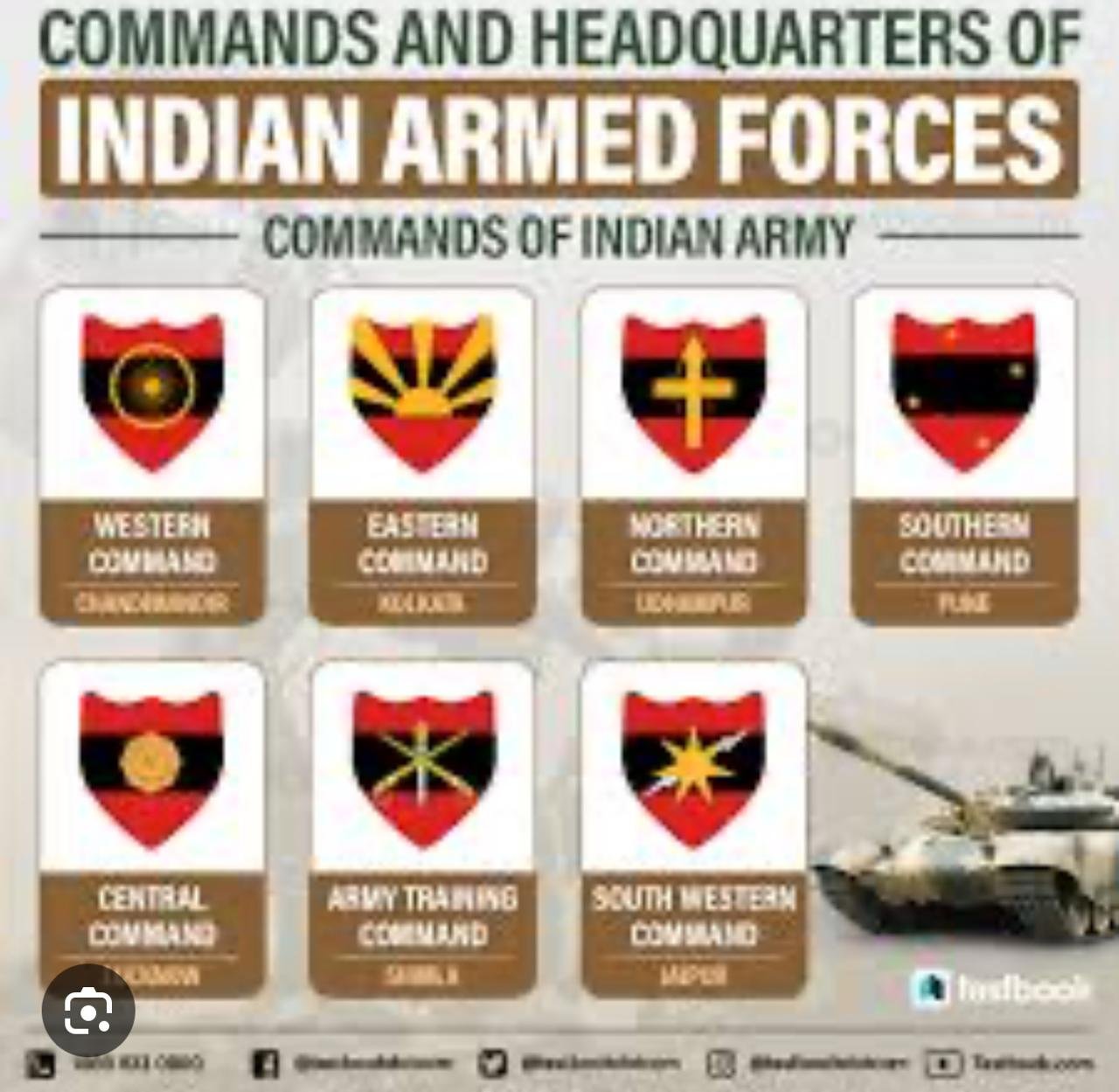
FORMATION SIGNS
FORMATION SIGNS
ALL HUMANS ARE ONE CREATED BY GOD
HINDUS,MUSLIMS,SIKHS.ISAI SAB HAI BHAI BHAI
CHIEF PATRON ALL INDIA SANJHA MORCHA
LT GEN JASBIR SINGH DHALIWAL, DOGRA
SENIOR PATRON ALL INDIA SANJHA MORCHA
MAJOR GEN HARVIJAY SINGH, SENA MEDAL ,corps of signals
.
.
PATRON ALL INDIA SANJHA MORCHA
MAJ GEN RAMINDER GORAYA , CORPS OF
sanjhamorcha303@gmail.com
PRESIDENT HARAYANA STATE CUM COORDINATOR ESM
BRIG DALJIT THUKRAL ,BENGAL SAPPERS
PRESIDENT TRICITY
COL B S BRAR (BHUPI BRAR)
PRESIDENT CHANDIGARH ZONE
COL SHANJIT SINGH BHULLAR
.
.
PRESIDENT PANCHKULA ZONE AND ZIRAKPUR
COL SWARAN SINGH
PRESIDENT SAS NAGAR (MOHALI)
COL BALBIR SINGH , ARTY
INDIAN DEFENCE FORCES
DEFENCE FORCES INTEGRATED LOGO
FORCES FLAGS
15 Th PRESIDENT OF INDIA SUPREME COMMANDER ARMED FORCES
Droupadi Murmu
DEFENCE MINISTER
Minister Rajnath Singh
CHIEF OF DEFENCE STAFF (2nd)
General Anil Chauhan PVSM UYSM AVSM SM VSM
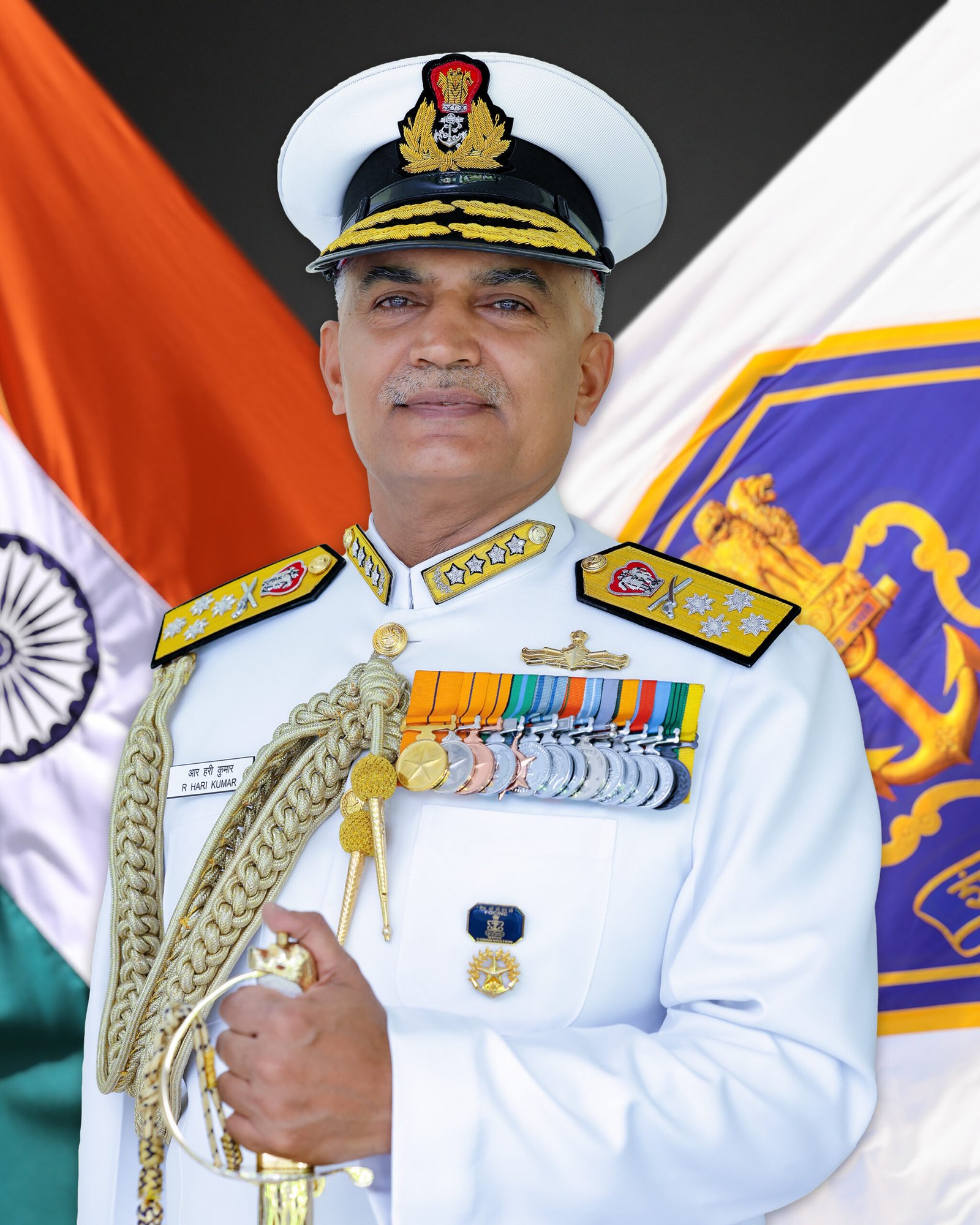
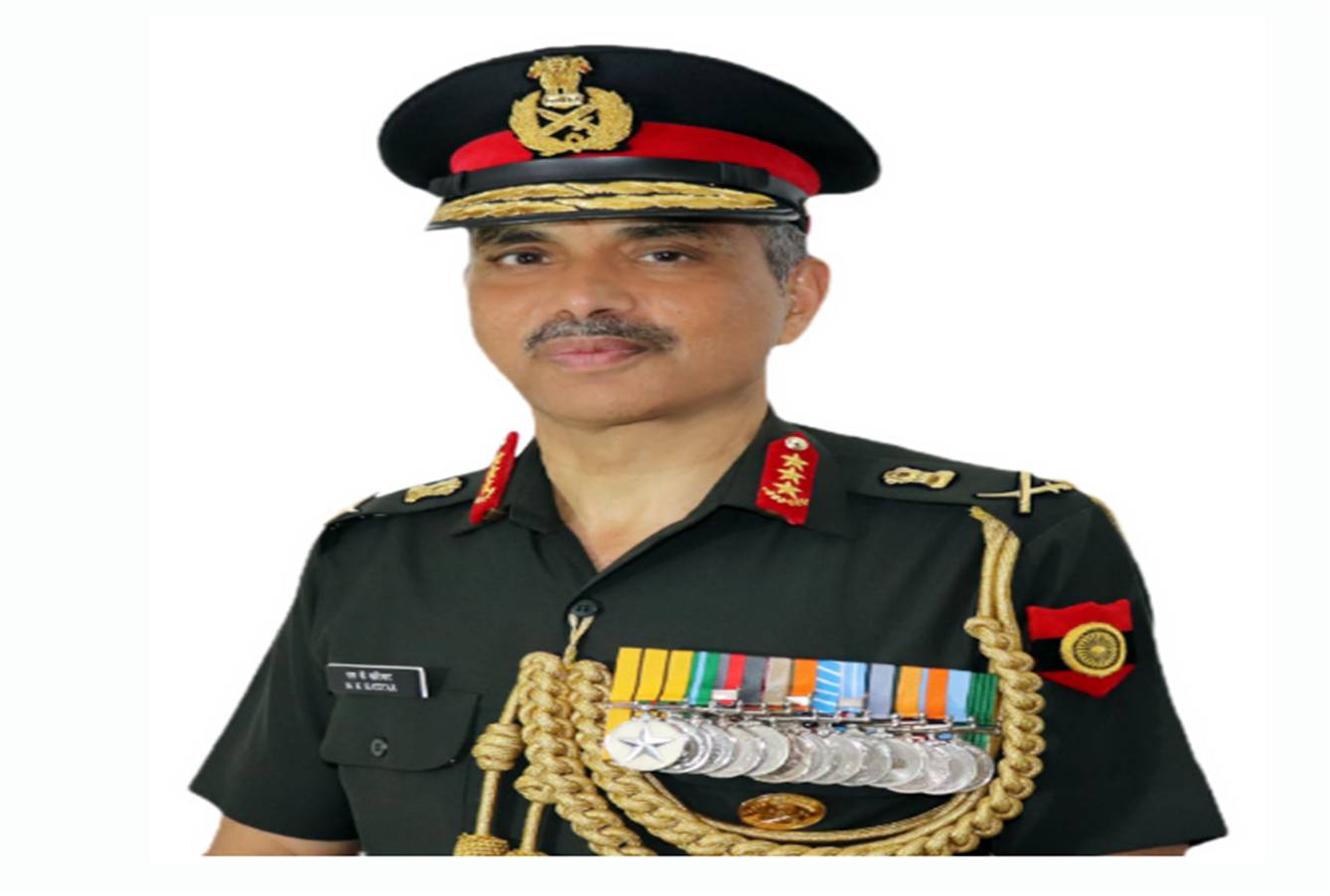
INDIAN FORCES CHIEFS
CHIEF OF ARMY STAFF(29th)
General Upendra Dwivedi, PVSM, AVSM (30 Jun 2024 to Till Date)