



Sanjha Morcha

What’s New

Click the heading to open detailed news

Current Events :

web counter

Print Media Reproduced Defence Related News

This village kid from Punjab’: US Army Major ‘Simmer’ Singh promoted to Lieutenant Colonel

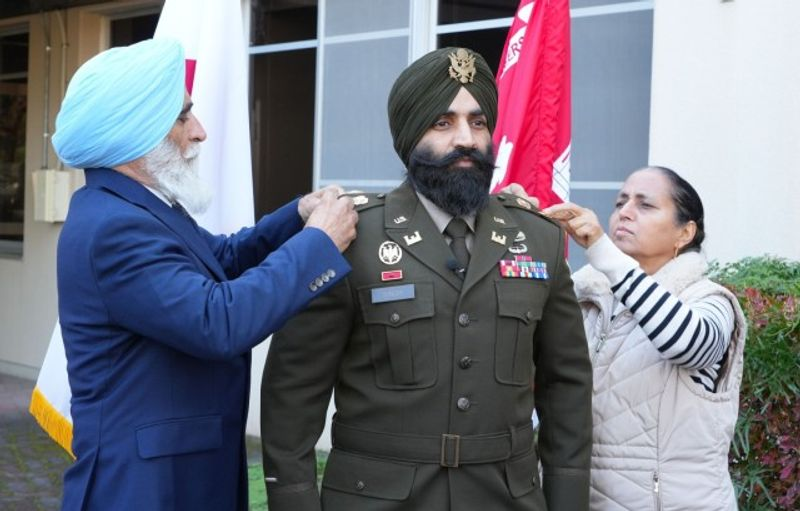
Major Simratpal “Simmer” Singh, deputy commander of the US Army Corps of Engineers – Japan Engineer District (JED), was promoted to lieutenant colonel during a ceremony November 26 at District headquarters on Camp Zama.

Col Patrick Biggs, JED commander, presided over the event and administered a reaffirmation of the oath of office, reports army.mil.

Singh’s parents, Sukhbir Singh and Jasvir Kaur, pinned on their son’s new rank in front of family, friends and colleagues.

Singh reflected on his journey during remarks at the ceremony, crediting mentors, friends and Army leaders for their support throughout his career. “The Army and this Nation have given this village kid from Punjab far more than he deserves, and my hope is to be able to give even a tenth of it back,” he said.

“Good leaders throughout my career have lifted me up and helped remove barriers. This is what I hope to emulate.”

As deputy commander, Singh helps oversee a diverse portfolio of engineering missions that support the U.S.–Japan Alliance and contribute to regional stability across the Indo-Pacific. His promotion represents a significant endorsement of his leadership and ability to manage complex operations on behalf of the United States.

Over the course of more than 15 years in uniform, Singh has built a career as a combat engineer and leader in key command and staff roles. He began his service with the 2nd Stryker Brigade Combat Team, 2nd Infantry Division, where he served as an assistant brigade engineer and platoon leader. He deployed to Kandahar, Afghanistan, in support of Operation Enduring Freedom, leading more than 180 combat patrols to clear routes, strengthen base defenses, and support the establishment of the first medical facility in Shah Wali Kot Province.

After returning from deployment, Singh served as brigade finance officer, preparing annual budget estimates and helping allocate $15 million for a National Training Center rotation while overseeing financial support to more than 20 enabling units.

Following the Engineer Captain’s Career Course, he joined the 249th Engineer Battalion at Fort Belvoir, Virginia. There, he helped plan and execute 23 critical national-defence power-generation missions supporting strategic facilities worldwide. He also contributed to real-world hurricane response efforts—including during Hurricanes Matthew, Harvey and Maria—and coordinated major disaster-response exercises with FEMA, USACE Headquarters and multiple state emergency agencies.

Singh later commanded the battalion’s Headquarters and Headquarters Company, managing the Army’s only industrial-scale generators deployed globally. He subsequently served as an instructor and assistant professor of economics and finance at the US Military Academy at West Point, teaching future Army officers and contributing to academic research.

A native of Kent, Washington, Singh is a 2010 graduate of the US Military Academy with a Bachelor of Science in electrical engineering. He also holds a Master of Science in engineering management from Missouri University of Science and Technology, a Master of Business Administration from the University of Maryland, and a Master of Operational Studies from the US Army Command and General Staff College.

His military awards and decorations include the Bronze Star Medal, Meritorious Service Medal with oak leaf cluster, Army Commendation Medal with oak leaf cluster, Army Achievement Medal, Afghanistan Campaign Medal, NATO Service Medal, German Armed Forces Proficiency Badge, Combat Action Badge, Air Assault Badge and Ranger Tab.
Himachal’s martyr families continue to wait for govt’s commitment

Projects announced in memory of martyrs in Himachal Pradesh have seen slow progress. Despite being one of the states with the highest representation in the armed forces, Himachal continues to lose soldiers in militancy operations in Jammu & Kashmir, Ladakh and the North East. During Operations Parakram, Rakshak and Vijay, the state lost 85, 54 and 174 personnel respectively.

Six years after Sepoy Tilak Raj of Dhewa village in Jawali subdivision, Kangra district, was martyred in the Pulwama attack, several commitments made to his family remain pending. The government had announced the construction of a memorial gate, naming the road to his home and improving access to the cremation ground, along with renaming the village school. While his widow, Savitri Devi, received a government job and the school was renamed, the remaining assurances have not been fulfilled. The family eventually installed a statue of the martyr using their own resources.

A similar situation exists in the case of Kargil martyr Havildar Surinder Kumar of Dann village in Nurpur. His widow, Veena Devi, says that apart from renaming the local ITI in Jawali after him, other assurances made during his cremation on July 20, 1999, including an LPG agency and a memorial gate, were never realised. “When my husband laid down his life, my sons were just 11 and 8. We were promised support, but many commitments remain unaddressed,” she said.

In earlier years, under former Chief Minister Virbhadra Singh, the government often reached out to bereaved families with financial assistance and jobs for widows. This practice, families say, has gradually declined and even the presence of elected representatives at funerals has become less frequent.

As the nation observes Kargil Vijay Diwas with pride, many martyr families in Himachal continue to wait for the honours and support they were promised, feeling that much of it remains limited to paperwork.


HEADLINES : till 24 NOV 2025

1971 INDO PAK WAR (THE LIBERATION WAR)BATTLE OF HILLI BOGRA: 23 NOV – 18 DEC1971, A HARD NUT TO CRACK by Maj Gen Harvijay Singh

Kangra bids tearful farewell to Wing Commander Namansh Syal

Dedicated fighter pilot, served nation with unwavering commitment: IAF pays tribute to Wg Cdr Namansh Syal

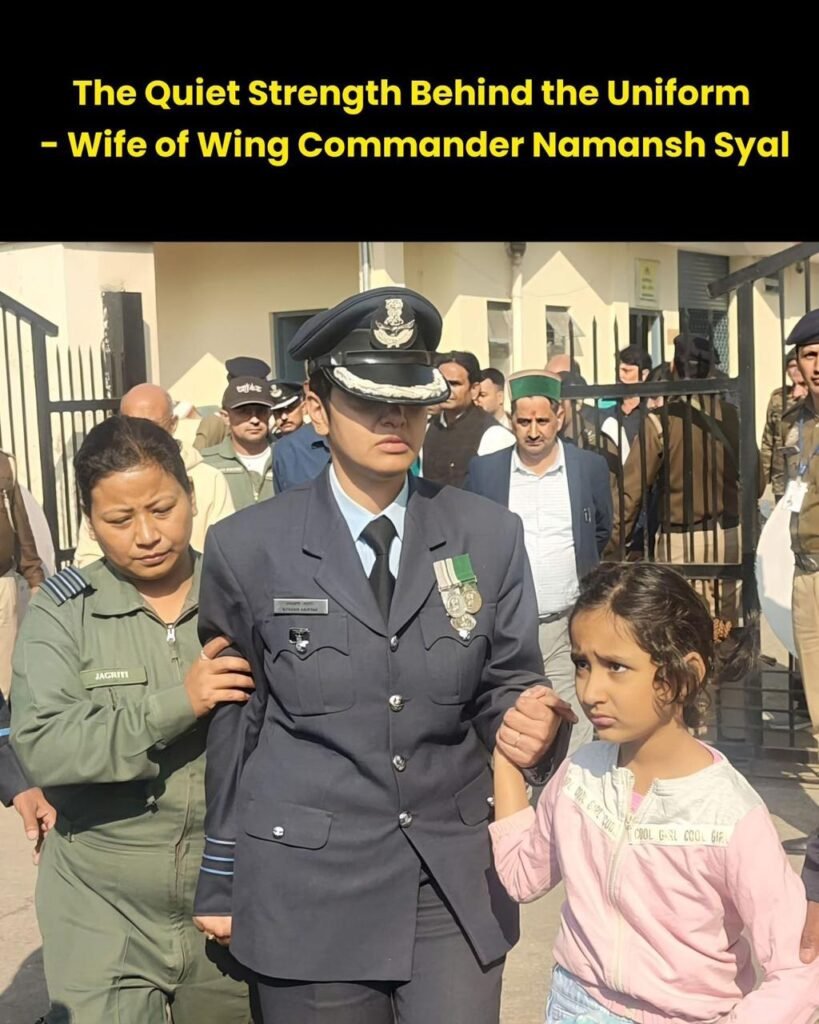
Afsaan, wife of Wing Commander Namansh Syal

Captain Chandra Narain (MVC): A saga of immortal bravery

Remembering Major Ramaswamy Parameswaran, the sole Param Vir Chakra recipient of Sri Lanka operations

Western Command validates operational preparedness of new Ashni specialist drone platoons

Borders can change, Sindh may return to India again: Rajnath

ADG STRAT COMN PRINT EDITION UPDATE: NOV 2025

IAF’s leased mid-air refueller lands in Agra

Watch: Wing Commander Namansh Syal’s final video just hours before fatal Tejas crash

Army conducts integrated exercise Ram Prahar to hone skills in multi-domain warfare

Day after, IAF says no plan to ground Tejas  

India-US navies to scale up drills, eye new-age domains

Anandpur Sahib glows with devotion

Wing Commander Namansh Syal’s mortal remains to reach Kangra this afternoon


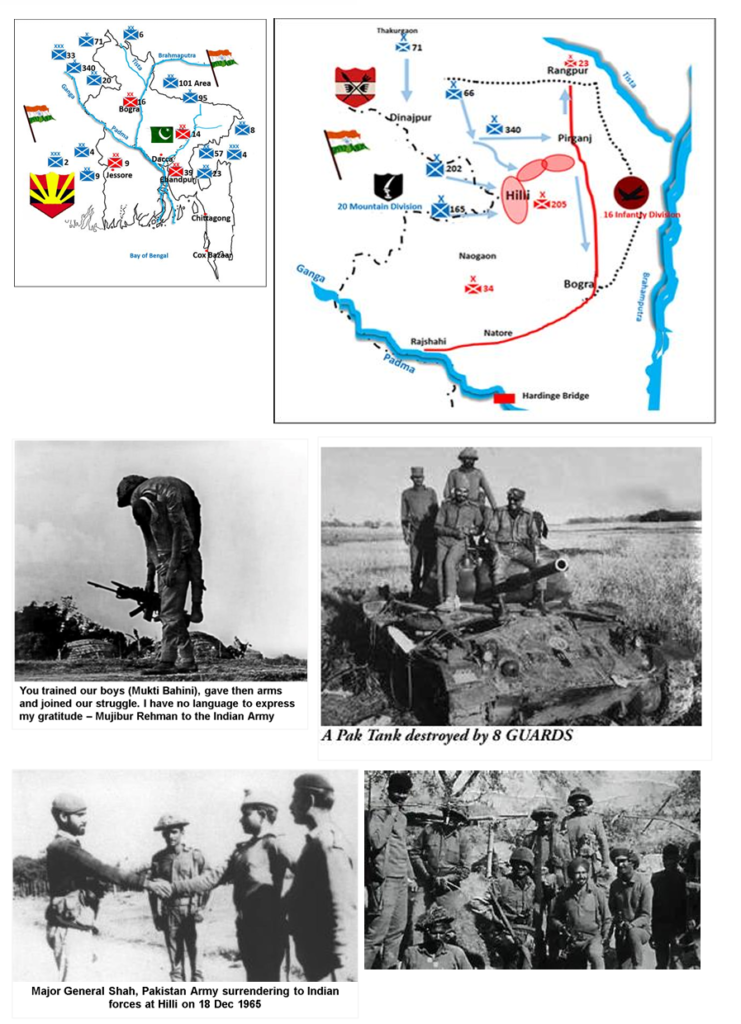
1971 INDO PAK WAR (THE LIBERATION WAR)BATTLE OF HILLI BOGRA: 23 NOV – 18 DEC1971, A HARD NUT TO CRACK by Maj Gen Harvijay Singh

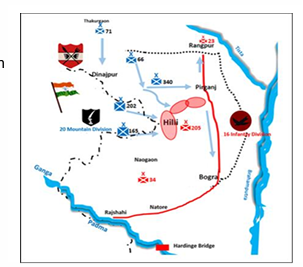
To defend East Pakistan, Lt Gen A A K Niazi, C-in-C East Pakistan, occupied important communication centres in strength. Theatre fortresses were created at towns of Jessore, Jhendia, Bogra, Rangpur, Jamalpur, Mymensingh, Sylhet, Bhairab Bazar, Comilla and Chittagong. Initially the Indian Army hammered head on into the fortresses but soon changed its strategy, and, despite its very small numerical superiority of 1.5 : 1 for the Attack Ops of War manoeuvred past the Pak defences. Numerous tactical battles were fought in the riverine terrain of Bangladesh. The toughest was perhaps the battle of Hilli in the Northwestern Sector from 23 Nov to 11 Dec although the final (formal) surrender took place on 18 Dec.

It involved great personal valour from the warring sides. • Maj J B S Yadava and Maj Abjeet Mamik, company commanders 5/11 Gorkha Rifles awarded Vir Chakra. • Maj Quazi Nuruzzaman awarded with Bir Uttom, 2nd highest award for individual gallantry in Bangladesh. • Maj Muhammad Akram Shaheed of Pakistan won Nishan-e-Haider, highest military honour of the country. • Brigadier Tajammal Hussain Malik commander of Hilli fought resolutely. Once Hilli was bypassed he withdrew to Bogra and even after the formal surrender on 16 Dec, refused to surrender till finally captured by Mukti Bahini and seriously injured. Malik on return to Pakistan was the only Brigadier from East Pakistan promoted to Maj Gen. In 1980 he was arrested by Gen Zia Ul Haq and court martialled on a charge of trying to overthrow Gen Zia. Terrain in the NW Sector was dry and suitable for armour. It was linked by rail and road to the Jessore-Jhenida in the South.

The only major river within the sector was the Tista, which flowed North-West to South-East and joined the Brahmaputra at Chilmari. Pakistan’s 16 Infantry Division with its headquarters at Bogra defended this sector with; • one brigade deployed in North, with HQ at Rangpur, • second held the centre with HQ at Bogra, • third was in the South at Nator. • an ad hoc brigade held Rajshahi. • The only regiment of armour with the enemy in East Pakistan was located in this sector, its four squadrons distributed among the regular brigades of 16 Division and other ad hoc formations.

The main offensive of 33 Corps was launched by 20 Mountain Division consisting of 66, 165, 202 and 340 Infantry Brigades, 3 Armoured Brigade, 471 Engineer Brigade and two artillery brigades augmented by 33 Corps Artillery. It was tasked to capture Hilli, cut off the railway line isolating Pakistani defences in the north. The frontal assault on Hilli turned out to be slogging match against its well prepared defences, held by up to a brigade strength leading to heavy casualties on both sides. Despite repeated attacks, the defenders held resolutely on. The Indian Army soon learnt its lesson and the futility of attacking Pakistani Fortresses. 340 Mountain Brigade, the corps reserve, was tasked to move north of (i.e Bypass) Hilli and threaten Pirganj, thereby forcing the thinning of Hilli to cater for this new threat to its rear. The advance of 340 Brigade was a classic manoeuvre: skilful use of tanks and tank-mounted infantry. The increased mobility enabled bypassing of enemy frontal defences, beating them to new defensive lines they had intended to occupy and attacking them from flanks and rear.

This bold strategy resulted in the rapid fall of Pak Army strongholds, and its forces were divided and pushed back towards the two extreme ends of the sector. (Rangpur and Bogra) Mukti Bahini a highly motivated lot, thirsting for revenge against the Pak soldiers provided effective intelligence of the locations of the Pak troops, which went a long way in helping the Indian Army to get through the gaps and achieve speed and surprise in their march towards Dacca. The battle was not without its lighter moments. “You may be right, Sir. But I swear the buffaloes have 100-mm guns fitted on them and they are picking off our bunkers one by one”. Paki Post Commander at Charkai, 11 Kms N of Hilli responding to HQ’s retort that he must be seeing buffaloes because tanks cannot come through marshes and nalas. 340 Infantry Brigade entered Bogra on 16 Dec, followed by rest of the corps, effectively ending the fighting in this sector. However, five Pakistani fortified positions continued to hold out, incl Rangpur, astride Indian lines of supply, which might have posed logistic problems, had the war dragged on.

A total of 371 soldiers were killed and 961 wounded on the Indian side, most in the battle of Hilli. Fighting in Bogra was stiff, tanks found it difficult to manoeuvre in built-up area. By midday on 14 Dec a large portion of the town was taken. Fighting continued on the following day with Pakistanis sticking to a small perimeter. In the early hours of 16 Dec small groups began to surrender and later during the day came the orders to cease-fire. Hilli became a symbol of heroic Pakistani resistance but also a lesson in the limits of static defence. Fortresses can delay but cannot halt a broader operational collapse if the attacker chooses to outflank it.


Kangra bids tearful farewell to Wing Commander Namansh Syal

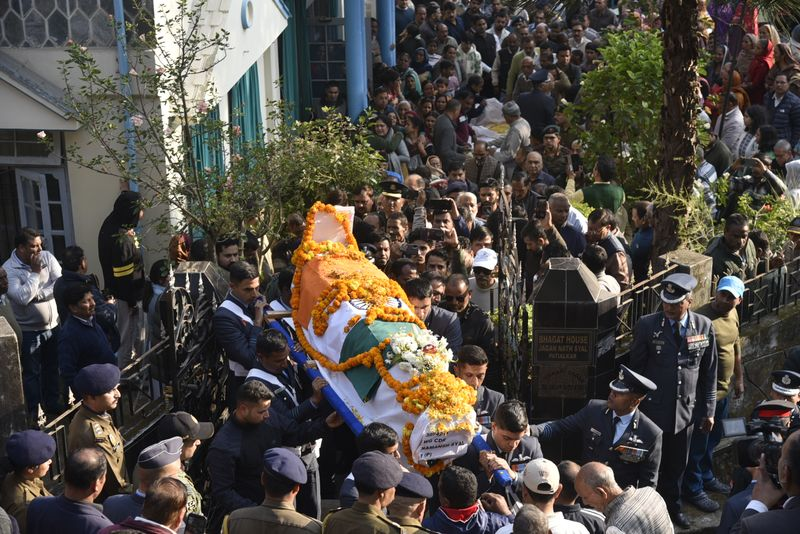
Kangra bid a tearful farewell to Wing Commander Namansh Syal, who lost his life in the LCA Tejas crash during the Dubai Air Show. His mortal remains arrived this afternoon at Kangra Airport from Sulur Air Base, Coimbatore.

His wife, an officer in the IAF, and their young daughter stood brave but heartbroken as the tricolour-draped coffin was received.

From the airport, the mortal remains were taken to his native village, Patialkhad near Yol, where the last rites were performed with full military honours. Hundreds of residents thronged the route, chanting “Bharat Mata Ki Jai,” their voices echoing through the valley in a moving tribute to the fallen hero. The atmosphere was heavy with grief as the martyr’s mother clung to the coffin of her only son, inconsolable in her loss. In a moment that left everyone humbled, his wife, wearing her uniform, offered a final salute to her husband, a gesture symbolising both love and unwavering service to the nation.

Minister for AYUSH, Youth Services and Sports Yadwinder Goma laid a wreath on behalf of the Himachal Pradesh government, calling the loss “unbearable for both the state and the country.” He assured the grieving family of the government’s unwavering support. Former Speaker and Sulah MLA Vipin Singh Parmar described Wing Commander Syal as an exceptionally skilled pilot whose demise is “a great setback to the nation.”

Nagrota Bagwan MLA Raghubir Singh Bali, Shahpur MLA and Vidhan Sabha Chief Whip Kewal Pathania, along with the Deputy Commissioner and senior military and civil officers were present to pay homage. Civil officials, senior military officers and a large number of ex-servicemen also gathered to pay their respects.


Dedicated fighter pilot, served nation with unwavering commitment: IAF pays tribute to Wg Cdr Namansh Syal

Wing Commander Namansh Syal with wife Afsaan.

Mourning the tragic loss of Wing Commander Namansh Syal, the Indian Air Force on Saturday said the air warrior was a “dedicated fighter pilot” and thorough professional, who served the nation with unwavering commitment, exceptional skill and an unyielding sense of duty.

Syal, who hailed from Himachal Pradesh’s Kangra, was killed on Friday after the indigenous multi-role Light Combat Aircraft (LCA), Tejas, crashed in a ball of fire during the aerial display at the Dubai Air Show.

The single-engine lightweight aircraft crashed around 2:10 pm local time (3.40 pm IST) after the pilot had flown across the site of the prestigious air show in Dubai during the demonstration flight. The aerial display of Tejas was scheduled to last for eight minutes.

The IAF in post on X shared a tribute note, remembering a fellow air warrior and his professional qualities.

“The Indian Air Force deeply mourns the tragic loss of Wg Cdr Namansh Syal, who lost his life in the unfortunate Tejas aircraft accident at the Dubai Air Show. A dedicated fighter pilot and thorough professional, he served the nation with unwavering commitment, exceptional skill and an unyielding sense of duty,” it said.

In its post, it also shared a photo of him in his IAF uniform and another one in his pilot overall and standing next to a fighter jet, besides a video of a send-off accorded to him after the tragic accident that claimed his life.

The video clip showed a group of uniformed personnel paying tribute, while some officials laid wreaths in front of a casket wrapped in the tricolour, bearing his mortal remains.

“His dignified persona earned him immense respect through a life devoted to service, and was visible in the send-off attended by UAE officials, colleagues, friends, and the officials of the Indian Embassy.

“The IAF stands in solidarity with his family in this hour of profound grief and honours his legacy of courage, devotion and honour. May his service be remembered with gratitude,” the IAF added in its post.

Syal is survived by his father, mother, wife Afsaan, who is also serving in the Air Force, and their six-year-old daughter.

As the crash inside the grounds of an airfield in Dubai cast a tragic shadow on an otherwise mega spectacle on the last day of the event in the desert city, video footage of the accident showed the jet abruptly dropping height after what looked like a low-altitude manoeuvre and then nosedived into the ground in a matter of seconds before being engulfed in a ball of fire.

Black smoke billowed over the Al Maktoum International Airport at Dubai World Central, as horrified spectators, including women and children, assembled in large numbers at a grand stand area behind a fenced airstrip watched in shock.

The crash of a Tejas at the Dubai Air Show, was the second accident involving the indigenous multi-role LCA in less than two years  On March 12, 2024, a Tejas aircraft crashed near a residential colony in Jaisalmer while returning from tri-services military exercise ‘Bharat Shakti’ in Pokhran desert in what was the first accident involving the homegrown jet since it began flying in 2001.


Afsaan, wife of Wing Commander Namansh Syal

She stands there in uniform, eyes holding a storm no one else can see. A wife who has lost her world, and an officer who must still hold her ground. If she wanted to scream her grief to the sky, she’d be right to. But the uniform on her shoulders asks for dignity even when the heart shatters. Only she knows the battle she’s fighting within. Soldiering always demands a price, sometimes unbearably heavy. Yet she stands steady, honoring the man she loved and the duty they both lived for. Farewell, brave air warrior. Blue skies and tailwinds.!!


Captain Chandra Narain (MVC): A saga of immortal bravery

An officer of 2nd Battalion of Garhwal Rifles, this son of Dharamsala laid down his life fighting Pak infiltrators in 1965

Captain Chandra Narain Singh, a proud Himachali Dogra, born in Dharamsala on July 2, 1939, embodied courage from the very start. Inspired by his father’s military legacy, he was selected to the Indian Military Academy on his first attempt and was commissioned into the illustrious 2nd Battalion of Garhwal Rifles, which is famous for its World War I Victoria Cross heroes, on June 11, 1961.

Captain Chandra Narain, who was affectionately known as CN, quickly distinguished himself and was entrusted with a staff officer’s role in an Infantry Brigade guarding the sensitive Poonch-Mendhar sector. In a tense buildup to the 1965 conflict with Pakistan, Captain Chandra Narain displayed exemplary leadership and unflinching bravery, proving beyond doubt that Himachali valour yields to none.

His supreme sacrifice in 1965 remains an enduring testament to duty, honour and the spirit of India’s fearless soldiers. As Government College, Dharamsala, is planning for its centenary celebrations, the Old Student’s Association has strongly recommended the college to be named after its alumni — this great son of the soil.

As tensions along the ceasefire line surged to unprecedented heights, the summer of 1965 became one of the most volatile periods since the conflict with Pakistan of 1947-48. By early August, Indian forces in Jammu and Kashmir were confronting an alarming escalation: infiltrating groups of 100 to 150 men slipping across the ceasefire line, armed and intent on destabilising the region and inciting unrest. These incursions, far bolder than earlier violations, marked the launch of Pakistan’s large-scale infiltration campaign — Operation Gibraltar.

Amid this unrest, a story of extraordinary courage unfolded in the rugged hills near Poonch. Captain Chandra Narain, serving as Staff Captain with 93 Infantry Brigade Headquarters, would on August 5, 1965, undertake an action that would forever etch his name in India’s military history.

That afternoon, a local informer arrived breathless at the Brigade Headquarters with a chilling news: Over a 100 Pakistani infiltrators in civilian attires had been sighted at Dabrot village between Galuthi and the ceasefire line. The Brigade Commander recognised the emergency and ordered Capt Chandra Narain to lead an immediate patrol, drawing personnel from the defence platoon of 22 Maratha Battalion. With him went his loyal sahayak, Rifleman Pushkar Singh Bisht, and an accompanying Maratha officer.

The patrol reached Dabrot swiftly. Capt Chandra Narain, with characteristic precision, organised a thorough search and soon, the infiltrators were sighted. Though Capt Chandra Narain and his team were heavily outnumbered, he launched a fearless assault, catching the enemy off guard. The infiltrators scattered in panic, abandoning three light machine guns and a sizable cache of ammunition.

But the danger was far from over. A concealed splinter group opened fire from behind boulders, turning the skirmish into a fierce close-quarter battle. In the melee, Rifleman Bisht was grievously wounded and he collapsed. As the infiltrators closed in to finish him, Capt Chandra Narain, shouting “Badri Vishal Lal ki Jai!”, charged alone at the enemy. Firing his carbine with deadly accuracy, he neutralised almost the entire group in a display of unmatched bravery.

In those final moments, the fate dealt its cruellest blow. A fleeing infiltrator fired wildly and one bullet hit Capt Chandra Narain in the head. He fell beside his sahayak, both having made the supreme sacrifice.

For his indomitable courage and leadership under extremely hostile conditions, Captain Chandra Narain was posthumously awarded the Maha Vir Chakra (MVC). A proud “Military Maha Vir” of Himachal Pradesh, Captain Chandra Narain remains an enduring symbol of fearless devotion to duty.

Six decades on, the hero remembered with honour, pride

  • On August 5, the 60th anniversary of Capt Chandra Narain Singh’s martyrdom, 16 Garhwal Rifles held a solemn ceremony at Dharamsala to honour the Maha Vir Chakra awardee’s legacy
  • In a deeply symbolic moment, his medals were received with reverence by Lt Gen DS Rana, Colonel of Garhwal Rifles and Garhwal Scouts and CINCAN
  • Senior officers, including Lt Gen Rajan Sharawat, Brigadier Vinod Singh Negi and Colonel Vishal Kumar Singh, also paid tributes
  • The medals are now preserved at the Garhwal Rifles Regimental Centre Museum at Lansdowne in Pauri Garhwal, Uttarakhand, serving as a lasting reminder of Capt Chandra Narain Singh’s heroism and selfless service

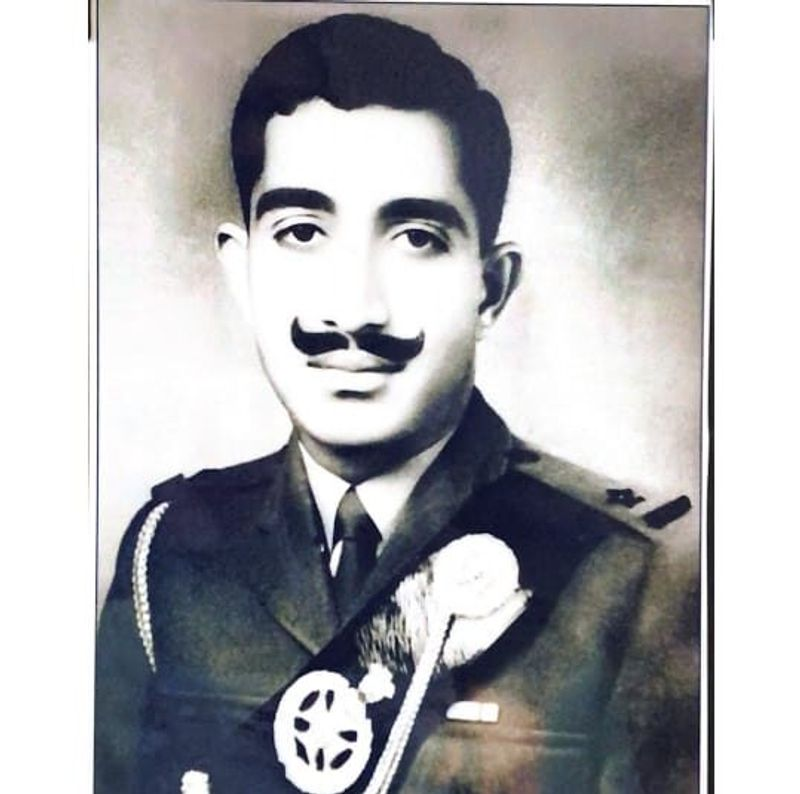
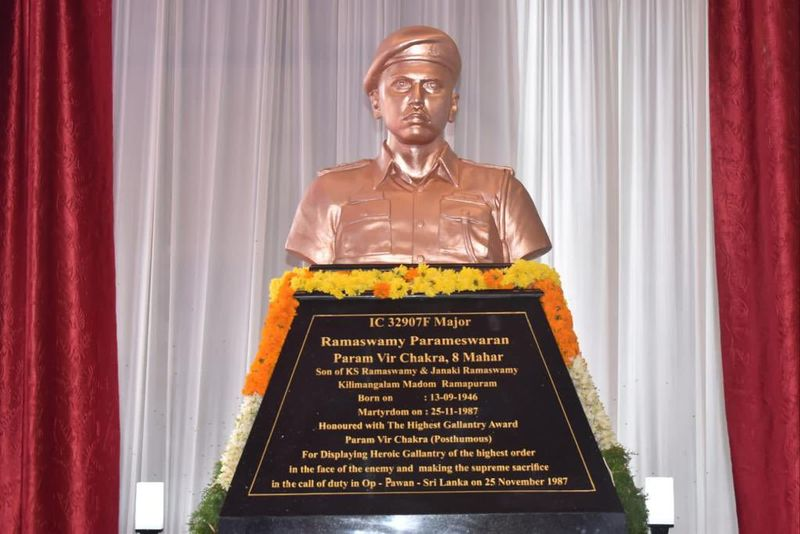
Remembering Major Ramaswamy Parameswaran, the sole Param Vir Chakra recipient of Sri Lanka operations

Major Parameswaran of the 8 Mahar Regiment was returning from a search operation late at night on November 25, 1987, when his column was ambushed by a group of militants

Veterans of the Indian Peace Keeping Force (IPKF), along with senior serving officers, will assemble at the National War Memorial in Delhi on Tuesday to pay tributes to Major Ramaswamy Parameswaran, who was the only soldier to receive the Param Vir Chakra (PVC) for gallantry during India’s operations in Sri Lanka.

The IPKF was deployed in Sri Lanka from July 1987 to March 1990 under a bilateral accord aimed at disarming Tamil militant groups, particularly the Liberation Tigers of Tamil Eelam (LTTE), and ending the civil war.

It was India’s first major overseas military campaign post-Independence. While the deployment is regarded as tactically successful, albeit at a heavy human cost, the political, diplomatic and intelligence aspects continue to be debated. By the time the last Indian troops were withdrawn, the IPKF had lost 1,171 troops with another about 3,500 being wounded.

Initially envisioned as a quick and low-intensity operation with little armed engagements, it quickly escalated into intense combat. The force found itself in gruelling battles involving jungle warfare, urban assaults and counter-insurgency operations and throwing up some hard lessons.

For the past few years, veterans have been holding private remembrance ceremonies. What marks a notable departure this year, according to IPKF veterans, is that for the first time Army Headquarters is officially commemorating Operation Pawan, the most significant operation undertaken in Sri Lanka, coinciding with the day of Major Parameswaran’s heroic stand in the line of fire. For long, veterans have been campaigning for official recognition and commemoration of the Sri Lanka operations.

Operation Pawan was the code name for the IPKF campaign to secure the Jaffna peninsula from the LTTE and enforce its disarmament as a part of the Indo-Sri Lanka Accord. After about three weeks of intense fighting, the IPKF succeeded in taking control of the region, something that the Sri Lankan Army had earlier failed to achieve.

As part of the operation, Major Parameswaran of the 8 Mahar Regiment was returning from a search operation late at night on November 25, 1987, when his column was ambushed by a group of militants.

“With cool presence of mind, he encircled the militants from the rear and charged into them, taking them completely surprise. During the hand-to-hand combat, a militant shot him in the chest. Undaunted, Major Parameswaran snatched the rifle from the militant and shot him dead. Gravely wounded, he continued to give orders and inspired his command till he breathed his last. Five militants were killed and three rifles and two rocket launchers were recovered and the ambush was cleared,” the citation for his award reads.

“Major Ramaswamy Parameswaran displayed the most conspicuous gallantry and thought nothing of dying at his post,” the citation adds.

He was the only PVC recipient of the Sri Lanka campaign. In addition, over 250 decorations, including three Maha Vir Chakras, the second-highest gallantry award, were conferred on IPKF personnel.

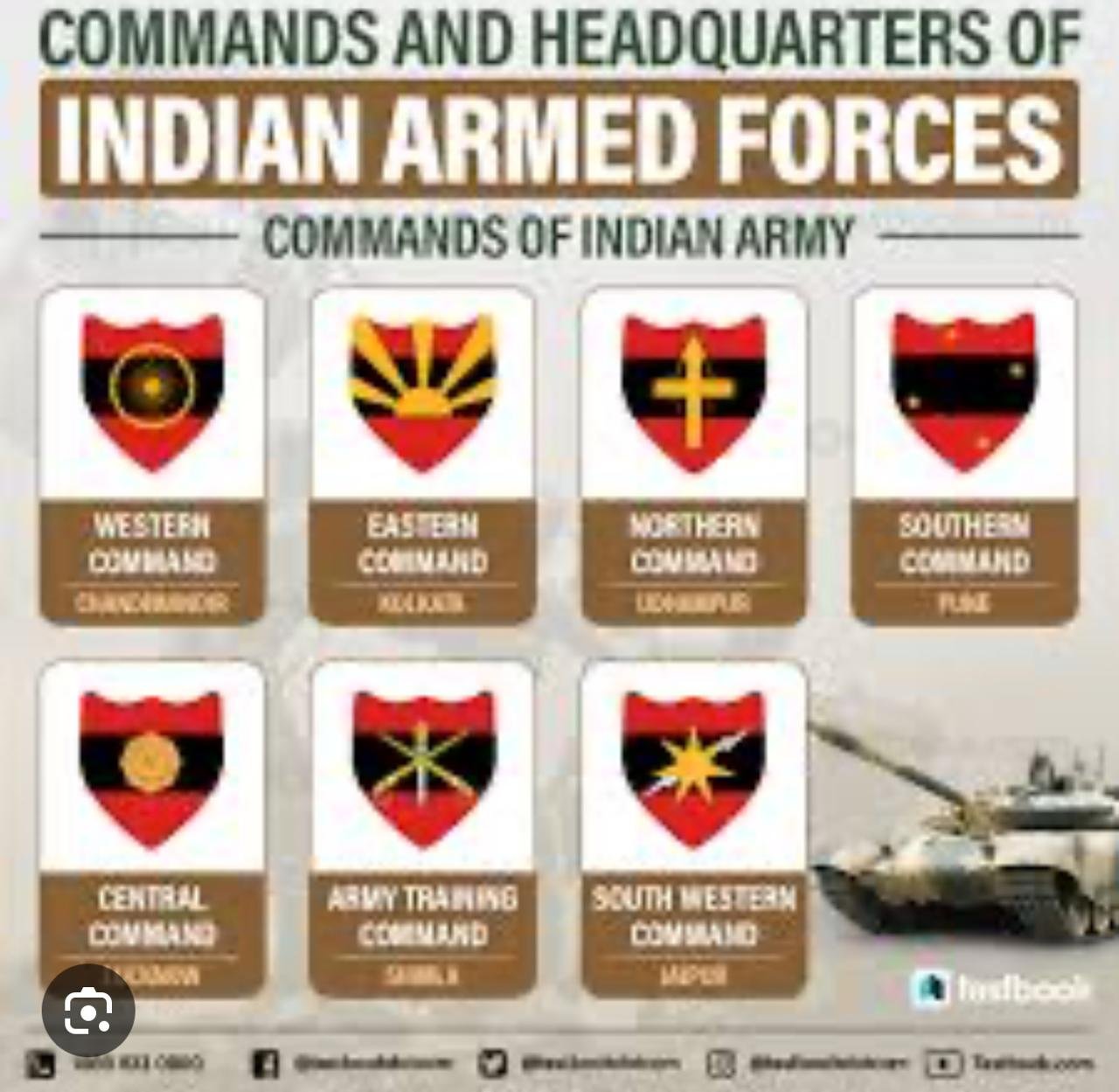
Operating under Southern Command, the IPKF deployment peaked at around 1,00,000 troops, involving the Army’s 4 Mountain Division, 36 Infantry Division, 54 Infantry Division and 57 Infantry Division, along with paramilitary forces, Special Forces, and elements of the Air Force and Navy.

Jaffna, Palaly, Vavuniya, Trincomalee, Batticaloa, Ampara and Mannar were along areas in northern and eastern parts of Sri Lanka where the IPKF was deployed.

While Indian involvement in the Sri Lankan civil strife had been continuing at the political and diplomatic levels since the tenure of Indira Gandhi as prime minister, the induction of the IPKF had been preceded by the first overt military operation, Poomalai, when five IAN An-32 transport aircraft, escorted by Mirage 2000 fighters, flew over Jaffna to airdrop 25 tons of humanitarian supplies in June 1987.

Among other major IPKF operations were Operation Viraat, Operation Trishul, Operation Checkmate, Operation Main Road, Operation Tiger Hunt and Operation Thrividra. Sri Lanka was also the first combat exposure for the Navy’s newly formed Indian Marine Special Force, now known as the Marine Commando Force.


Western Command validates operational preparedness of new Ashni specialist drone platoons

The Ashni platoons are in sync with other ongoing modernisation & restructuring moves like forming the Bhairav battalions and Rudra brigades, designed to enhance the Army’s offensive capabilities

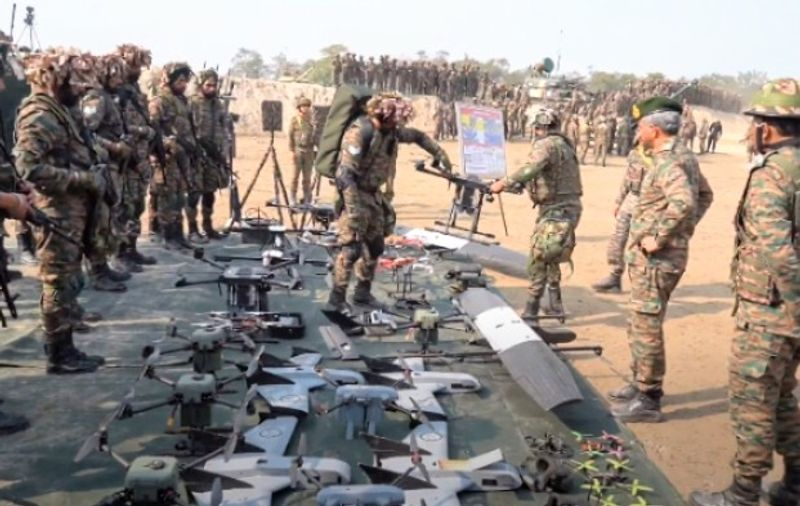
Field formations under the Western Command reviewed and validated the operational preparedness of newly raised Ashni platoons, which are specialised drone units integrated with Infantry battalions, during the ongoing integrated all-arms Exercise Ram Prahaar.

“An invisible #ThirdEye, #ASHNI enables real-time tactical level reconnaissance, surveillance and lethal mini-UAS precision strike capability of each Infantry Battalion of formations of #KhargaCorps,” the Western Command posted on its X handle on Sunday.

With the proliferation of drones across the battle space down to the tactical level, the Army has raised about 380 new specialist drone platoons. Designated ‘Ashni’, which means fire, each such platoon comprises about 25 specially trained personnel equipped with different types of drones.

The drones on the inventory of battalions are those meant for surveillance and recce as well as armed ones, including Kamikaze drones and precision ammunition dropping unmanned aerial vehicles. These tactical drones are smaller, having a range of a few kilometers and fly at lower heights as compared to the larger unmanned aerial systems employed for medium and long range missions by the armed forces.

Forming Ashni platoons is a key part of the Army’s modernisation efforts to develop ‘drone-first’ tactics and adopt counter evolving threats aimed at providing enhanced situational awareness, precision targeting and real-time intelligence as well as counter drone defence capabilities to infantry units through drone technology.

The Ashni platoons are in sync with other ongoing modernisation and restructuring moves like forming the Bhairav battalions and Rudra brigades, designed to enhance the Army’s offensive capabilities.

The Bhairav battalions are structured, trained and equipped for special operations and likely to be a bridge between the regular infantry and the elite special forces. Five such battalions, with about 250 soldiers, have already been operationalised and another four are in the process of being formed. The Army’s plans call for a total of 25 such battalions, all of which are expected to be complete next year.

The Rudra Brigades are the Army’s new, integrated combat formations that combine various arms such as infantry, armour, artillery and support elements under a single command to enhance battlefield cohesion, mobility and offensive capability by having all the necessary fighting elements permanently integrated, rather than assembled only after mobilisation.

Two Rudra Brigades have already been raised. The traditional brigades that these would eventually replace are single arms formations, that is each brigade is composed of units of the same arm or service like the infantry, armour or artillery.