Current Events :


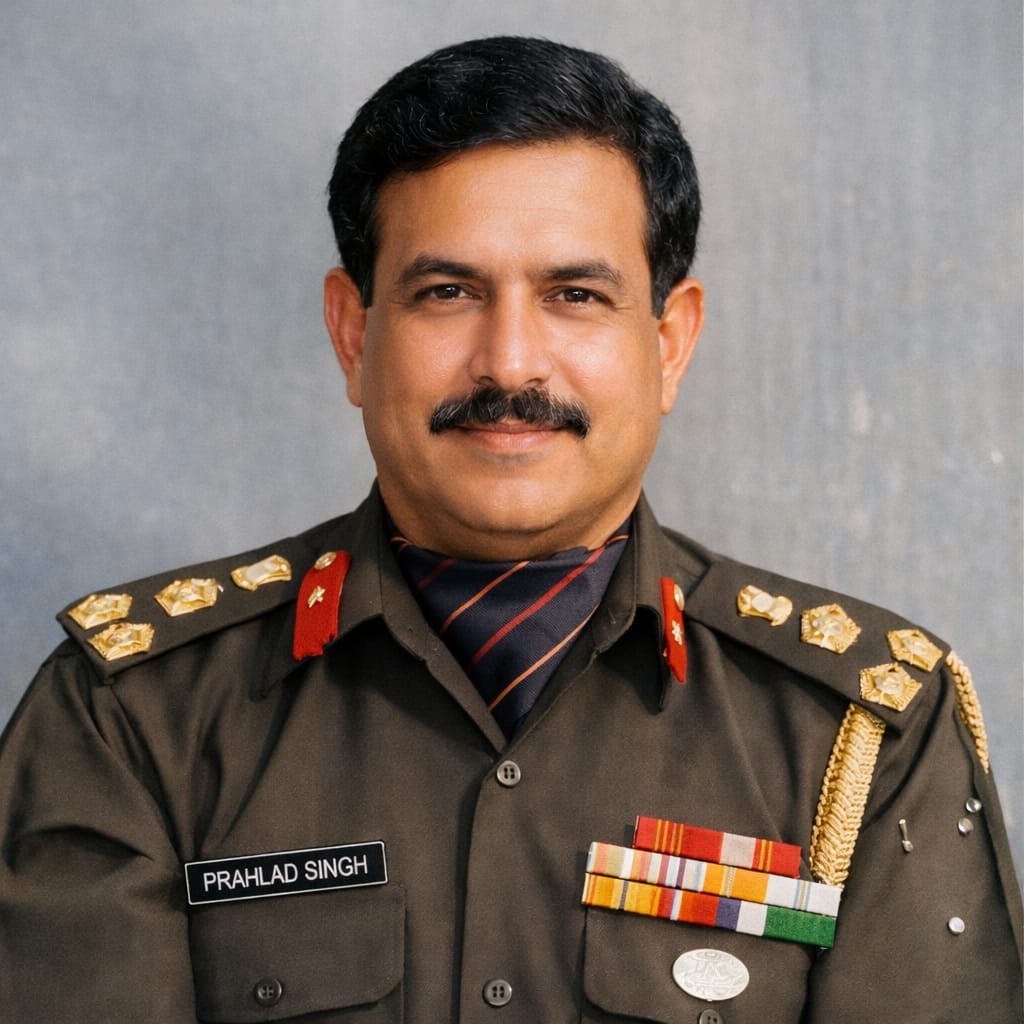













Indian Army Uniform Rules 2026 – Summary of New Rules for Wearing Medals
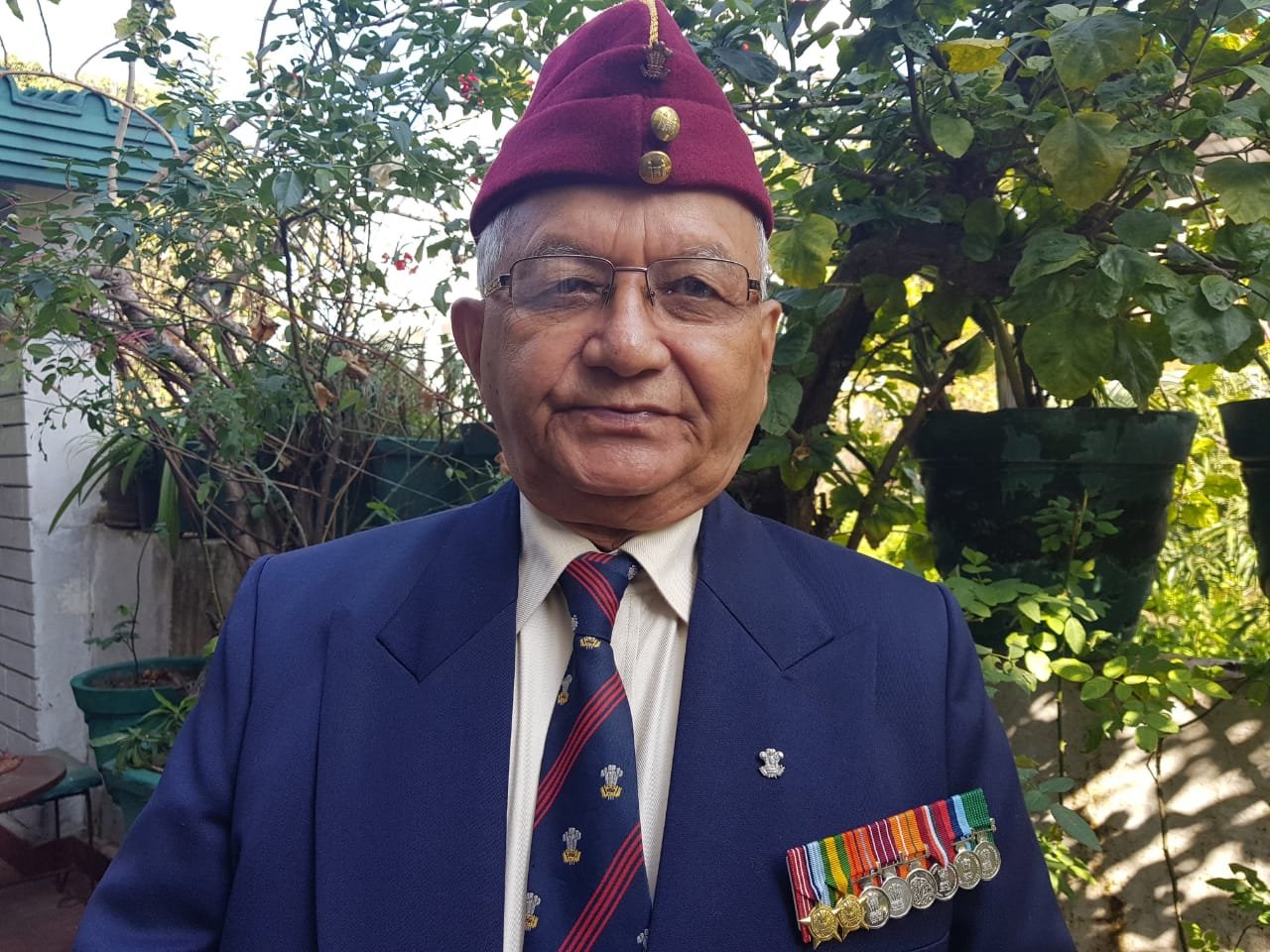
They may wear the uniform along with their rank badges on special occasions such as ceremonial parades, military functions, Ex-Servicemen rallies, reunions, and state functions.
(b) Honorary Commissioned Officers / JCOs / Territorial Army:
All honorary commissioned officers and JCOs/jawan holding honorary ranks are entitled to wear the uniform. When in civil dress, they may wear their full-size or miniature medals.
Medals shall not be worn at any political function. Any soldier who has been dismissed or removed through disciplinary action shall not wear medals on any occasion.
All medals will always be worn on the left chest.
This is the newest and most respectful provision. The family of a martyr or ex-serviceman (wife, husband, parents, children, ancestors) may wear their medals.
When they may be worn:
National / regimental war memorials / war cemeteries during homage ceremonies
State or military funerals
Official functions at Rashtrapati Bhavan / Raj Bhavan / embassies
Official functions of the Armed Forces, Ex-Servicemen rallies and reunions
National Day celebrations and when visiting military headquarters
When meeting senior officers such as the Governor, Collector / District Magistrate
An Ex-Serviceman who is also a Next of Kin may wear his own medals on the left chest and the family medals on the right chest at the same time.
A serving soldier who is a Next of Kin may also wear the family medals on the right chest while in civil dress.
When they must never be worn:
Political functions, private functions, social parties, or while appearing on media channels / YouTube / FacebooK
CLICK BELOW TO OPEN Pdf
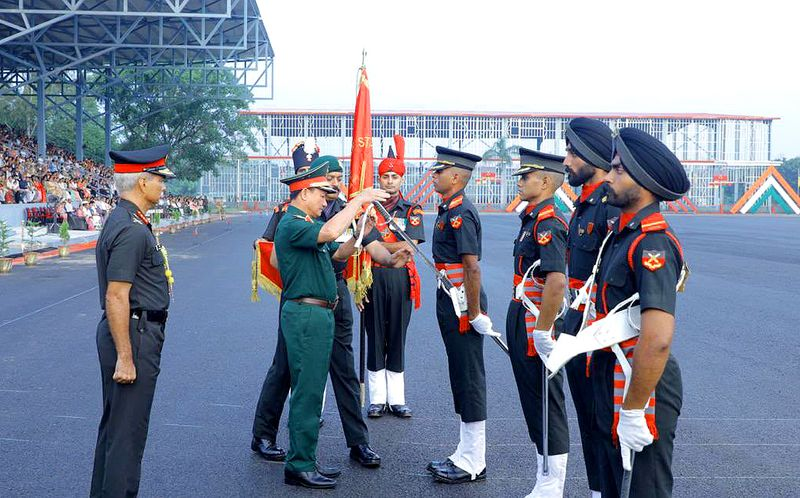
Lieutenant General Le Van Huong, Deputy Chief of the General Staff of the Vietnam People’s Army, reviewed the passing-out parade.
A story of excellence that began in the rank and file continued with the same inspiration and vigour as Lt P Sashi Kumar went on to win top honours after becoming an Army officer. Kumar, who had initially joined the Assam Rifles as a havildar, was awarded the Sword of Honour after being adjudged the overall best cadet at Officers Training Academy (OTA), Gaya.
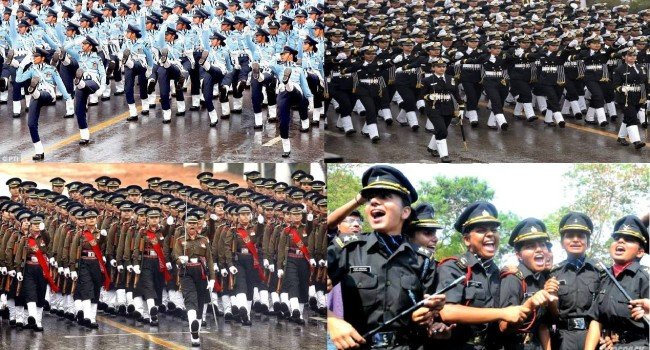
Kumar, who held the highest cadet appointment of Academy Under Officer (AUO) during his training, was also awarded the gold medal for standing first in the order of merit. He was among 253 officer cadets, including 35 women, from the Short Service Commission (Technical) Men – 65 and SSC (Technical) Women – 36 courses who passed out on September 5.
Lieutenant General Le Van Huong, Deputy Chief of the General Staff of the Vietnam People’s Army, reviewed the passing-out parade. He also presented the silver medal to Deepak Singh Rawat and the bronze medal to Navneet Singh for securing second and third positions, respectively.
Located in Bihar, OTA Gaya trains officers for the technical stream. At a separate event at OTA Chennai, 342 cadets, including 29 women, along with 17 cadets from friendly foreign countries, were commissioned. Chief of the Naval Staff Admiral Krishna Swaminathan was the reviewing officer. He presented the Sword of Honour to Lieutenant Gurkeerat Singh, who hails from Indore.
Born into the family of Naib Subedar C Pandi of the Army Ordnance Corps, Shashi Kumar grew up deeply inspired by the core values of courage, discipline and selfless service. He nurtured an unwavering, lifelong dream of wearing the coveted olive-green uniform, according to information shared by the Army Training Command.
Kumar completed his graduation and secured a prestigious and highly sought-after position at Tata Consultancy Services. However, he chose to answer his true calling of joining the Armed Forces rather than settle for a comfortable corporate career.
After joining the Assam Rifles, a Central Armed Police Force, as a havildar, he was awarded the Overall Best Recruit medal and served for two-and-a-half years in the counter-insurgency environment of Manipur. He later qualified in the Services Selection Board interview and joined OTA.
“His relentless hard work earned him the coveted and highest appointment of AUO at OTA. His journey exemplifies resilience, proving that unwavering determination and devotion to the right cause ultimately triumph over adversity,” the Army said.
Among the newly commissioned lieutenants was Lt Sparsh Chhetri, an engineer from Thapar University, Patiala, who marked the continuation of a four-generation family legacy in uniform. Donning the olive-green uniform came naturally to him, following in the footsteps of his great-grandfather, who served in the British Indian Army; his grandfather and father, who were infantry officers; and his mother, who served in the Army Education Corps.
A computer science graduate, Sparsh left a flourishing career as a senior data analyst at a top multinational company to join the Indian Army. A versatile all-rounder, he is a national-level equestrian medallist, a district-level badminton and swimming medallist, a skilled marksman and a former NCC under officer. During his training at OTA, he held the appointment of Battalion Under Officer, reflecting his leadership qualities.
The passing-out parade also witnessed several stories of grit, resilience and determination, with cadets from diverse backgrounds overcoming odds to pursue their dreams of joining the Army.
Hailing from a small village in Bilaspur district of Himachal Pradesh, Lieutenant Vikas Gautam initially joined the Army as an Agniveer after completing his engineering degree in computer science. He served as a T-90 tank gunner with the Scinde Horse.
The discipline, teamwork and sense of responsibility instilled in him by the regiment strengthened his resolve to become an officer. At OTA, his achievements included leading the academy in cross-country and winning a gold medal, earning a merit card in physical training and becoming a record-holder in the battle obstacle course, the Army said.
Lieutenant Syed Abu Hurera, an engineer from Cuttack and the first person in his family to become an Army officer, is a national-level footballer and state-level athlete. His journey at OTA was severely tested when he sustained a serious ankle injury during training, resulting in medical relegation in his first term. He fought through the pain and showed remarkable patience to restart his training, later excelling in physical training by earning a merit card and a gold medal in athletics.
Sub-Inspector Raghvendra Jha of the Central Reserve Police Force’s CoBRA battalion also made the transition from a Java developer to an Army officer. Having served in Naxal-affected areas of Odisha and in the challenging counter-terrorism environment of Anantnag, he was awarded the Director General’s Commendation.
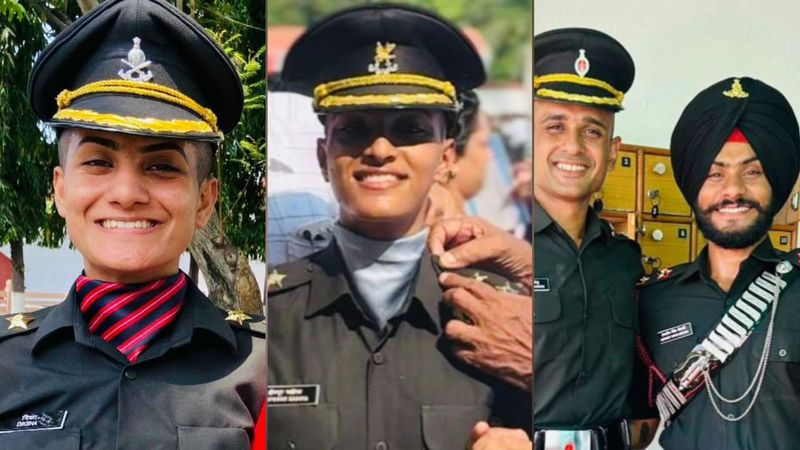
n a proud moment for Punjab’s military legacy, four cadets—two lady cadets from the Mai Bhago Armed Forces Preparatory Institute for Girls and two from the Maharaja Ranjit Singh Armed Forces Preparatory Institute (MRSAFPI)—were commissioned as Lieutenants in the Indian Army on Saturday.
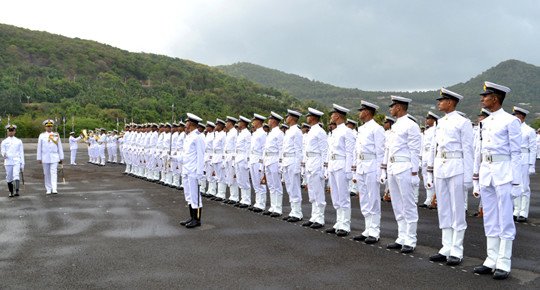
The commissioning took place at the Officers Training Academy (OTA) in Chennai during a spectacular passing out parade reviewed by Chief of Naval Staff Admiral Krishna Swaminathan, PVSM, AVSM & VSM.
Lady Cadet Deepnoor has been commissioned into the elite Army Aviation Corps, while Lady Cadet Diksha Dhiman joins the Army Ordnance Corps. Deepnoor is the daughter of S. Sukhbir Singh, Professor at Sardar Beant Singh State University, Gurdaspur and Ramanpreet Kaur, a Government School Teacher. Diksha is the daughter of Pawan Kumar, a businessman from Pathankot and Indu.
The MRSAFPI duo also made the state proud with Cadet Ishpreet Singh Dhillon, son of late Paramjit Singh Dhillon and Santosh Kaur, joining the Regiment of Artillery, and Lieutenant Arsh Singh, son of Maj Gen P.S. Sandhu (Retd), carrying forward his family’s legacy as a second-generation officer into the Judge Advocate General (JAG) Branch.
Congratulating the newly commissioned officers, Punjab Employment Generation, Skill Development and Training Minister Mr. Aman Arora said, “These young officers will inspire thousands of youth across Punjab to serve the nation. Under Chief Minister Bhagwant Mann’s leadership, the state government is fully committed to handholding and supporting every youth aspiring to join the Armed Forces as a commissioned officer.”
Expressing delight over the achievement, Maj Gen Jasbir Singh Sandhu, AVSM (Retd), Director, Mai Bhago AFPI, said, “This milestone will further energise our mission at Mai Bhago AFPI to prepare more daughters of Punjab for commissioning as officers in the Armed Forces.” He extended warm wishes to the newly commissioned officers.
Maj Gen Ajay H. Chauhan, VSM (Retd), Director, MRSAFPI, exhorted the new officers to uphold the nation’s ideals and make their alma mater proud. He added that 15 more cadets of MRSAFPI have cleared SSB and are awaiting joining letters for the December 2026 course.
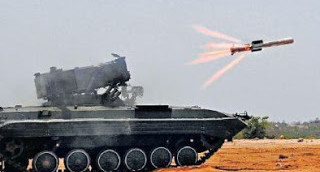
With military communication systems becoming increasingly resilient to electronic countermeasures, the Defence Research and Development Organisation (DRDO) is developing an advanced system to counter ‘smart’ or cognitive radio networks that use artificial intelligence to evade detection and jamming.
Christened the Smart Communication Jammer System (SCJS), the system will be a large vehicle-mounted platform capable of detecting, analysing, classifying, direction-finding, monitoring and jamming tactical communication mobile ad hoc networks (MANETs).
Cognitive radios and MANETs are advanced wireless communication systems that can sense their surrounding environment and automatically alter their settings to use the radio spectrum more efficiently. They can continuously scan for unused or underutilised frequency channels and rapidly switch frequencies, making them difficult to monitor or intercept using conventional jamming systems.
The Defence Electronics Research Laboratory, a DRDO establishment, is the nodal agency for executing the project. It is seeking Indian industry partners for the design and development of the SCJS.
According to DRDO’s requirements, the system should be capable of monitoring and jamming radios operating in the 30 MHz to 6,000 MHz frequency range, with 360-degree detection coverage and a range of 20 km. It should also be capable of countering radios that change frequencies at rates of up to 2,000 hops per second.
The wide frequency range covers several tactical communication bands used by modern military systems, including unmanned aerial vehicles (UAVs), loitering munitions and software-defined radios.
Unlike conventional radios that operate on preset channels, cognitive radios use artificial intelligence and machine learning to analyse their operating environment and dynamically switch between spectrum channels, potentially within microseconds, to evade interference.
Traditional static or brute-force jammers, which use high-power radio-frequency signals across fixed bands, can therefore be less effective against such rapidly changing systems, an officer explained.
Army officers said cognitive radio networks improve the reliability of military communications and the availability of information, but also make it more difficult to monitor an adversary’s activity.
Such networks, however, have significant civilian applications as well, including reducing spectrum congestion and improving the efficiency of wireless communications.
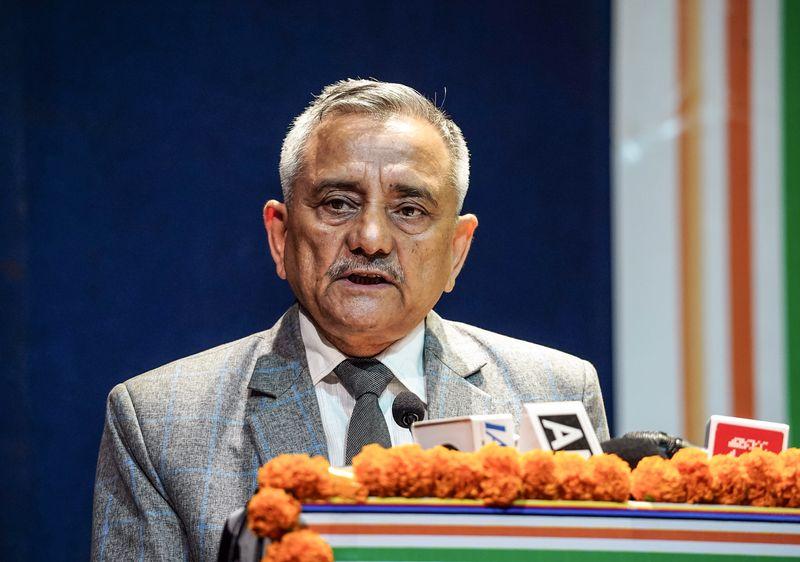
Former Chief of Defence Staff (CDS) General Anil Chauhan addresses the 22nd Bharat Ratna Pandit Govind Ballabh Pant Memorial Lecture on Threats and Challenges to India’s Security at the Pradhanmantri Sangrahalaya in New Delhi on Saturday. ANI
Pakistan remains a cause for concern, and the recently signed “Mecca Defence Agreement” with Saudi Arabia and Türkiye has made Islamabad “overconfident”, something India needs to remain watchful of, former Chief of Defence Staff General Anil Chauhan said on Saturday.
Speaking at the 22nd Govind Ballabh Pant Memorial Lecture here on the theme “Threats and Challenges to India’s Security”, Gen Chauhan, who retired as the country’s top military officer in May this year, also said the unresolved India-China boundary issue continued to carry the potential for friction.
Referring to the Mecca Joint Defence Agreement, Gen Chauhan said, “We have seen the accord and it seems to have induced a kind of overconfidence in Pakistan, and we have to be careful of that.”
The agreement, signed on August 7, 2026, is a mutual defence pact among Pakistan, Saudi Arabia and Türkiye. It states that “an armed attack on one member would be treated as an attack on all three”.
“Pakistan will remain, I think, a major issue of concern in the future,” Gen Chauhan said.
He said the presence of nuclear weapons had created a degree of “static stability” at every level, “but this had also induced instability at the lower levels”.
Pakistan, he said, sought to reduce the space for conventional military operations and relied on sub-conventional warfare, including cross-border terrorism and proxy war.
“Even if a terror network is dismantled, the system, the finance, propaganda and Pakistan’s state support means that terrorism and proxy war will remain a major challenge for us,” he said.
Citing Operation Sindoor and the Balakot strikes as examples of deterrence, Gen Chauhan said India needed to increase the cost of a proxy war for Pakistan.
“India must be able to increase the cost of a proxy war for Pakistan, so that it stops using this as an instrument of state policy,” Gen Chauhan said.
On China, he said it posed an “absolutely different and more long-term and comprehensive challenge”.
The boundary issue remained unresolved and there was no mutually agreeable definition even of the Line of Actual Control (LAC), he said.
“Differences in perception, combined with infrastructure development and power multipliers, create the possibility of friction,” he said.
Border stability required resilience, critical capabilities, clear agreements and consistent adherence to them, he said, in obvious reference to China having breached agreements during the May 2020 military stand-off in Eastern Ladakh.
India and China, he said, were two major nations that cooperated in some areas, competed for influence in markets and held divergent views on aspects of regional and global politics.
“There is a need to engage with China,” Gen Chauhan said, adding that the future of Asia would depend substantially on how India and China managed their relationship.
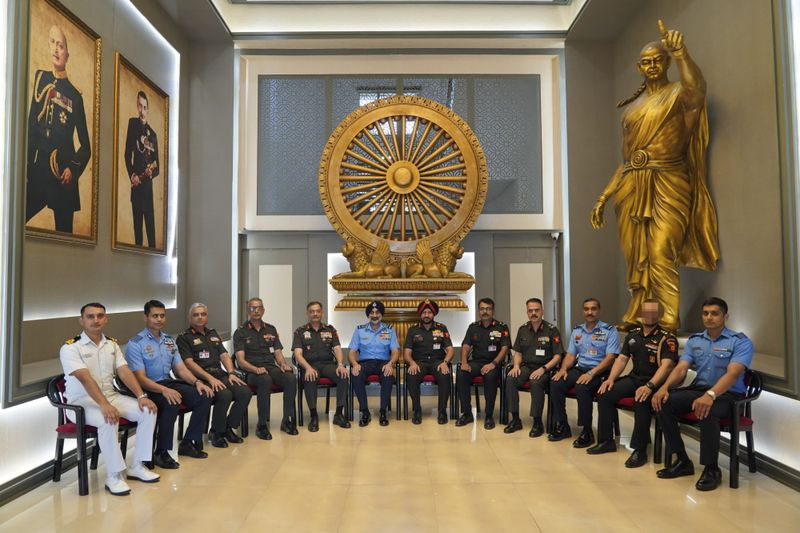
Chief of the Air Staff, Air Chief Marshal Amar Preet Singh, visited Headquarters Western Command, Chandimandir, and interacted with Lt Gen Pushpendra Singh, General Officer Commanding-in-Chief, Western Command and other senior officers.
The interaction focused on enhancing operational preparedness, strengthening joint planning and furthering integration between the Indian Army and the Indian Air Force for synergised operations.
During Operation Sindoor in May 2025, both the services had operated in close coordination for air defence as well as offensive operations through an integrated and networked environment.
The Air Chief also interacted with air warriors serving with the Western Command, acknowledging their vital role in fostering seamless Army-Air Force integration and reinforcing the shared commitment to mission readiness and decisive operational response.
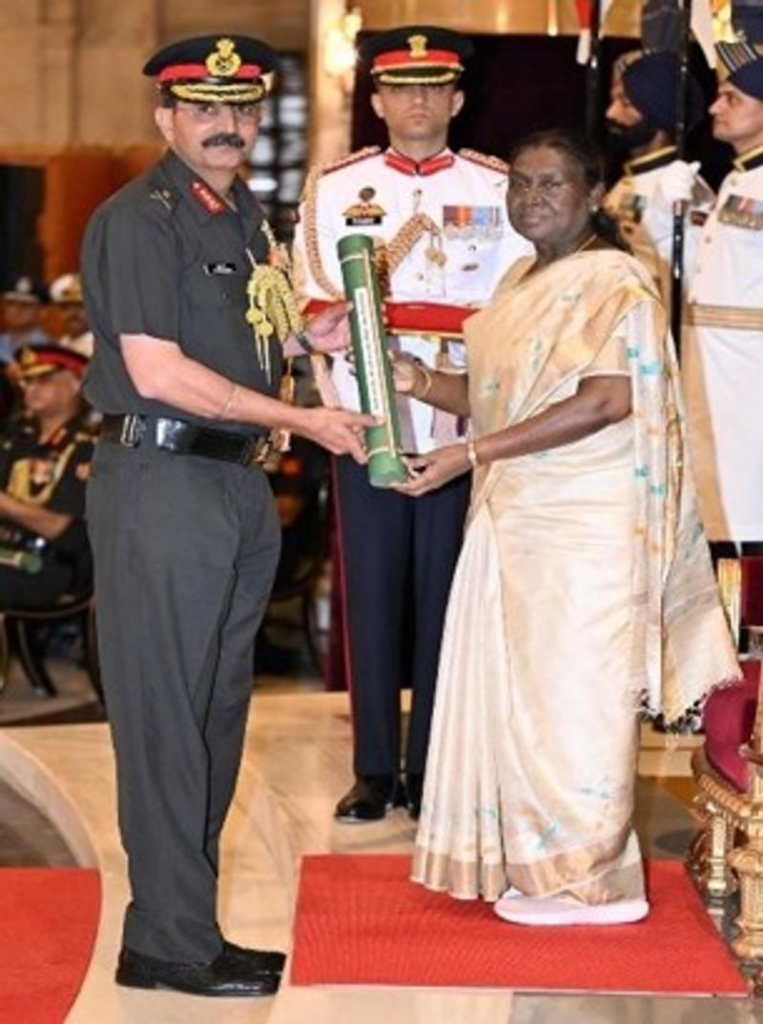
With Lieutenant General Devendra Sharma, General Officer Commanding-in-Chief, Army Training Command (ARTRAC), superannuating on August 31, the curtains come down on a century of collective military service by a family.
A second-generation officer, he had rendered 39 years of service. His father, late Wing Commander Shiv Kumar Sharma, was an Indian Air Force fighter pilot who saw combat in four operations – Goa in 1961, Fukcheh and Demchok in 1962, Halwara in 1965 and Pathankot in 1971. Shot down over Sargodha in 1965 and ejecting with a spinal fracture, he fought his way back to fitness to fly fighters again by 1971.
His father-in-law, Brigadier Sarjeet Singh Kaler (retd), saw combat in all three major wars – Rezangla in 1962, with 1 Jat in the Amritsar-Lahore Sector in 1965 and as the Adjutant of 1 JAT in 1971. He later commanded 2 Mechanised Infantry (1 JAT).
General Sharma’s elder brother, Air Commodore Shailendra Sharma, (retd), was a Mirage 2000 pilot who had flown strike missions over Kargil, Dras and Mushkoh during the 1999 Kargil conflict.
An alumnus of Mayo College, Ajmer, and the National Defence Academy, Khadakvasla, General Sharma won the coveted Sword of Honour for being adjudged the best cadet and the Sikh Light Infantry Medal for being the best sportsman. He was commissioned into the Scinde Horse, an old armoured regiment, in December 1987. He is the first Lieutenant General and Army Commander from this regiment and its longest-serving officer.
Early in his career, while serving with 11 Rajputana Rifles in counter-insurgency operations in Jammu and Kashmir, he was decorated with the Sena Medal for Gallantry. He went on to command the Scinde Horse, an armoured brigade, an infantry division and a pivot corps – all along the Western Front. In addition, He has been deputed for foreign service twice, first with the Indian Military Training Team in Bhutan and later with the United Nations Peace Keeping Mission in Congo as the Chief Military Personnel Officer, administering over 21,000 troops from 52 Nations.
He took over as the ARTRAC chief in July 2024, following which the Command promulgated the Chief of Army Staff Quadrennial Training Directive 2025-2029; pioneered drone warfare training with over 50,000 personnel being trained in their domain.
During his tenure, ARTRAC initiated the establishment of Maneuver Warfare Ranges, Urban Warfare Nodes and Cyber and Electronic Warfare Ranges. The Command also institutionalised ‘Vidur Vakta’, the cognitive Red Teaming for pan-Army adoption and delivered 74 publications, five seminal doctrines and steered 15 establishments as Centres of Expertise to absorb 33 niche technologies by 2030.
ARTRAC is also working on the Land Warfare Doctrine 2026, a blueprint for the Indian Army Futures Training Command (IAFTC) to build a proactive, adaptive, technology-enabled and future-ready force, absorption of new-generation equipment and emerging technologies and exam cell reforms to preserve meritocracy.
In an address to all officers before hanging up his boots, General Sharma highlighted the transformation of ARTRAC into a key driver of multi-domain readiness and outlined crucial training imperatives for the 21st century battlespace while calling for an institutional shift from ‘process orientation’ to ‘product delivery’.
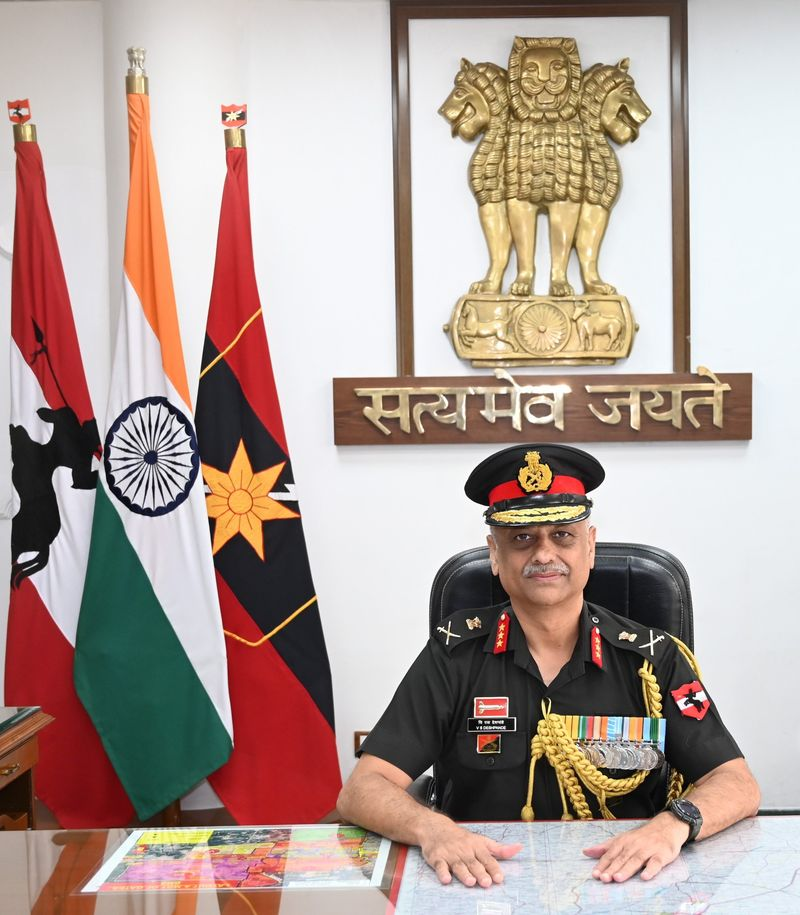
Lieutenant General Vikrant Suresh Deshpande has been appointed as the General Officer Commanding (GOC) of the Chetak Corps in Bathinda. He takes over the baton from Lt Gen Shamsher Singh Virk.
An infantry officer, Lt Gen Deshpande has extensive experience in counter-infiltration and counter-terrorist operations in Jammu and Kashmir and the north-east. He has also commanded an infantry division on the northern borders.
On assuming command of the Corps, tasked with the defence of southern Punjab and northern Rajasthan, he exhorted all ranks to continue their relentless efforts towards enhancing operational effectiveness and combat readiness.
Lt Gen Virk had led the Corps with distinction, reinforcing operational readiness, jointness and military-civil synergy since May 2025, the South Western Command said on September 1.
Lt Gen SS Kartikeya has taken command of the Brahmastra Corps from Lt Gen Yash Ahlawat. Based at Panagarh in West Bengal, the Corps is a strike formation specially raised for operations along the high-altitude border with China.
Lt Gen Kartikeya has earlier served as the GOC of the Red Shield Division based at Leimakhong in Manipur.
Lieutenant General IS Panjrath has assumed the appointment of Director General, Army Air Defence, at Army Headquarters, while Lt Gen Amit Rao has taken over as the Commandant of the Army Air Defence College in Gopalpur.
Lieutenant General Sandeep Narang has been appointed as the Commandant of the Military College of Materials Management in Jabalpur. He takes over from Lt Gen Sanjay Sethi, who has superannuated.
On the medical front, Surgical Vice Admiral Dilip Raghavan has been appointed as the Director General Hospital Services (Armed Forces) in the Directorate General of Armed Forces Medical Services. He is an alumnus of the Armed Forces Medical College (AFMC) and a renowned ENT and neuro-otologist.
Air Marshal Vivek Hande has taken over as the Director General Medical Services (Air). An alumnus of AFMC, he is a gastroenterologist and has commanded the Indian Naval Hospital Ship Asvini.