Sanjha Morcha

What’s New

Click the heading to open detailed news

Current Events :

web counter

Print Media Reproduced Defence Related News

Iran fires on targets across West Asia while Israel,US hit Tehran as war nears end of 5th week

Iran fired on targets Fri day across the Middle East, damaging a desali nation plant and setting a refinery ablaze in Kuwait, while American and Israeli airstrikes hit the Islamic Republic as the war neared the end of its fifth week. Tehran has kept the pres sure on Israel and its Gulf Arab neighbour, despite US and Israeli insistence that Iran’s military capabilities have been all but destroyed. In a sign that part of Iran’s theocracy could be willing to negotiate, the country’s former top dip lomat published a proposal for ending the conflict in an influential American magazine. Iran’s attacks on Gulf energy infrastructure and its tight grip on the Strait of Hormuz, through which a fifth of the world’s oil and natural gas transits in peacetime, have roiled stock markets, sent oil prices sky rocketing, and threatened to raise the cost of many basic goods, including food. Iran’s ability to wreak havoc in the global economy has proved a major strate gic advantage, and world leaders have struggled to figure out how to reopen the waterway. The UN Se curity Council was expected to look at a new proposal. Former Iranian Foreign Minister Mohammad Javad Zarif — a seasoned diplo mat with long experience negotiating with the West who remains close to a pragmatic wing of Iran’s leadership — wrote on Fri day that the time has come to end the suffering on both sides. PT


Three-language formula from Class 6;two levels of maths, science for Class 9

The Central Board of Sec ondary Education (CBSE) has rolled out its new curriculum, launching a phased implementation of the three-language formula from Class 6 and a two-level system of mathematics and science for Class 9 starting in the 2026-27 academic session, officials said on Friday. While the three-language formula mandated under the new National Educa tion Policy (NEP) will be implemented from 2026 for Class 6, introduction of the two-level system of mandatory standard and optional advanced courses in mathematics and science will be done for Class 9. “Languages are organ ised through a structured three-language framework across stages: R1, R2 and R3. As per recommen dations of new National Curriculum Framework (NCF), two of these three languages must be native to India. In continuation of the board’s phased implementation of mul tilingual education, a third language will be made mandatory from Class 6 with effect from the aca demic session 2026-27, ensuring that every learner studies at least two Indian languages,” a senior board official said.


IAF looks to build hydrogen airship to boost surveillance

Indian vendors have been asked to submit proposals by April 30

Taking a technological leap, the Indian Air Force (IAF) is exploring a hydrogen-powered, autonomous airship capable of long-endurance missions for persistent surveillance.

The IAF has invited bids from Indian companies to indigenously design, develop and manufacture a platform that can operate at altitudes of around 30,000 feet and carry payloads of up to 5,000 kg. Multiple bidders will be shortlisted, with one final partner selected for production.

While foreign collaboration is permitted, the project mandates a minimum of 50 per cent indigenous content. Indian vendors have been asked to submit proposals by April 30.

The platform, termed a “Medium Altitude Heavy Lift Airship”, will be unmanned. The IAF aims to partner with domestic defence industry players to execute the project.


The airship is expected to be hydrogen-powered and used for persistent intelligence, surveillance and reconnaissance (ISR) missions, while also providing communication capabilities similar to airborne radar and electronic warfare platforms.

It is required to carry specialised payloads and function as a launch platform for missiles and drones during flight.

The IAF has highlighted hydrogen as a preferred fuel due to its lighter-than-air properties, availability, non-toxic nature and clean emissions, producing only water vapour.

The service is also looking at hybrid propulsion systems —combining hydrogen fuel with solar power, batteries or fuel cells — to enable an endurance of at least 10 days. The platform should be capable of autonomous launch and recovery from both prepared and unprepared surfaces.

Additionally, the airship must support line-of-sight communication of at least 250 km or operate via satellite links.

The IAF has not specified the number of platforms it plans to procure. However, bidders are required to demonstrate strong financial and technical capabilities, along with manufacturing infrastructure, in-house design expertise and project management capacity.


Armed with BrahMos, 6,670-tonne stealth frigate Taragiri joins Navy fleet

It incorporates advanced stealth features to significantly reduce its radar signature, enhancing survivability and combat effectiveness in contested environments

INS Taragiri, the fourth ship in the seven-vessel Nilgiri-class of stealth frigates, was commissioned on Friday, showcasing the Navy’s adoption of advanced shipbuilding techniques such as integrated construction to accelerate delivery timelines.

Commissioned at Visakhapatnam in the presence of Defence Minister Rajnath Singh, the 6,670-tonne warship has been built by Mazagon Dock Shipbuilders Limited.

The frigate incorporates advanced stealth features to significantly reduce its radar signature, enhancing survivability and combat effectiveness in contested environments. It represents a generational leap in indigenous warship design.

Its weapon suite includes BrahMos supersonic surface-to-surface missiles (including land-attack capability), medium-range surface-to-air missiles, a 76 mm main gun, 30 mm and 12.7 mm close-in weapon systems, as well as anti-submarine and underwater warfare systems.

Around a decade ago, the Navy accelerated its warship production pace, aided by modern design software, modular construction techniques and a growing domestic industrial base. As a result, Indian shipyards are now approaching global benchmarks in build timelines.

A key enabler has been the Ministry of Defence’s adoption of integrated construction, where different sections of a ship —such as the hull, superstructure and internal systems — are built as separate blocks and later assembled seamlessly.

Over the past five to six years, shipyards have added new infrastructure, streamlined supply chains and increasingly used technologies such as artificial intelligence to optimise sequencing in construction, including material sourcing and production timelines.

The Nilgiri-class is the first major project to fully utilise this approach. These frigates are an advanced evolution of the earlier Shivalik class.

While Shivalik-class ships took nearly nine years from keel-laying to commissioning, the first three Nilgiri-class vessels were completed in under eight years. INS Taragiri has been delivered in under six and a half years, with timelines expected to reduce further as processes mature.

Naval designers at the Warship Design Bureau and shipbuilders have also optimised construction by installing a greater proportion of equipment before launch, reducing post-launch outfitting time. This includes key systems such as the superstructure, propulsion components, piping and cabling.

Each construction block, weighing around 250 tonnes, is precision-engineered to allow seamless integration, ensuring faster assembly and improved efficiency without compromising capability.


India inducts third indigenous nuclear sub, joins elite group

With the induction of INS Aridhaman, India now has the requisite number of submarines to maintain a “continuous at-sea deterrent” posture. This positions India as the only country apart from China, France, Russia, the UK and the US  to have this ability.

India on Friday commissioned its third indigenous nuclear-powered and ballistic missile-carrying submarine, INS Aridhaman.

In Naval parlance, such submarines are called ‘ship submersible ballistic nuclear’ (SSNB). India has already inducted two such submarines — INS Arihant and INS Arighaat — in 2016 and 2024, respectively. The series of these vessels is called the ‘Arihant class’.

INS Aridhaman and its sister submarines — INS Arihant and INS Arighaat — are nuclear-powered and can remain submerged under water for weeks at a stretch. India’s nuclear doctrine rules out a ‘first strike’; however, to carry out a retaliatory strike, an SSBN submerged under water is considered the best option.

Analysts say India now has the requisite number of submarines to maintain a “continuous at-sea deterrent” posture with at least one SSBN on armed patrol at all times. This will position India as the only country apart from China, France, Russia, the UK and the US — the five permanent members of the UN Security Council — to have this ability.

INS Aridhaman is expected to carry 750-km range K-15 and also a K-4 intermediate range (some 3,500 km) ballistic missiles, which can also carry a nuclear warhead.

The three submarines are part of India’s secretive advanced technology vessel (ATV) project and form a critical component of the nuclear triad – the ability to fire a nuclear weapon from air, land and sea.

INS Aridhaman — being longer in length than its sister vessels — has eight launch tubes instead of four, thus doubling the vertical launch system (VLS) capacity to fire missiles.

Earlier in the morning, Defence Minister Rajnath Singh, who was in Vishakhapatnam for the commissioning of warship Taragiri, posted a one liner in Hindi language on X which when translated in English means: “It’s not a word, It’s a power — Aridhaman”.

Sources said the nuclear submarine was commissioned after a public ceremony to commission INS Taragiri.

The submarine’s hull has been fabricated by L&T and built at Visakhapatnam. The Arihant-class submarines are powered by an indigenous 83 MW pressurised light-water reactor developed by the Bhabha Atomic Research Centre.

The sumbarine features improved sonar suites and indigenous communication systems, alongside more refined hydrodynamics to reduce its acoustic signature (noise level), making it harder to detect during deep-sea patrols.

Besides its indigenous SSBNs, India is looking to secure a nuclear-powered attack submarine from Russia. It does not carry nuclear missiles. Sources said it was expected to be arriving in India by 2027.


Trump says big destruction yet to start as Iran shoots down US jet

West Asia crisis: One of two pilots rescued | Opening Hormuz no big deal, claims Washington

article_Author
Ajay Banerjee Tribune News Service

A US fighter jet was shot down over Iran even as US President Donald Trump said the US “hasn’t even started destroying what’s left in Iran”. One of the two pilots of the downed jet had been rescued by the US forces, CBS News reported on Friday, citing two US officials.

Trump’s comments came hours after an under-construction civilian road bridge was damaged near Tehran, killing eight.

Iranian President Masoud Pezeshkian, responding to Trump’s threat to send Iran “back to the Stone Age,” called it an admission of intent to commit a “massive war crime”. “This was the question I asked my Finnish counterpart, who is a jurist,” he said, referring to Alexander Stubb. “History is full of those who paid a heavy price for their silence in the face of criminals,” he said. An Iranian capture of a US pilot could be a turning point in the war and bad optics for Trump. Iranian media said the downed jet was an F-35. Two US sources told Reuters the plane was a two-seat F-15E and a search was underway.

Iranian television announced that the country was offering a cash reward for anyone who could find the pilot. This is the second time Iran has hit a US jet. Three other jets of the US were downed, which Washington attributed to “friendly fire”.

On the re-opening of the Strait of Hormuz, Trump on Friday claimed that Washington could do it easily. In a post on Truth Social, Trump said with a “little more time, we can easily open Hormuz, take the oil and make a fortune”.

In Washington, the Trump administration has requested the Congress to increase defence spending by an astonishing $1.5 trillion. Trump and his Cabinet have long pushed allies to increase their defence budgets.

Iran’s deputy foreign minister Kazem Gharibabadi said Tehran was putting together a framework to administer and manage passage through the strait. However, countries that were hostile to Iran were not allowed to pass through. There had been consultations with Oman as the narrow water body sits between the two countries.

The southern side of the Strait of Hormuz is controlled by Oman, yet the Iranian side is deeper; that’s why most ships prefer to pass through the Iranian side. It isn’t feasible for large vessels to pass through the Omani side.

Major oil and gas exporters from the Gulf region rely on it to move supplies to international markets, while importing nations depend on its uninterrupted operation.

Israeli Prime Minister Benjamin Netanyahu has claimed that 70 per cent of Iran’s steel production capacity has been destroyed by the combined US-Israeli air strikes, which have repeatedly targeted critical Iranian infrastructure and the country’s industrial base.

Israel has threatened to destroy more of Lebanon’s bridges as Israeli invasion of southern Lebanon expands, spurring more fear, displacement and deadly attacks.

Kuwait says a water desalination plant and an oil refinery have been struck by Iran as Gulf nations continue to face attacks from Tehran. A gas plant in the UAE was also targeted on Friday morning. Iran has also fired missiles at Israel, where homes and cars have been damaged.

The UK is sending in an air defence system — Rapid Ranger — to Kuwait, a short-range system that is designed to counter drones.

Iran’s Press TV has posted a clip of army spokesperson Ebrahim Zolfaghari warning that if the US continues to threaten strikes on Iranian power plants, Tehran will target regional energy infrastructure and telecommunications companies with American shareholders.

The UN has warned that world food prices have climbed for a second consecutive month in March, reaching their highest level since December. The FAO Food Price Index, which tracks a basket of globally traded commodities, averaged 128.5 points last month, up 2.4 per cent from February.

Meanwhile, oil prices have surged following Trump’s renewed threats to destroy Iranian infrastructure. Brent crude, the international benchmark, rose about 8 per cent on Friday, topping $109 a barrel.

At least 2,076 people have been killed and 26,500 wounded by the US-Israeli attacks across Iran since February 28.


HEADLINES :03 APR 2026

Major Gen Harvijay : Senior Patron Sanjha Morcha gives Presentation MLF at Ferozepur. Regarding Turmoil in West Asia

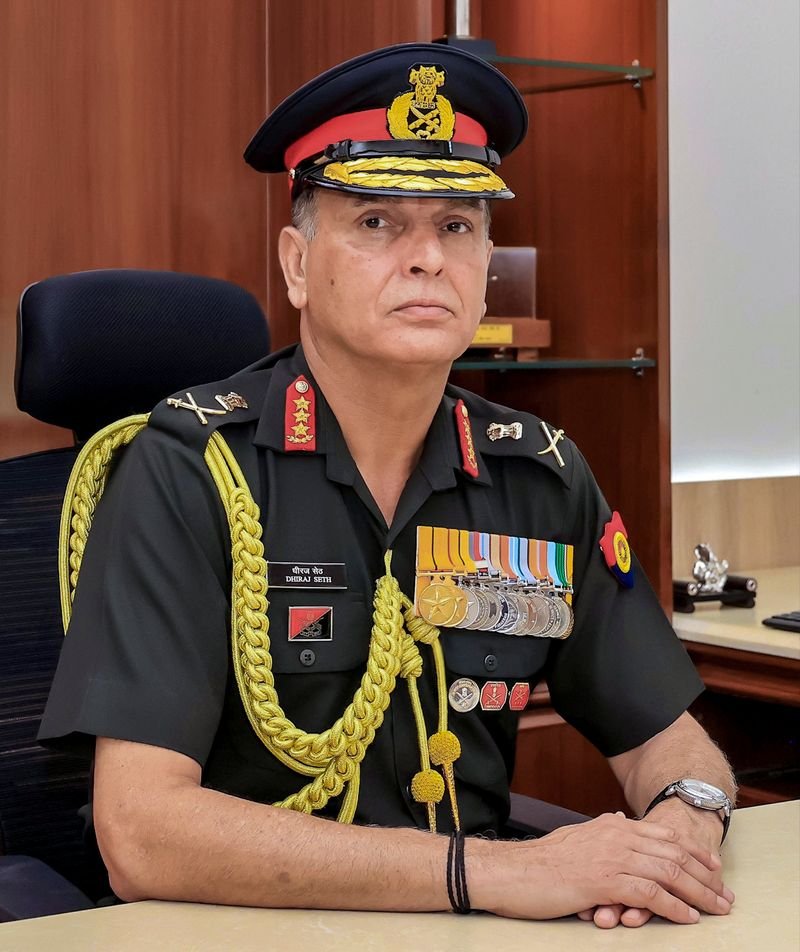
Lt Gen Pushpendra Singh takes over as Western Command GOC-in-C

Lt Gen Pushpendra Singh takes over as Western Command GOC-in-C

Iran-Israel War LIVE updates: Iran claims to be drafting proposal with Oman to ‘monitor’ Strait of Hormuz

Three US Apache Helicopters Arrive in India for Western Front Deployment

Now, get freehold rights of property within 35 days in Chandigarh

Future of US alliances hinges on Kharg Island

Trump wants to reshape Iran


Lt Gen Pushpendra Singh takes over as Western Command GOC-in-C

Lt Gen Pushpendra Singh assumes charge as the Western Command General Officer Commanding-in-Chief at Chandimandir on Wednesday.

On assuming command, he reaffirmed his commitment to sustaining high operational readiness

Lieutenant General Pushpendra Singh assumed charge as the Western Command General Officer Commanding-in-Chief at Chandimandir on Wednesday. He succeeds Lt Gen Manoj Kumar Katiyar, who superannuated a day earlier.

Prior to this, Lt Gen Singh, a Special Forces officer, was serving as the Vice-Chief of Army Staff at Army Headquarters. On assuming command, he reaffirmed his commitment to sustaining high operational readiness, fostering innovation and ensuring the welfare and morale of all ranks.

Commissioned into the 4th Battalion of the Parachute Regiment (Special Forces) in December 1987 Lt Gen Singh is an alumnus of the Indian Military Academy, Dehradun, and the Lucknow University.

With a career spanning nearly four decades, he has commanded formations in high-altitude and sensitive operational sectors along both the northern and the western borders.

His operational experience includes participation in Operation Pawan, as well as multiple tenures in counter-insurgency operations along the Line of Control (LoC) and the International Border.

In recognition of his distinguished service and gallantry, Lt Gen Singh has been awarded the Ati Vishisht Seva Medal and the Sena Medal twice.


India for action over attacks on UN troops in Lebanon

Nearly 600 Indian troops serving in interim force in Beirut

External Affairs Ministry spokesperson Randhir Jaiswal. File photo

India on Thursday strongly condemned the recent deadly attacks on United Nations peacekeepers in southern Lebanon, calling for strict accountability and reiterating that the safety and inviolability of UN missions must be upheld under international law.Responding to queries, Ministry of External Affairs spokesperson Randhir Jaiswal said India had already issued a statement denouncing the incidents involving the United Nations Interim Force in Lebanon (UNIFIL), where three peacekeepers were killed and injured in successive attacks.

“We have around 600 Indian troops serving in UNIFIL. Our peacekeeping operations go back several decades, and India remains one of the largest troop-contributing countries to UN missions. The contribution of our peacekeepers has been widely recognised in maintaining global peace and security,” Jaiswal said.

He added that India “strongly condemns the recent attacks” and paid homage to the “brave blue helmet soldiers” who lost their lives in the line of duty.

The remarks come in the backdrop of a sharp escalation along the Israel-Lebanon frontier, where the UN has confirmed multiple fatal incidents involving its personnel.

According to UNIFIL, two peacekeepers were killed and others injured on March 30 when an explosion of unknown origin destroyed their vehicle near Bani Hayyan in southern Lebanon. The incident followed another deadly blast a day earlier, marking the second fatal attack within 24 hours.

The UN has termed the attacks “unacceptable”, with spokesperson Stephane Dujarric stating that investigations were underway and stressing the need for full accountability.

Indonesia also condemned the incident, calling any harm to peacekeepers unacceptable, while reiterating its criticism of Israeli actions in southern Lebanon. The Israel Defence Forces said it was aware of the reports and that the incidents were under review to determine whether they resulted from the actions of Hezbollah or its own operations.

India, aligning its position with established UN norms, invoked United Nations Security Council Resolution 2589, which underscores the responsibility of states to ensure accountability for crimes against peacekeepers. “As one of the largest and longest-serving contributors to UN peacekeeping, we seek accountability for crimes against peacekeepers,” Jaiswal said.

At the UN Security Council, Under-Secretary-General Jean-Pierre Lacroix described the developments as “abhorrent”, noting that three peacekeepers had been killed within a span of 24 hours. Initial findings indicate that one of the incidents involved a roadside explosion targeting a UNIFIL convoy, while another was caused by a projectile strike on a UN base.