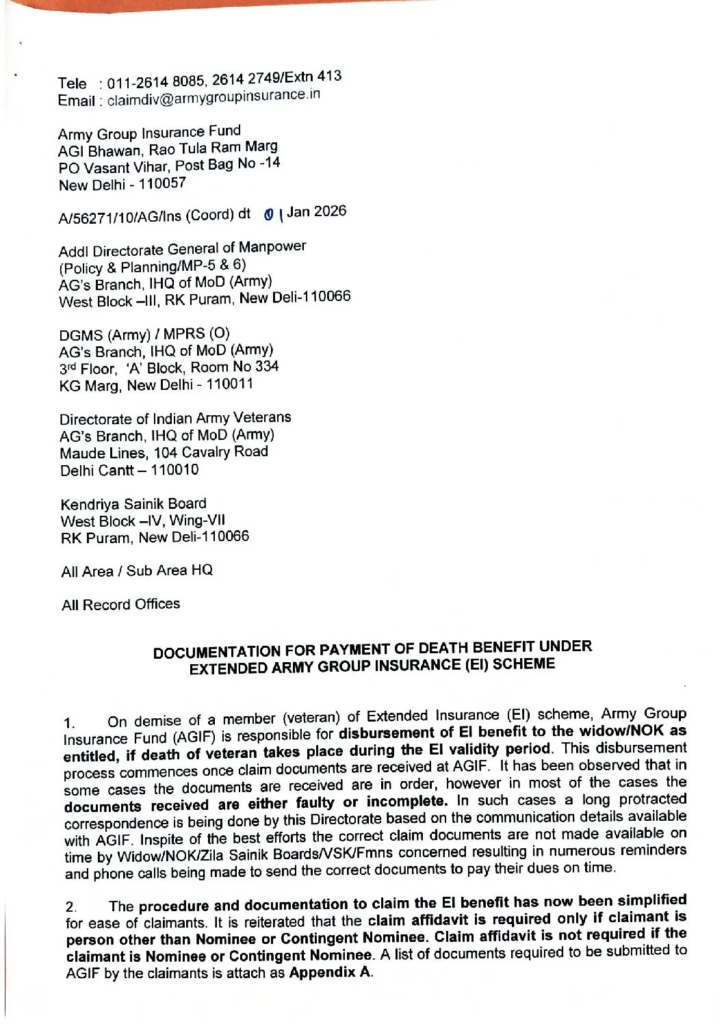
AGIF Extd Ins Docus: Pdf FILE
Handbook of benefits 10 Jan 25: PdF FILE


Current Events :







A Proud Moment in the Glorious history of the Bengal Sappers as the then President of India, Sh R Venkataraman, presented us the Regimental Colours, honouring their exceptional courage, engineering excellence and selfless service to the Nation. (First amongst the three groups)
Steadfast, skilled & always Ahead.
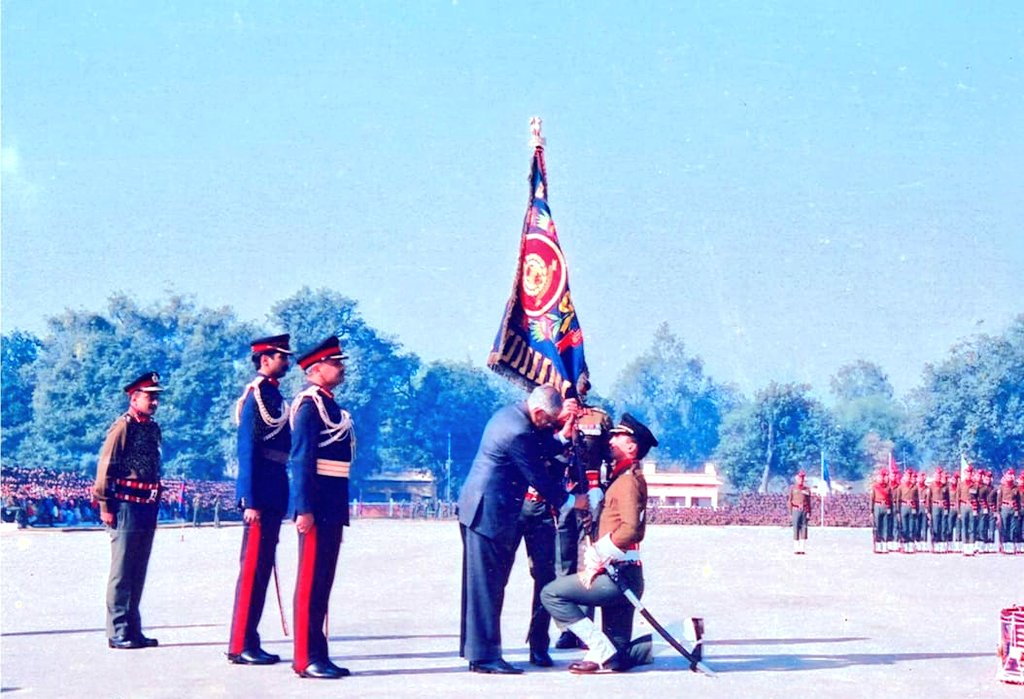
A Proud chapter in the glorious legacy of the Bengal Sapper

Former Chief of Naval Staff Admiral Arun Prakash (retired) received a rude shock on January 11, 2026, Sunday, when the Election Commission of India (ECI) sent him a notice to establish his identity as part of the ongoing Special Intensive Revision (SIR).
According to reports, Prakash, who has been living in Goa since he retired, has said that SIR forms must be revised if they do not contain the required information.
Prakash wrote in an X post, “May I point out to @ECIVEEP that (a) if the SIR forms are not evoking reqd info they should be revised; (b) the BLO visited us 3 times and could have asked for additional info; (c) we are an 82/78 yr old couple and have been asked to appear on 2 different dates 18 km away!!”
As the notice has sparked online debate, Prakash went on to write on X that, he “neither needs, nor have ever asked for any special privileges since retirement 20 yrs ago.” He added that he and his “had filled the SIR forms as reqd (sic.) and were pleased to see our names figures in the Goa Draft Electoral Roll 2026 on the EC website. We will, however, comply with EC notice.”
According to reports, the voter list updated in 2002 does not contain Prakash’s details meaning that he falls under the “unmapped” category of citizens. “This is what is happening in most such cases. Admiral Prakash falls in the unmapped category,” South Goa District Returning Officer Egna Cleetus told PTI on Sunday.
A collector for South Goa, Cleetus has said that she will go through the Navy veteran’s enumeration form. The authorities will reach out to him, she added.
Meanwhile, the ECI notice has generated some online debate about the procedure and information available. Both netizens and armed forces officials have pointed out that Prakash’s PPO/ Veteran card should be enough to identify him for the ECI purposes.
Lt Col T S Anand (retd) wrote on X, “I believe Bugs in software may have caused, but if such a notice does come every citizen who has things in order can just go and show it, nothing wrong. So in case of Adm Arun Prakash Sir his PPO/Veteran Card is proof enough and for protocol the SIR team can go to his home.”
he development follows a similar instance involving South Goa MP Viriato Fernandes, who is also a retired naval officer and Kargil war veteran. (Reuters)
Ever since the ECI commenced the Special Intensive Revision exercise, there have been multiple reports of citizens getting notices to prove their identity despite filling required forms. The electoral rolls revision has once again come under scrutiny after former Indian Navy chief Admiral Arun Prakash (retd) said he was asked to appear in person to prove his identity for remaining on Goa’s voter list.
In a post on X, Admiral Prakash said he and his wife had received notices asking them to attend a meeting as part of the voter roll verification exercise. The retired officer questioned the design and implementation of the SIR process.
“If the SIR forms are not eliciting the required information, they should be revised,” Prakash wrote on X. He pointed out that the Booth Level Officer (BLO) had visited their residence three times and could have sought any additional documents then.
He further said that he and his wife, aged 82 and 78, had been asked to appear on two separate dates at a location around 18 km away. According to a report by Times of India, Admiral Prakash has been directed to appear with his documents on January 17, while his wife, Kumkum, has been asked to attend separately on January 19.
Admiral Prakash also clarified that he was not seeking preferential treatment. Responding to a social media suggestion that the BLO could verify documents at his home, he said, “I neither need, nor have ever asked for any special privileges since retirement 20 years ago. My wife and I had filled the SIR forms as required and were pleased to see our names figured in the Goa Draft Electoral Roll 2026 on the EC website. We will, however, comply with EC notices.”
Admiral Prakash served in the Indian Navy for four decades, during which he commanded a carrier-borne fighter squadron, a naval air station and four warships, including the aircraft carrier INS Viraat, NDTV reported.
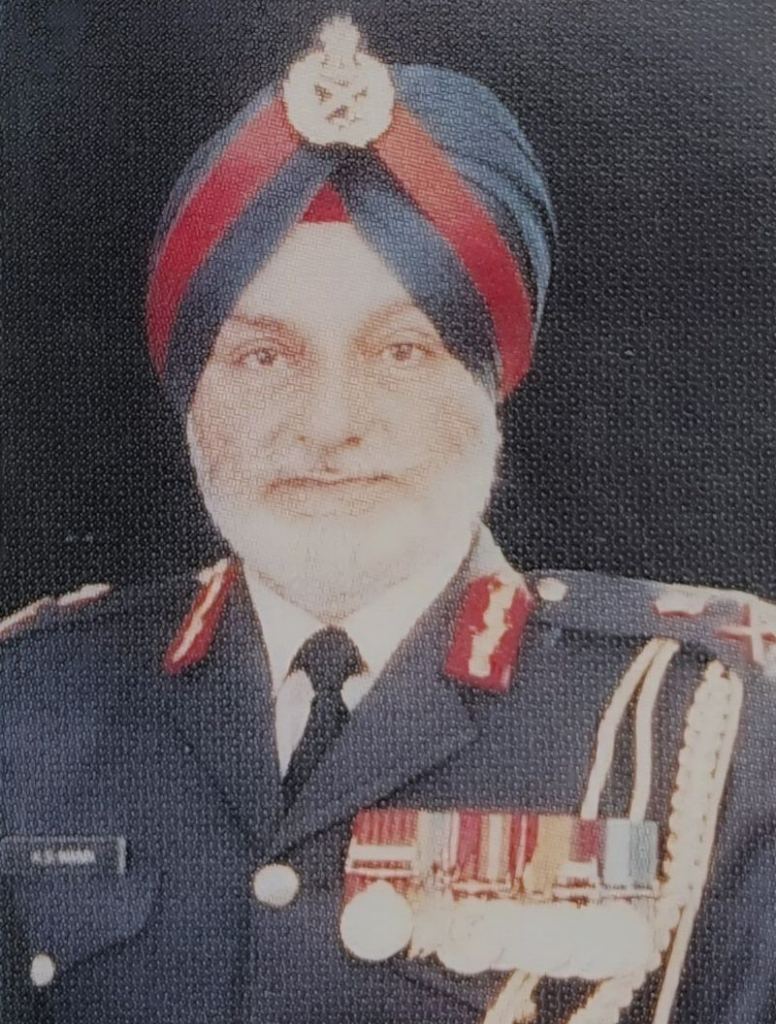
Officers of the Bihar Regiment, to which Lt Gen Kulwant Singh Mann (retd) belonged, remember him as a hardcore regimental officer who was a thorough gentleman. The 83-year old officer was killed in a hit-and-run accident near his home in Panchkula on Saturday.
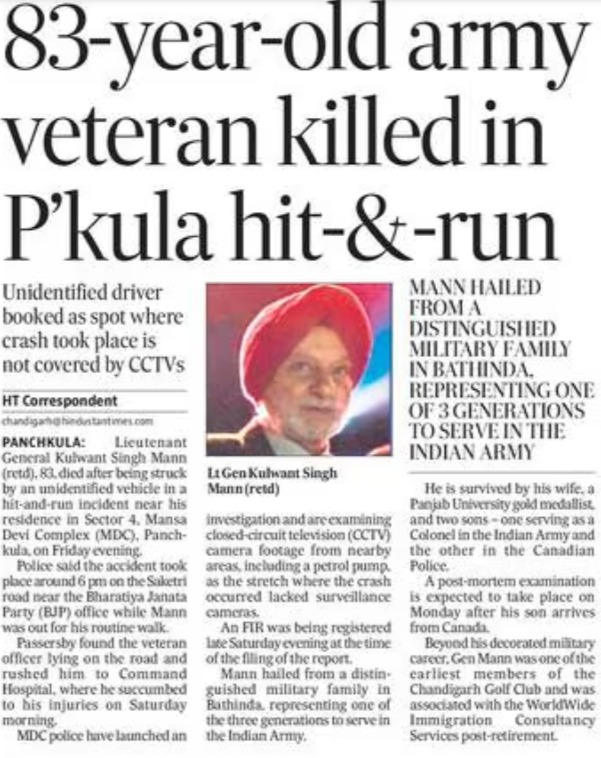
“He was a senior Major when I was commissioned as a Second Lieutenant in 1970. Though very firm in his approach, he was very helpful and guided young officers benevolently,” Col SS Sohi (retd), who has served with the General said. “He was a fatherly figure and a docile gentleman who spoke kindly with everyone,” he added.
A veteran of the 1971 India-Pakistan War, he was commissioned into the Third Battalion of the Bihar Regiment in 1960. He later raised and commanded the Regiment’s 12th Battalion.
During the war, he was posted with 10 Bihar in the eastern theatre, where the battalion took part in the Battle of Akhaura, a crucial engagement in which the Indian Army captured the strategically important Pakistani town near Agartala.
Subsequently, he commanded two brigades, one at Twang in the east and the other at Dehradun. As Major General, he commanded the 22 Infantry Division in Meerut. As a Lieutenant General, he headed the Infantry School, Mhow, and retired as the Director General Infantry. Besides undergoing a foreign course in Australia, he was also the Colonel of the Bihar Regiment for several years.
“Post retirement, he remained actively associated with regimental affairs and participated in social activities and events,” Brig DK Mohan (retd), general secretary of the Bihar Regimental Association said. “He was also an excellent hockey player and during his service days, was captain of the regimental hockey team.”
Officers recalled that over a year ago, he drove all the way from Chandigarh to Gwalior along with his wife to attend the Platinum Jubilee of 3 Bihar, which had moved to the peace location after a stint in Siachen.
“Lt Gen Mann hails from a military family from Bathinda. One of his sons served with the Corps of Engineers before opting for premature retirement,” Brig Mohan said. His other son is a police officer in Canada.
Brig Kiran Kiran (retd), president of the local chapter of the Indian Ex-servicemen’s Movement has condoled Lt Gen Mann’s demise. “We used to meet and interact at different forums and it was always nice to talk to him on different subjects. Our fraternity is also urging the Panchkula Police to expedite its investigation into the unfortunate accident,” he added.
The General was reportedly hit by an unknown vehicle while he was taking a walk in Panchkula’s Mansa Devi Complex. Passers-by rushed him to the Command Hospital, Chandimandir, where he was diagnosed with head injuries, to which he succumbed. Sources said that CCTV footage from a petrol pump near the site of the accident has indicated that he was hit by an auto-rickshaw.
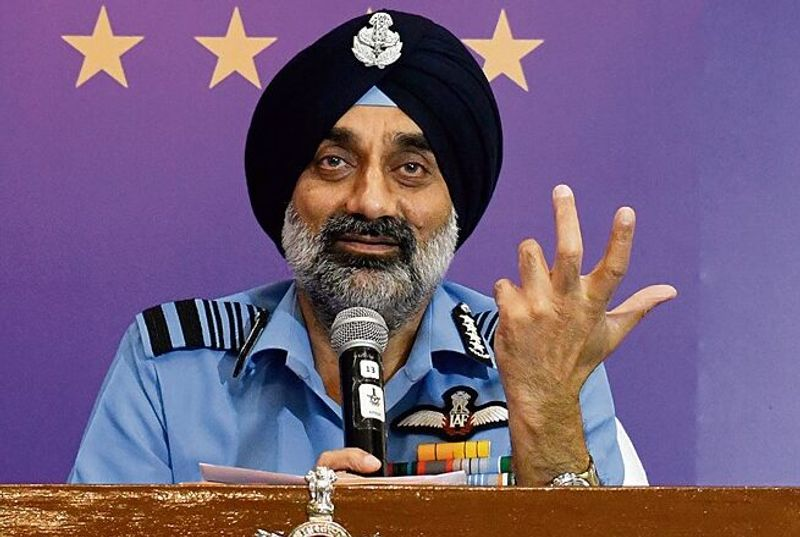
Chief of the Air Staff, Air Chief Marshal AP Singh, will deliver the keynote address for the first Air Commodore Mehar Singh MVC DSO Memorial Talk at the Air Force Station, Chandigarh, on January 9.
Former Chief of Air Staff, Air Chief Marshal S Krishnaswamy, Air Marshal Jagjeet Singh (Retd), Senior Vice President of the Air Force Association (AFA), Air Marshal Sukhchain Singh (Retd), President of the AFA (North Zone), senior serving and retired officers of the IAF will be attending the event.
Known as ‘Baba’ Mehar Singh, Air Cmde Mehar Singh is a legendary figure in the IAF and despite his tragically short career, he achieved extraordinary feats and displayed unwavering courage in the face of danger. He joined the erstwhile Royal Indian Air Force and was sent to Cranwell for training before being commissioned in August 1936. He quickly became an exceptional pilot, earning accolades for his skill and dedication early in his career operations in the North-West Frontier Province and during World War II. As commander of No. 6 Squadron in Burma, his leadership and daring exploits earned him the Distinguished Service Order (DSO) in 1944, a rare honour for an Indian officer.
Air Commodore Mehar Singh’s most notable achievements were during the 1947-48 Indo-Pakistani War, when as the Air Officer Commanding No. 1 Group, he played a crucial role in defending Jammu and Kashmir. He was the first pilot to land at the hastily constructed airstrip in Poonch in Nov 1947, establishing a vital air bridge that saved the town and refugees.
His most daring feat came in May 1948 when he landed a Dakota aircraft at Leh. Flying over treacherous Himalayan ranges without navigational aids, he successfully landed on a makeshift airstrip at an altitude of 11,540 feet, a feat then considered impossible. This daring mission ensured the reinforcement and supply of Leh, a strategic move that helped India retain control of the region.
Chandigarh, Updated At : 08:18 PM Jan 07, 2026 IST
Air Chief Marshal AP Singh. File
Chief of the Air Staff, Air Chief Marshal AP Singh, will deliver the keynote address for the first Air Commodore Mehar Singh MVC DSO Memorial Talk at the Air Force Station, Chandigarh, on January 9.
Former Chief of Air Staff, Air Chief Marshal S Krishnaswamy, Air Marshal Jagjeet Singh (Retd), Senior Vice President of the Air Force Association (AFA), Air Marshal Sukhchain Singh (Retd), President of the AFA (North Zone), senior serving and retired officers of the IAF will be attending the event.
Known as ‘Baba’ Mehar Singh, Air Cmde Mehar Singh is a legendary figure in the IAF and despite his tragically short career, he achieved extraordinary feats and displayed unwavering courage in the face of danger. He joined the erstwhile Royal Indian Air Force and was sent to Cranwell for training before being commissioned in August 1936. He quickly became an exceptional pilot, earning accolades for his skill and dedication early in his career operations in the North-West Frontier Province and during World War II. As commander of No. 6 Squadron in Burma, his leadership and daring exploits earned him the Distinguished Service Order (DSO) in 1944, a rare honour for an Indian officer.
Air Commodore Mehar Singh’s most notable achievements were during the 1947-48 Indo-Pakistani War, when as the Air Officer Commanding No. 1 Group, he played a crucial role in defending Jammu and Kashmir. He was the first pilot to land at the hastily constructed airstrip in Poonch in Nov 1947, establishing a vital air bridge that saved the town and refugees.
His most daring feat came in May 1948 when he landed a Dakota aircraft at Leh. Flying over treacherous Himalayan ranges without navigational aids, he successfully landed on a makeshift airstrip at an altitude of 11,540 feet, a feat then considered impossible. This daring mission ensured the reinforcement and supply of Leh, a strategic move that helped India retain control of the region.R
In 1950, Air Commodore Mehar Singh was awarded the Maha Vir Chakra (MVC), India’s second-highest military decoration, for his exceptional gallantry and leadership. His pioneering spirit, courage, and innovative approach to warfare have left an indelible mark on the Indian Air Force.
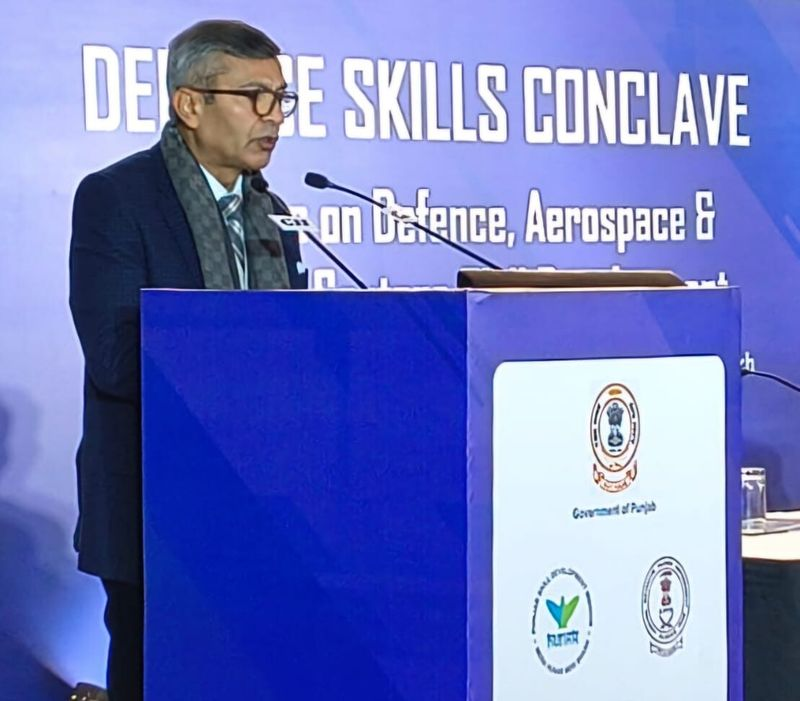
Punjab, with its strong military tradition can take the lead in tapping the skills of Agniveers after their release from the Armed Forces by offering them institutional pathways to transition into the defence manufacturing ecosystem as supervisors, equipment maintainers or entrepreneurs, Defence Secretary Rajesh Kumar Singh said here on Saturday.
“The Agniveer scheme provides an opportunity of harnessing a skilled manpower which is already disciplined and trained through a skilled certification framework to ensure that their certified training leads into civilian qualifications recognised under the National Skills Qualification Framework, which can seamlessly turn towards our defence industry,” he said while speaking at a Defence Skills Conclave organised by the Punjab Government.
Approved in 2022, the Agniveer scheme entails recruitment to the rank and file for a four-year period, including basic training, out of which 25 percent would be absorbed into the permanent cadre and the rest would be released from service. The batch of Agniveers are now in their final year of service.
The Defence Secretary also said that the central government is putting in place a process to make Agniveers “industry-ready” by imparting them requisite skills as part of their training and awarding them a diploma to help them get absorbed in the industry. This is in addition to reservations already made for them in the para-military forces and other government organisations.
Delving upon giving an impetus to the industry, he said that self-reliance is no longer a strategic aspiration but a national imperative. “At a time when geopolitics is increasingly trumping economic theories, the world is redefining global supply chains and technology dominance is shaping new security architectures. For India, this is a challenge as well as an extraordinary opportunity,” said
The ceremony also featured a display of in-house developed drones, showcasing the technological innovation and self-reliance achieved by troops of Western Command in line with the Indian Army’s modernisation efforts
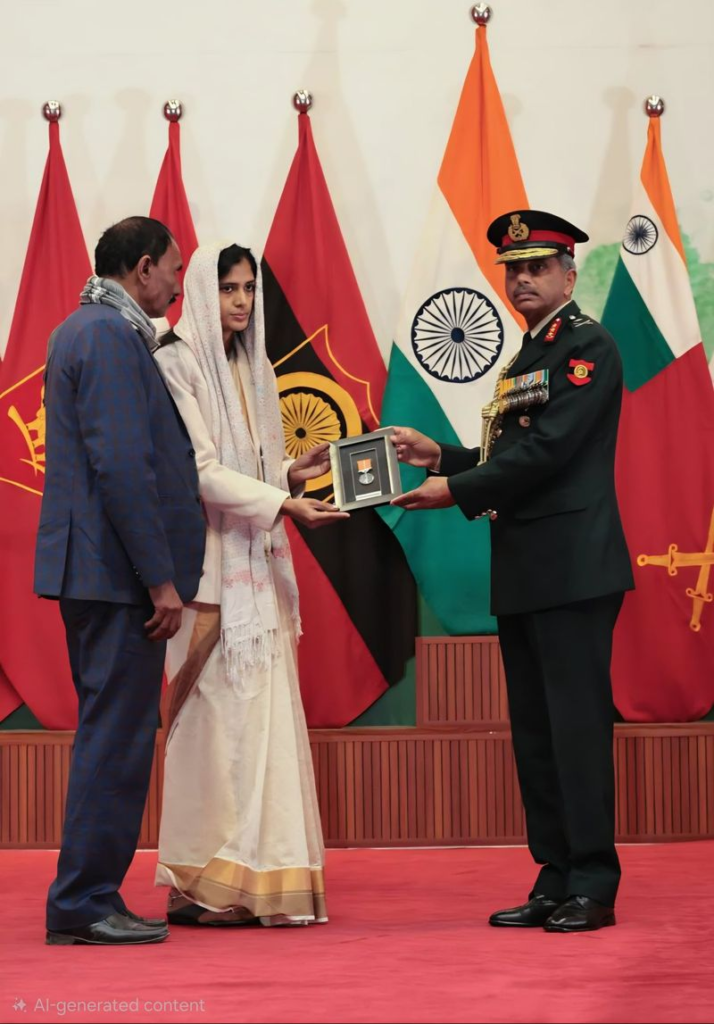
As many as 100 gallantry and distinguished service awards were presented to Army personnel at the Western Command investiture ceremony held at New Delhi on January 10.
These included six Yudh Seva Medals, 30 Sena Medals (Gallantry), including four posthumous, 17 Sena Medals (Distinguished Service), including one Bar to Sena Medal and 44 Vishisht Seva Medals, recognising acts of exceptional bravery, leadership and distinguished service to the nation.
Addressing the gathering, Lt Gen Manoj Kumar Katiyar, General Officer Commanding-in-Chief, Western Command, congratulated the award recipients and expressed his solemn homage to those who made the supreme sacrifice in the line of duty.
He also exhorted all ranks to continue striving for professional excellence, innovation and operational readiness, while remaining steadfast in their commitment to safeguarding India’s security and sovereignty.
Following the investiture, the Army Commander and Shuchi Katiyar, Regional President, Army Women’s Welfare Association (AWWA), interacted warmly with the awardees, war widows and family members, acknowledging their invaluable contribution and sacrifices in the service of the nation.
The ceremony also featured an impressive display of in-house developed drones, showcasing the technological innovation and self-reliance achieved by troops of Western Command in line with the Indian Army’s modernisation efforts.
Headquartered at Chandimandir near Chandigarh, Western Command is one of the largest operational commands of the Indian Army, entrusted with guarding India’s Western Frontiers. The Command has played a pivotal role in major India-Pakistan wars and conflicts, including Operation Sindoor, a strong attestation of the capabilities of the command.

Beginning April 1, the Income Tax Act, 2025, will come into force replacing the six-decade old tax law and the changes made in tax laws in 2026-27 Budget will be incorporated in the new legislation.
The 2025 I-T law is revenue neutral with no change in tax rates. It has only made direct tax laws simple to understand, removed ambiguities thus reducing scope for litigations. It reduces text volume and sections by about 50 per cent vis-a-vis the 1961 income tax act.
The new law simplifies the tax timeline by doing away with the distinction between the assessment year and the previous year, replacing it with a single ‘tax year’ framework. It also allows taxpayers to claim TDS refund even when ITRs are filed after deadlines, without any penal charges.
Any changes with regard to taxation of individuals, corporates, HUFs and others, which are announced in the Budget for 2026-27 on February 1 will be incorporated in the new I-T Act, 2025.
The rules to implement the new Income Tax law are being framed and likely to be notified after the presentation of the FY27 Budget.
The new Income Tax law was approved by Parliament on August 12, 2025 after a scrutiny by a Parliamentary committee. It had become an Act after receiving assent of President Droupadi Murmu on August 21, 2025.
The rules relating to the Income Tax Act, 2025, are being worked out, while the various tax return forms like those relating to payment of Advance Tax, TDS, will be notified thereafter.
Income tax law was enacted 64 years ago in 1961 and since then a lot of changes have taken place in the society, in the way people earn money and companies do business. The 1961 Act was framed at a time when Indian republic was young and faced challenges peculiar to those times. Over the time, as the country progressed, the Act was amended to keep pace with changing times.
In view of the technological advancement and changes in the socio-economic fabric of the country, there was a pressing need to completely overhaul the archaic Income Tax Act which has become bulky on account of hundreds of amendments in the law. It has become almost impossible for the common man to comprehend the law and multiple references to different sections, sub-sections, and provisos.
The new law is leaner and more reader-friendly. The intention of the government is to halve the volume compared to the old law and make the language simpler so that taxpayer can know his exact tax liability. It would also help in reducing litigations and thereby cut down on disputed tax demands.
The Income Tax Act, 1961 deals with imposition of direct taxes — personal I-T, corporate tax, securities transaction tax, besides gift and wealth tax. The Act has about 298 sections and 23 chapters. Over the time, the government has abolished various levies including wealth tax, gift tax, fringe benefit tax and banking cash transaction tax. Several sections have been amended, added, removed or have become obsolete over the last 6 decades. The new Act will be free of all the amendments and sections which are no longer relevant.
Any tweak in income tax rates is usually done through Finance Act which is part of the Union Budget presented in Parliament every year on February 1. All amendments announced in the upcoming Budget will be incorporated in the new Bill.
In 2010, ‘The Direct Taxes Code Bill, 2010’ was introduced in Parliament. It was referred to the Standing Committee for scrutiny. The Bill, however, lapsed because of the change in government in 2014. In November 2017, the government had set up a six-member committee to redraft the Income Tax Act. The panel had submitted its report to finance minister in August 2019.
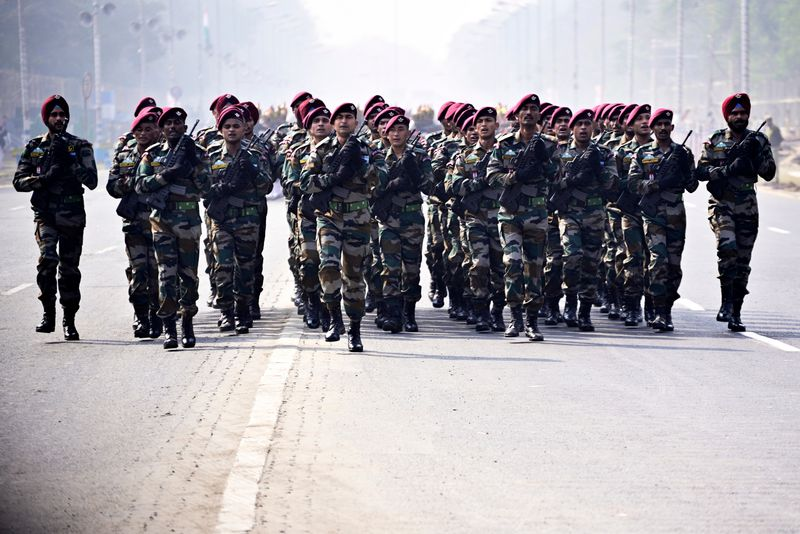
The Indian Ex-Services League (IESL), the apex body representing retired soldiers, has written to all Members of Parliament seeking intervention to resolve long-pending issues related to healthcare, pensions and the forthcoming pay commission.
In letters sent to MPs of both the Lok Sabha and the Rajya Sabha, the IESL highlighted pending bills under the Ex-Servicemen Contributory Health Scheme (ECHS), stating that there has been a steady deterioration in its implementation, primarily due to a shortage of funds.
“The biggest problem is the outstanding bills of empanelled hospitals and individual beneficiaries,” the IESL said, adding that while there is no funding issue for serving personnel, retired soldiers continue to face difficulties.
On the issue of the proposed 8th Central Pay Commission (CPC), the IESL said the panel would determine the future of over 25 lakh veterans. “We continue to suffer from anomalies carried forward from one pay commission to another. Even the one-man judicial committee report of Justice Narasimha Reddy, appointed in 2015 on one-rank-one-pension (OROP), has not been implemented,” it said.
The organisation also pointed out that even when courts grant relief in individual or collective cases involving veterans, the Ministry of Defence often files appeals.