Sanjha Morcha

What’s New

Click the heading to open detailed news

Current Events :

web counter

Print Media Reproduced Defence Related News

1965 war hero’s bust unveiled

CHANDIGARH: The bust of 1965 war hero Naik Darshan Singh was unveiled by Lt Gen KJ Singh, General Officer Commandingin-Chief (GOC-in-C), Western Command, in SAS Nagar on Monday.

GURMINDER SINGH/HTLt Gen KJ Singh, GOC-IN-C, Western Command, unveiling the statue of martyr NK Darshan Singh at the entrance gate of Darshan Vihar, Sector 68, in SAS Nagar on Monday.

Naik Darshan Singh of 5 Sikh Light Infantry had laid down his life in Mendhar sector of Jammu and Kashmir during the 1965 India-Pakistan War.

The citation recalled how Darshan had crawled forward while charging at the enemy, despite losing a leg in a mine blast.

While moving forward, the citation added, another mine explosion wounded Darshan severely, but the Naik dragged himself to an enemy bunker and threw a grenade into it.

Darshan also has a residential society in SAS Nagar named after him.

Addressing a gathering of serving personnel and veterans on Monday, Lt Gen KJ Singh paid glowing tributes to the martyr. The GOC-in-C also honoured Basant Singh, the martyr’s son. Lt Gen Singh also said the army was alive to the welfare of the martyrs kin and added efforts were underway to provide all services to the veterans under one roof at the Kendriya Sainik Sadan, SAS Nagar.


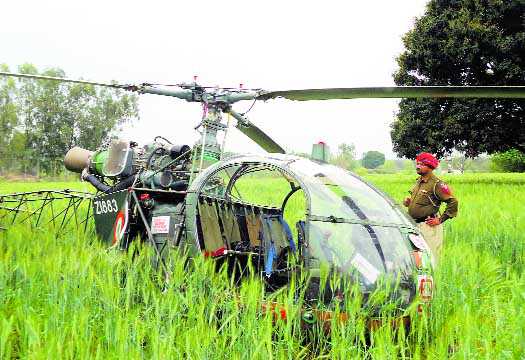
Army chopper crash-lands in Hoshiarpur fields

Army chopper crash-lands in Hoshiarpur fields
A policeman inspects an Army chopper that made an emergency landing at Maili village in Hoshiarpur on Friday. photo: malkiat Singh

Hoshiarpur, March 11

An Army chopper carrying four Army men was forced to make an emergency landing in a wheat field in Maili village near Mahilpur after it developed a technical snag, the police said on Friday.

“The helicopter made an emergency landing in the village at around 12:30 pm,” Hoshiapur Senior Superintendent of Police Dhanpreet Kaur said.

All four onboard are safe, although two suffered minor in injuries.

“There was no damage to the chopper,” the SSP said.

With four crew members on board, the chopper took off from Jalandhar cantonment on routine sortie today at about 11 am.

Major Guriqbal Singh and Lt Col B.S. Chohan received minor injuries in the incident, DSP (Chabbewal) Hardeep Kumar said, adding that they were given first aid.

Pilot Aditya Verma and Co-pilot Ajit remained unhurt, the police said, adding that they were taken to Jalandhar by Army personnel. — TNS/ PTI


SBI, other banks to go on strike on Feb 29

short by Anupama K / 07:29 pm on 27 Feb 2016,Saturday
With public sector banks threatening to go on a strike on February 29, the State Bank of India has said that some of its officers will participate in the same. Protesting against the termination of PV Mohanan, General Secretary of Dhanlaxmi Bank, the strike will be held on the day when Finance Minister Arun Jaitley will present the Union Budget.

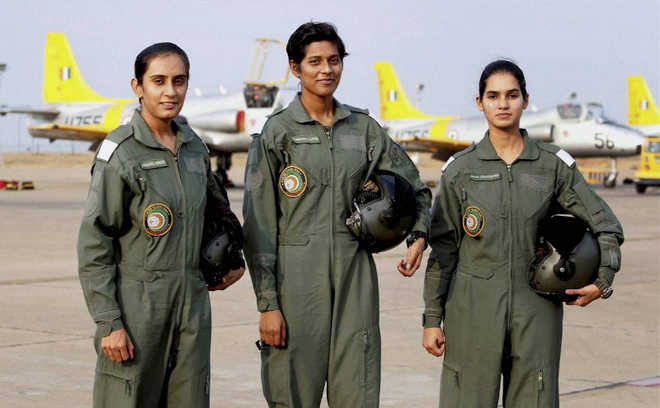
1st batch of women fighter pilots in June

New Delhi, March 8

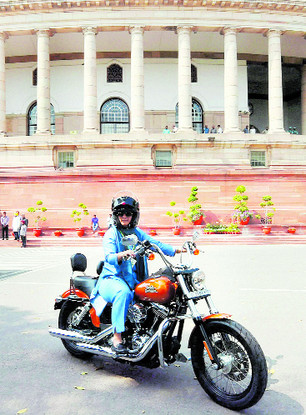
MP from Bihar Ranjeet Ranjan rode to Parliament on a Harley Davidson on women’s day. pti

The first batch of women fighter pilots, comprising three cadets, will be inducted into the Indian Air Force on June 18.Air Chief Marshal Arup Raha said three women trainee officers had volunteered to be inducted in the combat role. “We inducted women as pilots in 1991, but on only helicopter and transport (planes). I must thank the Defence Minister for having approved the IAF’s proposal to induct women as fighter pilots. Very soon…on June 18, the Air Force will get women fighter pilots.”As of now three women trainees have volunteered to join the fighter stream. They are under the second phase of their training. Once they complete their training…they are on par with their male colleagues and the passing out parade is scheduled on June 18,” Raha said.He was speaking at a seminar on ‘Women in Armed Medical Corps’ organised to mark International Women’s Day here, which was also attended by Defence Minister Manohar Parrikar. The Defence Ministry had cleared the proposal of inducting women as fighter pilots in October last year. Parrikar also lauded Raha’s insistence to push forward the proposal to induct women as fighter pilots in the Indian Air Force. —PTI


Modi salutes womenSaluting achievements of all women on Women’s Day… From Beti Bachao, Beti Padhao to better health & education facilities, our govt’s efforts towards women-led development are unwavering – Narendra Modi, prime ministerSonia for quota Bill}Maximum governance also means giving us our legitimate due — Women’s Reservation Bill… thanks to Rajiv Gandhi that we have mandatory reservation for women in panchayats and nagarpalikas – Sonia Gandhi, Cong President

clip


Pathankot martyr’s kin get 20 lakh

AMBALA: Haryana health minister Anil Vij on Friday handed cheques worth ` 20 lakh to the family of martyr Gursewak Singh at village Garnala. Garud commando Singh was killed in the terrorist attack at the Pathankot airbase early this month.

Cheque of ` 10 lakh has been handed over to his wife Jaspreet Kaur and ` 5 lakh each to his father Sucha Singh and mother Amrik Kaur.

Vij had announced ` 10 lakh compensation from his discretionary fund, while MPs Rattan Lal Kataria and Prem Singh Chandumajra had announced ` 5 lakh from MPLAD fund.

Vij told the family that the formalities regarding payment of pension as per rules would soon be completed and the process of giving job to a family member would also begin soon.


Army says veterans doing their bit to curb violence

Tribune News Service,Chandigarh, February 22

The “mediatory role” played by ex-servicemen between the agitating populace in Haryana and the armed forces deployed to curb violence played a large role in diffusing volatile situations, the Army has claimed.The substantial population of retired soldiers in the state proved to be an important factor which enabled the Army to stem violence and prevent the situation at many places from spiralling out of control, a spokesperson said.“Acting as a bridge between the Army and the agitating civilians, the veterans were able to convince the protesters to abide by the instructions given by the Army,” he said, adding that they were instrumental in dispersing a large crowd that had gathered at Karnal Chowk in Kaithal.Haryana has been a major contributor of manpower to the armed forces, who have played a very important role in all wars and other major operations undertaken by India, including counter-terrorist operations.The Army is also playing a major role in evacuating travellers from affected areas to safer places. A large number of senior citizens, women and children who required immediate help were moved to Ambala over the past two days in military vehicles. Army columns also arranged evacuation of patients from a private hospital in Kaithal.


This Is Why Indian Army’s Avalanche Rescue Teams Are Always Ready

avalanche_650x400_51454998919

GULMARG:  On the upper reaches of Gulmarg, an avalanche rescue team of the Indian Army conducts a mock drill. Carrying special equipment in backpacks that weigh more than 25 kilos, the soldiers patrol snow-bound peaks. An avalanche victim detector shows the possible location of men buried under several feet of snow and the team swings into action, clearing the snow with shovels and rods.

The first thing they find is a rifle. Then, a man buried under the snow is pulled out. They rush him to the medical camp where doctors work to revive his heart beat and give him first aid.

The rescuers have trained at the High Altitude Warfare School in Gulmarg. They have had rigorous training before being sent out in rescue missions. The time available to react in emergencies is very less and there is no scope for acclimatisation.

The men who carried the recent rescue operation at Siachen after a post was hit by an ice wall on February 3 were trained here. Avalanches and frostbites are among the main reasons for casualties at the 72 km long glacier that has killed nearly 850 soldiers since 1984. But, Siachen is not the only area prone to avalanches where soldiers are deployed.

“The people who are launched into rescue operation are the ones who are already acclimatised. There were men already at Siachen and they were launched immediately after it was learnt that the post has been swept away in an ice avalanche,” says Major General Navneet Kumar- Commandant at the High Altitude Warfare School.

“Those who get buried under (an) avalanche, the rescue equipment is used to find them,” says instructor Prakash Singh, pointing out to ropes, snow bars and avalanche victim detectors with the team.

But, innovation is key on such missions. When the teams are not carrying tents, they construct Igloos and snow caves. These snow shelters can accommodate up to 10 men. They can cook inside these snow caves and light them up.

“This is basically a part of survival training. We are training Indian army jawans here…If they don’t carry tents, they are well trained to make these shelters,” says the instructor.


The Art of Misusing the Indian Army

article-image4

There’s been a lot of talk about the army recently, particularly about how our soldiers must be respected because they’re guarding our borders and keeping us safe. I am in full agreement with this sentiment. Our ministers especially have stood up for the rights and honour of our soldiers. As they should.

Someone else who seems to have our ministers’ support is Sri Sri Ravi Shankar, whose Art of Living Foundation is all set to throw a gala celebration event to mark its 35th anniversary. An event that will be attended by 3.5 million people over three days, we are told, including the honourable prime minister of India.

Keep in mind that this is a private event. Not a state or national celebration.

The event, called The World Culture Festival, has already been panned for the large-scale ecological destruction being undertaken in the process of preparing the venue. It is going to be held over 405 hectares of the riverbank, much of which has already been cleared of vegetation and been levelled. The event is going against the National Green Tribunal order of January 2015 putting a stop to all construction activity on the Yamuna’s banks and saying that any such activity would be deemed criminal. But in the world of Sri Sri, these are small matters and obviously no one says no to him.

Also, 650 portable toilets will be set up. No one knows how this waste will be disposed. There will be diesel generators, cars and sound pollution. Manoj Mishra of the Live Yamuna campaign has been quoted as saying that more than 1,000 acres of land have been cleared for the ‘party’ – there really is no other word for it.

Till now, my only and major bone of contention with this event was the imminent environmental damage that will take place and whose effects are likely to last for years. But it seems that the foundation’s Art Of Misusing is not just limited to the environment.

It has now been reported that instead of protecting our borders and people, 120 soldiers have been made to spend over a week building two temporary bridges that will float on the Yamuna river.

I can only conclude that Sri Sri Ravi Shankar and the Ministry Of Defence (which must be in the know of what its soldiers are up to) saw these ads about joining the army.

Released by the Indian Army, starring actual army men, they’re ads that make army life sound wonderful, and the profession sound noble. As of course it is. The problem is that it seems that the government and Sri Sri Ravi Shankar took the ads at face value – especially the first one, which says, “it is India’s best construction company and biggest logistic operator”. Even if the Indian Army has soldiers trained to make bridges, they are not supposed to be daily labourers or labourers of any sort on hire. And they are definitely not supposed to be called in to do odd jobs for private events. Next thing we know, soldiers will be asked to be valets at the World Culture Festival. Because you know, the ad said they know how to drive cars.

Why is the army involved in labour activities such as building a bridge for this event? What justifies them being called in to do so?

The event, which will allow “spiritual and religious leaders, politicians, peacemakers and artists to spread the message of global peace and harmony in diversity”, seems to also spread the message of how to misuse the Indian army. According to an NDTV report, “army sources who asked not to be named confirmed to NDTV that 120 personnel were assigned to build the bridges, and that after expressing reservations about the task, senior officers made it clear that the organizers must accept liability for any accident that injures attendees”.

In fact, these soldiers (and by extension, the army) are being made complicit in the ecological nightmare that is this private event. The committee which has been set up to investigate the potential ecological damage that may be caused as a result, has said that the building of the two pontoons is in direct violation of their order. In fact, the “committee has noted that there is no way to find out whether the debris generated during the construction of the bridges has been dumped into the river”.

Is this what our soldiers are expected to do? One would think that the dismal conditions in which they have to protect our borders are bad enough. Now they have to lug construction material around to build bridges for a spiritual guru’s private celebrations? Forget any politician speaking up about the misuse of the army, the event is going to be inaugurated by Prime Minister Narendra Modi. One would think he would step in and put a stop to this utter misuse of our soldiers.

In India, for all our beating-our-chest adulation for our soldiers, we don’t think twice about asking them to carry out jobs that are not their responsibility. Whether it be pulling a child out of a borewell or being called in to maintain peace and order during riots, it’s all kosher.

Imagine you manage to qualify to enter a military academy, then you spend years training, finally you join the army. Then you’re told that your first call of duty is to build a bridge – not for an army sortie or in a disaster-struck part of the country, but for a yoga and meditation event. To be attended by the very Prime Minister who should be ensuring your job is respected. What could be more demoralising? We should just be pleased that they weren’t called in to make the stage for Baba Ramdev and Shilpa Shetty’s yoga celebration, or for Gautam Adani’s son’s wedding. Keeping with the spirit of the Art Of Living, don’t hold your breath though. It seems anything is possible.

What is worse is that other than for NDTV, nobody else seems to be bothered about this incident. No media has written about it since the news broke. Not one politician or minister tweeted about it or made a statement. These are the very same politicians and ministers who are leaving aside no opportunity to tell us how much we Indians should be indebted to the Indian Army. Could the silence be because if anyone has friends in high places, it is Sri Sri Ravi Shankar? Now that is the true Art of Living.



Oh Pakistan! Peshawar again: 20 killed on varsity campus

Charsadda (Pakistan), Jan 20

2016_1$largeimg21_Thursday_2016_010721717

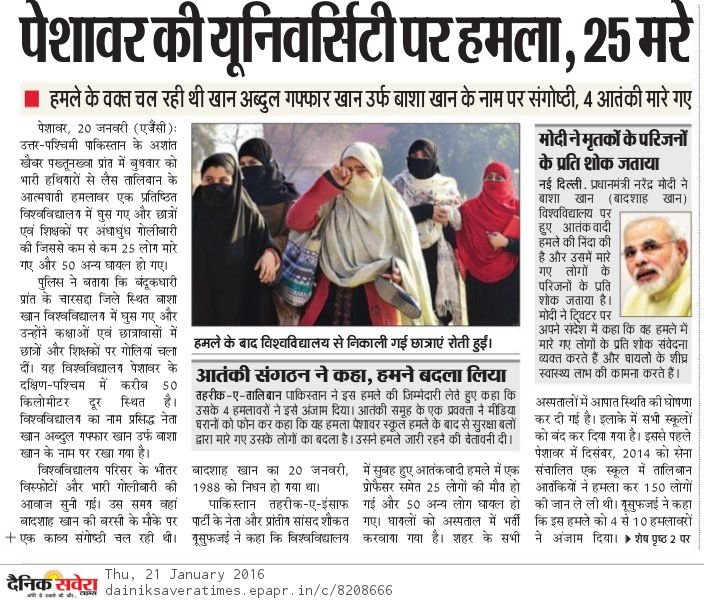
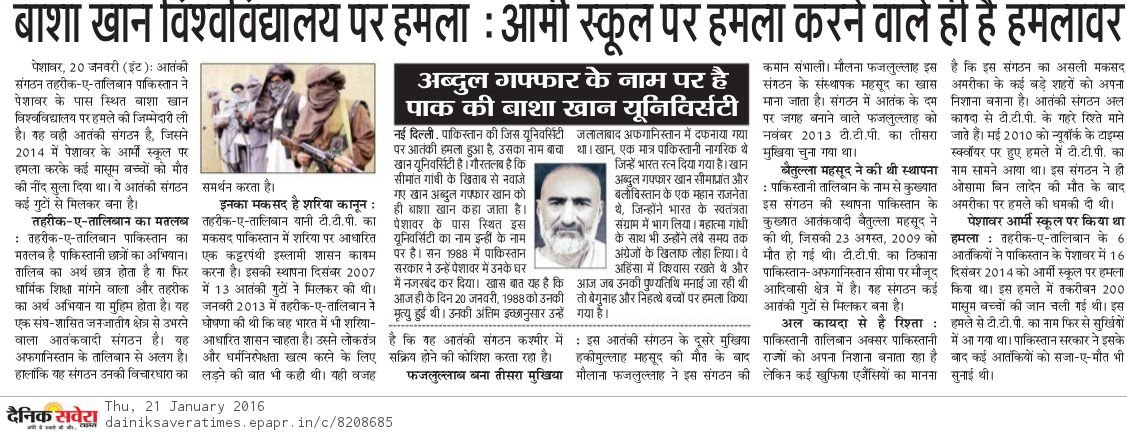
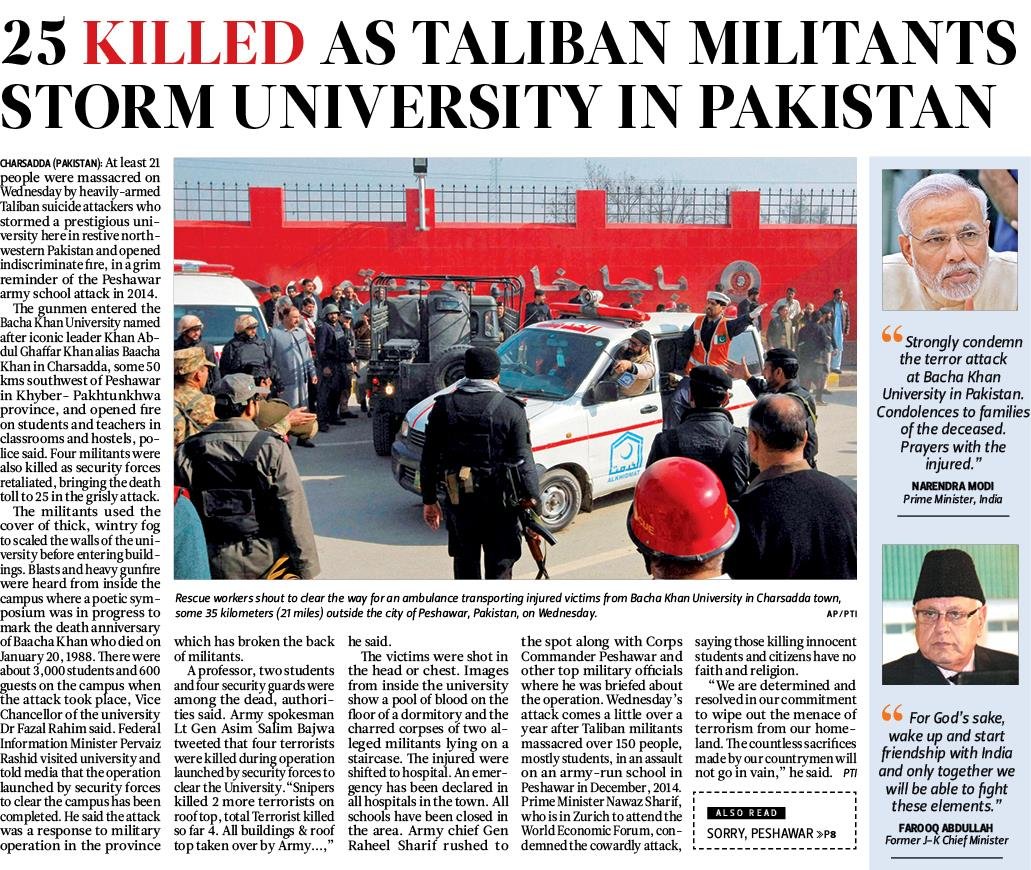
At least 20 people, mostly students, were massacred today by Kalashnikov-wielding Taliban suicide attackers who stormed a prestigious university here in restive northwestern Pakistan and opened fire, in a grim reminder of the 2014 Peshawar army school attack.The gunmen entered the Bacha Khan University named after iconic leader Khan Abdul Ghaffar Khan alias Bacha Khan in Charsadda, some 50 km southwest of Peshawar in Khyber-Pakhtunkhwa province, and opened fire on students and teachers in classrooms and hostels, police said.Earlier, reports said that 21 people and four terrorists were killed but later army spokesman Lt Gen Asim Bajwa held a press conference and stated that 20 people —18 students, a professor and a staffer — and four terrorists had been killed in the attack. The militants used the cover of thick, wintry fog to scale the walls of the university before entering buildings.Blasts and heavy gunfire were heard from inside the campus where a poetic symposium was in progress to mark the death anniversary of Bacha Khan who died on January 20, 1988. There were about 3,000 students and 600 guests on the campus when the attack took place, Vice-Chancellor of the university Dr Fazal Rahim said.Umar Mansoor, Peshawar school attack mastermind and a commander of the Hakimullah Mehsud faction of the Tehreek-e-Taliban Pakistani (TTP), claimed responsibility for today’s assault. He called local media from a mobile number in Afghanistan to claim that they have carried out the attack. A spokesman for the militant group said it was revenge for those killed by security forces since Peshawar school attack. The attacks would continue, he warned. But the spokesman for another Taliban faction, Mohammad Khurasani, condemned the attack and said they were not involved in it.The Inter-Services Public Relations chief said the four terrorists were using two mobile phones on which phone calls were received from different locations including Afghanistan.Federal Information Minister Pervaiz Rashid visited the university and told the media that the operation launched by security forces to clear the campus has been completed. He said the attack was in response to military operation in the province, “which had broken the backbone of militants”.The victims were shot in the head or chest. Images from inside the university showed a pool of blood on the floor of a dormitory and charred corpses of two alleged militants lying on a staircase.PM Nawaz Sharif, who is in Zurich to attend the World Economic Forum, condemned the attack. — Agencies‘Attackers were like us’The attackers were like us — they were very young. They carried AK-47 guns. They wore jackets like the forces do… We were in the hostel sleeping as we don’t have classes… After everything was over, the Army men knocked on our room and told us we were safe — A university studentStrongly condemn the terror attack at Bacha Khan University in Pakistan. Condolences to families of the deceased. Prayers with the injured — PM Narendra Modi on twitterWe are determined in our commitment to wipe out the menace of terrorism from our homeland. The countless sacrifices made by our countrymen will not go in vain — Nawaz Sharif, Pakistan PM

Terrorists kill 21 in Peshawar university

ISLAMABAD: Suspected Islamist gunmen stormed a teeming university campus in Pakistan’s volatile northwest on Wednesday, killing 21 people, including a chemistry professor who tried to protect his students by firing at the militants.

AFP PHOTORescue workers shift an injured victim into an army ambulance in Charsadda, Pakistan, on Wednesday.A security official said the toll could rise as the army cleared out student hostels and classrooms at Bacha Khan University in Charsadda, around 50km from Peshawar, in the Khyber-Pakhtunkhwa province.

Former cricket hero Imran Khan’s Pakistan Tehrik-e-Insaf Party, which rules the province, initially said about 25 people were killed and 50 wounded in the attack.

The death toll was later revised by police officials to 21. The brazen attack coincided with the death anniversary of renowned Pashtun leader Khan Abdul Ghaffar Khan or Bacha Khan, the apostle of peace after whom the varsity is named.

The assault was claimed by a Taliban faction led by Umar Mansoor, mastermind of the 2014 attack on an army-run school in Peshawar that killed nearly 150 people. “Our four suicide attackers carried out the attack on Bacha Khan University today,” said Mansoor.

But it was branded “un-Islamic” by the leadership of the Tehrik-e-Taliban Pakistan — a divergence that signalled continued infighting in the Taliban at a time when the Islamic State is trying to gain a foothold in the region by recruiting disaffected fighters. The TTP’s central leadership also denied any involvement in the attack.

Prime Minister Nawaz Sharif vowed to fight to the end and destroy “the menace of terrorism” while his Indian counterpart Narendra Modi condemned the attack.http://paper.hindustantimes.com/epaper/viewer.aspx

0f5049dc-c667-4ccd-961a-1ac63a42a70f 61993 59738 d843481d-3ff6-488d-9739-8f6b9aab9f42

88fb6500-d406-4e21-98ec-43499e0fe611 0fd04b4f-a113-406c-a793-4caeb0292412 62925


Encounters in J&K: Reiteration of the ‘Last Mile Philosophy’::Lt Gen Syed Ata Hasnain

Gen SA Hasnain 1

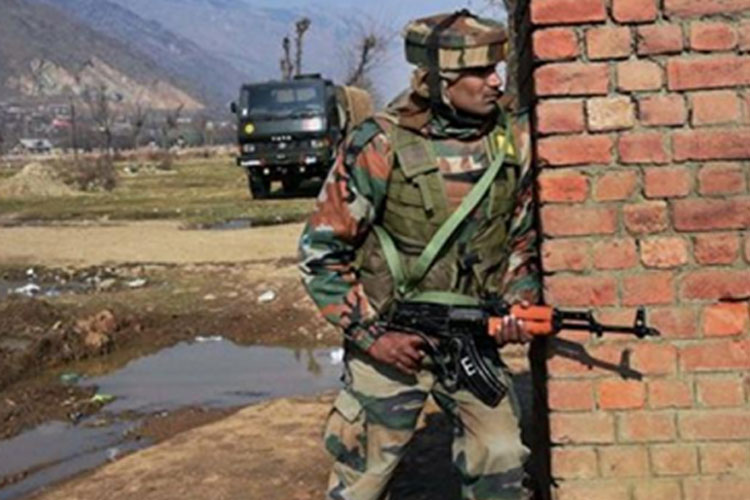
High intensity encounters between the Security Forces (SF) and the sponsored terrorists from Pakistan continue in the Valley with a degree of regularity, not as frequent as in the past but worrisome nevertheless. It is not the numbers but the quality of standoffs and the casualties that the Army is taking which cause dismay in public perception and rightly so. On one hand the public is fed with information about the improving situation and the strength of the counter terror and counter infiltration grids in J&K, by none other than analysts like me. Then there are frequent reports of glitches at the tactical and sub tactical levels leading to avoidable casualties. I have also gone to the extent of certifying the J&K counter terrorism model as the ideal one with each force and entity knowing where its space exists, its own limitations and strengths and the degree of cooperation it needs to overcome these. During the Pathankot incident I was strongly advocating that Punjab will have to sooner than later adopt this model. I am still convinced about that because the J&K model is inherently strong, based on years of experimentation and experience of some very competent practitioners. So, how do I view these repeated casualties in operations during contacts in the Valley? More importantly, how should the public be viewing this? If people with ground experience at tactical and operational levels cannot suitably convince public perception it is a failure of intellect and communication skills more than anything else; the public is not to be blamed. And, that unfortunately is the problem.

Almost a year to the date, Archana Masih of Rediff.com carried an interview with me in the online publication. In that I termed the situation in the Valley, ‘The Last Mile’. I then went on to explain what exactly this means.

‘The Last Mile’ is simply a situation which is a symbolization of the last stages of conflict stabilization in the military domain; quite different from the political, ideological and social domains. The strength of terrorists is at the lowest ever, the LoC is well dominated to prevent easy calibration by the other side. High profile leadership is missing due to inability to infiltrate without the terrorists facing heavy attrition in the march to the hinterland. Even if successfully infiltrated the ability to strike root is difficult due to all round domination by the SF and intelligence agencies. Terror groups avoid contact with SF and attempt only small scale actions and await their day for a larger deliberate operation, like the current one underway in Pampore. The Army, in particular, is used to high octane stuff; big ticket events, large scale contacts and regular contacts with intelligence inputs. It confirms the high energy levels and the desire to do more; no one in the Army has the patience to sit it out and that is how an Army always is. Everyone is out to kill the last terrorist so that the ugly face of terrorists is eliminated. However, the lesser the terrorist presence and more that the Army tries the results will never be commensurate with statistics of the past. Take it from me; there will be casualties on the Army side higher in ratio than at the time when there were a larger number of terrorists.

jkencounter

In the Last Mile the attention of the Army will also be diverted by other issues. Human rights take bulk of the attention as do political and legal correctness and a host of other issues. Among many of these issues is something that commanders, staff and junior ranks never faced before; that is the issue of crowds and flash mobs descending on contact sites and attempting to divert SF attention or assist the terrorists to somehow get away. Hence, the greater urgency to finish operations at the earliest. This has been a phenomenon prevalent in South Kashmir in particular over the last two years or a little more. It instigates the SF and leads to responses where civilians are injured or die and that leads to fresh cycle of violence. Shupiyan and Pulwama districts have been the centers of this. Flash mobs can be unnerving and it is to the credit of the CRPF that it has done its task of crowd control rather well. Given the number of times it does it and the nature of instigation there will be occasions when mistakes will be made leading to loss of lives. This can never be justified but nevertheless will remain a factor among the challenges of the Last Mile.

How does the Last Mile translate into nature of operations and how exactly should the recent encounter at Pampore be viewed? There are all kinds of commentaries in the air and most compare Pathankot with Pampore; ‘chalk and cheese’ was what I tweeted on these commentaries, implying there can be no comparisons. It is foolish to state that the Special Forces were inefficient in handling the encounter and that given a chance at Pathankot they would have bungled.

The Pampore encounter is one of its kind; in fact a very rare one. Having witnessed hundreds of these in the Valley, to me it would probably appear as one of the better planned actions by the terrorists. They first targeted the CRPF administrative convoy taking advantage of the weak road protection; inflicted casualties there. They then withdrew either by design or by default to one of the largest buildings in the Pampore built up area. Entrepreneurship Development Institute (EDI) is a five floor building with many people inhabiting it in the late afternoon. The CRPF and 50 RR did well to quickly cordon the building. The CRPF was keen to attempt intervention and this is understandable because it had lost men in the ambush. Its early action forced evacuation and gave little time to the terrorists to attempt any profiling to take hostages or risk eliminating a few of the civilian inmates in the building. In the Valley terrorists do not necessarily focus on taking hostages as it is counterproductive to their cause. Observers may argue that there have been cases of hostage taking in the past and they would be right. However, in almost all cases inmates of buildings, in which terrorists take refuge have invariably been evacuated, without too much trouble, notwithstanding allegations against the Army using human shields.


The EDI building is not an easy one to assault to carry out an intervention operation. The CRPF was brave in attempting it but after suffering casualties decided to hand over to the Army’s Victor Force which looks after South Kashmir. The Army has a couple of Special Forces teams dedicated to the two RR Force HQ. Given the circumstances, the nature of objective and the fact that it would be a matter of time before flash mobs moved in to upset the Army and CRPF’s equilibrium the Army decided to use the Special Forces teams to carry out intervention operations. I can say with complete assurance that if I was in the position of Major Gen Arvind Datta (GOC Victor Force) my decision would have been the same. I write with the experience of also having been the Colonel General Staff of Victor Force during the heyday of militancy. The Special Forces teams did a professional job of it. Two officer casualties that they suffered, along with a L/Nk, is drawing the ire of many and forcing comparison with Pathankot where the NSG also suffered a fatal officer casualty; to add to this is the death of some Commanding Officers in the last one year. All this has resulted in allegations of lack of professionalism. This is the Last Mile effect playing out on perception. I know it is a clichéd argument but it is worth repeating that the Indian Army’s officer cadre leads from the front, even beyond the professional needs. Not many may know that when Special Forces teams operate in such operations they are officer intensive. A squad may have buddy pairs of officers and JCOs or even two officers. A troop may have as many as five officers for a specific operation where the entire unit is not involved. This is the way Special Forces function in counter terror operations where small teams with high efficiency are formed for specific tasks.

Coming to the operation itself, there have been many allegations that intervention was unnecessary and that the building should have been brought down using explosives. In the mind’s eye of all those making these allegations, including veterans, there is this usual picture of a typical Kashmiri house made of brick and cement and perhaps even mud, along with an attached cowshed. This wasn’t the case here. To wire up and lay the explosives for bringing down the cement and concrete five floor building would have taken fairly long. In the bargain the flash mobs would have created a major problem. These are the issues impinging on minds of senior officers and their advisers and decisions have then to be taken. The factors are hardly evident to those who may never have had the chance of going through such loops of decision making under stress.



In the final word, let me state clearly that fatal casualties are most regrettable but they will take place in such operations where Indian Army officers will always lead from the front. That is their ethos; it is a part of their DNA. Citizens of India must empathize with the travails that their warriors undergo in keeping them safe and express concern about casualties just as they have done in this instance. However, they must also be aware that in the peculiar security situation of the Last Mile there will be occasions when the last post will have to be played quite often. Those who have the honor and privilege of donning the Indian Army’s uniform and embellishments are fully aware of it. It is a measure of their patriotism, their energy and their professionalism that they never flinch from their duties to the Nation.

As a last word I cannot let go a negative comment by a Joint Secretary about the current Army Chief having to repeatedly attend wreath laying ceremonies and funerals of warriors who are martyred in such operations. This gentleman has poked fun at a Chief who is in sync with his men and their sacrifices. He should be put through the exercise of one exposure for just a 48 hour high octane operation in the Valley. I guarantee you he will never return with the seat of his pants in the state it was when he went up there.

http://www.ibnlive.com/blogs/india/lt-gen-syed-ata-hasnain/encounters-in-jk-reiteration-of-the-last-mile-philosophy-14405-1207067.html