Sanjha Morcha

What’s New

Click the heading to open detailed news

Current Events :

web counter

Print Media Reproduced Defence Related News

117 kg nilgai meat, 40 guns seized during raid on ex-Army officer’s house

117 kg nilgai meat, 40 guns seized during raid on ex-Army officer's house
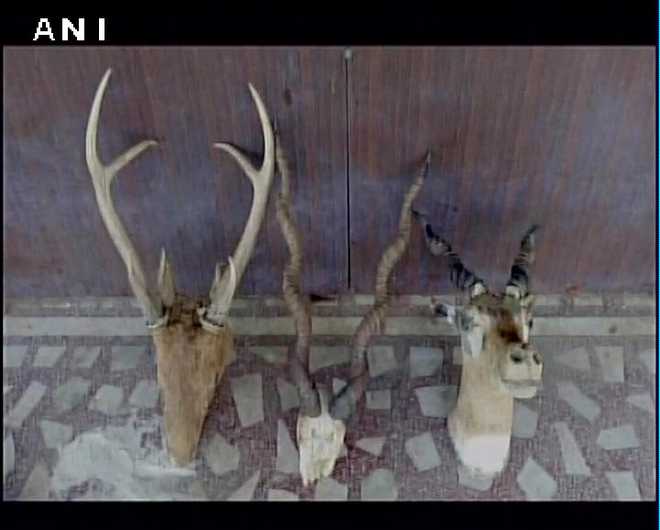
These deer heads were among the things seized from the retired Colonel’s house. ANI photo

Meerut, April 30

At least 117 kg nilgai meat, animal skin, ivory and 40 guns have been seized from the house of a retired Army officer here during a 17-hour-long joint raid conducted by the Directorate of Revenue Intelligence and the forest department.

(Follow The Tribune on Facebook; and Twitter @thetribunechd)

A team of DRI officials reached the Civil Lines residence of Colonel (retd) Devindra Kumar yesterday in the afternoon and the raid continued till 3:30 am.

Kumar’s son Prashant Bishnoi is a national-level shooter.

A DRI official said the raid was conducted in connection with a disproportionate assets case. Five skulls of deer, horns of sambar deer, antlers of antelopes and black bucks, animal skin and ivory were seized from a makeshift warehouse in Kumar’s residence.

Chief Conservator of Forests Mukesh Kumar said: “The meat of blue bull was seized from a refrigerator. A sample was taken and it will be sent to laboratory for testing”. Action will be taken against the retired army officer and Bishnoi under relevant provisions of the Wildlife Protection Act, 1972, though no case has been registered against them yet, he said. — PTI


Pakistan’s back in the Great Game

Washington’s disinterest and Beijing’s ascent are helping Islamabad gain ground in Afghanistan

The horrific suicide bomb attack in Kabul on May 31 that left 150 dead, and subsequent similar attacks at a funeral a few days later briefly brought Afghanistan back into the news. But only briefly since the British elections, the string of terrorists’ attacks in that country and general consternation with Trump’s antics and shenanigans meant that Afghanistan soon receded from public attention. This has meant that Pakistan’s game of gaining ‘strategic depth’ has gained substantial traction and the constitutional framework set in motion with the ouster of the Taliban in 2001 is in real danger of unravelling.

America’s failure to stabilise Afghanistan has led to a sense of fatigue about that country as reflected in the minuscule coverage of the terrible acts of terrorists’ violence that has grown unabated in recent years. America has also been distracted by its domestic political wrangling that marked the presidential election campaign, and has worsened with the coming into office of Donald Trump. This has allowed Pakistan to rearrange regional power equations quite dramatically, ably supported by China who brought in the Russians onto the same side. While the Islamic State Khorasan Province (ISKP) has made its appearance in the eastern Afghan province of Nangrahar, its influence and ability to launch terrorist strikes has been exaggerated to achieve this. American missteps and the Iranian tendency to adventurism has meant that over the past decade, Iran and the Taliban have become close tactical allies. The result is that despite stepped up terrorists attacks aimed at civilians, the Taliban is being presented by these countries as a moderate player that should have a key role in any peace process.

Russia has admitted to opening up lines of communications to the Taliban and even initiated a dialogue process along with China and Pakistan. The Afghan government strongly objected and had to be brought in along with regional stakeholders, India and Iran. Neither the US, the main military and economic player in Afghanistan, nor NATO were part of these talks. Russia took the stand that while violence was unacceptable, the Taliban were very much relevant players. Expectedly, the talks went nowhere; but helped build the case that it was the Taliban alone who held the veto over any attempted peace process.

The disputed elections of 2014 led to the US-backed uneasy coalition between President Ashraf Ghani and his challenger Dr. Abdullah Abdullah, who was given a new title, chief executive; but if anything, dissonance in governance has only enlarged. Initially Ghani made bold moves to placate Pakistan in the belief that it would lead to peace. What Afghanistan saw was increased violence, especially suicide attacks on civilians in crowded places leading to hundreds of causalities. The aim of damaging the credibility of the Afghan government by showing up its inability to protect its citizens was achieved very substantially. This has allowed Pakistan to emerge as the key interlocutor on behalf of the Taliban even as it continued to deny that it had anything to do with them. Exhaustion and distraction meant that the US and other western countries were happy to buy this fiction if it allowed them to quietly exit Afghanistan.

President Ghani’s failure to build a cohesive and inclusive government, or to establish working relations with parliament, whose term has incidentally expired, has meant that the Afghan government is internally hobbled and unable to deliver on good governance. The agreement that set up the National Unity Government with Abdullah in 2014 required that within two years the constitution would be amended to provide for a prime minister, has not happened. The largely non-Pashtun Jamiat from whose ranks Abdullah, foreign minister Rabbani and many more joined the government, has started speaking up as an opposition party. They led a big anti-government demonstration two days after the May 31 terrorist attacks leading to police firing with six dead including the son of the deputy speaker of the upper house of parliament. The next day, at his funeral, attended by Abdullah, Rabbani and others, three bombs went off killing nine persons. Jamiat leaders like Governor Atta of Balkh blamed persons within the government for the complicity in the May 31 bomb blast. And for the same reason, Rabbani boycotted his own government’s Kabul Peace Process presided over by President Ghani.

Trump’s effectively ceding leadership to China on many fronts has meant that Pakistan is emboldened enough to try and push the Afghan government hard enough for them to acknowledge that Pakistan would have de facto control over Afghan affairs, something it tried to do after 1989 Russian withdrawal. At present, the momentum seems to be favouring them as neither is the Afghan government united nor are the security forces in a condition to take the initiative back from the Taliban. If these trends are not reversed, Afghanistan could see increased violence that could potentially spill over its borders.


Report offensive WhatsApp, FB posts, Army tells its staff Alarm over messages airing discontent over pay panel hike

Report offensive WhatsApp, FB posts, Army tells its staff
Barring the forces, all central employees have got 7th pay panel hike

Ajay Banerjee

Tribune News Service

New Delhi, April 28

Faced with criticism on social media, the Army has asked its personnel to report back any “vitriolic, abrasive or negative” posts against the force or its individuals.The message has been posted on internal website ‘Army wide area network’ (AWAN). Additional Director General Public Interface, a senior officer under the Military Intelligence wing stationed at South Block, New Delhi, has been listed as the person to be contacted. A WhatsApp number has also been provided where the “offensive” messages can be reported. Posted earlier this week, the message also provides an email-id — of the official Army web-server — and two Delhi-based MTNL landline numbers.Sources said posts on WhatsApp groups in recent weeks airing “discontent” over the pending 7th Central Pay Commission proved to be the trigger. These messages reportedly questioned the government as well as top brass of the three forces for their “failure” to sort out the matter, pending since September last year.Barring the forces, all central government employees have received hiked salaries. The forces had raised six objections, including disability pension, risk area allowance, increased pay and accordance of status, but the matter could not be resolved despite several meetings with the Ministry of Defence (MoD).Last week, the MoD approached the Supreme Court to contest a lower court’s verdict okaying the grant of non-functional upgrade hike in salary without getting promoted. This has been given to all central staff minus the forces. The moment the appeal was filed in the SC, messages started doing the rounds on WhatsApp groups naming “three officers who were behind the appeal”. 


J&K FOCUS Evolving Situation in J&K: Summer 2017 (Part I) by Lt Gen Ata Husnain

Since the turn of the millennium, most military experts have advised the Indian government and the Indian Army to view J&K related issues with a longer and wider perspective. The longer perspective is needed because the year-on-year review and concept does not lead to the desired strategic effect; and the wider perspective is required because all departments of government need to play a joint role without abdicating responsibility only to the Army. The advice has been taken in parts but a comprehensive long term strategy has somehow been elusive.

The coming together of the BJP-PDP alliance created hope since it could see more equitable balance between the Jammu and Kashmir regions with Ladakh also having its aspirations in line. However, since 2015, those hopes have been belied due to circumstances that prevented any fructification of efforts of the new alliance. The success of a political initiative is contingent on the stability of the security environment. That has remained elusive chiefly due to the avowed intent of the adversaries to disallow cementing of the political alliance and initiative; that intent has been avidly executed through the use of street power, terrorist operations and focused propaganda to lead to alienation. Thus the Indian strategy for the current season can only take a short term view because stabilisation of the security situation before anything long term is the key.  That means a greater focus on security, greater role for the Army and lesser scope for political initiatives.

This is the reason why there are few initiatives from the government despite pleadings by different delegations that have made way to the Valley. The age old dictum probably applies – one cannot begin looking for peace from a position of weakness as much as one cannot keep reminiscing about initiatives that have become history. So is the Indian position really weak from a security point of view and are the peace delegations being realistic at all? These are worthy issues to analyse as we head into the campaigning season of 2017.

Most analysts like to quote statistics to analyse the security situation but it is more the nature of incidents and how they have been handled that dictates the course of the security environment. North Kashmir has been quiet in the hinterland and infiltration attempts are taking place in some non-traditional areas; entirely expected. The Army should by now have strengthened the counter-infiltration grid for the summer. A surge in terrorist strength is the last thing that the security set up can currently afford; it will have a cascading effect.

It is Central and South Kashmir where the local flavor of terror has increased in content, the security forces have suffered attrition, and the J&K police has been targeted with a view to reduce its effectiveness through demotivation and thereby dilute the intelligence grid. The targeting of Lt Umar Fayaz, a Kashmiri officer on leave was designed to send an ominous message to those seeking to be part of the Indian system. An effective response to this has been the success of 14 young Kashmiris in the Civil Services examination, hundreds of them lining up at other recruitment centres despite separatists’ call, and the runaway success of the Army’s Super 40 coaching initiative for the entrance examination to IIT/JEE (being increased to Super 50).

Yet no one can miss the sullen silence in Kashmir’s youth. None reveal their minds but the parallel track to the turnout at recruitment rallies and skill development initiatives is also a grim reality. Losing sight of this would not help and therefore the security domain has to research sufficiently to ascertain the real factors that drive alienation so vehemently. While many have taken to the streets to demonstrate this alienation, there are others who nurse a grudge and do not display it. The Army’s outreach has always been very cordial but the real challenge for it today is with regard to recapturing the old relationship while also being strong against those who treat law and order with disdain, support flash mobs at encounter sites or target detachments of security forces as it happened in the Major Nitin Leetul Gogoi affair.

Apt to mention here that a major lesson emerging for a military mind observing South Kashmir over a period of time is the fact that the Army withdrew prematurely after a tenuous stabilisation, without going the full way. It treated military resources in the south as a bank to draw from and hence the imbalance today. The space in the Kulgam-Shupiyan belt was lost due to declaration of premature victory. It needs immediate reoccupation. As and when Kulgam had a Rashtriya Rifles headquarters the area was always more secure. The maximum gravitation of the approximately 100 local youth who have taken to militancy is to this area.

With no remorse for targeting of locals who have joined the Indian system, there appears a change in the ethics in the militancy too. That is worrisome because Amarnath Yatra, the iconic pilgrimage, will commence within a few weeks. Its security will be of paramount importance. There are rogue elements across the borders that would not stop at anything to see the targeting of India and Indians.

This commentary is Part 1 of the two-part analysis on the evolving situation in Kashmir.


Heat wave in Kashmir The pitfalls of facile logic

The attack on the Kupwara army camp has heralded the start of the killing season in Kashmir. It is not as if the situation was under control when snow made movement difficult. Subsequently, the 7 per cent polling in Srinagar, the postponement of the Anantnag bypoll and the turbulence in the streets are clear signs that the situation has hit an air pocket. And from available signs the turbulence is going to be a prolonged one if the Central Government continues to give simplistic and superficial responses and reasons for the unrest roiling Kashmir since Burhan Wani was gunned down nine months ago.In November, the Prime Minister touted demonetisation as the panacea for all national security ills such as drug trafficking, counterfeit currency, Maoist violence and unrest in Kashmir. The first two manifested themselves within days and the Maoist violence never abated. Rather than demonetisation, it was the onset of winter that provided a temporarily lull in Kashmir. When stone-throwing resumed, the Prime Minister told Parliament that this was an aberration: the money for the provocation came from a bank robbery in Srinagar! The embarrassingly poor polling in Kashmir that left eight dead demonstrated the pitfalls of facile reasoning. It was the same with surgical strikes. While the partisans cheered from the sidelines, the country was told that Pakistan had been taught a salutary lesson for the cowardly attack on an army camp.Now that the political ground is slipping and PDP MLAs are showing signs of unease with the governing arrangement, Mehbooba Mufti has outlined a three-month plan to bring the situation within manageable limits. She is hoping that a relative lull will create the atmosphere for talks. But she may well be talking to a blank wall. The Centre believes that the PM’s Rs 80,000-crore package will bring around the emotionally lacerated populace. Instead of scoring points with their Hindutva supporters with simplistic jumlas, the PM needs to think of out-of-the-box responses. He can begin with encouraging civil society missions. Yashwant Sinha, who has travelled this road before and has volunteered for the job, may be a good start.


Scouts’ honour: The Ladakh Scouts, the army’s newest infantry regiment, will get the President’s colours this month*

Image result for Ladakh Scouts

Image result for Ladakh Scouts

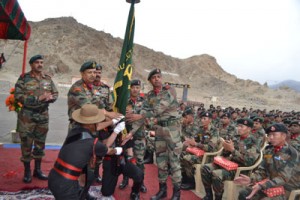
The Ladakh Scouts, victorious at Dog Hill, during the Kargil conflict in 1999

The dramatic air landing of two Indian infantry battalions in Srinagar in October 1947, which drove back Pakistani tribal raiders from the outskirts of the capital of Jammu & Kashmir, is the stuff legends are made of. As the Indian Army built up troops in Kashmir, the raiders were driven back and Baramula, Uri and Tithwal liberated. But a similar, less known, crisis occurred in May 1948, when the capture of Kargil by tribal lashkars left the routes to Leh open.
Defending Ladakh against the tribal hordes were just 33 men of the J&K State Forces. Reinforcing the tiny Leh garrison were 20 volunteers, led by Lt Col Prithi Singh – the legendary “X Force” that dragged itself heroically over the wind-swept Zoji La pass. But, with the snows melting and passes opening, hundreds of Pakistani tribal fighters converged on Leh, driven by the promise of monasteries groaning with wealth, salacious dreams of unprotected women, and the belief that Ladakh’s Buddhist men knew little of fighting.
“Cometh the hour, cometh the man”, it is said. On May 13, 1948, as Lt Col Prithi Singh raised the tricolour in Leh and called for volunteers to fight the tribals, the first hand to go up was that of Chewang Rinchen, a 17-year-old schoolboy from Nubra. For the next two months, until the first Indian Army troops were airlifted to Leh and built up into a viable force, Rinchen and a band of youngsters that he formed into the Nubra Guards, confronted and thwarted the battle-hardened tribals. For his heroic defence of Ladakh and the leadership he displayed, Rinchen was appointed a junior commissioned officer in the Indian Army and awarded the Mahavir Chakra, the army’s second-highest gallantry award.
Not content with being the youngest-ever winner of that award, Rinchen went on to win a Sena Medal in the 1962 war with China; and then a second Mahavir Chakra in 1971 for capturing over 800 square kilometres of territory from Pakistan, including the strategically vital village of Turtok. Eventually retiring as colonel, Rinchen is one of the army’s greatest legends.
      (Above: Sheikh Abdullah pins the MVC onto Rinchen)
Rinchen and the Nubra Guards are also the progenitors of today’s Ladakh Scouts – a regiment so distinguished in war and peace that President Pranab Mukherjee will travel to Leh this month to present it the coveted President’s Colours. These are normally presented to units that distinguish themselves consistently over decades.
The Ladakh Scouts, in contrast, became a regular army regiment only in June 2001, after their stunning performance in the Kargil conflict. No sooner than the Pakistani intrusions across the Line of Control were detected in May 1999, the Ladakh Scouts swung into action, reconnoitring routes, fixing ropes and enabling the initial successes of regular Indian battalions. The Ladakh Scouts were also instrumental in exposing the role of regular Pakistani soldiers in the intrusions, which Islamabad was flatly denying.
Embroiled in the fighting at Kargil, the Ladakh Scouts lost 31 men and were awarded 55 gallantry awards, more than any other army unit in per capita terms. Major Sonam Wangchuk, who led his Ladakh Scouts men to the capture of Chorbat La, was awarded a Mahavir Chakra. In recognition of their valour, the chief of army staff (COAS) awarded the Ladakh Scouts the COAS Banner – the only such award ever given. They were also conferred with a Battle Honour for Batalik and Theatre Honour for Kargil.
The army quickly saw the benefit of converting the Ladakh Scouts into a full-fledged infantry group, on the lines of the Gurkhas, Dogras, Sikhs, etcetera. Unlike other infantry groups, which alternated between peacetime and field deployments, the Ladakh Scouts would remain in high-altitude field postings in the vicinity of their homes – the Kargil and Leh districts of Ladakh.
For an army that has so many soldiers committed on its Himalayan frontier, mountain men like the Ladakh Scouts are a godsend. Genetically conditioned for high altitudes, with physiological advantages like larger lungs, Ladakhis seldom suffer from mountain sickness. Regular army units, manned by plainsmen or mountain folk from lower altitudes, require up to a week of acclimatization before they can survive at altitudes of 15,000 feet. Ladakhis, however, can be deployed above 15,000 feet without acclimatization.
Ladakh Scouts are also adept at operating “self sustained” for up to ten days in extreme altitudes – that is only on supplies in their backpacks.
A display of this unique ability came in February 2016, when an army post called Sonam, almost 20,000 feet high on the Siachen Glacier, was buried by a collapsed ice wall along with ten soldiers from the Madras regiment who manned it. With sensors indicating signs of life, survivors needed to be dug out quickly. Ordinary soldiers were breathless at those heights, so Ladakh Scouts were brought in, without acclimatization, from an altitude of 12,000 feet – something that would kill most soldiers. But the Ladakh Scouts, working non-stop at Sonam, extricated Lance Naik Hanumanthappa Koppad alive. He did not survive for long, but the Ladakh Scouts had again proved their unique worth.
Since Kargil, the Ladakh Scouts have been built up to five battalions, each one with some 850 soldiers. At any time, two battalions are operationally deployed in extreme high altitudes, including one in the Siachen Glacier. Two more are stationed in Ladakh, with just one battalion in a peace location in Chandimandir. Seeing the value of these soldiers, there are plans to raise another two battalions.
With only a limited populace to recruit from, soldiers may also be drawn from Lahaul and Spiti, in Himachal Pradesh, which are also reputed for tough mountain soldiers.
At a recruiting rally at the Ladakh Scouts Regimental Centre, however, it does not seem as if the regiment wants for recruits. Defying the cold that has us wrapped in parkas, a crowd of youngsters stand in their underwear, readying for a medical examination followed by a two-mile run. The candidates are well-built, but short, which is not a deterrent since the army has relaxed height requirements for Ladakhis.
Mohammed Abdullah, a recruit from Phyang, near Leh, tells us frankly that young men in Ladakh have only two career choices: joining the Ladakh Scouts or driving a taxi for tourists. Another recruit, Thinless Norbu, from Chuchot village tells us that soldiers are held in high esteem by local people, and most educated girls would choose to marry a Ladakh Scout.
Even so, the changing values of Ladakhi society are evident from the controversy over the memorial to Colonel Rinchen. After he died in 1997, the spot in Leh where he was cremated was transformed into a public park. On his death anniversary, the army, administration officials and prominent citizens would lay wreathes in his memory.
Now, however, the local administration is moving to transform most of Colonel Rinchen Park into a memorial for the local police. Rinchen’s family is protesting this initiative but, with powerful administration officials backing the police, one of India’s most captivating war heroes might soon find his memory slighted.
Says one of the local officials, responding to a query on how local police in an entirely peaceful and crime-free district can be compared with a national hero like Rinchen: “Why should there be any comparison? After all, whenever anyone salutes the police memorial, they will also be saluting Colonel Rinchen.”


Reduction of BOPs: Parliamentary panel takes serious note

Reduction of BOPs: Parliamentary panel takes serious note
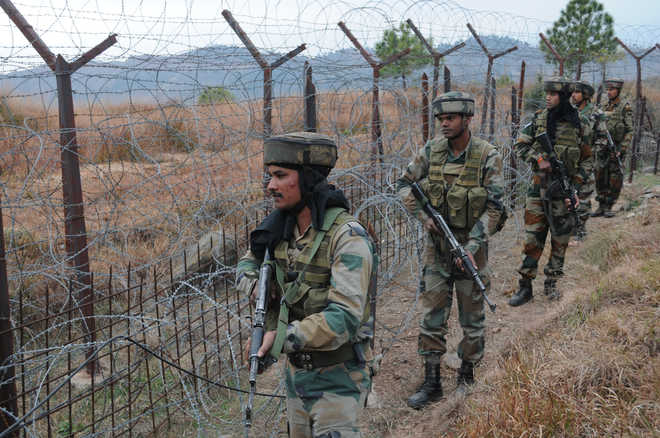
Army jawans patrol along LoC in Jammu and Kashmir. Tribune file photo

New Delhi, April 23

A parliamentary panel has taken strong exception to the government’s move to reduce the number of new outposts along the Indo-Pak and the Indo-Bangla borders, saying such posts are crucial for the country’s security.

The Parliamentary Standing Committee on Home Affairs, headed by senior Congress leader P Chidambaram, said no reasons were furnished by the home ministry on why the proposal to construct 509 additional border out posts (BOPs) in the two borders had been revised and reduced to 422.

The panel recommended that the original plan of constructing 509 BOPs should be reconsidered in the interest of the country’s security.

“Reducing inter-BOP distance is very crucial for the security of the country and to keep a tab on the activities going on at the border,” the panel said in its report.

In 2009, the government had approved a proposal to construct additional 509 BOPs along the Indo-Pak and the Indo-Bangla border at an estimated cost of Rs 1,832 crore. In 2016, the scope of the project was revised by the Cabinet Committee on Security from 509 BOPs to 422 BOPs.

At present, there are 609 BOPs along the 3,323 km-long Indo-Pak border and an additional 126 BOPs (including upgrading of 38 BOPs in Jammu) are to be constructed to reduce the inter-BOP distance to 3.5 km.

There are 802 BOPs along 4,096 km-long Indo-Bangla border where the additional 383 BOPs were to be constructed.

The parliamentary panel said even the reduced target was not achieved and only 97 BOPs have been completed by the end of 2016 along the Indo-Bangla border. It has also taken serious view of the cost and time overrun due to delay in land acquisition.

“The government should have taken advance action to overcome all such difficulties for timely implementation of the project,” it said.

There will be barracks, generator room, kitchen, toilet block and officers’ chamber in each of the BOP.

The committee said it was anguished over the extremely slow pace of construction of fencing along the Indo-Bangla border as the home ministry has been able to complete just 21 km of fencing in 17 months since July 2015.

“The committee notes that a long stretch of 423.34 km has remained unfenced due to non-feasibility of physical barrier and deployment of non-physical barriers is still in its testing phase and will require time before its implementation,” it said. — PTI


Emulate Gill, Capt tells young officers

Emulate Gill, Capt tells young officers
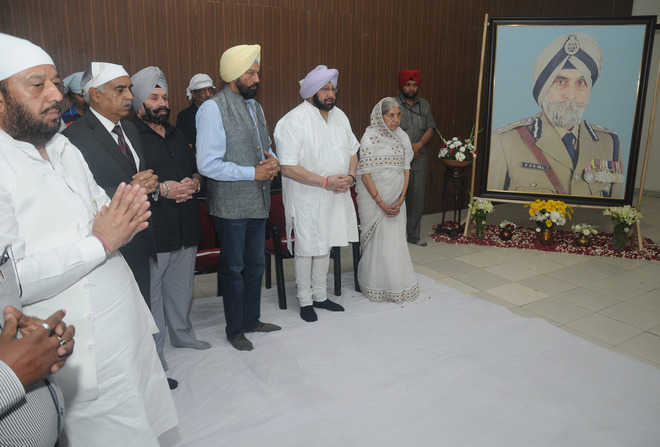
Punjab CM Capt Amarinder Singh and senior BJP leader Laxmi Kanta Chawla pay tribute to ex-DGP KPS Gill in New Delhi. Mukesh Aggarwal

New Delhi, June 3

Punjab Chief Minister Amarinder Singh today exhorted the people of Punjab to work for peace which, he said, would be a befitting tribute to former DGP KPS Gill. The latter, who is credited with crushing terrorism in Punjab, succumbed to a kidney ailment on May 26. He was 82.Speaking at Gill’s bhog ceremony at the Constitution Club here, Amarinder Singh said: “A true tribute to the great man would be to ensure peace in Punjab for which he had fought.” He said Gill had led from the front when the Punjab Police was a demoralised force. “Only those who lived through those dark days of terrorism can appreciate his role.” Recalling Gill’s “Operation Night Dominance” to restore the confidence of the people, he hoped that young police officers would draw inspiration from him and emulate him.(Follow The Tribune on Facebook; and Twitter @thetribunechd)Asked if he was breaking tradition by attending Gill’s bhog, the CM replied: “He (Gill) was my friend and a great man.” Punjab DGP Suresh Arora said Gill was a “messiah” for the police force. “He led us during the days of terrorism. For the Punjab Police, he never did retire. I continued to consult him even after he had retired.” Promising to protect peace and amity in Punjab, he added: “We will not let him (Gill) down.”Calling him “Punjab ka Jarnail (General)”, former BJP minister Laxmi Kanta Chawla said those who respected the country’s unity and integrity would appreciate Gill’s contribution.Former Haryana Chief Minister Bhupinder Singh Hooda arrived along with MLA Karan Singh Dalal. He described Gill as “a true nationalist.” Others at the bhog ceremony were president of the All-India Anti-Terrorist Front MS Bitta, Congress MPs Abhijit Mukherjee and KTS Tulsi, former captain of the Indian hockey team Ajitpal Singh, Punjab MLA Rana Gurmit Singh Sodhi and adviser to Punjab CM BIS Chahal, besides bureaucrats. No leader from AAP or the SAD attended the bhog. — TNS




2 soldiers killed in Anantnag ambush

2 soldiers killed in Anantnag ambush
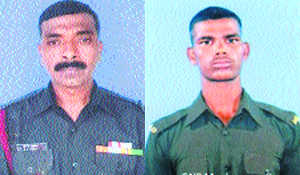
Naik Dipak Maity (L) and Grenadier Manivannan G

Anantnag, June 3

Two Army men were killed and four injured when their convoy came under heavy firing from militants in Hillar village of Anantnag district along the Srinagar-Jammu NH this morning. The attack comes a day after Army Chief General Bipin Rawat chaired a high-level security meeting at 15 Corps headquarters in Srinagar.“The militants fired indiscriminately, leaving at least six Army men injured,” Deputy Inspector General  (South Kashmir Range) SP Pani said. The injured were rushed to the Army’s base hospital in Badamibagh cantonment, Srinagar, where two of them — Naik Dipak  Maity, 43, from Midnapur, West Bengal, and Grenadier Manivannan G, 24, from Thiruvannamalai, Tamil Nadu — succumbed to their injuries.(Follow The Tribune on Facebook; and Twitter @thetribunechd)An Army spokesperson said the condition of the other four was stable. After the attack, Hillar and adjoining villages were cordoned off and searched. Locals claimed the fierce attack and subsequent deployment of security forces brought traffic on the national highway to a halt for a couple of hours. Disagreeing, DIG Pani said the traffic was normal after  20 minutes. The Hizbul-Mujahideen has claimed responsibility for the attack. In a joint operation, the Army and the police had killed Hizb commander Sabzar Ahmad Bhat in Tral area of Pulwama district last week. — TNS

CM pays tributes to two Army jawans killed at Qazigund

Srinagar, June 3

Chief Minister Mehbooba Mufti has paid tributes to the two Army jawans who were killed when a convoy in which they travelling was attacked at Lower Munda, Qazigund, today.The Chief Minister has extended her heartfelt condolences to the bereaved families of the slain soldiers. She has also conveyed her sympathies to the soldiers who were injured in the incident.Mehbooba said that it was unfortunate that an unending cycle of violence had got unleashed in the society which only spread miseries and desperation. — TNS


Of fauji vote bank and failed promises BY Col (retd) Dabby S De Mello

On September 15, 2013, in an election rally at Rewari the BJP had promised to implement the One Rank One Pension scheme. Almost three years later, the promise has still not been fulfilled. The issue is far from being resolved. The nurturing of the armed forces en bloc has created a new vote bank.

Of fauji vote bank and failed promises
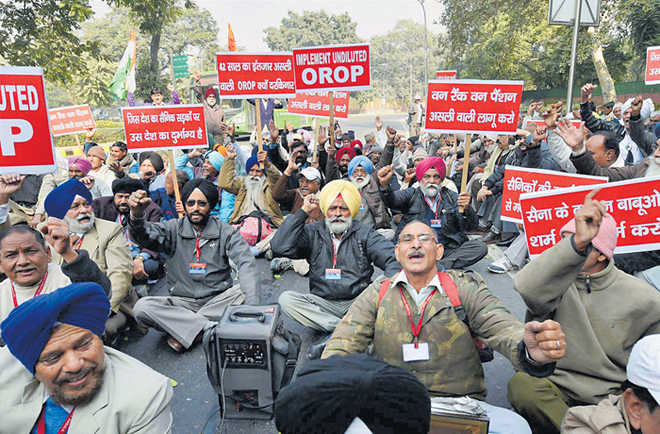
Veteran ex-servicemen protest against the non-implementation of the One Rank One Pension scheme outside Finance Minister Arun Jaitley’s residence in New Delhi. PTI

IN present-day India, come elections, the political parties throng to the various vote banks.  On September 15, 2013, one more vote bank was added to the existing list; the “Armed Forces Vote Bank”. Persons from the armed forces, especially  retired soldiers, are a fairly close-knit community.The mollycoddling of the military had thus far not been openly attempted by any political party even though politicisation had been going on for long. The collective mindset of the veterans it seems altered on  September 15, 2013. On this day they (rightly or wrongly) allowed themselves to be considered a vote bank, perhaps due to the feeling that they have been taken for granted. In the run-up to 2014 General Election, a poll strategist of the BJP apparently came up with a bright idea: “Why not tap the neutral armed forces, serving as well as retired, and use them as a vote bank”. The idea, appreciated by one and all as one whose time had come, was considered a master stroke. A survey was conducted to ascertain the numerical strength of this vote bank.  The strength of the three services —the Army, Navy and the Air Force regulars is already well known. The district and state sainik boards have the data regarding the ex-servicemen, military widows and the reservists. The combined strength of the three services as per the Indian Defence Year Book is around 14 lakh, ex-servicemen constitute nearly 26.5 lakh, military widows and war widows 6.5 lakh and 45.5 thousand, respectively, (a testimony to the huge, but unrecognised, national sacrifice of our soldiers and the most unjustly  neglected lot), the reservists are 1.7 lakh. The sum total is 49.1 lakh. Multiply it by a modest figure of  10 (family members and close friends) and the simple arithmetic  gives you a whopping and magic number  of 4.91 crore. A pan-India electorate which could influence 110 parliamentary seats, if evenly dispersed constituency wise. If the demographic spread is slightly uneven, the influence pattern may get marginally reduced but would still be formidable. Sometime during the middle of 2013, the BJP started a primary membership drive for ex-servicemen. The veterans were excited about being part of the electoral process, something denied to them since Independence. They even got a (misplaced) feeling of empowerment. Within a couple of months, the membership grew unexpectedly. Senior veterans organised motivational workshops at the block and district level and the middle-level ones motivated those  at the village and mohalla level. The agenda was to project the BJP as a jawan-friendly party, worth giving a chance to. The disciplined and obedient vote bank was shaping well. For the game plan to work, the BJP needed a believable electoral promise, a bait attractive enough for the faujis to bite, and an organisation with a strong leadership to spread the promise to the jawans throughout the country. The bait already existed for the ex-servicemen — the promise to implement One Rank One Pension (OROP) for defence pensioners. Prior to this, to press home the longstanding demand of OROP, in 2008 the entire ex-servicemen community came under one umbrella, with the formation of the United Front of Ex-Service Men (UFESM), headed by a retired General officer. Since then the UFESM made its presence felt all over India in support of the highly emotive issue of OROP. Poll strategists of the BJP were monitoring the influence and expanse of this front of disciplined and obedient ex-servicemen who would obey their seniors, including voting en masse for a particular political party in the polls. The aim as well as the mechanism to spread it among the 4.91 crore-strong armed forces vote bank were readily available. The only thing the BJP needed was a master stroke to showcase a supposedly charismatic figure and kick-start the campaign. It was a win-win strategy. The BJP had one  in Narendra Modi. Now that the statistics had been worked out, the BJP and the veterans devised a plan to collect the ex-servicemen and tell them that the BJP was truly a jawan-friendly party, committed to safeguarding their interests. Accordingly, Rewari a small town in southern Haryana was chosen as the venue for the All-India Ex- Servicemen Rally on September 15, 2013, to be addressed by Narendra Modi, the projected prime ministerial candidate. Captain Abhimanyu, a veteran and a BJP heavyweight in Haryana, was tasked to organise the rally. Handouts with tri-services colours and the lotus logo were distributed far and wide. Narendra Modi had quietly been declared the prime ministerial candidate on September 13, 2013 but it was on  September 15, when  he addressed his maiden election rally at Rewari that this was publicly announced. The rally was attended by 31 retired generals, many more brigadiers and colonels ( I was one of them ), majors and captains running into hundreds, and an estimated seven lakh JCOs and jawans — all flashing their shining miniature or full medals on their chests. A photographer’s delight indeed. Narendra Modi mounted the stage, bowed five times in front of the ex-servicemen and there was a thunderous roar by the upbeat veterans: “Dekho, dekho kaun aaya! Bharat Ma ka sher aaya”. Yes the lion, the would-be king had arrived. The lion mesmerised the audience with his one hour and five minutes’ flawless oratory. He  mentioned that some political parties were indulging in vote-bank politics with the military and they should not fall prey to them. What he said in the 47th minute of his speech was what the entire defence fraternity was waiting for. “Hamare fauji bhaiyon ki wazib maang sweekar honi chahiye”. He continued, “Your longstanding and just demand of One Rank One Pension has been pending since so many years. Why?”He further added, “Had our government come to power in 2004, fauji bhaiyo, maanniye Vajpeyi ji would have ensured that your wazib demand of One Rank One Pension was met and the honour and dignity of the serving and retired is restored”. It had an instant connect with the jubilant audience. Another roar by the now totally mesmerised, or should we say brainwashed innocent faujis, “Dekho dekho kaun bol raha. Bharat ma ka sher bol raha”. After the massive response by the ex-servicemen in Modi’s maiden election rally at Rewari, for the NDA (read the BJP) the wind of approval seemed favourable, the sea seemed calm and the Ark (vote bank of the ex-servicemen) seemed ready too. All it needed was a call from the General to all veterans to vote for the BJP to ensure the BJP’s Ark, sails through. At the appropriate time, the General gave a call to the entire fraternity of ex-servicemen throughout India: “Vote for the BJP. Modiji has promised to fulfil our demand of One Rank One Pension”. The entire defence fraternity of 4.91 crore responded to the General’s rallying cry and en masse as a vote bank cast their ballot for the BJP. As a result, over one-fifth of the NDA’s thumping majority in the 2014 General Election was courtesy the soldiers in and out of uniform. On September 15, 2013, a new vote bank, the “Armed Forces Vote Bank” was rightly or wrongly formed. The defence pensioners have been given just a one-time raise in their pension and the government has maliciously termed this raise as One Rank One Pension. The Prime Minister has the utmost affection for the jawans but his colleagues and his subordinates (bureaucrats) seem to have misinformed him, resulting in him repeatedly telling a lie to the nation about granting of the One Rank One pension to the faujis. The veterans feel let down at this sellout. Surely they are not foolish enough to continue to agitate  if the OROP had been granted. The number of veterans sitting at the Jantar Mantar for the past one year and nine months, without break, asking for their promised One Rank One Pension is increasing day by day. It is not merely the unkept promise  by the Prime Minister to the faujis. Modi, a world-class statesman and the head of the government is repeatedly misinforming the country at the cost of serving and retired soldiers just to convince the larger electorate — the civilians— about his good governance. In 2014, the General gave a call to the serving and the retired soldiers and all responded. They always do. Come 2019, and the General will again give a call but that time the narrative may not be the same as it was in 2014.

 Shri Narendra Modi speech at Ex-Servicemen Rally in Rewari, Haryana: 15.09.2013