Sanjha Morcha

What’s New

Click the heading to open detailed news

Current Events :

web counter

Print Media Reproduced Defence Related News

45 ANOs take part in one-day conclave

Tribune News Service

Amritsar, November 13

A one-day conclave of associate officers of National Cadet Corps (NCC) was held at Sri Guru Harkrishan International School here today.The conclave was organised by the 11th Punjab Battalion NCC.As many as 45 associate NCC officers (ANOs) from all three wings of defence –Army, Air force, Naval — took part in the conclave. The day-long event saw a number of activates to upgrade the skills of instructors, known as ANOs. These instructors are responsible for training young students who have opted for NCC in schools and colleges.NCC officials laid stress on improving the quality of imparting skills, ways to motivate students and enhancing knowledge. A tug of war contest was also organised on the occasion.Col Ashwani Kumar, Commanding Officer of the battalion, said, “It is a maiden effort to bring people together from the NCC to one platform. Our aim is to achieve great results.”


Battle of Chhamb:Was the ceasefire premature?

1971 INDO­PAK WAR India should have negotiated the return of its territory under Simla Agreement, says author of a new book

› I used my father’s diary and many other jottings on the battle to write a detailed, balanced and definitive account of this battle. AJS SANDHU , Major Gen (retd)

CHANDIGARH: Did former Prime Minister Indira Gandhi jump the gun by declaring unilateral ceasefire in the western sector in 1971? Shouldn’t she have allowed her troops to recapture the lost territory of Chhamb that continues to be with Pakistan even now? This is the question Maj Gen AJS Sandhu (retd) mulls as he sets about bringing to life the Battle of Chhamb in his book “Battleground Chhamb: The Indo-Pakistan War of 1971”.

KARUN SHARMA/HT■ Major General AJS Sandhu (retd) with his book ‘Battleground Chhamb’ in Chandigarh on Friday.Fought in western sector when the world attention was focused on the liberation of Bangladesh in the East, the battle is the story of raw courage and tactical hits and misses.

For Maj Gen Sandhu, it is both a son’s tribute and a wellresearched piece of military history. Sandhu was a young captain in the eastern sector during the 1971 Indo-Pak war when his father, then Maj Gen Jaswant Singh, was the general officer commanding of 10 Division in Kashmir, which fought the Battle of Chhamb.

Interestingly, Jaswant’s three brothers were also fighting the war, two in the eastern theatre and one in the west.

Sandhu says his father, who kept a diary during the war, wanted to pen a book on the battle but died following a cardiac arrest while he was serving as the vice-chief in 1980. “I used his diary and many other jottings on the battle to write a detailed, balanced and definitive account of this battle,” says Sandhu, who received a fellowship from the United Service Institution of India (USI) to research this book over two-and-half years.

OTHER SIDE OF THE HILL

Sandhu also approached Pakistani army officers who had fought this battle. A chapter titled “View from the Other Side of the Hill”, carries the uncensored first-hand accounts of the battle by four Pakistani officers. Interestingly, one of them is an officer who shot down the plane of Air Marshal Denzil Keelor. “Keelor was flying support missions in Chhamb when his plane was shot down by the Pakistani army,” says Sandhu. He managed to bail out and landed in the no-man’s land. Luckily, Indians managed to evacuate him.

Chhamb, says Sandhu, saw Pakistan’s biggest land offensive as Maj Gen Yahya Khan wanted to capture the only connecting bridge on the Chenab as that would make it possible for them to wrest Rajouri and Poonch. Sandhu says initially, the Indian Army planned to launch an offensive on Pakistan in the western sector but the plan was aborted at the last minute. “Indira Gandhi felt she could defend her attack on the East Pakistan to the world following 1 million Bangla refugees and her tours to the US and Canada seeking a solution to this problem. But she didn’t want to hazard an adverse world reaction to an attack on West Pakistan,” says Sandhu.

MASSIVE PAK OFFENSIVE

The 10 Division was in the process of reorienting itself when Pakistan caught it off guard with a massive offensive backed by heavy artillery support. Pakistani forces outnumbered the Indian troops defending Chhamb 4 to 1 in infantry, 10 to 1 in armour (tanks) and 2 to 1 in artillery.

The battle, which began on the evening of December 3 with air strikes by Pakistan, ended with Indira Gandhi announcing a unilateral ceasefire that took effect on December 17.

HEAVY CASUALTIES

The battle saw a heavy loss of life with Pakistan losing 45% of its strength in the West in it. Pakistan’s Maj Gen Ifthikar Khan Janjua became the highest ranked officer to have died in combat during this offensive. The Indians also captured Col Basharat Raja, the senior-most Pakistani commanding officer in the western theatre.

Sandhu says later Indira, when being introduced to Jaswant Singh as the general who fought a “tough battle in Chhamb”, intervened to describe it as “not tough, but the toughest battle” in the western sector.

The battle, Sandhu says, holds many lessons even for the present day warfare. But clearly, what rankles him the most is the loss of Chhamb. “We had 90,000 prisoners of war with us. Shouldn’t we have negotiated the return of our territory in the Simla Agreement?” he questioned.


Army corrects a self-goal Now fix other anomalies

Army corrects a self-goal

Ever since the Modi Government came to power with the substantial help of the ex-servicemen community, the question of pay, allowances and izzat for those serving in uniform and out of it has occupied centre stage. For a party that repeatedly invokes the fauji and has politically appropriated the surgical strikes for repeated unfurling in state elections (Himachal Pradesh is the latest example), the BJP has been stumped by its inability to match its election rhetoric with delivery on the ground.  Against the contextual background of the One Rank One Pension (OROP) conundrum and the inability of the government to resolve the rank parity issue, it is welcome that the Army has worked around a problem hanging fire for six years. For years the armed forces have lived with the notion that the civilian bureaucracy has nudged or massaged rules in its favour. Their hopes had arisen after the advent of the BJP government wrapped itself in olive green. If the restoring of gazetted officers status for JCOs is meant to divert the issue of rank parity with civilian bureaucrats, discontent will continue to remain high. Successive Defence Ministers have handed out assurances, just as it was with OROP. But a year after a committee set out to resolve the rank parity issue, a narrative has been rolled out to the effect that the Government will not permit any false rank parity. This was after heated exchanges in the correspondence exchanged between the Army and the civilian bureaucracy.In order to prevent the rank parity issue from becoming another issue of dissatisfaction like the OROP, the expectation among the armed forces is that the government needs to bite the bullet. If the downgrading of JCOs was an Army self-goal, the armed forces hold the civilians culpable for disturbing the equivalence and downgrading the status of service officers in the armed force headquarters. The anomaly was a hand-me-down from the UPA government that had been unable to resolve the issue for six years. This is a pointer to the tortuous nature of the task at hand.


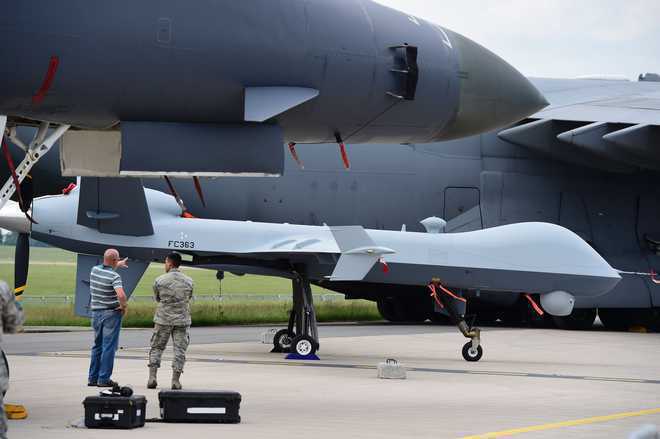
‘US considering Indian request of armed drones for air force’

‘US considering Indian request of armed drones for air force’
Fiile photo of a Guardian drone. AFP

Washington, October 22

The Trump Administration is “considering” India’s request for armed drones for its air force, weeks after approving the sale of high-tech unarmed Guardian drones to India.“Yes, yes,” a senior administration official told PTI when asked about India’s pending request about the purchase of armed drones as part of its armed forces’ modernisation drive.

(Follow The Tribune on Facebook; and Twitter @thetribunechd)

The armed drones, the Indian Air Force (IAF) believes, would help it strengthen its defence capabilities.Early this year, the IAF had requested the US Government for General Atomics Predator C Avenger aircraft. It is understood that the IAF would need 80 to 100 units making it approximately a whopping USD 8 billion deal.The Trump Administration’s consideration in this regard comes months after a successful meeting between Prime Minister Narendra Modi and President Donald Trump at the White House on June 26, during which the US announced to sell 22 unarmed Guardian drones to India, which would add to the Indian Navy’s surveillance capabilities in the strategic Indian Ocean region.“We are at ways to, in terms of foreign military sales, but really also in defence cooperation broadly how to strengthen our relationship and cooperation,” said the official, who spoke on condition of anonymity.The official was responding to questions on defence relationship and India’s quest for high-tech defence equipments and technologies from the US as part of its long overdue armed forces’ modernisation drive running into several hundred billions of dollars over the next decade.Previous Obama Administration had designated India as major defence partner and the Trump Administration has accelerated the process of considering Indian requests.“The US Navy and the Indian Navy have been cooperating for many years on counter-piracy efforts, on ensuring freedom of navigation in the Indian Ocean and the Red Sea and the Persian Gulf,” the official said.“I think that (defence) cooperation is only going to increase based on the need for it to increase and the kind of trust that we are building through personal relationships and through a fundamental understanding that our interests aligned so clearly,” the official said.Last week, US Secretary of State Rex Tillerson had said that in keeping with India’s status as a major defence partner and their mutual interest in expanding maritime cooperation, the Trump administration has offered a menu of defence options for India’s consideration, including the Guardian UAV.“We value the role India can play in global security and stability and are prepared to ensure they have even greater capabilities,” Tillerson had said ahead of his visit to India.He did not mention about armed drones. He, however, said “the proposals the US has put forward, including for Guardian UAVs, aircraft carrier technologies, the Future Vertical Lift program, and F-18 and F-16 fighter aircraft, are all potential game changers for our commercial and defence cooperation.” PTI


Agra E-way closed for IAF touchdown

Lucknow-Agra Expressway to be closed for IAF touchdown

Lucknow: The Lucknow-Agra Expressway will be closed for commuters from 10 am on Monday till 2 pm on Tuesday as the Indian Air Force plans to conduct a major touchdown exercise involving 20 planes on the highway. This is for the first time that transport aircraft AN-32 will “land and then take off” from this highway. PTI

Lucknow-Agra Expressway to be closed for IAF touchdown

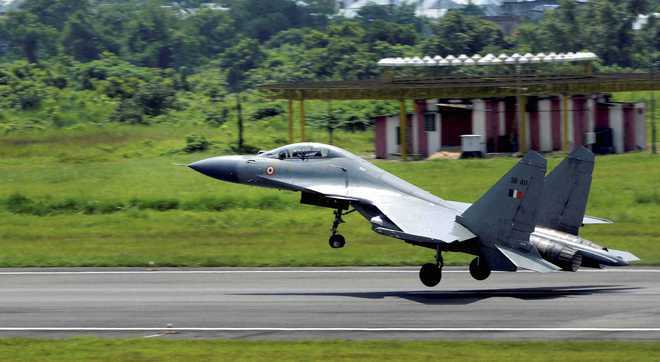
File photo of the Sukhoi-30 MKI jet.

Lucknow, October 22

The Lucknow-Agra Expressway will be closed for commuters from 10 am on Monday till 2 pm on Tuesday as the Indian Air Force plans to conduct a major touchdown exercise involving 20 planes, including the AN-32, Mirage 2000 and Sukhoi-30 MKI, on the highway.

This is for the “first time” that transport aircraft (AN-32) will “land and then take off” from this highway, an official said.

According to PRO, Defence (Central Command), Gargi Malik Sinha, the IAF will conduct the aircraft touchdown exercise on the Agra Expressway near Bangarmau in Unnao district.

“It is for the first time that any transport aircraft will land and then take off (on the highway). The AN-32 are meant for humanitarian assistance and disaster relief. The aircraft can bring a large amount of relief material and can also help in evacuating people,” Sinha said.

In all, 20 aircraft including AN-32 transport and fighter planes like Mirage 2000, Jaguar, Sukhoi 30 MKI will take part in the exercise, she said.

“Two AN-32 planes will participate in the October 24 Expressway touchdown,” the PRO said.

To ensure a smooth conduct of the touchdown by IAF aircraft, traffic restrictions will be placed on the Agra-Lucknow Expressway for general public from October 23 to October 24.

In a letter sent to district magistrate Unnao, the Chief Executive Officer (CEO) of the Uttar Pradesh Expressways Industrial Development Authority (UPEIDA) Awanish Awasthi said that Indian Air Force was planning to conduct highways flying operations on October 24 on the airstrip of Agra- Lucknow Expressway in Unnao district.

The letter further said, “It is to bring to your notice that due to Diwali vacation, a lot of traffic is moving on the expressway. Hence, keeping in view the convenience of the expressway users, it is proposed to stop the use of expressway for general public from 10 am on October 23 to 2 pm on October 24”.

The CEO asked the Unnao district magistrate to ensure that sufficient police force is deployed to control the public and movement of authorised vehicles on expressway and also take measures to ensure safe flying operations on the scheduled day from 8 am till 1 pm. PTI

CBI to look into private detective’s allegations in Bofors case

CBI to look into private detective's allegations in Bofors case
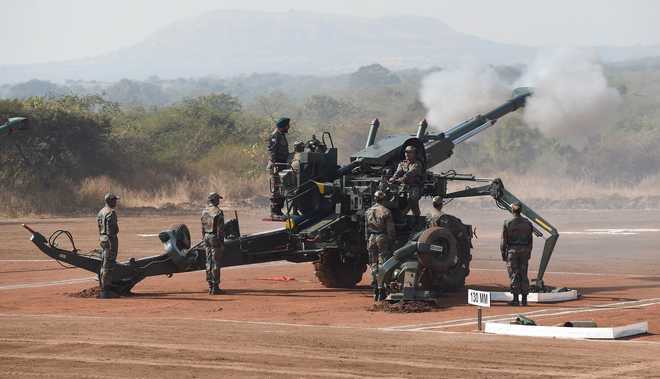
File photo of a Bofors gun. AFP

New Delhi, October 18

The CBI on Wednesday said it would look into the “facts and circumstances” of the Bofors scam mentioned by private detective Michael Hershmam, who alleged that the Rajiv Gandhi-led Congress government had sabotaged his investigation.

Hershman, who is the president of the US-based private detective firm Fairfax, claimed in television interviews recently that Rajiv Gandhi was “furious” when he had found a Swiss bank account “Mont Blanc”.

Hershman, who was here last week to address a conference of private detectives, also alleged that the bribe money of the Bofors gun scandal had been parked in the Swiss account.

“The agency has learnt of the matter pertaining to the Bofors aired on certain TV channels containing interview of Michael Hershman,” CBI informationa officer and spokesperson Abhishek Dayal said in a statement.

“Facts and circumstances as mentioned in the interview will be looked into as per due process by the CBI,” he said.

Hershman was quoted as telling television channels that Rajiv Gandhi got very upset when “our work was uncovered”. He then established a Supreme Court commission to look into the circumstances surrounding then finance minister V P Singh’s hiring of Fairfax.

In his interviews, Hershman has expressed his willingness to testify and help Indian agencies on the Rs 64 crore Bofors gun pay-off scandal but the effort has to be a credible one. PTI

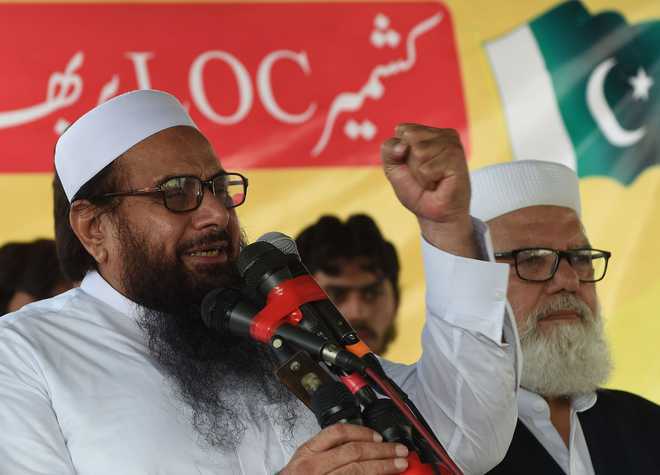
Let off for Hafiz Saeed? Pakistan plays off US, India

Let off for Hafiz Saeed?

THE absence of a dialogue can hurt, especially if the only Indian strategy to rein in Pakistan is an endless supply of verbal fusillade. Pakistan seized its moment as soon as US President Donald Trump telegraphed his appreciation for its army rescuing five Western hostages from the clutches of the Haqqani network. A day later, the Punjab government (Pakistan) told the Supreme Court that it will not press ahead with militant leader Hafiz Saeed’s incarceration for the fifth time under the anti-terrorism legislation. The Pakistan administration did not feel the need to continue with the façade of pretending to rein in one of its strategic assets once it successfully pulled off the caper of “rescuing” Western hostages from a militant organisation mentored by the spy agency, ISI. Sections of the media will make much of this let off but the fact is that Saeed and his cohorts will remain under house arrest under another law.Pakistan is currently divided over the usefulness of its resident militant leaders. The ISI wants to de-radicalise militant-linked organisations by bringing them into political processes. Saeed duly formed a political party and contested the byelections featuring former PM Nawaz Sharif’s wife. But a section of the Pakistani establishment was not pleased with this rather blatant attempt to whitewash a militant organisation. Its election commission has refused to register his political party because it has links with militants and accused by the US and India of involvement in the Mumbai attacks. This is Pakistan at its quintessential enigmatic best: If a door is shut, a window remains open.However, India under PM Modi has gone through one of the longest estrangements with Pakistan in recent times. The various dialogue formats in the past always helped resurrect the relationship after a period of bitterness. The US seemed to be siding with the Indian approach soon after Trump became President. It may not bother with India’s woes if the Pakistani army appears to be playing ball in Afghanistan. India needs to find its mojo to deal with Pakistan. Raining down verbal fire is neither helpful nor sustainable.


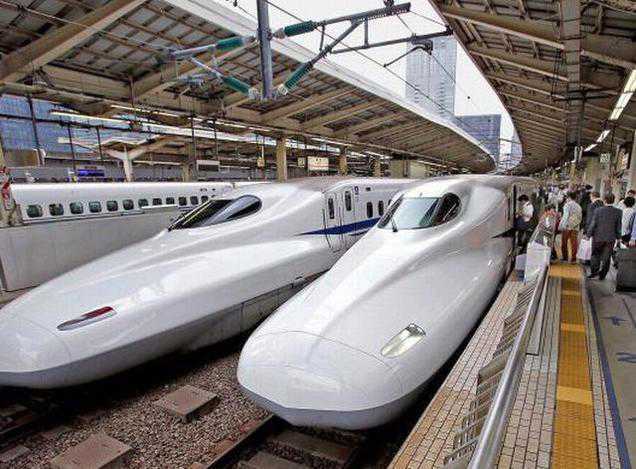
Dokalam effect? China delays high-speed train project in south India

Dokalam effect? China delays high-speed train project in south India
”Lack of response” from Chinese railways has been stated has the reason behind the delay. — Representative photo

New Delhi, October 15

An ambitious high-speed train project in south India has been delayed after Chinese railways, that completed a feasibility study a year ago, did not respond, railway officials have said, suggesting that the “lack of response” may be due to the Dokalam standoff.An internal brief of the Mobility Directorate on the status of nine high-speed projects of the railways, accessed by PTI, shows that the Chennai-Bangalore-Mysore corridor, a 492-km stretch, lies in limbo because the Chinese railways has failed to respond to the ministry’s communiqués.”The Chinese company submitted the final report in November 2016 and after that the Chinese team has suggested for a face to face interaction. No date has been fixed from their side,” said the note prepared by the Mobility Directorate.On the reason for the delay, the brief states — “lack of response” from Chinese railways.The brief also states that the feasibility study by the China Railway Eryuan Engineering Group Co Ltd (CREEC) was submitted to the Railway Board in November 2016 and after that the Chinese company had sought meetings with officials of the Board.However, officials say the Board has been unable to get in touch with officials of CREEC despite repeated communications sent to them via mails in the last six months.”We have even tried to get in touch with them through their Embassy here, but we are yet to hear from them,” said an official.The ministry officials said it was the standoff between the two countries in Bhutan’s Dokalam area between June 16 and August 28 this year that seems to have derailed the project.”The study began in 2014 and they submitted the report in 2016. The entire cost was borne by them. In fact they have shown so much interest in collaborating with us for other projects as well, so we think that it was the standoff that must have raised doubts,” said a senior rail official.An email to the Chinese Embassy by the PTI on the issue did not elicit any response.Troops of India and China were locked in a 73-day-long standoff in Dokalam since June 16 after the Indian side stopped the building of a road in the disputed area by the Chinese Army. Bhutan and China have a dispute over Dokalam.The brief, prepared by the department in charge of all the high speed corridors, also states that except the Chinese roadblock, work on the eight other projects was on track.China had in fact not only pitched for the Mumbai- Ahemdabad high speed network, which was finally bagged by Japan, but also for the bullet project in the Mumbai-Delhi sector, which is yet to be finalised.China is also training railway engineers in heavy hauling and it is with Chinese collaboration that India is setting up its first railway university.The Chennai-Bangalore-Mysore corridor is one of nine such high speed corridors being developed by the ministry. The aim was to increase the speed from the present 80 kmph to 160 kmph.While the Delhi-Agra route was made operational in 2016 with the country’s fastest train Gatimaan Express running between the two cities, the work on rest seven of eight of 8 is going at a fast pace, the brief indicated. — PTI

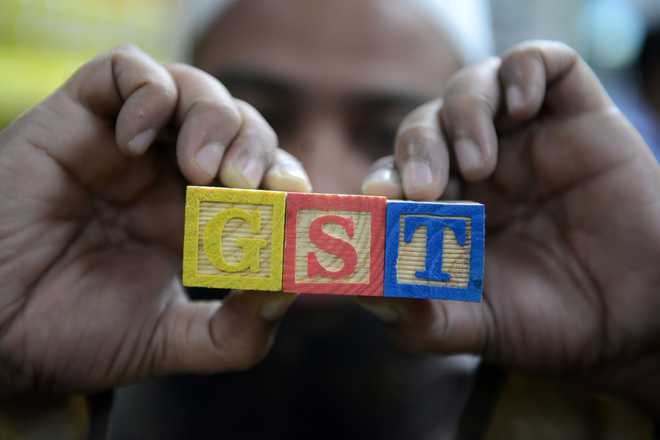
Nothing ‘simple’ about GST Political temptations complicate resolution

Nothing ‘simple’ about GST

THE government’s half-hearted attempt to revamp GST will neither shield it from the ongoing criticism of economic mismanagement nor help the BJP in wooing back its estranged vote bank — the trading community. The decision to cut duties on 27 items, including khakra, on the eve of Prime Minister Modi’s two-day Gujarat visit, is more political than economic. The Friday announcement also exempted jewellers from reporting data on buyers’ purchases worth over Rs 50,000, besides slashing duty on man-made fibre to mainly placate businessmen in Gujarat. This happened despite PM Modi’s emphatic statement last week that he detested the politics of announcing sops before elections. Everyone knows that he can’t afford to lose the political battle in Gujarat, his home turf. Sporadic exemptions to small businessmen and temporary relief to exporters will certainly bring them some cheer but these are not substantial enough to reverse the current economic downturn. The new tax regime is also far away from being called “good and simple tax” because of compliance hassles, technical glitches, uncertainty over refunds and unpredictability. It is feared that multiple tax slabs, exemptions under political pressure, ad hoc institutional arrangements and absence of a clear roadmap will make GST more complex and cumbersome than the previous VAT regime. It seems that officials in the Finance Ministry and members of the GST Council are ignoring the GST concept paper that promises “ease of doing business” by simplifying the tax regime with fewer exemptions, reducing multiplicity of taxes, cutting down compliance costs and so on. The new regime has already gained experience of one quarter. Data shows that out of 54 lakh registered entities, only about 10,000 have contributed two-thirds of the total Rs 94,000 crore mopped up in July. The government must find out the reasons for such a small number of contributors and devise mechanisms for better collection sans coercion. The best way is to keep the regime uncomplicated with one or maximum two tax rates, besides levying cess only on luxury goods and hazardous items. Minimal paperwork, robust IT infrastructure and friendly taxmen would certainly make it “good and simple tax”, not politically-driven tinkering


SECURING PERMANENT DEFENCES IN PUNJAB

The unsecured state of the defence line came most glaringly to public notice when a restaurateur sought to boost his business with ‘bunker tourism’

PERMANENT DITCH­CUM­BUNDH DEFENCES IN PUNJAB NEED TO BE SECURED IN PEACE TIME TOO FROM THE ENEMY’S HUMAN INTELLIGENCE AND SABOTEURS

General Prem Bhagat who commanded the corps defending Punjab in 1966-70 analysing the lessons of the 1965 war in detail concluded that loss of territory in the strategically important state was politically unacceptable.

In the absence of any natural defences in the area, he advocated digging of a deep ditch obstacle all along the most vulnerable stretches of the border. This was to be surmounted by a high earthen embankment. At various points concrete emplacements for weapons were embedded in the structure. Water was to be released into the ditch during war. While screen positions protected bridges and vulnerable points ahead of the ditch, strong mobile reserves were held in readiness behind the obstacle to counter-attack any penetration. On certain very vulnerable stretches a dual obstacle system was constructed.

The Bhagat Line, as I prefer to call it in the memory of a most illustrious general, has protected Punjab well. However, in peace time the ditch-cum-bandh obstacle lies unoccupied open to enemy humint scrutiny and potential sabotage. This unsecured state came most glaringly to public notice when a restaurateur sought to boost his business with ‘bunker tourism’ – trips to the defence line complete with selfies inside defensive positions.
How are the permanent defences to be kept out of harm’s way in peace time? One solution could be to have them occupied permanently by a militia composed of ex-servicemen and youth from the border areas. These can be posted in penny packets to man intersections and patrol the defence line. When regular troops occupy the defences for training or operational alerts they can be concentrated for training. During war the force can be used for rear-area security, flank protection or manning of gaps.

40TH NDA ON A CRUISE

Nothing is quite as strong as the bonds of friendship, camaraderie and affection between officers of the armed forces who have done their pre-commission training together at one of the Service academies – the legendary brotherhood of coursemates. The 40th National Defence Academy (NDA) course is a case in point. Passing out in June 1971 they served to replace the casualties of the war in December and fought in Sri Lanka, Siachen, Kargil and all the no-war, no-peace conflicts through the 70s to the early years of this century. Stalwarts from this course include former Army Chief General Bikram Singh, former Northern Army Commander General KT Parnaik, General DS Chauhan, General Dhruv Katoch, strategic thinker Brigadier Gurmeet Kanwal and Sri Lanka warhero Colonel Anil Kaul, Vir Chakra.

Now the 40th course plans to take an eight-day cruise together on a liner to reaffirm those ties of fellowship. Ninety coursemates and their families will be sailing together in December topped off with a three-day holiday in Singapore. Bon voyage to them! Earlier the 34th and 39th Courses had done a cruise together too.

SWACHH ARMED FORCES?

The defence minister’s off the cuff remark that the Army would clear garbage in tourist spots in high-altitude areas has caused consternation among veterans.

This is a typical example of the unthinking kind of statement which offends both the serving and retired fraternity. The Defence Services maintain a very high degree of cleanliness and sanitation in their cantonments and stations. No special efforts or hygiene drives are required for the purpose. It just comes to them in the natural course of things.

Please write in with your narratives of war and military life to msbajwa@gmail.com or call/ WhatsApp on 093161­35343