Sanjha Morcha

What’s New

Click the heading to open detailed news

Current Events :

web counter

Print Media Reproduced Defence Related News

The killing of Bukhari is a potential tipping point by Lt Gen Syed Ata Hasnain

  in his famous book ‘Tipping Point’ explained the title with the description – “the moment of critical mass, the threshold, the boiling point”; classically the point at which a nudge either way could make the difference, perhaps change the situation. It can be extrapolated to real life situations, particularly in as turbulent an environment as Jammu & Kashmir. We worked on this once before attempting to take an internal security situation to a point where the popular wish was to go beyond and never return. It almost succeeded, reached the crucial stage but could not tip beyond for a variety of reasons.

The killing of

Shujaat Bukhari

 by elements that obviously disliked his middle path approach and, in particular, his take on the suspension of operations as an opportunity beyond the ordinary, is in my perception one of those junctures of history where the tipping point could be crossed through a positive nudge. Yet, binaries cannot work in such a situation. When disgust and condemnation against violence become the common sentiments, people are more open to gestures considered as magnanimous.

In 2011, after three years of unabated street violence, loss of children’s academic years, poor tourist seasons and low business sentiment even for Kashmir’s iconic fruit industry, the populace was yearning for a period of peace. Its pride failed to let it admit it but it yearned for gestures that could bring even a semblance of peace and normalcy. Social media had not yet made its entry in any transformational way but sincerity of purpose and a public outreach system which went beyond the ordinary exemplified India’s commitment towards peace. The Kashmiri media too was excited by the change in approach. It was nothing but an appeal to the people to join hearts with the nation, feel the pulse of change and participate in it through mutual trust and confidence.

Bukhari’s death brings forth the notion of irrationality that is prevalent among those who wish to employ violence to take Kashmir away from India. It may need spontaneity, sincerity and only a bit of rationality to explain why that may never be a reality but within the idea of India much more can be achieved with dignity and accommodation. The situation probably seeks the application of brilliant minds to meander through the maze of complexity of emotions. It’s a moment for leadership to emerge and show the way. India has never been short of the power of the mind and any application at the current juncture will reveal that

people can change if they sense sincerity. It is not the time that single minds will produce ideas that can be the engines of change but it is a time for collective thinking and soul searching. Promoters of violence are few and they have had the public mind in their grip with the thought of achievability of their aims. If the public can be swayed by sentiments of the killing of young terrorist leaders, it can equally be moved to express disgust for actions which trigger more hatred and even more violence in an unending spiral.

8

No one is suggesting that immediate action be initiated. All that is being ideated about is the thought that sentiments for peace can be stronger than the emotions of violence. With the world in reset mode and the most intractable conflicts under possible resolution, the thought of handing over conflict situations from generation to generation without consideration towards the regression in human progress is a phenomenon we need to be acutely aware of. Triggered by the emotions of the moment, can we make a difference? Why not?

(The writer is a retired lieutenant general who commanded the Army’s 15 Corps in Jammu & Kashmir)

TOP COMMENT

The most significant point that Ata makes is that in the affairs of Kashmir public policy making is to bridge the gap between the realm of ideas and the domain of public policy making. The stakeholders are the non governmental public intellectuals who have not been tapped so far. Those tapped are well known writers and journalists whose views were well known and hence no fresh thinking has been imbibed in this process. What Ata is talking is the imposition of the combined genius of the entire Indian thinking rooted in the idea of “INDIA” That alone will give not only out of box thinking but also a viable fresh thinking about the entire situation in Kashmir. It is not bureaucratic, political, governmental or the tactical thinking that matters now but a much more situational analysis of the sociological and perhaps anthropological perspective that must be done to find a way so as to strategise tactics to bring peace in the valley. The tacticising of strategy from the point of view of action by the processes undertaken so far must be augmented by the fresh realm of ideas for creating a new public policy making in Kashmir. It is this seminal aspect that Ata has enumerated as a person who is deeply rooted to find a lasting solution to the present situation. I only hope that the constitutional powers understand what Ata is talking in between the lines. When information based analysis is mixed only with experience and judgement, there is always a pitfall of not taking a wise decision. The information must be distilled to create a knowledge base and then the knowledge must be combined with compassion to cull out wisdom for the formulation of a public policy to bring peace and tranquility to Kashmir which has always been classified due to its natural beauty, environment and the Kashmiriyat as the “paradise on earth”. Professor Gautam Sen, Pune

Gautam Sen


A Petty Quarrel by Lt Gen by Bhopinder Singh |

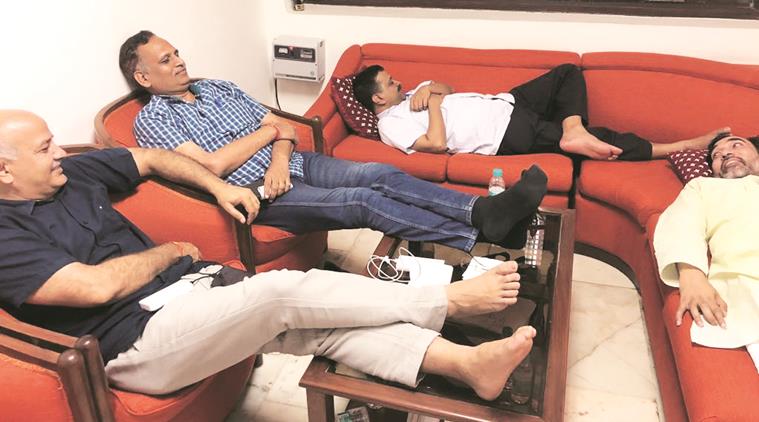
Delhi Chief Minister Arvind Kejriwal on dharna at the LG's office.Delhi Chief Minister Arvind Kejriwal on dharna at the LG’s office. (File) 

The unending Delhi saga of “full statehood” versus “partial statehood” has less to do with constitutional correctness and more to do with the political compulsions, instincts and pettiness. The dissonance over Delhi’s status dates back to the Sheila Dikshit era. Relations between the then chief minister and lieutenant general were tense even though the Congress held office at both the state and the Centre. It has not changed. The principle of special sensitivities for national capitals (for example, Washington DC, London, Paris etc.) on account of their national and international importance, geographical location and strategic significance has been consistently invoked to make a case for Delhi’s claim to “full statehood” to be treated differently from that for Goa, or even a more empowered “partial statehood” in Puducherry.

The result is a fractured arrangement of power-sharing, with law and order, land and services residing with the central government. This arrangement has always been contested by the state government. Such constitutional arrangements militate against the preferences of the “elected government”, which is accountable to the citizens. Political parties that endorse the “full statehood” demand in manifestos, however, fall silent on winning power at the Centre. The state government’s frustrations are understandable. The AAP formed the government after winning 67 of the 70 seats in the 2015 Delhi assembly elections. The formation of the government was followed by the LG’s office imposing more constraints like disabling the power of the state government to transfer employees, ordering vigilance probes on complaints or proceeding against corrupt officials.

These questionable restrictions also came in the backdrop of unprecedented theatrics. A perfectly legitimate grouse about the timing and the intent of these notifications was soon lost in the personalised, combative and anarchic retaliation from the party in power in the state. The expanding political ambitions of the AAP, which went beyond Delhi, may have also contributed to the widening of the Centre-state divide. The Centre successfully and, perhaps unfairly, checkmated the state government. Meanwhile, the party running the state government took the battle to Varanasi and Punjab. The forays were unsuccessful, leaving the party even more frustrated. Even on the current issue of the “strike” by Delhi’s bureaucrats, the essential character of the protests has been theatrical and obstructionist. The IAS association has refuted the allegations (that the bureaucrats are hampering the work of the government) as “unwarranted and baseless”. The association points to the passing of the state budget and the accompanying budget session as proofs of a working machinery. The sense that bureaucrats have been “agitated” following the alleged attack on the Delhi chief secretary has sullied the environment.

Trust between the political class and bureaucracy is necessary for good governance. The impasse in Delhi suggests a total breakdown in the relations between the two sections. It also implies that the entire administrative staff is against the state government. This is not possible given the diversity and scale of the administrative machinery. The government must introspect and adopt a more mature approach to the bureaucracy. Slandering the entire administration as corrupt may rouse the cadres, but yields diminishing returns in the long term.

The state government is well within its moral right to demand the inclusion or exclusion of any official on basis of apolitical and professional considerations, as opposed to intemperate, whimsical and blanket aspersions cast on the entire “system”. The means and expressions of the current protest reflect reciprocal pettiness and diminution of constitutional sobriety. Unintentionally, the case for more empowerment of the Delhi state government — not “full statehood” — may have further stalled with the repeated optics of the “sleep-in” at the Raj Niwas waiting room: It is reminiscent of the AAP’s 2014 street protests outside Rail Bhawan. Delhi with its commitments to international confabulations, transit infrastructure, inter-intra dependence on neighbouring states and stately ceremonies cannot risk fanciful drama. This round of LG-CM spat has further diminished the nobility of constitutional offices, without achieving the desired corrections.


Kargil II unlikely to happen Lt Gen Syed Ata Hasnain (Retd)

What should worry India is Pakistan army’s irrationality, not its capability

Kargil II unlikely to happen

THE THEATRE: It was Kargil where the gaps were vulnerable especially in winter

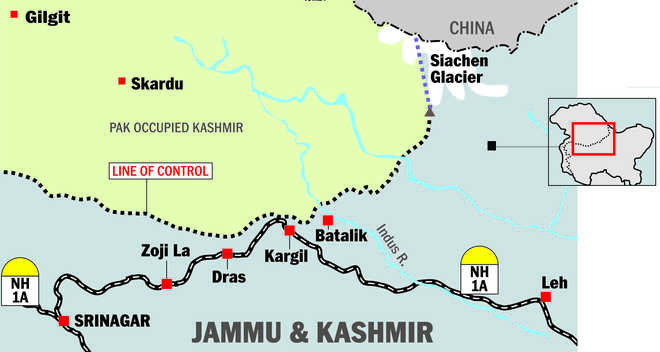
Lt Gen Syed Ata Hasnain (Retd)ALL over India there are efforts by many to hold events marking the Kargil Vijay Diwas today, the anniversary of the day when the undeclared war at the Kargil heights drew to a close in 1999. The Indian Army recaptured much of the territory occupied deceitfully by Pakistan during the ‘winter vacated’period of 1998-99. As many as 527 of our jawans made the ultimate sacrifice and 1,363 were injured. The remaining territory was vacated by the Pakistan army under politico-diplomatic pressure from India and the international community. India needs to remain reassured that if our politico-diplomatic efforts had not borne fruit, our Army would have fought on and recaptured the occupied territory and more. This would have been even to the extent of launching a war and suffering more casualties; an unfortunate consequence of misreading intent and being lulled at the operational level by events at the national-strategic level. As someone who had a grandstand view of events from the flank and was repeatedly tasked to analyse the potential of a second Kargil, I remain convinced that a Kargil-like situation may never again be experienced. Yet I am diffident about the Pakistan leadership’s utter unpredictability and irrationality. It is not just our weapons, equipment, training or intelligence that will prevent a potential Kargil 2, but better public information, interest in matters related to the armed forces, knowledge on national security at every level and better aware operational and tactical level commanders, that will. Most of the events organised today will remain bereft of explanation of what happened at Kargil and why. We are duty bound to tell the nation more about this. It is good to read Pakistani author Nasim Zehra’s recent book, From Kargil to Coup, to get a better idea of Pakistani psyche and how irrationally things work in that country. Why did Musharraf decide to target Kargil? A Mohajir General picked from lower in the seniority list to be chief; a former SSG commando deluded by perception of Indian incapability and a man perceiving himself smarter than all, led his army to intrude across the LoC for early occupation of the Indian ‘winter vacated’Kargil heights. He hoped it would give advantage by interdicting the summer highway from Srinagar to Leh. This artery is the lifeline to Ladakh and opens in May each year; the alternative route from Manali is less viable. In the absence of a communication artery for the logistics stocking effort, Indian occupation of the Siachen glacier would become untenable, thus forcing withdrawal; at least, that is what Musharraf thought. He had other linked intentions too. One of these was to bring J&K into limelight again and the other was to give an impetus to militancy in the Valley. He was convinced that the movement of reserve forces from the Valley (immediate flank) would open vast spaces for conduct of militant operations and infiltration; he wasn’t wrong on this. In addition, concerns of the international community would run high as there was little clarity on doctrines and protocols in the nuclear-armed region. This would bring diplomatic intervention by the big powers and force India to the negotiating table to resolve J&K. From all indicators and recent literature, the political leadership of Pakistan remained in the dark up to a point after which it was misled into acquiescence. Nawaz Sharif, at best, gets the benefit of the doubt. Musharraf’s attempted deception through projection of his army as just local mujahideen, out to expand the J&K conflict, also considered PM Vajpayee’s Lahore bus yatra as a contribution to the credibility of the deception plan. His assumption, like many Pakistani leaders before him, was that India lacked the will and courage to pursue robust operations to evict the intruders. No one questions the valorous response of the Indian Army to a situation that surprised it. The question is how and why we were surprised. The lesson from Kargil is that at no time must we lose balance in our focus. Our concentration was on the big-ticket counter-terror operations to neutralise the dangerous situation in the hinterland of the Valley and the Jammu region, as also on Siachen, where we were strong, but even a toehold by the adversary on the Saltoro Ridge could be disastrous. So it was only Kargil where the existing gaps in deployment were unviable and, therefore, vulnerable, especially in winter when a large number of posts were vacated. Attempts to do serious wide-area reconnaissance by helicopter in winter were restricted many times due to constraint in flying hours. At the operational level, the Army can never allow itself to be lulled by actions being undertaken at the national strategic level (such as the peace efforts through the Lahore yatra). The operational stance must cater to manageability of the volume of intelligence inputs, resources for deployment and response and even the nature of terrain. The sheer expanse of 15 Corps which managed the deployment from Gulmarg to Demchok (east Ladakh), Siachen and the hinterland operations obviated focus on a comparatively low-priority sector such as Kargil, where the population was not anti-national and the nature of LoC apparently fitted into the perception of only frequent exchanges of fire. In the light of an unstable state of polity in Pakistan, under the control of an army which seeks ways of retribution against India despite many efforts coming cropper, India needs to be wary. The Pakistan army has not learnt its lessons and is ever willing to risk employing innovative ways of attempting to wrest advantage. A nation in the habit of issuing daily nuclear threats and believing that it has achieved deterrence against us may lack intellectual capability to read the likely effects of its actions. Not its capability but its irrationality should continue to worry India. Kargil Vijay Diwas is a good occasion to recall the grit, valour and supreme sacrifice which was on display during the Kargil war. However, it would also be in order to conduct an audit of what has changed for the better since then, and what continues to constrain the armed forces. The Kargil Review Committee’s recommendations along with the Group of Ministers’ report have many benchmark measures which yet need consideration almost 20 years down the line. Shying away from them would be tantamount to repeating the mistakes of Kargil 1999. A former GOC of the Srinagar-based 15 Corps


Shimla man gets 3 months in jail for delay in filing return

CHANDIGARH:A district court sent a Shimla man to three months of rigorous imprisonment for failing to file his income tax return on time.

The court of chief judicial magistrate Akshdeep Mahajan also imposed a fine of ₹8,000 on the convict, Sanjay Kumar Sood, for wilfully failing to furnish return of his income.

Deputy commissioner of income tax Laganpreet Sandhu had moved a complaint against Sood, mentioning that Sood had not filed tax return worth ₹13.8 lakh on the due date for the assessment year 2012-13, which was September 30, 2012.

The complaint mentioned that Sood, without any reasonable cause, had instead filed the return on April 2, 2013 (beyond the deadline).

Accordingly, a show-cause notice dated February 5, 2014 was issued to him, in a reply to which he claimed that he had deposited the tax voluntarily as March 31, 2013, was a Sunday and April 1 was a bank holiday relating to assessment year 2012-13.

Sood’s reply claimed that the belated return was voluntarily submitted within time allowed under section 139(4) of the Income Tax Act, so there was no intent on his part to evade tax before any notice was issued.

However, the complaint said the notice was issued only after obtaining the requisite sanction under Section 279 (1) of the Act.

Meanwhile, Sood’s counsel had submitted that instant prosecution against the accused was illegal, and on account of ulterior motive by the officers of income tax department.

It was also contended that Sood had filed the return for the assessment year 2011-12 in time and that for 2012-13 was also filed in time with tax on the delayed period.

clip


AFT upholds woman officer’s conviction

Vijay Mohan

Tribune News Service

Chandigarh, July 21

Almost a decade after a general court martial (GCM) awarded the first-ever conviction to a woman Army officer for alleged professional misconduct, the Armed Forces Tribunal has upheld the verdict but reduced the quantum of sentence from dismissal from service to a severe reprimand.In July 2009, Capt Poonam Kaur of the Army Service Corps was tried on 10 charges under the Army Act for disobedience of lawful command, acts unbecoming an officer, levelling false accusations with an intent to defraud.The GCM had held her guilty on seven charges, but acquitted her on three charges pertaining to disobedience and intent to defraud. Almost a decade after a general court martial (GCM) awarded the first ever conviction to a woman army officer for alleged professional misconduct, the verdict has been upheld by the Armed Forces Tribunal, but has reduced the quantum of the sentence from dismissal from service to a severe reprimand.The AFT’s Chandigarh Bench held that the punishment awarded to her was not commensurate with the charges. The Bench has ordered that she be notionally reinstated in service and deemed to have been discharged from service on the completion of her term of engagement.  As a short-service commission officer, she had completed three years and nine months of service and had one year and three months’ service left for her term to end.Poonam had been posted to an ASC battalion in Kalka, near Chandigarh. In 2008, she had levelled allegations of physical and mental harassment against her superior officers, but the subsequent court of inquiry held her blameworthy of professional and personal misconduct.


Partial relief  

  • The tribunal ordered that Capt Poonam Kaur of the Army Service Corps be notionally reinstated in service and deemed to have been discharged from service on the completion of her term of engagement
  • Though she will be entitled to terminal benefits, she will not receive any salary for the intervening period from the trial to the notional date of discharge

Training will help combat terror’

DEHRADUN: Gentleman cadets from friendly nations said they will use Indian Military Academy (IMA) training in fighting terrorism in their countries.

Seventy four cadets from friendly nations took part in the passing out parade of IMA, Dehradun on Saturday after finishing their training. The cadets will be commissioned as army officers in armies of their respective countries.

Among the foreign cadets, 45 were from Afghanistan. Afghan cadets said they were determined to fight for their country against Taliban. One of them Asadullah Naimi from Badakshan province said, “I will use IMA training to fight Taliban in my country. The experience here at IMA and India is unforgettable.”

Speaking on difference between training given in Afghanistan and IMA, Naimi said, “Back in Afghanistan the focus is on arms training and running with heavy loads on back. But here in IMA, lot of emphasis is given on PT exercises and cross-country race. It makes one tough both mentally and physically.”

Nigerian cadet STJ Minimah said he will fight Boko Haram in Nigeria. “Our country is affected by one of the deadliest terrorist organiations Boko Haram.”


Army, police discuss ways to contain militancy in Kashmir High-level meet at Kulgam attended by 15 Corps GOC, DGP

Suhail A Shah

Anantnag, July 17

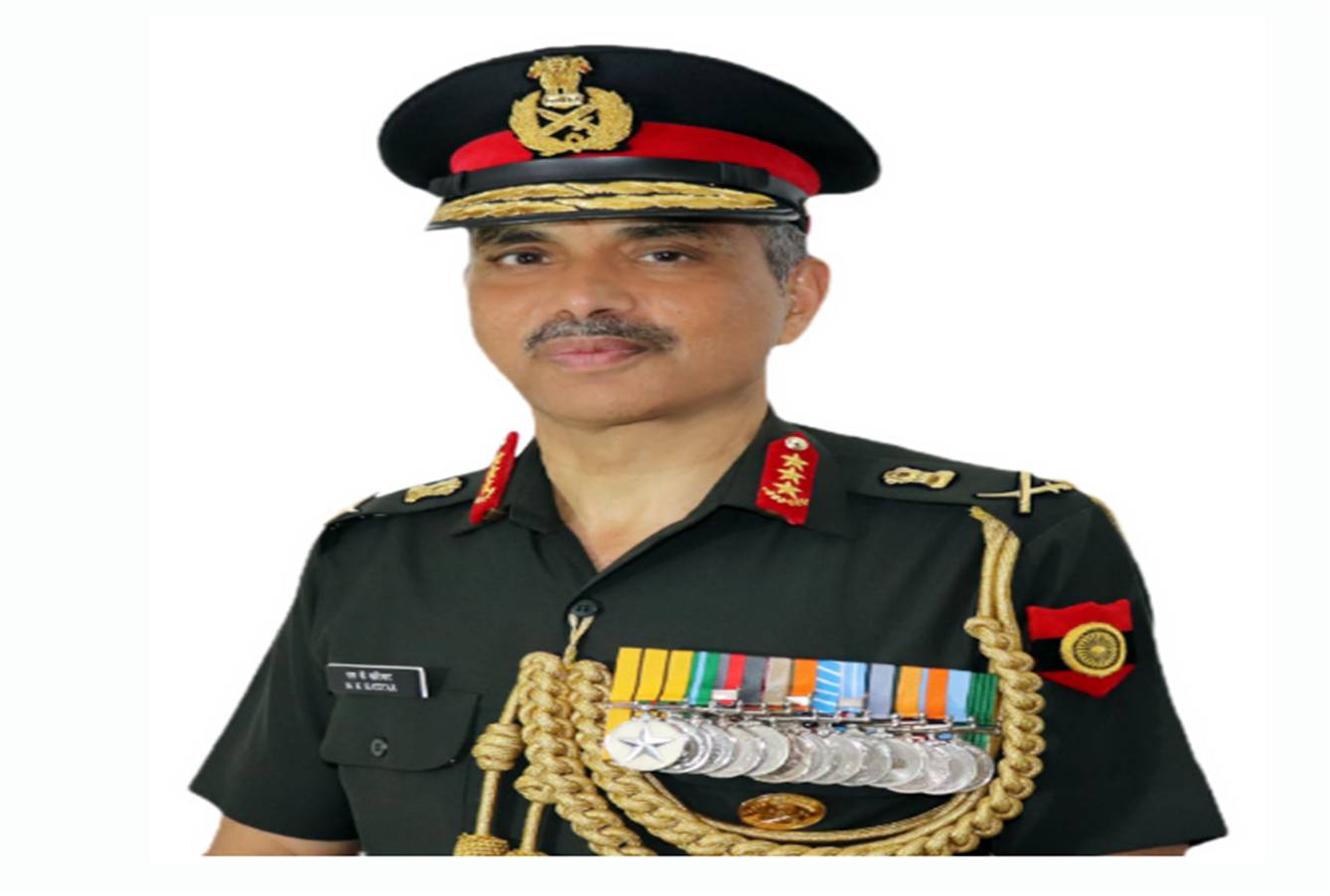
A high-level meeting of top Army and police officers was held in Kulgam town on Tuesday to “get acquainted with the ground realities” and find ways and means to tackle the rising graph of militancy in south Kashmir.The meeting comes amid a rise in militancy in south Kashmir. As per official figures, a total of 70 youth have picked up gun in the four districts of south Kashmir till June-end.The meeting held at the office of the Superintendent of Police in Kulgam was attended by General Officer Commanding (GOC) of the 15 Corps Lt Gen AK Bhatt, Director General of Police SP Vaid and Inspector General of Police SP Pani.Following the meeting, the officers held a brief interaction with mediapersons.Vaid told the media that the meeting was held to get acquainted with the ground realities.“The aim was to meet the officers at the ground level and take stock of and review the ongoing situation. We wanted to assess whatever help was needed from the headquarters to make the situation better in the Kashmir valley,” Vaid said.Asked about the rising militancy and repeated infiltration bids on the Line of Control, Vaid asked Lt General Bhatt to answer the question. “In an ongoing operation, an infiltration bid has been foiled,” Lt General Bhatt said.Asked how the graph of rising militancy could be brought down and the youth who have picked up arms could be brought back to the mainstream, the GOC said the purpose of the meeting was to discuss all these things. “All of us had assembled here to ponder over all these things,” the GOC said.90 youths have picked up gun this yearOf the 90 youths who have picked up arms in the Kashmir valley since January this year, around 70 belong to south Kashmir. Anantnag has the lowest share of militant recruits at 12, while Shopian has the highest at 21. Kulgam district has a total of 16 youths who have picked up arms this year, while 20 youths have joined militant ranks in Pulwama district.


Bluestar as a tragedy and a reminder by Pritam Singh

A suggestion for an Indian government in the future oriented towards reconciliation could be to take a bold step in following South Africa’s example of establishing a truth and reconciliation commission.
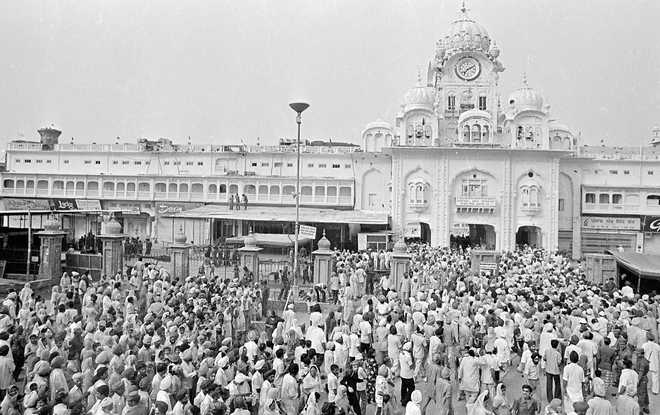
Bluestar as a tragedy and a reminder

RAGIC: People gather at Golden Temple to mourn the deaths caused during Operation Bluestar in Amritsar. Tribune photo: Yog Joy (file)

Pritam Singh
Professor, Oxford Brookes University, UKJUNE 6 marks the 34th anniversary of Operation Bluestar. With one-third of a century on, how do we describe this action, and what meaning do we attach to it? Do we describe it, as the Congress ideologists did then, as a holy task undertaken by the Indian military to clear the temple of the militants who had taken control of it? Or do we describe it, as some Indian nationalists and Leftists do, as a sad and necessary action to defeat an imperialist conspiracy to disintegrate India? Do we celebrate it, as some Hindu nationalists do, as a successful assertion of India’s Hindu supremacy against the Sikh minority’s separatist aspirations? Or do we condemn it, as Sikh and Punjabi nationalists do, as a genocidal attack on Sikh dignity, assertion and identity? Perhaps, we decry it, as most human rights defenders and Leftists do, as a tragedy resulting in the deaths of thousands of human beings — pilgrims, priests, Sikh combatants and Indian army men?The contesting descriptions of Operation Bluestar and the meanings attached to it are reflections of serious fault lines in the Indian society and polity. To say that there would never be a consensus on how to describe and signify this military action may be unreasonable and ahistorical. But to say that there is little likelihood of a consensus in the foreseeable future would be alluding to an uncomfortable truth about the fractured nature of Indian nationhood. However this operation is described and whatever meaning is subsequently attached to it, one thing is clear: one day, everyone else might want to forget it — and,  might succeed in doing so — but this will never be true of the Sikh community.

The third ghallughara

Operation Bluestar has become an integral part of the Sikh collective historical memory. It has become the third ghallughara (holocaust) in Sikh history — the first referring to the massacre of some 10,000 Sikhs in 1746; the second to the even larger massacre of Sikh men, women and children in 1762, when 30,000 (nearly 50 per cent of the population) were slaughtered in Punjab. Today, the available evidence suggests that many (though not all) gurdwaras in India and abroad include references to the third ghallughara in their daily ardas, or prayers.The most reliable estimates of the total number of deaths during Operation Bluestar are anywhere from 5,000 to 7,000. Yet, a crucial difference between the third ghallughara and the previous two is that this massacre occurred in the Golden Temple, while the first two took place on open battlefields. This gives an added religious dimension to the significance of the military action: a much larger number of Sikhs died during Partition, but the 1947 deaths are not seen in terms of attacks on and in defence of religion. In religious terms, the largest Sikh loss in 1947 was the fact that the Nankana Sahib gurudwara — marking the birthplace of Guru Nanak, the founder of the faith — was suddenly located in Pakistan. This, too, was a loss that today figures in the daily ardas.

Human rights approach

What should be the human rights approach in dealing with the complex situation of destruction, loss and pain associated with Bluestar? It could be to put forward a position of truth, accountability and justice as a methodology to study and a tool with which to deal with this painful situation. One can hope that truth and justice can heal the wounds, and there can be sound grounds based on an understanding of human history that such a hope is not wholly unfounded. However, one is also simultaneously troubled that the truth may never be allowed to come out and that justice may never be done because of the complicated conflicts of competing nationalisms implicated in this tragedy. Another dimension of human history which creates pessimism is that history is also full of intractable conflicts and continuing injustices.As for how to think about Bluestar, first and foremost, it was a massive human tragedy. It was a tragedy that could have been avoided if — and that is a big if —- Indira Gandhi had had a larger vision to reach a political settlement with the moderate Akali leadership. Most Akali Dal demands — regarding federal decentralisation, river water rights, territorial readjustment and the transfer of Chandigarh to Punjab as its capital — could have been negotiated. In 1985, Rajiv Gandhi agreed in the Rajiv-Longowal Accord to each of these demands, plus many more. It is a different matter that he implemented none.Indira Gandhi’s political calculations — those of using the ‘Hindu card’ for electoral victories — led her to deliberately choose a dangerous path of confrontation, first with the Akalis and eventually with the entire Sikh community. She paid for this miscalculation with her life, but still left Punjab and India communally scarred and polarised. Sikh nationalism was defeated militarily, but Hindu nationalism was unleashed so powerfully that the Hindu nationalists succeeded within a few decades to capture the Indian state.Regarding the demands that led to the Akali agitation of the early 1980s, the situation today remains where we were back then. As far as accountability for atrocities committed during Bluestar and subsequently during the conflict between the Indian state and the armed opposition Sikh groups is concerned, one suggestion for an Indian government in the future oriented towards reconciliation could be to take a bold step in following South Africa’s example of establishing a truth and reconciliation commission. No one wants history to be repeated. The least anyone can do today is to remember those thousands — pilgrims, priests, politicians, traders, militants, policemen and soldiers — who became victims in the tragedy of the third Sikh ghallughara.



On Unprovoked Attacks During Ramzan, Defence Minister’s Message To Pak

On Unprovoked Attacks During Ramzan, Defence Minister's Message To Pak

NEW DELHI: 

HIGHLIGHTS

  1. Home Ministry data shows attacks in Kashmir rising

  2. The government had announced a Ramzan ceasefire
  3. Will respond to any unprovoked attack, says Defence Minister
  Defence Minister Nirmala Sitharaman today categorically said India will honour the Ramzan ceasefire in Jammu and Kashmir but will respond to any unprovoked attack.

“When it is an unprovoked attack, the army was given the right to retaliate… We honour the ceasefire but a margin was given to us when there is an unprovoked attack,” Ms Sitharaman said at a function to mark her ministry’s achievements in Delhi today.

Amid repeated terror attacks in Jammu and Kashmir and repeated ceasefire violations by Pakistan at the border, the government had announced that the security forces will desist from anti-terror operations in Jammu and Kashmir.
Last month, data collated by the home ministry, however, showed that the number of terror attacks in the Valley has been on the rise and civilians have been facing the brunt of it. While four incidents of terrorist violence were reported in the valley a week before the initiative was announced on May 16, the number rose to 13 a week after.

Over the last four days, 10 attacks have taken place in the Valley. In the last one, which took place yesterday, 14 civilians and two police officers were injured. Terror group Jaish-e-Mohammed has claimed responsibility for the attacks.

The defence minister said it was not her ministry’s role to “assess whether ceasefire in Jammu and Kashmir has been successful or not”.

But she made it clear that unprovoked attacks even at the border will not go unpunished. “It is our business to guard the border and we won’t stop if we’re provoked. We shall be alert that no unprovoked attack goes without us responding. It’s our duty to keep India safe,” she said.