Sanjha Morcha

What’s New

Click the heading to open detailed news

Current Events :

web counter

Print Media Reproduced Defence Related News

Army man shot by colleague in J&K

Doda, December 25

An Army jawan of 4 Rashtriya Rifles, Rajesh Daqua (40) of district Adilabad in Andhra Pradesh, was allegedly shot by his colleague in Sarna tehsil of Bhaderwah late Monday evening following an argument.

Doda SSP Mohammed Shabir Malik said a team from the Forensic Science Laboratory, Jammu, was on its way to collect samples at the murder site. Critically wounded, the soldier was rushed to a hospital where he succumbed. — OC


IG scale assured for CAPF vet officers after 20 yrs in service

Vijay Mohan

Tribune News Service

Chandigarh, December 21

The Centre has approved dynamic assured career progression (DACP) for the combatised veterinary officers of the Central Armed Police Forces (CAPFs). Consequently, promotions of veterinary officers from the level of assistant commandant (Vet) to higher ranks will not be based on available vacancies, but on the duration of service, sources said.

Further, automatic pay scale upgradation to pay matrix 13A and 14 are assured to all officers, implying that every officer is guaranteed promotion to the rank of commandant after 13 years service and the pay level of an inspector general after 20 years of service.

The DACP will be implemented with effect from April 2002, the date from which the Ministry of Health and Family Welfare has implemented an order of the Central Administrative Tribunal passed in a similar case in 2010. The scheme is applicable to officers in the Border Security Force, Central Reserve Police Force, Central Industrial Security Force, Indo-Tibetan Border Police, Sashastra Seema Bal, Assam Rifles and the National Security Guard.

According to orders issued by the Home Ministry on December 19, an assistant commandant will be promoted as deputy commandant after four years of service, and thereafter as second-in-command after another five years.

Promotion to the rank of commandant, equivalent to a colonel in the Army, will be after four years of service in the previous rank, placing the officer in level-13 of the pay matrix. Another three-year service at this rank will place the officer in level-13A, which is equivalent to a Brigadier.

Thereafter, pay upgradation to Level 14, in which an inspector general of police of a Major General is placed, will be done after four years service at level13-A. If there are no vacancies at DIG or IG level, automatic pay scale upgradation to pay matrix 13A and 14 is assured provided their annual confidential reports are at benchmark.

Why the move 

  • Aim is to remove stagnation in veterinary cadre of Central Armed Police Forces
  • Paramilitary vet officers are deployed in border locations to look after horses, mules and camels that provide logistic support
  • The officers also look after CAPF dog squads that are used for security cover

6 militants, including Zakir Musa’s aide, killed in gunfight in Pulwama

6 militants, including Zakir Musa’s aide, killed in gunfight in Pulwama

Intermittent firing exchanges are still going on at the gun battle site.

Tribune News Service
Srinagar, December 22

A foreign militant belonging to the Zakir Musa outfit, Ansar Ghazwatul Hind, was among the six militants killed on Saturday in a gunfight with security forces in Tral area of Pulwama district in Jammu and Kashmir, police said.

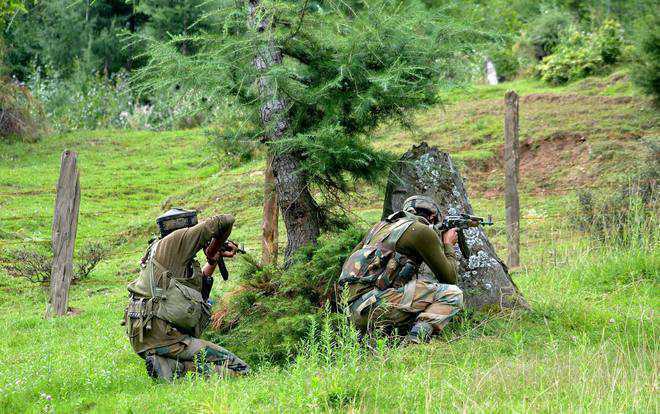
Following information about the militants’ presence, the security forces surrounded Arampora village. “As the cordon was tightened, the militants fired triggering the encounter,” a police officer said.

Intermittent firing exchanges were still going on at the gun battle site. With agencies 

2 Army JCOs die in Pak fire along LoC

Suspecting infiltration, combing ops on

Majid Jahangir
Tribune News Service
Srinagar, December 21

Two Junior Commissioned officers (JCOs) of the Army were killed in ceasefire violation by Pakistan along the Line of Control in the frontier Kupwara district, officials said.

While initial indications are that the two were hit by sniper fire, the Army termed it “unprovoked ceasefire violation” by Pakistan, which was retaliated strongly.

Sources said the incident took place at Jumagund in the Keran sector around noon, when Pakistan troops targeted an Army post manned by 2/8 Gorkha Rifles some 500 metres inside the LoC.

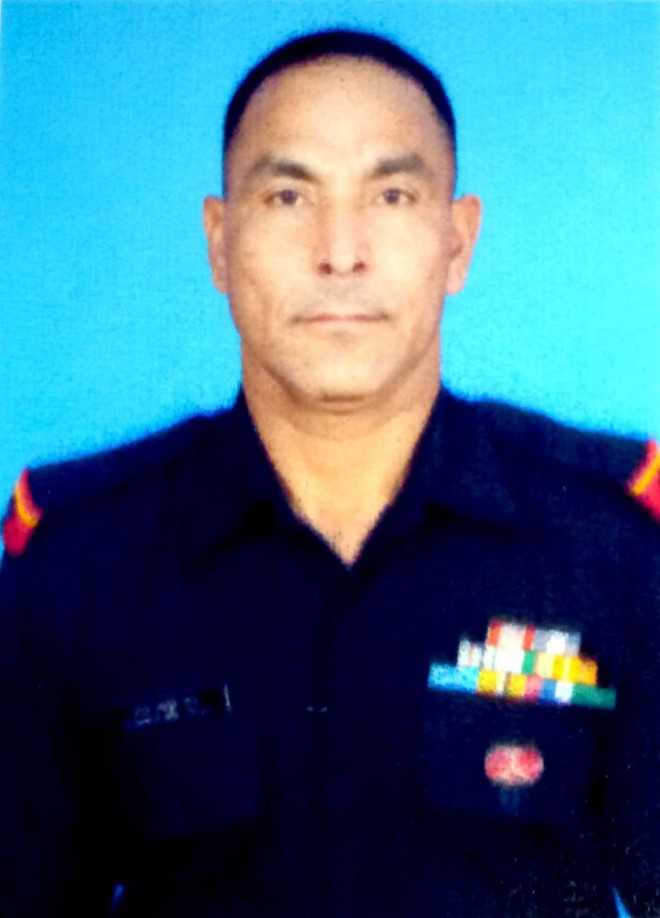
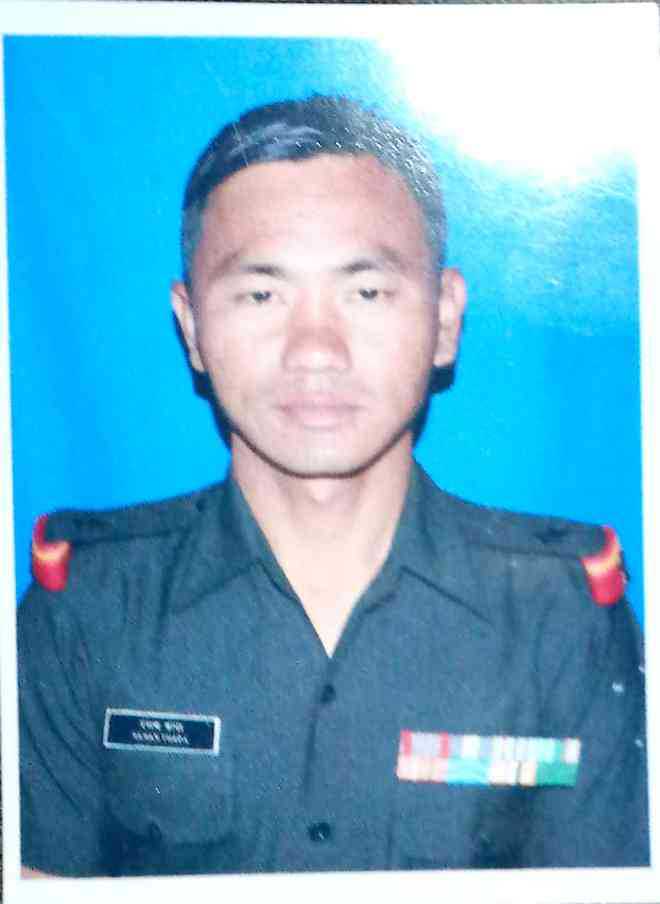
“In the Pakistan firing, Subedar Gamar Bahadur Thapa, 42, was killed on the spot, and Subedar Raman Thapa, 29, critically wounded. He was shifted to the Army Base Hospital in Srinagar, where he succumbed to injuries,” an official said.

The Army launched a massive combing operation in the sector as they suspected the violation by Pakistan might have been aimed at pushing infiltrators from across the border.

“The combing operation is still underway in the dense forest area to see if the firing was carried out to push infiltrators,” a defence official said.  This is the second ceasefire violation along the LoC in Kupwara district this month. On December 6, a soldier, Rajesh Kumar, was killed in truce violation in the Machil sector of Kupwara.

As many as 89 security men have so far been killed in the line of duty in Kashmir this year. Incidentally, this is the highest casualty figure for the forces in the past decade. Over 235 militants have also been killed this year.


Can’t Give Women Combat Roles, There Will be Ruckus When Maternity Leave is Denied: Army Chief Bipin Rawat

In an exclusive conversation with News18, General Rawat said combat role would put women at risk and they can’t leave behind young children.

New Delhi: Army chief General Bipin Rawat on Saturday said women are not ready for combat roles and gave reasons like they have the responsibility of raising kids and a woman officer would feel uncomfortable at the frontline and accuse jawans of peeping as she changes clothes.

In an exclusive conversation with News18, General Rawat said that while he was ready to introduce women to combat roles, the Army may not be as most jawans come from villages and they may not accept a woman officer leading them.
He also highlighted the issue of maternity leave and said the Army would not be able to give her leave if she is the commanding officer as she can’t leave her unit for six months, but said objecting to the leave could create a “ruckus”.

Here are the edited excerpts of the conversation:

Q. Women make very good soldiers, but why isn’t the Army accepting them?
A: That’s a misnomer.

Q. Military Police doesn’t count. Are there any women in combat roles, tell me?
A: We have women officers as engineers, they are doing mining and demining work. In air defence, they are manning our weapon systems. But we have not put women in frontline combat because what we are engaged in right now is a proxy war, like in Kashmir.

If there is just one officer in a company and if that officer is a lady… suppose you have to go for an operation. Everybody is ready, company commander has to lead. Now in that operation you have to deal with terrorists, there will be a firefight in which the commanding officer dies, company commander dies, and so the lady officer can also die or become a casualty.

Q. Everyone knows that risk but women are volunteering to go now.
A: They are going, yes. I will give you an example. A lady who died was in service for 7-8 years. She has a kid of 2 years. He is in Delhi or Chandigarh and parents are taking care of the baby. So what I am saying is, now do you think we are ready for this?

Q. Women can fly fighter jets but not armoured tanks?
A: See, I am not saying a women who has children doesn’t die, she can also die in a road accident. But in combat, when body bags come back, our country is not ready to see that.

Secondly, what will happen is there is just one woman and rest around her are just jawans. She is very much a commander so she has to do everything. She will have to go for operations. But even today we don’t have that acceptance. Even today our jawans come from villages, so that acceptance will take time.

Let me tell you one thing, we have started copying western ways. I did a course in US. We had 4 ladies and 10 male officers. So what happens is after every 3-4 hours you get a break of 1 hour in which you are supposed to have your lunch or you can go to the gym. Now when we go to the gym, we all change in the gym clothes in classroom all of us.

Q. This is just logistics.
A: When I was new, I would look the other way because ladies were also there but that is the culture there. They do it this way. We need to get this system. Now what will happen will be if there will be a lady officer here. Our orders are that a lady officer will get a hut in the COB, then there are orders that we have to cocoon her separately. She will say somebody is peeping, so we will have to give a sheet around her.

Q. These are all just assumptions.
A: If you think this, then even in Delhi, ladies tell me that people peep. I am talking about isolation situation when she has 100 jawans around her but it happens here also in Delhi.

Q. Are you saying army isn’t ready to accept women combat officers?
A: See I am ready, it is not that army is not ready. You are getting into something now you answer. Will she command?

Q. Why not?
A: Ok, so now I make her a commanding officer. She is commanding a battalion. Can that lady officer be away from her duties for 6 months?

Q. No.
A: Then what happens? Do I put a restriction on her to say that in that command tenure you will not be given maternity leave? If I say that, there will be ruckus created.


IAF to give MIG-21 for permanent display in Chandigarh

Ramkrishan Upadhyay

Tribune News Service

Chandigarh , December 6

Residents of the City Beautiful will have an opportunity to see the MIG-21 fighter aircraft grounded by the Indian Air Force (IAF) as the Air Force authorities have agreed to provide one for permanent display at Sector 31. Besides that, the Air Force will also provide one MI 17 helicopter for display.

Chandigarh Mayor Devesh Moudgil said he had requested the Air Force authorities to allot a fighter plane to the city a year ago. With his constant efforts the IAF agreed to give a MIG-21 fighter aircraft and one helicopter for installation in the city.

“The place for displaying the MIG 21 has been finalised. The grounded aircraft will be installed at the Japanese Garden in Sector 31. The place for helicopter will be decided later,” he added.

“While the necessarily expenditure for the installation of the plane will be borne by the Municipal Corporation, the Air Force will maintain it in future,” he said.

“A team of IAF technicians will come for the installation. Displaying of an aircraft will make people of the city proud of the IAF,” he added.

“Chandigarh has long association with the Air Force. The city has a training school, 12 Wing and 3 BRD Station,” he added. “The display will encourage more and more youth to join Air Force and other defence services,” the Mayor said.

The tricity already has a tank displayed at Leisure Valley in Sector 10 and twin tanks at the entrance of the Chandimandir Cantonment in Panchkula. One decommissioned Air Force helicopter has also been displayed on the Punjab Engineering College (PEC) campus in Sector 12.


HAL CEO says Rafale deal negotiations with Dassault Aviation went south due to disagreements over technology transfer

Hindustan Aeronautics Ltd (HAL) CEO R Madhavan in an interview answered questions over the Rafale deal negotiations with Dassault Aviation, saying that the deal breaker was because of disagreement over technology transfer and that HAL man hour rates are lower than global rates. The CEO also asserted that the focus must be on the final cost.

The clarifications came from the CEO after BJP minister Babul Supriyo on 27 September had indicated that HAL lost on the Rafale deal because it quoted 2.57 times more man-hours to build fighter jets. In an interview with CNN-News18, Madhavan also said that HAL is not actively looking for any offset business offers and said that “we work in offset business if it is in our domain.”

Madhavan had further stated that HAL is primarily engaged in manufacturing aircraft and it has technology transfer agreement with foreign original equipment manufacturer (OEM) but as far as offset is concerned, “we are not going to actively pursue offset deal.”

Image of chairman of defence PSU Hindustan Aeronautics Limited (HAL) - R Madhavan. ANI

While talking about the deal with Dassault, he said that first quote by the French aviation firm was 170 percent higher.

HAL was to produce 108 fighter jets locally in a joint venture with French firm Dassault Aviation in the deal for 126 Rafale jets that the previous UPA regime had negotiated. The state-owned firm, however, was left out in the deal as the present government signed to buy 36 fighter jets in ‘fly-away’ condition from France, reported PTI.

In an interview with news agency ANIDassault CEO Eric Trappier was questioned about the initial agreement with HAL and the subsequent breakdown of talks with the Indian PSU for production of Rafale jets. Trappier had said that if the initial deal of 126 jets went through they would not have hesitated to work with HAL and Mukesh Ambani-led Reliance.

“It’s because the 126 didn’t go smooth that the Government of India had to reconfigure to urgently acquire 36 from France. And then I took the decision to continue with Reliance, and HAL even said in the last few days that they were not interested to be part of the offset. So, it has been done by my decision and the decision of Reliance to invest in a new private company,” added Trappier.


We Can Use Strike Drones in Kashmir If People Will Accept Collateral Damage : Army Chief

The Indian army is capable of using drones to attack hostile targets inside Jammu and Kashmir and across the Line of Control, and sees “no problem” in using them provided the nation is willing to accept “mistakes” and “collateral damage”, army chief Bipin Rawat said on Wednesday.

He was responding to a question about India following the example of the United States in using strike drones. India has not used air power in domestic counter-insurgency operations since the 1960s, largely out of concern over civilian casualties.

“There is just no problem in using these kind of weapons” on either the Indian side of the Line of Control or in Pakistan-occupied territory, said General Rawat – so long as there was no backlash in public opinion or from the international community.

The army chief delivered the ninth Y.B. Chavan Memorial Lecture at the Institute for Defence Studies and Analyses in the capital. His subject was ‘hybrid conflict’ – a term that describes a range of hostile strategies that a belligerent can use in place of conventional warfare, especially against an enemy with a strong conventional military advantage.

The lecture focused on the threat of hybrid warfare aimed at India, mainly by Pakistan. He underscored the use of social media for one hybrid threat – the radicalisation of young people in Kashmir – and sketched out the need for “proactive defence”.

If the nation will spare us’ ::

After his prepared lecture, General Rawat took questions from the audience. His full remarks in reply to the question on drones were as follows:

“When you talk of strike drones, how does the Israeli strike the Hezbollah – how do they do it? You see, they have sources on the ground, who pinpoint a vehicle – who say that, this is a vehicle in which a leader has just come out of a house, and somebody has just given the information. They electronically mark that vehicle.

“That vehicle gets marked. And now a drone takes off in the air, and hits that vehicle. God help you if you’re in the following vehicle – you’re also gone.

“Now, this kind of thing is possible in that area – in that country. In our country, you’ve seen the kind of repercussions… the kind of flak that you face when you take such action even against a stone-thrower, who’s carrying out offensive action against you.

“In our country, the way things are moving, it’s very nice to say we need these drones. But will you accept mistakes being committed by such weapons systems? You have to accept it. If the nation will spare us, for the kind of mistakes that may get committed using such kind of weapons, then I think we can take a call.”

At this point, the officer asking the question clarified that his question was about deploying drones across the Line of Control: “I’m talking across – to kill their leaders, basically.”

General Rawat answered:

“You see, across also there can be mistakes. Either way, whether in your territory or the territory across, there will be mistakes. So if we are willing to accept these mistakes, and we feel that there will be no repercussions, there will be no backlash, there is a way forward.

“It’s not to say that we can’t use it. That is the reason why we are trying to procure these weapons. But these weapons are being procured more for… not for the hybrid warfare systems, we’re looking at it from the conventional war… but yes, anything that we procure has got dual use.

“But the first issue is of collateral damage. We get so concerned. In your own nation, your people get concerned about collateral damage so much – when you are fighting this kind of warfare, I think you have to accept that collateral damage will happen. It is war. If that is something which we can accept, then there is just no problem in using these kind of weapons.

“But can we accept it. Will the international community get after us? Or will they spare us in case mistakes happen? That is a call we have to take. Otherwise there is just no problem in using it.”

Hybrid threats, from Russia to Assam ::

Hybrid warfare implies a wide and shifting set of hostile acts, from irregular strategies used through history – instigating guerrilla uprisings or terrorist acts ­– to 21st-century subterfuge, like cyberattacks and psy-ops via fake news and digital propaganda.

In the present day, Russia is widely thought to be at the cutting edge of hybrid warfare, within its neighbourhood and as far away as the United States. Russian officials, on their part, believe Russia is a victim of hybrid warfare originating in the West.

The essential difficulty of confronting most hybrid threats is that they do not play out on the battlefield, but amidst the population ­of the target country – they are designed to infiltrate and disrupt the fabric of civic and social life. Hostile agents are meant to be indistinguishable from civilians. They can be armed infiltrators wearing cargo pants, sneakers and backpacks, as in the Mumbai attacks ten years ago, or malicious instigators on Facebook pages.

No stranger to controversy ::

In the past year, the army chief has made other controversial remarks, pushing the boundary between military and civilian-government prerogatives in response to perceived hybrid threats.

In January of 2018, he accused government schools in Kashmir of breeding separatist sentiments (“If you go to any Kashmir school you will find two maps — one of India and the other of J&K. Why should there be a separate map of J&K!”) and recommended that education in the state be reformed.

Just a few weeks later, he declared that illegal migration from Bangladesh was part of a “proxy game… very well played by our western neighbour [Pakistan], supported by our northern border [China] to keep the area disturbed.” He also referred directly to a political party, the AIUDF, as a beneficiary of this “proxy dimension of warfare.”

Last year, Gen Rawat was criticised for awarding a medal of commendation to Major Leetul Gogoi – the army officer who courted international controversy by tying a Kashmiri civilian to the bonnet of his jeep – even as the army’s own court of inquiry into his action was underway.



Navy Chief Sunil Lanba on 4-day Russia visit from Monday

Navy Chief Sunil Lanba on 4-day Russia visit from Monday

The Navy chief will hold wide-ranging talks with his Russian counterpart Admiral Vladimir Korolev. File photo

New Delhi, November 25

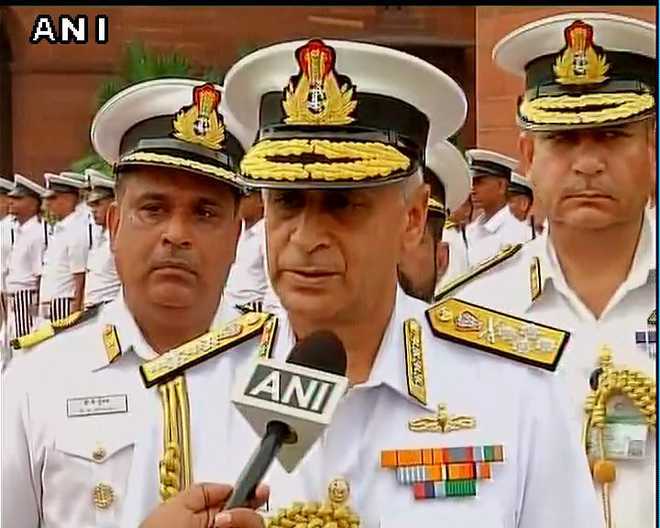
Chief of Naval Staff Admiral Sunil Lanba will begin a four-day visit to Russia on Monday with an aim to explore new avenues for the already close defence ties between the two countries, officials said on Sunday.

The Navy chief will hold wide-ranging talks with his Russian counterpart Admiral Vladimir Korolev and meet a number of top military officials including General VV Gerasimov, Chief of General Staff and First Deputy Defence Minister of Russia, they said.

“The visit aims to consolidate bilateral defence relations with Russia, as also to explore new avenues for defence cooperation,” Navy Spokesperson Capt. D K Sharma said.

Adm. Lanba’s visit to Russia comes around a week after the two countries signed a USD 500 million deal for construction of two missile frigates in Goa for the Indian Navy.

Under the deal, Russia will provide design, technology know how and key materials to Goa Shipyard Ltd. for the construction of the ships in India.

Adm. Lanba is also scheduled to visit the Nakhimov Naval School and Admiralty Shipyard.

He will also visit the Military Academy of the General Staff of the Armed Forces of the Russian Federation and deliver a talk on “Indian Navy’s Perspective on Maritime Security”, Capt. Sharma said.

Russian President Vladimir Putin visited India last month during which both sides had decided to further ramp up bilateral defence and security cooperation.

India is going ahead with mega defence deals with Russia disregarding warnings by the US of sanctions. The Trump administration has put several Russian firms under sanctions under Countering America’s Adversaries Through Sanctions Act (CAATSA).

The US said countries engaged with Russia’s defence firms may also face actions under CAATSA. India has been hoping to get a waiver from the US on the deals with Russia.

Russia has been India’s largest defence supplier. The bilateral defence and security cooperation has been on an upswing over the last few years. The Indian and Russian navies cooperate on many fronts, including operational interactions and training.

The Indian Navy and the Russian Navy have been conducting the bilateral Maritime Exercise ‘INDRA NAVY’, since 2003 and INDRA Tri-Services Exercise since 2017. PTI


HEROES MANIFEST BRAVERY AND HUMILITY

Brigadier Kuldip Singh Chandpuri (retd), war hero and lovable soul, has fallen to the ravages of time and a dreaded ailment which even he could not combat. His life and times were such that from humble beginnings he went on to become a household name, especially when his daring war time feat was memorably portrayed in the film Border. Sunny Deol essayed the role of the then Major Chandpuri who successfully battled enemy forces in the battle of Longewala when he and his men had hardly a hope of survival.

PHOTO COURTESY FAMILY ALBUMS■ The hero of the historic Battle of Longewala, Maha Vir Chakra winner, late Brig Kuldip Singh Chandpuri .Brig Chandpuri was a national icon and his demise has been mourned by all sections of society. But only those who knew Brig Chandpuri personally understood the true stature of this humble hero. Whenever I met him he would be full of positivity and cheer. He would address many like me as ‘sir’ despite our protests. His laughter was an uninhibited guffaw, with charm and sincerity gushing forth from his being. I have often told his elder son Hardeep that I felt truly inspired by the great man.

I fondly recall the occasion when he and I were fellow judges for a national level competition. He exemplified tireless grace in the long hours during which we deliberated upon the merits of potential winners.

His persona held a disarming charm which was old world and dignified, with nary an indication of his valorous past. He was harmless and genial, hardly the sort of man who could be expected to kill, even in war. Yet, his bravery and doggedness in uniform is the stuff of legends.

Last year, he called me up from a government office where he had gone to sort out some paperwork. He was apparently sitting in the PA’s office waiting for the Sahib to summon him inwards to his cabin. Such was Brig Chandpuri’s humility that instead of feeling riled he was rather apologetic about the whole thing. As if the government was doing him a favour by providing him a service to which he was entitled!

Humility actually runs in the family. Hardeep Chandpuri is the doyen of radio jockeying in this region and runs a training institute for RJs. He too is the epitome of simplicity.

Real life heroes are obviously brave and accomplished people. But what really sets them apart is the inner calmness and humbleness which they possess. Common citizens who save lives by diving into a river or rushing into a building on fire seldom boast about their feats later. They play with fire as if it is their bounden duty to do so. They are usually grounded, sincere and level headed people. Very few acts of bravery or selfless service come from the pompous and high-headed.

Those who crave for mileage and awards are perhaps lesser mortals, not having understood the fact that true following comes from intrinsic mettle and a down to earth approach to life. Flashes in the pan are common these days. Two minutes of fame is easy to attain with digital media spewing forth in viral fashion whatever it considers transiently worthy.

But true champions, heroes who have saved or changed lives, never seek glory. Goodwill comes to them in constant unstoppable showers, like a pleasant drizzle which never ends. The memory of a fallen soldier who sacrificed his life for the nation, or of a fearless fireman who saved dozens but perished himself, can never fade away.

Young people growing up in this highly materialistic era would do well to read about and try to emulate the qualities exemplified by inspiring personalities. They need to be motivated like never before. Otherwise they will end up being the cynical sorts who couldn’t care less.


The heroism of a tireless and spotless official who gives his entire life for the nation but hardly considers himself worthy of any praise, stating that it is only his duty to do so, should also inspire us all.

On humility, Ralph Waldo Emerson said, “A great man is always willing to be little!” When angelic heroes like Brig Chandpuri choose to leave the world, they leave behind a glowing aura which refuses to fade away and leaves us feeling embalmed and grateful.


Anil Ambani’s Reliance Sues NDTV For 10,000 Crores For Rafale Coverage

NDTV has been sued for 10,000 crores by Anil Ambani’s Reliance Group in a court in Ahmedabad for its reportage on the Rafale fighter jet deal. The hearing has been listed for October 26th and NDTV will argue that the charges of defamation are nothing more than a heavy-handed attempt by Anil Ambani’s group to suppress the facts and prevent the media from doing its job – asking questions about a defence deal and seeking answers that are very much in public interest.

The lawsuit is filed against NDTV’s weekly show, Truth vs Hype, which aired on September 29. Top executives of Reliance ignored repeated, multiple and written requests to appear on the show or comment on what is being widely discussed not just in India but in France as well – whether Anil Ambani’s Reliance was transparently chosen as the partner for Dassault in a deal that saw India buying 36 fighter jets.

Remember that just days before this show aired, the role of Reliance appeared to have been questioned by none other than Francois Hollande, who was the president of France when the deal was struck. The NDTV show reported all sides of the story including Dassault’s denial that it had been under any pressure to select Reliance. The panellists, in a balanced discussion, examined whether issues like Reliance’s vast debt and record in defence manufacturing made it a suitable choice for Dassault in India.

As the Rafale deal has become a larger news story in India, the Reliance group has been on a notice-serving spree; to sue a news company for 10,000 crores in a court in Gujarat on false and frivolous charges, ignoring facts that are widely reported everywhere and not just by NDTV, can only be interpreted as an unsophisticated warning to the media to stop doing its job.

NDTV outright rejects any charges of defamation and will present material in court to support its case. As a news organisation, we are committed to independent and fair journalism that uncovers the truth.