Sanjha Morcha

What’s New

Click the heading to open detailed news

Current Events :

web counter

Print Media Reproduced Defence Related News

MEA allows post-police verification for passport


short by Prashanti Moktan / 03:36 pm on 26 Jan 2016,Tuesday
The Ministry of External Affairs on Monday announced that all first time applicants for normal passports will be able to avail passports on post-police verification basis without any additional fees. The MEA also launched ‘mPassport Police App’, a phone application that allows quick submission of Police Verification Report. The Ministry has made these reforms to speed-up the issuance of passports.
French army first foreign contingent at R-Day
short by Bhavika Bhuwalka / 05:31 pm on 26 Jan 2016,Tuesday
French army soldiers on Tuesday became the first foreign military contingent to take part in India’s Republic Day parade. Led by Lieutenant Colonel Paul Bury of the 35th Infantry Regiment, the 76-member contingent marched down Rajpath before President Pranab Mukherjee, French President François Hollande and Prime Minister Narendra Modi. Also, a French band played two military tunes at the parade.
Books on Param Veer Chakra awardees launched
short by Ankur Vyas / 03:47 pm on 26 Jan 2016,Tuesday
HRD Minister Smriti Irani and Army Chief General Dalbir Singh on Monday launched the first batch of books on the Param Vir Chakra awardees. The books aim to introduce the younger generation to the stories of valour of the bravest of brave Indian soldiers and inspire them. The illustrated story books are meant for children between 7 and 11 years.
Reports claim shot-down balloon came from Pak
short by Aarushi Maheshwari / 08:03 pm on 27 Jan 2016,Wednesday
The balloon shot down by a Sukhoi-30 fighter aircraft over Rajasthan on Republic Day came from Pakistan, according to reports. The balloon was flying at approximately 25,000 feet, and could have been sent to gauge India’s response time. The Indian Air Force said, “on analysis of the debris it was established that there was no dangerous payload.”

IAF BASE ATTACKED Why is Pathankot on target again?

Through the district pass the strategically important lone rail and road links to Jammu & Kashmir

Ajay Banerjee,Tribune News Service,New Delhi, January 2

2016_1$largeimg03_Sunday_2016_014401438
An armoured vehicle moves near the Indian Air Force base that was attacked by terrorists in Pathankot on Saturday. PTI

2016_1$largeimg03_Sunday_2016_014439857gallery

A narrow plain (just 30-km wide) lies between the Himalayas and the international border with Pakistan. Located at the eastern edge of this plain and nestled in the foothills at an altitude of 1,090 feet is the militarily vital town of Pathankot. It is the northern-most district of Punjab that is located at the confluence of the boundaries of J&K and Himachal Pradesh.The narrow 30-km plain is clearly India’s ‘jugular vein’ — the weakest point. India’s military prowess at Pathankot and around is tasked to ensure dominance in the topography marked by fast-flowing seasonal rivulets and jungles. Through these 30 km pass the lone rail and road connection to J&K. The national highway connecting Jammu is the lone link across the Ravi, allowing military and civilian movement and so is the lone rail link that carries passengers to Udhampur and Katra. The air base at Pathankot had been attacked by the Pakistan Air Force (PAF) during the 1965 and 1971 wars. Today’s attempt by terrorists to storm the base can be counted as the third attempt to target it even though it does not match the scale of the PAF attack. “Today’s attack had the potential to cause damage to planes and helicopters at the base. Good that it was contained,” says Commodore Uday Bhaskar (retd). Besides a MiG 21 fighter jet squadron, Pathankot is home to a squadron of attack copters that fly in tandem with ground-trawling tank regiments. The base also has UAVs, air defence guns and long-distance surveillance radars. A town having 1.56 lakh population, Pathankot houses Mamun cantonment, which is used as a launching ground. The Army has a division —some 15,000 men — complete with artillery guns and tanks. It is also the base for a new division which is part of the upcoming 17 Mountain Strike. Pathankot remains top priority for the IAF which has otherwise formed a formidable ‘ring fence’ of air fields like Adampur (Jalandhar), Halwara (Ludhiana), Bathinda, Sirsa and Ambala in Haryana and Suratgarh in Rajasthan. Air Commodore Kaiser Tufail (retd) of the PAF — known as an aviation historian — writes in his blog ‘aeronaut’ about the Pakistan design to damage the Pathankot runaway. “In 1971, Pathankot was singled out for two successive raids,” he says. SN Prasad in his book ‘The India Pakistan War of 1965’, an authorised account from the Ministry of Defence archives says the PAF, on the intervening night of September 6 and 7, 1965, launched an unusual attempt to destroy IAF aircraft and airfield installations. Paratroopers of the Special Services Group were air-dropped at night near Pathankot, Halwara and Adampur. Of the 180 Pakistani commandos, 136 were taken prisoner, 22 killed and the rest managed to escape. Pak phone number used to hire taxi Pathankot: The terrorists were in regular touch with their Pakistani handlers, who even arranged a taxi for them by calling from a mobile number of that country. Sources said the terrorists had first used a Toyota Innova on Friday and it has been found that the driver was called from a Pakistan number. Security agencies are questioning the driver and trying to find out whether he had any links with terrorists or was it a case of him not recognising a Pak number. Sacked IAF technician to be quizzed New Delhi: A sacked IAF official, arrested for allegedly sharing secret information with ISI, will be interrogated, investigators told a city court which extended his police custody till Monday. Ranjith KK, a Leading Aircraftman with IAF posted at Bathinda, was dismissed recently and later arrested. He had allegedly shared secret information with intelligence operatives suspected to be backed by ISI after being “honeytrapped” into an espionage racket.

Gujarat on high alert

Ahmedabad: The Gujarat Police have issued an alert and the security personnel have been told to take necessary steps to keep a check on suspicious activities in the wake of the terror attack in Punjab. “In the wake of today’s terror attack in Punjab, I have asked the police department and respective heads to remain alert. Based on some inputs available with us, I have ordered the police force to take all necessary steps and increase vigil across the state,” said PC Thakur, DGP.

Parrikar meets NSA

  • Defence Minister Manohar Parrikar on Saturday chaired a high-level meeting during which he was briefed in detail by National Security Adviser Ajit Doval on the terror attack.
  • It was attended by the three service chiefs and the Defence Secretary. The meeting lasted 90 minutes during which Parrikar was given a detailed overview about the intelligence received and the action taken.
  • The meeting focussed on the intelligence inputs received and the counter measures taken by the armed forces, including deployment of the NSG commandos, personnel of the special forces belonging to the Army and the IAF, besides regular soldiers.

Rafale deal inked, price still an issue Inter-governmental pact on plane purchase later

Simran Sodhi & Ajay Banerjee,Tribune News Service,New Delhi, January 25

2016_1$largeimg26_Tuesday_2016_010547778

India and France today signed a memorandum of understanding (MoU) on the purchase of the Rafale fighter jets. The much-anticipated inter-governmental agreement (IGA) on Rafale will now be signed later, once the financial negotiations between the two sides are completed.Hectic negotiations had been going on for the past few days to enable the IGA to be signed during French President François Hollande’s visit.At the end of the delegation-level talks between Prime Minister Narendra Modi and Hollande, Modi said only the financial details needed to be worked out in finalising the purchase of Rafale jets from France.“Only financial aspects of the Rafale deal are left. The inter-governmental agreement has been finalised. It will be done soon,” said the Prime Minister. Foreign Secretary S Jaishankar, while briefing the media, later said only the MoU had been signed today and the IGA would be the next step.He said both countries had been able to reach an agreement on the non-financial side, while they were yet to agree on the financial side.The joint statement issued at the end of the delegation-level talks said: “The two leaders welcomed the conclusion of the inter-governmental agreement on the acquisition of 36 Rafale fighter aircraft in flyaway condition, except for some financial issues relating to the IGA which they agreed must be resolved as soon as possible.”India had announced that it would buy 36 Rafale fighters in a government-to-government deal during Modi’s Paris visit in April.Since then, negotiations had been going on about the pricing of the aircraft, the main sticking point in the financial side of the deal. The Tribune had first reported on January 16 that India was looking to go for a better price than take a hasty step at this stage.Sources indicate the cost negotiation committee of the Indian Air Force has met and suggested a price that does not match the expectations of French company Dassault Aviation, the maker of Rafale.The Indian side is doing a cost benefit analysis as it may end up paying nearly Rs 1,200 crore per plane, including arsenal, training and base facilities.In comparison, the last order for 42 Sukhoi-30 MKI fighter jets was agreed upon in 2010 and cost Rs 470 crore per plane. The IAF has told the Ministry of Defence that it needs at least 80 Rafale-type multi-role combat fighter jets to be battle-ready in the next few years.A “mere” 36 jets — presently on order — would not meet the shortfall due to the phasing out of fleet of MiG-21 and MiG-27 jets by 2022.Dassault, in a press release issued, today said: “During French President François Hollande’s visit to India, French and Indian governments signed an inter-governmental agreement paving the way for the conclusion of a contract for the sale of 36 Rafale fighters to India.“Dassault Aviation is very pleased with this progress.”

The cost factor

  • IAF’s cost negotiation panel has suggested a price that does not match the expectations of Rafale maker Dassault Aviation, say sources
  • At the current price, India may end up paying around Rs 1,200crore per jet, including arsenal, training and base facilities
  • During the 2010 Sukhoi-30 MKI jet deal, the fighteraircraft had cost Rs 470 crore each

9726c7b9-f626-4c92-91c7-5ca117de1dce dogs-republic-day-5_012316091236

bd90cb9a-eb44-4ed5-8139-a51ad41ebf4d

France, India sign deal for Rafale jets

13 agreements signed in a number of sectors; India to get $10 billion investment in next five years

NEW DELHI: India signed an agreement with France on Monday to buy 36 Rafale fighter jets but said sorting out details of the multibillion euro deal such as pricing and post-sales servicing would take some more time.

PIBPrime Minister Narendra Modi and French President Francois Hollande take a Metro to Gurgaon where they inaugurated the interim secretariat of the International Solar Alliance on Monday.On the second day of French President Francois Hollande visit, the two sides also signed 13 pacts in various fields including railways and civil nuclear energy, with the French promising to invest $10 billion in next five years in India.

“…Leaving out financial aspect, India and France have signed inter-governmental agreement on purchase of 36 Rafale fighter jets. We expect that even the financial aspects… will be resolved as soon as possible,” Prime Minister Modi said at a joint press event with Hollande.

The French President, who will be the chief guest at the Republic Day celebrations on Tuesday, described the deal on Rafale as “a decisive step”.

Modi had announced India’s intention to buy 36 Rafales in Paris in April. Modi and Hollande had to step in after New Delhi scaled back the original plan to buy 126 Rafales and commercial negotiations between planemaker Dassault Aviation and Indian officials collapsed.

Dassault Aviation said on Monday it was supporting French authorities in their efforts to finalise a complete agreement within the next four weeks.

India desperately needs to upgrade its aging Soviet-era fleet plagued by engine troubles and poor availability. The Indian Air Force requires at least 44 fighter squadrons — with 18 planes each — to counter the combined threat from Pakistan and China.

Officials had hoped to seal the deal during Hollande’s visit but resolving the technicalities appeared more complicated than expected, leaving the French President to temper expectations and say such negotiations take time. India was steering clear of setting a deadline to seal the deal as it wanted to get the best price for the fighters, a government official said. HT wrote last week that France had indicated a maximum price of around euro 11.6 billion for the warplanes with full armament complement. India is negotiating to bring the price down to around euro 8 billion.

“What was signed today was an MoU and, when the financial part of it issettled, then obviously the inter-governmental agreement in its entirety will be concluded,” foreign secretary S Jaishankar later told mediapersons.

The agreement, government sources said, would be signed once the prices had been finalised which they hoped would take another four weeks.

The French leader arrived Sunday in Chandigarh, where he was received by Modi. Independent India’s first planned city, Chandigarh was designed by Swiss-French architect Le Corbusier and is one of three places that France has pledged to help develop as smart cities. The other two are Puducherry and Nagpur. France will also help modernise Ambala and Ludhiana railway stations. In a boost to the government’s Make in India campaign, French firm Alstom will manufacture 800 electric locomotives at Madhepura in Bihar.

Hollande said an agreement for France’s Areva to build six nuclear reactors in India should be concluded within a year. The two sides have been wrangling over the price of power from these units for more than a year.

“From nuclear cooperation to railway locomotives, we are sowing the seeds of an ever-tightening web of cooperation between our two countries,” Modi said.

HOLLANDE VISIT

India, France ask Pak to bring Pathankot attackers to justice

Simran Sodhi,Tribune News Service,New Delhi, January 25

2016_1$largeimg26_Tuesday_2016_005839591 2016_1$largeimg26_Tuesday_2016_005943544gallery

India and France today took a significant step forward in addressing the challenges of global terrorism and said there was an “urgent need to establish a comprehensive international legal framework to address the growing global menace of terrorism”. While the recent attacks on Paris and Pathankot found a common resonance in the bilateral discussions, the joint statement clearly called on Pakistan to bring the perpetrators of the recent attacks in Pathankot and Gurdaspur and also the perpetrators of the deadly Mumbai 2008 attacks to justice. “From Paris to Pathankot, we saw the gruesome face of the common challenge of terrorism…I also commend the strength of your resolve… President Hollande and I have agreed to scale up the range of our counter-terrorism cooperation in a manner that helps us to tangibly mitigate and reduce the threat of extremism and terrorism to our societies.“We are also of the view that the global community needs to act decisively against those who provide safe havens to terrorists, who nurture them through finances, training and infrastructure support,” Prime Minister Narendra Modi said at a joint press event with French President Francois Hollande.The joint statement on counter-terrorism issued today said: “Stressing that terrorism cannot be justified under any circumstance, regardless of its motivation, wherever and by whomsoever it is committed, both leaders asked for decisive actions to be taken against Lashkar-e-Toiba, Jaish-e-Mohammad, Hizb-ul-Mujahideen, Haqqani Network and other terrorist groups such as Al-Qaida.”“Condemning the recent terror attacks in Pathankot and Gurdaspur in India, the two countries reiterated their call for Pakistan to bring to justice their perpetrators and the perpetrators of the November 2008 terrorist attacks in Mumbai, which also caused the demise of two French citizens, and to ensure that such attacks do not recur in the future,” it said.The two leaders also strongly condemned the terrorist attacks that occurred in many parts of the world recently and “expressed their shared anguish and outrage at the loss of innocent lives in Paris, Bamako, Beirut, Tunis, San Bernardino, N’Djamena and the Lake Chad Basin Region, Kabul, Gurdaspur, Istanbul, Pathankot, Jalalabad, Jakarta, Ouagadougou and Charsadda.

61916


LCA Tejas set to debut outside Indian airspace

NEW DELHI: The locally-produced light combat aircraft (LCA) is set to make its international debut. The LCA Tejas will fly outside Indian airspace for the first time at the Bahrain International airshow being held at the Sakhir airbase from January 21-23, a defence ministry spokesperson said on Friday.

The fighter is among the 15 weapon systems identified for export by the Defence Research and Development Organisation to help the country get into the international arms bazaar. The Indian Air Force plans to induct six squadrons (120 planes) of the LCA with upgrades, including a new electronic warfare suite, refuelling capacity, better missiles and improved radar.

A report released by the comptroller and auditor general in May 2015 had revealed that the LCA-Mark1 was riddled with 53 “significant shortfalls” that could compromise its survivability in combat.


‘Rudra’ to debut at R-Day parade

Tribune News Service,New Delhi, January 23

2016_1$largeimg24_Sunday_2016_012902432

Indigenously designed, developed, built and weaponised version of advanced light helicopter (ALH) — “Rudra” — will make its debut at the Republic Day parade. The helicopter produced by the Defence Ministry owned public sector giant Hindustan Aeronautics Limited (HAL) is being used by the Army since February 2013.The HAL is to produce 76 of these helicopters of which 60 are for the Indian Army’s Strike Corps formations — three of them headquartered at Mathura, Ambala and Bhopal. Armed helicopters fly in coordination with ground-based tank regiments. HAL handed over the first two Rudra helicopters to the Army’s Aviation wing in Bangalore in 2013 and since then more machines have been added.Rudra is equipped with a mix of weapons providing it with the capability to search and destroy any target. It carries a 20mm automatic cannon, which can fire at a rate of 750 rounds per minute with an effective range of 2,000 metres.The stub-wings of Rudra can be fitted with up to eight Helina (helicopter-launched Nag) anti-tank guided missiles, four MBDA mistral short-range air-to-air missiles or four rocket pods for 70mm rockets. The helicopter is equipped with Integrated Defensive Aids Suite (IDAS), radar warning receiver, IR jammer, flare and chaff dispenser. Pilots have a helmet-mounted sight and fixed sight facilitating firing of the onboard weapons. Future upgrades will include infra-red jammer, obstacle avoidance system for the Army version of the helicopter and Nuclear Biological and Chemical sensors. The helicopter is powered by French origin Turbomeca engines and has a maximum speed of 270 kmph with flying ceiling of 20,000 feet. Another first this time will be a covered bulletproof enclosure — that will have a roof. Last year, the dignitaries sat through rain.French President Francois Hollande will be the chief guest. The Army’s dog squad used as sniffers and explosive detectors will also figure in the parade. It will be after 27 years that the dogs will be part of the parade. Also plagued by monotony and security concerns of protecting a large number of high-risk individuals, this year’s parade will be shorter by 25 minutes (of 90 minutes).

ccafe1e2-d160-4a9b-b7e9-a85796dace18 62163


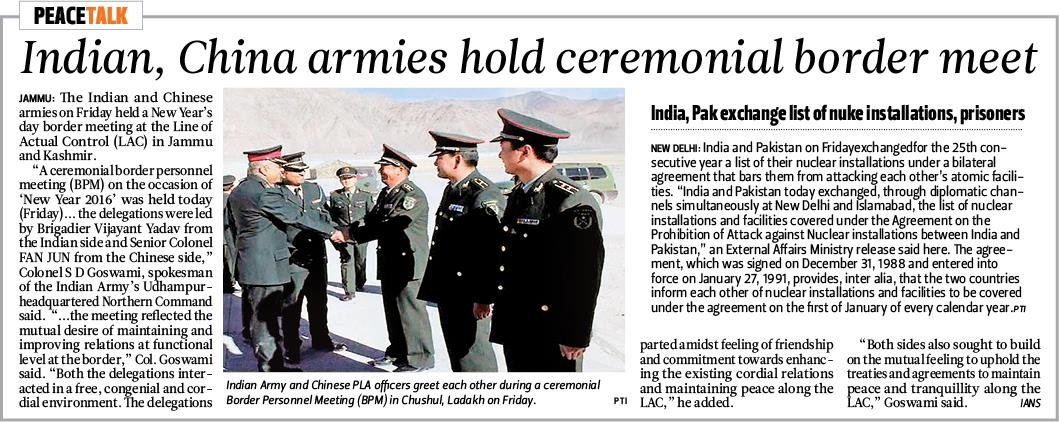
India, China border personnel meet held on LAC

ribune News Service,Jammu, January 1

2016_1$largeimg01_Friday_2016_234827618
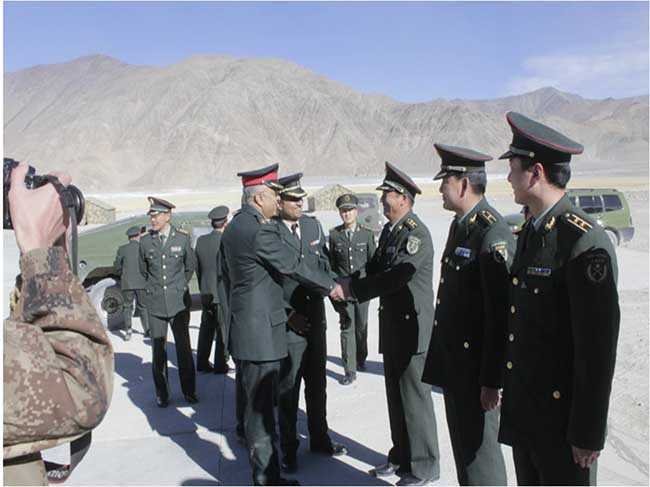
A ceremonial border personnel meeting in the Chushul Sector of eastern Ladakh on the New Year. A Tribune photo

A ceremonial border personnel meeting between India and China was held on the Line of Actual Control (LAC) in the Chushul sector of eastern Ladakh on the New Year today. The meeting was held at the Moldo Garrison of the Chushul sector, said defence spokesperson SD Goswami.“Both the sides sought to build on the mutual feeling to uphold the treaties and agreements signed between the governments of the two sides to maintain peace and tranquility along the LAC,” said Goswami.The Indian delegation was led by Brigadier Vijyant Yadav whereas the Chinese side was represented by Senior Colonel Fan Jun.The meeting was marked by saluting the national flag of China by the members of both the delegations followed by ceremonial address by leaders of the two groups. The delegation heads exchanged New Year greetings and expressed mutual desire of maintaining and improving relations at functional level at the border, said the spokesperson. Both delegations interacted in a free, congenial and cordial environment, the spokesperson added.During the recent visit of Northern Command chief Lt Gen Hooda to Lanzhou Military Region, measures to maintain cordial relations, peace and tranquility were discussed between the two sides. Meanwhile, a culture programme showcasing vibrant Chinese culture and traditional grandeur was also organized on the occasion.

62417

Two Army men arrested for extortion in Kulgam

Suhail A Shah,Anantnag, January 1

Four persons, including two Army men, have been arrested in Kulgam district of south Kashmir for allegedly extorting money on gun point while posing as Hizbul Mujahideen militants.The Army men have been found involved in more than one case of extortion, the police said.The police were investigating an extortion complaint by a doctor from Khrewan village of the district when the role of the two Army men came under scrutiny.The accused soldiers have been identified as Muhammad Yousuf Teli and Muhammad Rafiq Khanday of Jammu and Kashmir Light Infantry. They are presently posted with the 19 Rashtriya Rifles camp in the Larkipora area of Kulgam district.The police said the accused Army men were the residents of the district.According to police report, an FIR (303-2015) under sections 34, 386 and 452 of the Ranbir Penal Code was registered against the accused after an extortion complaint by Dr Bila Beigh from the Khrewan Malpora area.Dr Beigh told the Tribune that two armed men, posing as Hizb militants, had held his family hostage on Sunday evening and ransacked their house, before decamping with Rs 32,000 and some electronic gadgets.“I was in Delhi when the incident took place. My sister and her husband were at my place and they were in deep shock,” Dr Beigh said.Station House Officer (SHO), Qazigund, Parvez Ahmad said it was Dr Beigh’s sister who had spotted one of the accused at the Emergency Hospital in Qazigund, where she works as a senior dental technician.“The police swung into action and arrested the identified man, who led us to his accomplice,” the SHO said.The two were identified Muzaffar Ahmad Bhat and Nisar Ahmad, he said.While the police were interrogating the arrested duo, one of Dr Beigh’s neighbours Muhammad Yousuf Teeli approached him and confessed to have provided weapons to the accused duo.“He pleaded for forgiveness and was worried that he will be thrown out of the Army,” Dr Beigh said. “I, however, informed the police regarding the incident and they picked up the threads from there,” he said. The police questioned Teeli and subsequently secured a confession from him of being involved in multiple extortion cases. “He also led us to one of his accomplices. Both have been produced in court and sent to remand,” the SHO said.The police officer said the Army men have also confessed to having carried out similar extortions across Kulgam and in neighbouring Anantnag district.

In the dock

  • Two Army men and two civilians have been arrested in Kulgam district for allegedly extorting money on gun point while posing as Hizbul Mujahideen militants
  • The accused soldiers have been identified as Muhammad Yousuf Teli and Muhammad Rafiq Khanday of the Jammu and Kashmir Light Infantry. They are at present posted with the 19 Rashtriya Rifles camp in the Larkipora area of Kulgam district

Poor quality products from Ordnance Factory Board forces soldiers to purchase boots and uniforms

NEW DELHI: Soldiers of the world’s second-biggest army are being forced to buy their own boots and uniforms because those issued to them are so poor in quality. Defence ministry officials told ET that the Ordnance Factory Board (OFB), responsible for the production of boots and uniforms, has been inundated with complaints about substandard products.

While the matter has been raised with the defence ministry, OFB officials are said to have been conducting surveys and inspections across units in the last few months, besides interacting with officials on the quality of products.

The boots are liable to tear and the heavy sole is prone to dropping off, said a soldier who has had to buy a new pair within three months of being issued OFB footwear.

As for uniforms, the biggest complaint is the quality of the material, which gets ripped and fades, adding to colour mismatches. A havildar said that this means getting pulled up at inspections and parades. Awkward sizing is another complaint, making it also almost impossible for the soldiers of the 1.2 million strong army to find the right fit.

“The OFB issues uniforms and boots every 18 months, but they last only three-four months,” said one of the persons cited above. “There is no option but to buy these from the market.” OFB hadn’t responded to queries as of press time.

Army headquarters confirmed that there were flaws in the boot design. “Boot High Ankle DVS was reported to have heavy sole and a better design and lighter weight with polyurethane rubber sole for better flexibility has been identified,” said an official. Approval for an open tender enquiry ( OTE) has been obtained, he said.

ET VIEW
Put out tender for accessories

Armies are no longer measured by their size alone, but by their armoury — and how their soldiers are treated. Clearly, the Indian Army has been suffering on the second front. No matter how much we valorise our soldiers, if basic equipment like uniform and boots are sub-standard, there is a serious problem of morale –especially when soldiers are made to make their own purchases. If the ordnance factories can’t do the job, put out tenders to get them from elsewhere.


Pakistan’s army is building an arsenal of ”tiny” nuclear weapons—and it’s going to backfire

rtx1nnfn

Pakistan has the fastest growing nuclear arsenal and, within the next five to ten years, it is likely to double that of India, and exceed those of France, the United Kingdom, and China. Only the arsenals of the United States and Russia will be larger.

In recent years, Pakistan has boasted of developing “tactical nuclear weapons” to protect itself against potential offensive actions by India. In fact, Pakistan is the only country currently boasting of makingincreasingly tiny nuclear weapons (link in Urdu).

Pakistanis overwhelmingly support their army and its various misadventures. And the pursuit of tactical weapons is no exception. However, there is every reason why Pakistanis should be resisting—not welcoming—this development. The most readily identifiable reason is that, in the event of conflict between the two South Asian countries, this kind of weaponization will likely result in tens of thousands of dead Pakistanis, rather than Indians. And things will only go downhill from there.

Why would Pakistan want “the world’s smallest nuclear weapons”?

In late 1999, Pakistan’s general Pervez Musharraf (who took power of Pakistan through a military coup in Oct. 1999 and remained in power until 2008), along with a tight cabal of fellow military officials began a limited incursion into the Kargil-Dras area of Indian-administered Jammu and Kashmir. While planning for this began in the fall of 1998, by the time Pakistani troops were discovered there in May of 1999 Pakistani forces had taken territory that was several miles into India-administered Kashmir.

Because the Pakistanis had the tactical advantage of occupying the ridge line, India took heavy losses in recovering the area from the invaders. The so-called Kargil War was the first conventional conflict between India and Pakistan since the two conducted nuclear tests in May 1998. International observers were wary that the conflict would escalate either in territory or aims, with the potential for nuclear exchange.

Fearing such escalation, then Pakistani prime minister Nawaz Sharif sought support from China and the United States. Both were adamant that Pakistan respect the line of control, which separated the portions of Jammu-Kashmir administered by India and Pakistan.

Under international pressure and branded an irresponsible state, Pakistan withdrew its forces from Kashmir. It initially claimed that the intruders were mujahedeen—but this was later found to be pure fiction. While Pakistan was isolated internationally, the international community widely applauded India’s restraint. The Kargil War provided the United States with the opportunity to reorient its relations away from Pakistan towards India, while at the same time, demonstrated to India that the United States would not reflexively side with Pakistan.

In retrospect, the Kargil war catalyzed the deepening security cooperation between the United States and India. It also galvanized a serious rethink in India about its domestic security apparatus, intelligence agencies’ capabilities, and overall military doctrine.

Crucially, India learned from this conflict that limited war is indeed possible under the nuclear umbrella. In Oct. 2000, air commodore Jasjit Singh, who retired as the director of operations of India’s air force and headed India’s Institute for Defence Studies and Analyses until 2001, laid out the lineaments of an India’s limited war doctrine. However, no apparent effort was made to make this a viable military concept immediately and India persisted with its defensive posture. In late Dec. 2001, Pakistani terrorists from the Pakistan-backed military group Jaish-e-Mohammad attacked India’s parliament in New Delhi.

In response, India’s government began the largest military mobilizationsince the 1971 war, which resulted in the liberation of Bangladesh, then East Pakistan. Just as the crisis was subsiding, another group of Pakistani terrorists, Lashkar-e-Taiba, attacked the wives and children of Indian military personnel in Kaluchak, Kashmir. India again seemed poised to take military action but ultimately backed down. The crisis was officially defused after India held elections in Kashmir later that fall. Pakistan concluded that its nuclear arsenal had successfully deterred India from attacking.

As Walter Ladwig has written, analysts identified several problems with India’s posture during that crisis. First, the Indian army took a long time to mobilize which gave Pakistan time to internationalize the conflict and to bring international pressure to bare upon India. Second, the mobilization of India’s strike corps had no element of surprise. Even Pakistan’s modest surveillance capabilities could easily detect their movements, and given their “lumbering composition,” could quickly discern their destination. Third, according to Ladwig, India’s holding corps’ were forward deployed to the border but lacked offensive power and could only conduct limited offensive tasks.

In response to these collective inadequacies, and the prospects of enduring threats from Pakistan, the Indian defense community began formalizing what came to be known as “Cold Start.” Ladwig, who wrote the first comprehensive account, claims that the doctrine aimed to pivot India away from its traditional defensive posture, and towards a more offensive one. It involved developing eight division-sized “integrated battle groups” that combined infantry, artillery, and armor which would be prepared to launch into Pakistani territory on short notice along several axes of advance.

These groups would also be closely integrated with support from the navy and air force. With this force posture, India could quickly mobilize these battle groups and seize limited Pakistani territory before the international community could raise objections.

India could then use this seized territory to force Pakistan into accepting the status quo in Kashmir. While Indians insist that this doctrine never existed, other analysts discount Indian demurrals and note slow—but steady—progress in developing these offensive capabilities. Irrespective of India’s protestations, Pakistanis take “Cold Start” to be a matter of Quranic fact.

Worried that its primary tools of using terrorism fortified by the specter of nuclear war, and fearing that India would be able to force acquiescence, Pakistan concluded that it could vitiate “Cold Start” by developing tactical nuclear weapons. As Pakistan’s former ambassador the United States and current ambassador to the United Nations,Maleeha Lodhi, explained, the basis of Pakistan’s fascination with tactical nuclear weapons is “to counterbalance India’s move to bring conventional military offensives to a tactical level.’’

Pakistani military and civilians often boast of their fast growing arsenal of the world’s smallest nuclear weapons and routinely update the world on the progress of the short-range missile, the Nasr, that would deliver this ever-shrinking payload.

Why should ordinary Pakistanis care?

While Pakistanis overwhelmingly applaud their army’s continued efforts to harass India in pursuit of Kashmir—a territory that Pakistanwas never entitled to but fought three wars to acquire by force—there are numerous reasons why Pakistanis should be more sanguine, or evenalarmed by Pakistan’s development of tactical nuclear weapons.

The first reality that should discomfit ordinary Pakistanis is that there is really no such thing as a “tactical nuclear weapon.” Even the smallest so-called tactical nuclear weapon will have strategic consequences. (Simply calling them “battlefield nuclear weapons” does not obviate this serious problem.) If Pakistan should use such weapons on India, there is virtually no chance that India will be left responding alone. The international community will most certainly rally around India. The response to Pakistan breaking a nuclear taboo that formed after the Americans used atomic bombs on Japan will most certainly be swift and devastating.

Second, as Shashank Joshi, a war studies researcher at the University of Oxford, has argued, these weapons do not have the military benefits that Pakistan’s military boasts, yet they exacerbate the enormous command and control challenges, including the possibility that nefarious elements may pilfer them once they are forward deployed. For one thing, tactical nuclear weapons do not have significant battlefield effects on enemy targets. For another, it is not evident that these weapons are in fact capable of deterring an Indian incursion into Pakistan.

Third, while Naeem Salik, a former director for arms control at Pakistan’s Strategic Plans Directorate, has said that Pakistan has shifted away from merely doctrinal thinking towards “actual nuclear war fighting,” such thinking is hardly viable for the simple reason of faulty math.

Even if, for the sake of argument, one assumes that Pakistan deploys its one hundred odd weapons of 15 to 30 kilotons at India’s major cities, it is unlikely that Pakistan would be able to deploy all of these weapons to conduct a “splendid first strike,” by which Indian capabilities are completely destroyed.

Moreover, it takes considerably fewer weapons of similar magnitude to utterly destroy Pakistan. Pakistan has thoughtfully concentrated all but three corps in central the Punjab region, which is also its most populous province and the country’s industrial and agricultural center. In short, Pakistan will cease to be a viable political entity while India, though grievously hurt, will survive as a state. Even if Pakistan obtains a functioning triad and retains launch capabilities from submarines, they will be launched in defense of a state that, simply put, no longer exists.

There is a fourth problem that should disquiet Pakistanis perhaps even more than the triggering of the destruction of their country through the deliberate or inadvertent use of their micro-weapons—these tactical nuclear weapons are intended to be used first against Indian troops on Pakistani soil. According to a conference report by the Naval Post School, which hosted Pakistan’s military and diplomatic officials, one Pakistani luminary opined that the “Nasr creates a balancing dynamic that frustrates and makes futile the power-maximizing strategy of India.”

He envisages the Nasr’s shells being used to carry atomic explosives that would annihilate advancing Indian armored thrusts in the southern deserts and blunt Indian advances toward major Pakistani cities, such as Lahore. Retired military general S. F. S. Lodhi, in the April 1999 issue of the Pakistan Defence Journal, laid out four stages of escalation in Pakistan’s use of tactical nuclear weapons which aligns with this view as well.

The consequences of Pakistan nuking itself to keep the Indians out should disturb Pakistanis. According to calculations by Jaganath Sankaran, Pakistan would have to use a 30-kiloton weapon on its own soil, as this is the minimum required to render ineffective fifty percent of an armored unit.

Using Lahore as an example, a 30-kiloton weapon used on the outskirts of the city could kill over 52,000 persons. As Indian troops move closer to Lahore and as the population increases, such a weapon could kill nearly 380,000. Sankaran notes, as an aside, that this would “genuinely destroy a larger battalion or brigade.” Consequently, many more Pakistanis would be likely to die than these horrendous figures suggest.

All of sudden, Pakistan’s tactical nuclear weapons don’t look so fun for any Pakistani who thinks through the math.

Fifth, Pakistanis should be derisive of this new weapon in the national arsenal because it cannot do what the army promises: protect Pakistan from an Indian offensive. Would any Indian military planner take seriously Pakistan’s threat to use nuclear weapons on its own soil when the casualties are so high? Pakistan may have been willing to eat grass to get its nuclear weapons, but is it willing destroy its own center of gravity to maintain its ability to harass India with terrorism over territory to which it never had any legal claim? If the Indians do not take this threat seriously, how is it a deterrent against them? What additional deterrent capability do these weapons afford Pakistan that its strategic assets do not that compensates for the enormous risks they convey?

Finally, if India took Pakistan’s threats seriously, it does not have to invade Pakistan to coerce the country’s leaders to detonate one of these weapons on its own soil. Presumably simply looking adequately likely to cross the international border and threaten a major Punjabi city could provoke a “demonstration detonation.”

I am not encouraging a nuclear Armageddon upon Pakistan; rather expositing the limited utility that these weapons confer upon Pakistan.

Even if Pakistan fully inducts these weapons in its arsenal, it still has an army that can’t win a conventional war against India and nuclear weapons it cannot use. This leaves only an industrial farm of terrorists as the only efficacious tool at its disposal. And given the logic of the above scenario, India and the international community should consider seriously calling Pakistan’s bluff. The only logical Pakistani response to a limited offensive incursion is to accept the fait accompli and acquiesce.
So far, the West has seen Pakistan’s nuclear weapons as a proliferation threat rather than a security threat. The implications of this has largely been appeasement. The United States, worried that Pakistan’s weapons may fall into the hands of non-state actors or that Pakistan will once again reopen its nuclear weapons bazaar to aspirant nuclear powers, perpetually argues for engaging Pakistan diplomatically, militarily, politically, and financially. In essence, Pakistan has effectively blackmailed the United States and the international community for an array of assistance exploiting the collective fears of what may happen should Pakistan collapse.

In recent months, some US White House officials have even argued for a potential nuclear deal to reward Pakistan for making concessions in fissile material production, limiting the development and deployment of its nuclear weapons among other activates to address Washington’s proliferation concerns. Unfortunately, Washington has yet to seriously formulate punishments rather than allurements to achieve these ends, even though Pakistan has shown no interest in making such concessions.

There are reasons why the United States and the international community should begin to see Pakistan’s nuclear weapons as a direct security threat. For one thing, these nuclear weapons have always been intended to allow Pakistan to harass India through the use of militant proxies. Consequently, Pakistan has become an epicenter of Islamist terrorism.

Had Pakistan not had these nuclear capabilities, India could have sorted out Pakistan some time ago. Moreover, the critical time period for Pakistan’s nuclear program was in the late 1970s, when Pakistan was on the threshold of obtaining a crude weapon. (We now know that Pakistan had a crude nuclear weapon by 1984 if not somewhat earlier.) The United States even sanctioned Pakistan in 1979 for advances in its program.

The United States relented in its nonproliferation policy with respect to Pakistan after the Soviet Union invaded Afghanistan. Reagan, after getting sanctions waived in 1982, began supporting the so-called mujahedeen produced by Pakistan for use in Afghanistan. (Pakistan actually began its own jihad policy in 1974 on its dime without US assistance.)

Saudi Arabia matched America’s contributions. While al-Qaeda is not truly the direct descendent of the Afghan mujahedeen, there can be little doubt that the structures built to wage this jihad gave birth to the group. Had the United States remained focused on nuclear weapons in Pakistan, and used a different strategy in Afghanistan, a wholly different future could have been realized.

As tensions between the United States and Pakistan deepen, and as Pakistan’s arsenal expands and permits it to target US assets in South, Central, and Southwest Asia, the United States should begin considering Pakistan’s proliferation of nuclear weapons and delivery vehicles as a direct threat to its security, rather than merely a proliferation problem to be managed. We welcome your comments at ideas@qz.com.

http://qz.com/579334/pakistans-army-is-building-an-arsenal-of-tiny-nuclear-weapons-and-its-going-to-backfire/



Ex-servicemen protests outside Jaitley residence

New Delhi : This is the second time in two weeks the veterans have staged demonstrations outside the minister’s official residence.

Ex-servicemen seeking changes in the government’s One Rank One Pension (OROP) scheme on Sunday staged a protest outside the official residence of Finance Minister Arun Jaitley in New Delhi, alleging that he failed to respond to concerns raised by them during an earlier meeting.

This is the second time in two weeks the veterans have staged demonstrations outside the minister’s official residence.

“We had staged protest outside the Minister’s residence on January 3. At that time, he had assured us he will speak to Defence Minister (Manohar Parrikar) over our demands.

“He had said he would get back to us within a week. But it’s two weeks now that he has not responded. What kind of Finance Minister he is if he can not keep his word?” said Group Captain (retd) V.K. Gandhi.

Mr. Gandhi, general secretary of Indian Ex-Servicemen Movement, said the veterans will continue with their protest until Jaitley or Parrikar holds parleys with them.

“Either of the Ministers will have to come and speak to us. We will not move an inch from here until then. If they don’t want to give us actual OROP, they should clarify so to us. Why lie?” he said, reiterating that the government notification has “flaws” and was “unacceptable”.

Around 200 ex-servicemen including Major General Satbir Singh, who has been spearheading the protest, have been demonstrating outside Mr. Jaitley’s residence, Mr. Gandhi added.

– See more at: http://www.prameyanews7.com/en/jan2016/national/11807/Ex-servicemen-protests-outside-Jaitley-residence.htm#sthash.uY9vKJuf.dpuf


JAG dept celebrates Corps Day in Udhampur

Tribune News Service,Jammu, December 21

2015_12$largeimg21_Monday_2015_233936286
Brig Praveen Kumar salutes martyrs at the War Memorial in Udhampur on Monday. A Tribune photo

Northern Command chief Lt Gen DS Hooda today commended the Department of the Judge Advocate General (JAG) for meeting emerging challenges in the form of cyber law, terrorism and human rights.While appreciating the exemplary service of the JAG Department, Lt General Hooda extended good wishes to the officers, staff and their families.The JAG Department celebrated its 32nd Corps Day at the Northern Command headquarters in Udhampur today.The Northern Command chief also recognised the efforts of the department in ensuring speedy justice and re-emphasised upholding the department’s motto ‘Nyaya Eva Dharm’ (Justice alone in the supreme duty) at any cost and in all circumstances.The origin and evolution of the JAG (Army) is closely linked to the evolution of the military law in England and can be traced back to the British “Articles of War – 1385”.On the occasion, Brigadier Praveen Kumar, Deputy Judge Advocate General, laid a wreath at the war memorial, paying a tribute to those who laid down their lives for the country.The JAG Department also organised a conference which was inaugurated by Lt Gen NPS Hira, Chief of Staff, Northern Command.