







Sanjha Morcha

What’s New

Click the heading to open detailed news

Current Events :

web counter

Print Media Reproduced Defence Related News

Notice to defence ministry for holding near-naked army test

PATNA/NEW DELHI: The Patna high court on Tuesday sought response from the defence ministry over reports on the Indian Army making candidates take a written exam in their underwear in Bihar to prevent cheating.

On the basis of photographs in newspapers, lawyer Deenu Kumar had filed a PIL on Monday, which a division bench converted into a writ and gave the order to the ministry of defence on Tuesday, seeking a reply by April 5.

According to sources, the zonal recruiting office of the Indian Army has already taken note of the incident and sent a detailed report to the army headquarters. The army headquarters had sought a detailed report as soon as the matter came to light.

Sources said the report has underlined that such examinations were conducted this way for a long time and there was nothing unusual.

“In Bihar, one such exam had to be cancelled fully due to cheating. Thereafter, a decision was taken to conduct the one-hour examination in the open, which would also avoid frisking,” the source added.

The question that the army posed was if the conduct of examination in the open was to harass or humiliate anyone, according to other sources.

“This is a practice since the British age. The candidates never had any objection to it. In fact, after the cancellation of February 2015 exam, some of the candidates wanted bare-body examination.”

In Bihar, candidates asked to strip down to their underwear for Army exam

short by Anupama K / 12:33 pm on 01 Mar 2016,Tuesday
As many as 1,150 candidates who appeared for an army recruitment test at Muzaffarpur district in Bihar on Sunday were asked to sit in their underwear to avoid cheating. This was done to save time on frisking so many people, reported The Indian Express. Local residents said that this is the second time the test was being conducted this way.

After that defining freezeframe from Vaishali last year of people perched on the window shades of a multi-storey building, passing on answer chits to students appearing for exams inside, comes another image from Bihar showing the other side of the coin.

This one, from Sunday, shows over 1,150 candidates, dressed only in their underwear, sitting cross-legged on an open ground in Muzaffarpur, putting pen to paper in the hope of making it to the Army. They said they were ordered to do so by supervisors to ensure they don’t cheat in the recruitment exam for soldiers on general duty and in the clerical and technical categories.

Sources at the Army Regional Office (ARO) said the candidates were asked to remove their clothes to “save time on frisking so many people”.

When contacted by The Indian Express, Col V S Godhara, director, ARO, said, “We conduct thorough frisking and ensure that candidates carry minimum external things to the exam centre.”

But photos from the venue, accessed by The Indian Express, and interviews with candidates who appeared for the exams in their underwear suggest that the supervisors went a few steps further. “As we entered Chakkar Maidan, the venue, we were asked to remove all clothes except underwear. We had no option but to comply with the instructions even though it felt odd. The gap between candidates was about eight feet in all directions,” said a candidate, who did not wish to be identified. “We do not expect to appear for such largescale examinations in halls, but telling us to remove our clothes was not dignified,” said another candidate. Officials confirmed that 1,159 candidates appeared for the written test on Sunday, including 775 candidates in the general duty category, 211 candidates in clerical and 173 candidates in technical. They said that the written test lasted an hour, adding that the medical and physical tests were conducted between February 4 and 12. Asked about photos that show uniformed personnel supervising candidates writing the test in their underwear, Col Godhara said, “I have seen one photo (from the exam centre) but that is too vague.” Asked if the arrangement was specific to Bihar, Col Godhara said, “Nothing is state-specific”. While local residents said that this was the second time that the Army recruitment test was being conducted in this manner, a senior officer described the procedure as an “administrative lapse”. Speaking to The Indian Express on the condition of anonymity, the Army officer said, “There is no question of the Army conducting a written test in this manner. It is only during physical tests and medical exams that candidates are asked to remove their clothes. The written test is a test of the mental faculty anyway, and making candidates appear for that in their underwear amounts to an administrative lapse”.

3f36a552-db5c-49c8-908d-60a2587a7050


Capt Mahajan’s schoolteachers remember him

Our Correspondent

Udhampur, February 23

Little Flower Convent High School paid tributes to Capt Tushar Mahajan here today.Captain Mahajan, who lost his life while fighting militants in the Pampore area of Kashmir on Sunday, had been a student of the school and learnt his first lessons of patriotism and valour in the campus. He was always in the forefront and led by examples. His teachers remembered him as a naughty but lovable boy.His classmates remembered him as a lovable and dedicated friend who left an inerasable impression on all those whom he met. He was a brilliant student, excellent in all disciplines.

Protesting Gujjars block Pathankot highway, seek compensation

Vishal Jasrotia

Samba, February 23

A day after the death of a Gujjar youth in the alleged police firing in the Sarore area of Samba, locals, including the relatives of the victim, blocked the Jammu-Pathankot national highway at Vijaypur in protest on Tuesday.The protesters laid Mohammad Yaqoob’s body in the middle of the road and raised slogans against the authorities.Despite inputs, no preventive measures were taken by the district administration and security agencies to avert the protest, which led to disruption in vehicular movement for more than two hour.The blockade led to a massive traffic jam on both the sides of the highwayThe protesters demanded compensation to the victim’s family and registering of criminal case against the police personnel responsible for the incident.Later, Deputy Inspector General Ashqoor Wani, senior National Conference leader Mian Altaf, Surjeet Singh Slathia and senior district officials reached the spot and assured the protesters of compensation and a magisterial probe into the incident.“We assured Rs 5 lakh from district administration as compensation to the deceased’s family. Directions have also been given for providing tents and relief material to the affected families. A magisterial inquiry has been ordered and the situation is control,” said Deputy Commissioner, Samba, Sheetal Nanda.An FIR into the killing of the youth has already been registered and police have constituted a team headed by Additional Superintendent of Police Faizal Qureshi to investigate the case, said a police spokesperson.A civilian was killed and seven police personnel, including two women constables, were injured after a clash over an anti-encroachment drive by the Jammu Development Authority in the Sarore area.

End of siege, diversions on NH lifted

Srinagar, February 23

The traffic on the Pampore-Panthachowk stretch of the Srinagar-Jammu National Highway was allowed to ply normally today after remaining in absolute disarray for about three days.Traffic on the NH remained diverted from Saturday afternoon to Monday evening in the wake of the 48-hour gun battle between security forces and militants in Sempora area of Pampore near here.Nine people, including three Army men, two CRPF personnel, three militants and a civilian, were killed in the gunfight.Security agencies, keeping the safety of commuters in view, diverted Srinagar and Anantnag-bound traffic to different routes to avoid the actual spot of the gunfight.The traffic today, however, was very thin in wake of a sporadic shutdown being observed in many parts along the highway, including Panthachowk, Pampore and Awantipora. Sources said public transport remained largely off the roads throughout the day.—OC


Seminar discusses entry schemes to join Army

Seminar discusses entry schemes to join Army
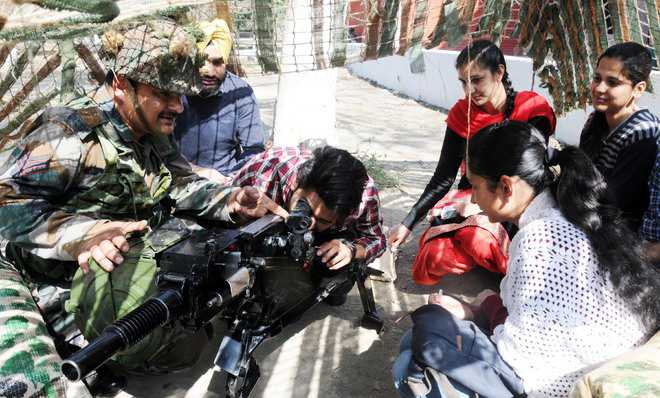
A soldier explains features of a weapon to students at a seminar at Guru Nanak Dev University in Amritsar. A Tribune photograph

Amritsar, February 22

Panther Division organised a seminar at Guru Nanak Dev University on various entry schemes to motivate and encourage youth of Punjab to join Army here today.The seminar was attended by a large number of civil officials, faculty members and students. The life of an officer in the Army was highlighted among students, including girls, besides other entry schemes during the seminar.The event commenced with an address by Commander Dograi Brigade, which was followed by a movie “Life less ordinary”, featuring life of an officer and various adventure activities undertaken by the Indian Army. Students were given information about various entry schemes for joining the Army as commissioned officer. A team of officers gave details about complete selection procedure of the Service Selection Board (SSB).Hundreds of students from various colleges attended the seminar. The display of weapons used by the Infantry at the end of the seminar was the main attraction, especially among the younger generation.— TNS


Downgrading the military is bad for nation’s health

nitin

In the last 48 hours, the Indian army is once again in the news. One, for its deployment in Haryana to control the Jat agitation in the state which spiraled out of control, thanks to inept political and administrative handling. And two, losing a young officer, a para-commando officer—who incidentally was a graduate from the Jawaharlal Nehru University—in an on-going operation in Kashmir. It is not clear if the para-military forces—CRPF and BSF—were deployed in Haryana after the police lost control over the situation but what is evident is that increasingly, the Army is being called in to deal with what essentially are law and order situations. The decision to deploy the Army in Haryana at the first indication of trouble instead of using it as the last resort is debatable but given that the agitators were hell bent on destruction of public property and indiscriminate violence, perhaps the decision was unavoidable.

The Army has in the past done whatever job it has been assigned to do and will continue to do so in the future too, its reservations on certain aspects of decision-making notwithstanding but what hurts the men in olive green is the continuing attempts to downgrade the Army’s status and constantly downplay its contribution to the national effort. The award of the 7th Central Pay Commission (CPC)—thankfully only a recommendation so far not accepted by the government–is a case in point. It seeks to place the Army at par or below the central armed police forces (CAPFs) through granting lower grade pay and lesser allowances. This is harmful to the Army–and the nation in the process–in the long run for several reasons.

Progressive degradation of status of Armed Forces personnel has had alarming adverse impact on self esteem of personnel and hence their operational effectiveness. International Journal of Management and Social Sciences Research (IJMSSR) in its issue of 12 Dec 2013 listed the findings of its research stating that only eight per cent of youth surveyed opted to join Armed Forces as against 58 per cent choosing to join other Central government services although Armed Forces Officers cadre constitutes 72 per cent of all Group A and All India Services strength. Though not being spoken formally, the following facts are undeniable if the current trend continues.

  • Shortage of officers in Armed Forces will be extremely difficult to be fully mitigated.
  • Self Esteem of those joining as officers, is taking a hit quickly after joining. This, despite many in-house measures, is reflected in relatively lower morale and less than desired level of commitment of younger generation officers.
  • Owing to large scale unemployment, intake of recruits (as Jawans) has not declined yet, their quality and amenability to discipline and of being shaped into combatants with high degree of commitment and sacrifice, has been declining by the day. So far significant numbers have been responding positively to the quality of leadership by the officer cadre. However, with declining self esteem of officer cadre itself, their collective capacity at stemming the rot and keep jawans motivated, is eroding. Increasing numbers have already begun displaying unwillingness to serve beyond initial period of engagement. This trend is already affecting retention of skilled manpower, adversely.

And this despite the fact that personnel of Armed Forces, on an average, incur Least Lifetime Cost to the Government on account of the following:-

  • Largest numbers serve for shortest period and retire early (between ages of 35 yrs to 54 yrs). Hence, draw least per capita government salary.
  • During entire career, they serve maximum time in junior ranks and least time in senior ranks hence, draw lower salaries for maximum portion of career.
  • Owing to combination of both of above (largest numbers retiring early and in lower ranks), their last pay drawn is much lower than civilian counterparts. Pension, though being 50 per cent of Last Pay Drawn as applicable to all, pension amount of Armed Forces personnel is much lower.

And yet, as an Instrument of last resort, the demands on the armed forces are significantly higher in terms of proficiency, commitment and sense of sacrifice. Armed forces being ‘Instrument of Last Resort’ do not have the luxury of ‘failing’ or handing over adverse situation to any other government agency. This singular fact demands of its personnel much higher degrees of commitment, leadership, risk taking, proficiency in multiple technological and tactical skills and willingness to sacrifice.

It is therefore imperative that armed forces should at least be considered ‘First amongst Uniformed Services’. Unfortunately, the 7th CPC has not considered this and placed Defence Personnel even below the Indian Police Service (IPS) by awarding them two additional increments at 4, 9 & 13 years Service (now at par with IAS) while military personnel continue to get only one increment each at 2, 6 & 13 years Service. Overall, taking pay and allowances cumulatively, the 7th CPC has further placed Armed Forces either at par or below CAPF.

This faulty award is because of faulty assumptions and inadequate Appreciation of Actual Roles and Required Degree of Proficiency & Risks. For instance, equating of CoBRA unit of CRPF with ‘Special Forces’ and assuming their hardship & risk as more severe than ‘Airborne Forces – Para units,’ reflects gross ignorance of roles, desired proficiency levels & attendant risks of various components of Armed Forces and the CAPF. Consider 7th CPC recommending ‘Risk & Hardship Allowance’ for National Disaster Relief Force (NDRF) personnel when employed in disaster relief. Since Disaster Relief is the only role assigned to the NDRF, how can the organization seek extra allowance over & above their salary for doing their primary and only task? By this logic, ask the armed forces personnel, why shouldn’t the military be awarded special allowance when called out to aid civil authority during disasters which is not its primary task?

It’s time a thorough review is done in the way we as a nation compensate our soldiers. Otherwise, one of our most admired institutions is bound to face decay that will come at the cost of nation’s security.http://www.abplive.in/blog/downgrading-the-military-is-bad-for-nations-health


Roads blocked, copters troops

Ravinder Saini,Tribune News Service,Rohtak, February 20

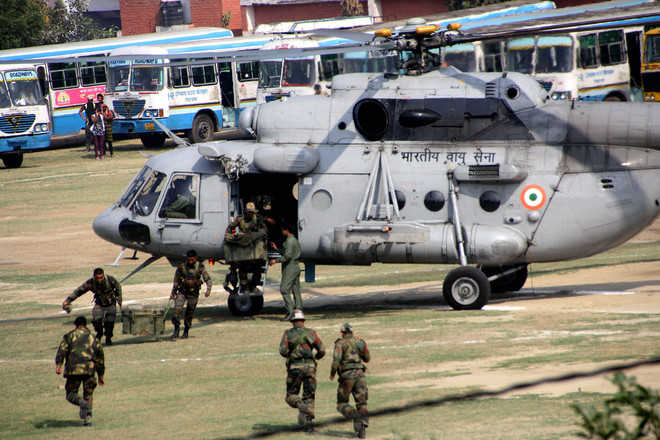
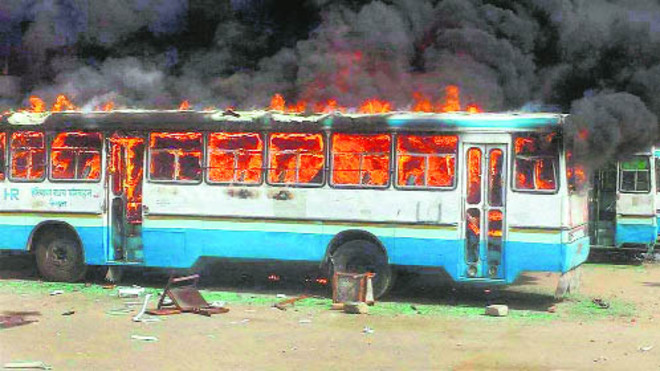
With the main roads leading to Delhi, Hisar and Jaipur either dug up or blocked by protesters, choppers were used to drop troops at the Police Lines ground early this morning. As three Army helicopters made several rounds to drop the personnel, curious residents rushed to their housetops for a better view. The district authorities had to call more troops in the afternoon in view of the large number of protesters who encircled the city.Though the district authorities imposed a curfew and issued shoot-at-sight orders, people were seen roaming around on two-wheelers. Over a dozen autos were found burnt at various places on the city’s main road. Distraught traders and shopkeepers whose business establishments were set on fire last night were seen assessing their loss. The Army and the police staged a flag march from the Police Lines till the Maharshi Dayanand University (MDU) campus where a large numbers of protesters were on dharna. The protesters did not budge despite repeated warnings.  BJP to issue show-cause notice to Saini New Delhi: The BJP has decided to issue a show-cause notice to its Kurukshetra MP Raj Kumar Saini for speaking against reservation forJats. “The party has taken cognisance of remarks made by Saini and decided to issue him a show-cause notice,” BJP general secretary Anil Jain, who is in charge of Haryana, said. “Saini was asked to refrain from making such statements but he defied the central leadership’s diktat,” Jain said at a press meet jointly addressed by Union Ministers Chaudhary Birender Singh and Sanjeev Balyan and Haryana Minister OP Dhankar. TNSPowergrid puts off recruitment examNew Delhi: The state-owned transmission utility firm Powergrid has deferred screening test for engineers due to the Jat agitation. The test was originally scheduled for Sunday. “Test stands postponed. Fresh dates will be be announced later,” Powergrid said in a statement. Haryana continued to be on the boil on Saturday as the Jat stir unleashed fresh incidents of violence and arson, in which railway stations,  police stations and some buildings were set ablaze even as the Army had to use choppers to reach parts of the blocked Rohtak district. PTICentre keeps tabs; UP, Rajasthan on alertNew Delhi: With Haryana on the boil, the Centre is monitoring developments in the state and has advised UP and Rajasthan Governments to be on alert, as it fears spread of the agitation in other parts too. Sources in the Ministry of Home Affairs while refuting the allegation of Intelligence failure said, “The ministry is keeping a watch on the development in the troubled state and has assured the local administration all possible help.” UP and Rajasthan Governments have been asked to be on alert, as “they might witness a cascading effect of the stir in Haryana,” they said. TNS


MINISTRY OF DEFENCE DECLASSIFIES THE REPORT OF THE COMMITTEE OF EXPERTS CONSTITUTED FOR REDUCTION OF LITIGATION,

MINISTRY OF DEFENCE DECLASSIFIES THE REPORT OF THE COMMITTEE OF EXPERTS CONSTITUTED FOR REDUCTION OF LITIGATION, REVIEW OF SERVICE AND PENSION MATTERS AND STRENGTHENING THE INSTITUTIONAL MECHANISMS OF REDRESSAL OF GRIEVANCES
In a step towards greater transparency, the Raksha Mantri has ordered the declassification of the Report of the Committee of Experts constituted for reduction of litigation, review of service and pension matters and strengthening the institutional mechanisms of redressal of grievances. The panel had submitted its Report on 24th November 2015.

The Raksha Mantri has already directed all wings of the Ministry of Defence to submit an “Action Taken Report” on the same.

The entire Report has been placed in public domain on directions of the Raksha Mantri and can be downloaded from the official Ministry of

Defence website: http://mod.gov.in/writereaddata/Reportcc.pdf

It was for the first time after independence that such a committee had been instituted and at the time of submission of the Report the Members had thanked the Minister for taking a historic step to minimize litigation and grievances in the Ministry of Defence so that the focus could remain on the core issues of governance and administration. The Expert Panel had also thanked the Minister for ensuring that there was no interference in the Committee’s functioning and for encouraging the panel to come up with honest, dispassionate and objective observations without fear or favour.

As per the Ministry’s official press release at the time of submission of the

Report (http://pib.nic.in/newsite/PrintRelease.aspx?

relid=131870), the Committee’s approach remained to identify practical on-ground solutions to reduce litigation, especially appeals, and steps towards reduction of heartburn, maintenance of harmony between employees and the establishment and balancing of rights of both parties which could lead to an increase in productivity and enable the Government to focus upon its basic responsibilities. As per the release, the Committee had postulated practical, workable, reformatory and gradual solutions in its 509 page report encompassing 75 recommendations in areas concerning service and pension matters, discipline and vigilance issues, matters concerning promotions and confidential reports, military justice, issues related to civilian employees and other potential areas of disputes.

The Members of the Committee Lt Gen Mukesh Sabharwal, Lt Gen Richard Khare, Maj Gen T Parshad, Maj Navdeep Singh and Maj DP Singh thank everyone for the support and the faith.

download (1)


Jai Hind


Major Navdeep SIngh(Retd)

.

Some pertinent incongruities in the OROP tables and the Circular issued for implementation of OROP by the Principal Controller of Defence Accounts (Pensions)

On careful perusal of the OROP tables issued by the Office of the Principal Controller of Defence Accounts (Pensions) vide Circular Number 555, the following preliminary observations take shape:

(a) The Circular, on its own, has added many ifs and buts to the parent Government of India/Ministry of Defence Letter dated 07 Nov 2015 on OROP. These additional clauses are not a part of the OROP Scheme as implemented vide the above letter of the Ministry.

(b) As per Govt of India Letter above, pensions of past retirees are to be re-fixed on the basis of 2013 retirees of the same rank and same length of service. However, in the Circular, the PCDA(P) has reintroduced the distinction between the ‘rank last held’ and ‘rank for pension’ [See Note (b) under Para 11 of the Circular]. This has been apparently stated so because prior to 2006, service of 10 months in a rank was required to earn pension for that particular rank. Hence, as per the PCDA(P) Circular, if a Naib Subedar had served only for 6 months in the said rank, he would be paid the pension of a Havildar and not that of a Naib Subedar. This stipulation is incorrect since the parent MoD letter does not discriminate between ‘rank last held’ or ‘rank for pension’ which is a dispensation anyway abolished w.e.f 2006. The pension, as per the Ministry’s letter, is to be based on ‘same rank and with the same length of service’ and not as per ‘rank for pension’ [See Para 3 (ii) of the Letter].

(c) As per the PCDA(P) Circular, pension is only to be granted as per maximum terms of engagement existing at the time (See Para 7 of the Circular). So for example, if the maximum term of engagement for a particular rank was 22 years but the person was made to serve for 26 years, or had 26 years of combined service based on two spells, his pension would be capped at 22 years. This also is a condition superimposed by the Defence Accounts Department and does not find mention in the Ministry’s letter. The Ministry’s letter is simple: pension is to be based on live data of 2013 based on similar rank and similar length of service. Hence, if a person retired in a particular rank with 26 years of service, he is to be paid a pension in accordance with a person of the same rank with 26 years of service retiring in 2013, nothing more, nothing less, and as simple as that. An imposition of an additional condition is undue display of creativity.

(d) It seems that the system of full pension at 33 years and proportionate reduction below the said length has again been applied in the tables, which is incorrect, since as stated above, the pensions are to be linked with live 2013 data as per the Govt of India letter. Hence for example, if a Colonel had retired in 1996 with 22 years of service, he is to get his pension in accordance with a Colonel retiring in 2013 with 22 years of service, similarly, if a Colonel had retired with 33 years of service, he is supposed to get pension in terms of what a Colonel with the same length got in 2013. The system of 33 years is not applicable after 2006 and since OROP is based on live pension data, it cannot be brought back by circumventing the main notification.

(e) The pension tables of Territorial Army personnel seem incorrect. The system of non-grant of weightage to TA stands abolished in 2006 and the pensions are to be granted as per the live pension data of 2013 wherein TA and Regular Army personnel were at par. However, still, the system of calculation is woefully off the mark. For example, a Lt Col of the Regular Army with 33 years of service has been shown with a pension of 34,765 while an officer of the TA of the same rank with same service has been granted a pension of 16,405, the logic of which is totally incomprehensible since both TA and Regular Army Lt Cols in 2013 were in receipt of the same pension with the same length of service.

(f) Pensions of Lt, Capt and Maj of AMC, ADC and RVC seem awry. For example, the pension of a Major of the AMC which should be much more than other Arms due to addition of NPA, is shown as 17,010 while that of a Major of other branches is shown as 23,815.

(g) Calculation of pensions for the ranks of Major and below, on notional basis, have not been undertaken correctly. Since nobody retires in the rank of Major as per the current dispensation, the pension of past retirees was to be based on notional fixation. The figures in the tables however fall below the notional fixation for the said ranks. An officer of the rank of Major, if taken as not promoted to Lt Col and progressing in his own rank with due increments in his own pay-band would retire with a higher pension than what has been recorded in the tables.

(h) Rounding off of qualifying service has been undertaken based upon various cut-off dates in the circular (Para 10). This is incorrect since the concept of cut-off dates in now otiose in view of the Ministry’s letter- pension is simply to be based on the live pension data of 2013 linked with the length of service with the same length of service, which takes into its ambit the system of calculating the said length of service too.

(i) Honorary Naib Subedar and Naib Subedar are supposed to be at par w.e.f 2006 since the grant of Honorary rank of Naib Subedar is now to be treated as a regular promotion for the purpose of pensionary benefits. Further, the distinction in pension between pre and post-2006 retirees of the rank of Honorary Naib Subedar has been struck down and upheld as such till the Supreme Court, hence the wide difference in the tables of both seems to be a little incompatible and perhaps more clarity would be required on the same.

As per my opinion, various disabling factors that existed earlier as per old dispensations including some of which have already been set aside by judicial fora, have been reintroduced by the Defence Accounts Department in the tables and in the Circular while giving effect to the Ministry’s letter dated 07 Nov 2015 whereas no such conditions were imposed by the said letter of the Ministry. Needless to state, the DAD/CGDA/PCDA(P) could not have superimposed their own conditions over and above of what had been prescribed by the Ministry of Defence. I am sure the Services HQ would convey the above (and other anomalies) to the concerned competent authority and that the Department of Ex-Servicemen Welfare, as also the Judicial Committee, would take note of the infringement of the conditions of the letter issued by the Govt of India on 07 Nov 2015.The above is an analysis only after a cursory glance. Shall update in case more issues crop up.Let us work towards resolution of all anomalies in a methodical manner.


Indian, Nepal armies hold joint guerrilla exercise

Indian, Nepal armies hold joint guerrilla exercise
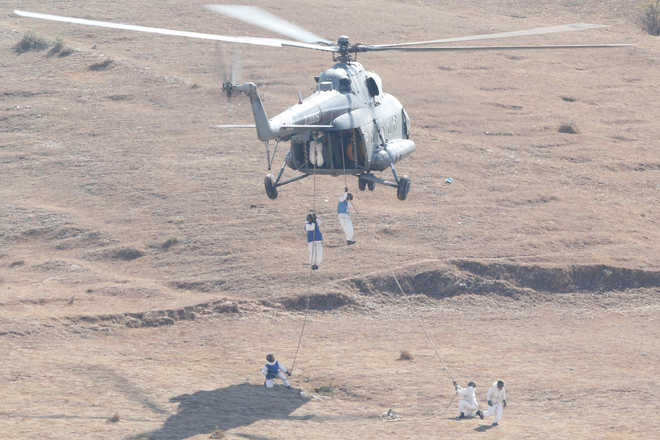
A helidrop exercise at Pithoragarh as part of the India and Nepal military exercise linked to disaster managment. Tribune photo

Our Correspondent

Pithoragarh, February 18

On the 10th day of the India -Nepal military exercise, named ‘Surya Kiran IX’, Army units of both nations today held jungle disaster mitigation and guerrilla war exercises at the Army ground of the local Cantt area.According to a press- note of the Army, the troops taking part in the exercise are also getting training in searching hidden enemy through jungle warfare and in reaching at the war zone by helicopters. “We have also organised friendly volleyball, football and basketball matches between the units of the two nations and a seminar on disaster management,” said Rakesh Manocha, an officer taking part in the exercise.


Guwahati stint ‘harder’ than Siachen::: COMPARE SAICHEN VEDIOS :WORTH WATCHING

Indian Army Soldier’s Miraculous Survival After Being Stuck Under Siachen Snow For 6 Days

https://youtu.be/Echp2o2UT0A

http://

Great battles – Indian army in siachen glacier 1 of 3

https://youtu.be/SvtgAM_l54g?list=PLP_tMnHrPtX3uvdg7ZRqFAYkq_oFLT-N6

http://

Great battles – Indian army in siachen glacier 2 of 3

https://youtu.be/zSfHIjW5wNc?list=PLP_tMnHrPtX3uvdg7ZRqFAYkq_oFLT-N6

http://

Great battles – Indian army in siachen glacier 3 of 3

https://youtu.be/tMJxA7czQIs?list=PLP_tMnHrPtX3uvdg7ZRqFAYkq_oFLT-N6

http://

Life Of A Siachen Soldier

https://youtu.be/kaCnhxWPnaQ?list=PLP_tMnHrPtX3uvdg7ZRqFAYkq_oFLT-N6

http://

pakistan army siachen glacier

https://youtu.be/FanThCLK8cI?list=PLP_tMnHrPtX3uvdg7ZRqFAYkq_oFLT-N6

http://

NDTV at Siachen: How India is consolidating its hold on world’s highest battlefield

https://youtu.be/3LeA8eQV4CQ

http://

What warriors are up against at Siachen

Quite obviously, if you have seen it all live and felt the frozen chill of the Siachen Glacier, the memory will not leave you in a hurry.

Soldiers walking up to the Glacier often witness returning helicopters carrying the victims of the Glacier’s vagaries. They secretly pray to every god that they should return safe to see their comrades and their families.

Inevitably they turn towards OP Baba, the legendary keeper of the Glacier whose huge cavern-like cave at Base Camp also has a resemblance to the Shivling on the pattern of the Shri Amarnathji shrine.

There is no individual faith here. OP Baba is revered by all Indian soldiers, symbolising the uniqueness of the Indian Army’s social culture. After the prostration and ringing of bells, it is a crisp salute by the soldier to the Baba which initiates his climb to Siachen.

It is only when tragedies strike that the warriors are remembered and this is as good a time as any to educate the public about what its warriors are up against at the Glacier.

Just remember the Glacier itself is like any other, a frozen river of ice which is several hundred feet deep. The slope is just about that of a river but that’s not where the Indian soldier lives or remains deployed to protect the national interest.

Running on its west along its entire 76km length and even more is a ridge of sharp peaks and precipices; it is called the Saltoro Ridge. The Indian Army was proactive enough to get to the Saltoro Ridge and occupy it in 1984 and since then, Pakistan has been attempting to dislodge us without success.

What does deployment or occupation mean? Tactically important passes exist along the Saltoro which can provide access to the sub-glaciers which lead to the mother glacier or Siachen. Each of these passes has to be denied by occupying the shoulders which are formed by high peaks.

The space for deployment is extremely limited and there is no local construction material except snow and ice which can be packed into thick plastic bags to form large ice bricks. Other material has to be lugged all the way from the bulk breaking point lower down in the sub-glacier.

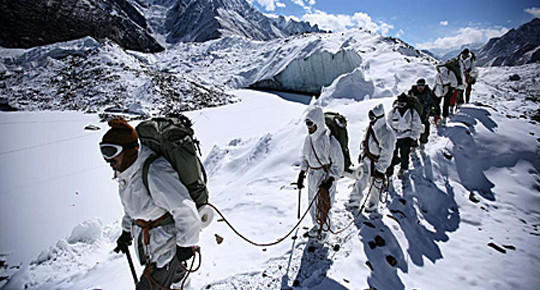
Survival of pre-fabricated shelters is for a year or little more. Usually 10 men stay together but besides maintaining vigil (many attempts have been made by the enemy to sneak up almost un-passable sharp ridges to capture a post), it is daily survival which takes up most of the time and energy.

Life starts early at Northern Glacier because when the sun is not up, the snow is firm and movement is easier. Usually after 11am, all movement away from posts is halted unless it is for life-saving purposes or for tactical reasons.

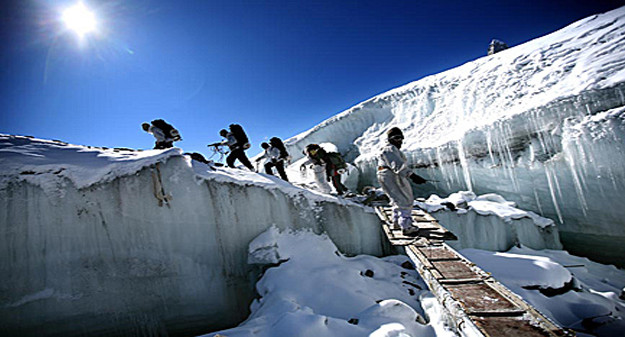
In the seven or eight working hours of the morning, there will be heli-dropping of kerosene and some heavier stores near the flatter portions of the sub-glacier. Teams of spotters ensure every load is marked and recovered by snow scooters and sledges which themselves are in danger of being swallowed up by wide chasms called “crevasses”. These chasms can be a couple of hundred or more feet in depth. Links of five or six men are known to have disappeared down such crevasses, never to be recovered.

The problem of low ambient temperature is worsened by wind chill brought on by blizzards or snow storms reducing visibility. It is in such conditions that the enemy may make suicide attempts to get to a post at Saltoro. Hence, the vigil in bone-chilling conditions where even firing a weapon has to be done by removing the trigger guard and converting it to an “arctic trigger” to enable firing while wearing mittens.

Maintaining line communications to smaller posts is extremely challenging. Line parties of Corps of Signals and unit signalmen are always vulnerable because of the amount of movement they do.

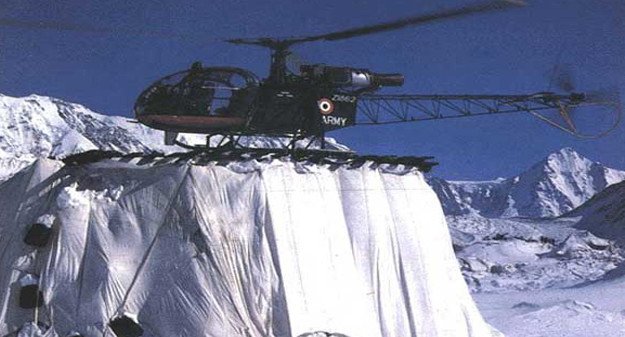
The lifeline is provided by light helicopters which are responsible for maintenance, stocking of the posts at Saltoro, movement of key personnel such as rescue teams and casualty evacuation.

In the instant case of the avalanche at the base of the ice wall, helicopters had to be employed to move the heavy equipment and machinery for the rescue teams to work with. Five days of continuous digging at 20,000 feet requires superhuman stamina.

These teams are trained for rescue and are accompanied by avalanche rescue dogs (ARDs) which have the capability to sense life under deep snow.

All movement of helicopters is restricted to morning hours because as the heat rises at the glacier, the density of air reduces and the thrust required by a helicopter is insufficient. In addition, air turbulence increases exponentially.

However, for casualty evacuation, there are no restrictions and pilots risk everything to save a single life.

Why is the Indian Army hellbent on weathering minus 50-60 degree temperatures and uncomfortable habitat in the most unique, one-of-its-kind environment. Can it afford a mutual agreement with Pakistan to withdraw to lower heights?

The public needs the rationale upfront because the taxpayers’ money is involved – almost Rs 4-5 crore every day, 365 days of the year for an interminable period.

The long and short of it: simply because we have the tactical advantage of occupying the heights of the Saltoro which Pakistan Army would give its right arm to occupy.

We cannot trust it enough that it won’t renege on an agreement and occupy the heights when we vacate them. Take it from me, if we have to recapture the heights which give depth to the Glacier, it will be at a cost of a thousand lives or more.

Now with the Pakistan-China collusion in construction of the China-Pakistan Economic Corridor through Pakistan-occupied territory in Gilgit Baltistan, at its height our hold over Siachen gives us the leverage of occupying a flank and giving Leh the necessary military depth.

Last, it is important for the public and more important for the Seventh Pay Commission to know just what conditions exist in Siachen’s lofty wasteland. Reports that the Pay Commission has recommended allowances for bureaucrats in “remote Guwahati” that are double and more than that of warriors at Siachen are both an insult to the collective intellect and conscience of the nation and a symbol of almost depraved thinking.


• Lt Gen Syed Ata Hasnain is a former commanding officer of the Northern Glacier, who later also commanded
the strategic, Srinagar-based 15 Corps. He is currently associated with the Delhi Policy Group and
the Vivekananda International Foundation

Guwahati stint ‘harder’ than Siachen:7TH PAY COMMISSION

Ajay Banerjee,Tribune News Service,New Delhi, February 5

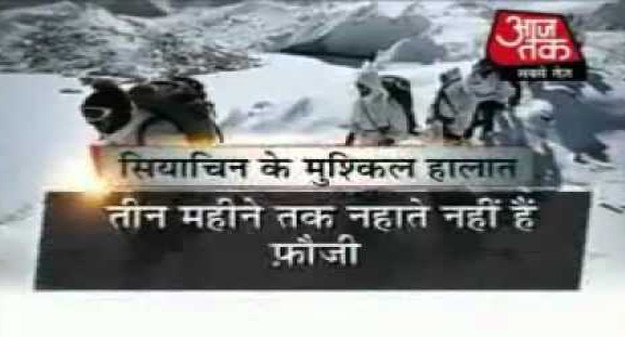
Posting in Guwahati is “tougher” than serving on the forbidding Siachen Glacier, if one goes by the 7th Central Pay Commission (CPC) recommendations to the government. The CPC has suggested Rs 31,000 per month for officers and Rs 21,000 per month for jawans as allowance to compensate them for the “hardship” faced at Siachen. However, once the pay commission’s new salary slabs come into place, the tough area allowance (TRA), which is about 33% of the basic salary, in civilian services works out to be in excess of Rs 55,000 for IPS and IAS officers and Rs 30,000 for others posted in areas like Guwahati.Demanding “fair play”, the armed forces in a representation to Defence Minister Manohar Parrikar have suggested a new “hardship matrix” to decide allowances. The representation contends that the facts presented before the CPC are erroneous and its 899-page report submitted in November 2015 has inaccuracies while dealing with military salaries, say sources.The armed forces feel Siachen cannot be equal or lower to Guwahati when deciding on the “hardship” factor. On Wednesday, 10 soldiers died after an avalanche struck “Sonam post” at 19,600 feet on Siachen Glacier, burying them alive and wiping out a helipad.A soldier is posted for six months on the glacier with the mission to protect it from the Pakistan army. The induction process involves three months of acclimatisation and a three-week trek to the post with a full load of weapons. Besides the Army, IAF’s 114 Helicopter Unit and Army Aviation are tasked with providing supplies, besides carrying out rescue missions.The armed forces have suggested a “hardship matrix” that grades the hardship on two fronts — nature of job and geographical location.They have suggested that Siachen be placed on the top of the list and those posted should get 65 per cent of their basic pay as “hardship allowance”. This, as per the new salary slabs of the CPC, will be a fair allowance.Antarctica comes second on their list of suggestions, followed by counter-terrorism duties. Fourth on the list are special operations forces in counter-terrorism roles.


Rs 31,000 vs Rs 50,000: Pay panel’s strange logic

  • The 7th Central Pay Commission has suggested Rs 31,000 per month in hardship allowance for officers posted at Siachen
  • However, IPS and IAS officers posted in areas like Guwahati are set to get Rs 55,000 as tough area allowance
  • The armed forces have approached the Ministry of Defence seeking a new ‘hardship matrix’ to decide allowance

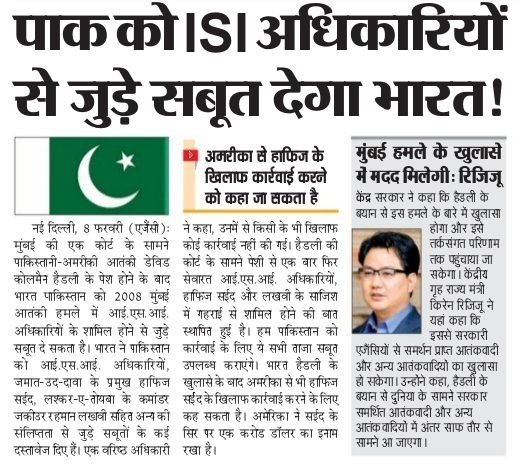
Headley names ISI officers, Hafiz Saeed in 26/11 case

Deposition strengthens demand for faster trial in Pak, Saeed’s indictment

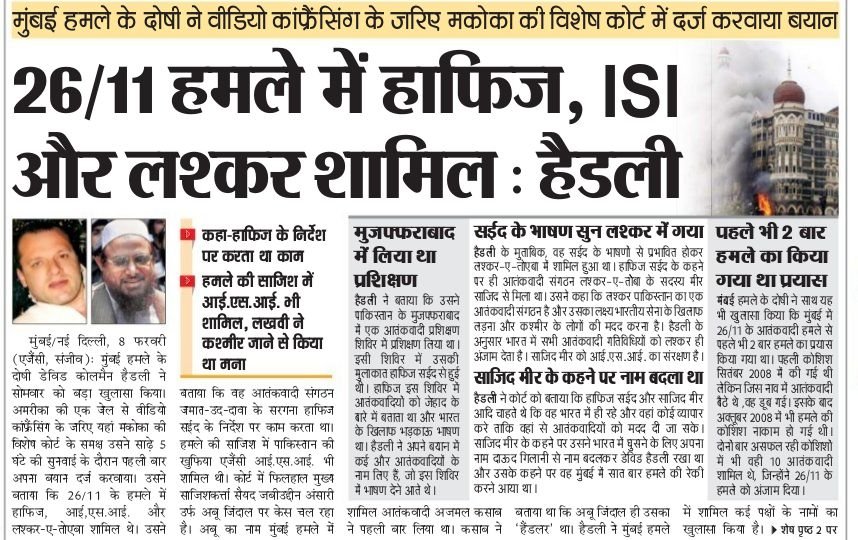
MUMBAI: Lashkar-e-Taiba (LeT) operative David Coleman Headley told a court on Monday that he was in touch with Pakistani spy agency officers before the 26/11 Mumbai attacks and that the militant group chief Hafiz Saeed knew about the deadly plan.

Deposing via video conference from the United States, Headley also said he visited India seven times to identify terror targets and revealed terrorists tried to attack Mumbai twice before 26/11 but failed on both occasions. In one instance, their boat hit some rocks and sank in the sea, taking down with it a cache of guns and grenades.

Monday’s deposition is the first by the 56- year- old US national in an Indian court and will be admissible as evidence in the trial against another key 26/11 accused Zabiuddin Ansari alias Abu Jundal. He had made similar revelations in a US court and to the National Investigation Agency.

The testimony may also help Indian authorities put together a fresh dossier of evidence, and strengthen New Delhi’s demand that Islamabad speed up its trial into the 26/11 attack, including the role of Saeed who Pakistan has refused to indict.

“It is clear, we think, that there was a close nexus between ISI and LeT. That is what has been gathered from the revelations made from Mr Headley,” said public prosecutor Ujjwal Nikam outside the court in Mumbai.

Headley’s deposition is unlikely to hurt efforts between New Delhi and Islamabad to revive peace talks after the attack on an Indian airbase last month.

India says Saeed was the brain behind the multiple terror strikes that hit two luxury hotels, a popular café, a Jewish centre and Mumbai’s main railway station, killing 166 people.

Headley called Saeed his inspiration, named his close associate Zakiur Rehman Lakhvi, and told the court details of terror camps he attended in Pakistan-occupied Kashmir’s Muzaffarabad since 2002.

For two years, he was given leadership training, how to handle AK-47 assault rifles, bombs and explosives. Headley said 10 terrorists were to strike in the first attempt in September 2008, but their boat hit some rocks in the Arabian Sea, resulting in loss of weapons and ammunition, but those on board survived as they wore life jackets.

The second attempt came in October, with the same people involved as in the first, but that also failed for unknown reasons, before the third and successful attack was executed on November 26, he said. Headley, who has been sentenced to 35 years in prison in the US, was granted conditional pardon by a Mumbai court in December in return for a deposition. Monday’s testimony brought into focus the role played by Pakistani authorities – especially the Inter Services Intelligence.

Headley said though his sole contact in the LeT was Sajid Mir, he was also in touch with an ISI agent he called Major Ali.

Headley told judge GA Sanap that he came in contact with the ISI officer after he was arrested along with a retired Pakistani military officer, Major Abdul Rehman Pasha, at Landi Kotal along the Afghanistan border in the Federally Administered Tribal Area.

Headley said Major Ali introduced him to one Major Iqbal as the former thought that the US national could be used to gather intelligence in India. Headley, according to his deposition before the court, changed his name from Syed Daood Salim Gilani to David Coleman Headley in Philadelphia in order to conceal his identity and also obtained a passport in the new name, as instructed by Mir.

He said he gave false information while applying for a visa at the Indian consulate in Chicago and later took the help of his friend and former Pakistani army doctor, Dr Tahawwur Husain Rana, and his partner Raymond Sanders to obtain a five-year business visa with multiple entries.

ca805666-97a7-4ca5-a51a-cd98b2df032d90a256b7-bb2e-4846-a8d7-f45ff6392a81


Russian aircraft service centre soon in India

Technodinamika (a Rostec company) will shortly open a service centre in India, for repairs and maintenance work on various Russian-made aircraft, and ensure parts are always available for Russian airplanes and helicopters operating in India.

“ASC Aeronautical Equipment, part of the Technodinamika Holding, will open a service centre in India before the end of the first quarter of 2016,” Oleg Vasiliev, CEO of the Aviation Service Center (ASC) Aeronautical Equipment, a member company of the Technodinamika Holding, told RIR..

“This company will be engaged in repairing Russian military vehicles currently operating in India, supplying accessories and ground equipment, and ensuring all aircraft and helicopters have the parts they need. Technodinamika has already concluded long-term agreements for repairs with local operators,” Vasiliev said. In particular, they will repair and maintain components of the Antonov and Ilyushin transport aircraft and Mi series helicopters.

Active work on organizing repair works in India started last year. In early 2015, ASC became accredited with the Indian Air Force, giving it the opportunity to participate in tenders for supply of components and assemblies, as well as maintenance of the Air Force’s aircraft fleet.

“Repair works will be fully localized in India. A joint venture is now being created with the Indian side. Repair and maintenance of aircraft in the service centre will be carried out by local staff who will be trained by our specialists. The centre will be provided by all the necessary repair documentation and, in fact, this will be an Indian company. At the same time, the Air Force will receive guaranteed scheduled repairs and quality at manufacturer prices,” said Vasiliev.

Earlier, the head of Technodinamika Maxim Kuzyuk informed Russian media that such centres would start operating in Peru, China, and several African countries.

Technodinamika (part of the state corporation Rostec) – is a leading developer and manufacturer of equipment for aircraft, including landing gear, fuel systems, flight control systems, and auxiliary power units.

In addition to aircraft equipment, the holding produces parts and components for other industrial sectors such as oil and gas, automotive, transport, and energy.