



Sanjha Morcha

What’s New

Click the heading to open detailed news

Current Events :

web counter

Print Media Reproduced Defence Related News

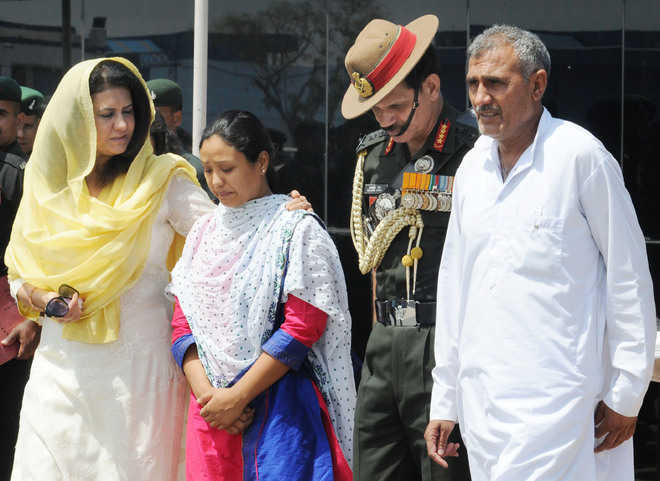
Tearful adieu to Major Deswal in Jhajjar

Chief of Army Staff, Gen Dalbir Singh, and his wife Namita Suhag console the martyr’s wife, Neeta, and father Rishiraj Deswal during the homage-paying ceremony at Palam Airport in New Delhi on Friday. Tribune photos

Tribune News Service

Jhajjar, April 15

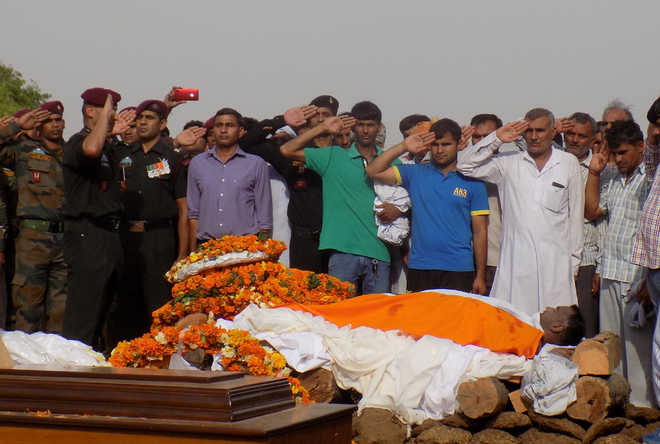
Heart-rending scenes were witnessed as the body of martyr Major Amit Deswal (31) arrived at his residence in HUDA Sector-6 here today. Major Deswal was killed in an encounter with terrorists in Manipur on Wednesday nightAmit’s mother Vedvati and wife Neeta cried, while his three-year-old son Arjun was unaware of the tragedy that had struck the family. The body was brought by an Army chopper.Wrapped in the Tricolour, the body was later taken to his native Surheti village, about 12 km from here, where his younger brother Ankit Deswal lit the pyre. A contingent of the Army reversed arms and fired a volley of shots in the air to bid farewell to the departed soul.Apart from representatives of various social and non-political organisations, former Chief Minister Bhupinder Singh Hooda, Agriculture Minister Om Prakash Dhankar, MLAs Geeta Bhukkal, Raghuvir Kadian and Naresh Kaushik, DGP KP Singh and other administrative officers paid tributes to the martyr by laying wreaths on his body.Retired Subedar Rishiraj Deswal, inconsolable father of Amit, said his son had laid down his life for the sake of the nation and he was proud of his son.Maj Amit of 21 Para SF was killed in a gun battle with ZUF militants in the densely-forested Nungba area during a combing operation undertaken by the Rashtriya Rifles and Special Forces personnel.“Amit, who was born on January 15, 1985, was so passionate about serving the nation that he had started preparations for competitive examinations after 12th class and qualified CDS examination at the age of 19 years in 2005,” said Amit’s uncle Shamsher Singh.He maintained Amit got commissioned in 2006 and his first posting was with an Artillery unit. He had secured ‘Commando Daggar’ during ‘Ghatak’ course after joining the elite Para unit in January 2011. Amit had last visited his home in Jhajjar in February to attend his brother’s marriage.

Retd military brass find lucrative careers in growing defence sector

VEXED ISSUE While the plan to build local capacity in defence has opened up new professions for former personnel, it has also raised questions over their conflict of interest

NEW DELHI: The Make in India plan to build local capacity in defence has fuelled a trend of private companies hiring retired top military brass and tap their expertise to get a toehold in the arms bazaar.

LOCKHEED MARTINUS aerospace giant Lockheed Martin has offered to manufacture its F-16 fighter jet in the country under Make in India which has generated more jobs for former military personnel.While the development has opened new and greener pastures for defence personnel it has also raised questions over conflict of interest and propriety.

Recently, Rolta India Limited hired Lieutenant General KT Parnaik, a retired Northern Army commander, to head its defence business. To kick-start its new businesses, Reliance Defence and Aerospace (RDA) inducted a battery of retired three-star officers — Air Marshal M Matheswaran, president of aerospace business; Vice Admiral HS Malhi, group president of Reliance Defence and Engineering Ltd; Lieutenant General MS Buttar, president of land systems and Vice Admiral KN Sushil, president of submarine business.

A senior RDA executive said the officers were hired for their operational expertise and not for liaisoning.

Industry sources said the salaries range from `36 lakh per annum to `One crore, depending on the profile of retired officers and the companies that hire them.

Retired officers are free to join defence companies after a year-long cooling-off period. The opinion is divided on whether this ‘break’ is sufficient to avoid a conflict-of-interest situation.

In 2012, a Parliamentary panel suggested the coolingoff period be extended to five years to address concerns about top officials being hired by firms to influence decisions.

Air Vice Marshal AJS Walia (retd), now the regional executive (India and South Asia) of Sikorsky Aircraft Corporation, argues that top officers have manned sensitive positions in service and are aware of their responsibility to avoid conflict of interest.

“They come with decades of experience. They understand technology and how requirements change. Why should this talent be wasted on the golf course?” he said.

But some serving officers have called for stricter checks and balances to ensure the ‘Lakshman Rekha’ of propriety was not crossed. “There are pros and cons…Old contacts definitely should not be used to push business interests,” said a senior officer on the condition of anonymity.

Industry leaders contend that preference for retired officers rests solely on their understanding of customers’ requirement. “Firms hire them to communicate to the armed forces what they are all about and what they bring to the table,” said Ashok Atluri, managing director of Zen Technologies, an indigenous firm that manufactures simulators.

“There are many experts in the market to interpret the DPP. Retired brass only provides insights into what solutions may be liked by the customers,” said the CEO of a top defence firm, adding that the defence procurement procedure (DPP) was transparent and left no room for outsiders to influence decisions.

Lieutenant General JS Bajwa (retd), editor of Indian Defence Review, concurs. “Gone are the days when people could influence decisions,” Bajwa added.


Italy convicts 2 in copter scam

New Delhi, April 8

Two former top officials of Italian aerospace and defence group Finmeccanica have been convicted by a court in Italy for corruption in the sale of 12 VVIP choppers to India for Rs 3,727 crore.Giuseppe Orsi, former CEO of Finmeccanica, and Bruno Spagnolini, former head of AgustaWestland (a Finmeccanica subsidiary) were yesterday sentenced to over four years in prison, PTI reported.All eyes are now on the CBI, which had registered a case against 13 persons and six firms. Former Air Force Chief SP Tyagi and two Chandigarh-based firms are among those booked by for alleged bribery. — TNS


WhatsApp encrypts all messages now: Why does it matter

SECURITY New feature helps make communication via WhatsApp private – sort of like a face-to-face conversation

When you send a message, the only person who can read it is the person or group chat that you send that message to. No one can see inside that message. Not cybercriminals. Not hackers. Not oppressive regimes. Not even us.

WHATSAPP

NEW DELHI: WhatsApp has extended the option of communicating over the application without being eavesdropped on. The encryption feature has been developed by the messaging giant with support from Open Whisper Systems, the makers of another popular messaging app, Signal.

This means, messages sent using the app will be end-to-end encrypted: Once a message leaves the sender’s phone, it is turned into a series of numbers and alphabets that only the intended receiver’s phone can decipher.

So what does it do, why does it matter, and what is not encrypted?

WHAT DOES END TO END ENCRYPTION DO

In a blog post, the Facebookowned company explains:

“The idea is simple: When you send a message, the only person who can read it is the person or group chat that you send that message to. No one can see inside that message. Not cybercriminals. Not hackers. Not oppressive regimes. Not even us. End-to-end encryption helps make communication via WhatsApp private – sort of like a face-to-face conversation.”

WhatsApp further stated that “your messages are secured with a lock, and only the recipient and you have the special key needed to unlock and read them. For added protection, every message you send has its own unique lock and key. All of this happens automatically: No need to turn on settings or set up special secret chats to secure your messages.”

HOW TO ACTIVATE ENDTO-END ENCRYPTION

It should be noted that the feature is enabled by default in WhatsApp, which means that if you and your friends are on the latest version of the app, all chats will be end-to-end encrypted. Users will not have the option of switching it off. Other messaging services like Telegram offer users an opt-in feature for encrypted communication called

‘secret chat’.

HOW WILL THIS AFFECT LAW ENFORCEMENT

This might further drive a wedge between law enforcement agencies and the tech industry across the world. In the US, Apple is fighting a battle with the FBI on the issue of encryption. The federal investigative agency and other law enforcement agencies believe that stronger encryption protocols may allow criminals and terrorists to communicate with impunity. Technology companies on the other hand argue that better encryption allows them to provide better privacy and security to their users.

According to a report on Statista, 12% of India’s population (approximately about 175 million people) is active on WhatsApp.

WHAT ARE LOOPHOLES THAT REMAIN

A report on Livemint says that WhatsApp is not encrypting everything. Buried in the fine print of its new terms and conditions is this line: “WhatsApp may retain date and time stamp information associated with successfully delivered messages and the mobile phone numbers involved in the messages, as well as any other information which WhatsApp is legally compelled to collect.”


Pathankot attack staged by India: Pakistan JIT

The Pakistan Joint Investigation Team (JIT) that visited India to probe the Pathankot airbase attack has said in a report that the incident had been staged by Indian authorities, reported Pakistan Today. Calling it a “vicious propaganda” against Pakistan, the team said India did not cooperate with them. The report will be submitted to Pakistan Prime Minister Nawaz Sharif soon.

NUCLEAR SECURITY SUMMIT Modi meets Cameron in US; focus on defence, Make in India

Modi meets Cameron in US; focus on defence, Make in India
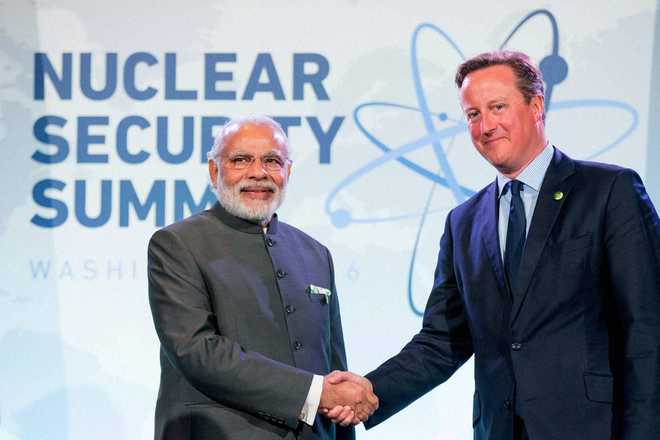
Prime Minister Narendra Modi shakes hands with British Prime Minister David Cameron before a meeting at the Nuclear Security Summit at the Walter E. Washington Convention Center in Washington on April 1, 2016.— AP/PTI

Washington, April 2

Prime Minister Narendra Modi met his British counterpart David Cameron here on the sidelines of Nuclear Security Summit (NSS), during which the two leaders discussed defence co-operation and Make in India issues.

“My meeting with PM David Cameron focused on defence cooperation, make in India and other key issues,” Modi said in a tweet before he left for Saudi Arabia after two days of engagement with world leaders during the NSS here.

Briefing reporters, the Ministry of External Affairs spokesman Vikas Swarup said during the meeting yesterday both leaders recalled Modi’s visit to London last year, during which India and the UK had signed deals worth 9-billion pounds and inked a civil nuclear pact.

Modi said that ties between the two countries had become “richer and deeper”.

Defence cooperation came up for discussion and Prime Minister Modi mentioned that Britain could be a partner in the ‘Make in India’ initiative, especially in the defence sector.

Visa issues also came up for discussion, Swarup said.

Both the leaders also reviewed the decisions that had been taken during Modi’s visit to Britain last year in particular the decision to launch rupee bonds at the London Stock Exchange.

Cameron expressed happiness that it was proceeding very well.

“He also said that we need to increase our partnership in defence. Prime Minister said that high-tech defence production has now been opened up to 100 per cent FDI, India had skilled manpower, cheap labour was also available and as such UK can become very important partner in the Make in India initiative particularly in the defence sector,” Swarup said.

The two leaders discussed some of the other pending issues between them including terrorism.

“Prime Minister also raised the issue of Tier II visas for IT companies. He said skilled professionals should not find it difficult to come to work in the UK. And, in this context the recommendations made by the migration advisory committee could caste a negative light,” Swarup said.

“Cameron promised to take a look at it. He said we do not want to disadvantage bonafide IT companies, but at the same time we would also want to ensure that the UK system is not misused,” the spokesman said. — PTI


143 youths from J-K inducted into Army

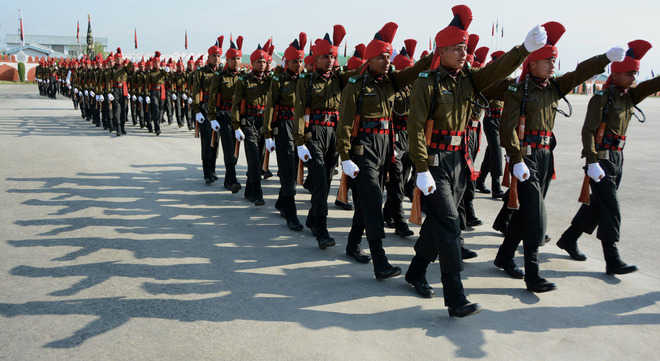
143 youths from J-K inducted into Army
Recruits during a passing-out parade on the outskirts of Srinagar. Tribune Photo: Yawar Kabli

Tribune News Service

Srinagar, March 29

Over 140 youth from the state were inducted in Jammu and Kashmir Light Infantry (JAKLI) regiment at a colourful passing out parade on Tuesday.A defence spokesperson here said: “143 recruits successfully completed strenuous training regime of 11 months at the JAKLI Regiment Centre at Rangreth.”“The passing-out-parade was attended by over 2,500 parents and relatives of the young soldiers from the state along with a number of civil and military dignitaries. The parade was reviewed by Major General BK Jain,” the spokesperson added.Major General Jain congratulated the young soldiers for their immaculate parade and impressed upon selfless service towards the nation.He also praised their contribution towards encouraging more and more youth from J&K to come forward to join the security forces and also highlighted the vital role played by the parents in motivating their wards to join the noble profession.Major General Jain also presented awards to the meritorious recruits, who excelled in various facets of training, said the spokesperson.Shabir Ahmed of Reasi received the Chewang Rinchen Medal. He was adjudged ‘best in firing’. Iftikar Beigh of Jammu was conferred the Bana Singh Medal for being ‘best in drill’.The JAKLI Regiment came into being as Jammu and Kashmir Militia in 1948 when the volunteers rallied to the clarion call given by Sheikh Mohammad Abdullah from the historical Lal Chowk for fighting the Pakistan-backed raiders.


Get ready for power pangs this summer

Get ready for power pangs this summer
The Baglihar dam on the Chenab in Doda district. Tribune file Photo

Arteev Sharma

Tribune News Service

Jammu, March 28

Scanty rain and less snowfall are set to compound electricity woes of Jammu and Kashmir this summer as the state continues to generate only 50 per cent of its total power generation capacity due to low discharge of water into all major rivers.“The generation capacity of the state is 770 MW. Generation has come down drastically to around 400 MW due to low discharge into rivers. We have been running only two turbines of 150 MW capacity each of BHEP-I due to low water level in the Chenab. The generation capacity of other projects has been affected in view of low discharge into rivers,” said a senior official of the Jammu and Kashmir State Power Development Corporation (JKSPDC).The 450-MW BHEP-II is yet to be put on generation fully despite its inaugurated by Prime Minister Narendra Modi. With its functioning, the energy generation capacity will go up to over 1,200 MW.The JKSPDC runs 21 power projects, including the 900-MW BHEP (BHEP-I and BHEP-II with 450-MW capacity each) in the state.The state requires 2,500 MW to meet energy requirements. The state purchases power from the Northern Grid and other resources to meet its power demand.“At least eight small power projects being run by the JKSPDC with an aggregate generation capacity of around 35 MW have been shut due to low discharge. Generation has been affected by scanty rain and snowfall in the upper reaches of the state,” said the official.He added that the current electricity demand of the state was nearly 2,000 MW, which was being met by purchasing power from outside the state.Ajay Gupta, Executive Director (Electric), JKSPDC, said they had been running only two of the six turbines of 150-MW capacity each of BHEP-I and BHEP-II due to low discharge of water.“Other turbines will be made operational only after snow starts melting, which will increase the water level in the river,” he said. He added that day-to-day power generation depended on the availability of water.To a query, he said less snowfall and scanty rain “could affect the overall power scenario” of the state in the coming summer.“The availability of water in rivers is not in our control. Power generation is dependent on discharge of water into the river, snowfall and melting of glaciers. It is a natural phenomenon and the prevailing scenario can disturb the power scenario,” Gupta said.The estimated hydro power potential of the state is 20,000 MW, of which 16,480 MW has been identified. Of the identified potential, only 2,458 MW (about 15 per cent) had been exploited so far.It consists of 770 MW in the state sector from 21 power projects, 1,680 MW from four power projects in the Central sector and 17.5 MW from two private-sector projects.


CRPF to hold inquiry into ‘disrespect’ to body of jawan: Rajnath

Kochi, March 26

Home Minister Rajnath Singh today assured Lok Sabha MP K C Venugopal that CRPF would hold an inquiry into the alleged disrespect shown by the paramilitary force to the body of one of its jawans, who died in Bilaspur in Chhattisgarh.The Alappuzha MP told PTI that the body of Anil, hailing from Harippad in the district, “was treated with utmost disrespect by the CRPF authorities.””Anil, a native of Chingoli panchayat, died in a drowning accident on Thursday at Bilaspur in Chhattisgarh. But when the body reached Alappuzha, it was found naked, not embalmed and covered in a plastic sheet,” he said.His shocked relatives protested and refused to receive it.Local police then took the body and kept it at the mortuary of a nearby hospital for autopsy.Venugopal said he wrote to Rajnath Singh and Minister of State for Home Kiren Rijiju, seeking an inquiry into the ‘disrespect’ shown by CRPF authorities.”The Home Minister telephoned me today. He told me that he has directed the CRPF Director General to conduct an inquiry into the incident,” Venugopal said.He said Anil’s agitated relatives were pacified after the Home Minister’s assurance and received the body for cremation.”As a civilised society, it is a common gesture that the body of a person be treated with utmost respect and dignity,” he said.He said those responsible for the ‘disrespect’ must be severely punished. — PTI