Sanjha Morcha

What’s New

Click the heading to open detailed news

Current Events :

web counter

Print Media Reproduced Defence Related News

Women To Get Permanent Commission In 10 Army Branches

he Defence Ministry said that it has taken necessary steps to ensure that women, who were earlier inducted for short service commission (SSC), get permanent commission in the armed forces.

Women To Get Permanent Commission In 10 Army Branches

Women will be eligible for branches like army aviation and army air defence among others

NEW DELHI: 

Women officers can now get permanent commissions in 10 branches of the Indian Army, the government announced on Tuesday.

The Defence Ministry said that it has taken necessary steps to ensure that women, who were earlier inducted for short service commission (SSC), get permanent commission in the armed forces.

Permanent commission will be granted to women officers inducted in branches such as Signals, Engineers, Army Aviation, Army Air Defence, Electronics and Mechanical Engineers, Army Service Corps, Army Ordinance Corps and Intelligence.

The Short Service Commission (SSC) women officers will have to give their option for permanent commission before completion of four years of commissioned service and they would be able to choose their specialisation, the Ministry said.

 The government had earlier approved the the same for the Air Force, where all branches including fighter pilots are open for women officers.

“In Indian Navy, all non-sea going branches/cadre/specialisation have been opened for induction of women officers through Short Service Commission,” the Ministry said.

2 COMMENTS

The Navy is also building three ships for training of women officers after which they can be deployed at sea.


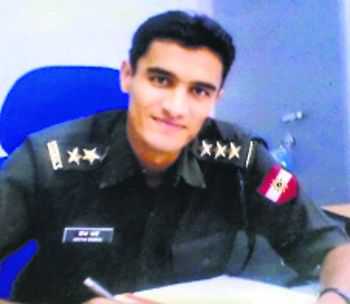
For Capt Deepak Sharma, Army was his first love Was awarded Kirti Chakra for sacrificing life in anti-terror operation in J&K

Col Dilbag Dabas (Retd)

Deepak, son of Naresh Sharma, was born in Bidhlan village of Sonepat district on July 3, 1983. He grew up listening to the stories of valour of his grandfather, who was part of the action during World War II, and at a very young age, decided to follow into his footsteps.

Deepak passed his senior secondary education from Shiksha Bharti School, Rohtak. After attaining a Bachelor of Technology degree from Maharishi Dayanand University, he joined the Officer’s Training Academy, Chennai, and was commissioned into the Signal Regiment on September 16, 2006. In March 2008, Deepak, as a young Captain, was sent on two-year attachment with 42 Rashtriya Rifles (Assam) operating in Pulwama district of Jammu and Kashmir.

Pulwama district, located between the Pir Panjal Range and the Greater Himalayas, though geographically not close to the line of control (LoC) in the west, has the dubious distinction of being one of the hotbeds of militancy in the Kashmir valley. And it is strongly believed that due to a false notion of being alienated by the state, Kashmiri youths have covertly been assisting militants exported by Pakistan. Nonetheless, 42 Rashtriya Rifles has an impressive record of conducting many successful cordon and search operations in the Kashmir valley from time to time since its deployment there. During one such counter-militancy operation in Pulwama district, Captain Deepak Sharma, an officer from the Signal Regiment attached to 42 Rashtriya Rifles (RR) Battalion, displayed gallantry of the highest order, for which he was awarded the coveted Kirti Chakra, the second highest peace-time military decoration in the country. The account of gallantry of Captain Deepak Sharma during a counter-militancy operation in the Kashmir valley is recorded in the War Diary of 42 RR Battalion. 

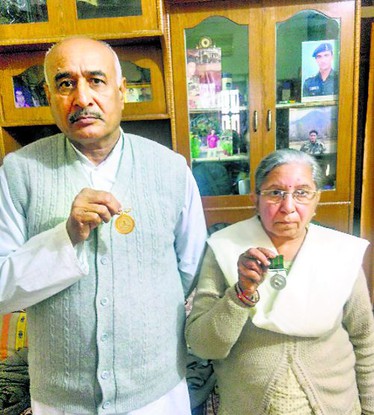
Naresh Sharma, a retired banker, recalls, “During his B Tech final semester, Deepak was offered a well-paid job in an upscale corporate house but for his love for the Army, he declined the offer. I asked him as to what special was he looking for being an Army officer? He told me ‘papa, Army mein mujhe salute milegi, samman milega aur sahi maine mein desh sewa ka mauka milega’. His reply really made me proud”.

During his short leave in January 2010, Deepak got engaged to a serving lady officer from the Signal Regiment itself at a simple ceremony and the marriage was scheduled sometime in June the same year. But no one knew he had a different kind of date with fate three months before that. 

Indu Sharma, mother of Capt Deepak Sharma, opens up with a sigh, “Every mother’s son has a date with fate. My son too had his but he met his date with fate as a warrior, as a ‘shoorveer’, in the finest traditions of the Indian Army”.

The account of his bravery in War Diary of 42 RR Battalion reads…

On March 4, 2010, some terrorists were suspected to be hiding in a room in a village in Pulwama district of Jammu and Kashmir, which could not be cleared due to its close proximity to a large Jamia Masjid. Since the targeted room was adjacent to the masjid, and to avoid any damage to it, direct room intervention was the only option to flush out the militants. At 8.15 am, on March 4, Capt Deepak Sharma along with his buddy closed in and entered the house through a small window by lobbing hand grenades. At point-blank range, Capt Sharma fired and killed one terrorist in the first room. He then crawled to the next room under heavy volume of fire from the terrorists and lobbed another grenade. On spotting two terrorists under the staircase, with total disregard to own safety, Capt Sharma charged at them with a steely grit and killed both of them on the spot. However, during the fire fight, Capt Deepak Sharma sustained a gunshot wound on his neck and he later succumbed to his injuries. Captain Deepak Sharma displayed unflinching devotion to duty and indomitable courage in the face of the enemy and made the supreme sacrifice in the finest traditions of the Indian Army.

(The writer is a veteran Gunner, 6 Field Regiment)


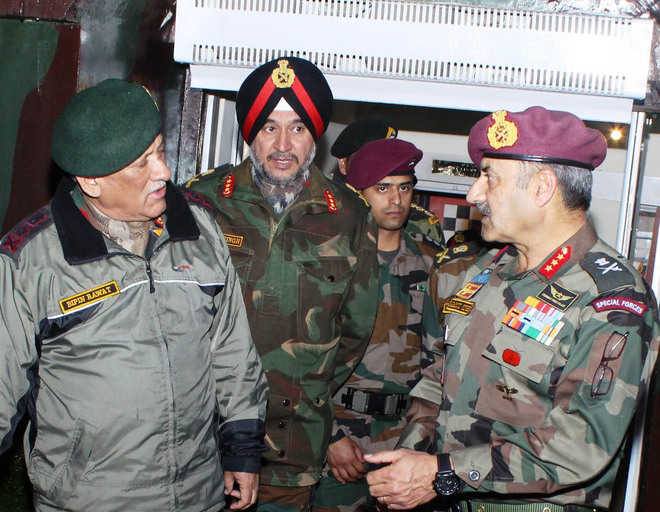
Army chief visits 16 Corps Headquarters in Jammu Reviews operational preparedness, compliments soldiers for dedication to duty

Army chief visits 16 Corps Headquarters in Jammu

Army chief General Bipin Rawat (left) and Lt Gen Ranbir Singh, Northern Command chief, in Jammu on Saturday. Tribune photo

Tribune News Service

Jammu, March 2

Amid heightened tension between India and Pakistan and continuous ceasefire violations by Pakistan Army on the Line of Control (LoC), Army chief General Bipin Rawat today visited the 16 Corps headquarters to review the operational preparedness of his forces in view of the current situation.

Accompanied by northern Army commander Lt-Gen Ranbir Singh, the Army chief was briefed and updated by Lt-Gen Paramjit Singh, GOC, White Knight Corps, about the current operational situation, prevailing security scenario and the preparedness of the formation.

Giving details, a defence spokesman said the chief of the Army staff was briefed on the actions taken to meet the challenges of increased ceasefire violations and measures put in place to thwart the designs of the adversary. “He was also briefed on the measures reinforced in hinterland in the Area of Responsibility towards ensuring peace and stability,” Lt-Col Devender Anand, defence spokesman, added.

During the visit, the Army chief commended all soldiers for their unwavering dedication to duty, selfless devotion and high standards of professionalism. “He was appreciative of the measures and standard operating procedures instituted by the units and formations in the Corps Zone to minimise the casualties due to the ceasefire violations and infiltration bids.

The need to be prepared for effectively meeting current emerging security challenges was also reinforced,” the spokesman said.


US mobilised troops to eliminate terrorists India was ‘reluctant’ to take help

Washington, November 25

The then Bush administration had mobilised special forces to neutralise Pakistan-based Lashkar-e-Toiba (LeT) terrorists holding people hostage in hotels during the deadly Mumbai terror attack in November 2008, a former White House official has revealed.

But, before the Indian authorities gave the necessary clearances and the special forces could take off for Mumbai from an overseas regional location, Indian commandos had already completed their job, said Anish Goel, who was part of the White House’s 26/11 crisis management group.

Recalling the developments at the White House during the 2008 Thanksgiving weekend, Goel said the US had “some (special forces) teams in the region that we were willing to deploy quickly”. “In the beginning, the Indians were reluctant to accepting US assistance. But, as the attack dragged on for two-three days, they became more accepting of US assistance,” Goel said. — PTI


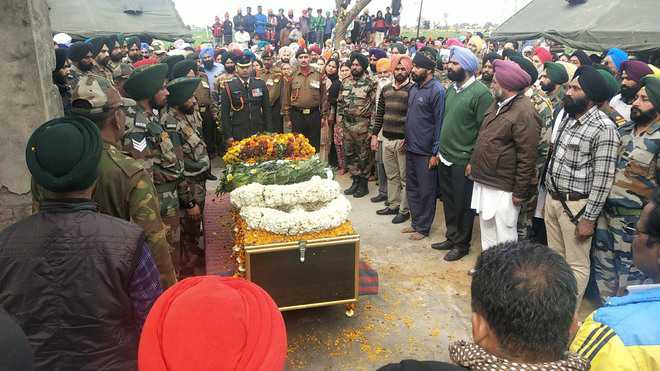
Lance Naik cremated with state honours

Lance Naik cremated with state honours

Tributes being paid to Lance Naik Kuldip Singh at Kale Bala village in Amritsar on Sunday. Tribune photo

Tribune News service

Amritsar, March 3

Lance Naik Kuldip Singh of the 5 Sikh Regiment was cremated with state honours at his native Kale Bala village in Majitha here today.

Besides the Army, others who were present to pay tributes to the martyr included MP Gurjeet Singh Aujla, Shiv Charan Singh, OSD of SAD MLA Bikram Singh Majithia, SAD leader Talbir Singh Gill, Ashok Kumar, SDM, Baba Bakala; and Deputy Director, Sainik Welfare Officer, Col Gurinderjit Singh.

Kuldip Singh had died in an avalanche in the Kargil area. He was leading a troupe during patrolling in the hills. He is survived by his wife Pawanpreet Kaur and five-year-old son Jashanpreet Singh.

His body arrived at this native village today. His brother Sukhwant Singh and his son lit the pyre.


The battle for the skiesBY MK Bhadrakumar

The battle for the skies

Mission space: Russia can build a lone lunar station, but funds are a challenge.

MK Bhadrakumar
Former Ambassador

Us space agency NASA has abruptly called off a planned visit to the US in February by the head of the Russian state space corporation, Roscosmos Dmitry Rogozin. NASA made the announcement on January 4 following criticism by the US media and lawmakers who demanded cancellation of the visit. The snub to Moscow presages sudden death of the historic Russian-American collaboration in exploring the ‘last frontier’ for mankind. It becomes an inflection point.

Rogozin is a close political associate of President Vladimir Putin. He has been subjected to the Western sanctions over Moscow’s annexation of Ukraine’s Crimean Peninsula in 2014. US Senator Jeanne Shaheen, who is a leading critic of Russia’s alleged meddling in the 2016 US presidential election, threatened that the Congress will be ‘forced to act’ unless NASA withdrew the invitation to Rogozin. Shaheen called Rogozin ‘one of the leading architects of the Kremlin’s campaign of aggression towards its neighbours’ and said the invitation ‘undercuts our message and undermines the US’ core national security objectives’.

The big question is whether the curtain is coming down on the space cooperation between the US and Russia. It is a poignant moment since the two countries have had a long history of working together in space ever since the joint Apollo-Soyuz mission in 1975, and more so, in the past two decades. Within the ambit of cooperation, the two countries have shared training, communications, operational capabilities and expenses in support of the International Space Station (ISS). In particular, following the cancellation of the US Space Shuttle Program in 2011, the US began relying on Russia’s Soyuz capsules for transport to the ISS. Russia receives an average of $81 million per seat on the Soyuz. In a joint statement in 2017, the two countries even projected the idea of collaborating on deep space exploration, including the construction of the Lunar Orbital Platform-Gateway, a research-focused space station orbiting the moon. (Rogozin’s visit aimed at fleshing out the tantalising idea.) Both countries saw clear benefits, given the high price tag for solo space exploration.

However, times have changed. Russia and the US are flaunting today their capability to destroy each other in a thermonuclear war, something unheard of even at the height of the Cold War. Space has become a new domain of warfare. If the 2018 US National Defense Strategy characterised ‘space and cyberspace as war-fighting domains’, Russia’s 2010 military doctrine explicitly stated that ensuring superiority in space would be a ‘decisive factor’ in achieving its strategic goals. In this tense security environment, the need arises to protect space assets (satellites, etc.) with space-based weapons. Suffice to say, the scope for sharing sensitive technology or capabilities in space partnerships has dramatically shrunk due to the growing hostility between the US and Russia.

Secondly, a private sector space industry has appeared in the US and it has spawned commercial interests. The development of advanced technologies by private companies means NASA has new options to choose from and to reduce the dependence on Russia. In fact, NASA is already in a position to use Boeing and SpaceX capsules for human spaceflight beginning in 2020 and even has the option to phase out the procurement of Russian RD-180 rocket engines by 2022. With President Trump ordering the establishment of a sixth branch of the military (‘Space Force’), the dominant aerospace companies in the US — Boeing, Lockheed Martin, Northrop Grumman, Raytheon and BAE Systems — are eyeing the new frontier. 

Russia’s preference has always been to press on with a space programme entwined with the US’s. But in a scenario where NASA turns its back on Roscosmos, Russia may have to turn to China or India for partnership. Recently, Rogozin openly hinted at this. In his words, ‘China is offering many initiatives for cooperation, is asking us to help them develop, though they have already achieved a good level of development. They are suggesting creating a joint station.’ Rogozin even floated the idea of a ‘BRICS station’. Of course, Russia is technologically capable of building a lone Russian lunar station. But then, as the director of the Institute of Space Policy in Moscow, Ivan M Moiseyev, told the New York Times recently, ‘The technical capability exists, but the finances don’t.’

Quite obviously, considering that space efforts are inextricably connected to military plans, Russia needs to take a leap of faith to form an alliance with China. On the one hand, the scientific space-related endeavours have immense commercial potentials, while on the other, they signify the ultimate ‘eye in the sky’ through a combination of satellites and unmanned aerial reconnaissance vehicles that would give unmatched insight into positions of enemies (as well as allies). They will phenomenally improve military logistics, facilitate ‘orbital strikes’ at enemy targets as well as open up new lucrative trade and travel routes.

India is far better placed than China can ever be to align with Russia’s space programme, as there are no contradictions in the relations between the two countries. China is a competitor for Russia — as much as for the US — in space. Commenting on the recent landing of a Chinese scientific probe on the far side of the moon, Mary Dejevsky at the Guardian newspaper, a veteran Russia hand, wrote, ‘The response in political and military quarters in Washington, as in Moscow… is likely to reflect trepidation.’ It cannot be otherwise in New Delhi also. All factors taken into consideration, therefore, a tapering off in the NASA-Roscosmos cooperation, which is on cards in a near-term scenario, can be to India’s advantage. Delhi should seize the opportunity.




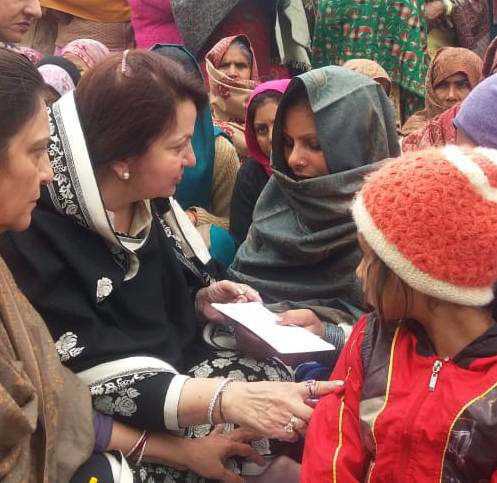
Martyr’s daughter gets helping hand from MP Chopra’s wife

Martyr’s daughter gets helping hand from MP Chopra’s wife

Karnal MP Ashwani Chopra’s wife Kiran meets Baljeet Singh’s kin at his residence at Dinger Majra on Wednesday. Tribune photo

Tribune News Service

Karnal, February 21

Karnal MP Ashwini Chopra’s wife Kiran Chopra will bear the expenses of the daughter of Baljeet Singh (35) of Dinger Majra, killed in a recent gunfight between security forces and militants in the Ratnipora area of Pulwama district.

She handed over a cheque for Rs 1 lakh to the martyr’s family on Wednesday. She announced Rs 2,000 per month for the education of the martyr’s daughter. She promised to bear the expenses of the wedding of the martyr’s daughter.


“Being a citizen, it is our duty to extend support to the family of every martyr who sacrifices his life for the country. My contribution is nothing compared to his sacrifice,” Kiran said.

“I will bear the educational expenses and transfer Rs 2,000 a month into her mother’s account till she passes Class XII. I will bear the expenses of her graduation or any other course. I will also take care of her wedding,” she said.


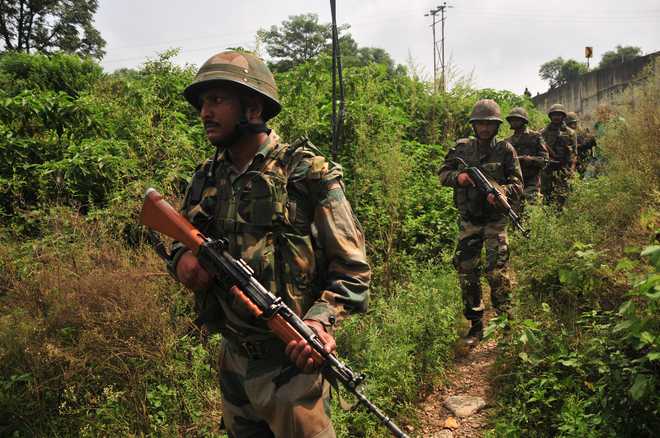
4 militants killed in gunfight in Shopian district of J&K

4 militants killed in gunfight in Shopian district of J&K

The operation is still under way. Tribune file

Majid Jahangir

Tribune News Service

Srinagar, November 25

Four militants were killed in a gunfight in south Kashmir’s Shopian district on Sunday, officials said.

The gunfight broke at Kapran village of Shopian around 1.30 am when a joint team of the police, Army and CRPF were carrying a cordon and search operation after a specific input about the presence of militants in the area.

“As the forces zeroed in on the suspected area, the militants opened fire, triggering a gunfight. In the gunfight that followed, four militants have been killed so far,” a police officer said. The toll may mount as the operation is still under way.

While identity and the group affiliation of militants is being established by police, sources said the slain include top commanders of Hizbul Mujahideen and Lashkar-e-Toiba

This is the second major encounter in south Kashmir since Friday. On November 23, six local militants, including a top Lashkar-e-Toiba commander accused of murdering top journalist Shujaat Bukhari in June this year, were killed in a gunfight in Bijbehara area of Anantnag district.


Fresh SOPs on convoy movement in J&K soon

Chandigarh, February 21

Following a suicide terrorist attack that killed over 40 CRPF personnel in Jammu and Kashmir last week, fresh standard operating procedures (SOPs) on the movement of security forces’ convoys in the troubled state will be issued shortly.

CRPF Inspector General from Jammu Zone, RK Yadav, said the SOPs are being modified and some rules, including restricting civilian traffic on the route, are being revised. “These would be implemented in a phased manner, but if civilians face problems due to this, we can consider other measures,” he said. Pointing out that such an attack had never been executed in the past, Yadav said there was no specific intelligence on the likely time, place or manner of attack or the type of materials to be used, available prior to the incident, though routine advisories kept coming in. “The force is introspecting on any possible lapses in following SOPs or security drills and will take remedial steps accordingly,” he said.

Yadav, who is also holding additional charge as the IG North-West Sector, was here to attend a memorial ceremony organised by the Para Military Forces Retired Officers Association to pay homage to the slain personnel. Besides CRPF officers and personnel, a large number of retired officers from all CAPFs attended the event.

The association’s president, AS Sidhu, a former IG with the CAPF said: “A number of demands pertaining to the welfare of serving and retired CAPFs are pending with the government. This includes grant of one rank-one pension.” — TNS


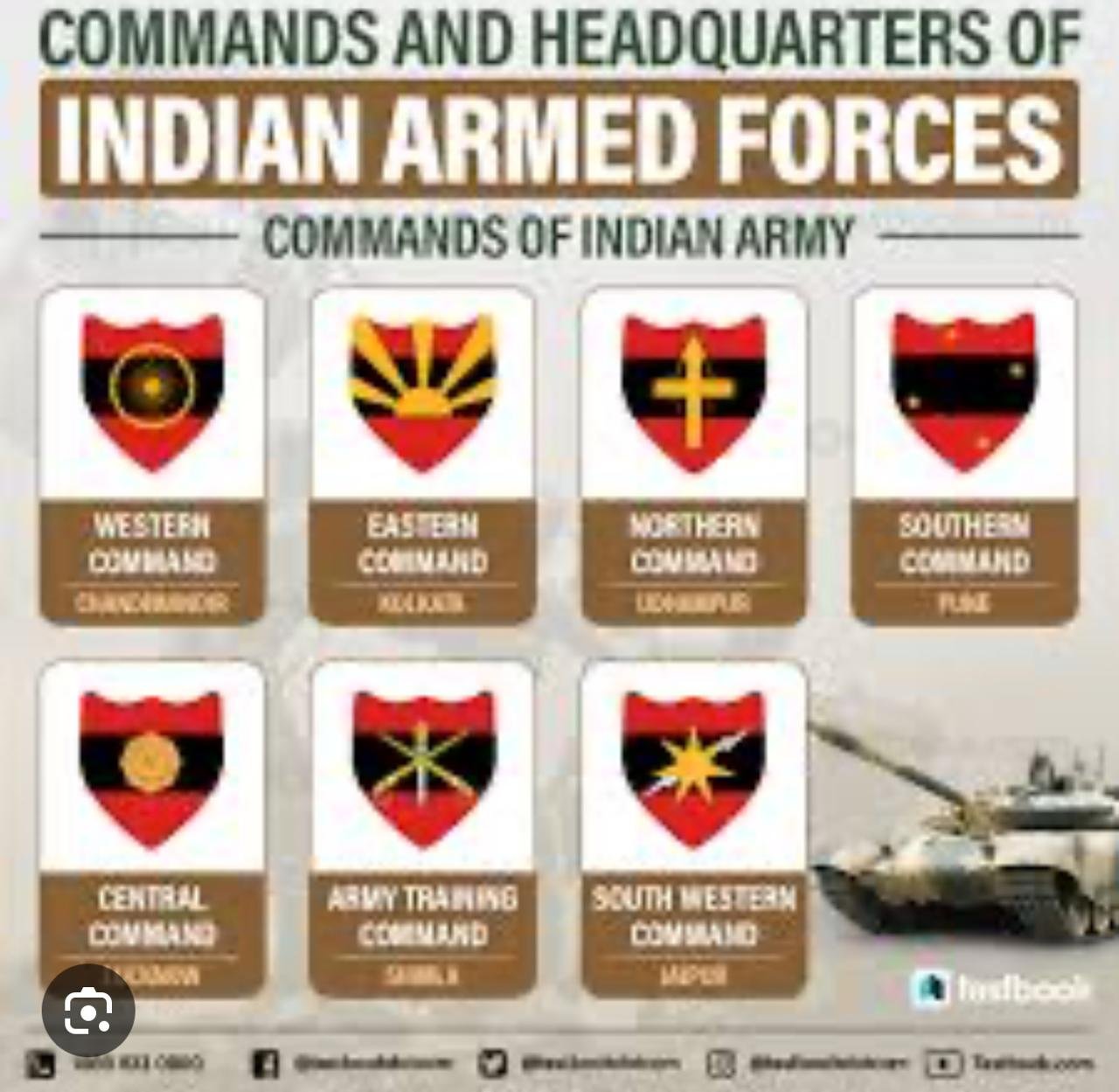
Major restructuring in the offing, India may soon have thousand-General Army

Indian Army Major Generals

Restructuring is a tri-service matter and Navy and Air Force also have to approve it. If the number of Major Generals go up, the number of Rear Admirals and Air Vice Marshals would also increase.

File image  |  Photo Credit: PTI

New Delhi: The Indian Army could soon have over a thousand Generals amongst its ranks if a proposal given by it is cleared by the government and also agreed to by the Air Force and the Navy. The Army currently has about 42,000 officers and if the planned move is cleared, the force would see the biggest one-time jump (700) in the number of Major Generals since Independence.

The top Army leadership has been open to a recent idea of the officers bypassing the Brigadier rank. As part of the proposal, some 1,000 Colonels are to be promoted as Major Generals bypassing the Brigadier rank.

In the present system, about 1000 colonels are promoted to Brigadier rank and then, 300 of them become Major Generals.

It may be noted that the proposal does not envisage the abolition of the Brigadier rank. Officers in charge of brigades will serve as Brigadiers for the time they are in command. And as their tenure comes to an end, the officers will automatically get promoted to Major General rank.

​At present, there are some 300 Major Generals, nearly 90 Lieutenant Generals, and one General — the Chief of Army Staff – in the Indian Army. The restructuring would not put any financial burden on the Indian Army, sources said.

It may be noted that the restructuring issue is a tri-service matter and the Navy and Air Force also have to approve it. If the number of Major Generals go up in the Army, the number of Rear Admirals and Air Vice Marshals would also increase.

Once all three wings of the Indian armed forces are on the same page, the proposal would be placed before the government.

The Army believes the proposal would help streamline the structure of the force and also make the armed forces a better career option.