

Current Events :





Valletta (Malta), November 28
— PTI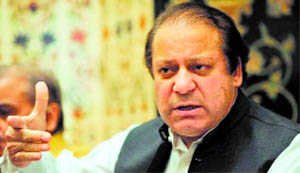
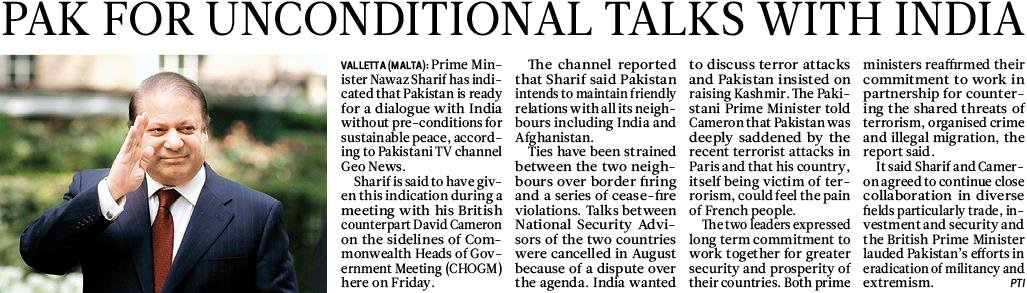
Prime Minister Nawaz Sharif has indicated that Pakistan is ready for a dialogue with India without pre-conditions for sustainable peace, according to Pakistani TV channel Geo News. Sharif is said to have given this indication during a meeting with his British counterpart David Cameron on the sidelines of Commonwealth Heads of Government Meeting (CHOGM) here yesterday.
The channel reported that Sharif said Pakistan intends to maintain friendly relations with all its neighbours including India and Afghanistan. Ties have been strained between the two neighbours over border firing and a series of ceasefire violations. Talks between National Security Advisers of the two countries were cancelled in August because of a dispute over the agenda.
India wanted to discuss terror attacks and Pakistan insisted on raising Kashmir.
The Pakistani Prime Minister told Cameron that Pakistan was deeply saddened by the recent terrorist attacks in Paris and that his country, itself being a victim of terrorism, could feel the pain of the French people.
The two leaders expressed long-term commitment to work together for greater security and prosperity of their countries.
Both Prime Ministers reaffirmed their commitment to work in partnership for countering the shared threats of terrorism.

NEW DELHI: India’s first indigenously-developed nuclear-powered nuclear attack submarine, Arihant, has successfully test fired a dummy or unarmed missile, reliable sources said.
The vital first test in ejecting a missile from its onboard silos was conducted on Wednesday, proverbially adding a feather to the cap of the Indian Navy and scientists from DRDO and BARC, the sources said. The firing was done remotely from a far away location by the Strategic Forces Command (SFC), India’s nuclear command authority which is tasked with creating nuclear deterrence.
To mention more achievements, the submarine has also successfully completed its critical diving tests, and significantly, met nearly all its design and designated parameters just about 100 percent, including the maximum possible power option tests.
It is actually good news all over, but the final step before the submarine is formally inducted in the Indian Navy as INS Arihant, will be the firing of proper missiles – albeit with unarmed warheads. Details are unavailable but this should happen soon enough as there are indications of the submarine taking part in the International Fleet Review (IFR) being hosted by the navy in February, 2016.
The boat should be operational by then. Notably, only operational ships and submarines can take part in an IFR.
The missile fired was a dummy version of DRDO’s B 5, which approximately has a range of 800 km to 1,000 km. Later, missiles with a reach of 3,500 km to 4,000 km are likely to be inducted on-board.
India plans to build some half-a-dozen Arihant class submaries in line with its nuclear doctrine which calls for No First Use but Massive Retaliation if attacked. Arihant is built with Russian designs, but this will be the country’s first nuclear attack submarine, classified in international naval lingo as SSBN.
India has one more nuclear-powered submarine, INS Chakra, leased from Russia, but that cannot fire nuclear missiles. The classification for such boats is SSN.
Like any submarine, both Arihant and INS Chakra are pearl shaped to accommodate the vertically launched missiles, and designed to move faster underwater than on the surface. They can stay deep in the darkness of the oceans for months, the only restrictions being the limits on human tolerance and availability of nuclear fuel.
It may be recalled that the project for nuclear submarines was sanctioned soon after the 1974 nuclear test by prime minister Indira Gandhi but it suffered when Morarji Desai and V.P. Singh occupied the office in the coming years.
In 1983, Gandhi once again pushed the project with required funds, but it was only in 1998, when India conducted the second round of nuclear tests, that prime minister Atal Bihari Vajpayee sanctioned the project afresh and a decision was also taken to involve the private sector. Larsen & Toubro, India’s premier engineering construction company, was involved right from then onwards.
L&T, as it is known, has done commendable work in gradually and systematically building a horizontal supply-chain base and meeting the DRDO and naval specifications. DRDO, or Defence Research and Development Organisation, has been in-charge of the India’s missile systems programmes throughout, which it has delivered with distinction.
Nuclear propulsion systems have been installed and managed by experts from BARC, or Bhabha Atomic Research Center Indications of Arihant’s journey have been coming out for some time, and recently, the Indian Navy chief, Admiral Robin Dhowan, mentioned the possibility of its inclusion in the IFR although he did not understandably commit anything.
The tests are done one-by-one and for a nuclear boat, every single check is critical.

KOLKATA: India’s first warship exporter, the Garden Reach Shipbuilders and Engineers Ltd. (GRSE), has attracted interests from nearly a dozen countries for building warships, a top official here said on Thursday.
“We have received interest from at least a dozen countries, including the Philippines, Cyprus, Vietnam, Algeria and Egypt, for building warships,” GRSE chairman and managing director Rear Admiral A.K.Verma said.
“Countries from Africa, Asia and Latin America have shown a keen interest in our ship-building capabilities,” he added.
Verma said talks were on with these countries for building offshore and inshore patrol vessels and landing craft utility (LCU) meant for transporting equipment and troops on the shore. He said the success of CGS Barracuda – an offshore patrol vessel that was commissioned by the National Coast Guard of Mauritius earlier in the year – has established the GRSE’s shipbuilding credentials.
“Most of the countries realise that shipbuilding cost here is far less than European shipbuilders and once our technology is proven, then there will not be any problem in getting foreign orders,” Verma said.
“The export of CGS Barracuda has already generated quite an interest among foreign countries and has played a part in establishing our technology credentials,” he added.
GRSE has also been shortlisted for the tendering process for building two frigates for the Philippines Navy.
“GRSE is the only Indian shipbuilder which has been shortlisted along with two Korean and two European companies. The bidding process is expected to commence in December and we are very confident of being competitive,” he said on the sidelines of a ceremony for the handing over of anti-submarine warfare (ASW) corvette ‘Kadmatt’ to the Indian Navy.
Kadmatt is the second of the four ASW corvettes being built at the GRSE.
The GRSE, which is currently building around 24 warships for the Indian navy, will also be entering into a contract in December with the Indian Coast Guard for building five inshore-patrol vessels.
ALLEGE DISCRIMINATORY PROVISIONS Premature retirees being kept out a sore point
 Hundreds of ex-servicemen from Punjab, Haryana, Delhi, Chandigarh, Rajasthan and Himachal Pradesh participated in the rally in Fatehgarh Sahib on Sunday.
FATEHGARH SAHIB: The United Front of Ex-Servicemen organised a rally of ex-servicemen here on Sunday to protest against the provisions of ‘one rank, one pension’ (OROP) notification issued by government.
Hundreds of ex-servicemen from Punjab, Haryana, Delhi, Chandigarh, Rajasthan and Himachal Pradesh participated in the rally in Fatehgarh Sahib on Sunday.
Hundreds of ex-servicemen from Punjab , Haryana, Delhi, Chandigarh, Rajasthan and Himachal Pradesh participated in the rally.
The protesters shouted slogans against the Prime Minister and the defence minister and accused them of deceiving the ex-servicemen.
Maj Gen (retd) Satbir Singh, who has been on the forefront in the OROP agitation, led the rally.
He said the provision in the OROP notification that if someone took premature retirement, he would not be entitled to benefits under the OROP scheme, was unjustified. “This is not acceptable to ex-servicemen,” he added.
According to an earlier announcement, all the soldiers and officers, who opted for earlier retirement, were excluded from benefits, but later, the government included those, who had already taken retirement, and excluded those who would do so in future. Satbir Singh said, “All armymen served equally, so all should be included. The provision is not in the interest of a young army.”
“If someone, who wants to take premature retirement, is forced not do so in view of financial benefits and continues in service, it will ultimately lead to an army of elderly.”
“The notification says that the burden on the exchequer will amount to `8,300 crore, which if divided among all defence pensioners, will benefit each by around `950 per month in the basic pension. The notification further states that the expenditure will increase to more than `10,000 crore in the coming years, which is absolutely wrong as dearness allowance (DA) will be zero with effect from January 1, 2016 and the burden will be only of `950 to each of of 25 lakh pensioners, which amounts to `23,750 crore. This is just peanut in a likely bill of over `4 lakh crore,” said Kuldip Singh Grewal, president, SEWA.
“It will affect 60% ex-servicemen adversely if this notification is implemented. The government is trying to deceive us,” said Maj Gen (retd) Satbir Singh.
SATARA (MAHA): Hundreds of people from all walks of life today converged at a small village here as the mortal remains of Colonel Santosh Mahadik, who laid down his life battling militants near LoC in north Kashmir’s Kupwara district, were consigned to flames with full military honours.

Family members of Colonel Santosh Mahadik after his body was brought to his hometown in Satara on Wednesday.
The 39-year-old martyr’s body was brought to Pogarwadi village in Maharashtra’s Satara district on Thursday moring where his last rites were performed.
The body was kept for sometime at his mother’s house in the neighbouring Aaray village where Defence Minister Manohar Parrikar paid homage to him. A large number of villagers from various communities gathered at the cremation site to pay their respects to the martyr.With teary eyes, the mourning villagers bid adieu to their son who made them proud and shouted slogans like “Col Mahadik Amar Rahe” as his mortal remains were consigned to flames.
Maharashtra CM Devendra Fadnavis had paid tributes to Col Mahadik in Pune last night when the the Army officer’s mortal remains were brought there en route to his native Satara district. Col Mahadik, the Commanding Officer of 41 Rashtriya Rifles, was critically injured during an operation in the Haji Naka forest area of Kupwara near the LoC in Kashmir on Tuesday. He succumbed to his injuries at a hospital later.
An officer from the elite 21 Para-Special Forces unit, Col Mahadik was awarded a Sena Medal for gallantry during Operation Rhino in the North-East in 2003.
Born in a family of modest means at Pogarwadi village in Satara, Mahadik set the foundation to his journey of becoming an army man when he joined the Sainik school in 6th standard in the year 1987 and later went on to join the Army.
His father was a tailor and brother a milkman. Colonel Mahadik is survivied by wife and two children.
Merignac (France), October 8
Defence Minister Rajnath Singh on Tuesday formally received the Indian Air Force’s first Rafale fighter jet from a series of 36 such aircraft purchased from France.
Singh attended the handover ceremony along with his French counterpart Florence Parly at aircraft maker Dassault Aviation facility in Merignac, southwestern France.
The minister performed a brief Shastra Puja on the new aircraft as he emblazoned it with an ‘Om’ tilak and laid flowers and a coconut, just before he was to take off in it for a sortie. He was joined by senior representatives of the Indian Armed Forces to mark the induction ceremony.
“Our Air Force is the fourth-largest in the world and I believe that the Rafale Medium Multi-Role Combat Aircraft will make us even stronger and will give a boost to India’s air dominance exponentially to ensure peace and security in the region,” Singh said, addressing the gathering in Hindi.
“I have been told that the French word Rafale means andhi in Hindi or gust of wind. I am sure that the aircraft will live up to its name,” he said.
BUREAUCRATIC WINDFALL Commission submits report to finance minister Jaitley, recommends a minimum salary of `18k per month, annual increment of 3%

NEW DELHI: In the new year, central government employees can look forward to fatter pay cheques and heftier allowances.
The seventh pay commission on Thursday recommended an average 23.55% increase in their salary, allowances and pension, a move that will benefit 4.8 million staffers and 5.5 million pensioners. The hike will be effective from January 1, 2016.
A minimum pay of `18,000 per month and a maximum of `2.5 lakh has been recommended by the commission, headed by justice (retired) AK Mathur, that presented its 900-page report to finance minister Arun Jaitley.
More cash in hand is likely to result in higher consumption by the government’s massive employee base, which accounts for a large segment of the Indian middle-class. More demand could boost the economy through higher spending on assets such as cars and housing.
The government usually accepts the broad proposals for pay revision — due every 10 years — and state governments usually respond with their own hikes. Jaitley said a secretariat will be set up to implement the pay panel recommendations. A separate empowered committee of various departments will examine the suggestions of the panel.
“The recommendations will be examined expeditiously and the government will take a final decision,” Jaitley said.
The government’s spending on employee payouts will rise by `1.02 lakh crore. Of this, expenditure on salaries will go up by `39,100 crore and allowances by `29,300 crore, while revised pensions would `33,700 crore.
A fresh IAS recruit will get a basic salary of `56,000 a month against R23,000 currently, while a sepoy in the Indian Army will earn `21,700 per month from `8,460 currently. NEW DELHI: The seventh pay panel has sought to make short-service commission (SSC) in the armed forces an attractive option by recommending easier norms for exiting service and increasing the payout of retiring personnel.

The panel has recommended that SSC officers be allowed to quit any time between seven and 10 years of service, compared to the existing exit option at 10-14 years.
The panel noted the attractive exit options would encourage SSC officers to switch to other careers. It noted that such a move would provide the industry and other sectors a young crop of well trained and disciplined officers at the middle-management level.
The panel has recommended that the military service pay (MSP) and hardship allowances for soldiers also be raised. Officers up to the rank of brigadier are now likely to get an MSP of `15,500 per month compared to the existing `6,000. For junior commissioned officers and jawans, the MSP will go up from `2,000 to `5,200.
The panel has also recommended an attractive severance package for lateral entry of officers into para-military forces. A sepoy’s salary will go up `8,460 per month to `21,700 plus allowances.
The allowance for soldiers serving on Siachen is likely to go up from `14,000 to `21,000 while for officers it will increase from `21,000 to `31,500.
The pay commission has recommended that the retirement age in central armed police forces (CAPFs) like the CRPF, BSF, ITBP and SSB should be uniform 60 years for all CAPFs. As of now, the retirement age for officers up to commandant level is 57 years.
The pay commission has also agreed to accord martyr status to CAPFs personnel and central police organisations like the CBI, NIA as well as police forces of Union Territories and Railway Protection Force, in case of death in the line of duty.
It has also suggested an “attractive severance package” for lateral entry of retired or decommissioned defence personnel into the CAPFs apart from other services. It batted for a full coverage of House Rent Allowance to troops and officers who are deployed in difficult and far-flung border areas for various internal security duties. The commission also recommended hiking the ex-gratia lump sum compensation paid by the government to the next of kin of these troops in cases of death in the line of duty.
NEW DELHI: Heeding to a long-standing demand of the Army, Defence Minister Rajnath Singh has given in-principle approval to enhance monetary assistance to next of kin of battle casualties from existing Rs 2 lakh to Rs 8 lakh, officials said Saturday. They said the financial assistance will be granted under Army Battle Casualties Welfare Fund (ABCWF).
At present, financial assistance of Rs 2 lakh was given to battle casualti ..