



Sanjha Morcha

What’s New

Click the heading to open detailed news

Current Events :

web counter

Print Media Reproduced Defence Related News

China’s waging a water war on India

Beijing is denying hydrological data on upstream river flows even as floods ravage Indian states

Tibet, a treasure-trove of natural resources, including water and precious metals, is a great strategic asset for China in its pursuit of an often improvident style of economic growth. The sprawling Tibetan plateau also arms Beijing with water leverage over downstream countries because it is the starting point for most of Asia’s great rivers, many of which are being heavily dammed just before they cross into neighbouring nations.

China is sharpening its leverage with coriparian India. Water indeed has emerged as a new divide in Sino-Indian relations, as Beijing quietly and opaquely builds dams, barrages and other structures on rivers flowing to India. It spurned then Prime Minister Manmohan Singh’s 2013 proposal that the two countries enter into a water treaty or establish an intergovernmental institution to define mutual rights and responsibilities on shared rivers. The flash floods that ravaged Himachal Pradesh and Arunachal Pradesh between 2000 and 2005 were linked to the unannounced releases from rain-swollen Chinese dams and barrages.

At a time when the Doklam face-off has entered its third month and the risk of a Chinese military attack on India is growing, there is more troubling news: Beijing is fashioning water into a political weapon by denying India flood-related hydrological data since May, even as major flooding has hit the region from Assam to Uttar Pradesh. Data on upstream river flows is essential for flood forecasting and warning in order to save lives and reduce material losses. China’s data denial crimps flash flood modelling in India.

By embarking on a dangerous game of water poker, Beijing has demonstrated how the denial of hydrological data in the critically important monsoon season amounts to the use of water as a political tool against a downstream country. Indeed, even while supplying data in past years, China’s lack of transparency raised questions. After all, like rice traded on the world market, hydrological data comes in different grades and qualities — from good, reliable data to inferior data and broken data.

China’s latest action actually violates two bilateral MOUs of 2013 and a 2014 accord, which obligate it to transfer hydrological data to India from three upstream monitoring stations in Tibet every year from May 15 to October 15. No data has been transferred thus far this year, although India, in keeping with the MOUs, paid for the data in advance. While China sells hydrological data to downriver countries, India provides such data free to both its downstream neighbours — Pakistan and Bangladesh.

China has long displayed contempt for international law. No bilateral accord seems to have binding force for it once its immediate purpose has passed, as Beijing recently highlighted by trashing the 1984 Sino-British treaty that paved the way for Hong Kong’s handover in 1997. China said that pact had lost “practical meaning” because 20 years had passed since Hong Kong’s return. Yet it selectively invokes a 19th-century, colonialera accord to justify its Doklam intrusion, while ignoring its own violations — cited by Bhutan and India — of more recent bilateral agreements not to disturb the territorial status quo.

India should not be downplaying China’s breach of commitment to supply hydrological data from May 15. Yet, for two months, the ministry of external affairs hid China’s contravention, which began much before the Doklam standoff. When the ministry of external affairs (MEA) finally admitted China’s breach of obligation, it simultaneously sought to shield Beijing by saying there could be a “technical reason” for non-transfer of data (just as MEA sought to obscure China’s August 15 twin raids in the Pangong Lake area by gratuitously telling the Financial Times that “no commonly delineated boundary” exists there). How can a technical hitch explain data withholding from three separate stations for over two months? Had China been in India’s place, it would have promptly raised a hue and cry about the commitment violation and linked it to the downstream floods and deaths.

More fundamentally, the Doklam standoff, the Chinese hydro-engineering projects , the denial of hydrological data, and China’s claims to vast tracts of Indian land are all a reminder that Tibet is at the heart of the India-China divide. The 1951 fall of Tibet represented the most far-reaching geopolitical development in modern India’s history, with the impact exacerbated by subsequent Indian blunders. India must subtly reopen Tibet as an outstanding issue, including by using historically more accurate expressions like “Indo-Tibetan border” (not “India-China border”) and emphasising that its previously stated positions were linked to Tibet securing real autonomy.


Cattle battle for Army Military farms, with over 25,000 animals, to be shut

Ajay Banerjee

Tribune News Service

New Delhi, August 7

The Army is in the middle of a “socially sensitive issue”. With its military farms slated to be shut within three months, it does not know what to do with more than 25,000 head of cattle at these farms. Cabinet Secretary Pradeep Kumar Sinha will chair a meeting tomorrow to deal with the issue of allocating the cattle to the Agriculture Ministry for further use by the Animal Husbandry Department.Some of the cattle at the 39 military farms across the country are of a specific high-yield variety. These farms meet 14 per cent of the 210 million litres of annual milk supply needed for the 1.3 million strong Army. The rest is procured through various coops.(Follow The Tribune on Facebook; and Twitter @thetribunechd)These   farms, started by the British  in1889, have outlived their utility as milk supply is no more an issue.  The farms are spread over 20,000 acres of prime Defence land that is now needed for new projects, such as upcoming ground-based missile storage, aviation, new raisings and for housing for jawans.The decision to close down the military farms was in fact taken in 2013 after a meeting of Army Commanders. While 29 farms were to be shut between 2013 and 2015, the remaining 10 were to be closed by 2017. However, there were some hiccups in implementing the decision and the MoD handed over 30 acres of land under the Military Farm Meerut to the Indian Council of Agricultural Research (ICAR) for developing a cow breed.Earlier, the cantonments were largely isolated from towns and cities. But with rapid urbanisation, most cantonments are now located within population clusters. The ‘white revolution’ in the seventies changed everything and now milk availability is  a non-issue. On June 1 this year, Union Agriculture Minister Radha Mohan Singh reeled out figures at a public function, saying “India is a world leader in milk production for the past 15 years… milk production is (now) 465.5 million tonnes”.The military farms are located in places like Ahmednagar, Gwalior, Jabalpur, Secunderabad, Mhow, Jhansi, Dimapur, Guwahati, Jorhat, Panagarh, Kolkata, Ambala, Jalandhar, Agra, Pathankot, Allahabad, Lucknow, Meerut, Kanpur, Ranikhet, Jammu, Srinagar, Kargil and Udhampur.Personnel at the military farms, including more than 20 officers, will be progressively transferred to other wings and departments.

39 farms in all

  • At Ahmednagar, Gwalior, Jabalpur, Secunderabad, Mhow, Jhansi, Dimapur, Guwahati, Jorhat, Panagarh, Kolkata, Ambala, Jalandhar, Agra, Pathankot, Allahabad, Lucknow, Meerut, Kanpur, Ranikhet, Jammu, Srinagar, Kargil and Udhampur

20 dogs have their day at Red Fort

20 dogs have their day at Red Fort
File photo for representation only.

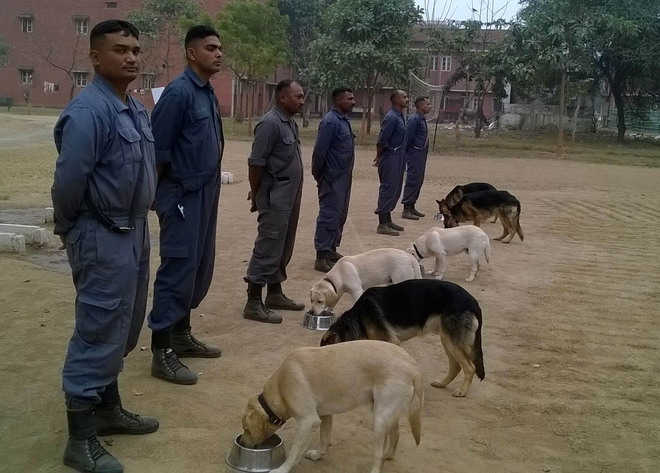
New Delhi, August 15Three-year-old Maru had a tiring day at the Red Fort on Tuesday but that did not stop him from dutifully springing up when the National Anthem played.The fawn-coloured Labrador was on its four feet—or paws—the moment his trainer stood at attention as the anthem played to mark the 70th anniversary of India’s Independence. He kept an eye on his trainer, relaxing only when the policeman by his side did so.Maru was among the 20-odd dogs put into service by the Delhi Police to ensure security at the 17-century iconic monument, from where Prime Minister Narendra Modi addressed the nation.“He has been here at the Red Fort since 1 am, so has got tired,” said Maru’s trainer, who accompanied him to the Mughal-era fort.During the course of the celebrations, which began at around 7:30 am, Maru and two other Labradors were seen slouching below the chairs kept on the front lawns in the audience section, clearly tired after hours of hard work, sniffing around for danger.Maru’s canine colleague, Mahan, also three in dog years, was at one point seen frolicking with his trainer.“They are fed vegetarian and non-vegetarian food. They eat fruits, vegetable and rice in the morning and meat in the evening. Diet is very important to keep them fit,” the trainer told PTI.A senior police official said the Delhi Police has 60-70 dogs in service at present.“About 40-43 are sniffer dogs and 15 of them trackers. About 20 canines were deployed at the Red Fort today, while the rest were stationed at public places such as stations and markets,” he said.Besides the Delhi Police, paramilitary forces too had put their dogs into service.Rex, a 10-year-old dog attached to the Indo-Tibetan Border Police (ITBP), was among those guarding the venue.“We either take in dogs when they are six-to-nine months old and then train them or we get them from the Army Veterinary Corps in Meerut, where dogs undergo training for 15 months or so,” the police official said.During the 2010 Commonwealth Games, 110 dogs were on duty, he said.Besides Labradors, the Delhi Police also has German Shepherds and other breeds. — PTI


Doklam: Strong-arming India will make it Beijing’s enemy, say China experts

China’s strong-arm tactics with India and Bhutan with regard to the trilateral border dispute in the Doklam region could push New Delhi further away from it and may make it an enemy, feel Macau-based China experts quoted by the South China Morning Post.

“The protracted eyeball-to-eyeball border stand-off now over 40 days old in a desolate region of the Himalayas, has not only raised tensions between the two Asian giants but could also potentially threaten China’s trade and infrastructure One Belt and One Road (OBOR) initiative,” the South China Morning Post has quoted experts, as saying.

Currently, both sides are blaming each other for escalating the dispute by deploying troops in the area.China has called on India to withdraw its troops first before agreeing to any kind of dialogue.

The South China Morning Post quoted Macau-based military expert Antony Wong Dong as warning Beijing to avoid playing psychological warfare with New Delhi.
 

ALSO READ: Doklam standoff: China must remember grievance-based nationalism is a double-edged sword

“It (China) should realise that even if it defeated India in a war on land, it would be impossible for the PLA Navy to break India’s maritime containment,” he said, pointing to the importance of the Indian Ocean as a commercial lifeline for Beijing.

Official statistics indicate that China is heavily reliant on imported fuel, as over 80 per cent of its oil imports travel via the Indian Ocean or Strait of Malacca.

“Unlike Southeast Asian countries, India has never succumbed to China’s ‘carrot and stick’ strategies.India is strategically located at the heart of China’s energy lifeline and the ‘Belt and Road Initiative’, and offending India will only push it into the rival camp, which [Beijing believes] is scheming to contain China by blocking the Malacca Strait and the Indian Ocean,” Wong added.
 

ALSO READ: India pledges to solve Chinese transgression in Uttarakhand locally

The South China Morning Post quoted Sun Shihai, an adviser to the Chinese Association for South Asian Studies, as expressing his concern over what he described as probably the worst military stand-off in more than three decades.

He cautioned that this could fuel anti-Chinese sentiment in India, as mistrust and hostility between the two countries runs deep.

He said that if the border row is not properly handled, China’s efforts to expand its diplomatic and economic influence beyond the Asia-Pacific region through OBOR could be severely impacted.

“India is one of the most important strategic partners for China’s ‘Belt and Road Initiative’ because of its geographic location,” Sun said.
 

ALSO READ: India, Japan forge ahead with connectivity project to counter China’s OBOR

The latest border dispute relates to the remote Doklam Plateau, known as the Donglang region by the Chinese.

China’s assertiveness in protecting its sovereignty “at all costs”, will only deepen the political trust deficit between China and its Asian neighbours, feels Dr.Rajeev Ranjan Chaturvedy, Research Associate at the Institute of South Asian Studies at the National University of Singapore.

“China’s ‘my way or the highway’ approach has complicated problems further,” he added.

In India, China is widely blamed for the standoff in Doklam after it attempted to build a motorway in the area. Beijing insists that the road construction project is on its side of the border.

India has so far refused to join OBOR due to sovereignty concerns over the USD 50 billion China-Pakistan Economic Corridor (CPEC) project, which runs through Pakistan-occupied Kashmir and Gilgit-Baltistan,both of which New Delhi considers Indian territories.

However, experts on both sides agree that the odds of the two countries going to war are slim, and would prefer a diplomatic solution.


Militarising students by S Nihal Singh

Militarising students
Taking it too far: A tank should have no place on any campus.

S Nihal Singh

THE amazing proposal of JNU VC Jagadesh Kumar to station an Army tank on the campus is the tip of the iceberg. In reality, it represents the second phase of the Sangh Parivar’s programme to change the idea of India.The first phase of the ruling dispensation was to “catch’em young”, as the old adage would have it. It began with the indoctrination of young schoolchildren by revising textbooks, banning foreign language instruction. For older school-goers, a drastic revision of textbooks was undertaken, with the Mughal period airbrushed, new heroes lauded and the myths of the RSS propagated. The indefatigable RSS warrior, Dina Nath Batra, is still at it, calling for editing of India’s Nobel laureate poet Rabindranath Tagore to take out words of foreign origin.   The second phase of the BJP’s programme is the militarisation of Indian society. The Parivar has always been jingoistic in its nationalism and what the world witnessed in the 20th century through the rise of Nazism and Mussolini’s fascism comes naturally to it. Employing the venue of the JNU has a ring of triumphalism for the Parivar’s supporters because the institution has long been in its sights. The JNU is all that the Parivar abhors: free thinking along several shades of the Left, a fraternity of rebels, as every such institution should be, and scholarship combined with testing the limits of conventions. Like the early morning drills with staves that are the staple of the RSS, the Parivar prizes obedience also to the myths of a bygone age.Thus the appeal of Jagdesh Kumar to the former Army chief and now a junior minister, Gen VK Singh (retd), to get him a tank for the university is a natural follow-up of the Parivar’s philosophy. Nationalism has to be clothed in the Tricolour to be effective after the examples of Hitler and Mussolini. And with the elections of 2019 looming on the horizon, few high-level decisions are taken without the electoral calendar in mind. The Parivar misses few occasions to conflate religion with politics. Its very ideal of a Hindu India derives from the nation being a Hindu country with Muslims and other minorities living on sufferance, as it were. Religion can be a potent force, as we have seen in the Arab world in more recent times, but it is ultimately raw nationalism that, given the right circumstances, drives peoples to frenzy.Cow protection vigilantes, fake or genuine, and their fondness for lynching those transporting cattle often to death are one aspect of mixing religious creed and the Hindu veneration of the cow with criminal activity. Prime Minister Narendra Modi’s dilemma is that he cannot cross the red lines drawn by the RSS and after long delays in commenting upon brutal acts of barbarity, he has now chosen to pass on the buck to the BJP-ruled states. But the problem will not go away.The problem of the militarisation of the country is of a different order. It is, in a sense, moulding the mind of the young into an attitude of obedience because discipline is a sine qua non of a good Army. And in the Parivar, discipline and obedience are valued above all virtues. The Parivar is obsessed with discovering the cause of foreign conquerors ruling India over centuries. Its simple conclusion seems to be that it was the people’s unpreparedness for war and the martial arts that let foreigners invade and rule. Thus far, its recipe is two-fold: the morning drill with staves substituting for guns and building of and conjuring up a golden ancient age in which India was a superpower.We have it on the authority of Modi that modern planes flew in ancient India, a country then proficient in cosmetic surgery and transposing heads and reaching a very high level of knowledge. His speech at an opening ceremony of a Mumbai hospital lauding the wonders of ancient India was quickly deleted on the web, but his beliefs are a reminder that he spent his formative years in the RSS cradle.Thus far, the JNU Vice-Chancellor’s suggestion of installing a tank on the campus has invited much derision and a riposte from the JNU Teachers Association suggesting that the university cannot be made into a “theatre of war”, and that the JNU was not a “boot camp”. But the ruling dispensation is serious about its intent to spread the message across institutions of learning that the armed forces must be an object of adulation and the discipline that keeps them alert and ready for all eventualities is the new motto of the patriotic student.This new campaign to reboot the country’s student population is bound to fail because although the BJP’s student wings will do all they can to burrow their way into unions’ leadership posts, the young are by nature rebellious and somewhat wild. It is an acknowledged fact that every conservative in later life was once a fire-breathing Left-wing student. If the space for dissent in student politics is closed, the young can only go to extreme philosophies to express themselves. There is little reason to doubt the seriousness of the Parivar in militarising the student body. But it remains an open question whether it has thought through the seriousness of the consequences of its decision on the country’s future. Leaving students with no option but to espouse extremist creeds to express their rebelliousness even as the country’s security forces are already fighting Maoists and others is a bad idea.The occasion for pronouncing Kumar’s words of wisdom was the celebration of the Kargil Vijay Diwas for the first time in the university’s history. Whether the tank will duly arrive remains to be seen but the thought processes of the Parivar and its supporters are clear. The RSS has reluctantly given up shorts for trousers for its obligatory morning drill but its thought processes have not changed.


China is building a great wall of silence in the US

As Aadhaar becomes the norm in India, and gets skewered for the involuntary nature of its imposition, our northern neighbours, as is their wont, want to do a number that will make this appear benign. That’s the proposed ‘social credit’, which the non-profit Freedom House, in its latest report, describes as a regime that “would connect each citizen’s financial, social, political, and legal data to produce a single numerical rating of his or her behaviour and trustworthiness.” Fittingly, it’s coordinated by the Orwellian-sounding Central Leading Group for Comprehensively Deepening Reforms. This reality contrasts with the alternate vision seen by some in recent months of China occupying a central place in the world as Donald Trump’s America withdraws into itself.

That the Chinese machinery has managed to further such propaganda is no surprise. As China unveiled a monumental $200 million new embassy building in Washington in 2010, it was a symbolic and in-yourface marker of its outsize ambitions. It employs lobbyists across the K Street corridor of the Beltway, including some dedicated to image-making for its ambassador. American companies with manufacturing bases in China are force multipliers for Beijing, while inroads into American academia and media add to its influence. China has ventured capital into Silicon Valley. Its investments into Hollywood, for instance, have made support for Tibet within the film community nearly non-existent.
Those are credible reasons why voices once raised over China’s actions, in Tibet or Xinjiang, have been muted to whispers, of the sort that country’s netizens have to resort to in questioning the regime, since even Winnie the Pooh can be blacklisted by the Chinese checkers for bearing an alleged resemblance to President Xi Jinping. Money can talk but, even better, it can buy silence.
As a result, the death by negligence of Nobel laureate Liu Xiaobo attracts bromides from the White House. As China watcher Jocelyn Ford poignantly noted in an article for Asia Society, this summer as Liu was essentially condemned to death, the World Economic Forum had its annual summer meeting in China. Despite its tagline ‘committed to improving the state of the world’, she wrote, it “self-censors on issues that China may take as an affront.” Beijing uses its support for a globalism, for example the Paris climate agreement, as it segues into its practical and tactical agenda.

Yet another Nobelist, the Dalai Lama, meanwhile, once had to exit the Obama White House via the back, walking out amidst ranks of garbage bags. While the human rights industrial complex hums along nicely in the democratic world, it confronts a barrier in the Great Wall of China.

The world, led by the United States, has vacated the moral space in challenging China. And that has allowed Beijing to, literally, push the boundaries of its megalomania. India’s vaunted soft power projection may have its votaries, but the Chinese velvet glove has punched its way into the heavyweight category.


Ladakh gets bridge at Chumathang

Ladakh gets bridge at Chumathang
The new bridge inaugurated at Chumathang on the Leh-Loma road. Tribune Photo

Tribune News Service

Jammu, July 21

The Border Roads Organisation (BRO) in eastern Ladakh has created yet another landmark by constructing the Chumathang bridge in the region.The bridge will connect Leh with important towns like Hanle and Loma in addition to the upcoming tourist destination of the Tso Morari lake.The 111 Road Construction Company (RCC ) of the 16 Border Road Task Force (BRTF) under Project Himank led by Brigadier DM Purvimath, Chief Engineer, has launched this 50-metre class 70 ton steel structure across the Chumatang nullah, which will facilitate smooth movement of various military and civilian vehicles on this important axis.The BRO is executing the work for upgrade of the Leh-Loma axis from the existing single lane to double lane, including replacement of existing temporary bridges.The Chumathang bridge was inaugurated by Lt Gen SK Shrivastava, Director General Border Roads, on Thursday during a solemn inauguration ceremony. He complimented the team of the 111 RCC for having completed the bridge despite the extreme working conditions in the region.Speaking on the occasion, he asked all ranks of Project Himank to make efforts to expedite the double-laning work of the Leh–Loma road as well as efficient maintenance and upgrade of other roads in the eastern Ladakh region.


Memorable moments with Sher Company at Dokala by Brig Jasbir Singh Bawa (retd)

There was a time when hostilities had not marred the pristine beauty of the landscape. With the recent month-long India-China impasse, the areas of Doklam plateau, Dokala, trijunction in east Sikkim and the Chicken’s neck-Siliguri corridor have been in the news for all the wrong reasons.

Memorable moments with Sher Company at Dokala
TOUGH TERRAIN: The belligerence between two big neighbours calls for tough diplomacy

Brig Jasbir Singh Bawa (retd)MY mind goes back to the “Hindi-Chini  bhai-bhai” days of friendship at Dokala in 1990-1991. As the Company Commander at Dokala, I was the presiding deity for friendly Chinese patrols once a quarter or so. That was a period of peace on the tactical surface that let you enjoy the sheer beauty of Dokala and the freedom of an independent command.    On my return from a posting abroad, I had the fortune of going back to command my old company,  “Delta,” at that time deployed at Dokala. This is fortunate for those of us who return to the unit after an outing. I had christened the Company as “Sher Company” and  men were  “Sher ka Bachcha”— surreptitiously  borrowed from the much-revered, late Papa Pande, our ex-Colonel of the regiment. Getting back to Sher Company was indeed a cause for much joy. The men were happy to see me again for we shared a very healthy rapport. I was fortunate to have my Company 2IC Sub Indra Bahadur still in the chair but a lot of the senior NCOs had moved away on posting or had retired. It was a great feeling to see the young sepoys and NCOs one had tutored and mentored, take up varying  positions of responsibility with confidence and pride. Dokala was the abode of an exceptionally happy family on the eastern-most tip of east Sikkim that descended sharply to the Jaldhaka wildlife sanctuary thence to the Siliguri corridor. Dokala, the most beautiful area in all of east Sikkim, is a lush green meadow in sharp contrast to the surrounding countryside that is characterised by jagged and  rocky ridgelines without a blade of grass for miles together. Significantly lower in altitude than the Batangla-Nathula ridge line, Dokala is approximately a two-km-long pass with a width varying from 150 to about 400 m. The Sher Company was deployed at its north-western base. The meadow is green except during the four winter months. Almost through the year, the green turf of the meadow is interspersed with clumps of wild flowers. Wild blue poppy, small rhododendrons and numerous tubular flowers add to the kaleidoscope of daisies in white, yellow, shades of red and blue. I have enjoyed many a walk with my trusted buddy and radio operator on the soft surface of Dokala, on our way up and down the formidable Gamochin Peak which dominates the pass from the south. Gamochin, a huge rocky feature, towers over the neighbouring heights and Dokala. The climb to Gamochin is a sheer wall and can only be negotiated by fixed rope — a challenge even for seasoned climbers. Troops deployed on the feature would welcome us with hot pakoras to be downed with a drink of warm jam water and glucose. As you regain your breath after the gruelling climb, the reality of scaling an impossible-looking massif sinks in. The view from its top is mesmerising. On a clear day you could catch the Kanchenjunga in all its glory, with just a speck of cloud covering the summit. Come winters and the ascent on snow and ice walls gets toughe,r while coming down is sheer ecstasy thanks to the innovative  snow slides that the Rhinoboys would develop. Any talk of the area would be incomplete without mention of the mighty Kanchenjunga. The Company Commander’s hut at Dokala is designed to host senior visiting officers should they get stuck due to the savagery of weather. It has huge perplex glass windows on three sides, with a breathtaking view of the mother of all Himalayan peaks. At day break on clear winter mornings the crimson glow that drapes the eastern slope of mount Kanchenchenga, the sight transports you to another world. The colours gradually change from a riveting deep crimson to orange to golden yellow, seamlessly meshing into each other as dawn gives way to a fresh bright day.  Hold your breath, the full moon nights at Dokala were also so special. The Kanchenchenga looked more than glorious while the snowy shine of the majestic Gamochin would be complemented by a seemingly endless silver sheen on  Dokala. Many such nights were spent by a bonfire, memories of which refuse to fade. There was a routine patrol that we would send to the trijunction then down to the Jaldhaka, circuit the base of our deployment, eventually  to emerge at the northern entrance of Dokala. This meant climbing about 1,000 feet from the post, going down a steep descent to a height of about 4,000 feet and again climbing up to 11,500 ft  or so getting  back to Dokala. The distance covered was approx 15 kilometre. The bulk of the area fell within the Jaldhaka wildlife sanctuary. In keeping with a compulsive tribal trait, a large number of animal traps were set up by  the Sher ka bachcha in this area before it was declared a sanctuary. There would always be a rush of volunteers for this tri-weekly patrol and understandably so — the boys would reap the fruits of their labour returning  with plenty of small game caught in the traps. These patrols would generally get back in the late afternoon to a hero’s welcome, particularly so on Saturdays for that meant a big bonfire, generous drinking and endless kahanis and  singing by the guitar and makeshift degchi drums followed by a feast for dinner. The Sher ka bachchas —  driven very hard on training, keeping watch, patrolling and negotiating tough climbs to fetch stores and rations through the week —looked forward to their Saturday  party. That was also the evening when Sher Company would open its liquor chest and come alive. Soon after dusk, Dokala would witness rising flames of the bonfire and reverberate to peppy song and music.  Those were dreamlike days that I would love to relive. The reality however lies in the increasing belligerence between the two big neighbours. That calls for tough diplomacy, difficult options and a strong military response that is thoroughly vetted for implications from the sub-tactical to the strategic. The response must hinge on deft diplomacy but has to be holistic with carefully orchestrated synergy between the stakeholders.The writer, an Infantry veteran, was the Company Commander at Dokala in the early 1990s.
clip


China holds live-fire drills in Tibet Tests combat capability in remote regions | Experts say it’s battle-ready message to India

China holds live-fire drills in Tibet
Reuters file photo

Beijing, July 17

China’s military today said it had conducted live-fire exercises in the remote mountainous Tibet region to test its strike capability on plateaus, amid the standoff between Indian and Chinese troops in the Doklam area in the Sikkim sector.The People’s Liberation Army (PLA) conducted the 11-hour-long live-fire exercises at an altitude of 5,000 metres on the plateau in Southwest China’s Tibet Autonomous Region, aimed at improving the combat capability on such locations, the military said.(Follow The Tribune on Facebook; and Twitter @thetribunechd)The exercise was conducted by a ground combat brigade of the PLA Tibet Regional Command this month and involved scenarios such as rapid deployment, multi-unit joint strike and anti-aircraft defence, state-run China Daily quoted a PLA press release as saying.The exercise effectively tested the brigade’s joint strike capability on plateaus, according to the press release. The brigade that conducted the drills was from the PLA’s Tibet Military Command and is one of China’s two plateau mountain brigades.The PLA Tibet command guards the Line of Actual Control (LAC) of the India-China border along several sections connecting the mountainous Tibetan region.Analysts believe that the drill is an apparent attempt by the military to reassure the Chinese public about the combat readiness of its troops.“Showing an opponent that you are combat ready is more likely to prevent an actual battle,” Wang Dehua, South Asia studies expert at Shanghai Institutes for International Studies, said.Broadcasting the drill on CCTV was also likely designed to keep the public happy, he said. “It could also reassure the Chinese people that a strong PLA force is there, capable and determined to defend Chinese territory,” Wang told Hong Kong-based South China Morning Post.The CCTV report did not disclose the location of the drills but said the brigade responsible for frontline combat missions has long been stationed around the middle and lower reaches of the Brahmaputra (Yarlung Zangbo in Chinese). Brahmaputra flows into India from Arunachal Pradesh border.“The PLA wanted to demonstrate it could easily overpower its Indian counterparts,” Beijing-based military commentator Zhou Chenming told the Post.The Chinese force that took part in the drill is stationed in the Lizhi region of eastern Tibet, close to the stand-off, the Post said.China has a clear advantage in terms of speed of movement, firepower, and logistics, Zhou said. “By staging a small-scale drill, China wants to control the problem and lower the risk of shots being fired,” he said.Separately, Tibet’s mobile communication agency conducted a drill on July 10 in Lhasa, capital of Tibet, where members of the agency practiced setting up a temporary mobile network to secure communications in an emergency.China and India have been engaged in a standoff in the Dokalam area in the Sikkim sector, where Indian troops stopped road construction by Chinese soldiers on June 16. — PTI 

Amid Sikkim standoff, key ITBP post restored

  • The government has restored a crucial senior-level post in the Sino-India border guarding force ITBP after three years, a development seen as strengthening the paramilitary in the wake of frequent military standoffs between the two sides
  • RK Mishra, a 1986-batch IPS officer, on Monday took over as the new additional director general of force with the strength of 90,000 personnel
  • The lone ADG post of the Indo-Tibetan Border Police was diverted to the NDRF in February, 2014 by the Union Home Ministry, under which the two forces function PTI

PRAYERS FOR WG CDR DHILLON; CM INVITED

PATIALA: The two-day antim ardas (final prayer) for wing commander Mandeep Singh Dhillon, who died in a chopper crash during a rescue sortie last week in Arunachal Pradesh, began at his house in Patiala on Saturday. Squadron leader PS Dhillon (retd), father of the Indian Air Force officer, urged CM Capt Amarinder Singh to attend. On July 4, Dhillon, the commanding officer of the Tezpur-based advanced light helicopter (ALH) unit, met with a tragic end. He is survived by wife Prabhpreet Kaur Dhillon, daughter Sehaj and son Eshar.